Qyrus Named a Leader in The Forrester Wave™: Autonomous Testing Platforms, Q4 2025 – Read More

Table of Contents

Precision Testing: Execute Suites with Specific Data Ranges! 
Proactive Alerts: Smart Warnings for High-Volume Executions! 
Complete the Picture: Automated Evidence Sync for Xray! 
Mix, Match, & Locate: Build Powerful Composite Locators! 
No More Guesswork: Instant Confirmation for Local Runs! 
End-to-End Encryption for All Sensitive Fields Across Web, Desktop and API 
Scale Without Limits: Unlimited Virtual Users for Enterprise Performance Tests! 

Master the Future of QA

Explore our full library of resources and discover how Qyrus can help you navigate the future of software quality with confidence.

Share article

Published on

January 21, 2026

V6.14.0 (January 2026 Release)

Nov release notes
Welcome to our first update of 2026!  

As we kick off the new year, our focus is on empowering you with precision, security, and limitless scale. This January, we are delivering features that refine the granularity of your testing control while ensuring your enterprise ecosystem remains robust and secure.  

We believe that the foundation of a great year in quality assurance starts with tools that are not just powerful, but also transparent and safe. 

In this release, we’ve fortified the platform with end-to-end encryption for all sensitive configurations and unlocked unlimited potential for enterprise performance testing.  

We’ve also introduced granular controls for your test data and locators, added smart proactive warnings for resource management, and closed the feedback loop with automated evidence syncing for Xray. These updates are designed to give you a total command over your testing strategy from day one. 

Let’s explore the powerful new capabilities arriving on the Qyrus platform this January! 

Web Testing

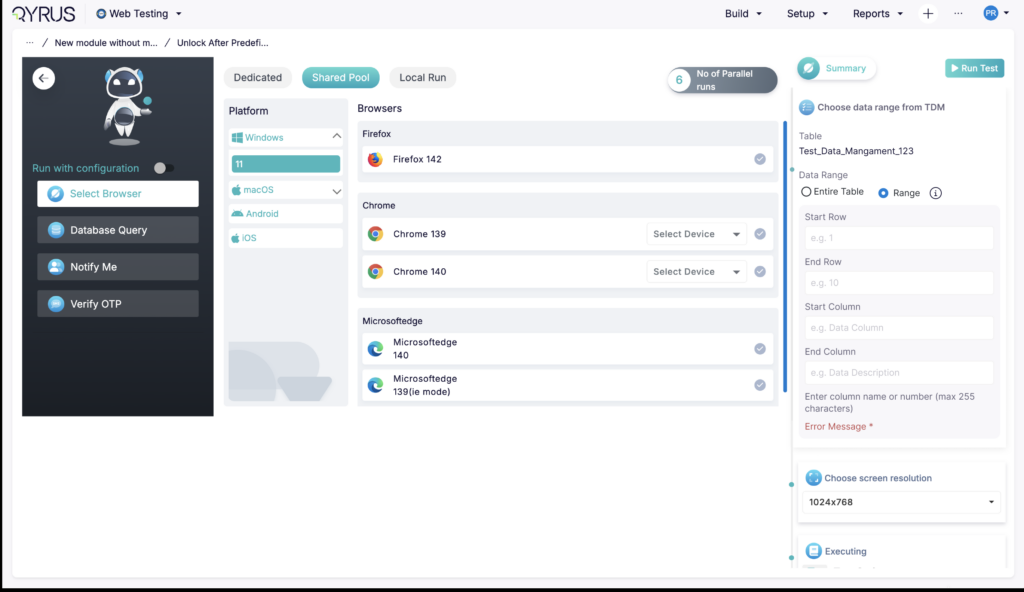
Precision Testing: Execute Suites with Specific Data Ranges! 

Precision Testing-Execute Suites with Specific Data Ranges

The Challenge:  

Previously, Test Data Management (TDM) was an “all or nothing” affair. While users could clone or remove rows, there was no way to simply select a specific subset of data for a test run. If you wanted to test just five specific scenarios out of a dataset of a hundred, you often had to create a separate data file or temporarily delete the unwanted rows, which was inefficient and risky. 

The Fix:  

We have introduced Data Range Selection for Test Suites. You now have the flexibility to select specific rows or define a range of data from your dynamic tables within TDM to be used for execution. 

How will it help?  

This feature gives you granular control over your test executions. 

  • Target Specific Scenarios: Easily isolate and test specific edge cases without running your entire dataset. 
  • Save Time: significantly reduce execution time by running only the data rows that matter for your current validation. 
  • Non-Destructive Testing: There is no need to modify or delete data from your master files just to run a partial test. 

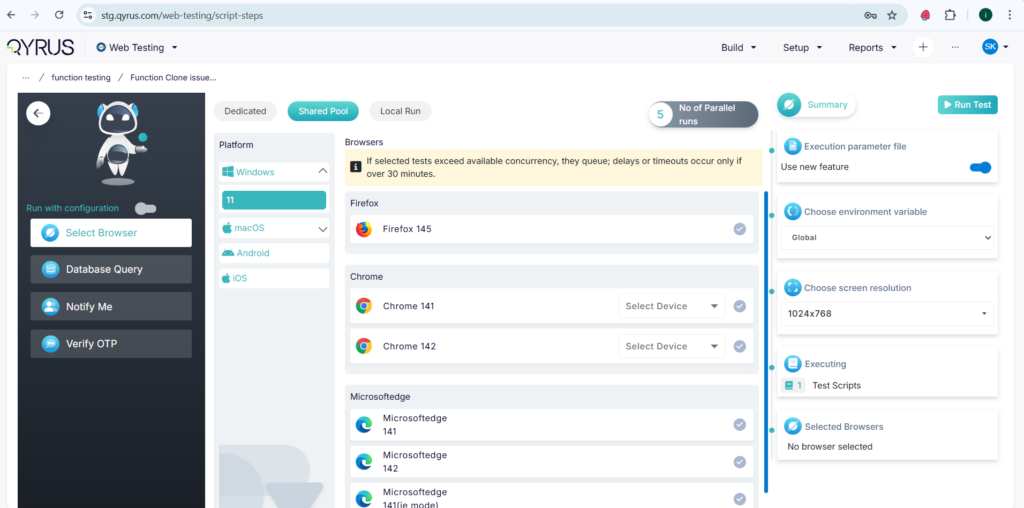
Proactive Alerts: Smart Warnings for High-Volume Executions! 

Smart Warnings for High-Volume Executions

The Challenge:  

When executing a large number of scripts simultaneously, users were often unaware of their organization’s concurrency limits. This frequently led to situations where scripts would sit in a queue for too long and eventually time out, or where all available browsers were monopolized for extended periods. This lack of visibility caused confusion and frustration when tests failed or resources became unavailable without a clear explanation. 

The Fix:  

We have added intelligent prompt messages to the execution screen. The system now detects when the number of queued scripts is high relative to your available concurrency. If this threshold is crossed, a message will automatically display, warning you that due to the high volume and limited concurrency, timeouts may occur, and browsers may be unavailable for the duration of the run. 

How will it help?  

This update manages expectations and helps you plan your test runs more effectively. 

  • Prevent “Silent” Failures: You are immediately alerted to the risk of timeouts before you even start the run, rather than wondering why tests failed later. 
  • Better Resource Planning: It provides visibility into your concurrency usage, helping you decide whether to break up large suites or schedule runs differently. 
  • Clearer Troubleshooting: It removes the mystery behind “stuck” or timed-out tests, clearly linking the issue to queue volume and concurrency limits. 

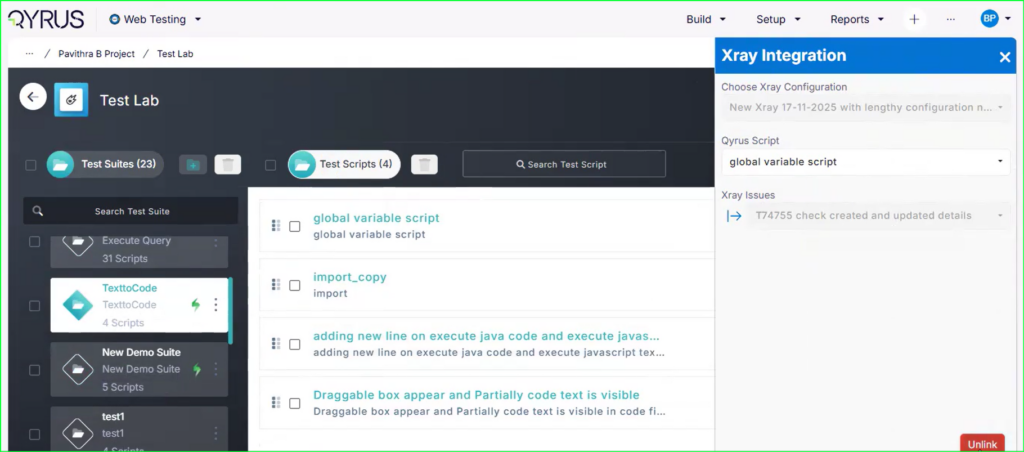
Complete the Picture: Automated Evidence Sync for Xray! 

Automated Evidence Sync for Xray

The Challenge:  

Previously, while Xray tracked the final status of a test (Pass/Fail), it lacked the detailed evidence needed to understand why a specific result occurred. To provide proof of execution or investigate a failure, users were forced to manually upload logs and screenshots to Xray or switch back to the Qyrus platform to find the data. This created a disconnected workflow and made audit trails difficult to maintain. 

The Fix:  

We have enhanced the Xray integration to support automatic evidence synchronization. Now, immediately after a test completes in Qyrus, all execution evidence—including detailed logs and screenshots—is automatically transmitted to Xray and attached directly to the corresponding test run. 

How will it help?  

This update ensures your test management tool becomes a complete, “single source of truth.” 

  • Eliminate Manual Work: No more tedious downloading and uploading of screenshots to prove a test passed or failed. 
  • Instant Traceability: Every test run in Xray is now automatically backed by concrete evidence, making audits and reviews seamless. 
  • Faster Debugging: Developers and testers can view logs and failure screenshots directly within Xray without needing to switch platforms. 

Mix, Match, & Locate: Build Powerful Composite Locators! 
Build Powerful Composite Locators

The Challenge:  

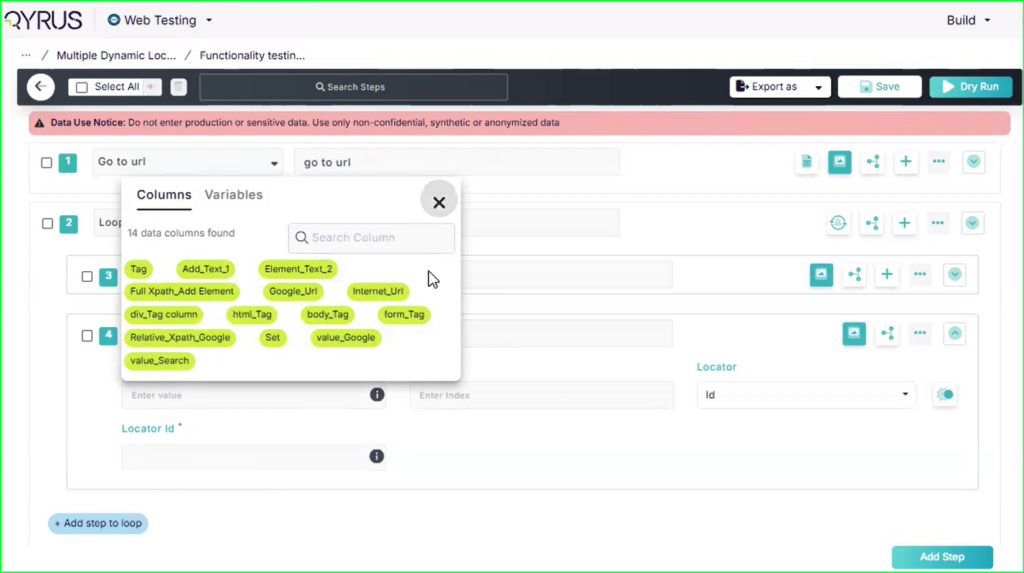
Previously, constructing locators for dynamic web elements was restricted by an “either/or” limitation. Users could use a static string, or a single TDM parameter, or a global Variable to define a locator. It was impossible to combine these elements—for example, creating an XPath that included both a static ID prefix and a dynamic user ID from a variable. This made interacting with complex, dynamically generated UIs (like grids or lists with unique, composite IDs) difficult and rigid. 

The Fix:  

We have unlocked the ability to create Composite Dynamic Locators. You can now construct a single locator by combining multiple dynamic values along with static text. 

How will it help?  

This update significantly increases the flexibility and robustness of your object identification. 

  • Reduce Scripting: You no longer need complex scripting workarounds to construct these strings before the step runs; you can build them directly in the locator field. 
  • Improve Reliability: Create more precise locators that adapt to changing data, ensuring your tests stay green even when the data shifts. 

No More Guesswork: Instant Confirmation for Local Runs! 
Instant Confirmation for Local Runs

The Challenge:  

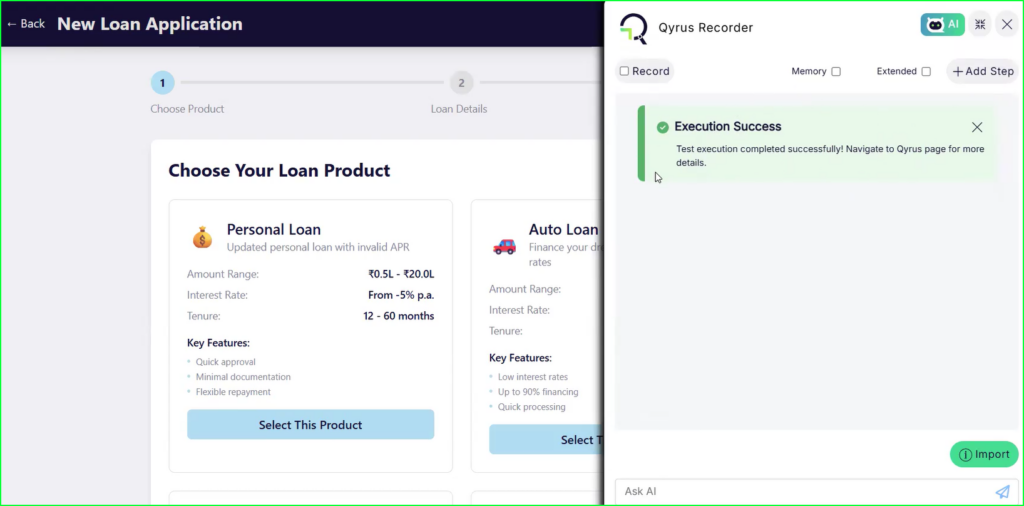
Previously, when running tests on a local agent (Local Run), the process would end silently. There was no explicit notification or popup to signal that the execution had officially finished. This left users in a state of uncertainty—wondering if the test was complete, if it was still processing in the background, or if the connection had simply hung. 

The Fix:  

We have improved the feedback loop for local executions. Now, the moment your local run finishes, the system will display a clear and prominent “Execution Completed” message. 

 How will it help?  

This simple but effective UI update removes ambiguity from your workflow. 

  • Immediate Certainty: You know exactly when you can proceed to the next task or review your results. 
  • Reduced Friction: It eliminates the need to double-check logs or wait unnecessarily to ensure the process is done. 
  • Better UX: It provides a polished, confident end-state to your local testing sessions. 

End-to-End Encryption for All Sensitive Fields Across Web, Desktop and API 

The Challenge:  

Previously, while the platform was secure, there were areas where sensitive configuration data—such as passwords in database connections, API keys in integrations, or secrets in global variables—might have been accessible in plaintext within the UI or API responses. In an enterprise environment, any visibility of these secrets poses a potential security risk and complicates compliance with strict data protection standards. 

The Fix:  

We have implemented a rigorous encryption protocol across the entire application. Now, all sensitive fields including Global Variables, Integrations, Database configurations, Authentication settings, and Certificates are strongly encrypted at rest and in transit. 

  • Zero Plaintext Visibility: These values are now permanently masked or hidden in the user interface. 
  • Secure API Responses: The backend API no longer returns these values in plaintext, ensuring they cannot be intercepted or viewed via network logs. 

How will it help?  

This update significantly strengthens your security posture. 

  • Data Leak Prevention: It guarantees that your most critical secrets (passwords, tokens, keys) are never exposed to unauthorized users, even those with access to the project. 
  • Enhanced Compliance: It helps you meet strict industry security standards and audit requirements regarding the handling of sensitive credentials. 
  • Peace of Mind: You can configure integrations and databases with confidence, knowing that your credentials are cryptographically secure. 

Scale Without Limits: Unlimited Virtual Users for Enterprise Performance Tests! 

Unlimited Virtual Users for Enterprise Performance Tests

The Challenge:  

Previously, performance testing was often constrained by licensing limits or caps on the number of “Virtual Users” (VUs) available to a project. This created a ceiling on how much load you could simulate, making it difficult to accurately stress-test enterprise-grade applications. You might have been able to test for normal traffic, but you couldn’t easily simulate massive spikes (like a Black Friday sale) without hitting an artificial wall or purchasing expensive add-ons. 

The Fix:  

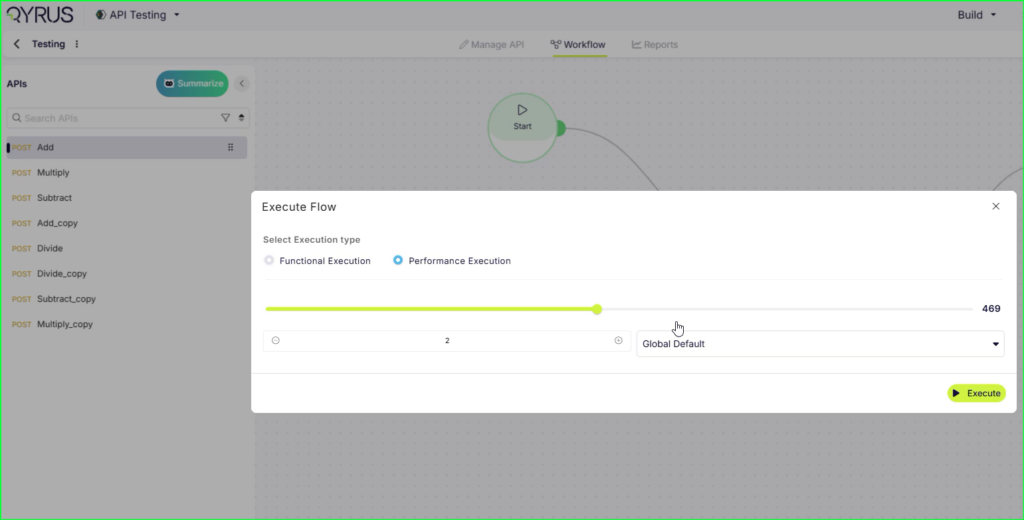
We have unlocked Unlimited Virtual Users for our Enterprise plan users. You can now configure your API performance tests with as many simulated users as required to match your real-world scale, without being held back by platform restrictions. 

How will it help?  

This update empowers you to conduct truly comprehensive load testing. 

  • Simulate Real-World Scale: Accurately replicate massive traffic surges to see how your APIs hold up under extreme pressure. 
  • Find Breaking Points: Push your system until it breaks to identify true bottlenecks, rather than stopping because you ran out of VUs. 
  • No Extra Costs: Run high-volume tests as often as needed without worrying about purchasing additional user packs or licenses. 

Ready to Leverage January’s Innovations?

We are committed to providing a unified platform that not only adapts to your evolving needs but also streamlines your critical processes, empowering you to release high-quality software with greater speed and confidence. 

Eager to explore how these advancements can transform your testing efforts? The best way to appreciate the Qyrus difference is to experience these new capabilities directly. 

Ready to dive deeper or get started? 

QYRUS gets even more powerful with AI!

Achieve agile quality across your testing needs.

Related Posts

Find a Time to Connect, Let's Talk Quality


    Ready to Revolutionize Your QA?

    Stop managing your testing and start innovating. See how Qyrus can help you deliver higher quality, faster, and at a lower cost.