Qyrus Named a Leader in The Forrester Wave™: Autonomous Testing Platforms, Q4 2025 – Read More

Table of Contents

The Codeless Promise — and Why 2026 Is Different 
What to Look for in a No-Code Test Automation Tool in 2026 
 The 2026 No-Code Test Automation Tools — Side-by-Side Comparison 
 Qyrus — Best for Unified Cross-Platform Orchestration 
The Self-Healing Question — What ‘AI-Powered’ Actually Means in 2026 
Frequently Asked Questions 

Master the Future of QA

Explore our full library of resources and discover how Qyrus can help you navigate the future of software quality with confidence.

Share article

Published on

May 13, 2026

Top No-Code Test Automation Tools for Web, Mobile, and API Testing 2026

Featured Image-Top No-Code Test Automation Tools

The Codeless Promise — and Why 2026 Is Different 

QA and test automation leaders are facing a familiar pressure: ship faster, cover more, and do it with the same headcount. Codeless testing was supposed to solve the first two. For many teams, it delivered, up to a point. Then came the maintenance. 

Record-and-playback tools created fragile tests. Every UI change triggered a cascade of broken locators. Engineers who should have been building coverage were instead fixing scripts. The promise of no-code test automation stalled somewhere around 25% automation coverage for most organizations. 

2026 is different. The platforms in this comparison have moved well past record-and-playback, transitioning into what Forrester now defines as “Autonomous Testing Platforms” (ATP) which replaces the traditional ‘Continuous Automation’ category to reflect the shift toward self-healing, agentic orchestration. Agentic AI now handles test creation, failure diagnosis, and self-repair. More importantly, the best platforms have unified web, mobile, and API testing into a single orchestrated workflow — meaning a single test can follow a user journey from a mobile app through an API call to a web confirmation, with session state persisting throughout. 

This guide compares six no-code test automation tools including Qyrus, Katalon, mabl, ACCELQ, Testsigma, and Leapwork, across five consistent criteria. The goal is to give QA and test automation leaders a clear, honest basis for a platform decision.  

What to Look for in a No-Code Test Automation Tool in 2026 

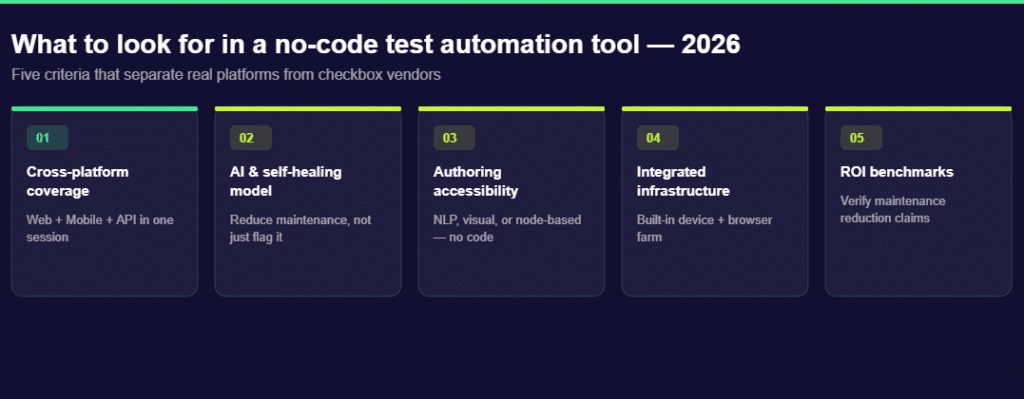
Before comparing platforms, it helps to agree on what matters. The five criteria below reflect what QA leaders consistently cite as the real differentiators, not feature checkboxes, but capabilities that change how a team operates.  

Criterion 

Why It Matters in 2026 

What to Look For 

Cross-platform coverage 

Modern user journeys span web, mobile, and API. Fragmented tools mean fragmented data. 

Single platform that maintains session state across all three channels 

AI and self-healing 

UI changes are constant. Tools that require manual locator fixes add maintenance overhead. 

Automated fix suggestions with human oversight controls 

Authoring for non-technical users 

QA bottlenecks form when only engineers can write tests. Broader authorship = faster coverage. 

NLP, visual node-based, or drag-and-drop interfaces 

Integrated infrastructure 

Third-party device/browser farms add cost, latency, and integration complexity. 

Built-in real device farm and browser grid 

ROI benchmarks 

Licensing costs are only part of TCO. Maintenance hours and ramp-up time are the hidden costs. 

Published customer benchmarks for maintenance reduction and authoring speed 

Keep these five criteria in mind as you move through the comparison. They surface the tradeoffs that vendor marketing typically obscures. 

 The 2026 No-Code Test Automation Tools — Side-by-Side Comparison 

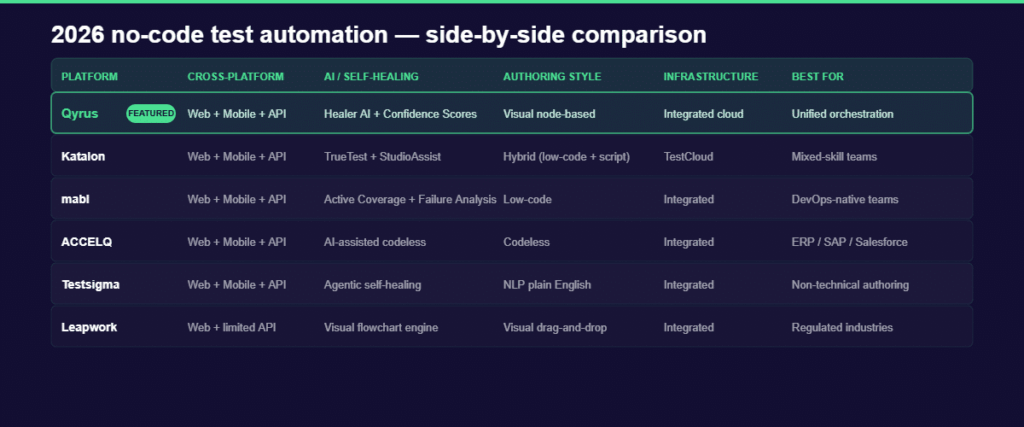
Before the deep dives, here is where each platform stands across the five criteria. Use this as a reference card throughout the article. 

Platform 

Cross-Platform 

AI / Self-Healing 

Authoring Style 

Infrastructure 

Best For 

Qyrus 

Web + Mobile + API 

Healer AI + Confidence Scores 

Visual node-based (no-code) 

Integrated cloud farm 

Unified orchestration 

Katalon 

Web + Mobile + API 

TrueTest + StudioAssist 

Hybrid (low-code + Groovy) 

TestCloud (integrated) 

Teams needing script fallback 

mabl 

Web + Mobile + API 

Active Coverage + Failure Analysis 

Low-code 

Integrated 

DevOps-native engineering teams 

ACCELQ 

Web + Mobile + API 

AI-assisted codeless 

Codeless 

Integrated 

ERP / SAP / Salesforce automation 

Testsigma 

Web + Mobile + API 

 Atto 2.0 (context-aware agentic healer) 

NLP plain English 

Integrated 

Accessibility-first authoring 

Leapwork 

Web + limited API 

Visual flowchart engine 

Visual drag-and-drop 

Integrated 

Regulated industry compliance 

Now let’s unpack what makes each platform worth a closer look — and where they fall short. 

 Qyrus — Best for Unified Cross-Platform Orchestration 

Most codeless testing platforms support web, mobile, and API testing. Fewer of them let those three channels share a single session. That distinction is the core of what Qyrus does differently. 

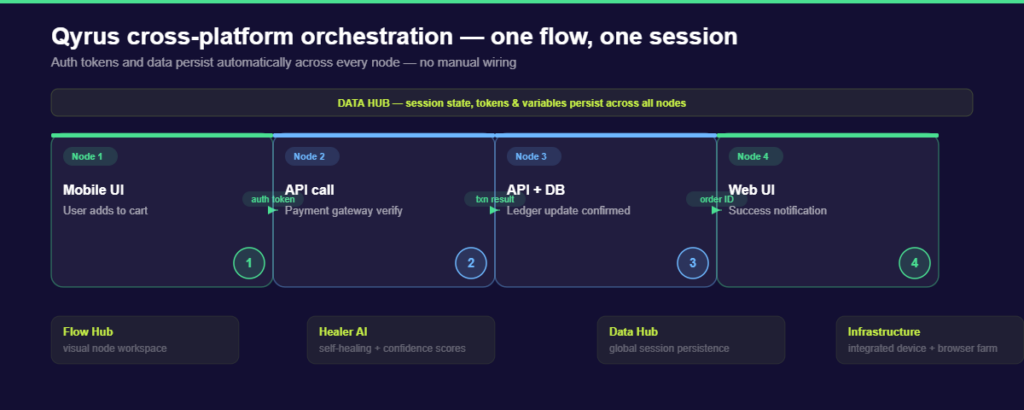
When a test touches multiple systems, a mobile app that triggers an API call that confirms via a web dashboard, most tools require separate projects, manual data exports, and careful re-import of tokens or IDs between stages. Qyrus handles this as a single orchestrated flow. The authentication token from step one is automatically available in step two. The transaction results from step three informs the validation in step four. No manual wiring is required. 
qyrus-flow-hub-diagram

This is the “wiring tax” that Qyrus is designed to eliminate. Here is how the platform’s SEER (Sense, Evaluate, Execute, Report) architecture delivers it: 

AIVerse Agents: Qyrus coordinates a population of specialized Single-Use Agents (SUAs)—such as Uxtract and API Builder —coordinated by the SEER orchestration layer. 

Nova + Healer AI: Nova is Qyrus’ AI layer for test generation. It suggests assertions from UI interactions and can generate test suites from API discovery using a Chrome extension that captures API calls as a user works through the UI. Healer AI handles maintenance: when a locator breaks due to a UI change, it proposes a fix and assigns a Confidence Score. High-confidence fixes can be auto-applied; lower-confidence fixes queue for human approval. 

Beyond testing standard apps, Qyrus is uniquely positioned for the “Agentic Era” by testing the AI itself. It is the only platform in this set that earned a perfect 5.0 from Forrester for testing RAG pipelines and agentic tool calling, capabilities essential for enterprises building and validating their own AI-infused applications. 

Integrated infrastructure: Qyrus includes a real device farm and browser cloud within the platform; no separate Sauce Labs or BrowserStack subscription required. For teams testing at scale, this removes one integration dependency from the stack. 

On ROI, Qyrus reports a 150% efficiency boost for a banking client as validated in a Forrester TEI study showing a 213% ROI with payback in under six months. Those numbers are worth pressure-testing in a proof of concept, but they reflect the platform’s core pitch: replacing multiple fragmented tools with one orchestrated environment lowers total cost of ownership even when the per-seat licensing looks comparable. 

Qyrus is the right choice for QA teams that need to test complex, multi-system user journeys and want to do it without specialized automation engineers gluing tools together. If your testing environment is primarily single-channel — web only, or mobile only — the orchestration depth may be more than you need. 

Want to see Qyrus handle your specific cross-platform testing environment? Request a demo. 

Katalon — Best for Teams That Still Need a Script Fallback 

Katalon has come a long way from its origins as a Selenium wrapper. By 2026, it has matured into the Katalon True Platform, a full quality management system with a credible AI generation story and one of the most capable mobile testing suites in this comparison. 

The standout addition in recent versions is TrueTest: a capability that ingests real user session recordings from production and auto-generates corresponding test cases. Instead of QA engineers manually mapping test scenarios, TrueTest continuously expands coverage based on how actual users interact with the application. It shifts the coverage conversation from “how many tests have we written” to “how much of real user behavior is covered.” 

For mobile testing specifically, Katalon’s live testing features are genuinely advanced. Biometric authentication simulation, GPS and IP geolocation, camera image injection, and network throttling across 2G, 3G, and LTE — these are capabilities that matter when you are testing applications with location-aware features or connectivity-dependent behaviors. 

The honest limitation is Groovy. For complex test logic including conditional flows, custom data manipulation, edge-case assertions, Katalon still routes teams through its Groovy/Java scripting editor. For organizations with technical QA engineers, this is a feature: a scripting fallback when the visual interface hits its limits. For organizations trying to enable business analysts or product managers to write tests independently, it is a bottleneck. The platform is genuinely hybrid, which means it serves mixed-skill teams well and fully non-technical teams less so. 

Katalon is the right choice for QA teams with a mix of technical and non-technical testers, particularly those who have existing Selenium or Appium experience they want to preserve alongside newer AI-assisted authoring. 

mabl — Best for DevOps-Native Engineering Teams 

mabl has built its identity around one principle: serving as an “independent quality reviewer” for AI-coding-agent output. In 2026, that positioning has deepened into a full agentic platform with the strongest developer experience in this comparison. 

The most concrete expression of this is mabl’s MCP Server integration, which lets developers interact with the platform directly from their IDE or terminal. Combined with its native Jira integration via Atlassian Rovo, where mabl can generate test cases from Jira tickets automatically, the result is a testing platform that lives inside the development workflow rather than alongside it. 

Two capabilities stand out for QA leaders evaluating mabl. Active Coverage means tests evolve automatically as the application UI changes: mabl detects the change, updates the affected tests, and keeps the suite current without manual intervention. Failure Analysis classifies failures before a human investigates, distinguishing genuine regressions from application changes and environmental noise. In high-velocity CI pipelines where flaky tests erode trust in automation, this classification step saves significant engineering time. 

For mobile testing, mabl’s Visual Assist finds elements based on visual appearance rather than underlying code. When a mobile layout shifts — a button moves, a form reorganizes — Visual Assist adapts because it reasons about what the element looks like and what it does, not what its ID is. 

The limitation to flag honestly: mabl is optimized for developer-QA collaboration in agile teams. Business analysts or non-technical stakeholders who want to author tests independently will find mabl’s interface less accessible than Qyrus’s node-based approach or Testsigma’s NLP authoring. If “democratizing test creation to non-engineers” is a strategic goal, mabl is not the primary tool to get there. 

mabl is the right choice for engineering organizations where QA and development share tooling, the CI/CD pipeline runs fast, and the priority is autonomous test maintenance over test authoring accessibility. 

ACCELQ, Testsigma, and Leapwork — At a Glance 

Three more platforms round out the 2026 no-code test automation landscape, each with a clearly defined niche. For most web, mobile, and API testing environments, the comparison above is the core decision. But for specific use cases, one of these three may be the right fit. 

ACCELQ — Best for ERP and Complex Business Process Automation 

ACCELQ is built for organizations where the application under test is a complex enterprise system: SAP, Salesforce, Oracle, or a custom ERP. Its codeless engine models business processes at a higher level of abstraction than most tools — you define what the process does, not the individual UI interactions required to execute it. 

Its codeless engine models business processes at a higher level of abstraction than most tools — you define what the process does, not the individual UI interactions required to execute it. While ACCELQ remains a dominant choice for Salesforce, Workday, and Oracle, Qyrus has significantly deepened its enterprise utility through specialized SAP capabilities, including Qyrus DataChain and Robotic Smoke Testing. 

The productivity numbers ACCELQ publishes are among the strongest in this comparison: 7.5x faster automation development and 72% reduction in maintenance overhead. For teams automating repetitive, process-heavy workflows across enterprise applications, those gains are credible. ACCELQ was also recognized as a leader in the G2 Winter 2026 reports, which reflects strong user satisfaction within its target segment. 

Where ACCELQ is less suited: greenfield digital products, consumer-facing web and mobile applications built on modern JavaScript frameworks, or organizations where the primary need is cross-platform orchestration rather than process modeling. 

 Testsigma — Best for NLP-First, Accessibility-Driven Authoring 

Testsigma’s core differentiator is plain-English test authoring. Testers write test steps in natural language — “click the login button,” “verify the order total equals $49.99” — and Testsigma’s NLP engine maps those instructions to executable automation. No code, no visual drag-and-drop, no node configuration. 

This makes Testsigma the most accessible platform in this comparison for non-technical contributors: business analysts, product managers, and domain experts who understand what the application should do but have no interest in how to automate it. The platform’s agentic healer claims a 90% reduction in test maintenance, and its cross-platform coverage — web, mobile, and API — is comprehensive. 

The platform’s Atto 2.0 (context-aware agentic healer) claims a 90% reduction in maintenance through its specialized Five-Agent model—Generator, Runner, Analyzer, Healer, and Optimizer. 

The gap relative to Qyrus is orchestration depth. Testsigma handles each test type well in isolation via its Five-Agent model (Generator, Runner, Analyzer, Healer, and Optimizer). For complex multi-system journeys where session state needs to persist across web, mobile, and API within a single flow, Qyrus’ node-based chaining provides more structural control. 

Leapwork — Best for Regulated Industries Requiring Audit Trails 

Leapwork’s visual flowchart approach to test automation has found a strong market in regulated industries including financial services, pharma, and healthcare, where auditability, process documentation, and deterministic test paths are requirements, not preferences. Each test in Leapwork is a visible flowchart that non-technical stakeholders can read and validate, which satisfies audit requirements in ways that code-heavy automation cannot. 

Its 2026 Continuous Validation Platform extends this positioning into AI-assisted test creation while maintaining the visual transparency that its regulated-industry customer base requires. 

The honest limitation: API testing coverage in Leapwork is thinner than the other platforms in this comparison. For organizations whose primary testing need is end-to-end API chain validation or API-first application architecture, Leapwork is not the strongest choice. For regulated organizations testing complex, multi-step business processes through a UI, it is hard to beat. 

The Self-Healing Question — What ‘AI-Powered’ Actually Means in 2026 

Every platform in this comparison claims AI-powered self-healing. The claim is accurate for all of them, and almost useless as a differentiator because of it. What matters to a QA leader is not whether a platform uses AI for maintenance, but what level of autonomy that AI operates at and what controls exist when it makes decisions. 
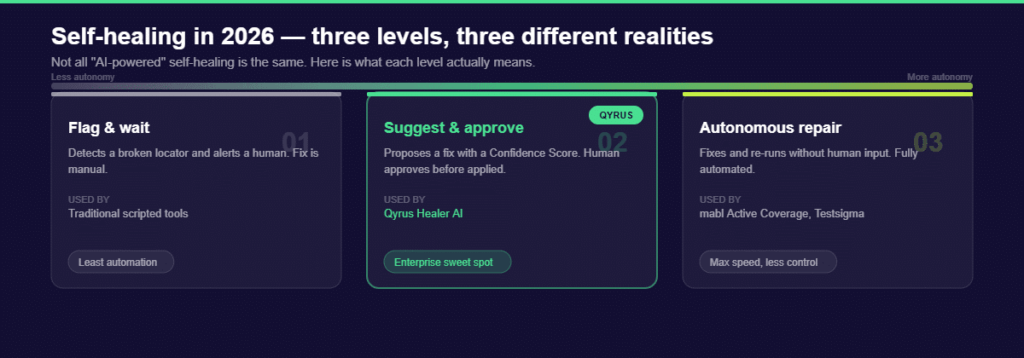
There are three meaningfully different levels of self-healing in 2026, and choosing between them depends on your organization’s tolerance for autonomous action versus human oversight: 


Level 

How It Works 

Who Uses It 

Level 1: Flag & Wait 

Detects broken locator, alerts a human. Manual fix required. 

Traditional scripted tools 

Level 2: Suggest & Approve 

Proposes a fix with a Confidence Score. Human approves before it’s applied. 

Qyrus Healer AI 

Level 3: Autonomous Repair 

Fixes and re-runs without human input. Fully automated. 

mabl Active Coverage, Testsigma Agentic Healer 


For most enterprise QA environments, Level 2 is the practical sweet spot. Level 3 autonomous repair sounds appealing, and in high-velocity pipelines where tests run hundreds of times a day, it genuinely reduces noise. But autonomous repair without oversight can mask a real product defect: if a button changes its label because a developer made an error, and the AI silently updates the test to match, the regression goes unreported. 

Qyrus’ Confidence Score model handles this tension directly. High-confidence fixes — where the AI is statistically certain the change is cosmetic, not a regression — apply automatically. Low-confidence fixes queue for human review. The result is AI-speed maintenance for routine changes, with human judgment preserved for ambiguous ones. 

When evaluating any platform’s self-healing claims, ask the vendor three questions: At what confidence threshold does the AI act autonomously? How does the platform distinguish a cosmetic UI change from a functional regression? And where is the audit log of every automated fix? 

Frequently Asked Questions 

What is a no-code test automation tool? 

A no-code test automation tool lets QA teams create, run, and maintain automated tests without writing code. Depending on the platform, test authoring happens through visual drag-and-drop interfaces (Qyrus, Leapwork), plain-English NLP inputs (Testsigma), or low-code visual workflows (mabl, Katalon). The goal is to make test automation accessible to testers who aren’t software engineers, while still producing reliable, maintainable coverage. 

Which no-code test automation tool is best for API testing? 

It depends on how API testing fits into your broader strategy. If your primary need is API testing within end-to-end cross-platform flows — where an API call sits in the middle of a user journey that starts on mobile and ends on web — Qyrus offers the most integrated approach through its Flow Hub and Data Hub. If your API testing is primarily within an ERP ecosystem like SAP or Salesforce, ACCELQ is the stronger fit. For API testing as a standalone discipline within a DevOps pipeline, mabl’s CI/CD-native architecture is worth evaluating. 

Can no-code tools replace manual testing entirely? 

Not yet — and any vendor who says otherwise is oversimplifying. No-code automation tools dramatically reduce the manual effort required for regression testing, functional test suites, and repetitive scenario validation. They expand coverage without expanding headcount. What they don’t replace is exploratory testing: the human judgment required to identify unexpected edge cases, assess the quality of a user experience, or catch bugs that only manifest under unusual conditions. Think of no-code automation as raising the floor on coverage, not eliminating the need for skilled testers. 

What is the difference between low-code and no-code testing platforms? 

No-code platforms — Qyrus, Testsigma, Leapwork — require zero scripting. Test authoring happens entirely through visual or natural-language interfaces, with no programming knowledge assumed. Low-code platforms — Katalon, mabl — offer a predominantly codeless experience but permit scripting for complex scenarios. For Katalon, that means Groovy and Java. For mabl, it means JavaScript for advanced configurations. The distinction matters when you are deciding who in your organization can contribute to test authorship: no-code platforms enable non-engineers; low-code platforms are primarily designed for QA engineers who want to move faster. 

How do I evaluate the ROI of switching to a no-code test automation platform? 

Start with three numbers from your current state: the percentage of your test suite that is currently automated, the average hours per sprint your team spends on test maintenance, and the number of people who can actively contribute to writing tests today. Then use those as your baseline when running a proof of concept with any platform. The platforms in this comparison all publish customer benchmarks — ACCELQ’s 7.5x faster authoring, Testsigma’s 90% maintenance reduction, mabl’s 9x faster release cycles — but benchmarks from other organizations are directional at best. Your architecture, team size, and application complexity will determine your actual return. A 30-day PoC on a representative part of your test suite is the most reliable evaluation method. 

Making the Decision: Which Platform Fits Your Team in 2026? 

No single platform wins across every dimension — and that is actually useful information. The 2026 no-code test automation market has matured to the point where the best tools have distinct, defensible positions. The right choice depends on your team structure, your application architecture, and where your biggest testing friction currently lives. 

If unified cross-platform orchestration is your priority — if your user journeys span web, mobile, and API and you are tired of manually wiring data between tools — Qyrus is built for exactly that problem. If your team is split between technical engineers and non-technical testers and you need the option to drop into scripting for edge cases, Katalon’s hybrid approach gives you that safety net. If your CI/CD pipeline runs fast and QA and development share tooling, mabl’s developer-native experience is the smoothest fit. If your environment is ERP-heavy, ACCELQ’s process modeling capabilities are unmatched. If plain-English authoring is the fastest path to getting non-engineers writing tests, Testsigma is the most accessible starting point. And if you operate in a regulated industry where auditability is non-negotiable, Leapwork’s visual flowcharts satisfy requirements the other platforms don’t address as cleanly. 

The evaluation framework in this guide — cross-platform coverage, AI self-healing model, authoring accessibility, infrastructure integration, and ROI benchmarks — applies regardless of which platform you are assessing. Use it as your proof-of-concept scorecard, not just a reading lens. 

If Qyrus is on your shortlist, the fastest way to assess it is against your own testing environment.

Request a demo to see how its cross-platform test orchestration handle the specific journeys your team needs to cover. 

QYRUS gets even more powerful with AI!

Achieve agile quality across your testing needs.

Related Posts

Find a Time to Connect, Let's Talk Quality


    Ready to Revolutionize Your QA?

    Stop managing your testing and start innovating. See how Qyrus can help you deliver higher quality, faster, and at a lower cost.