SAP Functional Testing: The Executive Guide to Risk, Automation, and Release Velocity
 Varun RS
A Strategic Framework for CIOs, CTOs, and IT Leaders Navigating SAP Quality Assurance
Imagine a global manufacturer closing its books for the quarter. On a Tuesday morning, a routine SAP transport—a minor configuration patch applied the previous Friday—silently severs the integration between Sales and Distribution and Financial Accounting. Purchase orders continue to flow. Inventory updates in real-time.
Yet, invoices stop posting to the general ledger. The oversight remains undetected until Wednesday afternoon, when the finance team discovers a 36-hour gap in receivables. By the time leadership identifies and remediates the break, the company absorbs three days of operational disruption, a delayed financial close, and an emergency session with external auditors. The catalyst? A single change that skipped regression testing before promotion to production.
This scenario repeats in SAP environments every quarter across every major industry. The financial stakes are absolutely important.
We designed this guide for executives accountable for the integrity of that nervous system. It outlines:
- The Business Risk Profile: Identifying the true cost of inadequate sap functional testing.
- Life Cycle Strategy: Defining your testing requirements at every phase of the SAP journey.
- The Maturity Model: An honest assessment of the path from manual testing to AI-driven orchestration.
- The Executive Diagnostic: A five-question audit to determine if your current approach is a hidden liability.
- Systemic Remediation: How Qyrus helps enterprise SAP programs close these gaps.
Why SAP Testing Failures Are a Board-Level Risk, Not Just an IT Problem
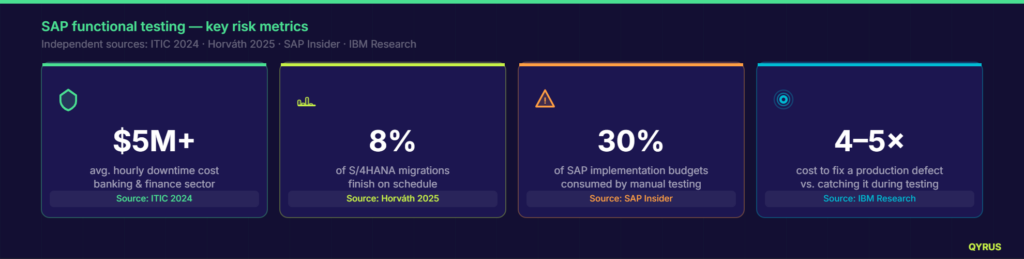
The ITIC 2024 Hourly Cost of Downtime Survey reveals that 97% of large enterprises report a single hour of downtime costs over $100,000. In sectors like finance, manufacturing, and retail, average hourly outage costs frequently exceed $5 million. SAP serves as the nervous system for these organizations; when it fails, the entire business halts.
Many leadership teams still misclassify SAP testing as a localized IT task—a technical checkbox to clear before a release. This perspective is a dangerous strategic miscalculation. In reality, SAP quality assurance represents a fundamental pillar of business continuity, financial reporting integrity, and regulatory compliance.
Over 440,000 organizations worldwide utilize SAP to orchestrate their most critical operations, including payroll, procurement, order management, and global supply chain logistics. These are not peripheral functions; they are the heart of the enterprise. When a core SAP module fails, the resulting operational paralysis extends far beyond the IT department, hitting the balance sheet and achieving board-level visibility within hours.
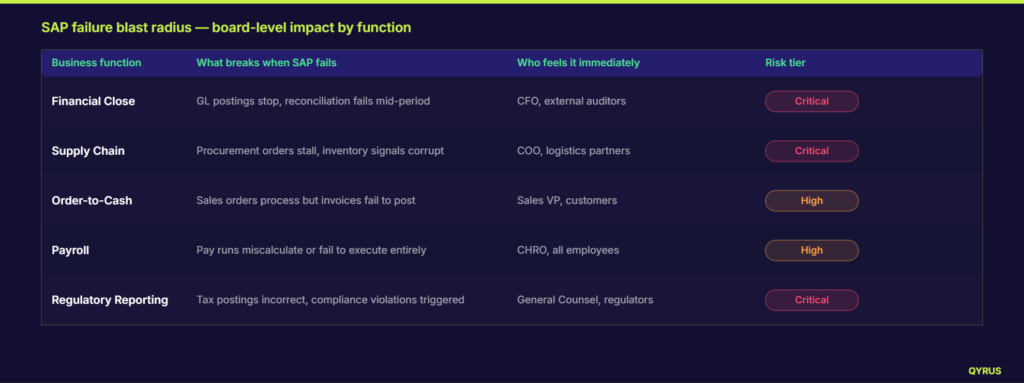
The following table illustrates the immediate impact an untested SAP change can have across typical enterprise functions:
Business Function | Operational Impact of Failure | Primary Stakeholders |
Financial Close | General Ledger postings halt; reconciliation logic fails. | CFO, External Auditors |
Supply Chain | Procurement orders stall; inventory signals become corrupt. | COO, Logistics Partners |
Order-to-Cash | Sales orders process, but invoices fail to post to the ledger. | VP of Sales, Customers |
Payroll | Pay runs miscalculate or fail to execute entirely. | CHRO, Employees |
Regulatory Reporting | Incorrect tax postings or compliance omissions trigger penalties. | General Counsel, Regulators |
The Capital Efficiency Problem
Beyond the immediate operational risk, a significant capital allocation dimension exists that CFOs rarely surface in testing discussions. Research from SAP Insider confirms that manual testing still consumes up to 30% of total SAP implementation budgets. On a $20 million transformation program, the organization effectively spends $6 million on a methodology that is both slower and less effective than modern automated alternatives. We do not view this as a QA budget line; we view it as a massive drain on capital efficiency. Redirecting that capital toward faster release cycles or innovation provides a genuine competitive advantage.
The Remediation Multiplier
Post-release risk compounds this financial picture further. According to IBM’s Systems Sciences Institute, fixing a defect in production costs 4 to 5 times more than identifying it during earlier testing phases. However, in the SAP ecosystem, the multiplier is even more punishing. Because SAP modules are so tightly linked, a single defect often cascades across multiple business units. The true remediation cost—accounting for developer hours, business downtime, and extensive data cleanup—frequently grows by an order of magnitude.
“What gets skipped in testing shows up as a live system issue. And live system issues cost far more to fix.” — SAP S/4HANA Migration Risk Guide
By shifting testing “left” and automating the validation process, we help enterprises transform QA from a cost center into a risk-mitigation engine that protects the organization’s most vital assets.
Defining the Domain: What SAP Functional Testing Actually Validates
Sap functional testing is the process of confirming that configured business processes align with specific business requirements. It is a distinct discipline from end-to-end, performance, or security testing, though a mature quality program must include all four. While other methods test for scale or vulnerability, functional testing confirms that the logic inside your SAP modules matches how your business actually operates.
The distinction is critical. In most struggling SAP programs, the failure isn’t that teams test too little; they test the wrong things, in the wrong order, using fragmented data.
The Four Essential Testing Layers
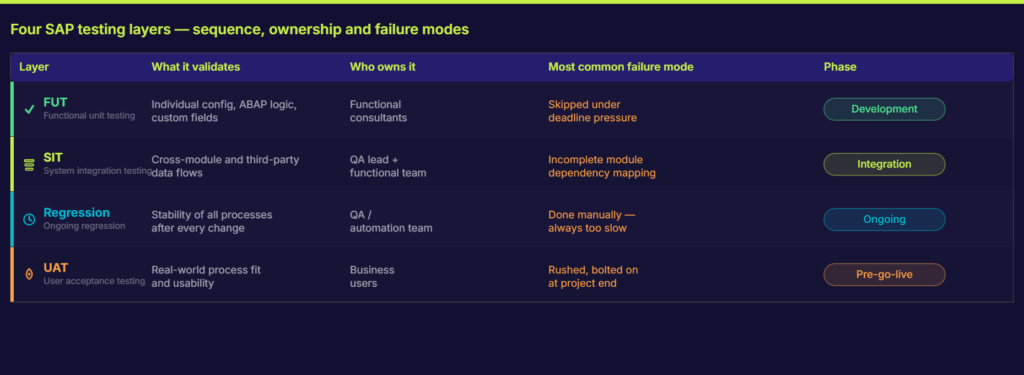
To maintain system integrity, every enterprise SAP program requires a structured approach across these four layers:
Layer | Strategic Validation | Primary Ownership | Primary Failure Mode |
Functional Unit Testing (FUT) | Validates individual configurations, ABAP logic, and custom fields. | Functional Consultants | Sacrificed under timeline pressure. |
System Integration Testing (SIT) | Validates cross-module and third-party data exchanges. | QA Leads + Functional Teams | Fragmented module dependency mapping. |
Regression Testing | Protects the stability of existing processes after every patch or transport. | QA / Automation Teams | Manual execution vs. release velocity. |
User Acceptance Testing (UAT) | Validates real-world process fit and day-to-day usability. | Business Users | Rushed and bolted on at the project’s end. |
The “Integration Wall”: Why SAP Defies Modular Testing
Most enterprise software allows for siloed, module-by-module testing. SAP does not. Its architecture creates what practitioners call the “Integration Wall”, the point where isolated testing produces false confidence because it ignores how modules interact.
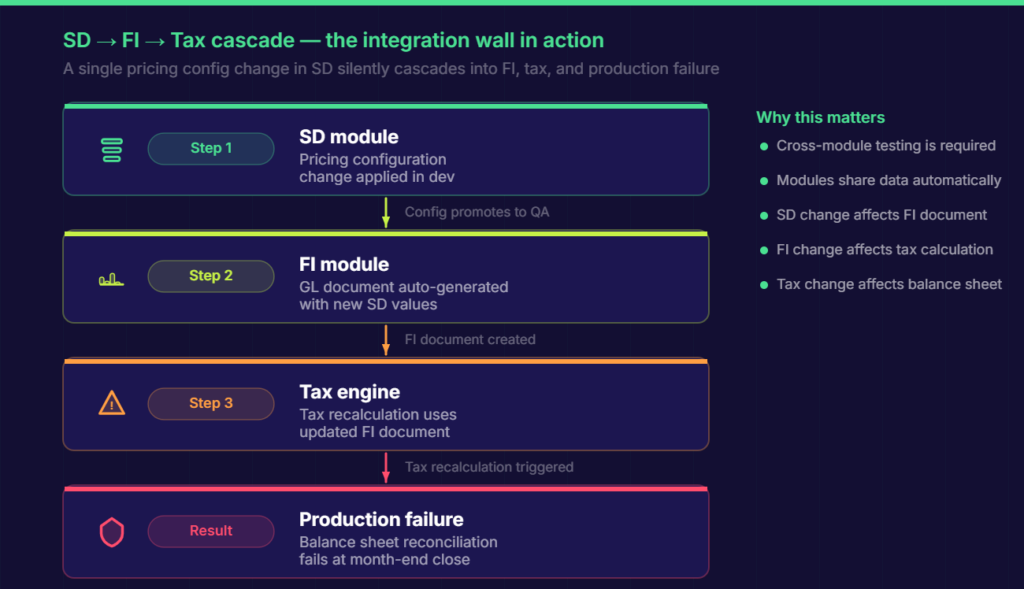
Consider a practical example: A development team applies a pricing configuration change within the Sales and Distribution (SD) module. In isolation, the change validates perfectly. A sales order generates, the pricing logic applies, and the tester signs off.
The risk lies in the downstream chain that remains untested: that SD pricing change alters the value of a document auto-generated in Financial Accounting (FI). This, in turn, corrupts the tax calculation logic posting to your general ledger accounts, which eventually breaks the month-end balance sheet reconciliation. These defects rarely surface until the finance team attempts to close the books.
This is not an edge case. In a 2025 iLab Quality case study, a manufacturing enterprise discovered, just two weeks before a major go-live, that a critical procurement workflow silently depended on a deprecated transaction code. Because the team had tested isolated modules rather than end-to-end processes, the issue remained invisible. The resulting remediation delayed go-live by six weeks while the team mapped the entire dependency chain.
S/4HANA and Fiori: The Legacy Script Liability
If your organization is among the 60% actively planning or undergoing an SAP S/4HANA migration, your existing ECC test scripts represent a systemic risk. They will not just fail occasionally; they will fail systematically.
The move to S/4HANA introduces three shifts that render legacy test cases obsolete:
- The Fiori UI Layer: Standard SAP GUI scripts cannot interact with web-based Fiori apps. Test automation built over the last decade for the legacy GUI requires complete re-engineering.
- Simplified Data Models: The S/4HANA Universal Journal consolidates tables that previously lived separately across FI and CO. Validation logic that targets specific ECC table structures will return errors or corrupt results in S/4HANA.
- Real-Time Processing: S/4HANA replaces ECC’s batch-oriented processes with real-time processing. This shift invalidates performance assumptions, transaction sequences, and timing dependencies.
The data confirms the difficulty of this transition. A 2025 Horváth study of 200 SAP user companies found that over 60% experienced schedule and quality deviations during migration, with projects running 30% longer than planned. Only 8% finished on schedule. In the S/4HANA era, undertested migrations have become the norm, not the exception.
Is Your SAP Testing Strategy a Hidden Liability? A 5-Question Executive Checklist
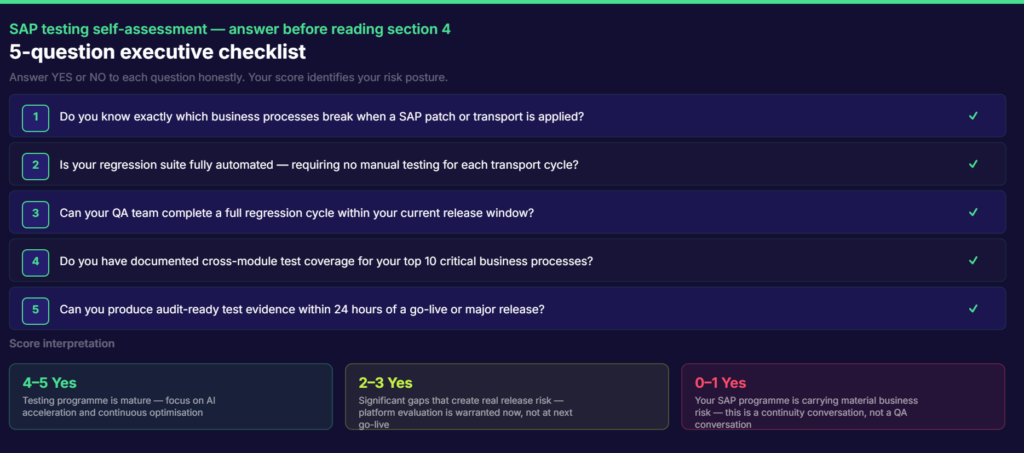
Before evaluating platforms or vendors, you must conduct an objective audit of your current SAP testing maturity. These questions bypass technical jargon to focus on governance and risk. If your leadership team cannot answer these with absolute certainty, your organization is likely carrying unmanaged operational risk.
Question 1: Impact Visibility
Do you know exactly which business processes are at risk when an SAP patch or transport is applied?
Most organizations lack this visibility. They recognize that a change occurred and perhaps identify the specific module it touched, but they cannot trace the downstream impact. Without automated change impact analysis, your team relies on “assumption-based testing.” These assumptions are precisely how six-week go-live delays happen.
Question 2: The Automation Bottleneck
Does your regression suite run autonomously, or do you still rely on manual intervention for every transport?
Partial automation is a bottleneck in disguise. SAP environments receive a constant stream of security patches, enhancement packages, and configuration updates. Each one introduces regression risk. Manual testing creates a compounding cost burden that eventually breaks the project budget. If your testing does not scale horizontally with your release frequency, the math will eventually fail.
Question 3: The Execution Window
Can your QA team complete a full regression cycle within your current release window?
This is the question internal teams often avoid. If your team must “selectively” skip tests to meet a deadline, you are making implicit risk decisions under pressure. Strategic quality assurance requires that every critical path receives validation every time. If your window is shrinking while your manual effort remains static, you are essentially gambling on system stability.
Question 4: Process-Level Coverage
Do you have documented cross-module test coverage for your top 10 critical business processes?
Standard documentation usually lives at the module level (e.g., SD or FI). However, your business operates through end-to-end chains: Order-to-Cash, Procure-to-Pay, and Record-to-Report. If your testing validates modules but ignores the connective tissue between them, you have a massive coverage gap at the process level—where the most expensive failures occur.
Question 5: Audit and Compliance Readiness
Can you produce audit-ready test evidence within 24 hours of a major release?
Regulatory frameworks like SOX, GDPR, and GxP require definitive proof that you validated critical processes before go-live. If your evidence is scattered across spreadsheets and email threads, you lack a proper system of record. This creates a compliance vulnerability that auditors will eventually expose, leading to significant fines or remediation costs.
Scoring Your Risk Posture
Score | Strategic Implication |
4–5 “Yes” | Mature: Your program is resilient. Focus on AI-driven acceleration and continuous optimization. |
2–3 “Yes” | At Risk: Significant gaps exist that threaten release stability. A platform evaluation is a priority, not a future project. |
0–1 “Yes” | Critical Liability: Your SAP program carries material business risk. This is a business continuity conversation that requires immediate executive intervention. |
The Evolution of SAP Test Automation: From Scripts to Agentic AI
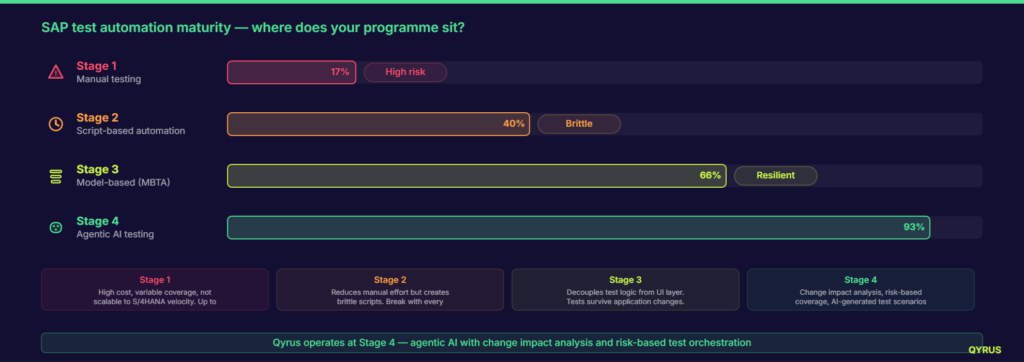
Understanding your organization’s position on the testing maturity curve is the prerequisite for any defensible investment decision. Not every enterprise must reach Stage 4 immediately. However, every leader managing a mission-critical SAP environment must identify their current stage—and calculate the literal cost of remaining there.
Stage 1: Manual Testing
This is the legacy starting point where many organizations remain stuck. Functional consultants and business users execute test cases manually, following scripts documented in Excel or Word. They capture results in spreadsheets and exchange sign-offs via email.
The primary deficit here is not just a lack of speed; it is a lack of repeatability. A manual tester executing 200 cases over three days rarely identifies defects consistently across cycles. Fatigue, interpretation drift, and deadline pressure make manual testing inherently variable and prone to oversight.
The financial case against this approach is overwhelming. SAP Insider research indicates that manual testing consumes up to 30% of total implementation budgets. On a $15 million S/4HANA program, that represents $4.5 million poured into a methodology that your competitors have already replaced with automation. In this stage, you aren’t just testing software; you are hemorrhaging capital.
Stage 2: Script-Based Test Automation
The first wave of automation introduced record-and-playback tools and scripted frameworks. These systems improved repeatability and reduced manual effort significantly. However, they introduced a new problem: brittleness. Scripts written for the SAP GUI often break when screen layouts shift, a frequent occurrence during enhancement package updates or Fiori migrations.
Maintenance costs represent the “hidden trap” of Stage 2. Many organizations that invested heavily in scripted automation during the ECC era now find their test libraries are liabilities rather than assets. Re-engineering thousands of brittle scripts for S/4HANA Fiori often costs as much as building a new suite from scratch. This realization creates difficult conversations with boards that previously approved major automation investments.
Stage 3: Model-Based Test Automation (MBTA)
Model-based testing represents a shift toward resilience by decoupling test logic from the application’s UI layer. Instead of scripts that reference specific, volatile screen elements, MBTA utilizes a business process model. This model describes what a process does—not how the UI renders it.
This approach offers three strategic advantages:
- Resilience: Test cases survive application changes without manual re-engineering.
- Accessibility: Business users can own and validate test cases without programming expertise.
- Hybrid Coverage: For large enterprises running SAP GUI and Fiori in parallel, a single process model generates tests for both paradigms simultaneously. This is the only sustainable way to manage quality during a long-term migration.
Stage 4: Agentic AI and Intelligent Orchestration
The current frontier moves beyond simple automation into genuine intelligence. Agentic AI tools act as “doers.” They receive plain-language instructions—such as “Create a sales order in SD, verify stock reservation in MM, and confirm the FI document posts correctly”—and execute the full cross-module scenario autonomously.
Early adopters report massive acceleration. A Forrester Total Economic Impact study found that advanced automation can accelerate application delivery by up to four times, with organizations reporting a 334% return on investment. More recent implementations of AI-driven sap test automation report test creation timelines dropping from hours to mere minutes.
The most transformative dimension of Stage 4 is Automated Change Impact Analysis. Instead of a “test everything and hope” approach, intelligence identifies exactly which business processes a transport will affect before it reaches the QA environment. Teams focus their energy on the 20% of processes that carry 80% of the business risk. This strategy enables faster releases with higher confidence, improving both velocity and coverage in tandem.
The market reflects this shift: between 2023 and 2025, intelligent testing tools reduced manual effort by nearly 34% on average. Automation now influences approximately 49% of SAP testing engagements, representing a total paradigm shift in how we secure the enterprise nervous system.
Bridging the Gap: How Qyrus Secures the Modern SAP Landscape
Legacy testing platforms often feel like an anchor in an S/4HANA world. They were built for an era of stable ECC instances, infrequent updates, and massive, dedicated QA teams. Today’s reality is the opposite: volatile cloud updates, hybrid GUI/Fiori environments, and release cycles that have compressed from quarters to weeks.
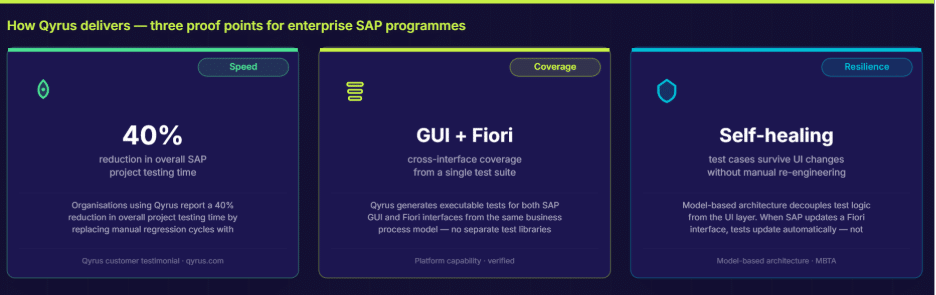
Qyrus bridges the gap between legacy QA constraints and modern release velocity. We provide an intelligent quality engineering platform that addresses the three points where traditional approaches consistently fail: test creation speed, cross-module visibility, and automation sustainability.
Proof Point 1: Accelerating Test Creation Across GUI and Fiori
Manual script authorship is a technical debt factory. In traditional models, functional consultants spend weeks translating process documentation into executable scripts. For an enterprise with hundreds of critical workflows, this process takes months and is often obsolete before it finishes.
Qyrus uses AI to compress this timeline. Business analysts can describe a process in plain language, and the platform generates executable test scenarios that run across both SAP GUI and Fiori apps. You no longer need separate test libraries for different interfaces—a massive advantage during S/4HANA migrations where both environments must coexist.
Proof Point 2: Ensuring Genuine Cross-Module Coverage
The most expensive testing gap isn’t an untested module; it’s an untested module interaction. A failure in an order-to-cash process that spans SD, MM, and FI usually stems from data that doesn’t flow correctly between the modules.
Qyrus validates these end-to-end chains, not just isolated steps. We trace data from the initial sales order through inventory reservation, goods issue, and final GL reconciliation. This prevents configuration changes in one area from triggering unexpected downstream failures that only surface in post-go-live “war room” sessions.
Proof Point 3: Resilience by Design
Most SAP automation efforts fail because they are brittle. Scripts break whenever an enhancement package updates a screen layout or a Fiori interface shifts. Maintenance costs eventually outpace the value of the automation, forcing teams back to manual testing.
Qyrus utilizes a model-based approach that decouples test logic from the UI. When SAP updates an interface, the underlying business process model remains valid. Because updates are localized rather than wholesale re-engineering projects, your automation becomes a long-term asset that survives every update cycle.
6 Strategic Best Practices for High-Performing SAP Programs
These are not generic QA suggestions. They address the specific failure patterns we see in SAP programs that overrun budgets and miss go-live dates.
- Map Cross-Module Dependencies First
Inadequate scoping causes more defects than inadequate testing. If you write test cases before mapping how SD affects FI or how MM triggers CO postings, you are testing in the dark. Build the dependency map first. This upfront investment saves multiples of that time in production remediation and emergency patching.
- Automate Regression in Parallel,Notas “Phase 2”
Many leaders treat automation as a secondary activity to be handled after go-live. By then, the team has already built a manual “technical debt” library. Start automation in parallel with test case development. Integrating even partial automation into your implementation creates a sustainable foundation for long-term maintenance.
- Apply the 80/20 Rule to Risk
Not all SAP processes carry equal business risk. A configuration change in a minor HR report is not the same as a change to a high-volume pricing engine. High-performing programs explicitly rank processes by business criticality. Ensure your most critical 20% of workflows receive the deepest testing rigor and the most frequent automated execution.
- Treat Test Data as a Strategic Asset
Misaligned test data causes nearly 30% of migration delays. Tests often fail not because the system is broken, but because the data doesn’t satisfy validation rules. This erodes team confidence and stalls sign-off cycles. Invest in data refresh utilities, masking for sensitive fields, and environment parity from day one.
- Transition to Event-Driven Testing
In many organizations, testing is a periodic activity scheduled before a major release. In a mature program, testing is continuous. Every SAP transport represents a regression risk. Automated checks should fire every time a transport moves from development to QA. This is the only way to catch integration defects before they accumulate into a systemic failure.
- Move Business Users from Gatekeepers to Partners
Late User Acceptance Testing (UAT) is the primary cause of go-live delays. When business users are treated as the final checkpoint, they often find critical defects when the window for remediation has already closed. Integrate UAT as soon as stable builds are available. Shifting UAT “left” ensures that the solution meets operational needs throughout the development cycle, not just at the end.
SAP Functional Testing — Frequently Asked Questions
What is SAP functional testing?
SAP functional testing is the validation that configured business processes in SAP operate according to defined business requirements. It confirms that the logic inside modules like Finance, Materials Management, and Sales and Distribution produces the correct outputs for real business scenarios — not just that individual screens display correctly, but that end-to-end process chains work as your business actually operates.
How is SAP functional testing different from SAP performance testing?
Functional testing validates correctness: does the process produce the right result? Performance testing validates scale: does the process remain fast and stable when 5,000 users are executing it simultaneously? Both are necessary. A process that is functionally correct but collapses under production load is still a production risk.
How long does a typical SAP functional testing cycle take?
It depends heavily on the scope of change and the maturity of the test automation program. For a major release in a manual-testing environment, regression cycles often run two to four weeks. For organizations with mature automation coverage, the same cycle can run in hours to days. This compression is one of the primary ROI drivers of investing in SAP test automation.
What is the difference between SIT and UAT in SAP?
System Integration Testing (SIT) validates that SAP modules and connected external systems exchange data correctly — it is primarily an IT-led activity focused on technical integration. User Acceptance Testing (UAT) validates that the system meets operational needs from a business user perspective — it is primarily a business-led activity focused on process usability and correctness. Both are required. SIT without UAT misses business process gaps. UAT without SIT misses integration defects.
How do you protect sensitive data during SAP testing?
Best practice is to replicate production data volumes in test environments while applying data masking to sensitive fields — employee personal information, customer financial data, and payroll details. This ensures test data reflects real-world complexity and volume without creating compliance exposure. Automated data refresh utilities are essential for maintaining environment parity across long test programs.
Is SAP test automation worth the investment for mid-size organizations?
The economics are compelling even at mid-scale. IDC research cited in enterprise testing studies shows enterprises implementing test automation achieving 548% ROI over five years, with average payback periods of seven months. For organizations facing S/4HANA migration timelines, the question is less “is it worth it?” and more “can we afford not to?” Manual testing cannot keep pace with modern SAP release velocity. The choice is not automation versus no automation — it is automation versus repeated production incidents.
Ready to Close the Gaps in Your SAP Testing Program?
Treating SAP quality as a secondary IT concern is no longer a viable strategy. As S/4HANA migration deadlines loom and release cadences accelerate, the margin for error has effectively vanished. In this environment, a single production failure carries a price tag—operational, financial, and reputational—that most enterprises simply cannot afford.
The organizations successfully navigating this shift do not rely on the sheer size of their QA departments. Instead, they prioritize intelligence: risk-based, autonomous testing programs designed specifically for the complexities of modern SAP development.
Qyrus provides that level of strategic resilience. By addressing the core friction points of enterprise quality—collapsing test creation timelines across GUI and Fiori while deploying automation that actually survives the next update—Qyrus helps teams move beyond the limitations of manual testing. This approach identifies the deep-seated logic defects that legacy scripts and manual checks consistently miss.
Request a Demo or start with a self-assessment: ask your team the five questions in this guide and see how many you can answer with confidence. The gaps in those answers are the gaps in your SAP risk posture.

 September 30, 2026
  9 min
9 min