 Kumar Vivek
23 Min. Read
October 7, 2026
What is an LLM Tool?
A LLM tool is like a application, interface, or integration that exposes the reasoning capabilities of a large language model to end users or downstream systems. It covers features right from a simple chatbot to an API to a fully autonomous agent that can browse the web, writes code, executes files, and completes multi-step workflows without human input in the loop. In simplest terms, every LLM tool shares three components: a language model (as AI reasoning engine), an interface layer (to interpret how humans or machines communicate with it), and an integration layer (how it connects to real data, APIs, and actions in the world).LLM vs AI Tool vs AI Agent
These three terms are used interchangeably in most conversations — and that confusion is expensive. An LLM, an AI tool, and an AI agent are fundamentally different things with different capabilities, different failure modes, and very different evaluation requirements. Understanding the distinction is the first step to building or deploying any of them responsibly.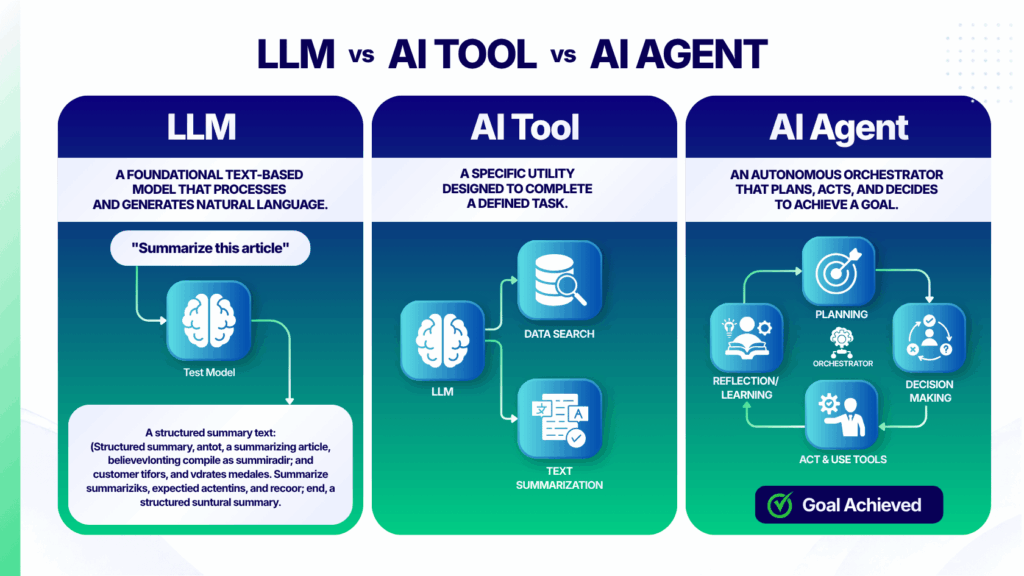
Side-by-side comparison
| LLM | AI Tool | AI Agent | |
| Acts on its own? | No | Within scope | Yes — until goal met |
| Has memory? | Context window only | Session-level | Persistent across steps |
| Uses tools? | No | Predefined set | Dynamic selection |
| Self-corrects? | No | No | Yes — reflects and retries |
| Eval complexity | Output scoring | Output + integration | Trajectory + goal + safety |
| Autonomy | Low | Medium | High |
Why LLM Tools Are Different from Traditional Software
Traditional software is designed to be deterministic. So it can give the same input and it will always produce the same output. But LLM tools are built to be probabilistic — outputs are generated by sampling from a learned distribution over language. This single difference changes everything: testing, debugging, monitoring, and quality assurance all require entirely new paradigms. Traditional software fails loudly. It crashes, throws errors, returns null. LLM tools fail silently. They generate confident, grammatically correct, beautifully structured text that happens to be wrong, biased, or dangerous. This is why evaluation — the practice of measuring LLM output quality systematically — has become one of the most critical disciplines in modern AI engineering.Why the Distinction Matters for Evaluation
The gap between these three categories is not just conceptual — it directly determines how hard evaluation is. An LLM needs output scoring: is this response accurate, relevant, safe? An AI tool needs integration accuracy on top: did it call the right API with the right parameters? An AI agent needs all of that plus trajectory evaluation: did it follow the right path, make the right tool choices at each step, and achieve the actual goal without unintended side effects? This is why QyrusAI is built as an end-to-end evaluation platform — not just an output scorer. As you move from LLM to tool to agent, the surface area for failure grows exponentially. The evaluation framework must grow with it.Now, What Does It Actually Take to Build an LLM Tool?
Building an LLM tool in 2026 is more accessible than ever — but the gap between a working prototype and a production-grade system remains vast. The prototype takes hours. The production system takes months. The difference is almost never the model itself — models are commoditizing fast.The Six-Layer Stack
- Foundation Model Selection
- Closed frontier models (GPT-4o, Claude, Gemini) offer capability with minimal setup. Open-weight models (Llama 3, Mistral) offer cost control, data privacy, and fine-tuning flexibility.
- Prompt Engineering Layer
- System prompts, few-shot examples, chain-of-thought scaffolding, and output format instructions shape model behavior before a single feature is written. Well-engineered prompts are the fastest lever for quality improvement — and the most underestimated engineering surface.
- Context & Memory Management
- LLMs have finite context windows. Production tools must carefully manage what goes into each inference call: conversation history, long-term user memory, retrieved documents, tool outputs.
- Tool & API Integration
- Modern LLMs call external tools via function calling or the Model Context Protocol (MCP). Each integration — search, database, calendar, code execution, CRM — multiplies the surface area for failures and requires its own evaluation criteria to catch regressions.
- Orchestration Layer
- For agentic workflows, orchestration manages agent state, tool routing, retries, and multi-step task decomposition. Frameworks like LangGraph, OpenAI’s Agents SDK, and Qyrus’s SEER provide the primitives.
- Evaluation & Observability Infrastructure
- Every production LLM tool needs logging, tracing, and automated evaluation. Without it, teams cannot detect regressions, understand failure modes, or improve systematically.
How LLMs Actually Work
A large language model is a probabilistic function that maps sequences of tokens to probability distributions over the next token. Train it on enough text and it learns to model the statistical structure of language at a depth that produces remarkable emergent capabilities — reasoning, translation, coding, logical deduction — that were never explicitly programmed.The Transformer Architecture
Every major LLM — GPT-4, Claude, Gemini, Llama — is built on the Transformer architecture introduced by Google in 2017. Its core innovation is the attention mechanism: a mathematical operation that allows every token in a sequence to dynamically attend to every other token, learning which relationships matter for predicting what comes next.The Attention Mechanism
Attention is the reason LLMs understand that “it” in a paragraph refers to a noun from three sentences back. For every token, attention computes a weighted combination of all other tokens in context, where the weights are learned across billions of training examples. The formula: Attention(Q,K,V) = softmax(QKᵀ / √d) · V. Each token acts simultaneously as a Query (what am I looking for?), a Key (what do I represent?), and a Value (what information do I carry?).Pre-training and Alignment
LLMs are trained in two phases. Pre-training exposes the model to hundreds of billions to trillions of tokens — internet text, books, code, scientific papers. The objective is simple: predict the next token. At scale, this simple objective produces emergent capabilities in reasoning, translation, and logic that were never explicitly programmed.Fine-tuning and alignment
then adapts the raw model into a useful assistant. RLHF (Reinforcement Learning from Human Feedback) trains the model to prefer outputs rated highly by humans. Constitutional AI, used by Anthropic, trains self-critique using a set of principles. These alignment techniques are what transform a raw language predictor into a safe, helpful product.How Large Data Drives Large Decisions
One of the most profound shifts in computing history is that modern AI systems are capable to make better decisions not primarily because of better algorithms — but because they trained on more data. This is a fundamentally different category from classical software engineering.Scaling Laws
Research from OpenAI, DeepMind, and others established empirical scaling laws: as you increase training compute, dataset size, and model parameters together, model capability improves predictably on a smooth power-law curve. The Chinchilla paper (Hoffmann et al., 2022) showed that most large models at the time were undertrained — the optimal strategy is to scale data and parameters together in balance. Practically, this means the model powering your customer service chatbot has “read” the equivalent of millions of books, billions of web pages, and hundreds of millions of lines of code. When it answers a contract law question, it draws on patterns from thousands of real legal documents. When it writes Python, it has processed more code than any human could read in a lifetime.The Data Flywheel Effect
The most defensible AI companies are not the ones with the best architecture today — they are the ones building data flywheels. More users generate more interactions. More interactions generate labeled feedback. Here labeled feedback produces better fine-tuned models. Better models attract more users. This loop is the real competitive moat in AI — not cleverness, not model architecture, but data velocity. OpenAI has over 400M weekly ChatGPT users. Google has it through Search and Workspace. Anthropic is building it through enterprise Claude adoption. The companies that win the next five years will be those who can convert user interactions into high-quality training signal at the highest speed — and measure that signal accurately with evaluation infrastructure.From Data Volume to Decision Quality
In healthcare, LLMs trained on clinical notes assist with differential diagnosis. In finance, models trained on earnings transcripts help analysts identify patterns across thousands of filings simultaneously. In legal, models trained on case law surface relevant precedents faster than any human search ever could. LLMs don’t “know” things the way humans do. They are sophisticated compression and interpolation machines that give responses in human-generated text. Their limitations comes from the breadth and depth of their training data.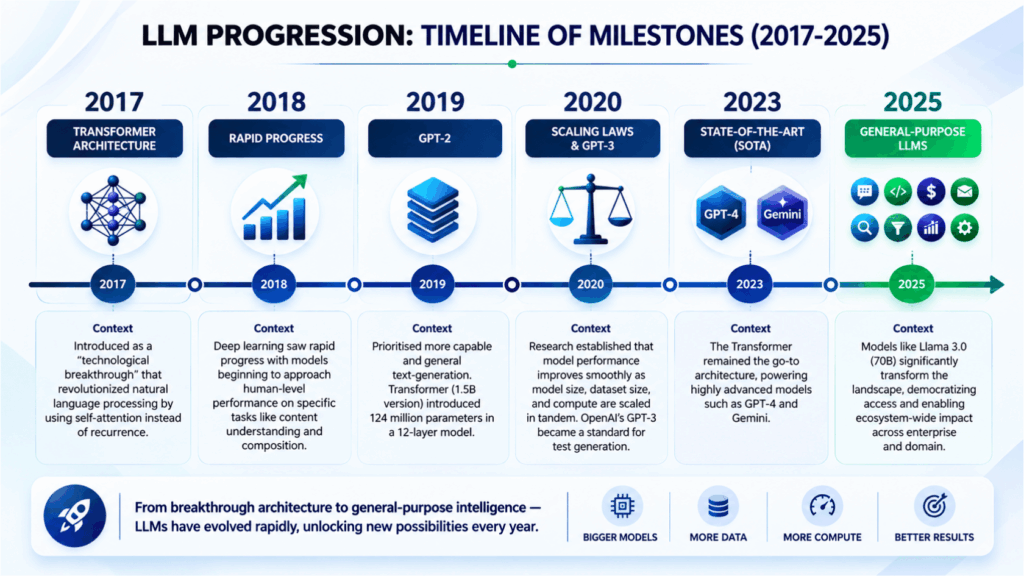
The LLM Progression
How Did We Get Here?
The honest answer to “what can an LLM do?” depends entirely on when you’re asking. In 2018, the answer was: complete sentences, sometimes coherently. In 2025, the answer is: write production software, pass bar exams, conduct multi-step research, operate computers autonomously, and reason through problems that stumped AI systems for decades. That gap — seven years — represents the most rapid capability expansion in the history of computing.2018–2019: Plausible text, unreliable reasoning
The first generation of Transformer-based LLMs (GPT-1, BERT, GPT-2) was able to produce grammatically coherent text and perform narrow NLP tasks — sentiment classification, named entity recognition, basic question answering. GPT-2, released in 2019 with 1.5 billion parameters, was considered dangerous enough that OpenAI staged its release. Looking back, it could barely maintain topic coherence across three paragraphs. The capability was limited to: fluent sentences on familiar topics, with frequent factual drift and no ability to follow multi-step instructions reliably.2020: The emergent leap — GPT-3 and few-shot learning
Post Covid GPT-3 (175B parameters) changed the fundamental question from “can LLMs do task X?” to “how well can LLMs do task X with the right prompt?” It demonstrated few-shot learning — the ability to learn a new task from just 2–3 examples in the prompt, without any weight updates. This had never been seen at scale before. Suddenly a single model could translate between languages it was never explicitly trained to translate, write code in frameworks it had only seen mentioned, and draft legal language with good reasonable structure. The capability unlock was the highlight — one model, many tasks, no retraining required.2021–2022: Instruction following and alignment
Raw capability means little if the model won’t do what you ask. InstructGPT (2021) introduced RLHF — training the model to follow instructions rather than just predict likely text. This was the transition from “impressive research” to “usable product.” Models now started being able to maintain personas, follow formatting instructions, refuse harmful requests, and produce outputs shaped around human preferences rather than before. ChatGPT in November 2022 was the product manifestation of this alignment work — and reached 100 million users in 60 days. During this same period, code generation became a serious capability. GitHub Copilot launched in 2021, trained on billions of lines of public code. By 2022, developers were reporting that Copilot was completing 25–40% of their code automatically. The model had learned not just syntax but idioms, patterns, library conventions, and common debugging strategies.2023: Multimodality, long context, and reasoning
GPT-4 (March 2023) came with two step changes: multimodal input (the model could now see images, not just text) and dramatically improved reasoning. It passed the bar exam in the 90th percentile. It scored at or above human performance on multiple professional certification exams. Chain-of-thought prompting — asking the model to reason step by step before answering — unlocked latent reasoning capabilities that had always been in the weights but were inaccessible with direct-answer prompting. Context windows grew from 4K tokens (GPT-3) to 32K (GPT-4) to 100K (Claude 2). This meant LLMs could now process entire codebases, legal contracts, or research papers in a single pass — tasks that previously required chunking, retrieval pipelines, and significant engineering overhead.2024: Tool use, agents, and computer control
The capability frontier shifted from what a model could say to what a model could do. Function calling — introduced as a first-class feature in mid-2023 and matured through 2024 — let LLMs call external APIs, query databases, run code, and trigger workflows. The model was no longer just a text generator; it was a reasoning engine that could take actions in systems. By late 2024, Anthropic shipped Claude for Computer Use with the ability for an LLM to see a computer screen, move the cursor, click, type, and operate arbitrary software like a human operator. OpenAI launched Operator on similar principles. GitHub’s 2024 report found that 46% of all new code written on the platform was AI-generated. LLMs had moved from helping write code to writing the majority of it.2025: Agentic reasoning and multi-step autonomy
The current capability frontier is agentic — LLMs are now operating as autonomous orchestrators that decompose goals, plan sequences of actions, execute them across multiple tools and systems, observe results, self-correct, and iterate until a goal is achieved. This is not a chatbot anymore. This is software that can be given a business objective — “research competitors and produce a positioning brief,” “audit our API responses for compliance issues,” “set up the dev environment from scratch” — and pursue it without human input at each step. The o1 and o3 model families introduced extended chain-of-thought reasoning — models that “think” before responding, spending compute on internal reasoning traces before producing output. On mathematical olympiad benchmarks, these models moved from near-zero performance (GPT-3 era) to exceeding PhD-level performance on many problem classes. DeepSeek R1 demonstrated that this reasoning capability can emerge from reinforcement learning without supervised examples — a fundamental shift in how capability is developed.The Rise of Agentic AI
For the first two years of the generative AI era, most LLM products were reactive: a user sends a message, the model responds, the loop ends. Agentic AI breaks this pattern entirely. An AI agent perceives its environment, makes decisions, takes actions, and operates across multi-step workflows — often without human intervention at each step. This shift — from reactive LLMs to agentic systems — is the most significant transition in AI since ChatGPT’s release. It transforms LLMs from sophisticated autocomplete into software that can do things in the world.Multi-Agent Systems and MCP
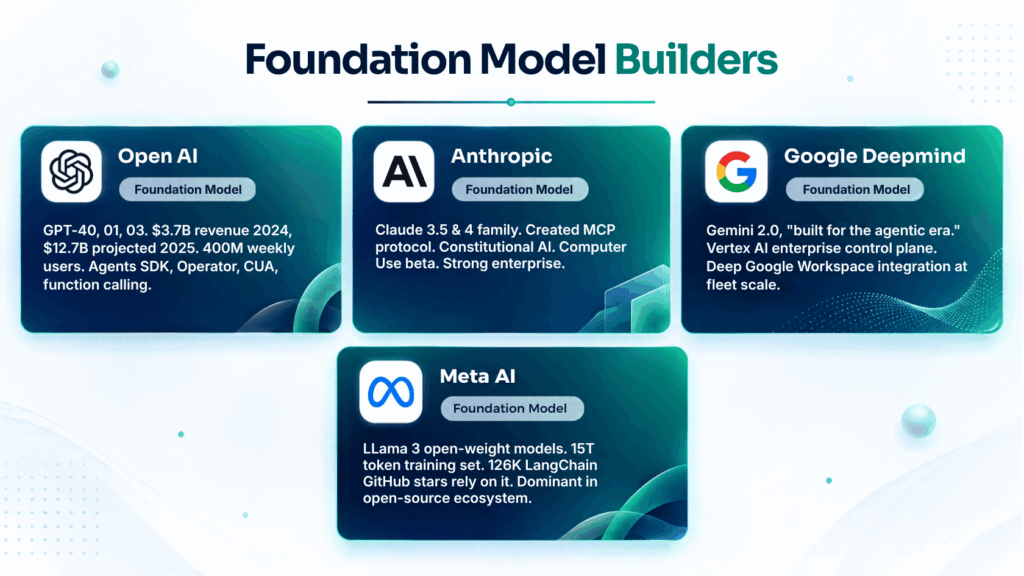
The frontier is moving beyond single agents toward multi-agent systems — networks of specialized AI agents that collaborate, delegate, and verify each other’s work. An orchestrator agent decomposes complex tasks, dispatches to specialist agents (a researcher, a writer, a coder, a critic), and synthesizes outputs. This architecture mirrors how high-performing human teams operate. Anthropic’s Model Context Protocol (MCP), created in November 2024 and donated to the Linux Foundation in December 2025, became the industry standard for connecting agents to external tools and data — with over 10,000 MCP servers deployed. OpenAI’s Agents SDK (early 2025) formalized multi-agent primitives: agents with instructions and tools, handoffs for control transfer, and guardrails for validation. Every major AI lab now has its own agent framework.Why Agents Make Evaluation Exponentially Harder
Evaluating a simple chatbot is already challenging. Evaluating an agentic system is orders of magnitude harder. Agents make sequences of decisions, each of which can compound errors. A single hallucination in step 3 of a 10-step workflow can corrupt all subsequent outputs. The final result may look reasonable even when the path to get there was deeply flawed. Traditional evaluation metrics — accuracy, BLEU score, human preference — were designed for single-turn outputs. Agentic evaluation requires new frameworks: trajectory evaluation, tool-use accuracy, goal completion rate, and safety monitoring across every action taken.The First Movers
What Can an LLM Actually Do?
The answer in 2025 is: almost anything that involves language, reasoning, or code. But “almost anything” is not the same as “everything reliably.” Understanding where LLMs excel and where they fail is the foundation of good system design.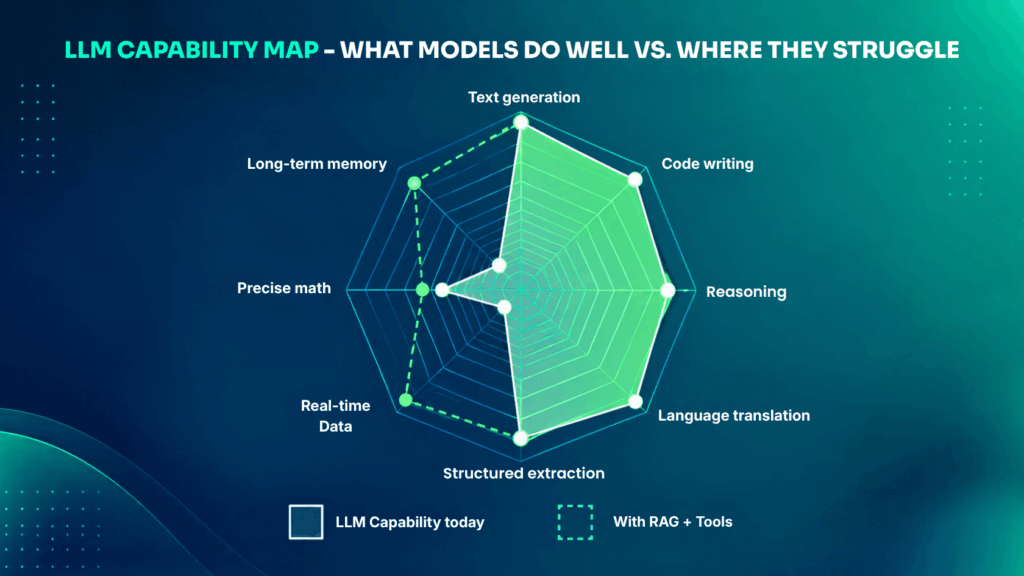
Why LLM Eval Matters Now
With custom LLM tools, copilots, and agents are becoming part of real workflows every day. But as usage grows, so do the risks — inconsistent outputs, hallucinations, broken prompts, and no clear way to measure quality. That is why the need for a reference point has become urgent. The problem we see is simple: LLMs are powerful, but they are not naturally predictable. The same prompt can produce different answers, prompt changes can shift behavior, and a model that looks strong in a demo can fail in real use. Without a standard way to evaluate quality, teams are left guessing whether they are actually improving or just seeing different output. That gap becomes even more serious as teams move from experimentation to production. Once an AI system is used for support, search, drafting, decision-making, or agent workflows, a weak output is no longer a harmless mistake. It can affect customers, slow teams down, and damage trust in the product.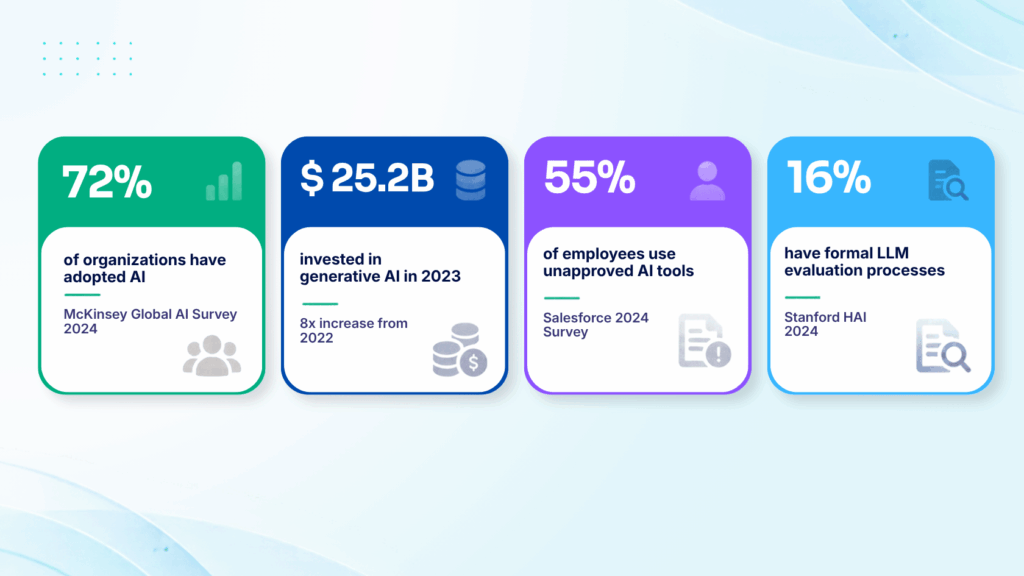
The Growth Problem
The rise of custom LLM tools is creating a new problem: usage is outpacing measurement. Enterprises are investing in AI systems, model experimentation, and custom workflows, but the discipline around evaluation is still catching up. Because teams are realizing they need a better way to measure outcomes. That matters because custom AI is not just one model call anymore. It often includes prompts, retrieval, tools, routing logic, agent loops, and guardrails. Each layer adds complexity, and each layer can fail differently. If the system is changing every week, a one-time test is not enough. Teams need something repeatable that can tell them whether quality is improving or drifting. This is where most teams feel the pain first:- Output quality varies from one run to the next.
- Prompts that work today can fail after a small edit.
- A better-looking answer is not always a better answer.
- Multiple models can behave differently on the same task.
- Agents can take the wrong step even when the final answer looks fine.
What Teams Are Struggling With
Teams building custom LLM tools are not just asking, “Did it work?” They are asking deeper questions:- Is the output correct?
- Is it consistent?
- Does it stay safe on edge cases?
- Does it behave the same after a prompt or model change?
- Can we trust it at scale?
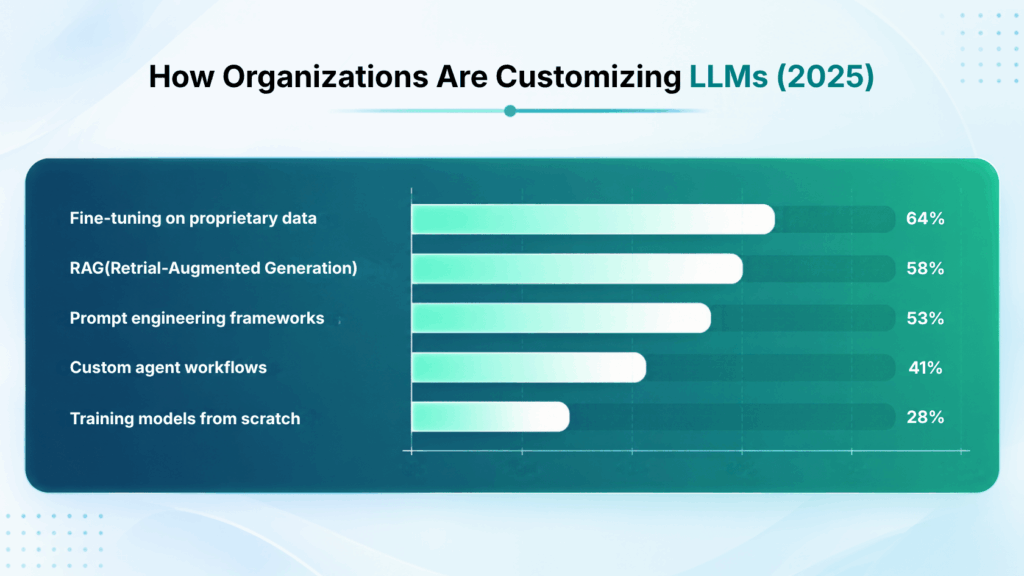 The biggest problem is that AI output is not binary. Traditional software testing often checks whether something passes or fails. LLM systems are fuzzier. They can be partially right, confidently wrong, overly verbose, too vague, or inconsistent across runs. That makes evaluation less about one perfect answer and more about a structured way to compare quality over time.
That is also why model comparison alone is not enough. A team may switch models and see better output in one area, but worse behavior somewhere else. Without evaluation, that trade-off is invisible. With evaluation, it becomes measurable.
The biggest problem is that AI output is not binary. Traditional software testing often checks whether something passes or fails. LLM systems are fuzzier. They can be partially right, confidently wrong, overly verbose, too vague, or inconsistent across runs. That makes evaluation less about one perfect answer and more about a structured way to compare quality over time.
That is also why model comparison alone is not enough. A team may switch models and see better output in one area, but worse behavior somewhere else. Without evaluation, that trade-off is invisible. With evaluation, it becomes measurable.
Real-World Failures: What Happens Without Evaluation
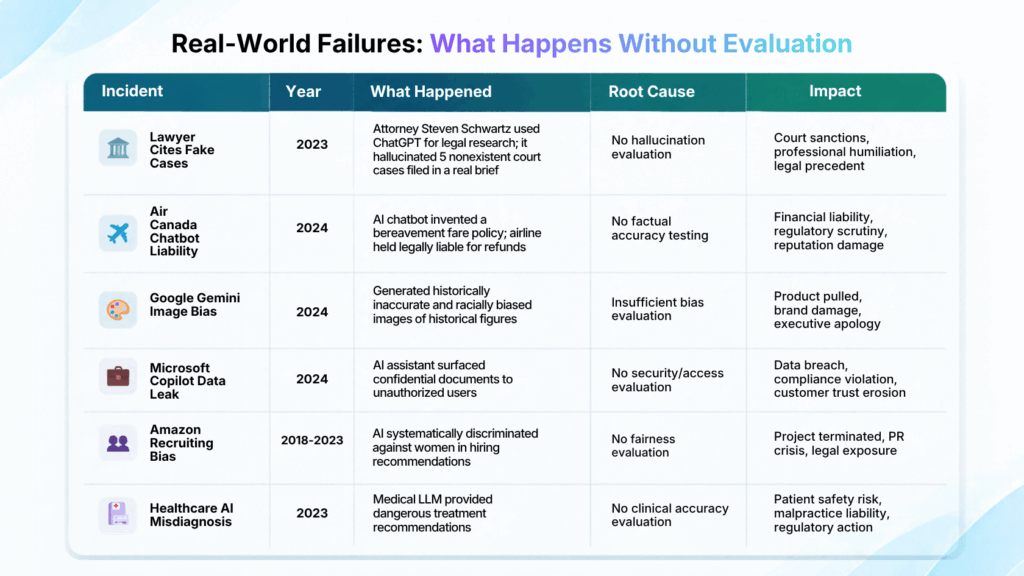
Expert Perspective
“In aviation, we don’t let a plane fly without rigorous testing. In pharmaceuticals, no drug reaches patients without clinical trials. Yet we’re deploying AI systems that influence millions of decisions daily with virtually no standardized evaluation.” — Dr. Percy Liang, Director, Stanford Center for Research on Foundation Models (CRFM)Why a Reference Point Is Needed
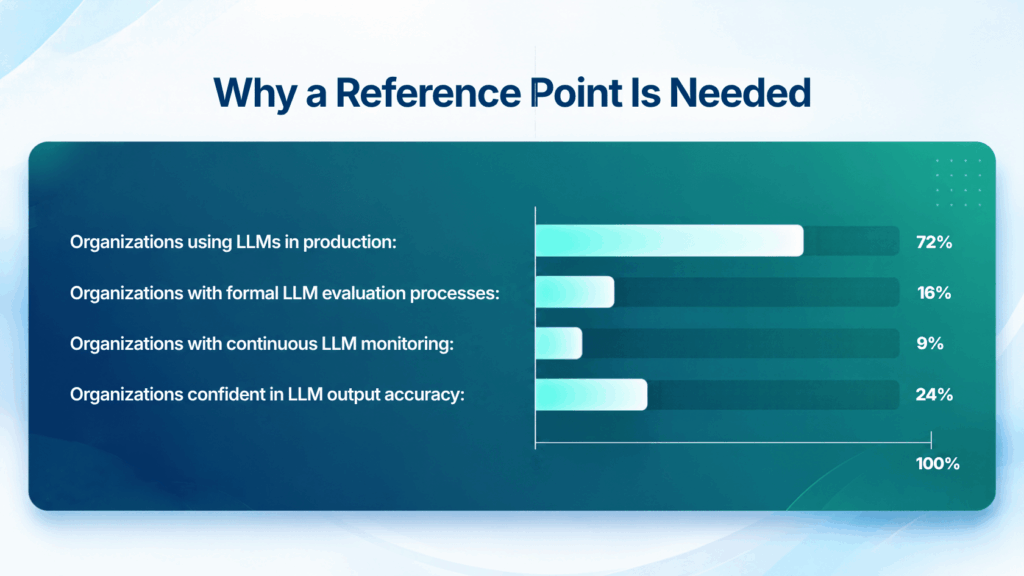 Sources: Stanford HAI 2024, MIT Sloan Management Review, Gartner
The industry needs a standard way to answer one question: Is this AI system actually getting better?
That is what evaluation metrics provide. They create a baseline that teams can return to whenever they change a prompt, swap a model, add retrieval, or release a new version.
A good evaluation metric acts like a compass. It does not just tell you whether a single answer looks decent. It tells you whether the system is moving in the right direction. That matters for quality, but it also matters for speed. When teams know how to measure improvement, they can move faster with less fear.
Evaluation also helps teams compare across the things that matter most:
Sources: Stanford HAI 2024, MIT Sloan Management Review, Gartner
The industry needs a standard way to answer one question: Is this AI system actually getting better?
That is what evaluation metrics provide. They create a baseline that teams can return to whenever they change a prompt, swap a model, add retrieval, or release a new version.
A good evaluation metric acts like a compass. It does not just tell you whether a single answer looks decent. It tells you whether the system is moving in the right direction. That matters for quality, but it also matters for speed. When teams know how to measure improvement, they can move faster with less fear.
Evaluation also helps teams compare across the things that matter most:
- Accuracy.
- Consistency.
- Safety.
- Retrieval quality.
- Tool use.
- Helpfulness.
- Resistance to hallucination.
- Unknown hallucination rates
- Undetected bias and discrimination
- Security vulnerabilities
- Regulatory non-compliance
- Reactive incident response
- Brand and trust damage
- Quantified accuracy and reliability
- Proactive bias mitigation
- Security assurance
- Regulatory compliance
- Preventive quality control
- Stakeholder confidence
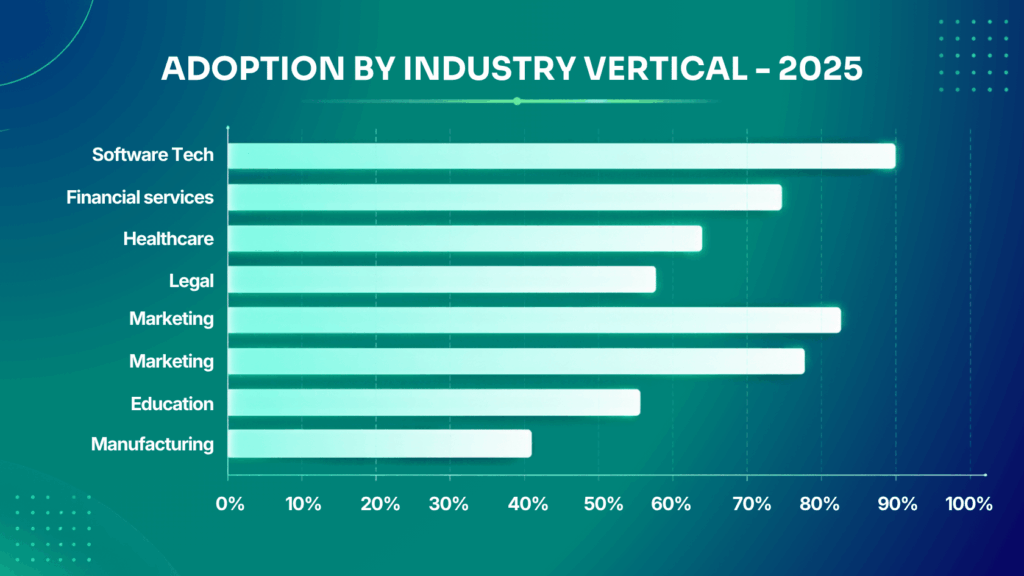
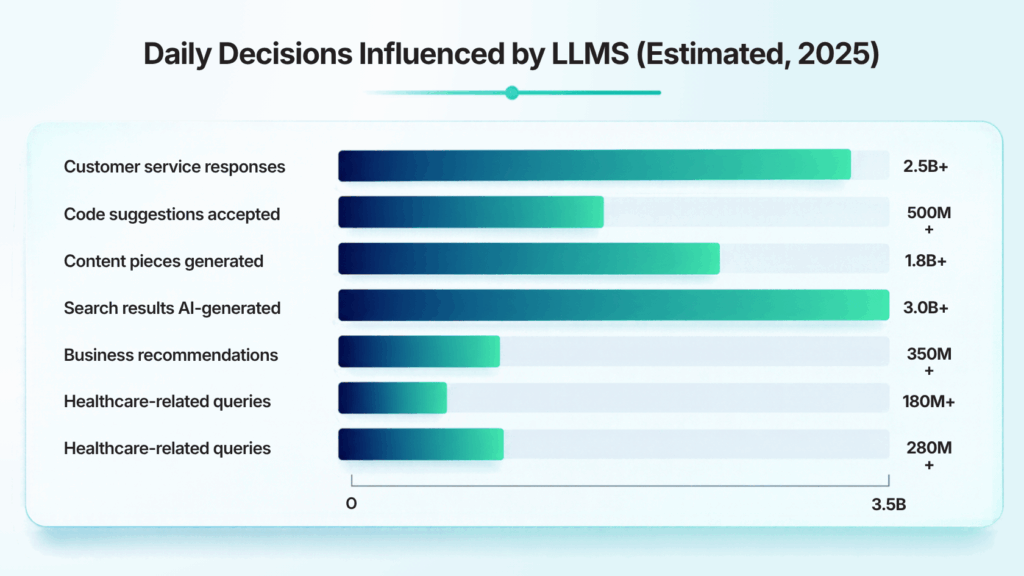 Source: Estimated from Statista, SimilarWeb, GitHub, Google data (2025)
If LLMs handle 3 billion decisions per day with just a 1% error rate, that’s 30 million failures daily. Over a year: 10.9 billion errors. Without evaluation, you don’t even know which 1%.
Source: Estimated from Statista, SimilarWeb, GitHub, Google data (2025)
If LLMs handle 3 billion decisions per day with just a 1% error rate, that’s 30 million failures daily. Over a year: 10.9 billion errors. Without evaluation, you don’t even know which 1%.
LLM Evaluation — How It Works & The QyrusAI Method
LLM evaluation is the practice of systematically measuring how well an LLM-powered system performs its intended function. As AI moves into production, evaluation is not optional quality assurance — it is the foundational engineering infrastructure that separates teams that improve their models from teams that just guess.What an LLM evaluator actually does
An LLM evaluator takes a test case — a prompt, the LLM’s response, and optional reference material — and scores it across one or more dimensions: accuracy, relevance, faithfulness, safety, coherence, goal completion. It can be a deterministic code check, an LLM-as-judge, a human reviewer, or a hybrid. The output is a score and a reason — structured signal that tells you exactly what to fix. QyrusAI connects to your live LLM API endpoints, fires your test cases, scores each output using your chosen evaluator model, and returns pass/fail results with detailed per-dimension scoring. You pay credits per test execution. No infrastructure to stand up. No dedicated ML platform team required.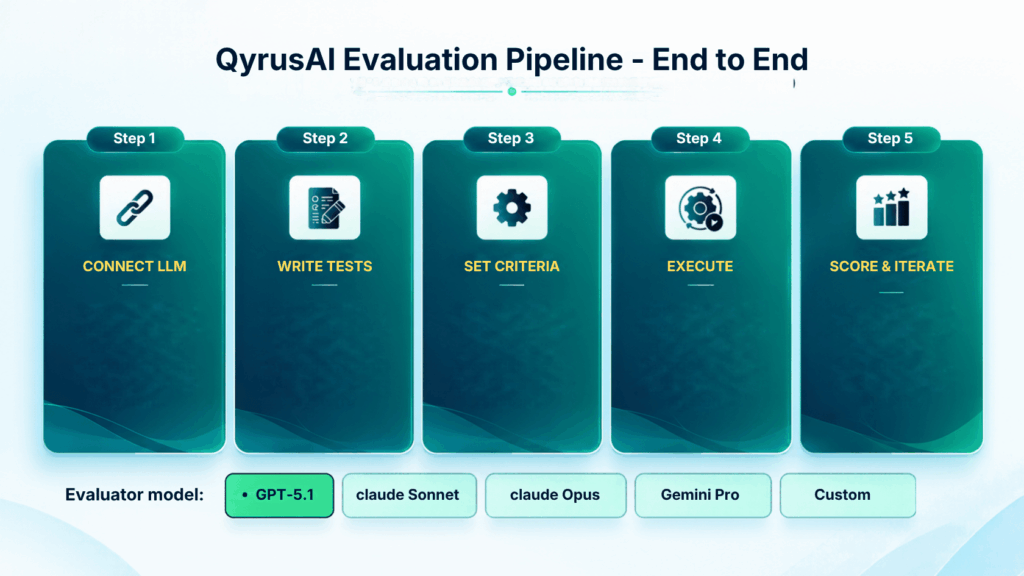
LLM Evaluation Best Practices — 8-Point Checklist
These are the practices that separate teams running reliable AI in production from teams constantly firefighting model regressions. Apply them in order — each builds on the last.- Define evaluation criteria before you write a single prompt
- Know what “good” looks like before you build. What accuracy threshold is acceptable? What tone must be maintained? What topics must be avoided? Teams that define criteria after the fact spend weeks retrofitting. Teams that define criteria first ship 3x faster.
- Test hallucination rate as a first-class metric
- Hallucination rate should be tracked on every deployment like latency or uptime. Build a test suite of prompts specifically designed to probe the model’s weak spots — topics where training data is sparse, numerical claims, citations. Measure the rate. Set a threshold. Alert when it crosses it.
- Use multiple evaluator types — never rely on one
- Code-based checks for structured outputs. LLM-as-judge for open-ended quality. Human review for high-stakes edge cases. Each catches different failure modes. A pipeline with only one evaluator type will have systematic blind spots.
- Run regression tests on every model update
- Model providers push silent updates. A prompt that worked perfectly on GPT-4-turbo-2024-04-09 may behave differently on the next version. Every deployment update — model version, system prompt, context window change — must run your full benchmark suite before going live.
- Evaluate RAG retrieval and generation separately
- If your RAG pipeline is underperforming, you need to know whether the problem is in retrieval (wrong documents fetched) or generation (model fails to use good documents). Treating them as a single system makes debugging nearly impossible. Evaluate each component with its own metrics.
- For agents: evaluate trajectories, not just final outputs
- An agent that reaches the correct answer via a flawed path is not a passing agent. It means your system got lucky. Evaluate every tool call, every intermediate decision, every handoff. Build automated checks for: correct tool selected, correct parameters passed, appropriate fallback triggered on failure.
- Monitor production continuously — not just pre-deployment
- Pre-deployment testing catches regressions from changes you made. Production monitoring catches degradation from changes the world made — new query patterns, seasonal topics, data drift. A model that passed all pre-deployment tests can still degrade silently in production over weeks.
- Feed evaluation results back into your improvement loop
- Every failed eval is a training signal. Every user complaint that triggers a human review queue is data. The teams compounding improvements fastest are those who convert evaluation results directly into prompt improvements, fine-tuning datasets, or retrieval configuration changes — within days, not quarters.
 October 7, 2026
  23 min