[MODERNIZE] + [ASSURE] + [OPERATE]
One Qyrus. Three AI businesses. One continuous system.
Agentic AI has made modernization, quality engineering, and application operations one continuous system — not three separate platforms that occasionally hand off to each other. QyrusAI is built on a shared Knowledge Graph, a shared orchestration layer (SEER), and a shared evidence store (Qhive)
BEFORE:
Three teams. Three tools. Three separate views of the same system.
AFTER:
One enterprise reality. Every action by one agent is context for the next.
Problem Stack
Three separate problems. Or one connected system failure
When modernization, testing, and operations function in silos, individual project successes often mask deep systemic vulnerabilities. True enterprise resilience requires tearing down these walls so every team and AI agent shares a single, unified reality.
Transformation projects that succeed in isolation —
and fail at integration because nobody mapped what connected to what across the whole estate
Test suites that prove what was built —
but never know what production has already broken
Operations teams that remediate incidents —
but never send the knowledge back to quality or to modernization
An AI agent for testing, an AI agent for monitoring, an AI agent for modernization —
none of which share context, evidence, or memory
Governance that is bolted on as a compliance exercise —
not built into every action every agent takes
Release pipelines that gate on "all tests pass" —
without knowing whether those tests still reflect what production actually runs
Modernization roadmaps planned in a boardroom —
not updated by the signals the production estate emits daily
THE RESOLUTION
QyrusAI makes modernization, quality, and operations one connected decision system — where every action enriches context, every decision cites evidence, and authority rises only when policy and approval allow.
One agentic platform that never stops learning.
Fragmented toolchains turn every handoff into a delay and every production incident into a multi-team investigation. By unifying transformation, quality, and operations into a single learning platform, context flows automatically across every stage of the lifecycle.
Before
Legacy Code
- Modernization team runs a discovery tool
- QA runs a separate test automation platform
- Operations runs a monitoring platform that knows nothing about what was modernized last month or what tests were run last week
- Every handoff is a conversation. Every conversation is a delay.
- When a production incident happens, three teams meet to share context that should have been shared automatically
- Knowledge locked in individuals, not systems
AFTER
Regression Code Base
- Modernize maps the estate and transforms it
- Every production incident enters Qhive
- Every test result is in the Knowledge Graph
- Governance is not a separate process
- Full dependency visibility before any change
- One dashboard shows: what is being transformed, what is being tested
Customer Journey Rail — In Practice
Modernizing mission-critical architecture requires absolute precision and zero tolerance for downtime.
CIO can: See transformation progress, test coverage, and production health in one real-time view
- Enterprise Architect can:Map every dependency before any modernization slice touches production
- QA Lead can: Prove every modernized slice against the same business processes the legacy system ran — with equivalence evidence
- SRE / Ops Lead can: Monitor the modernized platform from day one with a pre-built failure model
- Risk / Compliance can: Access a single audit record covering transformation, testing, deployment, and production events
Qyrus Ai Engine
A global bank is modernizing its core banking platform from a 25-year-old legacy system to a cloud-native architecture. 300 business processes. Regulatory scrutiny. Zero tolerance for production incidents during transition.
Modernize
UNDERSTAND
Estate X-Ray maps 300 business processes, all dependencies, blast-radius for every change
Modernize
CHANGE
One business process slice at a time; optimal conversion sequence; governance at every decision point
ASSURE
PROVE
SEER generates equivalence tests for the modernized slice; SAP-native testing where applicable; evidence stored in Qhive
ASSURE + OPERATE
DEPLOY
Evidence from Assure gates the production promotion; Operate health-checks all downstream dependencies
OPERATE
RUN
AIOps monitors the modernized process; self-healing handles known patterns; any production failure flows back to UNDERSTAND
THE UNLOCK: When all three pillars run on one intelligence layer, every stage of the lifecycle improves the next. The system learns continuously — not just from what was planned, but from what actually happened in production.
Joint Capabilities
One platform. Six layers. Three purposes. Zero handoff gaps.
Enterprise agility isn’t achieved by chaining together disconnected tools; it requires a single, unified intelligence layer

Estate X-Ray — live, continuously-updated map of every system, dependency, and technical debt signal
Blast-radius scoring — before any change, the full cascade impact is known
Prioritization intelligence — operational cost + technical risk + business value → next modernization target
Phase Zero governance — transformation scoped, owned, and measured before it starts
Transformation record — every change logged in Qhive with full context, available to Assure and Operate
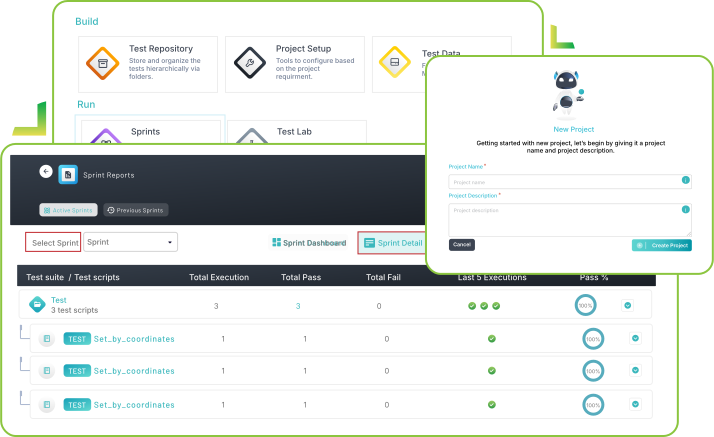
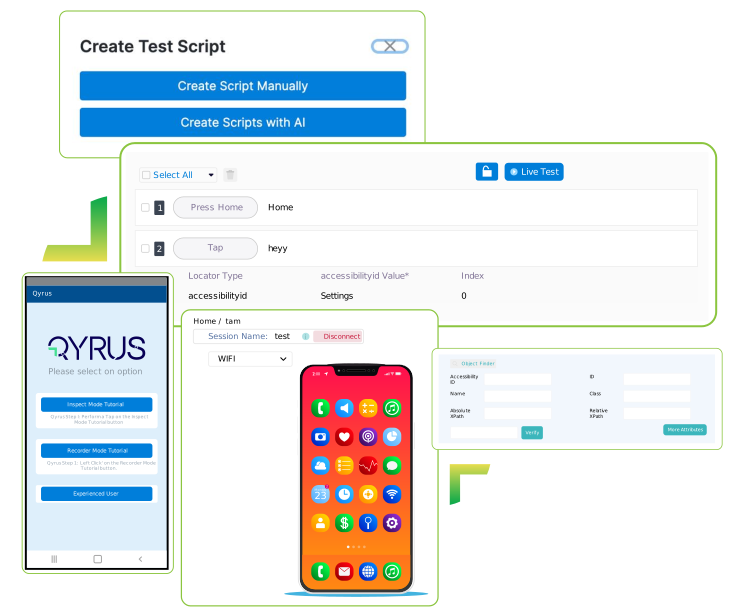
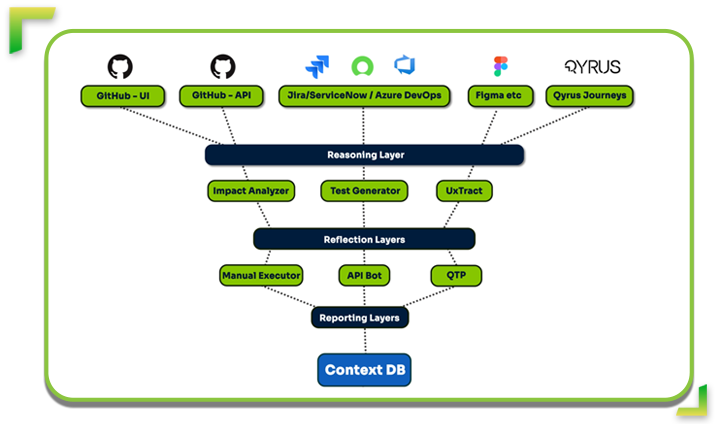
SEER orchestration — Sense → Evaluate → Execute → Report; plans and runs tests with full estate context
Equivalence proof — modernized system tested against the same business processes as the system it replaced
Release evidence — structured, queryable test record that gates every deployment
Incident → Test bridge — production failures from Operate generate permanent SEER test cases
SAP-native testing — blast-radius-aware testing for SAP transports, Z-objects, and IDoc chains
Production intelligence — real-time incident, cost, and health data per system; feeds Modernize priority engine
Deployment gate — release evidence from Assure is checked; dependency health is checked; only then does production promotion proceed
Self-healing — governed remediation within policy; known failure patterns handled autonomously where authorized
Post-modernization monitoring — baseline auto-configured from the transformation knowledge record
Governance layer — Level 0-3 autonomy model; every agent action is bounded by policy, auditable, reversible
Knowledge Graph — what exists, how it connects; applications, code, APIs, data, owners, tests, dependencies
Qhive — what happened and what was learned; executions, incidents, traces, outcomes, remediation evidence
SEER orchestration contract — how work is coordinated across all three pillars, with one typed capability model
Trust + Governance — policy, permissions, confidence, approvals, and audit; bounds autonomy at every layer
COMBINED FEATURES
Two disciplines. One outcome.
Neither pillar can do this alone. Modernize knows what the code is. Assure knows how to test it. Together, they convert legacy architecture into verified, continuously-tested codeless suites — without breaking anything along the way.
MODERNIZE
Continuous Application Discovery
Lorem Ipsum Dolor Sit Amet Lorem Ipsum Dolor
Dependency Mapping
Lorem Ipsum Dolor Sit Amet Lorem Ipsum Dolor
Code Analysis and Architecture Modeling
Lorem Ipsum Dolor Sit Amet Lorem Ipsum Dolor
Optimal Conversion Path Intelligence
Lorem Ipsum Dolor Sit Amet Lorem Ipsum Dolor
Technical Debt Scoring
Lorem Ipsum Dolor Sit Amet Lorem Ipsum Dolor
ASSURE
AI-Powered Test Generation
Lorem Ipsum Dolor Sit Amet Lorem Ipsum Dolor
Codeless Conversion of Selenium
Lorem Ipsum Dolor Sit Amet Lorem Ipsum Dolor
Self-Healing Test Scripts (Healer AI)
Lorem Ipsum Dolor Sit Amet Lorem Ipsum Dolor
SEER Orchestration Framework
Lorem Ipsum Dolor Sit Amet Lorem Ipsum Dolor
Test Evidence Trail for compliance
Lorem Ipsum Dolor Sit Amet Lorem Ipsum Dolor
A GLIMPSE ON THE NUMBERS
Enable Faster, More Reliable, and Cost-Efficient Retail Operations.
Maximize uptime, optimize infrastructure spend, and protect revenue during high-stakes shopping events. Explore how continuous quality and AI-driven operations deliver measurable performance gains across every omnichannel touchpoint.
Reduction in customer-impacting incidents at peak
Improvement in issue resolution time, omnichannel
Optimization in SaaS/cloud spend across teams
Faster root cause identification, retail systems
Continuous testing. Continuous learning. Continuous value.
Join leading enterprises
driving the loop forward.
Resources
Explore our curated library of expert blog posts, in-depth whitepapers, and real-world case studies, designed to help you stay ahead in the world of AI-driven application lifecycle management.
September 9, 2026 |
12 min
Why SAP Testing Breaks at Scale: The Hidden Cost of Brittle Automation
Read More
September 7, 2026 |
11 min
SAP ECC End of Life 2027: What CIOs Need to Know Before the Clock Runs Out
Read MoreSeptember 4, 2026 |
14 min
How to Write Effective Test Scripts: A Straightforward Guide
Read More
August 13, 2026 |
2 min
Qyrus Named in Gartner’s Market Overview for API and MCP Testing Tools
Read More
August 13, 2026 |
2 min
Qyrus Named in Gartner’s Market Overview for API and MCP Testing Tools
Read More
Blog
September 9, 2026 |
12 min
Why SAP Testing Breaks at Scale: The Hidden Cost of Brittle Automation
Read More
September 7, 2026 |
11 min
SAP ECC End of Life 2027: What CIOs Need to Know Before the Clock Runs Out
Read MoreSeptember 4, 2026 |
14 min
How to Write Effective Test Scripts: A Straightforward Guide
Read MoreCase Study
Events
Reports
August 13, 2026 |
2 min
Qyrus Named in Gartner’s Market Overview for API and MCP Testing Tools
Read More
Whitepaper
August 13, 2026 |
2 min
Qyrus Named in Gartner’s Market Overview for API and MCP Testing Tools
Read More
FREQUENTLY ASKED QUESTIONS
Common questions about the Full Loop.
Whether you are planning a phased rollout or addressing CISO concerns about AI autonomy, we have the blueprints ready. Explore how our single intelligence layer replaces fragmented integrations with built-in security, shared evidence, and scalable governance.
Do we need to deploy all three pillars at once, or can we start with one?
Start with one. Every pillar delivers standalone value. The Full Loop activates as each additional pillar is added. Most customers start with Assure (fastest time to value, most immediate business case) or Modernize (transformation agenda with board sponsorship). Operate is typically added once the first pillar is delivering. The platform is designed for this: shared capabilities are available from day one; they serve more pillars as they are activated.
The pitch says "one Knowledge Graph." But our estate spans SAP, Salesforce, Workday, and 40 custom applications. Can one Knowledge Graph actually hold all of that?
Yes — and this is specifically the architectural intent. The Knowledge Graph ingests from Estate X-Ray (Modernize), from SEER execution evidence (Assure), and from AIOps production signals (Operate). SAP, Salesforce, Workday, ServiceNow, and custom systems all have connectors. The graph holds the relationship and context model — what connects to what, what changed, what was tested, what broke. The richer the estate, the more valuable the graph.
How is this different from connecting three best-of-breed tools with an integration layer?
Three meaningful differences: (1) Shared SEER orchestration — one orchestration contract across all three pillars; test, transformation, and run cards are all first-class SEER typed outputs composable without an integration project; (2) Shared Qhive evidence — a test outcome is available to Operate as deployment gate evidence and to Modernize as priority signal immediately, not after an API sync; (3) Shared Trust + Governance — one policy layer governs every agent across all three pillars; you do not manage three separate governance frameworks.
We have a CISO who will ask about agents acting autonomously in production. How is that governed?
Three meaningful differences: (1) Shared SEER orchestration — one orchestration contract across all three pillars; test, transformation, and run cards are all first-class SEER typed outputs composable without an integration project; (2) Shared Qhive evidence — a test outcome is available to Operate as deployment gate evidence and to Modernize as priority signal immediately, not after an API sync; (3) Shared Trust + Governance — one policy layer governs every agent across all three pillars; you do not manage three separate governance frameworks.
What is the commercial model — one contract or three?
One orchestration contract covering all three pillars, with subscription and policy determining which capabilities are visible and active. The platform is designed for one commercial relationship; distinct licensing per pillar is preserved for customers who need it, but the default is one agreement. Ask your solutions architect for the current commercial structure.
• STAY AHEAD, STAY IN THE LOOP.