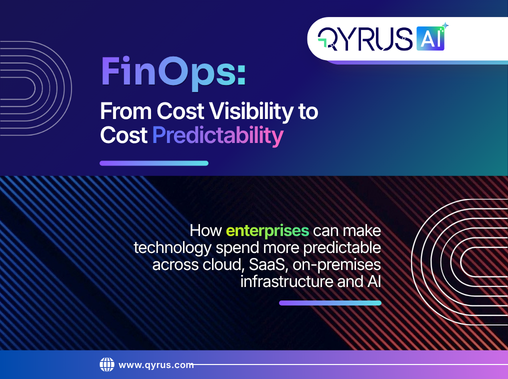
Technology spend is no longer predictable by looking at last month’s bill. Cloud, SaaS, on-premises infrastructure, and AI workloads now move too quickly, consume too differently, and depend on too many disconnected systems for traditional FinOps reporting to keep up.
This whitepaper explains why enterprises must move beyond visibility and build an architecture for cost predictability — one that connects billing data with telemetry, attribution, dependency context, AI usage signals, and decision intelligence.
Why Cost Visibility Should Be Your Priority
Most enterprises can see what they spent. Far fewer can explain why spend changed, which teams or applications drove the increase, or what will happen before the next invoice arrives.
The gap is not just a tooling issue. It is a data architecture issue. Predictable technology spend requires more than dashboards. It requires a connected model that understands usage, ownership, dependencies, utilization, AI token economics, and planned engineering change.
98%
of FinOps practitioners now manage AI spend.
90%
manage SaaS spend as FinOps expands beyond cloud.
29%
estimated IaaS/PaaS waste in 2026, driven by growing workload complexity.
What You’ll Learn in This Whitepaper
- Why historical cost forecasting fails in dynamic cloud, SaaS, hybrid, and AI environments
- How AI workloads introduce new attribution challenges through tokens, agents, retries, reasoning steps, and shared API usage
- The five root causes of technology cost unpredictability
- Why billing data alone cannot support finance-grade forecasting
- How QyrusAI combines cost data, telemetry, attribution, dependency mapping, and AI intelligence into a cost predictability architecture
- How enterprises can detect anomalies, explain cost drivers, and take action before spend becomes a month-end surprise
Built for Leaders Who Need Predictable Technology Spend
This whitepaper is designed for CTOs, CIOs, FinOps leaders, cloud leaders, engineering executives, finance stakeholders, and technology operations teams responsible for governing spend across modern, multi-source technology estates.
How QyrusAI Helps Enterprises Move from Visibility to Predictability
QyrusAI helps enterprises unify technology cost data across cloud, SaaS, on-premises infrastructure, licenses, and AI providers. By enriching billing data with telemetry, utilization signals, dependency maps, and AI usage instrumentation, QyrusAI turns cost reporting into cost intelligence.
- Unified cost data: Normalize spend across cloud, SaaS, AI providers, software licensing, and on-premises infrastructure.
- Telemetry-enriched attribution: Connect cost to real usage, resource efficiency, application behavior, and ownership.
- AI-powered forecasting: Forecast spend at enterprise, business unit, application, service, and resource levels.
- Anomaly intelligence: Detect cost deviations, identify root causes, route them to the right owners, and recommend actions.
- AI cost attribution: Track token, model, feature, agent, retrieval, and retry-level consumption to understand AI unit economics.
- Change impact simulation: Understand the financial effect of infrastructure, workload, and AI architecture changes before they happen.
Explore QyrusAI for FinOps
Learn how enterprises can build a cost predictability architecture for the AI era — and how to give Finance and Engineering a shared, actionable view of what spend is doing, why it is changing, and what can be done before the cost occurs.