The Blind Spot of Observability: Why IT Visibility Without Business Context Fails
 Dona Zacharias
The Comfort of Seeing Everything
Over the years, IT teams have made real progress. There was a time when visibility itself was the problem. Systems were opaque, issues were discovered late, and teams operated with limited awareness.
That’s no longer the case. Today, most enterprises have dashboards, alerts, metrics, and monitoring tools that provide a constant stream of information. On the surface, it feels like control. You can see everything—or at least, it seems that way.
When Something Breaks, the Real Question Emerges
And then something goes wrong:
- A system slows down.
- An API starts failing.
- A service becomes unavailable.
Alerts are triggered instantly and teams jump into action; but within minutes, the conversation shifts. Not toward the system—but toward the business, and the questions that begin to emerge are:
- Is this affecting customers?
- Are transactions failing?
- How critical is this right now?
- What is the business impact?
And that’s where things become less clear, because while the system issue is visible, the business impact is not.
The Gap Between Signals and Meaning
This is the gap most organizations don’t explicitly talk about. They have signals, data, and visibility, but they lack meaning due to lack of context.
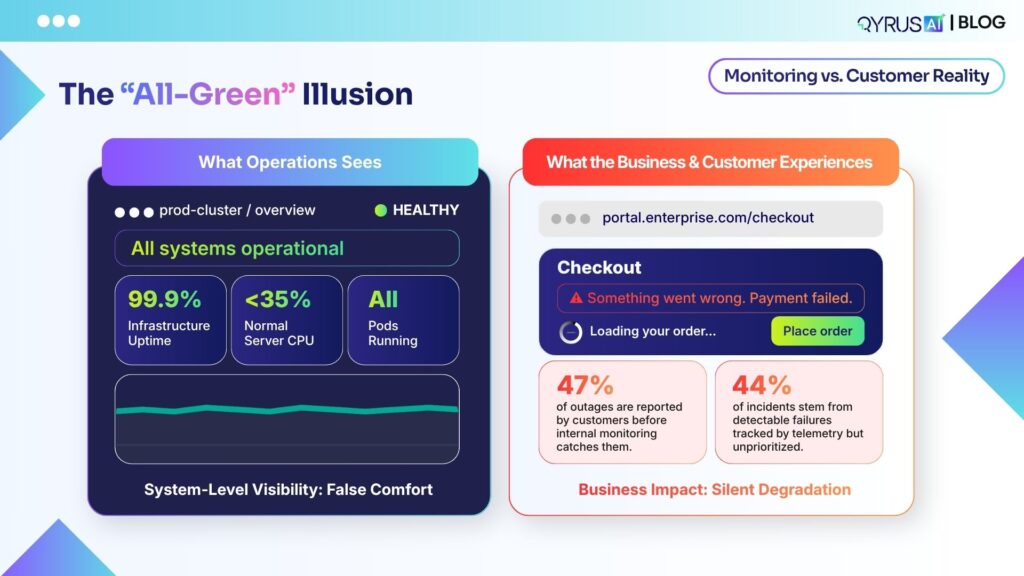
An alert might tell you that something is wrong with a service. It rarely tells you what that service means to the business. In fact, research shows that 44% of IT incidents stem from detectable failures—technical issues that telemetry actively tracked, but teams failed to interpret or prioritize in time.
Worse yet, 47% of outages are reported by customers before internal monitoring catches them. When dashboards flash green while users struggle to check out or log in, teams are left to interpret, correlate, and guess under pressure. And in that time, critical decisions are delayed.
Why More Data Doesn’t Solve the Problem
The instinctive response to this gap is usually the same:
- Add more data.
- Add more tools.
- Add more dashboards.
But the problem isn’t the absence of data. It’s the absence of connection. Modern IT environments are not just collections of systems; they are complex networks of dependencies.
A single business workflow may span multiple applications, microservices, cloud infrastructure, and third-party APIs. Unless those relationships are dynamically understood, no amount of raw data can provide operational clarity.
When Everything Looks Important, Nothing Is Prioritized
Without business context, every alert feels urgent and every issue looks critical. Every team believes their technical problem should be addressed first, creating a subtle but dangerous dynamic.
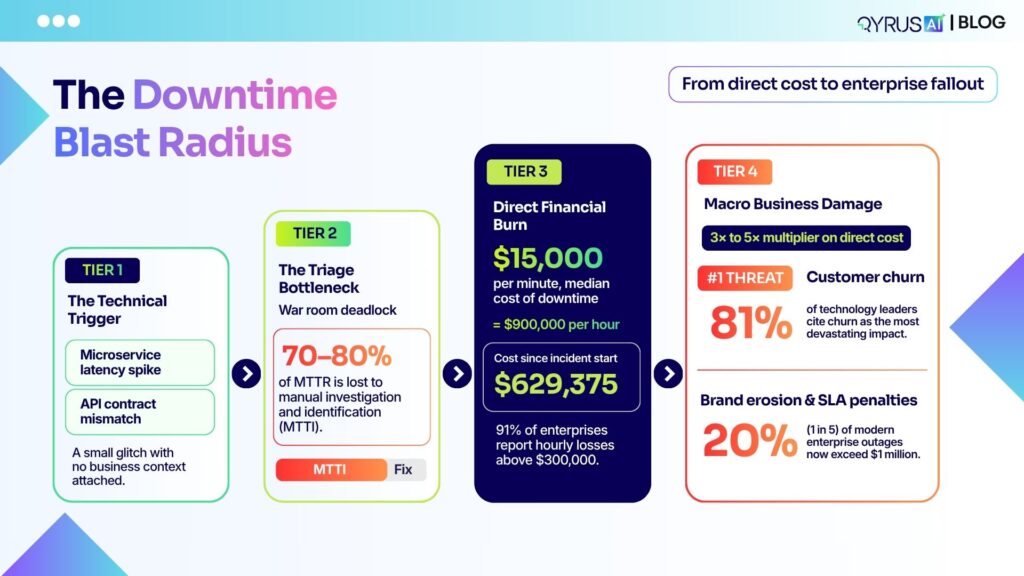
Efforts are spread thin, focus is diluted, and issues that truly move the needle sometimes wait longer than they should. Because teams lack a clear view of business dependencies, 70% to 80% of Mean Time to Resolution (MTTR) is consumed purely by investigation and Mean Time to Identify (MTTI)—manually hunting through logs, assembling war rooms, and figuring out which service broke what workflow.
The Cost of Misalignment
This isn’t just an operational inefficiency. It carries severe, measurable consequences:
- Critical business services remain impacted longer than necessary: The median cost of enterprise downtime has escalated to $15,000 per minute ($900,000 per hour), with 91% of enterprises reporting that a single hour of downtime costs over $300,000.
- Customer experience degrades without immediate visibility: The true fallout extends far beyond recovery costs. Organizations face 3x to 5x hidden costs, and 81% of technology leaders cite customer loss and churn as the most damaging consequence of an outage.
- Incident severity continues to rise: Even as component reliability improves, interconnected architectures mean that 1 in 5 organizations (20%) report their most recent major outage cost over $1 million.
- Trust slowly erodes along with enterprise value: When IT cannot clearly communicate business impact, cross-functional alignment fractures and leadership is left flying blind.
From Visibility to Understanding
The shift that organizations need is not from less visibility to more. What they need is to move from passive visibility to contextual understanding.
Understanding how systems support business services and how failures propagate across interdependent entities of a business process defines how effectively you respond. It transforms an ambiguous technical alert into an immediate understanding of what truly matters to the enterprise at any given moment.
Where QyrusAI Makes the Difference
QyrusAI bridges this exact gap. As an agentic platform designed to unify the enterprise application lifecycle, QyrusAI connects systems directly to business services, providing the missing layer of contextual intelligence.
At the center of this approach is QyrusAI’s Live Enterprise Knowledge Graph, which continuously discovers enterprise assets, maps dynamic dependencies, and binds technical telemetry directly to business workflows and transactions.
This continuous intelligence powers a connected lifecycle across three core pillars:
- Modernize: Uncovers application dependencies, illuminates technical debt, and rationalizes complex portfolios with live architectural context.
- Assure: Provides automated end-to-end testing across web, mobile, API, SAP, and data pipelines to validate changes before they reach production.
- Operate: Delivers full-spectrum BizOps, AIOps, FinOps, and automated incident response, connecting technical signals to customer journeys and business outcomes.
So when something happens, teams don’t just see an isolated alert. They understand it, they know what business service it affects, and they can prioritize and resolve it with complete confidence.
Frequently Asked Questions (FAQs)
Why is component-level visibility no longer enough for modern enterprise IT?
What is the difference between observability and Business Operations Intelligence (BizOps)?
How does QyrusAI prevent alert fatigue during high-severity incidents?
How does connecting IT to business context accelerate MTTR?
The Bottom Line
Visibility is no longer the differentiator. Most organizations already have it.
The real question is
Do you understand what you’re seeing?
Because that’s what separates mere awareness from true control.
Ready to move beyond dashboards and understand real business impact?
Discover how QyrusAI connects your systems to business outcomes—so your teams don’t just see issues, they understand what matters.
 October 16, 2026
  6 min
6 min