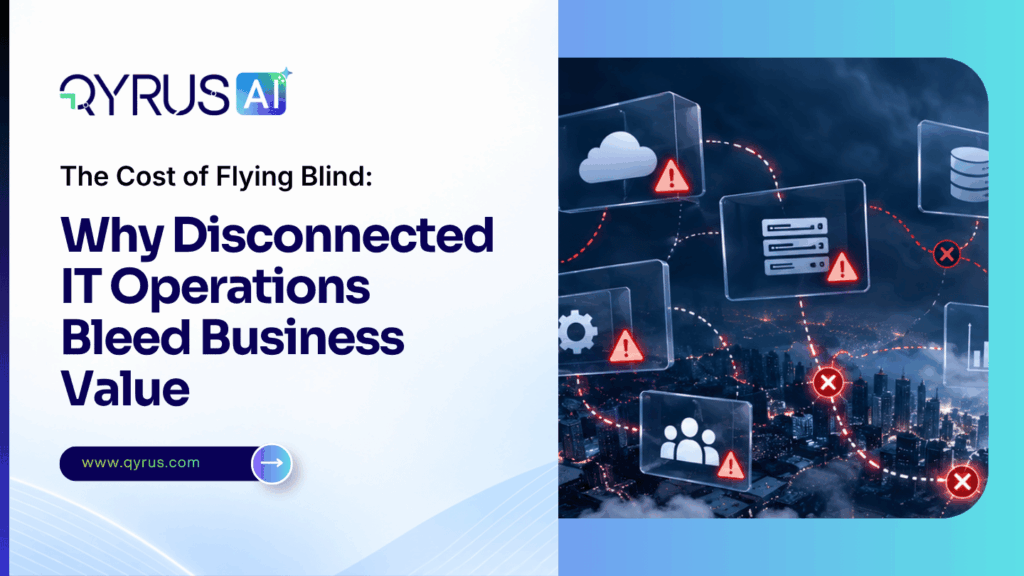
The Cost of Flying Blind: Why Disconnected IT Operations Bleed Business Value
 Varun RS
The Cost You Can Measure and the Cost You Can’t
Enterprises are very good at measuring certain things like:
- Infrastructure spend.
- Cloud usage.
- Licensing costs.
These numbers are visible, trackable, and often discussed. But there’s another category of cost that rarely appears clearly on any dashboard and that is the cost of not understanding business impact.
When an Incident Happens
Consider a typical incident. An application slows down, an alert is triggered and teams begin investigating.
But before anything else, there’s uncertainty.
- Is this affecting a critical service?
- Are customers impacted?
- Is revenue at risk?
And until these questions are answered, the response remains cautious. Or at worst misdirected.
The Cost of Delay
In many cases, the biggest cost is not the incident itself. It’s the time taken to understand its impact. Because during that time:
- Teams are aligning across functions
- Information is being gathered manually
- Decisions are being deferred
And all of this adds up, minutes turn into hours and the impact grows.
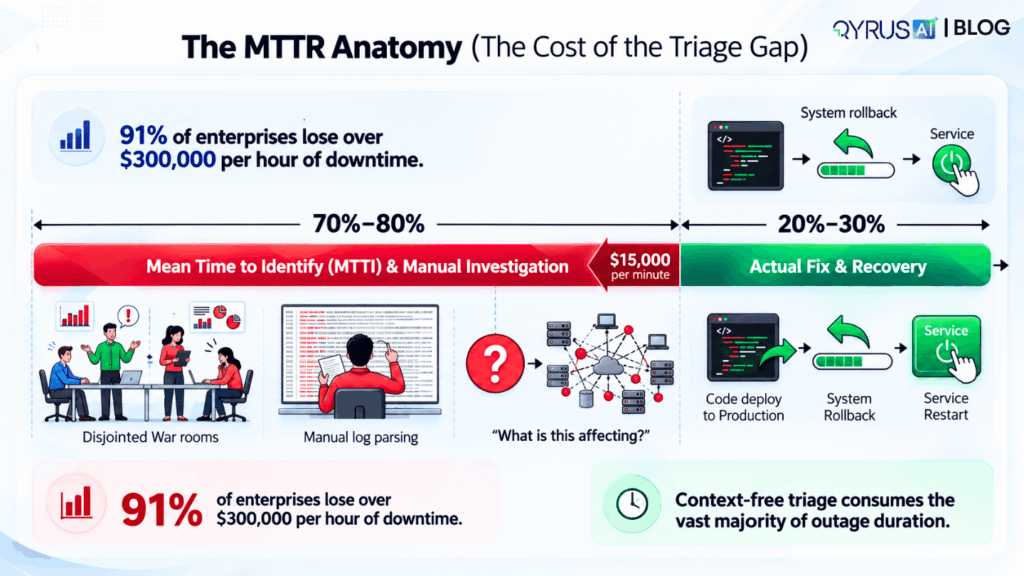
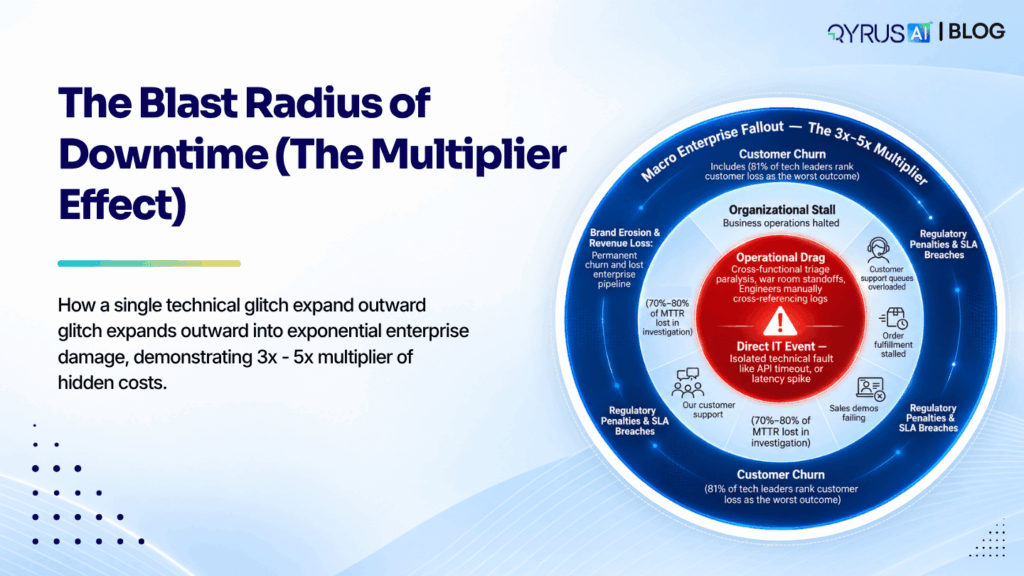
Industry benchmarks indicate that 70% to 80% of Mean Time to Resolution (MTTR) is spent solely on investigation and Mean Time to Identify (MTTI)—manually tracing dependencies, gathering logs, and determining what broke. When the median enterprise cost of downtime has climbed to approximately $15,000 per minute ($900,000 per hour), every minute spent searching for context in an active war room translates directly into catastrophic financial exposure. Furthermore, 91% of enterprises report that a single hour of IT downtime costs them more than $300,000.
When Effort Doesn’t Match Importance
Without clear business context, teams often fall into a common pattern. They respond to what is visible, not what is important. A technically complex issue may get immediate attention while a business-critical issue, if less visible, may take longer to surface. This misalignment is subtle but over time, it becomes expensive for the business.
Research reveals that 44% of IT incidents stem from detectable failures—technical issues that telemetry monitored, but teams failed to interpret or prioritize correctly in time. Worse yet, 47% of outages are reported by customers before internal monitoring catches them, exposing how traditional component alarms leave operational teams blind to real customer journeys and transactional bottlenecks.
The Ripple Effect Across the Organization
The lack of business impact visibility doesn’t just affect IT. It affects:
- Business teams waiting for updates
- Leadership trying to make decisions
- Customers experiencing disruptions
And because the impact is not clearly understood, communication becomes fragmented. Different teams operate with different assumptions. The result is an accelerated sense of chaos.
The true toll extends far beyond immediate remediation fees. Studies indicate that enterprises face 3x to 5x hidden costs—encompassing lost cross-departmental productivity, regulatory penalties, and brand equity damage. In fact, 81% of technology leaders cite customer loss and churn as the most damaging long-term consequence of operational downtime.
Why This Problem Persists
Most organizations do not intentionally ignore business impact. They simply lack a way to see it in real time. This is because systems and business services are not clearly connected. Without that connection, the true nature and quantum of impact has to be guessed and this is both often inaccurate and risky.
This blind spot is a primary driver behind why 1 in 5 organizations (20%) report that their most recent major outage exceeded $1 million in total losses. Across the Global 2000, unplanned downtime siphons an estimated $400 billion annually—not because telemetry was missing, but because isolated signals lacked structural and commercial context.
From Reaction to Clarity
The organizations that handle this well do something differently. They don’t wait to understand impact after an incident. They already know it. Because their systems are mapped to business services, the dependencies are visible and the context is always available. This helps to avoid decisions that come from inaccurate guesswork.
Where QyrusAI Fits In
QyrusAI enables this shift by connecting systems to business services and continuously mapping dependencies, allowing organizations to understand impact instantly.
As an agentic platform designed to unify the enterprise application lifecycle, QyrusAI grounds operational workflows across three core pillars:
- Modernize: Unpacks legacy architectures, illuminates hidden technical debt, and rationalizes application portfolios with comprehensive dependency context.
- Assure: Delivers continuous, automated testing across web, mobile, API, SAP, and data pipelines to catch defects long before code reaches production.
- Operate: Brings actionable operational intelligence across AIOps, observability, BizOps, and FinOps, directly correlating infrastructure alerts with customer journeys and business outcomes.
At the core of the platform is QyrusAI’s Live Enterprise Knowledge Graph, which maintains a continuously observed, real-time model of applications, integrations, and business processes.
So instead of asking:
“What does this affect?”
Teams already know. And instead of delaying decisions, they act immediately with clarity.
Frequently Asked Questions (FAQs)
- What is the hidden cost of IT downtime?
The hidden cost refers to secondary and long-term damages—such as lost employee productivity, brand erosion, missed sales opportunities, regulatory penalties, and customer churn. Research shows these indirect damages are typically 3x to 5x higher than the immediate direct costs of system recovery.
- Why does traditional IT monitoring fail to identify business impact?
Traditional monitoring tracks component-level telemetry (CPU, memory, server uptime, network packets) in isolation. It cannot determine whether a 500ms database delay affects a non-critical background task or halts an active checkout flow for high-tier enterprise clients.
- How does QyrusAI establish real-time business context?
QyrusAI utilizes its Live Enterprise Knowledge Graph to continuously discover assets, map dynamic dependencies, and bind technical telemetry directly to business services, workflows, and KPIs. This ensures teams see the commercial blast radius of any incident in real time.
- How does understanding business impact reduce Mean Time to Resolution (MTTR)?
Because 70% to 80% of MTTR is typically spent on investigation (MTTI), providing immediate topological and business context eliminates the guesswork. Teams instantly know which service is broken, which business workflow is impacted, and who needs to remediate it.
The Bottom Line
The cost of not understanding business impact is not always visible, it shows up in:
- Delayed responses
- Misaligned priorities
- Increased disruption
The real question to ask here is:
How much is uncertainty costing you today?
Still reacting before understanding impact?
See how QyrusAI helps you identify, prioritize, and act on what truly matters to your business in real time.
 October 14, 2026
  5 min
5 min