 Varun RS
There’s a common assumption in enterprise AI: if you have enough data, AI will work.
But in reality, that’s rarely the case.
The Missing Ingredient Isn’t Data
Most organizations today have:
- Vast amounts of data
- Modern data platforms
- Advanced AI tools
And yet, many enterprise AI initiatives fail to deliver expected business outcomes.
Why?
Because data without context is not intelligence.
The Problem with Disconnected Data
Enterprise data is spread across:
- Applications
- Infrastructure
- Cloud platforms
- Business systems
Each dataset exists in isolation, and while data may be accurate, its meaning is often incomplete.
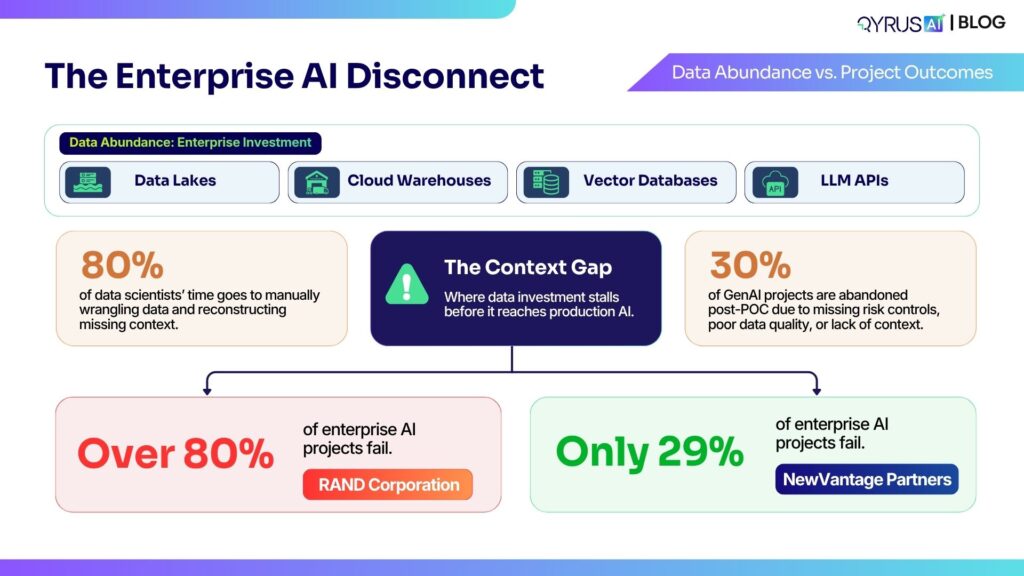
When algorithms ingest fragmented data, they lack the structural relationships that govern how an enterprise actually operates. A comprehensive study by the RAND Corporation found that over 80% of AI projects fail—more than double the failure rate of non-AI corporate technology projects—with researchers identifying a failure to ground models in operational context as the primary culprit. Furthermore, according to NewVantage Partners’ executive benchmark, only 29% of corporate leaders report achieving measurable business outcomes from their AI investments, pointing directly to persistent architectural silos and missing contextual relationships.
Why Context Matters
For AI to work effectively, it needs to understand:
- Relationships between systems
- Dependencies across processes
- How data flows through the organization
Without this:
- Insights lack relevance
- Predictions lack accuracy
- Decisions lack trust
When context is absent, teams burn enormous resources attempting to compensate with brute-force data engineering. Industry analysts at Gartner predict that at least 30% of generative AI projects will be abandoned after proof of concept due to poor data quality, missing risk controls, escalating costs, or unclear business value. Simultaneously, data scientists and engineers still spend up to 80% of their working hours manually preparing, cleaning, and reconstructing disconnected context rather than training and optimizing intelligent models.
From Data to Understanding
The shift organizations need is clear: moving from simply collecting data lakes to understanding how data is dynamically connected across systems, workflows, and business outcomes.
This is where concepts like:
- Enterprise knowledge graphs
- System-level dependency mapping
- Real-time digital twins
become critical.
Context provides the semantic anchor that bridges raw technical data and business intelligence. It transforms an isolated metric or log entry into a living relationship: which application produced it, which downstream API consumes it, and which revenue-generating customer journey depends on it.
The Role of Context in AI
When AI is powered by continuous context:
- Insights become more accurate
- Decisions become more reliable
- Outcomes become more actionable
Because the system understands not just what is happening, but why. Context provides the necessary guardrails that eliminate hallucinations, anchor agentic reasoning in verified ground truth, and give human stakeholders the transparency needed to trust algorithmic recommendations.
Where QyrusAI Fits In
This is where QyrusAI introduces a connected approach across the enterprise application lifecycle. As an agentic platform, QyrusAI creates a real-time, unified representation of your enterprise to ground AI systems in operational reality.
At the center of this capability is QyrusAI’s Live Enterprise Knowledge Graph, which continuously discovers enterprise assets, monitors live system interactions, and maps dependencies across services, databases, APIs, and business workflows.
By combining:
- Continuous asset discovery
- Dynamic dependency mapping
- Knowledge graph intelligence
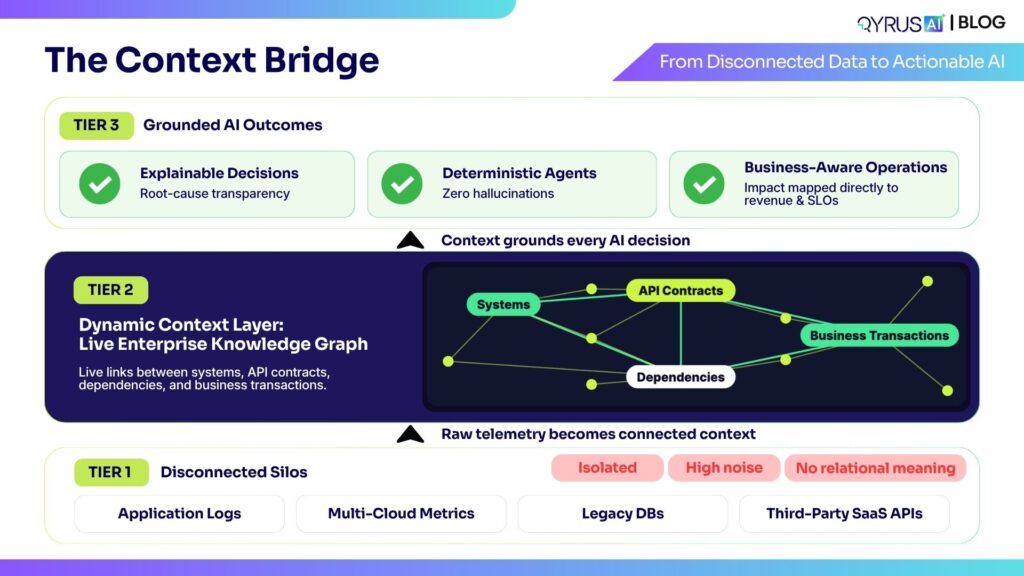
QyrusAI provides the continuous context layer that enterprise AI systems require[cite: 2]. This intelligence is operationalized across three core pillars:
- Modernize: Unpacks legacy architectures, assesses technical debt, and models real-time dependencies so modernization and portfolio decisions are driven by complete system context.
- Assure: Delivers continuous, automated testing across web, mobile, API, SAP, and complex data pipelines, verifying data contract integrity and application behavior before changes reach production.
- Operate: Brings operational intelligence across AIOps, observability, BizOps, and FinOps, directly correlating technical signals and operational anomalies with business outcomes.
This enables organizations to:
- Build more reliable, hallucination-resistant AI models
- Improve explainability and governance across automated decisions
- Accelerate time-to-value from AI investments
Frequently Asked Questions (FAQs)
- Why do enterprise AI projects fail even with massive data lakes?
Data volume is not the same as data understanding. Data lakes store raw data in isolated silos without architectural or business relationships. Without contextual mapping, AI models cannot determine which processes, transactions, or services that data actually influences.
- What is an Enterprise Knowledge Graph, and why does AI need it?
An Enterprise Knowledge Graph is a dynamic, semantic model that connects disparate data assets, applications, and workflows based on real-world relationships. It provides AI models with deterministic context, preventing hallucinations and enabling autonomous agents to reason accurately about complex systems.
- How does QyrusAI provide context to enterprise operations?
QyrusAI uses continuous discovery and automated dependency mapping to build a Live Enterprise Knowledge Graph. This connects raw telemetry, data pipelines, and infrastructure to the specific business workflows they support.
- How does contextual intelligence improve AI governance and explainability?
When AI makes a recommendation or triggers an automated remediation, context reveals the exact dependency path and reasoning behind the decision. This transparency makes models auditable, safe, and trustworthy for enterprise leadership.
The Bottom Line
AI doesn’t fail because of a lack of data. It fails because of a lack of context.
The question that helps you separate experimentation from real impact is no longer:
“Do we have enough data for AI?”
It is:
“Do we understand our data well enough for AI to work?”
Ready to move from disconnected data to contextual intelligence?
Discover how QyrusAI connects your data, systems, and business outcomes into a living operational Knowledge Graph.
 October 15, 2026
  4 min
4 min