Automated Visual Testing: The Future of Workflow-Driven Testing
 Varun RS
Modern software teams are shipping faster than ever, navigating denser dependencies and tighter release cycles across multiple environments. This is precisely why traditional, script-heavy automation is beginning to buckle under pressure. As CI/CD pipelines expand, maintaining brittle test code across UI changes, service dependencies, and multi-step user journeys becomes a drag on delivery rather than an accelerator. This is where a stronger workflow-driven QA automation model becomes critical for enterprise teams trying to simplify delivery at scale.
The challenge is not just technical complexity. It is also an execution gap. Enterprise teams often struggle to recruit and retain specialists who can build, debug, and maintain large automation suites over time. What begins as a strategic productivity investment can quickly turn into a maintenance burden, especially when even minor UI or workflow changes force repeated script updates.
Current market trend makes that shift hard to ignore. According to MarketsandMarkets’ automation testing market analysis, the automation testing market was estimated at $28.1 billion in 2023 and is projected to reach $55.2 billion by 2028. Furthermore, the broader software testing market reached $54.44 billion in 2026 and is expected to climb to $99.94 billion by 2031.
This surge in demand highlights why automated visual testing has become so essential. Visual testing is no longer just about catching layout issues with screenshot comparisons. It is evolving into a workflow-driven model that helps teams validate how applications behave across the entire testing process. This represents a definitive shift from script-centric execution toward a visually orchestrated automation strategy designed for the demands of modern software delivery.
What is Visual Test Automation?
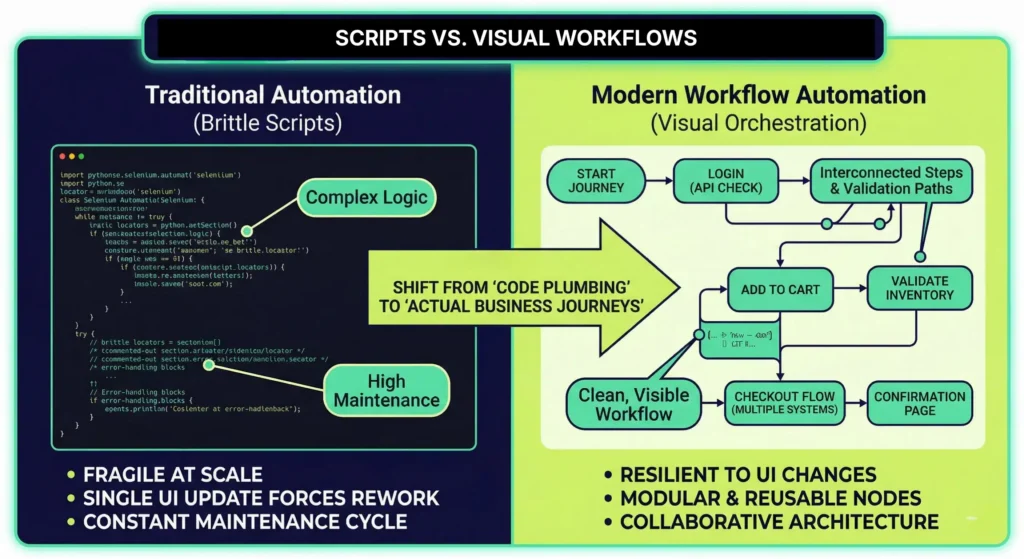
Visual test automation is a modern approach to designing, executing, and monitoring tests through visual interfaces rather than relying solely on handwritten scripts. Instead of burying logic deep within complex code, it transforms the testing process into a visible workflow composed of interconnected steps, validations, and execution paths.
This shift makes automation easier to understand, faster to build, and more accessible to QA, engineering, and product teams alike.
From Scripts to Visual Workflows
Traditional frameworks are powerful, but they are also fragile at scale. A single UI update, locator change, or environment mismatch can force teams into a cycle of constant maintenance. Visual workflows shift the focus from “code plumbing” to actual business journeys, making the automation architecture easier to build, review, and evolve. This is why more enterprises are investing in an enterprise visual testing strategy that connects automation to business outcomes, rather than managing isolated, fragmented scripts.
Core Components of Visual Automation
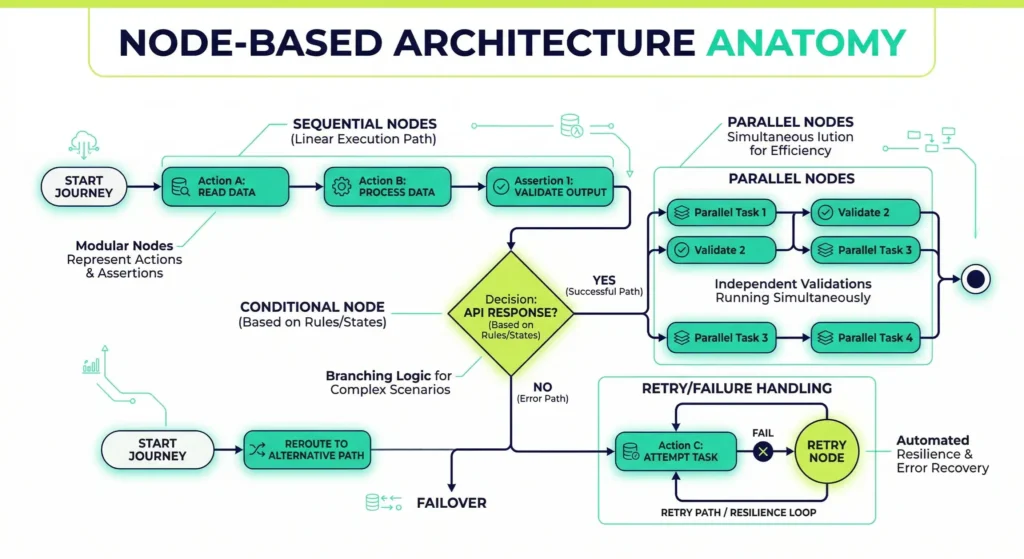
At the platform level, visual automation testing utilizes a “node-based” architecture which is similar to a flowchart, to represent each test step. Each node can represent an action, assertion, API call, or validation point, while workflow connections define how those steps execute in sequence, branch or loop under different conditions.
Modern platforms also support advanced features like data propagation and real-time execution monitoring, providing teams with a flexible way to model complex software behavior. The result is a testing model minimizes reliance on manual coding while making automation more visible, modular, and infinitely more scalable.
The Rise of Drag-and-Drop Test Automation
The growth of drag-and-drop test automation reflects a bigger enterprise need: reducing dependence on scarce scripting expertise without lowering quality. As software delivery speeds up, teams need testing tools that reduce coding dependency without sacrificing control or quality. This shift is precisely why visual, low-code interfaces are rapidly becoming the industry standard.
This transition is backed by significant market momentum. According to DataIntelo’s low-code test automation market report, the market reached $1.84 billion in 2024 and is projected to reach $13.3 billion by 2033 at a CAGR of 24.6%. These figures, combined with broader industry trends, reinforce a clear priority among modern software teams: the need for speed, accessibility, and scale.
For enterprise QA teams, drag-and-drop interfaces do more than simplify test authoring. They shorten onboarding, make workflows easier to audit, and create a shared layer where testers and developers can collaborate around the same logic. In practice, that turns automation from a specialist activity into a team capability, explaining why visual automation is now a cornerstone of modern CI/CD environments.
Node-based Automation: A New Way to Build Test Logic
Node-based automation is where visual testing becomes structurally stronger than long linear scripts. In this model, each node represents an action, validation, or system step, and the workflow defines how those nodes run together. That makes complex logic easier to read, reuse, and scale across the organization.
Sequential vs Parallel Nodes
Sequential nodes handle dependent actions, while parallel nodes improve speed by letting independent validations run together. This approach is far better suited for enterprise-grade execution models than packing multiple dependencies into a single, brittle script.
Conditional Execution Nodes
Conditional nodes enable dynamic test orchestration, allowing workflows to branch based on real-time application states, API responses, or specific business rules. This flexibility ensures that tests can adapt to the complexity of modern applications rather than following a rigid, “fail-fast” path.
Retry and Failure Handling Nodes
Retry and failure handling nodes improve resilience by rerouting, retrying, or stopping with more context instead of failing abruptly. This level of granular control is essential for teams focused on eliminating “flaky tests” within CI/CD pipelines and maintaining high-confidence execution across rapid release cycles.
Why a Test Workflow Builder is Essential
The value of a test workflow builder lies in its ability to address a modern reality: defects rarely stay confined to a single screen or a single layer of the technology stack. Today’s user journeys are inherently complex, spanning UIs, APIs, databases, and external notification systems. While traditional automation often validates these components in isolation, a workflow builder orchestrates the entire business path, mirroring exactly how modern applications function in the real world.
In enterprise QA, this distinction is critical. A checkout flow does not stop at a button click. It may also require API validation, database verification, payment confirmation, and downstream notification checks. The same logic applies to account creation workflows and multi-system integrations, where a single broken dependency can disrupt the full customer journey even when isolated test cases still pass.
This is where Qyrus fits naturally into the discussion. Its visual orchestration approach supports testing across web, mobile, API, and desktop environments through multi-protocol test workflows, with built-in support for branching logic, data propagation, session persistence, scheduling, and centralized reporting. This allows teams to move beyond disconnected scripts and instead validate complete, stateful journeys that ensure the software performs reliably at every touchpoint.
The Role of AI in Visual Test Automation
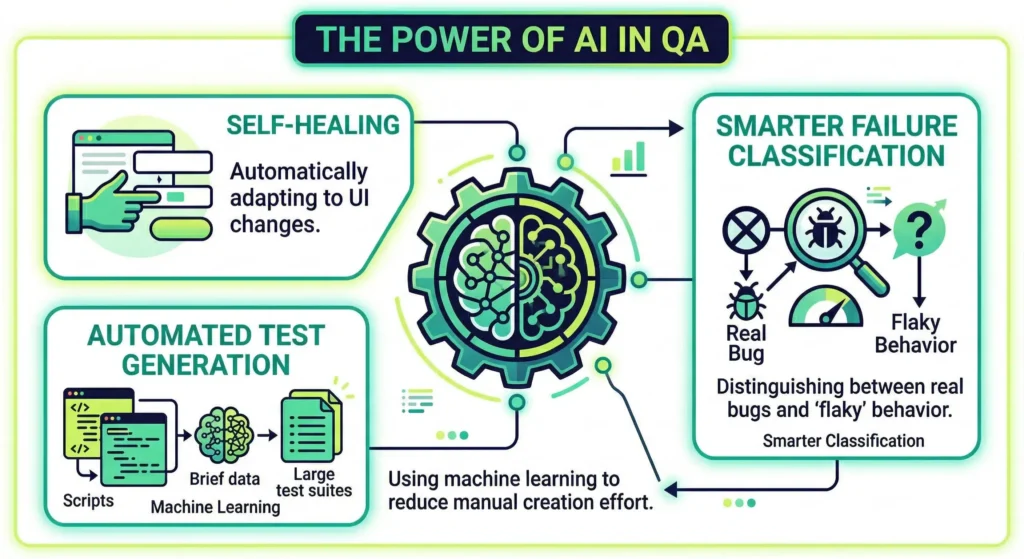
AI is pushing automated visual regression testing and broader visual automation into a highly scalable, intelligent phase. By integrating self-healing capabilities, smarter failure classification, and automated test generation, AI significantly reduces the manual burden of creating and maintaining complex workflows.
That shift is backed by market momentum. Industry projections suggest the AI-driven testing market could reach $28.8 billion by 2027, growing at roughly 55% annually. Some reports also suggest AI-based testing tools can deliver 300% to 500% ROI by reducing maintenance effort and improving execution efficiency.
The true value of AI, however, extends far beyond screenshot comparison. AI helps teams identify flaky behavior faster, reroute or retry failed steps more intelligently, and adapt test logic as the development process changes. In modern visual automation platforms, this results in a testing suite that is resilient, maintainable, and perfectly aligned with high-velocity release environments.
Benefits of Visual Test Automation for Enterprises
For the modern enterprise, the benefits of automated visual testing are fundamental to operations, not merely aesthetic. Visual platforms support faster automation development, reduced coding overhead, improved collaboration, lower maintenance, and more scalable architecture. They also align better with CI/CD pipelines as they orchestrate complete flows, not just isolated assertions.
Strategic efficiency is at the heart of this shift. Given that verification and validation often account for a substantial portion of total development costs, the efficiency gains provided by visual automation are of critical strategic importance.
Equally vital is the transparency visual automation offers to stakeholders. Rather than deciphering complex code or fragmented test suites, teams can audit intuitive workflows that mirror actual business logic, making the entire testing process accessible to everyone from developers to product owners.
Challenges in Traditional Automation That Visual Platforms Solve
Traditional automation struggles with script maintenance, brittle logic, limited cross-team visibility, and cumbersome dependency management. Even minor UI adjustments can trigger significant rework, with GUI-based automated tests often requiring updates in upto 30% of test methods.
Visual platforms address these issues by replacing code-heavy debugging with visible workflows, reusable nodes, and clearer orchestration. Instead of managing scattered scripts, teams can operate within a more structured and observable testing system.
The Future of Workflow-Driven Testing
The future of QA is not more scripting for the sake of scripting. It is workflow-driven, AI-enhanced, and cross-platform by design.
Emerging trends include:
- AI-Generated Testing: Leveraging machine learning to reduce the manual effort of test creation.
- Autonomous Pipelines: Developing self-adjusting test suites that adapt instantly to application changes.
- Unified Orchestration: Bridging the gap between UI, API, and underlying system layers for total coverage.
- In this model, testing evolves from execution to orchestration, where workflows, not scripts, define how quality is delivered.
Why Visual Automation Will Define the Next Generation of Testing
Script-based automation is hitting its scalability ceiling. Visual workflows, AI-assisted maintenance, and orchestration-first design are changing how modern QA is built and managed.
That is why automated visual testing is emerging as the future of workflow-driven testing. It does not just improve usability for test creation. It changes the architecture of automation itself, making it more collaborative, resilient, and aligned with how enterprises actually ship software.
Qyrus shows what that looks like in practice through visual node-based design, drag-and-drop workflow creation, support for component testing, and orchestration across real business journeys. For enterprise teams evaluating the next phase of automation maturity, the shift toward workflow-centric testing is not a trend. It is a more scalable operating model for quality engineering.
Ready to move beyond brittle scripts and isolated test cases? Explore how Qyrus Test Orchestration helps teams build visual, workflow-driven automation across modern enterprise testing environments.
FAQs
- What is automated visual testing?
Automated visual testing is the practice of validating user-facing application behavior through visual checks, workflow logic, and execution monitoring, rather than relying only on scripted assertions. It is increasingly used to support more scalable testing in CI/CD pipelines.
- How is automated visual regression testing different from functional testing?
While functional testing verifies if the application follows specific logic or business rules, visual regression testing focuses on unintended UI changes and the overall rendered user experience. Modern Quality Engineering platforms often converge these two disciplines into a single, orchestrated workflow to ensure both the logic and the interface are flawless.
- Why is visual automation testing important for modern CI/CD pipelines?
Visual automation allows teams to identify user-visible defects much earlier in the development lifecycle. By reducing the burden of brittle script maintenance, it enables QA teams to keep pace with high-velocity release cycles without sacrificing coverage or quality.
- What are the primary benefits of drag-and-drop test automation?
Drag-and-drop interfaces mitigate the shortage of specialized scripting talent and drastically shorten the onboarding process. By providing a “shared language” for testing, these tools foster deeper collaboration between QA, engineering, and business stakeholders.
- How does node-based automation improve test design?
By breaking complex logic into modular “nodes,” this approach improves clarity, reusability, and scalability. It allows for more sophisticated test designs including conditional branching and intelligent retry handling, without the “spaghetti code” often found in traditional frameworks.
- What does a test workflow builder do in enterprise QA?
A test workflow builder empowers teams to design end-to-end user journeys that span multiple layers—including UI, API, databases, and third-party integrations. Rather than validating steps in isolation, it ensures the entire business process functions correctly across web, mobile, and desktop environments.
 March 24, 2026
  10 min
![Featured_Image-LLM_evaluation[1]](https://www.qyrus.com/wp-content/uploads/2026/03/Featured_Image-LLM_evaluation1.webp)