


Beyond the Syntax: Governing the Era of Agentic Software
 Ameet Deshpande
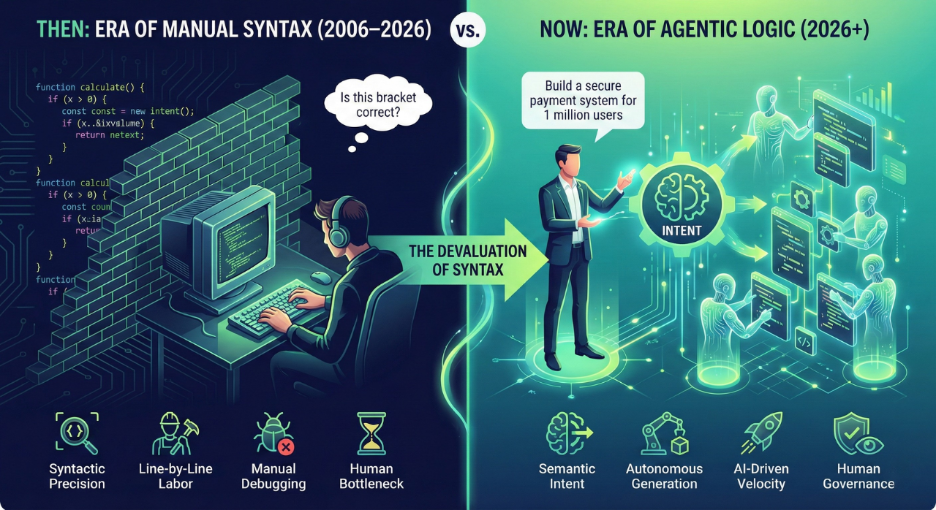
In the last thirty days, the software industry didn’t just advance; it underwent a structural collapse and a total rebirth. For twenty years, developers lived by the sword of Linus Torvalds: “Talk is cheap. Show me the code.” This filter prioritized the grueling labor of implementation over the “vapor” of ideas. But as of February 2026, that sword has been blunted. We have entered an era where products no longer look like assistants—they look like colleagues.
The tectonic plates of the technology sector shifted during this past month. Market volatility proved the reality of this transition. In a single week, India’s Nifty IT index plunged nearly 6%, erasing over $22 billion in market value. Investors didn’t see productivity; they saw substitution. This sudden repricing stems from a simple realization: code is no longer scarce. According to Gartner, 75% of enterprise software engineers will use AI code assistants by 2028, moving the needle from manual implementation to high-level orchestration.
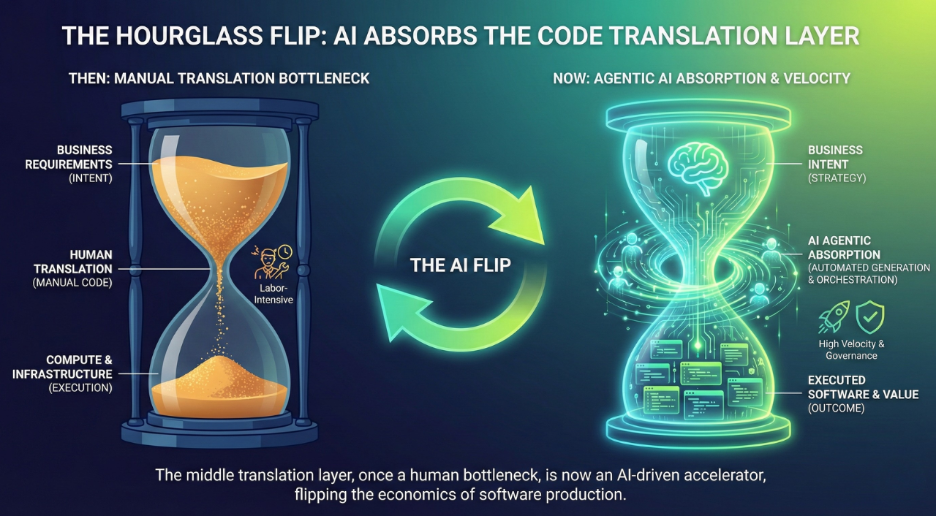
The hourglass of our industry has flipped. For decades, business requirements sat at the top, compute sat at the bottom, and a thin middle layer of human translators connected them. Today, that translation layer is evaporating.
When Poetry Outran Python
If a generative model can write English poetry with structure, rhythm, and intent, then code—with its rigid grammar and predictable scaffolding—was never the hard part. Engineers once viewed syntax as mystical because humans found it difficult to type. For a machine, the constraints of Rust or Python provide a far simpler path than the non-deterministic mess of human language.
“We used to treat code as mystical because it was hard for us to type. We now realize the machine finds Python easier than it finds a messy human conversation.”
The industry finally stopped pretending we were building “coding tools” and started building a production line for logic. Recent data supports this shift. As of early 2026, AI generates roughly 41% of all code, a number climbing as agentic systems move from suggesting snippets to orchestrating entire modules. The “mystical” element was never the brackets or the indentation; it was the judgment. We now prioritize the ability to choose what to build and knowing what “correct” means when reality refuses to be neat.
The Trillion-Dollar Reality Check
The timeline of the last thirty days reads like a controlled demolition of the old software development lifecycle. On January 8, 2026, Anthropic released Claude Code v2.1.0, explicitly framing it as an “agentic” environment. This update wasn’t just a better prompt box. It included 1,096 commits oriented around workflow portability and agentic “handshakes.” The system now spins up agents, controls their lifecycle, and carries context across sessions.
Then came the moment Wall Street heard the subtext. When Anthropic launched “Claude Cowork” on January 12, investors didn’t see productivity—they saw substitution. The resulting panic wiped off nearly $22 billion in market value in just three days. The market absorbed the reality that LLMs are moving “up the stack” into the application layer.
Apple made the shift inevitable on February 3, 2026. Xcode 26.3 now adds native AI coding agents from OpenAI and Anthropic directly into the environment. These agents don’t just suggest code. They operate within the IDE—updating settings, searching documentation, and verifying work visually via SwiftUI Previews. The IDE no longer acts as a tool; it serves as an agent host.
“In this new economy, we aren’t losing engineers; we are losing typists. We are gaining governors who must manage an industrial scale of logic production.”
The Day the Billable Hour Broke
The market panic wasn’t an irrational fear of “robots taking jobs.” It was a sudden repricing of an old assumption: that software and services companies sit behind defensible complexity. For two decades, the industry worked like an hourglass. At the top were business requirements; at the bottom was compute. In the thin middle sat the precious layer: people who could translate intent into software. This month, the hourglass flipped. Translation stopped being scarce.
The impact hit India, the world’s largest labor-intensive software engine, with particular force. On February 4, 2026, Reuters reported that Anthropic’s new plugins and other AI developments rattled the staffing-intensive IT model, wiping off close to $1 trillion in total market value globally. Indian Software services companies felt the shock acutely as the NIFTY IT index fell 6%—the steepest drop since the 2020 pandemic. Over $22.5 billion in value vanished in a single week.
Regional anxieties vary but remain interconnected. In the US, the conversation focuses on product margins and platform moats. In the EU, anxiety clusters around compliance-heavy services and data businesses fearing replacement by agentic extraction. In India, the crisis is existential because the business model historically monetized hours and headcounts. When an agent performs the first 80% of routine work, staffing becomes a cost center rather than a competitive moat.
The Architect-Governor: Why “The Talk” is the Only Scarcity Left
The coding workforce isn’t doomed, but the old identity of the “typist” is dead. On January 30, 2026, Kailash Nadh, CTO of Zerodha, flipped the industry script: “Code is cheap. Show me the talk.” This simple phrase captures the new reality. Writing syntactically correct logic no longer counts as a scarce skill. Scarcity now lives in the service the code provides. We have shifted the bottleneck from production to judgment.
This transition elevates a different kind of engineer—the Architect-Governor. These leaders hold the entire problem in their heads, negotiate tradeoffs, and communicate intent so clearly that the machine executes it perfectly. But speed brings a new danger. If code generation accelerates, failure creation follows right behind it. Data from the field confirms this anxiety. While developers use AI in roughly 60% of their daily work, only 0–20% of those tasks can be fully delegated without oversight.
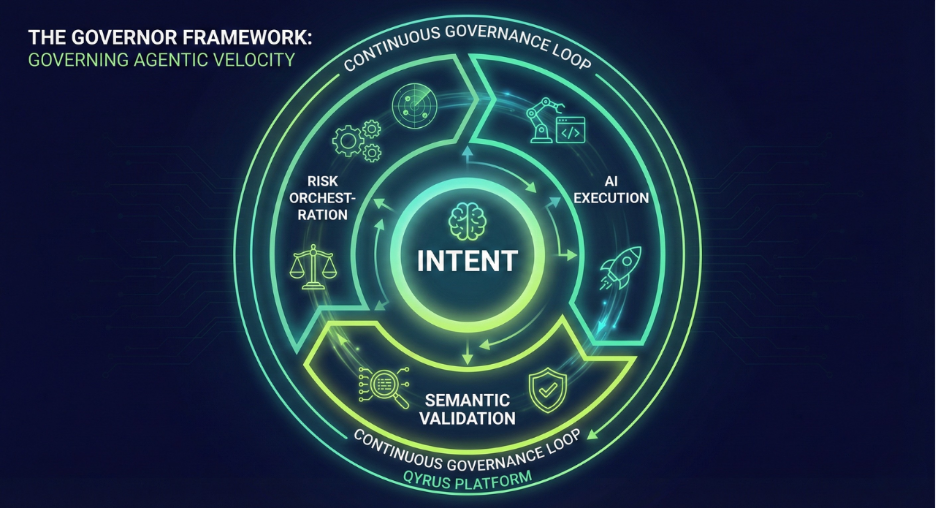
Quality Engineering now serves as the “governor” of this industrial-scale velocity. We no longer check for exact strings; we validate outcomes semantically. Organizations move from asking “Did the feature work once?” to “Do we trust this system to keep working after a hundred AI-assisted edits?” Recent surveys highlight the stakes: 88% of developers lack the confidence to deploy AI-generated code without explicit verification. The winners won’t just “use AI to code.” They will use AI to govern coding through automated evaluation and risk-based orchestration.
Engineering the High-Velocity Guardrail
Velocity without governance creates a “black box” of risk. When AI agents generate code at industrial speeds, traditional testing methods crumble. For years, QA teams relied on checking exact strings—verifying that a button had a specific ID or that a database returned an exact character set. In a world of agentic code, those static checks are useless. You cannot catch a semantic hallucination with a literal string match.
The industry now faces a “Quality Gap.” While AI can increase code volume by up to 40%, it also introduces subtle logic errors that traditional unit tests often miss. We transition from “checking strings” to “validating semantic outcomes.” This means the testing engine must understand the intent of the software, not just its syntax. If an AI agent modifies a checkout flow, the Governor doesn’t just check if the “Buy” button exists; it validates that the entire transaction logic remains sound across a hundred different edge cases.
“If you increase the speed of the engine without upgrading the brakes, you aren’t building a faster car—you’re building a more dangerous one. In 2026, Quality is the brakes.”
This is where risk-based orchestration changes the game. Instead of running every test for every minor AI edit—a process that would paralyze development—we use automated evaluation to identify high-risk changes. Qyrus employs this “Governor” logic to prioritize testing where the agents are most likely to fail. By mapping the relationship between AI-generated components and business-critical logic, we ensure that speed never compromises integrity. We turn the testing suite into an active monitor that understands reality’s messiness.
The New Social Contract: Human Intent, Machine Scale
The events of early 2026 have drafted a new social contract for the modern organization. In this framework, humans speak intent and bear the ultimate responsibility, while machines produce the first draft at an industrial scale. We are witnessing the final departure from an era where code was the only proof of seriousness. Today, code is plentiful, but trust is rare.
In this new economy, the ultimate proof of value is whether you can define the right product to build—and whether you can prove it is safe to ship. The demand for “Analytical Thinking and Quality Governance” is going up as technical implementation roles undergo automation. The focus has moved from the “how” of development to the “what” and “why” of system integrity.
At Qyrus, we recognize that as agentic velocity accelerates, the role of the Quality Architect becomes the most critical seat in the house. We build the tools that empower you to be the Governor, not the typist. Our platform provides the semantic validation and risk-based orchestration needed to turn “agentic logic” into reliable, enterprise-grade software. The talk is no longer cheap—it is the only thing that defines the future.
Stop fighting the surge of agentic code with brittle manual scripts. Contact Qyrus today to see how we help your team transition to semantic governance and secure your software’s integrity at scale.
A version of this article originally appeared on LinkedIn, authored by Ameet Deshpande, Senior Vice President – Product Engineering at Qyrus.
 March 31, 2026
  6 min
6 min
![Featured_Image-LLM_evaluation[1]](https://www.qyrus.com/wp-content/uploads/2026/03/Featured_Image-LLM_evaluation1.webp)


