Qyrus Named a Leader in The Forrester Wave™: Autonomous Testing Platforms, Q4 2025 – Read More

Featured_Image-LLM_evaluation[1]

Enterprises rush to deploy Large Language Models (LLMs) to gain a competitive edge. However, speed without control invites disaster. One incorrect answer in a customer support portal or a security flaw in AI-generated code can lead to legal action or a data breach.  

We know that quality assurance defines the success of any software deployment. AI requires even stricter standards. You must treat AI output validation as the steering wheel of your innovation, not the brake pedal. 

Current data highlights a massive gap in enterprise readiness. While healthcare data breaches affected over half the U.S. population in 2024, only 31% of organizations actively monitor their AI systems. This lack of oversight exists. It persists despite evidence that regular assessments triple the likelihood of achieving high value from GenAI.  
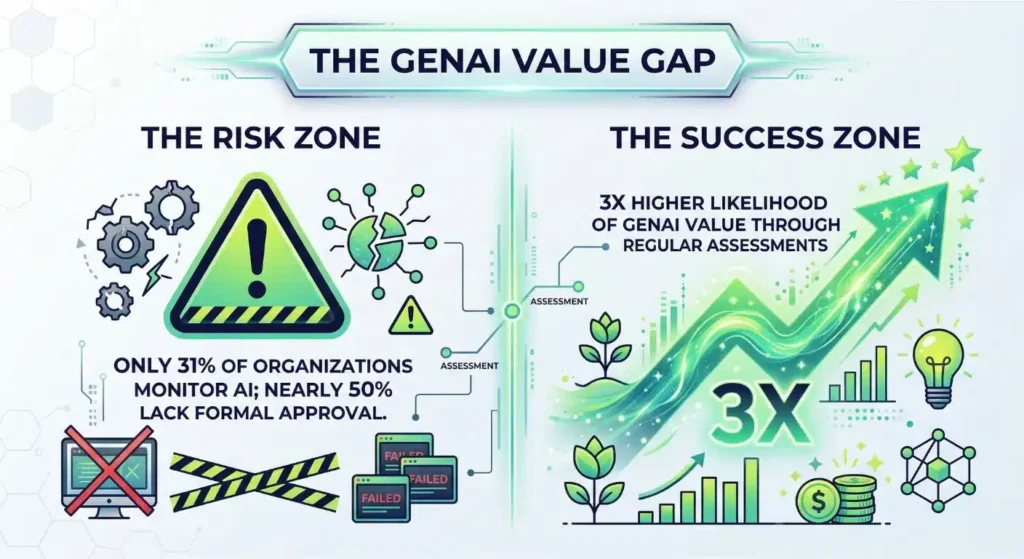
Organizations must implement robust LLM evaluation to bridge this safety gap. You protect your brand only when you prioritize generative AI testing throughout the model’s lifecycle. 

Why Is Simple Keyword Matching Failing Your AI Strategy? 

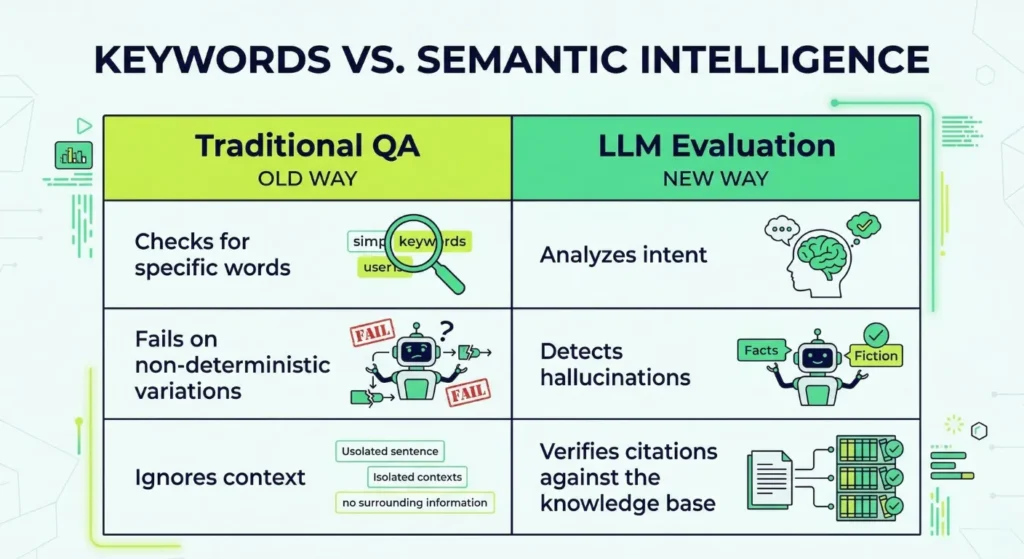
Traditional software testing relies on predictable, binary outcomes. If you input X, the system must return Y. LLMs behave non-deterministically. They produce thousands of variations for the same prompt. This unpredictability creates a massive challenge for AI output validation. If your quality assurance team relies solely on keyword matching, they will miss subtle but dangerous errors. 

Effective LLM evaluation rests on three key pillars:  

  • First, you need deep semantic analysis. You must verify that the AI captures the user’s intent rather than just repeating terms.  
  • Second, rigorous hallucination detection in LLM is non-negotiable. You must confirm that every claim the model makes exists within your trusted knowledge base. Industry analysts expect the market for these observability platforms to reach to about USD 8.07 billion by the early 2030s as companies prioritize safety.  
  • Finally, every response needs citation integrity. If an AI provides financial advice or technical specs, it must link back to a verified source. High-performing teams that automate these checks often see a 25% improvement in complex query accuracy. 
Is Your Generative AI Testing Covering the Whole Architecture? 

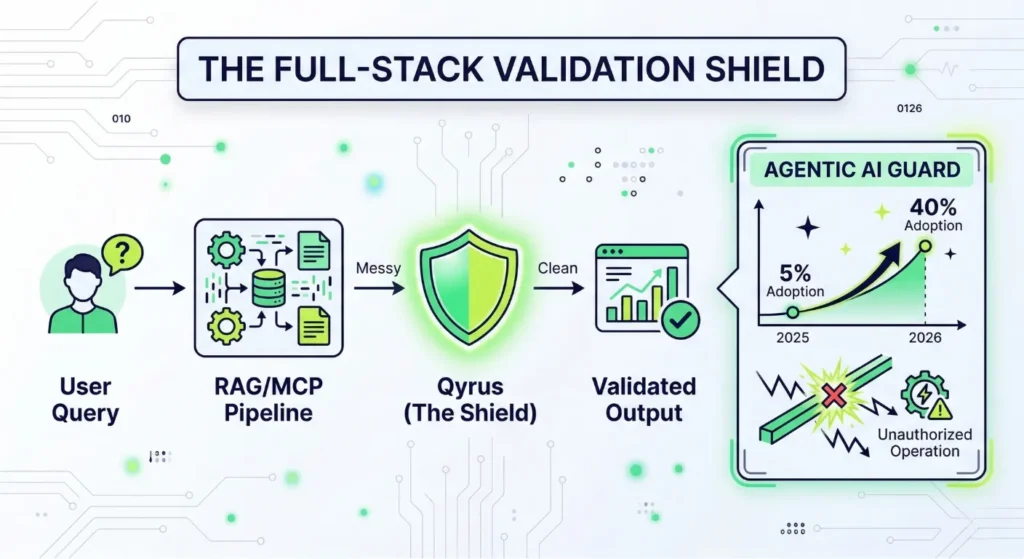
Many teams make the mistake of only checking the model’s final response. This narrow focus misses the technical cracks in your underlying architecture. Enterprise-grade generative AI testing must validate the entire stack. This includes your Retrieval-Augmented Generation (RAG) and Model Context Protocol (MCP) pipelines.  

Qyrus runs deep system-level checks to expose failures that surface-level reviews ignore. You must ensure your retrieval layer gathers the correct context before the model even starts writing. 

Agentic AI introduces even more complexity as autonomous systems take actions on your behalf. Industry forecasts suggest that enterprise applications using task-specific agents will surge from less than 5% in 2025 to 40% by the end of 2026. Without a robust LLM testing strategy that handles autonomous behavior, these agents might perform unauthorized operations.  

Qyrus provides an Agentic AI Guard to keep these systems within defined bounds. It verifies tool selection and blocks risky actions in real-time. Our AI Quality Suite achieves over 98% faithfulness in validated outputs. This level of precision ensures your agents remain reliable as they scale across your organization. Consistent LLM Evaluation ensures your AI stays on-task and secure.
How Do You Audit an AI That Never Gives the Same Answer Twice? 

Traditional testing fails when your software generates unique text for every single user. You cannot write a manual test case for every possible sentence an LLM might produce. Instead, you must build a system that understands intent and accuracy.  
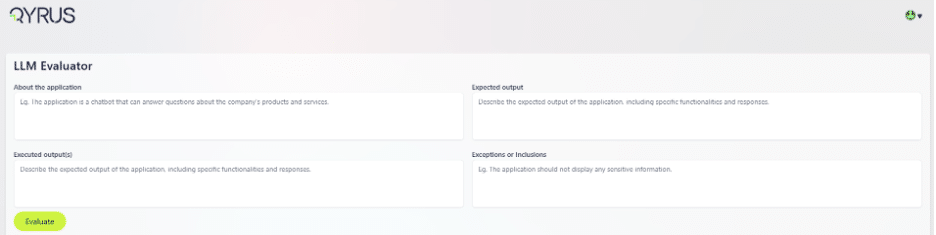
Qyrus LLM Evaluator simplifies this complexity by providing a structured framework for generative AI testing. You begin by defining the “About the Application” section to provide the evaluator with context. Then, you establish the “Expected Output”—your gold standard for what the AI should ideally say. 

The real power lies in defining “Exceptions or Inclusions.” For example, you might command the bot to never disclose account balances over one million dollars or to always include a specific legal disclaimer.  

You then input the “Executed Outputs” from your model. The system instantly analyzes the response, providing a relevance score from one to five and a detailed reasoning for that score.  

Can Your Team Scale LLM Evaluation Without Losing Precision? 

Automation is the only way to keep pace with rapid model updates. Manual reviews simply take too long and introduce human bias. A robust LLM testing strategy uses a “judge” model to verify the primary model’s work. It checks for specific positives and negatives in every response. Did the bot mention the account balance? Did it follow the formatting rules? The evaluator answers these questions in seconds. 

By automating your AI output validation, you achieve a level of consistency that human auditors cannot match. This automated layer provides a safety net that catches errors before they reach your customers. It handles the heavy lifting of hallucination detection in LLM by cross-referencing every generated claim against your source documents.  

When you integrate this into your CI/CD pipeline, LLM Evaluation becomes a continuous process rather than a final hurdle. You gain the confidence to deploy updates daily, knowing your guardrails remain intact and your brand remains protected. 

How Does Industry Context Change Your Validation Strategy? 

Enterprise risk shifts significantly depending on your field. A typo in a blog post might be embarrassing, but a mistake in a medical summary or a legal contract can destroy a company. You must tailor your AI output validation to the specific regulatory and operational pressures of your vertical. 

Will Your Internal Assistant Accidentally Violate Labor Laws? 

Internal HR bots often handle sensitive employee data and policy inquiries. If your AI provides incorrect guidance on overtime pay or hiring practices, you face immediate legal exposure. Quality engineering teams must implement LLM testing to verify that every response stays within corporate and legal guardrails.  

We focus on automated auditing that cross-references AI suggestions against current labor regulations. This prevents the model from exposing personally identifiable information (PII) or suggesting discriminatory practices. Rigorous LLM Evaluation ensures your internal tools protect your employees and your legal standing. 
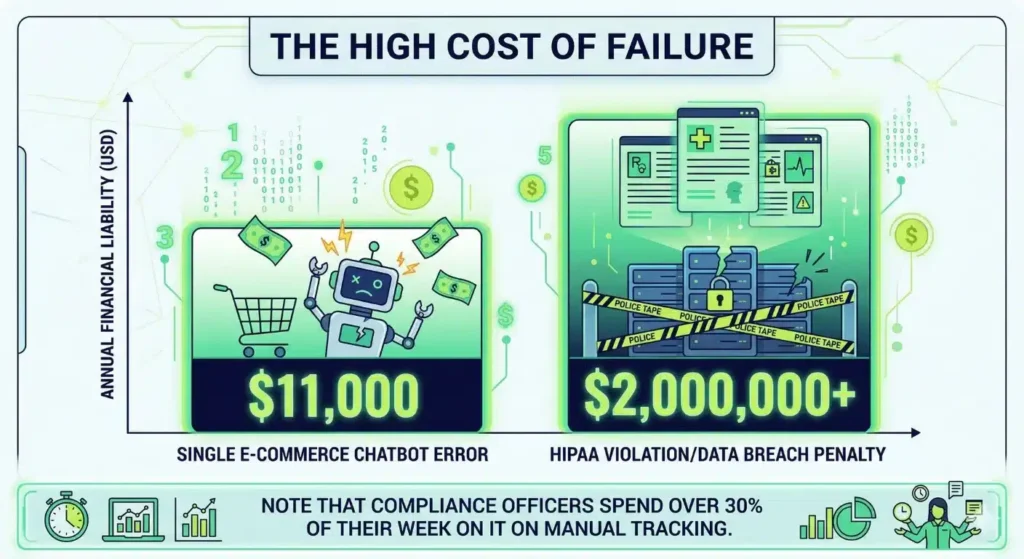
Could a Helpful Chatbot Cost You $11,000 in a Single Transaction? 

Ecommerce brands often prioritize a “polished” tone, but tone without accuracy creates merchant liability. One chatbot famously offered an 80% discount without any human approval. The resulting order totaled nearly $11,000. This is a real risk. Generative AI testing identifies these outliers by running thousands of simulated interactions before you go live.  

You must ensure your bot hits 95% accuracy against your live product manuals and pricing sheets. We use automated judges to flag any unauthorized promises, ensuring your AI remains a sales asset rather than a financial drain. 

Is Your Clinical AI a Multi-Million Dollar Liability Waiting to Happen? 

Healthcare and finance demand the highest levels of precision. In 2024, data breaches affected over half the U.S. population. Regulators now levy penalties exceeding $2 million annually for HIPAA failures. Meanwhile, financial compliance officers spend over 30% of their week manually tracking enforcement actions. You can automate much of this oversight.  

We implement deep hallucination detection in LLM to ensure clinical summaries or financial advice match verified source documents perfectly. Our platform achieves about 95% faithfulness in these high-stakes environments. This level of control allows you to innovate without fearing a regulatory crackdown. 

Why Automated LLM Testing Is the Key to Your Enterprise Growth 

Software quality defines the modern business. Generative AI testing simply extends those rigorous standards to the next generation of applications. Organizations that conduct regular assessments significantly increase the likelihood of extracting high value from their AI investments. You cannot afford to deploy models that act as black boxes. Qyrus and our LLM Evaluator transform these systems into transparent, reliable assets. 

We believe that quality functions as the steering wheel for your innovation. Our AI Quality Suite automates the most difficult parts of LLM Evaluation and AI output validation. We achieve about 95% faithfulness in validated outputs, allowing your team to move at high velocity without fear. Robust hallucination detection in LLM turns your AI from a liability into a competitive edge. It is time to move past experimental pilots and into governed, measurable operations.  

Secure your enterprise AI today. Reach out to the Qyrus team to schedule a demo and see how our platform safeguards your future. 

Frequently Asked Questions 

How to detect hallucinations in LLMs before they reach your customers? 

You must implement an automated judge that cross-references AI claims against your internal documents. Qyrus uses semantic comparison to identify assertions without evidence. This automated hallucination detection in LLM saves hundreds of manual auditing hours. It ensures every response stays grounded in your data. Relying on human reviewers for thousands of logs is impossible. 

Which LLM response validation methods offer the highest accuracy? 

Semantic scoring outperforms simple keyword matching. You should use LLM response validation methods that assign a score (1-5) based on relevance and faithfulness to the source. Our LLM Evaluation framework provides clear reasoning for every grade. This helps your team identify why a model failed and how to refine the prompt. 

Why is automated testing for generative AI essential for scaling? 

Manual testing cannot keep up with models that update frequently. Automation lets you run thousands of test cases in a single afternoon. Teams that use automated testing for generative AI reduce production time by 50% and see a 30% improvement in data extraction accuracy. 

What are the best tools for LLM evaluation on the market today? 

You need a platform that validates the entire architecture, not just the output. Qyrus Pulse and the LLM Evaluator provide full-stack visibility. We offer the precision required for enterprise-grade LLM testing. Our suite handles everything from simple chatbots to complex autonomous agents. 

How should your team approach validating LLM outputs for enterprise AI? 

Start by defining your “Expected Output” and “Exceptions or Inclusions.” This establishes the rules for the AI. You then compare the “Executed Output” against these rules. Since only 31% of organizations monitor their AI, validating LLM outputs for enterprise AI gives you a major security advantage. It prevents brand liabilities before they happen. 

What is the most effective way of testing RAG pipelines? 

You must run system-level checks on the retrieval layer and the prompt assembly. Testing RAG pipelines involves verifying that the vector search gathered the correct context. Qyrus Pulse exposes failures that surface-level reviews miss. We ensure your RAG system achieves over 98% faithfulness to the original source. 

How to test AI chatbots for legal and financial risks? 

Run adversarial simulations to see if the bot violates your internal policies. How to test AI chatbots requires setting clear “Negatives”—things the AI should never do. For example, you might block the bot from revealing account balances over a certain limit. This type of AI output validation stops costly errors in their tracks. 

Are there specific AI compliance testing tools for regulated sectors? 

Yes, you need tools that specifically address HIPAA and financial regulations. Regulated sectors face penalties exceeding $2 million annually for privacy failures. Qyrus offers specialized AI compliance testing tools that automate the auditing of clinical and legal outputs. We keep your AI within the strict bounds of the law. 
Qyrus and SurrealDB

Qyrus is proud to announce our official integration with SurrealDB, providing a dedicated data quality assurance layer for the world’s most advanced multi-modal AI agent database. 

As SurrealDB 3.0 redefines the database landscape with first-class agent memory and multi-modal storage, Qyrus Data Testing ensures that every record remains accurate, every migration is certified, and every AI model is trustworthy. 

This official partnership empowers organizations to move from legacy relational and document databases to SurrealDB with absolute confidence. 

Revolutionizing Data Migration for the Multi-Modal Era  

Moving data from PostgreSQL, MongoDB, or MySQL into a multi-modal architecture like SurrealDB introduces significant risks to data integrity. Qyrus Compare Jobs solve this by performing record-level, cross-source comparisons that map columns between heterogeneous systems automatically. Teams can now validate that relational rows, JSON blobs, and foreign keys have correctly transformed into SurrealDB documents, nested objects, and graph edges. 

Validating the Future of AI with SurrealDB 3.0  

SurrealDB 3.0 introduces a fundamental shift toward persistent agent memory and context graphs. Qyrus provides specialized AI evaluation testing to verify that agent memory payloads persist correctly and that context relationships remain bidirectional. With native support for vector search validation, Qyrus allows AI engineers to detect embedding drift and verify RAG pipeline quality before it impacts production performance. 

No-Code Quality for Schema less Scalability  

While SurrealDB offers incredible flexibility through its schema-less mode, maintaining data contracts is essential for enterprise stability. Qyrus Evaluate Jobs allow QA teams to enforce schema-level checks—such as null verification, regex pattern matching, and duplicate detection—without writing a single line of SQL. This “quality-at-the-testing-layer” approach ensures that business rules are upheld even in the most dynamic data environments. 

Democratizing Data Excellence  

This integration bridges the gap between data engineers, AI scientists, and compliance teams. Data Engineers can automate post-migration checks, while AI Engineers can run continuous regression tests on context graphs. Compliance and Governance teams gain access to tamper-evident audit trails and automated daily reports, aligning SurrealDB’s performance with regulatory requirements like GDPR and SOC 2. 

Getting Started with SurrealDB and Qyrus  

The Qyrus connector is now available as an official data quality validator on SurrealDB. Setup takes minutes—simply configure your SurrealDB endpoint in the Qyrus platform to begin running continuous, AI-augmented data validations today. 

For more information and detailed technical guides, visit the official SurrealDB integrations page or our documentation. 

How to scale the momentum of ‘Vibe Coding’ using intelligent test automation to enforce rigorous regression and security guardrails essential for the financial sector.

March 25

8:30 PM IST | 3:00 PM GMT | 10:00 AM EST

Vibe Coding

Software development has entered a new mode: Vibe Coding. It is fast, exploratory, and driven by the question, “Does it work?” rather than “Is it perfect?”. For startups and hackathons, this momentum is a superpower. But in banking, unchecked “vibes” can lead to hidden costs: tech debt, brittle systems, and compliance failures. 

How do financial institutions adapt to this new speed without compromising stability? 

Join our leaders, as they unveil the Hybrid Model for banking software. This session will demonstrate how to operationalize the speed of Vibe Coding by wrapping it in automated, intelligent guardrails that ensure scalability, security, and maintainability. 

What You Will Learn 

  • The “Vibe” vs. “Regulation” Conflict: Why the “code fast, fix later” approach fails in banking—and how to fix it without killing developer velocity. 
  • The Hybrid Model: A practical framework for a two-phase development lifecycle: Phase 1 (Vibe) for rapid prototyping and discovery, followed by Phase 2 (Formalize) for standardization and testing. 
  • Building Qyrus Guardrails: How to utilize the Qyrus platform to automate the “boring correctness” of software delivery: 
    • Contract-First Development: Using API Builder and hosted mocks to define boundaries early. 
    • Automated Test Generation: Using TestGenerator and Qyrus Journeys to create tests directly from real user behaviors and stories. 
    • Data & Orchestration: Leveraging Echo for synthetic boundary data and SEER framework for agentic self-healing and prioritization. 
    • The Vibe-Weighted Pyramid: How to restructure your testing strategy (60% Unit, 30% API, 10% E2E) to support rapid changes while maintaining evidence-driven quality. 

Who Should Attend 

  • Banking CXOs: Seeking faster time-to-value with bounded risk and auditability. 
  • Engineering Leaders: Who need to scale innovation pods and proofs-of-concept into robust, maintainable systems. 
  • QA Architects: Looking to transition from manual scripting to automated quality gates and “fix-forward” workflows. 

Meet Our Experts

Ravi

Ravi Sundaram 

President, Qyrus

Ameet-Deshpande

Ameet Deshpande

SVP, Product Engineering, Qyrus

Yadvendra Rathore

VP, Client Success, Qyrus

Ready to Operationalize Your Vibe?  

Vibe Coding is powerful, but chaotic if unchecked. Don’t let hidden costs like brittle systems and knowledge silos slow you down. See how Qyrus uses AI-driven tools—from API Builder to SEER—to wrap your rapid development in automated quality gates. 

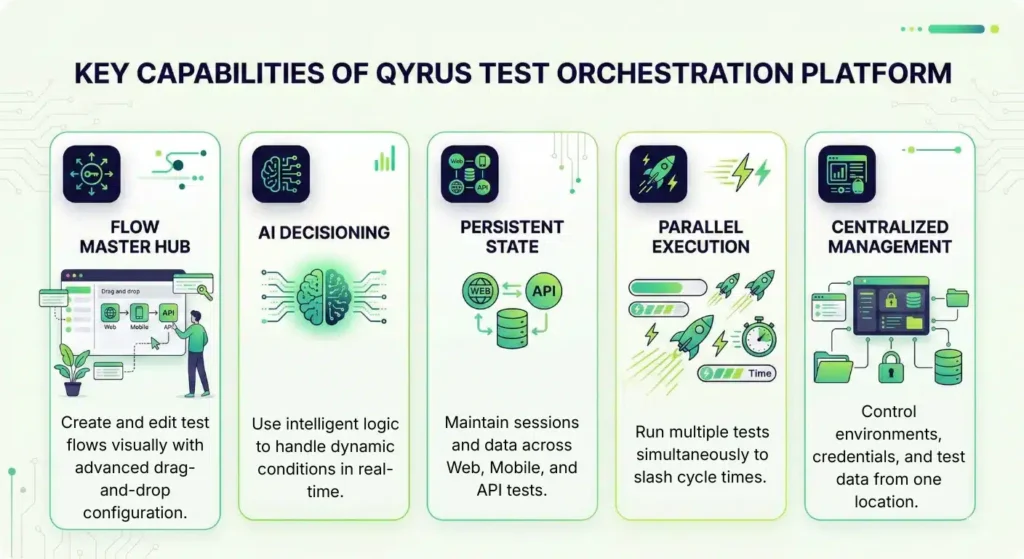
Software quality defines market leadership. QA teams today face a clear choice: continue managing fragmented scripts or switch to an integrated system that handles the entire testing lifecycle. Qyrus Test Orchestration provides this bridge. It allows teams to coordinate complex test scenarios across diverse environments using a visual, no-code interface. By centralizing execution and using AI to handle dynamic conditions, organizations move products from development to release faster than ever. 

Current data highlights a significant opportunity for growth. While 83% of developers now work within DevOps environments, 36.5% of firms still lack any form of test orchestration. This gap creates bottlenecks in high-velocity pipelines. Qyrus solves this with a workflow-driven automation platform that ensures every test runs in the right sequence, on the right device, at exactly the right time. 

The Strategic Need for Enterprise Test Orchestration Software 

Many organizations struggle with “automation silos.” Teams write scripts for specific features, but these scripts rarely talk to each other. This fragmentation causes major delays. According to a survey, 82% of testers still perform manual or component-level testing daily. Even more concerning, only 45% of teams have automated their standard regression suites. Isolated tests fail to capture how different components interact in the real world. 

Enterprise test orchestration software moves beyond simple execution. It acts as the brain of your testing strategy. Standard automation tools run scripts; orchestration platforms manage the relationship between those scripts. They handle data dependencies, environment setup, and error recovery automatically.  

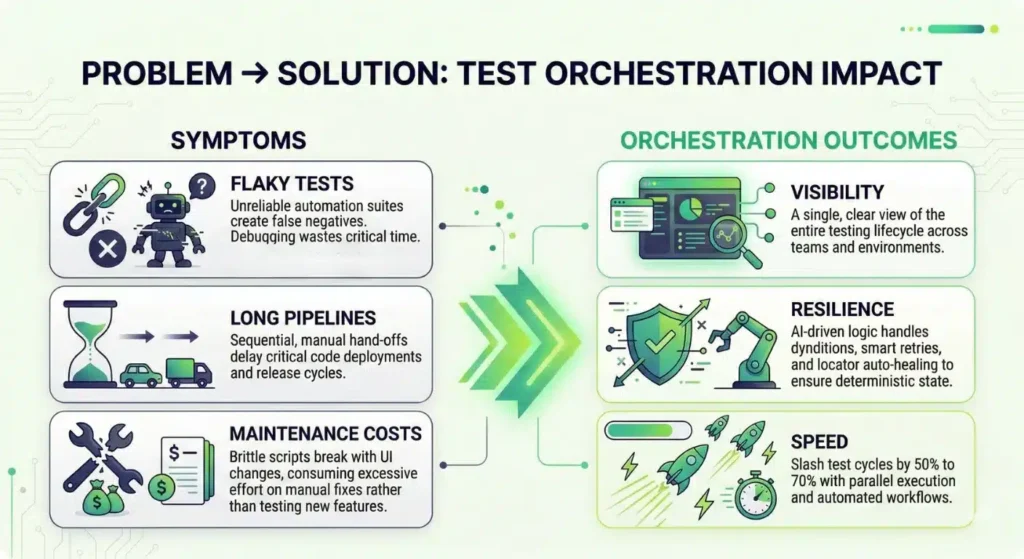
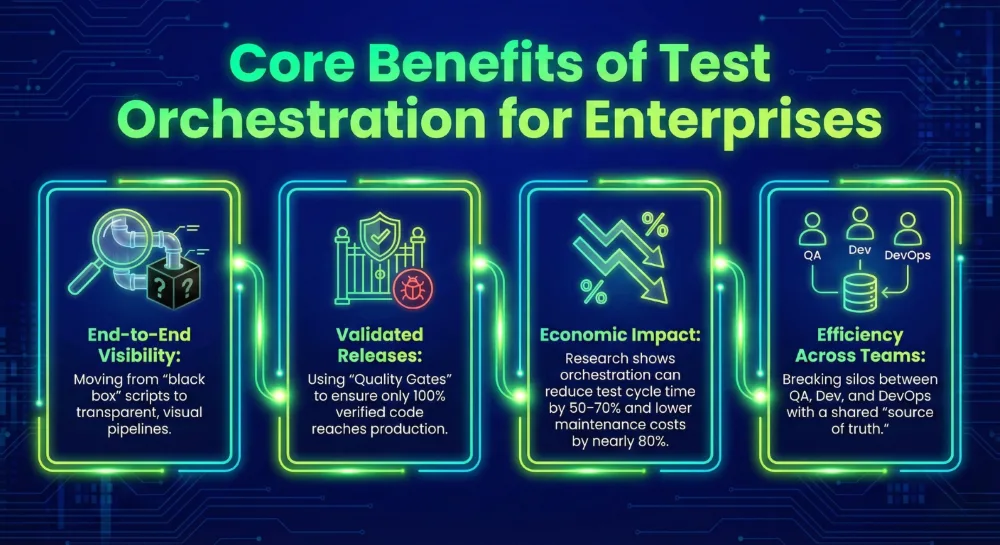
This shift reduces the “flakiness” that plagues most pipelines. When tests fail for non-functional reasons, it wastes developer time and slows down the release cycle. By coordinating the entire flow, orchestration cuts cycle times by 50% to 70% for many teams. 

Leaders prioritize orchestration because it lowers the defect escape rate. It creates a safety net that spans the entire software development lifecycle. You no longer hope that your components work together. You prove it. Consistent orchestration ensures that every code change undergoes rigorous validation across every layer of the system. 

Qyrus: The Modern Workflow-Driven Automation Platform 

Qyrus transforms testing from a collection of isolated tasks into a cohesive, managed system. It operates as a workflow-driven automation platform that integrates four core pillars: the visual Flow Hub, a centralized Data Hub, a powerful Orchestration Engine, and extensive third-party integrations. This structure allows teams to reduce manual testing efforts by 80% while maintaining total control over the release pipeline. Unlike standard tools that require heavy scripting to manage dependencies, Qyrus uses an AI decision layer to handle complex logic and environment promotion automatically. 

Flow Hub: Visual Logic Creation 

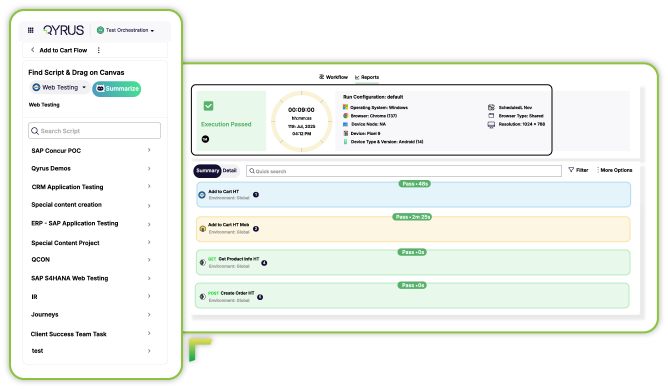
The Flow Hub serves as the primary workspace for your testing strategy. You drag and drop “Nodes”—individual units representing Web, Mobile, API, or Desktop scripts—and connect them to form a sequence. This visual approach allows QA experts to build sophisticated scenarios without writing a single line of code. Each node contains its own execution settings, allowing you to customize timeouts and skip conditions for every specific step. 

Data Hub & State Persistence 

Managing data dependencies often creates the biggest hurdle in automation. Qyrus simplifies this through a centralized Data Hub that supports Global, Workflow, and Step scopes. This ensures that an ID generated in an API test can move seamlessly into a Mobile or Web script. Furthermore, unique session persistence capabilities allow a single browser or device session to remain active across multiple scripts. This prevents the need for constant re-logins and ensures your tests mirror real user behavior. 

Resilience Patterns 

Flaky environments often derail even the best automation projects. Qyrus counters this with built-in resilience patterns, including “Retry with Backoff” and “Stop” actions. If an API call fails due to network lag, the platform automatically retries the operation using a linear or exponential delay. These patterns act as circuit breakers, preventing a single transient error from failing an entire multi-hour suite and saving your team hours of manual debugging. 

Integrations 

A platform must fit into your existing ecosystem to provide value. Qyrus connects directly with CI/CD tools and communication platforms like Slack and Microsoft Teams to keep stakeholders informed in real-time. It also supports major cloud providers and various test runners. This connectivity ensures that your orchestrated workflows remain a natural part of your DevOps stack. 

Core Features & How They Map to Enterprise Needs 

Enterprise testing requires more than just high-speed script execution. Large-scale organizations manage sprawling portfolios of legacy systems and modern microservices that must function in unison. Enterprise test orchestration software bridges this gap by addressing the specific structural failures that cause 73% of automation projects to fail. 

Visual Test Flows for Complex Coverage 

Most QA teams struggle to automate complex journeys because the underlying code becomes too brittle to maintain. Qyrus solves this through the Flow Hub. You drag and drop test nodes to map out the entire user journey visually. This approach enables teams to achieve higher coverage across multi-platform systems without the technical debt of thousands of lines of custom code. 

Conditional Logic for Environment-Aware Testing 

Tests often fail because they lack the intelligence to adapt to different environments. Logic control within the platform allows you to define “If-Then” scenarios. For example, a workflow can skip an email verification step in the Development environment but require it in Staging. This environment-aware testing ensures that the same workflow remains valid across the entire release pipeline. 

Session Persistence for True E2E Tests 

Standard automation tools usually restart the browser or clear the device cache between test scripts. This resets the user state and makes deep end-to-end testing nearly impossible. Qyrus maintains session persistence across Web, Mobile, and API tests. A single login at the start of a workflow carries through every subsequent node, mirroring exactly how a real customer interacts with your brand across different platforms. 

Data Hub for Deterministic State 

Inconsistent test data causes frequent false negatives. The Data Hub acts as a centralized repository that passes information, such as unique Order IDs or customer tokens, between steps. This ensures a deterministic state throughout the run. When every test uses fresh, accurate data from the previous step, you eliminate the “data pollution” that often breaks shared testing environments. 

Parallel Nodes for Faster Pipelines 

Cycle time remains the primary metric for DevOps success. Orchestration allows you to run independent test nodes in parallel rather than waiting for one to finish before starting the next. This capability significantly slashes execution time, helping teams meet the demand for daily or even hourly releases. 

AI Decisioning for Resilient Testing 

Flaky tests are a significant drain on resources, often consuming up to 16% of a developer’s time. Qyrus integrates an AI test orchestration platform layer to identify whether a failure is a genuine bug or a transient environment glitch. Smart retries and circuit-breaker patterns allow the system to recover from minor network lags automatically. This ensures your team only investigates real issues, which improves overall execution accuracy and builds trust in the automation suite. 

The AI Advantage: Why an AI Test Orchestration Platform Matters 

Traditional automation often collapses under the weight of flaky tests. When a locator changes or a network blips, scripts break and require manual fixes. An AI test orchestration platform solves this by introducing “self-healing” capabilities. If the system detects a modified UI element, it automatically updates the locator during execution to prevent a failure. This shift toward intelligence is why 76% of developers now use or plan to use AI tools in their development process. 

Smart classification provides the second major advantage. Instead of a generic “failed” report, the platform uses machine learning to categorize the root cause. It distinguishes between a transient environment glitch and a genuine code regression. This clarity allows teams to reduce triage time by up to 35%. You no longer waste hours investigating “ghost” failures that fix themselves on a rerun. 

Intelligence also optimizes how you run your tests. The platform analyzes historical data to prioritize high-risk areas. If a specific microservice fails frequently, the AI places those tests at the front of the queue. While the system handles these complex decisions, human oversight remains vital. The platform provides “Confidence Scores” for every automated decision, allowing QA leads to verify and approve major structural changes. This collaboration ensures that speed never comes at the cost of accuracy. 

The market reflects this move toward smarter systems. MarketsandMarkets expects the AI in software testing market to grow at a CAGR of 22.3% through 2032. By letting AI handle the routine repairs, your engineers can focus on designing better user experiences. 

Visual suggestion 

  • Flow with AI decision node: show a node that uses AI confidence to choose retry vs fallback. 
  • Placement: next to the AI section 

Typical Enterprise Use Cases & Playbooks 

Enterprise teams don’t just test features; they test business outcomes. A single user action often triggers a complex chain reaction across dozens of services, internal APIs, and legacy databases. Manually triggering these tests or relying on loosely coupled scripts leads to “blind spots” where integration failures hide. Orchestration provides a structured playbook for these high-stakes scenarios. 

Release Smoke + Regression Across 40 Microservices 

Large-scale applications now rely on hundreds of independent services. When a developer updates one microservice, you must validate how it interacts with the rest of the dependency graph. A workflow-driven automation platform allows you to chain contract tests, API mocks, and UI smoke tests into a single, synchronized flow.  

This coordinated approach helps companies achieve shorter test cycles by eliminating manual hand-offs between infrastructure and QA teams. 

The Resilient Payment Journey 

A standard checkout involves a UI interaction, an API call to a payment gateway, a ledger update, and a final customer notification. If the ledger update fails, the system shouldn’t just stop. Qyrus uses “circuit breaker” and “rollback compensation” patterns to manage these failures.  

If a critical step fails, the orchestrator can automatically trigger a compensating transaction or send an immediate high-priority alert to the DevOps team. This ensures that a failure in one layer doesn’t leave the system in an inconsistent state or corrupt customer data. 

Cross-Platform Continuity with Session Persistence 

Modern customers often start a journey on a mobile app and finish it on a desktop browser. Traditionally, testing this required two separate scripts with no shared data or session history. Enterprise test orchestration software changes this through session persistence.  

The orchestrator keeps the user logged in as the test moves from a mobile device to a web browser or a desktop application. This validates the true end-to-end experience and catches state-sync issues that isolated tests miss. By testing the way customers actually behave, you catch defects that usually escape to production. 

Security, Compliance & Enterprise Governance 

Enterprises in highly regulated sectors like finance and healthcare cannot compromise on data integrity. While cloud adoption grows, 90% of organizations will maintain hybrid cloud deployments through 2027 to meet strict residency and security requirements. Enterprise test orchestration software must provide the same level of control as the production environments it validates. A single data breach now costs companies an average of $4.4 million, and regulatory fines under frameworks like GDPR can reach 4% of global annual turnover. 

Governance and Data Control 

A workflow-driven automation platform acts as a secure vault for your testing assets. Qyrus handles sensitive information through dedicated credential management, ensuring that API keys and passwords never appear in plain text within test scripts. Role-Based Access Control (RBAC) limits visibility, so only authorized personnel can view or edit critical workflows in production-level environments. This prevents unauthorized changes and protects sensitive system configurations. 

Auditability and Segregation 

Regulated industries require a clear paper trail for every code change. The platform maintains detailed audit trails and activity logs that track who executed a test, what parameters they used, and when the run occurred. This transparency simplifies compliance audits and internal reviews.  

Furthermore, environment segregation prevents accidental cross-contamination between development, staging, and production tiers. By using data masking, teams can run realistic tests without exposing actual Personally Identifiable Information (PII) to the QA environment. This approach maintains the high standards of an AI test orchestration platform while protecting the organization from legal and financial risk. 

Migration Path: From Component Tests to Orchestrated Workflows 

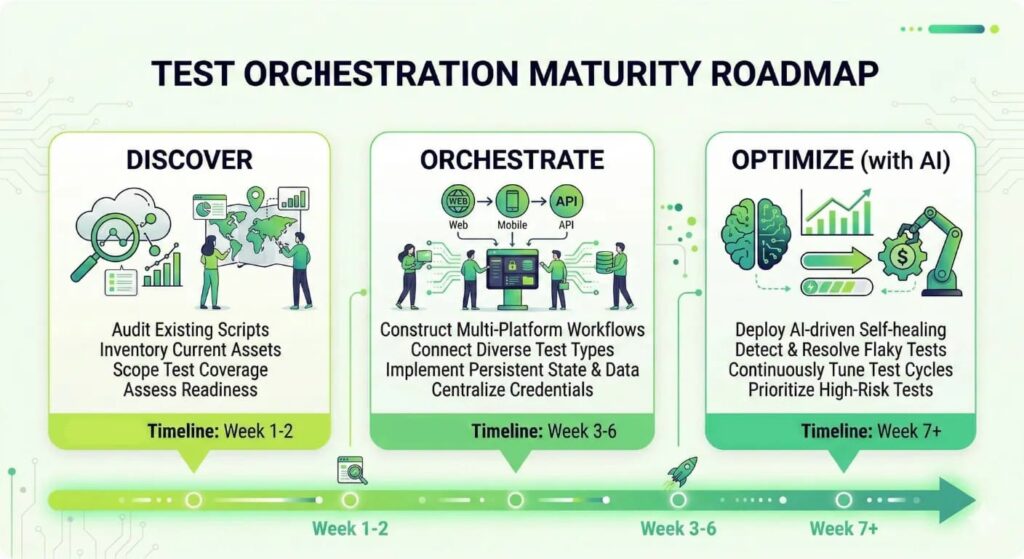
Transitioning from fragmented component testing to a structured workflow-driven automation platform requires a tactical, phased approach. Organizations cannot simply lift and shift every script overnight without creating technical debt. A successful migration moves through four distinct stages to ensure stability and immediate value. 

Stage 1: Inventory and Audit 

Begin by auditing your existing library of unit and functional scripts. Identify which tests provide the most value and which have become redundant or “flaky.” Statistics show that flaky tests consume up to 16% of a developer’s time, so this is the perfect moment to prune low-quality assets. Categorize your scripts by their role in the user journey to prepare them for the Flow Hub. 

Stage 2: Quick Wins with Smoke Workflows 

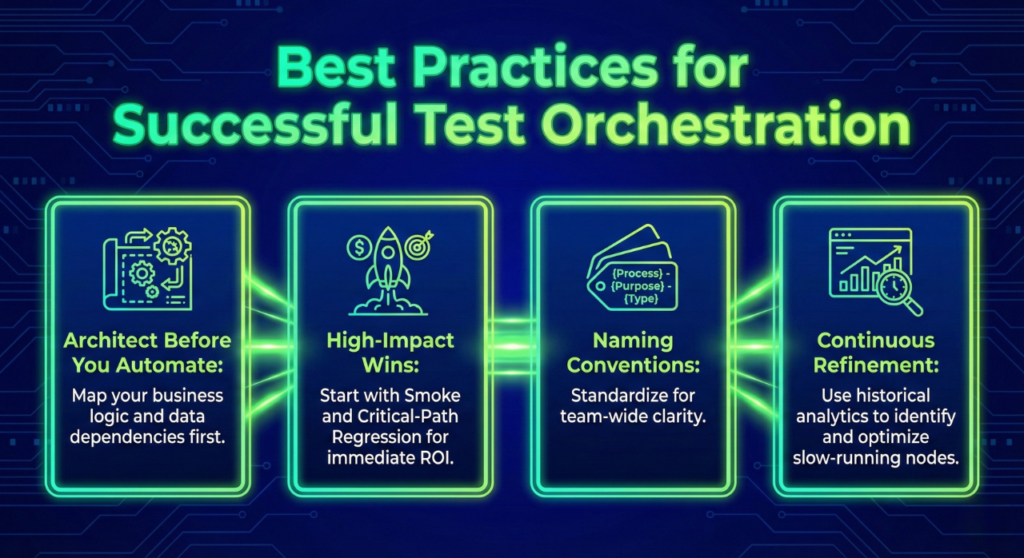
Do not attempt to orchestrate your entire regression suite on day one. Instead, focus on “quick wins” by building automated smoke tests for your most critical paths. Qyrus provides templates for login and session validation that allow teams to get up and running in just 1-2 hours. These high-visibility workflows demonstrate immediate ROI and build team confidence in the new system. 

Stage 3: Expanding Orchestrated Flows 

Once your smoke tests are stable, begin connecting more complex nodes. This stage involves using the Data Hub to pass information between Web, Mobile, and API scripts. Use session persistence to maintain a single user state across these platforms. Most enterprises find that coordinating these multi-component systems results in 50% to 70% shorter test cycles compared to their old manual hand-off processes. 

Stage 4: Optimize with an AI Test Orchestration Platform 

The final stage involves layering intelligence over your workflows. Enable smart retries and “retry with backoff” patterns to handle transient environment issues automatically. As the system gathers data, use the AI test orchestration platform capabilities to identify failure patterns and suggest locator fixes. This maturity level allows your team to stop “firefighting” and start focusing on strategic quality engineering. 

Migration Best Practices and Pitfalls 

Avoid the common pitfall of 1-to-1 script migration. Simply running an old script inside a new container does not capture the benefits of orchestration. Instead, re-think how those scripts should interact. Qyrus minimizes the technical burden by offering a managed migration process that typically requires only a 2-day downtime window to move all existing web scripts from old component services to the core orchestration engine. 

Quality Engineering: From Managing Scripts to Governing Systems 

Quality engineering moves from managing scripts to governing systems. Modern delivery pipelines demand more than isolated checks. They require a coordinated, intelligent strategy. Adopting enterprise test orchestration software allows your team to connect Web, Mobile, and API tests into one seamless journey. This shift removes the bottlenecks that prevent high-velocity releases. 

The financial and operational benefits remain high across all industries. Teams using a workflow-driven automation platform report shorter test cycles, lower maintenance costs, and reduced manual testing efforts. These improvements ensure your engineers spend their time building features rather than repairing brittle scripts. Early adoption provides a clear market advantage. Orchestration gives you the stability needed to release with absolute confidence. 

Take control of your testing lifecycle today with a demo of Qyrus Test Orchestration. 

Most engineering teams start with component testing because it feels safe. 

You test one module. One function. One service. You mock dependencies. You isolate behavior. The feedback loop is fast. Failures are easy to debug. Teams build confidence quickly. And at small scale, that confidence is justified. 

But I’ve seen this pattern shift dramatically once organizations move into enterprise territory — multiple microservices, shared environments, distributed teams, continuous deployment pipelines, and regulatory pressure. What once felt like disciplined engineering begins to expose cracks. The more components you add, the more those isolated tests start missing the bigger picture. 

That’s where the real component testing limitations begin to surface. 

Component tests validate logic. They do not validate behavior across systems. They do not validate workflow continuity. They do not validate production-like interactions between services, data stores, APIs, authentication layers, and user interfaces. 

At enterprise scale, software rarely fails inside a single component. It fails between components. And that’s exactly where traditional strategies struggle. 

Organizations continue to invest heavily in component-level validation. In fact, 82% of teams still rely heavily on manual or component-level testing, while only 45% have automated regression suites at scale, according to industry reports. 

This imbalance creates structural risk. 

Component testing builds a strong base in the testing pyramid. But when enterprises depend on it as the primary strategy, they encounter enterprise test automation challenges that no amount of isolated scripts can solve. 

Scalable test automation requires more than isolated verification. It requires coordination, orchestration, data continuity, and real system validation. And that is where traditional approaches start to break. 

What Component Testing Actually Covers — And What It Ignores 

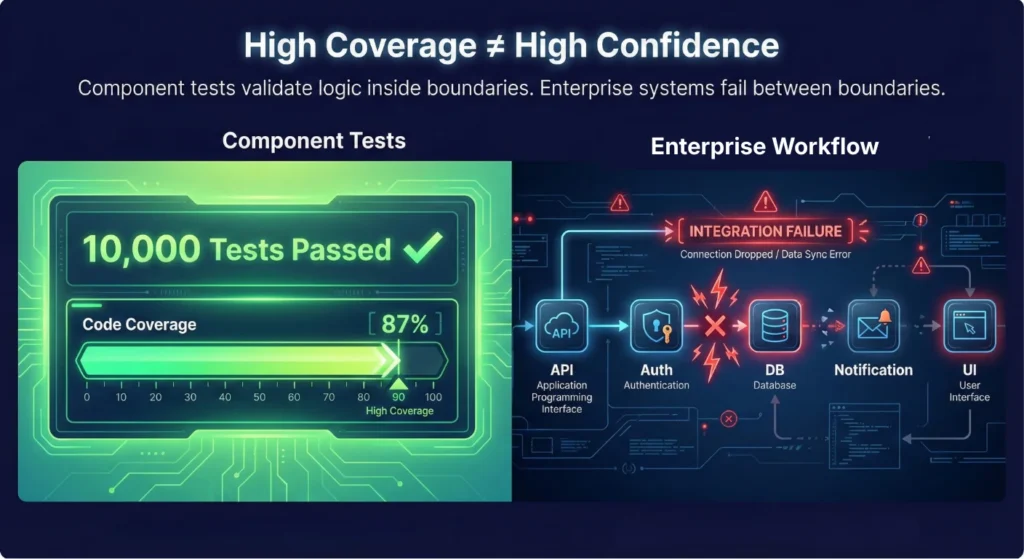
High coverage, low confidence

Component testing remains a foundational discipline in software engineering. It protects individual modules. It verifies business rules. It prevents regressions at the function or service level. 

But enterprise systems do not fail inside neat boundaries. They fail where systems connect. 

What Component Tests Do Well 

Component tests validate logic in isolation. Teams mock dependencies. They simulate external services. They inject test data directly into functions. They run thousands of tests in seconds. 

This approach gives developers confidence during rapid development cycles. It supports continuous integration. It reduces debugging time when something breaks. 

And for small systems, this works exceptionally well. 

Component testing strengthens the base of the testing pyramid. It provides early feedback. It improves code reliability. It reduces simple defects. 

But it assumes isolation reflects reality. 

Enterprise software rarely operates in isolation. 

What Component Tests Cannot See 

Once systems grow into distributed architectures, the blind spots become obvious. 

Component tests do not validate: 

  • Service-to-service communication failures 
  • Schema mismatches between APIs 
  • Authentication token expiry issues 
  • Database constraint conflicts across workflows 
  • Race conditions in asynchronous flows 
  • Real user journeys across multiple systems 

In microservices environments, failures typically occur between components, not within them. 

Industry benchmarks reinforce this risk. High-performing organizations maintain defect leakage under 2%, and most enterprises aim to keep it below 5%, according to the Capgemini World Quality Report. When teams rely heavily on isolated testing, integration defects frequently escape detection until staging or production. 

That gap represents one of the most critical component testing limitations. 

The Coverage Illusion in Enterprise Systems 

Strong component coverage creates an illusion of safety. 

A codebase may show thousands of passing tests. Dashboards may display green builds. Yet real workflows remain untested. 

Only 19.3% of organizations report automating more than half of their codebase. Even within that minority, automation often concentrates at the unit or component level rather than at workflow or integration layers. 

This imbalance creates enterprise test automation challenges that surface late in the release cycle. 

Component testing verifies correctness inside boundaries. Scalable test automation must verify correctness across boundaries. That shift requires coordination, state management, environment awareness, and execution control — capabilities that isolated tests do not provide. 

Many teams assume strong component coverage equals strong system quality. Yet overall automation coverage remains limited across the industry. Only 19.3% of organizations report automating more than half of their codebase, according to a report. That gap often reflects the difficulty of moving beyond isolated tests into integrated validation. 

The result? A testing strategy that looks robust on paper but leaves workflow-level risks exposed. This is where scalable test automation begins to demand more than component verification. It demands system-level validation that mirrors production behavior. 

And once enterprises attempt that transition, the next challenge emerges: instability. 

The Flaky Test Problem: When Isolation Starts Working Against You 

Hidden Cost of Flaky Tests

As test suites grow, instability creeps in. 

At first, it appears harmless. A test fails once. You rerun it. It passes. The team shrugs and moves on. 

But at enterprise scale, flakiness compounds. What begins as a minor annoyance becomes a systemic drain on productivity and trust. 

Flaky Tests Are Not a Minor Irritation 

A flaky test fails without a real defect in the code. It might fail due to timing issues, environmental variability, network latency, or improper mocking. 

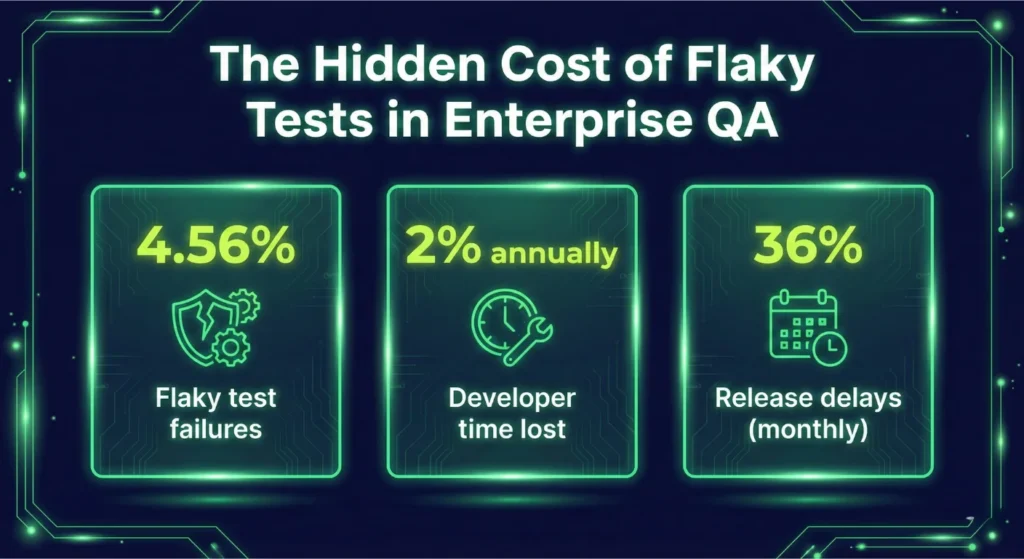
In isolation-heavy strategies, these issues multiply. Research from Google Engineering found that 4.56% of all test failures were caused by flaky tests, consuming approximately 2% of total developer time. 

Two percent may sound small. For a 100-engineer organization, that equals two full-time engineers spending their year diagnosing unreliable tests instead of building features. 

This represents one of the most underestimated enterprise test automation challenges. 

CI Pipelines Become Noise Machines 

As component tests scale into thousands, CI systems begin to amplify instability. 

Developers lose confidence in red builds. They rerun pipelines instead of investigating failures. Real defects hide behind intermittent noise. According to the GitLab Global DevSecOps Report, 36% of developers experience release delays at least monthly due to CI test failures. 

When instability affects releases, leadership notices. Frequent false alarms create operational drag. Teams slow down deployments. They hesitate to merge. They delay releases “just to be safe.” 

Ironically, a system designed to improve confidence begins to erode it. 

Isolation Does Not Prevent Instability — It Can Cause It 

Many teams assume that component tests are inherently stable because they run in controlled environments. 

In practice, excessive mocking and artificial setups introduce their own fragility. Mocks drift from real contracts. Dependencies change without synchronized updates. Data fixtures grow complex. Timing assumptions become brittle. 

Mozilla reported that fixing flaky tests improved developer confidence by 29% and significantly reduced escaped defects. 

The lesson is clear. Flakiness is not just a technical nuisance. It directly affects morale, productivity, and quality outcomes. 

And when component-heavy strategies dominate without orchestration and integration controls, flakiness scales with them. This is where scalable test automation demands coordination — retry logic, dependency awareness, environment control, and execution governance. 

Without those controls, enterprises end up managing instability instead of preventing it. 

The Hidden Cost: Maintenance Becomes the Real Project 

Maintenance becomes main job

Component testing does not fail overnight. It fails gradually — through maintenance. 

At small scale, updating a few mocks or fixing broken assertions feels manageable. At enterprise scale, maintenance transforms into a parallel engineering effort. 

And in many organizations, it quietly becomes the dominant one. 

Test Maintenance Starts Consuming Engineering Capacity 

Enterprise teams often underestimate how much effort they spend maintaining automated tests. 

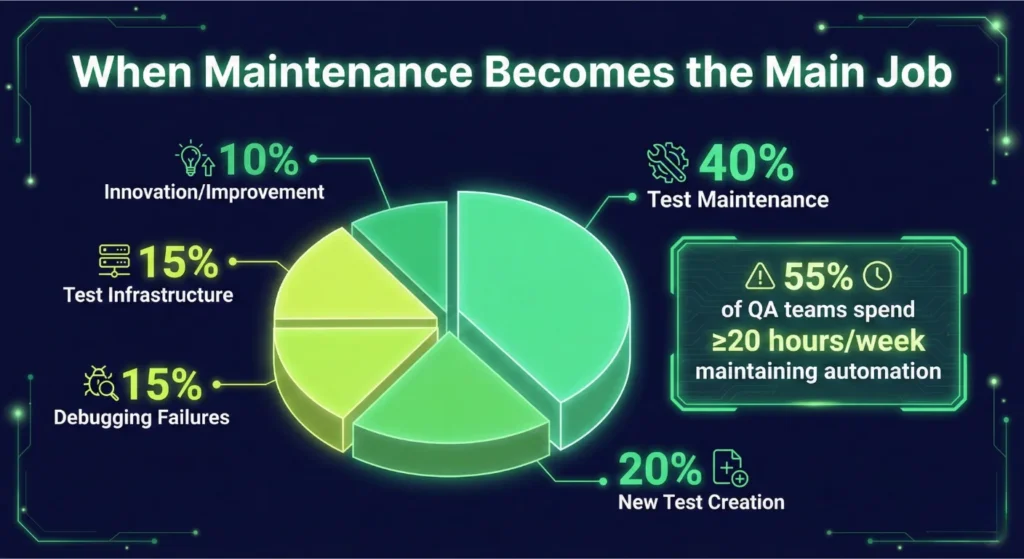
According to the PractiTest State of Testing Report, 55% of QA teams spend at least 20 hours per week maintaining automated tests. 

That is half a workweek. Not writing new tests. Not improving coverage. Not optimizing pipelines. Maintaining what already exists. 

In more complex enterprise environments, the numbers grow even more alarming. A Fortune 500 case study documented engineers spending 67–89 hours per week maintaining automation suites. 

That is not sustainable engineering. That is operational drag. This maintenance burden represents one of the most overlooked component testing limitations. 

Flakiness Multiplies Maintenance Effort 

Flaky tests amplify the problem. 

Google’s research shows flaky tests consume approximately 2% of total developer time annually, which equates to the output of a full-time engineer per 50 developers. In enterprise environments with hundreds of engineers, this compounds quickly. 

Every unstable test demands: 

  • Investigation 
  • Log analysis 
  • Reproduction attempts 
  • Temporary disabling 
  • Rewriting fixtures 
  • Updating mocks 

Multiply that across thousands of component tests and dozens of services, and scalable test automation begins to feel less scalable. Instead of accelerating delivery, automation becomes a maintenance ecosystem that teams constantly repair. 

Mocking at Scale Creates Structural Fragility 

Component testing relies heavily on mocks and stubs. At a small scale, that improves speed and focus. At enterprise scale, mocks drift from real behavior. Contracts change. APIs evolve. Data schemas update. Dependencies move independently across teams. 

Component tests continue to pass because they validate mocked behavior — not real system interaction. This creates a dangerous disconnect. 

Teams assume coverage is strong. Dashboards show green builds. Meanwhile, production failures reveal integration gaps that mocks never captured. 

Enterprise test automation challenges rarely originate from single modules. They originate from integration complexity. And maintaining isolated tests without systemic coordination only delays the inevitable. 

Maintenance is not just a technical inconvenience. It affects velocity. It affects cost. It affects release predictability. 

When automation maintenance consumes engineering bandwidth, organizations face a critical decision: Continue scaling component tests — or redesign the strategy for coordination and resilience. 

When Speed Turns into a Bottleneck: The Scalability Trap 

Scaling Tests

Component tests run fast. That is one of their strongest advantages. 

A single unit test completes in milliseconds. Thousands of them finish in seconds. Developers rely on that speed to keep feedback loops tight. 

But the scale changes the equation. Speed per test does not equal speed per pipeline. 

More Tests Do Not Automatically Mean Faster Delivery 

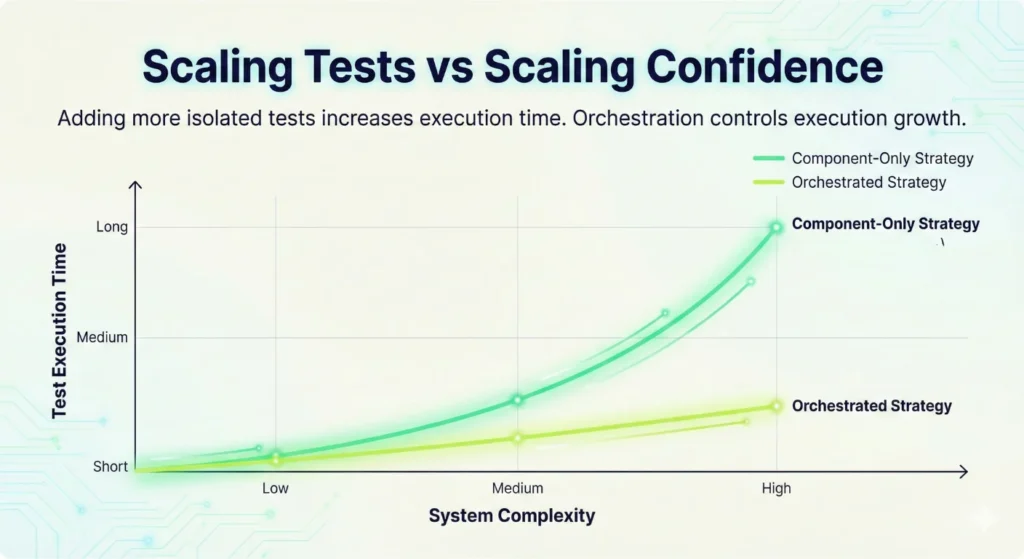
As systems expand, teams add more component tests to protect new services, new endpoints, and new edge cases. Test count grows linearly. Infrastructure demand grows with it. CI pipelines lengthen. Parallelization becomes mandatory. 

CircleCI notes that 10,000 unit tests can execute in approximately 30 seconds, but achieving equivalent workflow coverage through higher-level tests can take hours. 

The lesson is not that unit tests are bad. The lesson is that volume alone does not guarantee system confidence. 

When enterprises attempt to compensate for integration gaps by writing more component tests, they create execution pressure without solving coverage gaps. 

That is not scalable test automation. That is test inflation. 

Integration Complexity Extends Execution Time 

Enterprise systems rarely consist of simple synchronous flows. 

They include: 

  • Distributed services 
  • Event-driven messaging 
  • Database replication 
  • API gateways 
  • External integrations 
  • Identity providers 

Testing real system behavior requires environment coordination. Integration-level tests frequently move execution time from milliseconds into seconds or minutes due to environmental dependencies and real system interaction. 

When teams attempt to simulate these interactions inside component tests through heavy mocking, they trade execution time for artificial confidence. When they test them at integration level without orchestration, pipelines stall. 

Either way, enterprises face enterprise test automation challenges that isolated strategies cannot absorb efficiently. 

Pipeline Instability Slows the Organization 

As execution time increases, teams introduce workarounds: 

  • Split test suites 
  • Run nightly builds instead of per-commit 
  • Reduce test coverage in feature branches 
  • Disable unstable tests 

Each workaround introduces risk. 

Eventually, pipeline duration becomes a business metric. Leadership questions why releases take longer. Developers feel friction in every merge. 

Component testing alone does not create this bottleneck. But scaling it without orchestration does. 

Scalable test automation requires intelligent sequencing, parallelization strategies, environment provisioning, and workflow coordination. Without those controls, test execution grows faster than delivery capacity. 

And when testing becomes the slowest step in the pipeline, teams either slow down — or bypass quality gates. Neither option supports enterprise reliability. 

The Strategic Shift: From Isolated Tests to Orchestrated Workflows 

Enterprise teams do not struggle because they lack tests. They struggle because their tests do not operate as a system. 

Component testing protects logic. It does not coordinate environments. It does not manage state across workflows. It does not intelligently route failures. It does not sequence dependent validations across services. And it does not provide visibility into end-to-end execution health. 

That gap is exactly where modern enterprises experience friction. Scalable test automation requires more than scripts. It requires workflow intelligence. 

It requires: 

  • Coordinated execution across services 
  • Real-time decision logic 
  • Environment-aware workflows 
  • Data propagation across stages 
  • Built-in retry and failure strategies 
  • Cross-platform validation across web, mobile, API, and desktop 

This is not an incremental improvement to component testing. It is a structural upgrade. And this is where Test Orchestration becomes critical. 

Why Qyrus Test Orchestration Changes the Equation 

Qyrus Test Orchestration was designed for enterprise systems that outgrew isolated automation. Instead of running disconnected test scripts, Qyrus enables workflow-based execution that mirrors how real systems behave. 

With Qyrus, teams can: 

  • Build visual test flows that coordinate complex scenarios 
  • Execute conditional branching based on real-time outcomes 
  • Maintain state and session continuity across steps 
  • Parallelize independent nodes to reduce execution time 
  • Apply retry logic and fallback strategies intelligently 
  • Manage environments centrally across Dev, QA, Staging, and Production 

This approach directly addresses the core component testing limitations discussed throughout this article. 

It transforms automation from a collection of scripts into an execution framework. That is the difference between having tests — and having confidence.  

For enterprises facing enterprise test automation challenges, orchestration provides clarity where isolation creates blind spots. It aligns automation with system architecture. And when automation aligns with architecture, it becomes sustainable. 

Stop Scaling Tests. Start Scaling Confidence. 

Component testing remains essential. But enterprise systems demand more. 

  • They demand validation across boundaries. 
  • They demand coordinated workflows. 
  • They demand resilience under real-world conditions. 

Organizations that continue scaling isolated tests will continue fighting maintenance, flakiness, and execution bottlenecks. 

Organizations that adopt orchestrated, scalable test automation build release confidence at speed. The choice is strategic. 

If your team is experiencing growing pipeline instability, rising maintenance costs, or integration defects slipping into staging, it is time to rethink the structure of your automation. 

Not by adding more component tests. But by orchestrating them. 

Ready to Move Beyond Isolated Testing? 

See how Qyrus Test Orchestration helps enterprise teams coordinate complex workflows, reduce instability, and scale automation intelligently. Try Qyrus Test Orchestration and experience workflow-driven automation built for enterprise scale. 

Welcome to our February update!  

This month, we are shifting gears to focus on velocity, volume, and smarter orchestration. As your testing needs grow more complex, your tools need to be faster and more flexible to keep up. We’ve listened closely to your feedback and delivered a set of powerful enhancements designed to remove bottlenecks, streamline management, and give you total command over your execution strategy. 

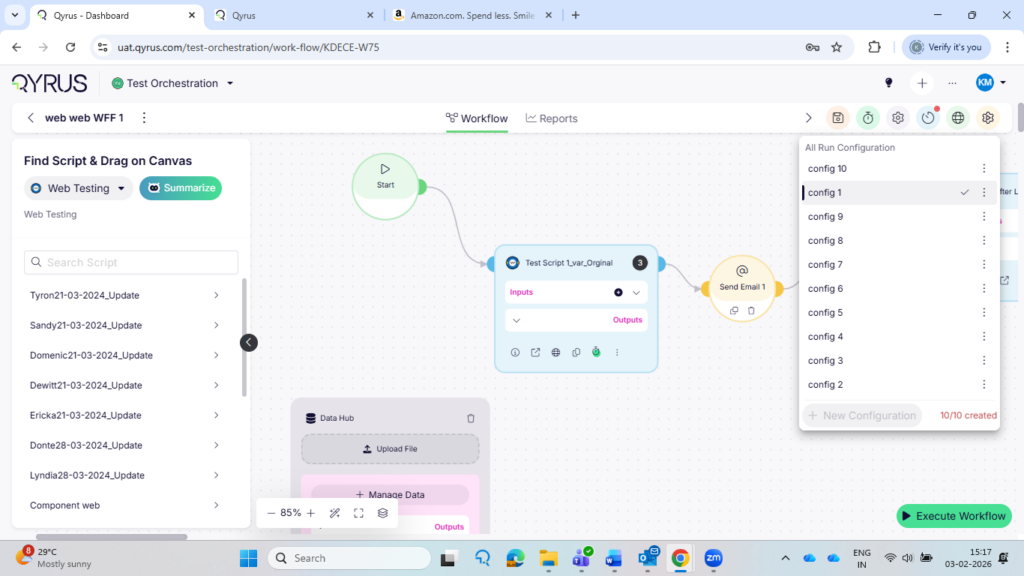
In this release, we’ve supercharged Test Orchestration by tripling your configuration limits and unlocking the ability to execute multiple workflows simultaneously. We’ve also brought massive performance improvements to the workflow canvas, ensuring even the most complex tests load instantly.  

On the execution front, you now have the power to bulk stop and delete web tests, while our new smart variable fallback ensures your environments are easier to manage than ever. Whether you are scaling up load tests or fine-tuning API timing with new Wait nodes, February is all about helping you test smarter and faster. 

Let’s dive into the powerful new capabilities arriving on the Qyrus platform this month! 

Web Testing

Take Command: Bulk Stop & Delete for Web Tests! 

Bulk Stop & Delete for Web Tests

The Challenge:  

Previously, managing test execution queues could be a tedious, manual process. If you accidentally triggered a massive suite with the wrong configuration, or if a set of tests stalled while allocating browsers, you were often forced to stop them one by one. This inability to mass-cancel or clean up runs meant valuable concurrency slots were tied up unnecessarily, and report dashboards became cluttered with irrelevant data. 

The Fix:  

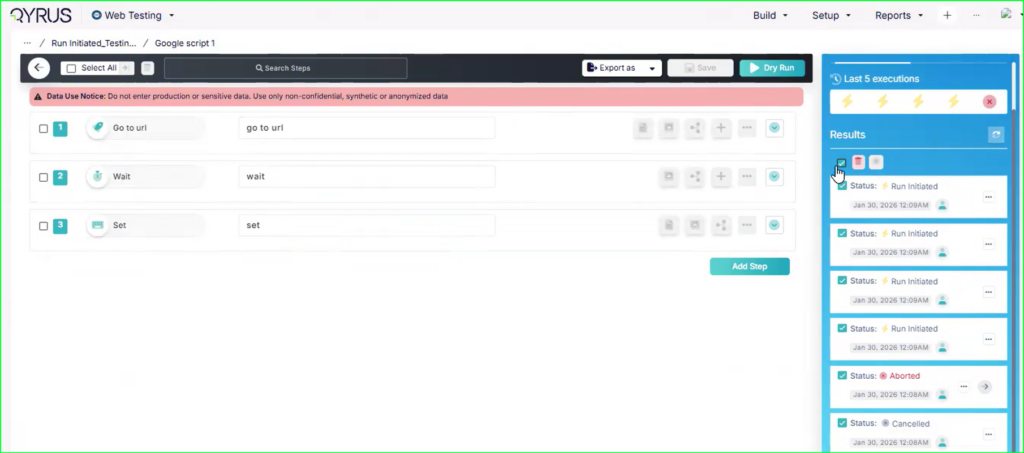
We have implemented a robust Bulk Stop and Delete functionality for Web Tests. You now have granular control over your execution queue: 

  • Selective Control: Select specific multiple tests or choose “Select All” to perform actions in bulk. 
  • Immediate Action: Instantly Stop running tests (updating them to “CANCELLED” or “ABORTED”) or Delete old runs to clean up your view. 
  • Broad Coverage: This works across various early-stage statuses like “Run Initiated,” “Allocating Browsers,” and “Running,” ensuring you can pull the plug before resources are wasted. (Note: Runs already generating reports will complete to ensure data integrity). 

How will it help?  

This feature gives you immediate command over your testing resources. 

  • Save Concurrency: Instantly free up browser slots by cancelling accidental or stuck runs in bulk, allowing legitimate tests to run sooner. 
  • Faster Cleanup: Keep your reporting dashboard organized by quickly deleting batches of irrelevant or failed execution entries. 
  • Safety First: Includes confirmation prompts to prevent accidental mass deletions, giving you confidence while managing high volumes of tests. 

Smart Variable Resolution: Global Fallback Now Active! 

The Challenge:  

Managing test data across multiple environments (SIT, UAT, Pre-Prod) often resulted in unnecessary redundancy. If you had a variable that was constant across all environments—like a shared API key or a common database URL—you were previously forced to define that same variable repeatedly inside every single environment profile. This not only cluttered your workspace but also made maintenance a nightmare; updating a shared value meant editing five different files instead of just one. 

The Fix:  

We have introduced a smart fallback mechanism for environment variables. The system now employs a hierarchical lookup logic during execution. When a test step requests a variable, the system first checks your currently selected environment (e.g., SIT). If the key is missing there, it automatically “falls back” and retrieves the value from your Global environment. 

How will it help?  

This update brings the “Don’t Repeat Yourself” (DRY) principle to your test configuration. 

  • Reduce Redundancy: Define shared values (like standard timeouts or common endpoints) once in the Global profile, and they automatically work everywhere. 
  • Simplify Maintenance: Update a shared credential in one place, and the change propagates instantly to all environments that don’t override it. 
  • Cleaner Configuration: Keep your environment-specific profiles focused only on what actually changes between environments (like URLs or user accounts), keeping your setup lean and readable. 

Expand Your Reach: Run 10 Configurations in a Single Workflow! 

Run 10 Configurations in a Single Workflow

The Challenge:  

Previously, test workflows were limited to a maximum of 3 configurations. For global teams needing to validate scripts across multiple markets or environments simultaneously, this limit was a major bottleneck. Users were forced to fragment their testing into multiple separate schedules or workflows just to cover all their required bases, creating unnecessary management overhead and “configuration dependencies.” 

The Fix:  

We have more than tripled the capacity for workflow customizations. You can now add up to 10 unique Run Configurations (Global Environment Configurations) within a single workflow. 

How will it help?  

This update streamlines your global testing strategy. 

  • One Schedule, All Markets: You can now validate a script across up to 10 different markets or environments in a single scheduled run. 
  • Reduced Clutter: Eliminate the need to create duplicate workflows just to bypass the previous limit. 
  • Simplified Management: Manage your entire multi-region or multi-config test strategy from a centralized, single pane of glass. 

Orchestrate at Scale: Execute Multiple Workflows Simultaneously! 

Execute Multiple Workflows Simultaneously

The Challenge:  

Previously, Test Orchestration was limited to a “one-at-a-time” execution model. If you had 20 different workflows that needed to run daily or weekly, you had to manually trigger or schedule each one individually. There was no mechanism to group them together and say “Run all of these now,” which made managing large-scale, recurring test cycles incredibly tedious and time-consuming. 

 The Fix:  

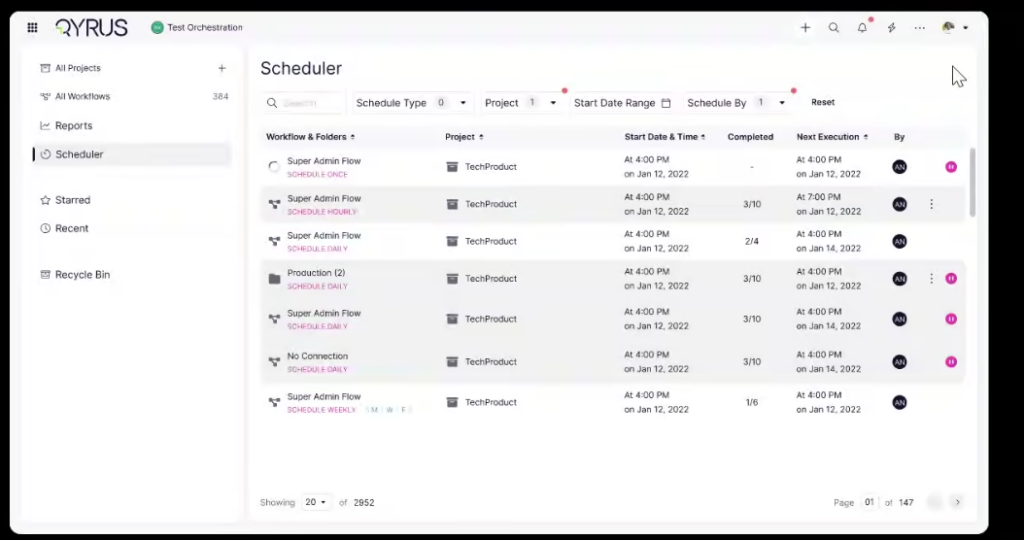
We have unlocked the ability to execute and schedule multiple workflows simultaneously. You can now select multiple workflows—whether they reside within a single folder or are scattered across different folders—and trigger them all in one go with their respective global environment configurations. 

 How will it help?  

This update transforms Test Orchestration into a true bulk-management tool. 

  • Massive Efficiency: Trigger your entire daily or weekly regression suite with a single click, rather than dozens. 
  • Parallel Execution: Leverage your grid’s full potential by spinning up multiple workflows at once. 
  • Simplified Scheduling: Set up complex, multi-workflow schedules easily, ensuring all your critical tests run exactly when they need to without manual intervention. 

Turbocharged Canvas: Load Complex Workflows Instantly!

The Challenge:  

As workflows grew in complexity with hundreds of steps and linkages, the Test Orchestration canvas struggled to keep up. Users with large projects (like those at Finzly) experienced frustrating load times—sometimes exceeding 15 minutes—or faced “Page Unresponsive” errors and browser timeouts. The sheer volume of data being rendered at once made the interface laggy and difficult to navigate. 

 The Fix:  

We have engineered a massive performance overhaul for the workflow builder. 

  • Web Workers: We now offload heavy processing tasks to background threads, keeping the UI responsive. 
  • Smart Rendering: We implemented incremental loading and pagination for IO variables, meaning the system only renders what you currently see or need, rather than trying to load the entire universe at once. 
  • Optimized Scroll: Navigation is now buttery smooth, even in massive workflows, thanks to optimized scroll performance and differential loading. 

 How will it help?  

This update transforms the user experience from “waiting” to “working.” 

  • Zero Wait Time: Open even your most complex workflows in seconds, not minutes. 
  • Stability: Eliminate browser crashes and “Unresponsive” errors, no matter how large your test logic grows. 
  • Fluid Experience: Zoom, scroll, and build without lag, allowing you to focus on orchestration rather than fighting the interface. 

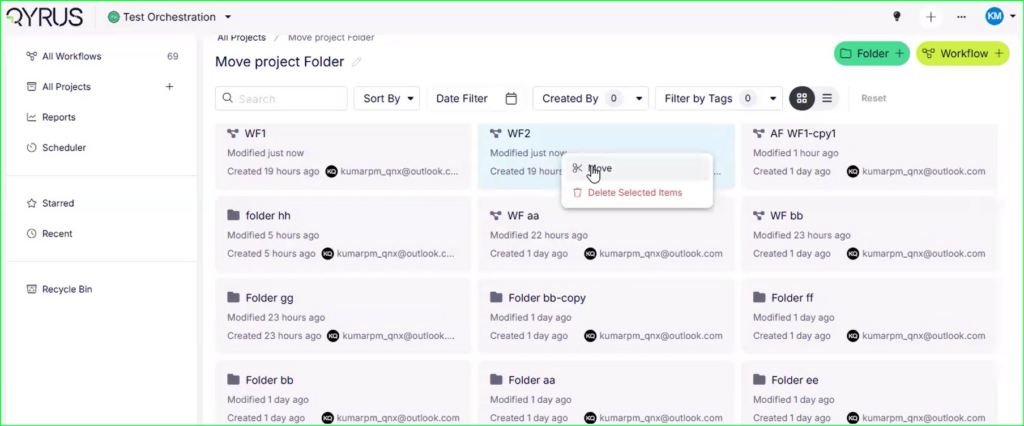
Organize with Ease: Move Multiple Workflows & Folders!

Move Multiple Workflows & Folders

The Challenge:  

As projects grew, test hierarchies often became cluttered or outdated. Previously, reorganizing these assets was a rigid and painful process. Users could not easily shift multiple workflows or folders to new locations in bulk. If you wanted to restructure your project or move a set of regression tests to a different folder, you were often stuck moving items one by one or, worse, having to recreate them in the new location. 

 The Fix:  

We have introduced Multi-Select and Move functionality for Test Orchestration. You can now hold Ctrl (or Cmd) and click to select multiple workflows or folders at once. With a simple right-click action, you can move these selected items in bulk to any other folder or project within your workspace. 

 How will it help?  

This update gives you the freedom to restructure your work as your project evolves. 

  • Declutter Your Workspace: Easily clean up messy projects by grouping related workflows into specific folders. 
  • Bulk Management: Save time by moving dozens of items at once instead of painstakingly reorganizing them individually. 
  • Project Refactoring: Seamlessly migrate workflows between projects or folders as your team’s testing strategy changes. 

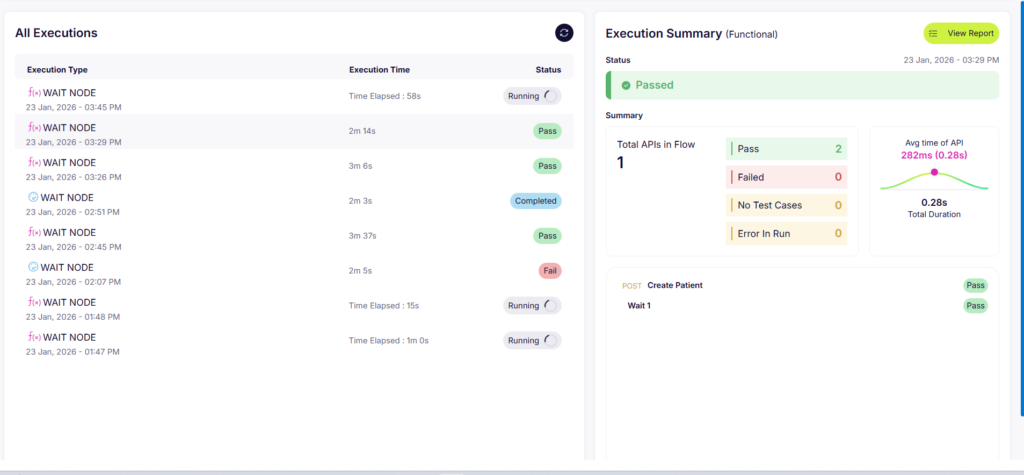
Master the Clock: Wait Nodes Now Available in API Workflows!

Wait Nodes Now Available in API Workflows

The Challenge:  

In real-world scenarios, systems don’t always respond instantly. A database might take a few seconds to update after a POST request, or a third-party service might need a moment to process a webhook. Previously, API workflows in QAPI executed steps as fast as possible. This speed often caused “flaky” tests—where a step would fail simply because the backend wasn’t quite ready yet—or resulted in unrealistic performance tests that hammered the server with unnatural intensity. 

 The Fix:  

We have introduced a dedicated Wait Node to the API workflow builder. This feature is available for both Functional and Performance testing types. You can now drag and drop a wait step anywhere in your flow to pause execution for a specific duration. 

 How will it help?  

This update gives you precise control over the timing of your tests. 

  • Eliminate Flakiness: Give your backend the time it needs to process asynchronous tasks (like database writes or queue processing) before the next validation step runs. 
  • Realistic Performance Testing: Simulate “think time”—the natural pauses a real user takes between actions—to create more accurate and realistic load scenarios. 
  • Better Orchestration: easily handle race conditions and timing-dependent logic without writing custom scripts. 

Ready to Leverage February’s Innovations? 

We are committed to providing a unified platform that not only adapts to your evolving needs but also streamlines your critical processes, empowering you to release high-quality software with greater speed and confidence. 

Eager to explore how these advancements can transform your testing efforts? The best way to appreciate the Qyrus difference is to experience these new capabilities directly. 

Ready to dive deeper or get started? 

Automated testing stands as a cornerstone of modern software delivery, yet many organizations find themselves hitting a “scaling wall” where more scripts no longer equal better quality. While many developers now participate in DevOps-related activities, traditional test automation often becomes a bottleneck in high-velocity environments. It focuses on isolated tasks—a single login check or an API call—but fails to account for the complex choreography required by today’s distributed systems. 

Enterprises are shifting from monoliths to microservices at a staggering rate, with the average number of applications in an enterprise growing to 957 in a single year. In this environment, running tests in a “fire and forget” fashion leads to fragmented results and massive maintenance overhead. Research shows that 73% of test automation projects fail because they lack a cohesive strategy to manage coordination, visibility, and architectural value. 

Test orchestration represents the strategic evolution of quality assurance. It provides the “connective tissue” that manages how, when, and where tests execute across disparate systems. While automation handles the individual tasks, orchestration ensures those tasks run in a controlled, synchronous process that validates entire business workflows. Without this coordination, teams remain trapped in a cycle of manual syncing and environment drift. 

The Atomic Unit: What is Test Automation? 

Test automation focuses on the execution of individual scripts to verify specific outcomes without human intervention. QA engineers typically use this to handle repetitive, well-defined tasks like regression checks or unit tests. By scripting these steps—such as clicking a button or sending an API call—teams improve consistency and allow for more frequent runs. 

Traditional automation relies on specific frameworks and tools: 

  • Test Scripts: Engineers write code using frameworks like Selenium for web UI, Appium for mobile apps, or JUnit and PyTest for unit-level validation. 
  • Isolated Execution: Each test generally runs independently or as a simple linear suite triggered by a code commit or a manual prompt. 
  • Individual Reporting: Tools provide pass/fail logs for the specific job at hand, rather than a holistic view of the entire system’s health. 

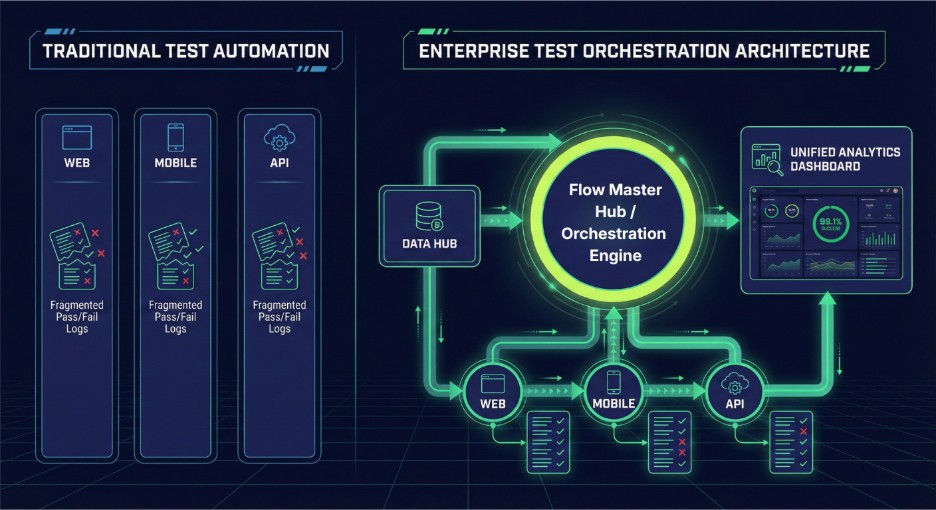
While automation speeds up testing and reduces manual effort, it operates in a vacuum. In complex enterprise automation architecture, these isolated scripts often lead to “maintenance death spirals” where teams spend more time fixing brittle locators than building new features. Global studies indicate that the average level of test automation remains around 44%, meaning more than half of all testing effort is still manual due to these scaling challenges. 

The Command Center: What is Test Orchestration? 

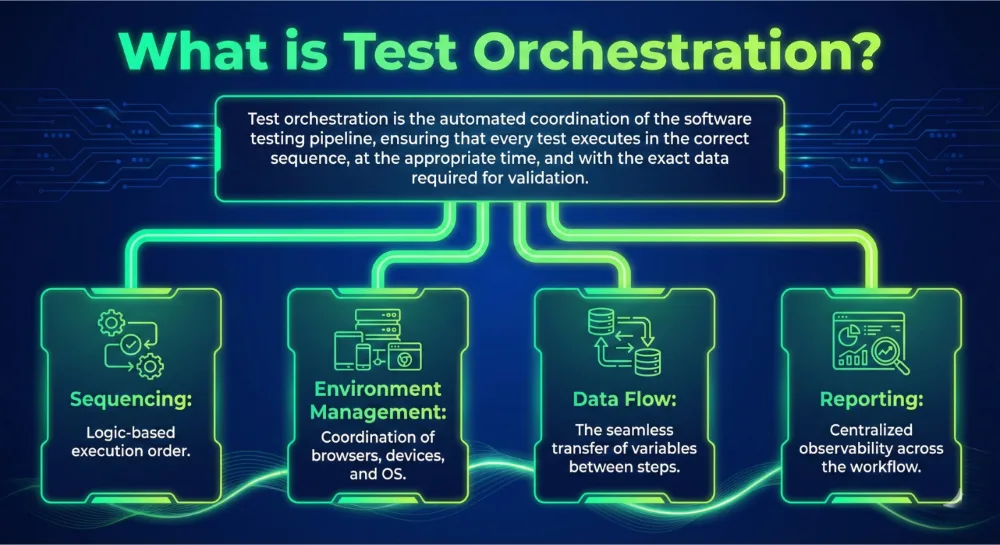
If automation provides the tools to run a test, orchestration provides the process to run hundreds of tests together in a controlled, intelligent sequence. Test orchestration is the automated coordination of your entire testing pipeline, ensuring the right tests run in the right order, in the correct environments, with shared data and unified reporting. It acts as a system-level coordination layer that manages end-to-end workflow orchestration testing across distributed microservices and multi-tier applications. 

Key capabilities that define a true orchestration layer include: 

  • Intelligent Sequencing and Dependency Management: Orchestration defines complex dependency graphs, allowing teams to model pipelines as specific workflows—such as running service-level tests in parallel only after shared component checks pass. 
  • Contextual Data Propagation: Unlike siloed scripts, orchestration enables “context data sharing,” where transaction IDs or session tokens generated in one stage automatically flow into the next. 
  • Environment Coordination: Orchestration engines automatically provision and tear down ephemeral test environments, enforcing consistency to prevent the “environment drift” that plagues manual setups. 
  • Logical Control and SmartFlow Mapping: Modern orchestration uses action nodes like conditional branching (If/Else), retries for transient failures, and “Stop” actions to halt pipelines on critical errors. 

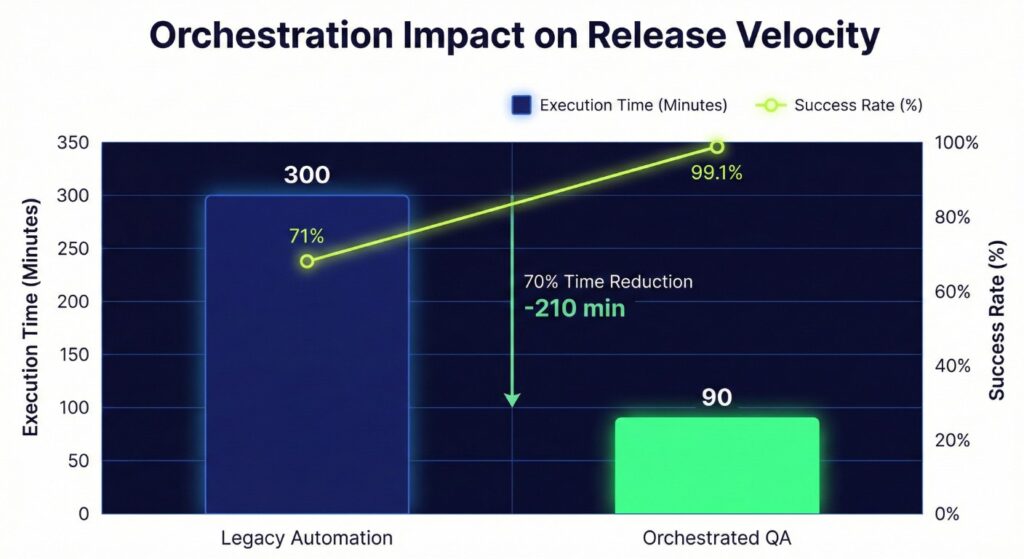
Organizations that move beyond simple triggers to full orchestration see immediate results. Research indicates that 36.5% of organizations still lack any orchestration, leaving them with brittle pipelines and long queues. However, those who implement dedicated orchestration platforms can achieve up to a 90% reduction in execution time by moving from sequential to adaptive parallel execution. 

Test Orchestration vs Test Automation: A Strategic Comparison 

Understanding the technical boundaries between these two paradigms is essential for building a resilient enterprise automation architecture. While automation answers “how do we execute without manual intervention,” orchestration answers “how do tests run together in a synchronous process”. 

The following table breaks down the core functional differences: 

Core Functional differences :

FeatureTest Automation Test Orchestration
Scope Atomic (Single scripts or suites) Holistic (End-to-end workflows)
Data Management Often hardcoded or siloed per test Dynamic "Data Hub" & variable propagation
Environment Handling Static, pre-configured environments Dynamic provisioning and coordination
Integration Limited to basic CI triggers Deep CI/CD + cross-platform toolchain
Logic Minimal/Linear Conditional branching (If/Else, Switch)
Decision Making Manual quality gating often required Automated conditional progression

Standalone automation typically generates fragmented pass/fail logs for individual tools. This forces engineers to waste hours daily “hunting for logs” across disparate dashboards to understand why a build failed. Orchestration eliminates this friction by providing centralized observability and aggregated insights. By managing these multi-step flows across components, orchestration ensures that automation provides actual business value rather than just a collection of fragile scripts. 

Workflow Orchestration Testing: Beyond Linear Execution 

Modern quality assurance requires more than just checking if a single feature works; it necessitates validating how data moves through a complex, multi-system environment. This is where workflow orchestration testing transforms testing from a series of checks into a high-fidelity simulation of user journeys. By focusing on the workflow rather than the isolated test case, teams can validate cross-cutting business logic that spans mobile apps, web interfaces, and backend APIs. 

Core concepts that drive this architectural shift include: 

  • Logical Control Nodes: Orchestration uses specialized actions like Wait for timing synchronization and Retry to handle transient network issues or “flaky” environment states. 
  • Adaptive Branching: If a critical smoke test fails, the orchestrator can execute “if/else” logic to bypass heavy regression suites, saving significant compute resources and providing faster feedback. 
  • Parallel and Dependent Stages: Pipelines are modeled as sophisticated graphs where independent services undergo validation simultaneously, while dependent steps wait for clear “pass” signals from upstream components. 

This level of coordination is no longer optional for the modern enterprise. Research indicates that up to 30% of failing tests in CI/CD pipelines are actually flaky, often due to environment drift or timing errors that linear automation cannot handle. By implementing orchestration, teams catch failures earlier in the cycle, with studies reporting up to 29.4% higher defect detection in modern API testing environments compared to traditional execution. 

Designing a Modern Enterprise Automation Architecture 

A high-performing QA stack requires more than a collection of standalone tools; it demands a structured enterprise automation architecture that connects code commits to production deployments. Think of this architecture as a city’s power grid. While automation scripts are the individual appliances, orchestration is the grid itself, managing the distribution of resources and ensuring every component receives what it needs to function. 

A resilient architecture, like the one provided by Qyrus, typically follows a hierarchical, three-tier structure: 

  • The Organization/Project Layer: This acts as the administrative foundation where you manage permissions, global variables, and cross-team standards. 
  • The Workflow Orchestration Layer: Here, teams design the “SmartFlow Mapping” that dictates how tests behave under real-world conditions. 
  • The Execution and Data Layer: This contains the individual test nodes (Web, Mobile, API, Desktop) and the Data Hub—a centralized repository for persistent data that remains available throughout the execution lifecycle. 

Despite the clear benefits, many organizations still struggle to build this connective tissue. By integrating an orchestrator engine directly into the CI/CD pipeline, enterprises transform testing into a proactive “fail-gate” rather than a reactive bottleneck. This architectural shift allows for centralized observability, where every stakeholder sees a unified view of quality rather than hunting through disparate logs. 

Navigating the Decision Between Test Orchestration vs Test Automation 

Avoid viewing these two concepts as competing alternatives. Instead, treat them as complementary tiers within a modern enterprise automation architecture. Choosing the correct layer for each testing task determines whether your pipeline accelerates delivery or grinds to a halt. 

Standard test automation remains the gold standard for verifying isolated functions. Use standalone scripts when you need to validate specific components, such as a single login field or a simple API endpoint response. These scripts are lightweight and provide the rapid feedback developers need during the initial coding phase. 

You must pivot to workflow orchestration testing once the scope expands to include multiple systems or complex business logic. Orchestration becomes essential when tests involve dependencies—for instance, when a “Step B” cannot begin until a “Step A” successfully populates a database record. 

Scenario Best Fit Primary Reason
Single component regression Test Automation High speed and low complexity for atomic checks.
Multi-system user journeys Test Orchestration Manages data flow across Web, Mobile, and API.
Multi-environment smoke tests Test Orchestration Automatically adjusts URLs and credentials per tier.
CI/CD "Fail-Gate" reporting Test Orchestration Provides the logical controls needed for hands-off releases.

The choice also impacts your human capital. QA teams that manually manage large automation suites often spend their days troubleshooting environment drift and syncing data across platforms. Research suggests that moving to an orchestrated model can reduce manual QA effort by up to 80%. However, many firms continue to lack this coordination layer, which directly contributes to the 73% failure rate observed in traditional automation-heavy projects. 

Real-World Examples: Solving High-Stakes Testing Scenarios 

Modern enterprises don’t just ship code; they ship experiences. When a user purchases a product on a mobile app, monitors the shipment on a desktop browser, and receives a real-time email notification, a simple automated script cannot validate the entire journey. This is where workflow orchestration testing replaces fragmented checks with a unified verification process. 

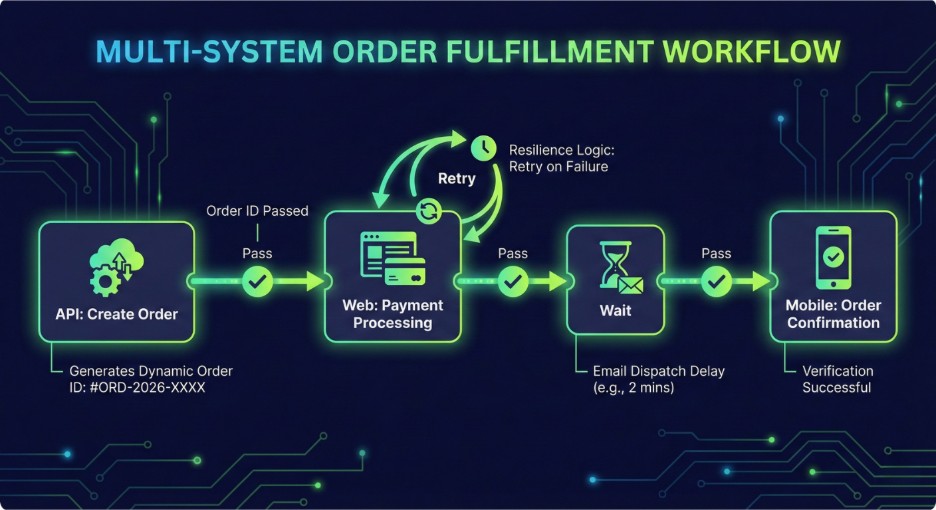
Scenario 1: The Multi-System Data Chain 

Consider an e-commerce platform where a code update changes the inventory service. In a robust enterprise automation architecture, an orchestrator identifies the change and triggers a choreographed sequence: 

  • Step 1: API tests create a new order and reserve inventory, capturing a dynamic order_id . 
  • Step 2: The system propagates this ID to a web test that validates the payment gateway and confirms the transaction. 
  • Step 3: Finally, a mobile script verifies that the “ready to ship” status appears correctly in the user’s account. This chain ensures data flows correctly between microservices, catching cross-system bugs that isolated scripts would miss. 

Scenario 2: Adaptive Resilience in Financial Workflows 

Financial transfers require absolute reliability. If a payment processor returns a temporary “Service Unavailable” error, standard automation simply fails and marks the build as “red.” An orchestrated workflow handles this with intelligence: 

  • Conditional Branching: The system detects the error and triggers a “Retry” action with exponential backoff. 
  • Fallback Logic: If the retry succeeds, the flow continues. If it fails after three attempts, the orchestrator executes a separate branch to alert the fraud monitoring team and clean up the test data. 

The impact of this coordination is measurable. Organizations that move from ad-hoc scripts to orchestrated pipelines report a massive reduction in overall test execution time. Beyond speed, the precision of these workflows drives higher quality.  

The Force Multiplier: Maximizing Your Existing Automation Investment 

Test orchestration does not replace your current scripts; it makes them work harder. Many organizations mistakenly view the debate of test orchestration vs test automation as a choice between two separate paths. In reality, orchestration preserves and elevates the technical work your team has already completed. By wrapping existing scripts into reusable nodes, you transform isolated code into modular assets that any team member can trigger within a larger sequence. 

Implementing this layer within your enterprise automation architecture can have a massive impact on the bottom line.  

Transitioning to workflow orchestration testing unlocks the following key benefits: 

  •  Reuse of automation assets in larger pipelines: You can chain together disparate scripts for Web, Mobile, and API platforms into a single, synchronous process. This approach turns standalone code into reusable building blocks that support complex end-to-end journeys. 
  • Better visibility into failures: Orchestration tools aggregate results and metrics from every stage into unified dashboards. This ends the inefficiency of engineers hunting for logs across different tools to understand why a test failed. 
  • Reduced redundancy: Automated environment provisioning and centralized data management eliminate manual hand-offs and the risk of environment drift. This coordination allows teams to reduce manual testing effort by 80%. 
  • Faster feedback loops: Intelligent parallel execution can reduce overall test runtimes by 70%. This acceleration moves testing from a nightly bottleneck to a real-time fail-gate that informs every code commit. 

This shift ensures your automation provides actual business value rather than just a collection of fragile, disconnected scripts. 

Building a Resilient Future for Quality Engineering 

The distinction between test orchestration vs test automation represents the difference between running a tool and managing a strategy. Automation provides the technical means to execute a script, yet orchestration provides the intelligence to govern how those scripts behave within a modern enterprise automation architecture. 

Lack of test orchestration forces quality teams to spend more time syncing data than discovering defects. However, enterprises that bridge this gap achieve shorter test cycles and release with up to 99% success. High-performing QA teams no longer view testing as an ad hoc event but as a continuous, synchronous process. 

To succeed with workflow orchestration testing, follow these essential best practices: 

  • Start with a manageable scope: Design your initial workflows with 2–5 nodes to ensure stability before scaling to more complex chains. 
  • Utilize structural templates: Use proven structural patterns for your workflows to maintain consistency across different teams and projects. 
  • Prioritize critical user journeys: Focus your orchestration efforts on real-world business processes—such as checkout or onboarding—to see immediate gains in release velocity. 
  • Automate environment coordination: Eliminate environment drift by using the orchestrator to manage target systems and configurations dynamically. 

By moving from isolated execution to automated choreography, you transform your QA department into a driver of business value. You stop reacting to brittle failures and start predicting quality outcomes. Quality demands precision. 

See How Qyrus Orchestrates Complex Test Workflows 

Frequently Asked Questions 

Is orchestration better than automation?  

Think of these as complementary layers rather than competing alternatives. Test automation handles the execution of individual scripts to verify specific functions. Test orchestration provides the “connective tissue” that turns isolated scripts into a controlled, synchronous process. It treats testing as an integrated pipeline step, ensuring that your automation serves a wider business goal. 

When do you need test orchestration in QA?  

Transition to workflow orchestration testing when your application complexity exceeds the limits of standalone scripts. You require it when a single user journey spans multiple protocols, such as an e-commerce order that begins on a mobile app and concludes with a web-based confirmation. It becomes essential when your tests have strict dependencies or require data propagation between steps. 

How orchestration improves CI/CD testing?  

Orchestration functions as the intelligent engine within a modern enterprise automation architecture. It eliminates the delays caused by manual triggers. By utilizing parallel execution, an orchestrator can slash test suite runtimes by up to 70%, delivering feedback to developers in minutes rather than hours. Furthermore, it provides unified reporting and centralized observability, aggregating metrics from every stage of the pipeline into a single source of truth. 

Test Orchestration

Software delivery has hit a structural wall. While AI coding assistants now contribute significantly to software development, most quality assurance teams still struggle with a fragmented process. We see a growing distance between the speed of development and the rigor of validation. This gap creates a dangerous environment where teams launch features quickly, but quality remains a secondary concern because the testing phase cannot keep up. 

Traditional testing often relies on isolated scripts. These scripts perform well for specific checks, but they fail to address the complexity of modern microservices or multi-platform user journeys. Currently, 36.5% of organizations still lack any form of test orchestration. They rely on “duct-taped” manual hand-offs that slow down the entire pipeline. In fact, 35% of companies still report that manual testing represents their most significant time-consuming activity. 

To keep up with modern engineering, you must transform your approach. Automated test orchestration provides the connective tissue required to synchronize your tools and environments. It changes the focus from “did this script pass?” to “is this business process ready for production?” By implementing workflow-based test automation, you eliminate the idle time between tests and ensure every check happens at the right moment with the exact data required for success. 

What is Test Orchestration? Definition & Core Concepts 

Think of test orchestration as the automated coordination of your entire software testing pipeline. It ensures every test executes in the correct sequence, at the appropriate time, and with the exact data required for validation.  

What is Test Orchestration

While traditional automation focuses on individual scripts, orchestration acts as the “connective tissue” that manages how those scripts interact across different platforms. Standalone automation validates individual functions, but orchestration manages the broader business outcome across your entire stack. (To explore the nuanced technical and operational contrasts between these two methodologies, read our detailed comparison: Test Orchestration vs Test Automation: What’s the Difference?) 

This structural shift requires a focus on four essential components. First, sequencing dictates the logical order of execution. For example, a system must validate a user’s credentials before attempting a complex transaction. Second, environment management handles the allocation of real browsers and mobile devices. Third, data flow allows the system to pass variables, such as session tokens, between disparate tests. Finally, centralized reporting aggregates every pass and failure into a single view for the engineering team. 

Transitioning to this model addresses the gaps found in basic frameworks. Research shows that 36.5% of firms still lack any form of orchestration, leaving them vulnerable to environment drift and manual bottlenecks. By implementing workflow-based test automation, you create a synchronized process where tools and data work in harmony. This move transforms testing from a series of disconnected events into a resilient, enterprise-grade pipeline. 

Breaking the Script: Why Automation Fails Without Test Orchestration 

Standard test automation handles the execution of individual scripts. It checks if a button works or if an API returns a 200 OK status. However, automation on its own lacks the structural logic to manage dependencies between different systems. This lack of coordination explains why 73% of test automation projects fail. Without a broader strategy, scripts become brittle and maintenance costs skyrocket. 

Test orchestration takes a different path. While automation focuses on the task, orchestration focuses on the workflow. It manages the entire lifecycle of a test suite across multiple environments. When you use automated test orchestration, you define the logic that guides a release. If an API login fails, the orchestrator stops the subsequent UI tests immediately. This prevents false positives and saves significant infrastructure costs. 

Differences Between Test Automation and Test Orchestration 

FeatureStandalone Test Automation Test Orchestration
Primary Focus Execution of individual scripts and tasks. Coordination of testing workflows and pipelines.
Data Management Often hardcoded or siloed per test. Dynamic data passing and state persistence.
Trigger Mechanism Manual or scheduled execution. Event-driven (commits, merges, deployments).
Environment Handling Static, often pre-configured environments. Dynamic environment provisioning and coordination.
Reporting Fragmented pass/fail logs per tool. Centralized observability and aggregated insights.
Quality Gating Manual intervention often required to halt pipelines. Automated conditional progression based on results.

Enterprise teams require more than just a collection of scripts. They need test orchestration tools that provide visibility into the entire delivery pipeline. Integration with CI/CD is the primary driver here, as 84% of developers now work in DevOps environments where speed is non-negotiable. Workflow-based test automation bridges this gap. It ensures your tests run as a synchronized unit rather than a series of ad-hoc events. Qyrus facilitates this through its visual Flow Master Hub, allowing teams to coordinate these complex sequences without writing additional code. 

Core Benefits of Test Orchestration for Enterprises 

Enterprise leaders often view testing as a necessary drag on momentum. However, shifting your strategy transforms this bottleneck into a strategic asset. By moving beyond isolated scripts, you gain total visibility into the delivery pipeline. This transparency allows development teams to identify risks early. It ensures that only high-quality code reaches your customers. 

Benefits of TO

Shattering the Black Box with Total Visibility 

Isolated scripts often create a “black box” where results are difficult to interpret. You might see a failure, but finding the root cause requires manual digging through logs. Automated test orchestration replaces this confusion with a transparent, visual pipeline. You see every step of the user journey as it happens. This clarity allows your team to pinpoint exactly where a process breaks, whether it occurs in an API call or a mobile UI element. 

Hardening Production with Intelligent Quality Gates 

Moving fast requires guardrails. Validated releases depend on “Quality Gates” that automatically block unstable code from moving forward. Using test orchestration tools, you set specific criteria for success at every stage of the pipeline. If a critical smoke test fails, the orchestrator halts the deployment immediately. This ensures only 100% verified features reach your users, maintaining your brand’s reputation for reliability. 

The Economic Impact of Automated Test Orchestration 

The financial argument for this shift remains undeniable. Research indicates that organizations adopting these strategies experience shorter test cycles compared to those using fragmented automation. Furthermore, these teams achieve better success rate in production releases. By streamlining the validation process, you reduce maintenance overhead by nearly 80%. This efficiency frees up your budget for innovation rather than constant troubleshooting. 

Unifying Engineering through Workflow-Based Test Automation 

Traditional testing often happens in a silo, separated from development and operations. Workflow-based test automation breaks down these barriers. It provides a shared “source of truth” that every department can access and understand. When developers, QA engineers, and DevOps professionals look at the same orchestration dashboard, they collaborate more effectively. This alignment accelerates the entire lifecycle. It ensures everyone works toward the same objective: delivering value to the customer. 

What Test Orchestration Looks Like in Action 

Test orchestration moves beyond the theory of “running tests” and enters the practice of managing business risks at scale. In a modern software environment, a single release often involves an API update, a change to the web checkout UI, and a new promotion in the mobile app. Standalone scripts struggle to bridge these gaps. However, with automated test orchestration, you build a unified flow that treats these separate components as one cohesive journey. 

High-Level Workflow Examples 

The Smoke Test: Rapid Validation  

Teams use smoke tests to perform quick, automated checks of critical functionality. The goal remains simple: verify the application works at a basic level before committing further resources. A well-orchestrated smoke suite should validate critical paths in less than 15 minutes after a deployment. This rapid feedback loop allows you to detect obvious issues immediately, preventing the team from wasting time on a fundamentally broken build. 

The Regression Suite: Enterprise-Scale Chaining  

As applications grow, so does the risk of “breaking” existing features. A comprehensive regression suite often requires chaining 10 or more workflows to achieve full system validation. Using test orchestration tools, you can organize these workflows into a logical hierarchy. If the “User Authentication” workflow fails, the system automatically halts the “Payment Processing” and “Order History” flows. This prevents the “crushing weight of maintenance” often seen in legacy systems, where most test automation projects fail due to a lack of coordination. 

The API-to-Web Journey: Cross-Platform Fluidity  

Real users do not live in silos; neither should your tests. An API-to-Web journey mirrors a real-world scenario by creating a user via an API call and immediately verifying that account on the Web UI. This requires seamless data propagation, where the session token or user ID from the first node becomes the input for the next. This workflow-based test automation ensures that your back-end and front-end systems communicate perfectly. 

Real-World Architectures: The CI/CD Connection 

Effective test orchestration relies on deep integration with your existing DevOps stack. Since more than 80% developers now work in DevOps environments, your orchestration engine must respond instantly to CI/CD triggers. 

Whether you use Jenkins, Azure DevOps, or GitLab, the architecture remains consistent. When a developer pushes code to a repository, the CI/CD tool sends a trigger to the orchestration platform. The engine then selects the appropriate environment—be it Staging, UAT, or Production—and begins the execution.  

By embedding these checks directly into the pipeline, you create “Quality Gates” that block unstable code. This automated choreography ensures that your release cycle stays fast without sacrificing the reliability your customers expect. 

Anatomy of an Orchestrated Test Workflow 

Orchestration begins with sequencing. You organize tests into logical units such as authentication, onboarding, or checkout. Traditional methods run scripts one after another in a linear queue. However, modern test orchestration tools enable parallel execution logic, which can reduce execution time by up to 90%. Chaining tests ensures that a subsequent stage only begins after a prior stage succeeds. For example, if the authentication stage fails, the orchestrator halts checkout testing to save compute resources. 

Data Management and State Persistence 

Data management serves as the fuel for these workflows. Successful test orchestration requires sharing session data, tokens, and identifiers across different platforms. You must pass a customer ID from an account creation step to the purchase validation step without manual entry. Furthermore, environment persistence maintains the application state throughout the entire process. This ensures that database snapshots or session cookies remain valid as the test progresses from an API call to a mobile interface. 

Resilience Through Failure Handling 

Reliable workflows include robust failure handling to prevent brittle pipelines. If a test fails, you need a strategy beyond simple termination. Automated test orchestration allows you to define specific retry, abort, or skip logic. For instance, if a non-critical UI element fails, the system might skip that step to continue the broader validation. In contrast, a failure in the login stage should abort the entire flow to prevent false positives. Advanced platforms even use self-healing mechanisms to address UI changes, which can slash maintenance efforts by 81%. 

Centralized Analytics and Observability 

The final piece involves results and analytics. Centralized reporting dashboards aggregate logs, videos, and performance metrics from every tool in the testing suite. You track specific KPIs such as pass/fail trends and execution duration to measure the health of your workflow-based test automation. These insights transform raw outcomes into a clear picture of overall software quality. Qyrus provides this transparency through its Mind Maps, which offer a visual, hierarchical view of the entire test repository and its execution status. 

How Test Orchestration Integrates with CI/CD & DevOps 

Modern software delivery requires a seamless connection between code changes and validation. When you integrate test orchestration into your DevOps pipeline, you move beyond simple automation. Your CI/CD tools, such as Jenkins or Azure DevOps, no longer just trigger scripts; they manage a sophisticated choreography of validation steps.  

Automated test orchestration introduces intelligent quality gates. These gates evaluate the health of a build in real-time. If a critical workflow fails, the orchestrator blocks the deployment immediately. This proactive approach prevents the accumulation of technical debt and protects the user experience.  

Effective test orchestration tools also provide immediate observability. Instead of searching through logs, your team receives results directly in Slack or Jira. This rapid feedback loop allows development teams to fix bugs as soon as they appear. Workflow-based test automation ensures that every code commit undergoes a rigorous, multi-environment check before it ever touches a customer. 

Selecting the Best Test Orchestration Tools & Platforms 

Choosing from the available test orchestration tools requires an understanding of how different architectures impact your long-term maintenance. The market generally splits into three categories. First, built-in orchestration engines exist within larger testing platforms. These offer native integration but may limit your flexibility. Second, plugin tools attach to your existing CI/CD pipeline. While these provide modularity, they often lead to “tool sprawl,” where engineers spend more time managing integrations than writing tests. Finally, full platform orchestration stacks provide a unified environment for cross-platform validation. 

Transitioning to a unified platform often reveals the inherent limitations of older, siloed testing models that lack cross-protocol support. (If your team currently relies on older frameworks, you should examine Why Traditional Component Testing Breaks at Scale to understand why a shift to orchestration is mandatory for enterprise growth.) 

The debate between code-based orchestration and visual workflow builders also shapes your team’s productivity. Code-based frameworks provide deep customization for highly technical teams. However, they often recreate the “crushing weight of maintenance” that causes test automation projects to fail. In contrast, visual builders democratize the process. They allow manual testers and product owners to contribute to the quality strategy without learning complex syntax. This shift is vital because 35% of companies still struggle with manual testing as their primary bottleneck. 

Orchestrating at Scale with Qyrus 

Qyrus offers a next-generation approach to automated test orchestration through its dedicated TO module. This platform eliminates the obstacles that hinder team progress by providing a high-performance environment for complex test scenarios. 

  • Flow Master Hub: This is your command center. Use the advanced drag-and-drop interface to create and edit test flows visually. It handles intricate user journeys across Web, Mobile, API, and Desktop platforms in a single execution. 
  • The Vault: Scale requires organization. The Vault provides a hierarchical structure to categorize projects by environments like QA, UAT, and Production. Advanced nesting and filtering tools ensure your team never wastes time hunting for the correct files. 
  • SmartFlow Mapping: Rigid paths lead to fragile tests. This feature adapts to live conditions during execution. If a login fails or a transaction lacks a balance, the mapper reroutes the test automatically to handle the edge case. 
TEST ORCHESTRATION

See How Qyrus Orchestrates Complex Test Workflows 

Best Practices for Successful Test Orchestration 

Moving from fragmented automation to a cohesive delivery pipeline requires more than just new software. It demands a shift in how your team perceives the lifecycle of a test. Success depends on treating your quality infrastructure with the same rigor as your production code. By following proven engineering standards, you ensure your test orchestration remains maintainable even as your application grows in complexity. 


TO Best Practices

Architecting the Journey Before Writing a Single Script 

Many teams rush into automation without mapping their business logic first. This lack of planning is a primary reason why most test automation projects fail to deliver long-term value. You must define your data contracts and system dependencies before building workflows. Identify which services require session persistence and where data must flow between platforms. Establishing these blueprints early prevents the creation of brittle, “duct-taped” sequences that break during minor updates. 

Prioritizing the Critical Path for Immediate Returns 

Avoid the temptation to orchestrate every minor feature at once. Start with high-impact workflows that protect your core revenue streams. Focus on building a robust smoke suite that validates critical paths in less than 15 minutes. Once you stabilize these essential checks, expand into complex regression suites. This incremental approach allows your team to demonstrate immediate ROI while gradually reducing the manual testing bottleneck. 

Maintaining Integrity Through Centralized Governance 

Reliable workflow-based test automation requires strict separation of environments. Never hardcode credentials or URLs within your scripts. Instead, use test orchestration tools to manage environment-specific variables for Dev, Staging, and Production. Centralizing your data management through a “Data Hub” ensures that every team member uses the same verified datasets. This practice eliminates the “it works on my machine” syndrome and ensures your results remain consistent across different infrastructure tiers. 

Closing the Loop with Performance-Driven Refinement 

Orchestration is not a “set and forget” activity. You must continuously monitor KPIs and failure trends to identify bottlenecks. If a specific node consistently delays your pipeline, use performance optimization patterns like parallel execution to reclaim time. Research shows that refining these sequences can improve execution speed by 40-50%. By analyzing historical reports and adjusting your retry logic, you transform automated test orchestration from a simple execution engine into a high-performance asset. 

The Road Ahead: Building a Sustainable Culture of Quality 

The shift to test orchestration marks a fundamental change in how enterprises deliver software. While standalone scripts once served a specific purpose, they cannot keep up with the speed of modern code generation. Adopting automated test orchestration is no longer a luxury. It is a prerequisite for survival in a market where many organizations still struggle with fragmented pipelines. By treating your quality layer as a first-class engineering citizen, you achieve the near perfect success rate required for enterprise scale. 

Transitioning your team requires a clear roadmap. First, map your core business processes and identify the data dependencies between systems. Second, define your “Quality Gates” to ensure only verified code moves forward. Finally, integrate your workflow-based test automation with your existing CI/CD tools. This incremental approach prevents the “crushing weight of maintenance”. 

Qyrus simplifies this journey by offering a unified environment for cross-platform validation. Our platform allows you to move away from rigid, siloed testing and toward a coordinated, visual strategy. Whether you are validating complex banking transfers or e-commerce user journeys, our test orchestration tools provide the precision and control you need to lead your industry. We help you move beyond ad-hoc scripts to build a resilient infrastructure that grows with your organization. 

Don’t let legacy testing methods hold back your engineering velocity. Contact us today for a personalized ROI report or schedule a demo to see how Qyrus can transform your testing into a direct driver of business growth. 

Devops Conclave

Save the Date:
📅 March 13th, 2026 
📍 Taj MG Road, Bengaluru 

If you’ve been keeping an eye on how fast DevOps is evolving across the enterprise, you already know one thing for sure: innovation doesn’t slow down for anyone. That’s exactly why we’re excited to share some big news. Qyrus is proud to be a Platinum Sponsor at the 11th Edition of the DevOps Conclave & Awards 2026, happening this March in Bengaluru. 

Over the years, DevOps Conclave has earned its place as a must-attend event for leaders, practitioners, and builders who care deeply about the future of software delivery. It’s not just another conference. It’s a space where real conversations happen, ideas are challenged, and the next phase of DevOps takes shape. 

If this event isn’t already on your calendar, here’s why it should be. DevOps Conclave brings together forward-thinking teams and technology leaders to talk openly about what’s working, what’s broken, and what needs to change. This year’s agenda dives into AI-powered DevOps, platform engineering, cloud-native innovation, GitOps, and the evolving practices that are redefining how software is built and delivered at scale. It’s practical, relevant, and grounded in real-world experience. 

The Big Stage: Ameet Deshpande on the Future of Engineering 

If you’ve spent any time in the product engineering world, you’ve probably heard the word “efficiency” thrown around more times than you can count. Too often, it becomes a catch-all phrase that hides manual effort, fragmented tooling, and growing complexity. We think it’s time to have a more honest conversation. 

That’s where this year gets even more exciting for us. Ameet Deshpande, SVP of Product Engineering at Qyrus, will be delivering a keynote at the Conclave. Ameet has spent years working closely with engineering teams to modernize how they design, test, and ship software. His perspective goes beyond theory. It’s rooted in what teams actually face every day. 

Ameet doesn’t just talk about trends. He challenges assumptions, asks uncomfortable questions, and offers practical ways to move forward. Expect clarity, thoughtful insights, and a dose of healthy disruption that will leave you rethinking how engineering organizations operate. 

Why We’re All In 

DevOps Conclave has always stood out for one reason. It’s a place where leaders share not just their wins, but the hard-earned lessons that come from scaling complex systems. This year’s focus on Platform Engineering and Developer Experience feels especially relevant to us at Qyrus. 

We believe the best tools are the ones that get out of the way, reduce friction, and let teams focus on building great software. As Platinum Sponsor, we’re looking forward to connecting with architects, VPs of Engineering, DevOps leaders, and hands-on practitioners who are shaping the next generation of digital-first operations. 

Whether you’re leading DevOps strategy, working on the front lines of delivery, managing product releases, or exploring how AI is changing automation, there’s real value here. Beyond the sessions, the conversations, debates, case studies, and awards make DevOps Conclave & Awards 2026 a true hub for what’s next. 

So, if you’re planning your DevOps roadmap for the year ahead, join us in Bengaluru. Stop by the Qyrus booth, attend Ameet’s keynote, and let’s talk about the future of quality, automation, and delivery. This isn’t about buzzwords. It’s about meaningful transformation, and we’re proud to be part of it. 

Beyond the Syntax

 In the last thirty days, the software industry didn’t just advance; it underwent a structural collapse and a total rebirth. For twenty years, developers lived by the sword of Linus Torvalds: “Talk is cheap. Show me the code.” This filter prioritized the grueling labor of implementation over the “vapor” of ideas. But as of February 2026, that sword has been blunted. We have entered an era where products no longer look like assistants—they look like colleagues. 

The tectonic plates of the technology sector shifted during this past month. Market volatility proved the reality of this transition. In a single week, India’s Nifty IT index plunged nearly 6%, erasing over $22 billion in market value. Investors didn’t see productivity; they saw substitution. This sudden repricing stems from a simple realization: code is no longer scarce. According to Gartner, 75% of enterprise software engineers will use AI code assistants by 2028, moving the needle from manual implementation to high-level orchestration. 

The hourglass of our industry has flipped. For decades, business requirements sat at the top, compute sat at the bottom, and a thin middle layer of human translators connected them. Today, that translation layer is evaporating. 

Era of Agentic Logic

When Poetry Outran Python 

If a generative model can write English poetry with structure, rhythm, and intent, then code—with its rigid grammar and predictable scaffolding—was never the hard part. Engineers once viewed syntax as mystical because humans found it difficult to type. For a machine, the constraints of Rust or Python provide a far simpler path than the non-deterministic mess of human language. 

“We used to treat code as mystical because it was hard for us to type. We now realize the machine finds Python easier than it finds a messy human conversation.” 

The industry finally stopped pretending we were building “coding tools” and started building a production line for logic. Recent data supports this shift. As of early 2026, AI generates roughly 41% of all code, a number climbing as agentic systems move from suggesting snippets to orchestrating entire modules. The “mystical” element was never the brackets or the indentation; it was the judgment. We now prioritize the ability to choose what to build and knowing what “correct” means when reality refuses to be neat. 

Agentic Ai Absorption

The Trillion-Dollar Reality Check 

The timeline of the last thirty days reads like a controlled demolition of the old software development lifecycle. On January 8, 2026, Anthropic released Claude Code v2.1.0, explicitly framing it as an “agentic” environment. This update wasn’t just a better prompt box. It included 1,096 commits oriented around workflow portability and agentic “handshakes.” The system now spins up agents, controls their lifecycle, and carries context across sessions. 

Then came the moment Wall Street heard the subtext. When Anthropic launched “Claude Cowork” on January 12, investors didn’t see productivity—they saw substitution. The resulting panic wiped off nearly $22 billion in market value in just three days. The market absorbed the reality that LLMs are moving “up the stack” into the application layer. 

Apple made the shift inevitable on February 3, 2026. Xcode 26.3 now adds native AI coding agents from OpenAI and Anthropic directly into the environment. These agents don’t just suggest code. They operate within the IDE—updating settings, searching documentation, and verifying work visually via SwiftUI Previews. The IDE no longer acts as a tool; it serves as an agent host. 

“In this new economy, we aren’t losing engineers; we are losing typists. We are gaining governors who must manage an industrial scale of logic production.” 

The Day the Billable Hour Broke 

The market panic wasn’t an irrational fear of “robots taking jobs.” It was a sudden repricing of an old assumption: that software and services companies sit behind defensible complexity. For two decades, the industry worked like an hourglass. At the top were business requirements; at the bottom was compute. In the thin middle sat the precious layer: people who could translate intent into software. This month, the hourglass flipped. Translation stopped being scarce. 

The impact hit India, the world’s largest labor-intensive software engine, with particular force. On February 4, 2026, Reuters reported that Anthropic’s new plugins and other AI developments rattled the staffing-intensive IT model, wiping off close to $1 trillion in total market value globally. Indian Software services companies felt the shock acutely as the NIFTY IT index fell 6%—the steepest drop since the 2020 pandemic. Over $22.5 billion in value vanished in a single week. 

Regional anxieties vary but remain interconnected. In the US, the conversation focuses on product margins and platform moats. In the EU, anxiety clusters around compliance-heavy services and data businesses fearing replacement by agentic extraction. In India, the crisis is existential because the business model historically monetized hours and headcounts. When an agent performs the first 80% of routine work, staffing becomes a cost center rather than a competitive moat. 

The Architect-Governor: Why “The Talk” is the Only Scarcity Left 

The coding workforce isn’t doomed, but the old identity of the “typist” is dead. On January 30, 2026, Kailash Nadh, CTO of Zerodha, flipped the industry script: “Code is cheap. Show me the talk.” This simple phrase captures the new reality. Writing syntactically correct logic no longer counts as a scarce skill. Scarcity now lives in the service the code provides. We have shifted the bottleneck from production to judgment. 

This transition elevates a different kind of engineer—the Architect-Governor. These leaders hold the entire problem in their heads, negotiate tradeoffs, and communicate intent so clearly that the machine executes it perfectly. But speed brings a new danger. If code generation accelerates, failure creation follows right behind it. Data from the field confirms this anxiety. While developers use AI in roughly 60% of their daily work, only 0–20% of those tasks can be fully delegated without oversight. 

Quality Engineering now serves as the “governor” of this industrial-scale velocity. We no longer check for exact strings; we validate outcomes semantically. Organizations move from asking “Did the feature work once?” to “Do we trust this system to keep working after a hundred AI-assisted edits?” Recent surveys highlight the stakes: 88% of developers lack the confidence to deploy AI-generated code without explicit verification. The winners won’t just “use AI to code.” They will use AI to govern coding through automated evaluation and risk-based orchestration. 

Governor Framework

Engineering the High-Velocity Guardrail 

Velocity without governance creates a “black box” of risk. When AI agents generate code at industrial speeds, traditional testing methods crumble. For years, QA teams relied on checking exact strings—verifying that a button had a specific ID or that a database returned an exact character set. In a world of agentic code, those static checks are useless. You cannot catch a semantic hallucination with a literal string match. 

The industry now faces a “Quality Gap.” While AI can increase code volume by up to 40%, it also introduces subtle logic errors that traditional unit tests often miss. We transition from “checking strings” to “validating semantic outcomes.” This means the testing engine must understand the intent of the software, not just its syntax. If an AI agent modifies a checkout flow, the Governor doesn’t just check if the “Buy” button exists; it validates that the entire transaction logic remains sound across a hundred different edge cases. 

“If you increase the speed of the engine without upgrading the brakes, you aren’t building a faster car—you’re building a more dangerous one. In 2026, Quality is the brakes.” 

This is where risk-based orchestration changes the game. Instead of running every test for every minor AI edit—a process that would paralyze development—we use automated evaluation to identify high-risk changes. Qyrus employs this “Governor” logic to prioritize testing where the agents are most likely to fail. By mapping the relationship between AI-generated components and business-critical logic, we ensure that speed never compromises integrity. We turn the testing suite into an active monitor that understands reality’s messiness. 

The New Social Contract: Human Intent, Machine Scale 

The events of early 2026 have drafted a new social contract for the modern organization. In this framework, humans speak intent and bear the ultimate responsibility, while machines produce the first draft at an industrial scale. We are witnessing the final departure from an era where code was the only proof of seriousness. Today, code is plentiful, but trust is rare. 

In this new economy, the ultimate proof of value is whether you can define the right product to build—and whether you can prove it is safe to ship. The demand for “Analytical Thinking and Quality Governance” is going up as technical implementation roles undergo automation. The focus has moved from the “how” of development to the “what” and “why” of system integrity. 

At Qyrus, we recognize that as agentic velocity accelerates, the role of the Quality Architect becomes the most critical seat in the house. We build the tools that empower you to be the Governor, not the typist. Our platform provides the semantic validation and risk-based orchestration needed to turn “agentic logic” into reliable, enterprise-grade software. The talk is no longer cheap—it is the only thing that defines the future. 

Stop fighting the surge of agentic code with brittle manual scripts. Contact Qyrus today to see how we help your team transition to semantic governance and secure your software’s integrity at scale. 

A version of this article originally appeared on LinkedIn, authored by Ameet Deshpande, Senior Vice President – Product Engineering at Qyrus.