AI in Testing: Architecting the Future of Software QA
 Varun RS
Modern software delivery has accelerated dramatically, with release cycles shrinking from months to days. This digital shift has intensified the pressure on QA teams to deliver flawless user experiences without slowing down innovation.
Poor software quality imposes a staggering $2.41 trillion tax on the US economy annually. For the modern enterprise, this is not a conceptual risk; it is a direct drain on innovation. Current research shows that developers spend a significant portion of their time on reactive bug fixing rather than building new features. A CI-focused study found that 26% of developer time is spent reproducing and fixing failing tests, amounting to 620 million hours and $61 billion in annual costs.
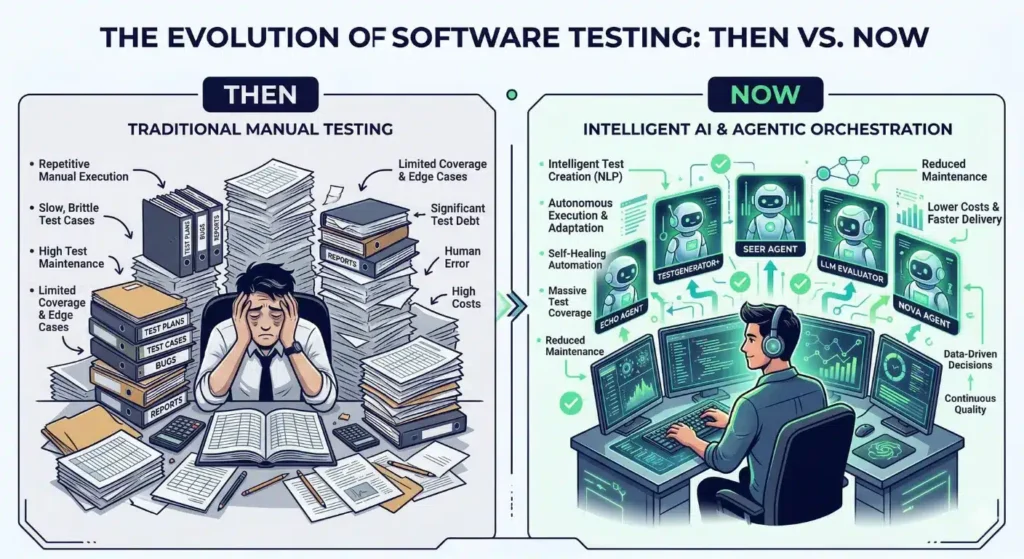
We are currently navigating an architectural pivot from traditional automation to the Third Wave of Quality. The “First Wave” relied on manual, linear verification; the “Second Wave” introduced brittle, code-heavy scripts that created a “Maintenance Nightmare.” Today, the move toward intelligent, self-healing, AI-driven automation marks a shift where quality is no longer a final checkpoint but a continuous engineering fabric.
Consider the transition: In the legacy model, a manual tester is buried in spreadsheets, attempting to verify a single user journey. In the modern orchestrated ecosystem, a quality engineer acts as an architect, managing a fleet of autonomous AI agents that validate complex, omni-channel environments across web, mobile, API, and ERP layers simultaneously.
AI in Testing: Beyond Scripting to Autonomous Intelligence
AI in software testing refers to the use of machine learning, natural language processing, and data-driven algorithms to automate, optimize, and enhance the software testing process. AI-powered testing gives your software a digital brain. Instead of just following a rigid, line-by-line script, the system uses machine learning and natural language processing to interpret code behavior and find flaws.
This shift addresses the Collaboration Bottleneck, the “tool sprawl” that costs an average of $50,000 per developer annually due to context switching and the 23-minute refocus time required after every interruption.
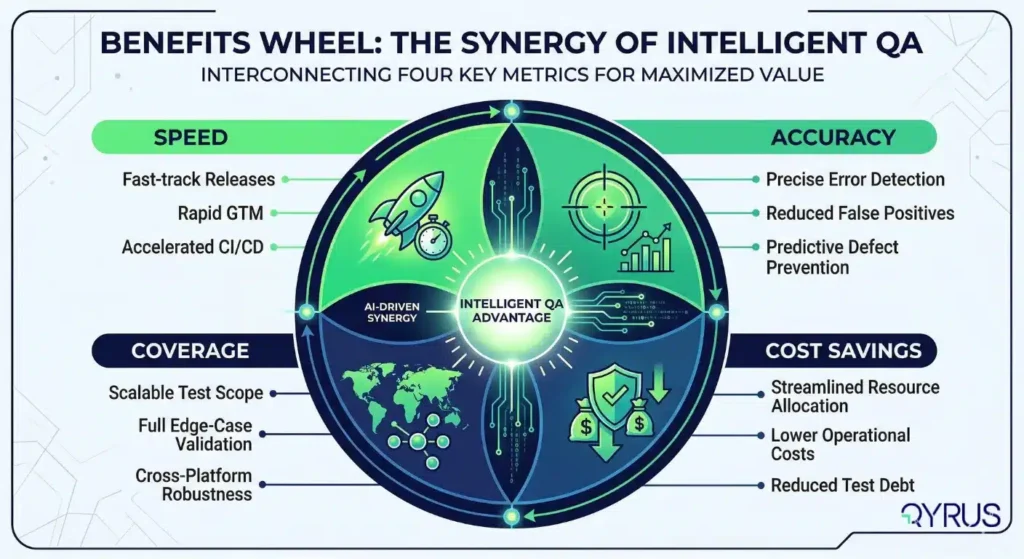
The Strategic Impact of AI-Driven QA:
- Speed: AI executes thousands of tests in parallel, finishing in minutes what used to take days. It removes the linear bottleneck that keeps your code stuck in the QA stage. You ship updates faster. You beat your competition to the punch.
- Accuracy: Human testers feel fatigue. They miss buttons or skip steps after the hundredth repetition. AI doesn’t blink. It executes every test with absolute consistency every single time. This precision ensures that you only ship code that actually works.
- Coverage: Traditional scripts often miss the weird, complex scenarios that real users create. AI hunts for these edge cases autonomously. It builds a massive safety net. It captures bugs in high-risk areas that manual testing simply cannot reach.
The Role of AI in the Software Testing Lifecycle (STLC)
AI integration transforms the STLC from a linear sequence into a continuous loop:
- Planning & Creation: AI tools help transform plain-text requirements or Jira tickets directly into executable visual test logic (Java/JS), democratizing automation for the 42% of QA professionals who are not comfortable with heavy scripting. TestGenerator from Qyrus enables plain-English test creation, bridging the gap between manual testers and automation engineers.
- Maintenance: AI solves “maintenance hell” via self-healing. When a UI element changes, the AI contextually recognizes the new locator and updates the script automatically, reducing maintenance overhead by up to 85%.
- Visual Validation: Computer vision detects rendering inconsistencies, while cloud-based test infrastructure enables validation across 3,000+ browser and device combinations that manual testing cannot reliably cover.
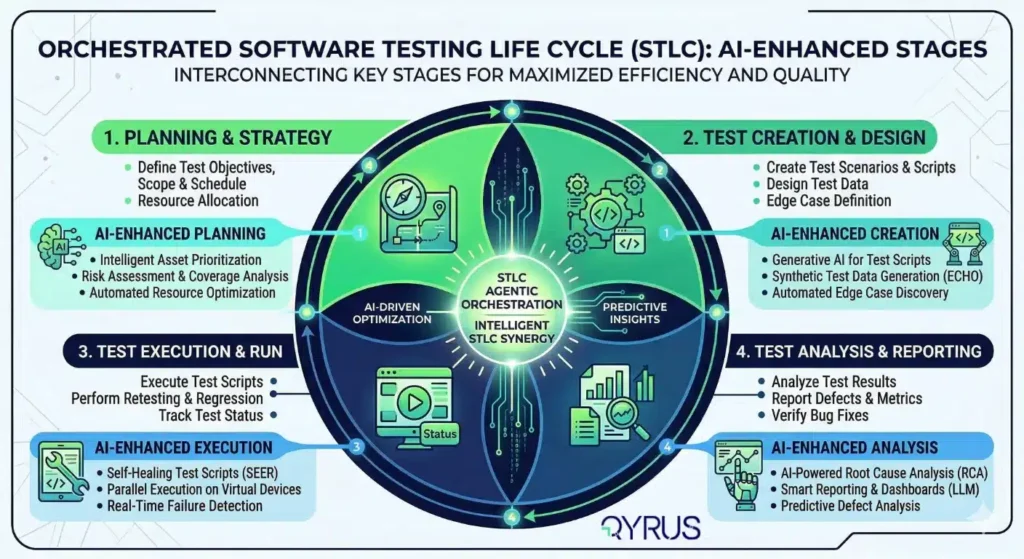
Types of AI-Powered Testing
- Functional & Regression Testing
Forget the manual regression slog. AI analyzes your recent code commits and historical failure patterns to prioritize which tests to run first. It selects the most relevant scenarios, which slashes cycle times and ensures you don’t waste resources on healthy code. This data-driven selection allows you to focus your energy on high-risk areas where bugs actually hide. Tools like Qyrus SEER even navigate these flows autonomously, learning the app’s behavior like a human tester to find bugs without a single line of manual script.
- Performance & Load Testing
Predicting a system crash is better than reacting to one. AI simulates real-world user behavior under heavy traffic to find bottlenecks before they impact your customers. It monitors speed and stability across different workloads, providing optimization tips that keep your infrastructure lean. By sifting through historical data, these tools can even anticipate future performance dips during peak usage hours.
- Security Testing
Security testing shouldn’t wait for a quarterly audit. AI-driven tools scan your code for vulnerabilities like SQL injection and cross-site scripting (XSS) automatically during the development phase. They catch these flaws before they ever reach deployment, preventing data breaches before they happen. By analyzing patterns from previous breaches, these systems stay one step ahead of potential attackers by predicting where new loopholes might appear.
- Accessibility Testing
Software should work for everyone. AI bots continuously audit your interface against WCAG standards to catch navigation gaps and contrast issues. They mimic how screen readers and keyboards interact with your pages, ensuring your app remains inclusive without requiring a manual accessibility expert for every update. Qyrus Vision Nova further simplifies this by generating functional accessibility tests directly from your UI, ensuring no user is left behind.
Together, these capabilities enable organizations to move from reactive defect detection to proactive quality engineering.
The Quality Diagnostic Toolkit: Matching Symptoms to Solutions
AI-driven testing enables a more diagnostic approach to quality engineering, where testing strategies are aligned directly with system behavior and failure patterns. For Engineering Managers, the shift to AI allows for a targeted approach to system health. Use this “If/Then” logic to prioritize your automation roadmap:
- If your app crashes under heavy seasonal traffic: You need Load & Spike Testing to simulate real-world “50-person kitchen rushes” and find the absolute breaking point.
- If an update to one feature accidentally breaks another: You need Agentic Regression Testing. Qyrus helped an automotive major achieve a 40% reduction in project testing time by embracing this autonomous “safety net.”
- If your front-end works but data is failing to fetch: You need API Integration Testing to validate the hidden logic layer where different systems communicate.
- If you are managing massive SAP migrations: You need SAP Intelligence. Agentic regression provided by Qyrus reduces testing cycles from days to hours by automating IDoc reconciliation and transaction validation.
The Shift to Agentic QA: Beyond Scripted Automation
Traditional automation follows a rigid to-do list. You tell a script exactly where to click, what to type, and what to expect. If a developer moves a button by ten pixels or changes a label from “Login” to “Sign In,” the script breaks. This brittle approach creates a massive maintenance burden that keeps QA teams stuck in a loop of fixing old tests instead of finding new bugs.
We are now entering the “Fourth Wave” of software quality. This shift moves us away from scripted instructions and toward autonomous exploration. Instead of writing code, you give an AI agent a goal, such as “verify that a user can complete a checkout with a promo code.” The agent then “sees” the application interface just like a human does. It interprets the page layout, identifies the necessary fields, and navigates the flow dynamically.
Platforms like Qyrus SEER drive this transformation by using Single Use Agents (SUAs) that reason through the application in real-time. These agents don’t just execute; they think. They adapt to UI changes on the fly, which effectively kills “maintenance hell.” If the path to the goal changes, the agent finds a new way to get there without a human needing to update a single line of code.
Speaking the Language of Intent
To guide these virtual testers, we use Behavior-Driven Development (BDD) as a universal “test speak.” BDD allows product managers and testers to define goals in plain English using “Given-When-Then” scenarios. This language acts as a bridge. It translates business requirements directly into agentic missions.
This workflow eliminates the “black box” problem often associated with AI. By using BDD, you maintain full control over the agent’s objectives while letting the machine handle the mechanical execution. You provide the intent, and the AI provides the muscle. This partnership allows your team to scale testing across thousands of scenarios without adding a single manual script to your backlog.
Solving the Paradox: How Qyrus Addresses AI Testing Challenges
QA teams often drown in maintenance. Qyrus ends this cycle with Agentic Orchestration. This system coordinates a fleet of specialized agents to handle complex workflows and clear the bottlenecks that stall your releases.
Meet SEER (Sense-Evaluate-Execute-Report), your autonomous explorer. These agents browse your application exactly like a human user. They identify bugs and broken paths without you writing a single line of code. You get deep results without the manual overhead.
Technical barriers shouldn’t stop quality. TestGenerator bridges the gap by turning plain-English descriptions into executable scripts. It empowers everyone—from business analysts to veteran engineers—to build robust automation instantly.
Comprehensive testing requires massive amounts of data. Echo (Data Amplifier) solves the “empty database” problem by generating diverse, synthetic test data at scale. It ensures your tests cover every possible input combination while keeping real user data private.
As you integrate AI into your own products, you need a way to verify its behavior. The LLM Evaluator provides semantic validation for your chatbots and generative features. It checks for accuracy and bias, ensuring your AI remains helpful and safe.
Comparative Analysis: Manual vs. AI-Powered Testing
The ROI of moving to an orchestrated AI platform is quantifiable. Research from IBM Systems Sciences Institute proves that a defect found in production is 100 times more expensive ($10,000) than one caught during requirements ($100).
Feature | Traditional Manual Testing | AI-Powered Agentic Testing |
Speed | Slow, linear execution | Fast, parallel execution |
Accuracy | Prone to human fatigue/error | Consistent; eliminates oversight |
Maintenance | Resource-intensive manual updates | Self-healing; 85% effort reduction |
Ideal For | Exploratory, UX testing | Regression, scale, performance |
Infrastructure | Local devices; limited scale | Cloud-Scale Farms; Infinite parallelism |
Logic Design | Script-heavy and brittle | Visual Node-Based / Codeless GenAI |
Business Value | $10,000 per production bug | $1M Net Present Value (NPV) |
Coverage | Limited and selective | Broad, intelligent, risk-based |
Market Leaders: Top AI Testing Tools for 2026
The AI testing landscape is rapidly evolving, with platforms differentiating across orchestration, visual intelligence, and no-code automation capabilities.
- Qyrus: The premier Agentic Orchestration Platform. It is the “sweet spot” between code-heavy frameworks (Playwright) and simple executors. Known for multi-protocol workflows and its documented 213% ROI (Forrester study).
- testRigor: Exceptional for no-code generative AI and plain-English command execution.
- Mabl: A leader in autonomous root cause analysis and low-code integration.
- Applitools: The industry standard for Visual AI and pixel-perfect UI rendering validation.
- Katalon: A robust platform for enterprise-scale teams with mixed technical skill sets.
Strategic Implementation: Best Practices for QA Leaders
- Target High-Maintenance Debt: Start by migrating “flaky” tests that stall your CI/CD pipeline to a self-healing environment.
- Unify the Toolchain: Replicate the success of Shawbrook Bank, which replaced siloed teams with a unified tool running in the cloud to create reusable test assets.
- Validate True User Journeys: Follow the Monument model, moving from isolated function tests to complex end-to-end scenarios that span platforms (Web to Mobile to API).
- Human-in-the-Loop: View AI as a “multiplier.” Use your senior engineers for high-level risk strategy and architectural oversight while AI handles the execution “grunt work.”
- Measure Impact Early: Track metrics such as test stability, execution time, and defect leakage to quantify the ROI of AI adoption.
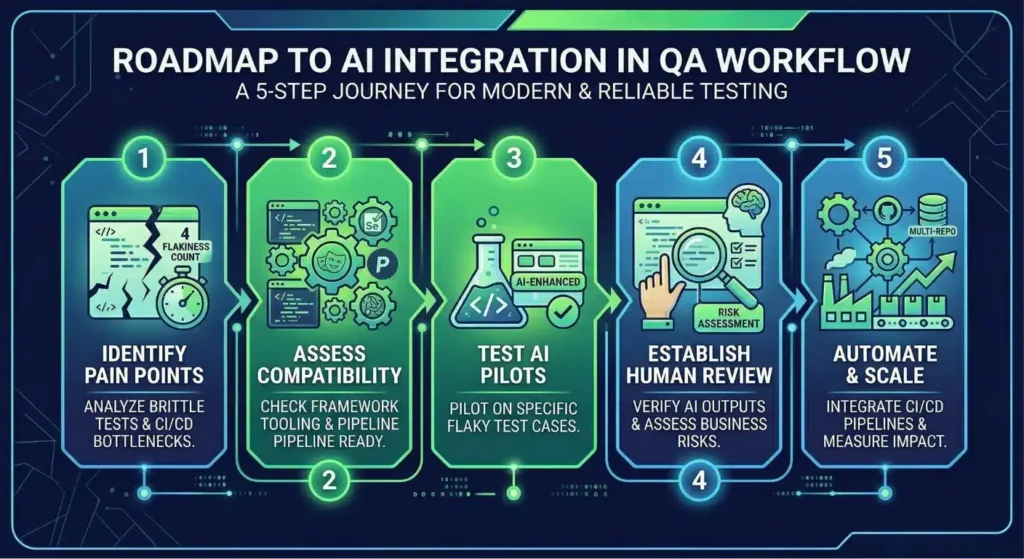
The Future: Scaling with Agentic Orchestration
The future of software testing lies in fully orchestrated, autonomous ecosystems. Instead of isolated tools, organizations will rely on Agentic Orchestration Platforms that coordinate multiple AI agents working in sync across the entire software stack.
Over time, testing will evolve toward self-adaptive systems that learn continuously from user behavior and production data. Test cases will no longer be static assets but dynamic entities that evolve alongside the application.
This shift enables true continuous quality, where every code change is validated in real time, and defects are identified before they impact users.
From Testing Chaos to Orchestration Clarity
AI-powered testing is no longer a luxury; it is the mandatory engine of speed for DevOps. By adopting an Agentic Orchestration Platform, organizations move from a reactive “cost center” to a proactive “value driver” that accelerates innovation.
The future of QA lies in a hybrid model where AI handles execution at scale while humans drive strategy, risk assessment, and innovation.
The question for engineering leaders is: Are you ready to stop paying the 2.41 trillion quality tax and start shipping with absolute confidence?
FAQs
What is AI in software testing?
AI in software testing refers to the use of machine learning, natural language processing, and automation to improve test creation, execution, and maintenance. It enables faster, more accurate, and scalable testing compared to traditional approaches.
Will AI eventually replace manual testers?
No. AI does not replace manual testers but transforms their role. It automates repetitive tasks like regression testing, allowing testers to focus on strategy, exploratory testing, and risk assessment.
What is the ROI of AI in testing platforms?
A Forrester Total Economic Impact™ study found that organizations using Qyrus achieved a 213% ROI and a sub-6-month payback, with over $557,000 in cost avoidance from reduced downtime.
How does AI solve “Maintenance Hell”?
Through Self-Healing AI. It intelligently adjusts broken locators when developers change UI elements, eliminating the need for manual script rewrites.
Is AI in testing just a “GPT wrapper,” or is there more to it?
No. Enterprise platforms like Qyrus coordinate specialized agents for Data (Echo), Execution (SEER), and Enterprise Logic (SAP) in a unified ecosystem that understands the full context of business logic.
What are the benefits of AI in testing?
AI in testing improves speed through parallel execution, enhances accuracy by reducing human error, and increases coverage by identifying complex edge cases. It also reduces maintenance effort through self-healing automation.
What are the top AI testing tools?
Popular AI testing tools include Qyrus for agentic orchestration, testRigor for no-code automation, Mabl for autonomous workflows, Applitools for visual validation, and Katalon for enterprise-scale testing.
Is AI testing suitable for enterprise applications?
Yes. AI testing is particularly valuable for enterprise environments with complex systems, as it enables scalable testing across web, mobile, APIs, and ERP platforms while reducing test maintenance overhead.
How is AI testing different from test automation?
Traditional test automation relies on predefined scripts that require ongoing manual updates. AI testing uses machine learning to adapt to changes, generate test cases automatically, and reduce maintenance through self-healing capabilities.
Ready to Break the Bottleneck?
Stop letting hidden engineering debt drain your innovation budget. Schedule a Personalized Demo to see the Qyrus platform in action.
Your Demo Takeaways:
• Multi-Protocol Workflow Creation
• Data Propagation
• Visual Node-Based Design
• Session Persistence
 April 10, 2026
  12 min