


From Trends to Transformation: How Qyrus Shaped Software Quality in 2025
 Varun RS
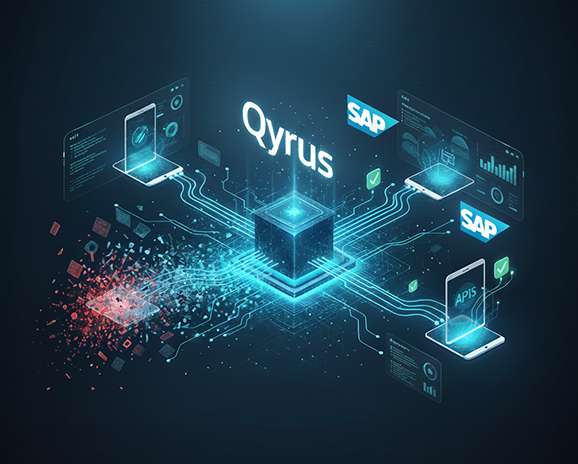
We stopped asking “can we automate this?” in 2025. Instead, we started asking a much harder question: “How much can the system handle on its own?”
This year changed the rules for software quality. We witnessed the industry pivot from simple script execution to genuine autonomy, where AI doesn’t just follow orders—it thinks, heals, and adapts. The numbers back this shift. The global software testing market climbed to a valuation of USD 50.6 billion , and 72% of corporate entities embraced AI-based mobile testing methodologies to escape the crushing weight of manual maintenance.
At Qyrus, we didn’t just watch these numbers climb. We spent the last twelve months building the infrastructure to support them. From launching our SEER (Sense-Evaluate-Execute-Report) orchestration framework to engaging with thousands of testers in Chicago, Houston, Santa Clara, Anaheim, London, Bengaluru, and Mumbai, our focus stayed sharp: helping teams navigate a world where real-time systems demand a smarter approach.
This post isn’t just a highlight reel. It is a report on how we listened to the market, how we answered with agentic AI, and where the industry goes next.
The Pulse of the Industry vs. The Qyrus Answer
We saw the gap between “what we need” and “what tools can do” narrow significantly this year. We aligned our roadmap directly with the friction points slowing down engineering teams, from broken scripts to the chaos of microservices.
The GenAI & Autonomous Shift
The industry moved past the novelty of generative AI. It became an operational requirement. Analysts estimate the global software testing market will reach a value of USD 50.6 billion in 2025, driven largely by intelligent systems that self-correct rather than fail. Self-healing automation became a primary focus for reducing the maintenance burden that plagues agile teams.
We responded by handing the heavy lifting to the agents.
- Healer 2.0 arrived in July, fundamentally changing how our platform interacts with unstable UIs. It doesn’t just guess; it prioritizes original locators and recognizes unique attributes like data-testid to keep tests running when developers change the code.
- We launched AI Genius Code Generation to eliminate the blank-page paralysis of writing custom scripts. You describe the calculation or logic, and the agent writes the Java or JavaScript for you.
- Most importantly, we introduced the SEER framework (Sense, Evaluate, Execute, Report). This isn’t just a feature; it is an orchestration layer that allows agents to handle complex, multi-modal workflows without constant human hand-holding.
Democratization: Testing is Everyone’s Job
The wall between “testers” and “business owners” crumbled. With manual testing still commanding 61.47% of the market share, the need for tools that empower non-technical users to automate complex scenarios became undeniable.
We focused on removing the syntax barrier.
- TestGenerator now integrates directly with Azure DevOps and Rally. It reads your user stories and bugs, then automatically builds the manual test steps and script blueprints.
- We embedded AI into the Qyrus Recorder, allowing users to generate test scenarios simply by typing natural language descriptions. The system translates intent into executable actions.
The Microservices Reality Check
Monolithic applications are dying, and microservices took their place. This shift made API testing the backbone of quality assurance. As distributed systems grew, teams faced a new problem: testing performance and logic across hundreds of interconnected endpoints.
We upgraded qAPI to handle this scale.
- We introduced Virtual User Balance (VUB), allowing teams to simulate up to 1,000 concurrent users for stress testing without needing expensive, external load tools.
- We added AI Automap, a feature where the system analyzes your API definitions, identifies dependencies, and autonomously constructs the correct workflow order.
Feature Flashback
We didn’t just chase the AI headlines in 2025. We spent thousands of engineering hours refining the core engines that power your daily testing. From handling complex loops in web automation to streamlining API workflows, we shipped updates designed to solve the specific, gritty problems that slow teams down.
Here is a look at the high-impact capabilities we delivered across every module.
Web Testing: Smarter Looping & Debugging
Complex logic often breaks brittle automation. We fixed that by introducing Nested Loops and Loops Inside Functions, allowing you to automate intricate scenarios involving multiple related data sets without writing a single line of code.
- Resilient Execution: We added a Continue on Failure option for loops. Now, a single failed iteration won’t halt your entire run, giving you a complete report for every data item.
- Crystal Clear Reports: Debugging got faster with Step Descriptions on Screenshots. We now overlay the specific action (like “go to url”) directly on the execution image, so you know exactly what happened at a glance.
- Instant Visibility: You no longer need to re-enter “record mode” just to check a technical detail. We made captured locator values immediately visible on the step page the moment you stop recording.
API Testing: Developer-Centric Workflows
We focused on making qAPI speak the language of developers.
- Seamless Hand-offs: We expanded our code generation to include C# (HttpClient) and cURL snippets, allowing developers to drop your test logic directly into their environment.
- Instant Migration: Moving from manual checks to automation is now instant. The Import via cURL feature lets you paste a raw command to create a fully configured API test in seconds.
- AI Summaries: Complex workflows can be confusing. We added an AI Summary feature that generates a concise, human-readable explanation of your API workflow’s purpose and flow.
- Expanded Support: We added native support for x-www-form-urlencoded bodies, ensuring you can test web form submissions just as easily as JSON payloads.
Mobile Testing: The Modular & Agentic Leap
Mobile testing has long been plagued by device fragmentation and flaky infrastructure. We overhauled the core experience to eliminate “maintenance traps” and “hung sessions.”
- Uninterrupted Editing: We solved the context-switching problem. You can now edit steps, fix logic, or tweak parameters without closing the device window or losing your session state.
- Modular Design: Update a “Login Block” once, and it automatically propagates to every test script that uses it. This shift from linear to component-based design reduces maintenance overhead by up to 80%.
- Agentic Execution: We moved beyond simple generation to true autonomy. Our new AI Agents focus on outcomes—detecting errors, self-healing broken tests, and executing multi-step workflows without constant human prompts.
- True Offline Simulation: Beyond basic throttling, we introduced True Offline Simulation for iOS and a Zero Network profile for Android. These features simulate a complete lack of internet connectivity to prove your app handles offline states gracefully.
Desktop Testing: Security & Automation
For teams automating robust desktop applications, we introduced features to harden security and streamline execution.
- Password Masking: We implemented automatic masking for global variables marked as ‘password’, ensuring sensitive credentials never appear in plain text within execution reports.
- Test Scheduling: We brought the power of “set it and forget it” to desktop apps. You can now schedule complex end-to-end desktop tests to run automatically, ensuring your heavy clients are validated nightly without manual intervention.
Test Orchestration: Control & Continuity
Managing end-to-end tests across different platforms used to be disjointed. We unified it.
- Seamless Journeys: We introduced Session Persistence for web and mobile nodes. You can now run a test case that spans 24 hours without repeated login steps, enabling true “day-in-the-life” scenarios.
- Unified Playback: Reviewing cross-platform tests is now a single experience. We generate a Unified Workflow Playback that stitches together video from both Web and Mobile services into one consolidated recording.
- Total Control: Sometimes you need to pull the plug. We added a Stop Execution on Demand feature, giving you immediate control to terminate a wayward test run instantly.
Data Testing: Modern Connectivity
Data integrity is the silent killer of software quality. We expanded our reach to modern architectures.
- NoSQL Support: We released a MongoDB Connector, unlocking support for semi-structured data and providing a foundation for complex nested validations.
- Cloud Data: We built a direct Azure Data Lake (ADLS) Connector, allowing you to ingest and compare data residing in your Gen2 storage accounts without moving it first.
- Efficient Validation: We added support for SQL LIMIT & OFFSET clauses. This lets you configure “Dry Run” setups that fetch only small data slices, speeding up your validation cycles significantly.
Analyst Recognition
Innovation requires validation. While we see the impact of our platform in our customers’ success metrics every day, independent recognition from the industry’s top analysts confirms our trajectory. This year, two major firms highlighted Qyrus’ role in defining the future of quality.
Leading the Wave in Autonomous Testing
We secured a position as a Leader in The Forrester Wave™: Autonomous Testing Platforms, Q4 2025.
This distinction matters because it evaluates execution, not just vision. We received the highest possible score (5.0) in critical criteria including Roadmap, Testing AI Across Different Dimensions, and Testing Agentic Tool Calling. The report specifically noted our orchestration capabilities, stating that our SEER framework (Sense, Evaluate, Execute, Report) and “excellent agentic tool calling result in an above-par score for autonomous testing”.
For enterprises asking if agentic AI is ready for production, this report offers a clear answer: the technology is mature, and Qyrus is driving it.
Defining GenAI’s Role in the SDLC
Earlier in the year, Gartner featured Qyrus in their report, How Generative AI Impacts the Software Delivery Life Cycle (April 2025).
As developers adopt GenAI to write code faster—reporting productivity gains of 10-15%—testing often becomes the bottleneck. Gartner identified Qyrus as an example vendor for AI-augmented testing, recognizing our ability to keep pace with these accelerated development cycles. We don’t just test the code humans write; we validate the output of the generative models themselves, ensuring that speed does not come at the cost of reliability.
Community & Connection
We didn’t spend 2025 behind a desk. We spent it in conference halls, hackathons, and boardrooms, listening to the engineers and leaders who are actually building the future. From Chicago to Bengaluru, the conversations shifted from “how do we automate?” to “how do we orchestrate?”
Empowering the SAP Community
We started our journey with the ASUG community, where the focus was squarely on modernizing the massive, complex landscapes that run global business. In Houston, Ravi Sundaram challenged the room to look at agentic SAP testing not as a future luxury, but as a current necessity for improving ROI. The conversation deepened in New England and Chicago, where we saw firsthand that teams are struggling to balance S/4HANA migration with daily execution. The consensus across these chapters was clear: SAP teams need strategies that reduce overhead while increasing confidence across integrated landscapes.
We wrapped up our 2025 event journey at SAP TechEd Bengaluru in November with two energizing days that put AI-led SAP testing front and center. As a sponsor, we brought a strong mix of thought leadership and real-world execution. Sessions from Ameet Deshpande and Amit Diwate broke down why traditional SAP automation struggles under modern complexity and demonstrated how SEER enables teams to stop testing everything and start testing smart. The booth buzzed with discussions on navigating S/4HANA customizations, serving as a powerful reminder that the future of SAP quality is intelligent, adaptive, and already taking shape.
Leading the Global Conversation
In August, we took the conversation global with an exclusive TestGuild webinar hosted by Joe Colantonio. Ameet Deshpande, our SVP of Product Engineering, tackled the industry-wide struggle of fragmentation—where AI accelerates development, but QA falls behind due to disjointed tools. This session marked the public unveiling of Qyrus SEER, our autonomous orchestration framework designed to balance the Dev–QA seesaw. The strong live attendance and post-event engagement reinforced that the market is ready for a shift toward unified, autonomous testing.
The momentum continued in September at StarWest 2025 in Anaheim, where we were right in the middle of the conversations shaping the future of software testing. Our booth became a go-to spot for QA leaders looking to understand how agentic, AI-driven testing can keep up with an increasingly non-deterministic world. A standout moment was Ameet Deshpande’s keynote, where he challenged traditional QA thinking and unpacked what “quality” really means in an AI-powered era—covering agentic pipelines, semantic validation, and AI-for-AI evaluation.
Redefining Financial Services (BFSI)
Banking doesn’t sleep, and neither can its quality assurance. At the BFSI Innovation & Technology Summit in Mumbai, Ameet Deshpande introduced our orchestration framework, SEER, to leaders facing the pressure of instant payments and digital KYC. Later in London at the QA Financial Forum, we tackled a tougher reality: non-determinism. As financial institutions embed AI deeply into their systems, rule-based testing fails. We demonstrated how multi-modal orchestration validates these adaptive systems without slowing them down, proving that “AI for AI” is already reshaping how financial products are delivered.
The Developer & API Ecosystem
APIs drive the modern web, yet they often get tested last. We challenged this at API World in Santa Clara, where we argued that API quality deserves a seat at the table. Raoul Kumar took this message to London at APIdays, showing how no-code workflows allow developers to adopt rigorous testing without the friction. In Bengaluru, we saw the scale of this challenge up close. At APIdays India, we connected with architects building for one of the world’s fastest-growing digital economies, validating that the future of APIs relies on autonomous, intelligent quality.
Inspiring the Next Generation
Innovation starts early. We closed the year as the Technology Partner for HackCBS 8.0 in New Delhi, India’s largest student-run hackathon. Surrounded by thousands of student builders, we didn’t just hand out swag. We put qAPI in their hands, showing them how to validate prototypes instantly so they could focus on creativity. Their curiosity reinforced a core belief: when you give builders the right tools, they ship better software from day one.
Conclusion: Ready for 2026
2025 was the year we stopped treating “Autonomous Testing” as a theory. We proved it is operational, scalable, and essential for survival in a market where software complexity outpaces human capacity.
We are entering 2026 with a platform that understands your code, predicts your failures, and heals itself. Whether you need to validate generative AI models, streamline a massive SAP migration, or ensure your APIs hold up under peak load, Qyrus has built the infrastructure for the AI-first world.
The tools are ready. The agents are waiting. Let’s build the future of quality together.

 March 31, 2026
  6 min
6 min
![Featured_Image-LLM_evaluation[1]](https://www.qyrus.com/wp-content/uploads/2026/03/Featured_Image-LLM_evaluation1.webp)


