Qyrus Data Testing vs. iCEDQ — Shifting Quality Left in the Age of Big Data
 Varun RS
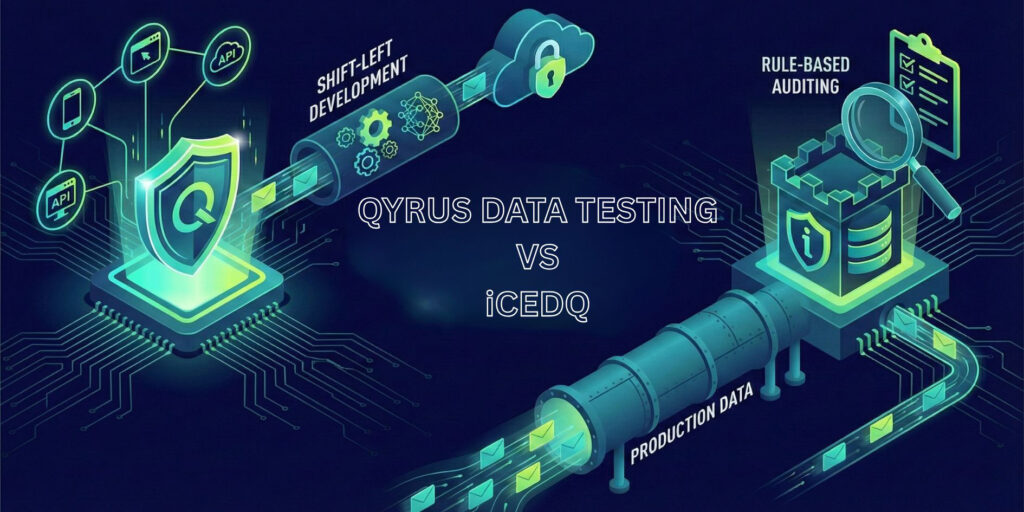
Information integrity defines the success of the modern autonomous enterprise. By 2026, 75% of all enterprise data will originate and undergo processing at the network edge. This massive shift creates a data stream of 79.4 zettabytes annually. Organizations face a choice: do you monitor for corruption after it hits your production systems, or do you stop it at the source?
Poor data quality costs organizations an average of $12.9 million every year. iCEDQ addresses this by acting as a powerful production sentry, utilizing an in-memory engine built to audit billions of records for compliance and governance. It excels at detecting errors that have already breached your environment.
Qyrus Data Testing takes the “Shift-Left” approach. It uses Generative AI to build test cases that identify logic flaws during the development phase, ensuring only “clean” data reaches your storage layers. High-speed decision-making requires absolute accuracy. While iCEDQ manages the end-state, Qyrus eliminates the “dirty data” problem before it becomes a liability.
Data Source Connectivity: Finding Signal in a 79 Zettabyte Haystack
Connectivity serves as the nervous system of your data architecture. By 2026, the volume of information generated by IoT devices alone will reach 79.4 zettabytes. However, a massive library of connectors does not guarantee a clear view of your operations.
iCEDQ positions itself as a heavyweight in enterprise connectivity, offering 50+ SQL connectors to support massive, established data environments. It excels in high-volume, rules-based auditing for Big Data stores like Snowflake and AWS Redshift. For organizations with vast, legacy-heavy footprints, iCEDQ provides the stable, wide-reaching “bridge” needed to monitor production end-states.
Data Source Connectivity
| Feature | Qyrus Data Testing | iCEDQ |
|---|---|---|
|
SQL Databases |
||
| MySQL | ✓ | ✓ |
| PostgreSQL | ✓ | ✓ |
| MS SQL Server | ✓ | ✓ |
| Oracle | ✓ | ✓ |
| IBM DB2 | ✓ | ✓ |
| Snowflake | ✗ | ✓ |
| AWS Redshift | ✓ | ✓ |
| Azure Synapse | ✗ | ✓ |
| Google BigQuery | ✗ | ✓ |
| Netezza | ✗ | ✓ |
|
NoSQL Databases |
||
| MongoDB | ✓ | ✓ |
| DynamoDB | ✗ | ✓ |
| Cassandra | ✗ | ✓ |
| Hadoop/HDFS | ✗ | ✓ |
|
Cloud Storage & Files |
||
| AWS S3 | ✓ | ✓ |
| Azure Data Lake (ADLS) | ✓ | ✓ |
| Google Cloud Storage | ✗ | ✓ |
| SFTP | ✗ | ✓ |
| CSV/Flat Files | ✓ | ✓ |
| JSON Files | ✓ | ✓ |
| XML Files | ◐ | ✓ |
| Excel Files | ◐ | ✓ |
| Parquet | ✗ | ✓ |
|
APIs & Applications |
||
| REST APIs | ✓ | ✓ |
| SOAP APIs | ◐ | ✓ |
| GraphQL | ◐ | ◐ |
| SAP Systems | ✗ | ◐ |
| Salesforce | ✗ | ✓ |
Legend: ✓ Full Support | ◐ Partial/Limited | ✗ Not Available
Conversely, Qyrus addresses a more pressing modern challenge: the integration gap. Research reveals that only 29% of enterprise applications are actually integrated, leaving the vast majority of data sources unmonitored. Qyrus prioritizes the API layer—specifically REST and GraphQL—where a significant portion of the 75% of edge data first appears. It maintains a focused set of 10+ core SQL connectors, choosing to master the critical pathways that feed modern digital transformations.
Velocity requires more than just a list of ports; it requires visibility at the point of origin. While iCEDQ monitors the final destination, Qyrus validates the flow at the source.
Data Source Connectivity: Why Your Validation Logic Must Live at the Edge
Data validation determines whether your autonomous systems act on reliable intelligence or dangerous assumptions. While traditional cloud architectures introduce significant round-trip latency, mission-critical operations now require results in single-digit windows. Your choice of validation tool either secures this window or creates a bottleneck.
iCEDQ serves as an industrial-scale auditor for production environments. It utilizes a high-performance in-memory engine to verify final data states against complex business rules. This rules-based approach ensures that massive datasets remain compliant with governance standards once they reach the central repository. It provides the deep surveillance necessary for regulated industries that cannot afford a breach in production integrity.
Data Validation & Testing Capabilities
| Feature | Qyrus Data Testing | iCEDQ |
|---|---|---|
|
Comparison Testing |
||
| Source-to-Target Comparison | ✓ | ✓ |
| Full Data Comparison | ✓ | ✓ |
| Column-Level Mapping | ✓ | ✓ |
| Cross-Platform Comparison | ✓ | ✓ |
| Reconciliation Testing | ✓ | ✓ |
| Aggregate Comparison (Sum, Count) | ✓ | ✓ |
|
Single Source Validation |
✓ | ✓ |
| Row Count Verification | ✓ | ✓ |
| Data Type Verification | ✓ | ✓ |
| Null Value Checks | ✓ | ✓ |
| Duplicate Detection | ✓ | ✓ |
| Regex Pattern Validation | ✓ | ✓ |
| Custom Business Logic/Functions | ✓ | ✓ |
| Referential Integrity Checks | ◐ | ✓ |
| Schema Validation | ◐ | ✓ |
|
Advanced Testing |
||
| Transformation Testing | ✓ | ✓ |
| ETL Process Testing | ✓ | ✓ |
| Data Migration Testing | ✓ | ✓ |
| BI Report Testing | ✗ | ✓ |
| Tableau/Power BI Testing | ✗ | ✓ |
| Pre-Screening / Data Profiling | ◐ | ✓ |
| Data Lineage Tracking | ✗ | ✓ |
Legend: ✓ Full Support | ◐ Partial/Limited | ✗ Not Available
Qyrus shifts the validation strategy to the left to prevent defects before they enter the high-latency pipeline. By employing Generative AI for Test Cases, Qyrus identifies logic flaws in the transformation layer during development. This proactive method supports high-speed environments, such as manufacturing lines that have achieved a significant reduction in false positive rates through localized quality control. Qyrus also allows teams to inject custom Lambda functions into their automated data quality checks, ensuring that unique business logic remains intact from the point of origin.
Your ETL data testing framework must provide a clear mirror of your operational truth. Whether you lean on iCEDQ’s industrial auditing or Qyrus’s AI-powered prevention, your goal remains the same: stop the rot before it reaches the warehouse.
Automation & Integration: Orchestrating the Future of AI-Ready Data Pipelines
Automation serves as the engine that drives modern data operations from development to the network edge. Without seamless integration, your data quality strategy creates friction that stalls innovation. Gartner predicts that by 2026, 40% of enterprise applications will feature task-specific AI agents. These intelligent systems require pipelines that function with absolute precision and zero manual intervention.
iCEDQ provides massive orchestration power for high-scale enterprise workloads. It integrates natively with dominant enterprise schedulers like Control-M and Autosys to manage rules-based testing across production environments. This deep integration allows DataOps teams to trigger automated audits as part of their existing high-volume batch processing. For organizations managing thousands of production jobs, iCEDQ acts as the heavy-duty transmission that keeps the engine running at scale.
Automation & Integration
| Feature | Qyrus Data Testing | iCEDQ |
|---|---|---|
|
Test Automation |
||
| No-Code Test Creation | ✓ | ✓ |
| Low-Code Options | ✓ | ✓ |
| SQL Query Support | ✓ | ✓ |
| Visual Query Builder | ✓ | ✓ |
| Test Scheduling | ✗ | ✓ |
| Reusable Test Components | ✓ | ✓ |
| Parameterized Testing | ✓ | ✓ |
|
AI/ML Capabilities |
||
| AI-Powered Test Generation | ✓ | ◐ |
| Auto-Mapping of Columns | ✓ | ✓ |
| Self-Healing Tests | ◐ | ◐ |
| Generative AI for Test Cases | ✓ | ✗ |
|
DevOps/CI-CD Integration |
||
| REST API | ✓ | ✓ |
| Jenkins Integration | ✓ | ✓ |
| Azure DevOps | ✓ | ✓ |
| GitLab CI | ✓ | ✓ |
| GitHub Actions | ✓ | ✓ |
| Webhooks | ◐ | ✓ |
|
Issue & Test Management |
||
| Jira Integration | ✓ | ✓ |
| ServiceNow Integration | ◐ | ✓ |
| Slack/Teams Notifications | ✓ | ✓ |
| Email Notifications | ✓ | ✓ |
Legend: ✓ Full Support | ◐ Partial/Limited | ✗ Not Available
Qyrus shifts this automation focus to the earliest stages of the development cycle. Using its Nova AI engine, the platform enables teams to build automated test cases 70% faster than traditional manual methods. This “Shift-Left” approach ensures that quality checks live directly within your Jenkins or Azure DevOps pipelines. Qyrus empowers manual testers to contribute to the automation suite through its no-code interface, effectively removing the technical bottleneck that often slows down development.
True velocity requires an architecture that prevents defects before they reach your storage layers. While iCEDQ manages the industrial-scale orchestration of production audits, Qyrus provides the AI-driven speed needed to stay ahead of the development curve.
Reporting & Analytics: Solving the Visibility Crisis in Distributed Architectures
Transparency acts as the final line of defense for data-driven organizations. As the edge computing market expands toward an estimated $263.8 billion by 2035, the sheer volume of distributed nodes makes manual oversight impossible. Without a centralized lens, your team cannot distinguish between a minor network hiccup and a systemic data corruption event.
iCEDQ provides a specialized command center for production monitoring and rules-based auditing. It offers the deep visibility needed to track data health at scale, ensuring that massive datasets comply with internal governance and external regulations. This “DataOps” approach excels in environments where audit trails and production stability are the highest priorities. iCEDQ ensures that your storage layer remains a reliable repository of truth through continuous, high-volume surveillance.
Reporting & Analytics
| Feature | Qyrus Data Testing | ICEDQ |
|---|---|---|
| Real-Time Dashboards | ✓ | ✓ |
| Drill-Down Analysis | ✓ | ✓ |
| Root Cause Analysis | ◐ | ✓ |
| PDF Report Export | ✗ | ✓ |
| Excel Report Export | ✓ | ✓ |
| Trend Analysis | ◐ | ✓ |
| Data Quality Metrics | ◐ | ✓ |
| Custom Report Templates | ◐ | ✓ |
| BI Tool Integration (Tableau, Power BI) | ✗ | ✓ |
| Audit Trail | ✓ | ✓ |
Legend: ✓ Full Support | ◐ Partial/Limited | ✗ Not Available
Qyrus delivers a unified “TestOS” dashboard that consolidates signals from every layer of the application. This comprehensive view aligns with IDC’s forecast that 60% of enterprises will deploy unified frameworks by 2027 to manage operational complexity. By merging reports from Web, Mobile, API, and Data testing, Qyrus eliminates the fragmentation that often hides critical defects. This holistic reporting allows you to achieve a 70-95% reduction in bandwidth consumption by validating only the most relevant, high-value data insights.
Your monitoring strategy must evolve from simple log collection to intelligent observability. Whether you require the specialized production auditing of iCEDQ or the cross-layer visibility of Qyrus, your dashboard must turn raw telemetry into a clear signal for action.
Platform & Deployment: Choosing Between Production Guardrails and Development Agility
The physical location of your data processing now dictates your quality strategy. By 2026, 75% of enterprise-generated data will originate and undergo processing at the network edge, far from centralized cloud hubs. This structural change demands deployment models that can live exactly where the data lives.
iCEDQ provides a robust infrastructure for high-scale production surveillance. Its in-memory engine handles the massive computational load required to monitor billions of records in real-time. This platform supports Cloud (SaaS), On-Premises, and Hybrid models, giving DataOps teams the flexibility to build a permanent sentry within their core data center or cloud region. For organizations with strict data residency requirements, iCEDQ offers a mature, secure environment built for the long-term governance of enterprise information.
Platform & Deployment
| Feature | Qyrus Data Testing | iCEDQ |
|---|---|---|
| Cloud (SaaS) | ✓ | ✓ |
| On-Premises | ✗ | ✓ |
| Hybrid Deployment | ◐ | ✓ |
| Docker Support | ◐ | ✓ |
| Kubernetes Support | ◐ | ✓ |
| Multi-Tenant | ◐ | ✓ |
| SSO/LDAP | ✓ | ✓ |
| Role-Based Access Control | ✓ | ✓ |
| Data Encryption (AES-256) | ✓ | ✓ |
| SOC 2 Compliance | ◐ | ✓ |
Legend: ✓ Full Support | ◐ Partial/Limited | ✗ Not Available
Qyrus prioritizes the agile, containerized workflows that define the modern “Shift-Left” movement. Because most enterprise deployments will soon reside on-premises at the network edge, Qyrus utilizes Docker and Kubernetes to ensure its automated data quality checks scale effortlessly alongside your microservices. As a unified “TestOS” ecosystem, it allows you to manage Web, Mobile, API, and Data testing within a single infrastructure footprint. While it actively expands its feature set, Qyrus provides the lightweight, AI-ready architecture needed to prevent “dirty data” from escaping the development cycle.
Your deployment choice depends on where you want to draw your line of defense. If you need a battle-tested sentry for production monitoring at a massive scale, iCEDQ is your champion. If you want to decentralize your quality checks and catch errors at the source, Qyrus provides the modern framework for an autonomous future.
The Industrial Sentinel vs. The AI Architect: Choosing Your Data Destiny
The architectural shift toward the network edge forces a total re-evaluation of the testing stack. Organizations must decide whether to invest in heavy-duty production surveillance or intelligent development-side prevention.
iCEDQ acts as a specialized industrial sentinel for the production environment. It utilizes a high-performance in-memory engine designed to audit billions of records for absolute compliance. Its “Rule Wizard” stands as a primary differentiator, offering a 90% reduction in effort for teams managing massive, rules-based auditing workflows. Deep integration with enterprise orchestrators like Control-M and Autosys makes it the dominant choice for DataOps teams who manage high-scale production schedules. If your world revolves around maintaining a pristine, audited end-state in a massive data warehouse, iCEDQ provides the necessary muscle.
Key Differentiators
| Vendor | Unique Strengths | Best For | Considerations |
|---|---|---|---|
| Qyrus Data Testing |
|
|
|
| iCEDQ |
|
|
|
Qyrus functions as the AI architect, prioritizing the “Shift-Left” philosophy to eliminate defects at the source. It distinguishes itself as a unified “TestOS,” allowing teams to validate Web, Mobile, API, and Data layers within a single ecosystem. While iCEDQ monitors for errors, Qyrus uses Generative AI for Test Cases to predict and prevent them during development. This approach is vital for an environment where zettabytes of IoT data flow annually, requiring immediate, accurate processing. Qyrus also empowers technical teams with Lambda function support for complex transformations, ensuring that logic remains sound before data ever reaches the warehouse.
Choosing between these platforms depends on where you want to draw your line of defense. Organizations with heavy production monitoring needs and massive, rules-based auditing requirements should choose iCEDQ. However, teams seeking to consolidate their stack into a single platform and use AI to build tests 70% faster should choose Qyrus. In a world where 50% of enterprises are moving toward edge strategies by 2025, your quality strategy must match the speed of your data.
Stop the data rot at the source—prevent defects before they reach production with Qyrus. Begin your 30-day sandbox evaluation today to verify your integrity across every layer of the stack.
![Featured_Image-LLM_evaluation[1]](https://www.qyrus.com/wp-content/uploads/2026/03/Featured_Image-LLM_evaluation1.webp)
 March 9, 2026
  9 min
9 min