Qyrus Data Testing vs QuerySurge: Why Your Data Strategy Needs Depth Over Volume
 Jerin Mathew
The integrity of a data pipeline often depends on more than just the number of connections you can make. Engineering leaders frequently get caught in a “connector race,” assuming that more source integrations equate to better protection. In reality, poor data quality remains a massive financial leak, costing organizations an average of $12.9 million every single year.
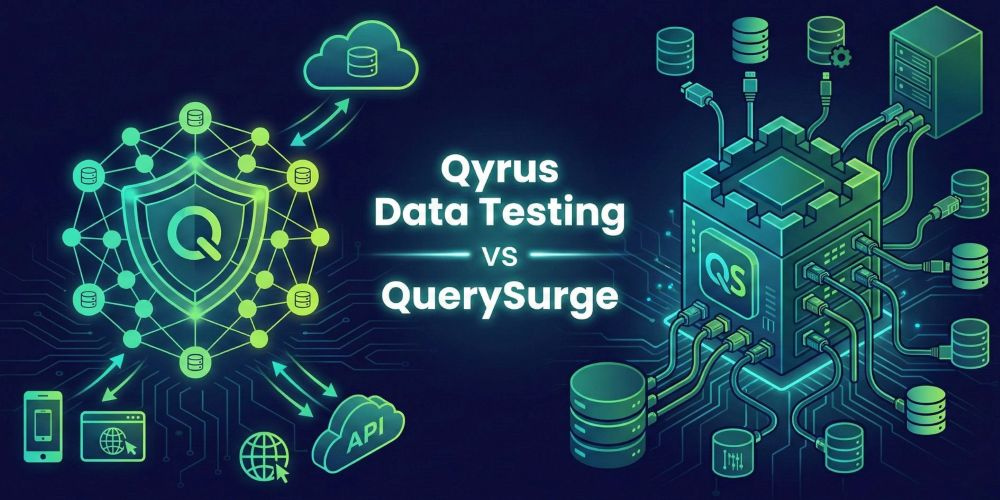
Choosing between a deep specialist and a unified platform requires a strategic look at your entire software lifecycle. QuerySurge serves as a high-precision tool for ETL specialists, offering a massive library of 200+ data store connections and a mature DevOps for Data solution with 60+ API calls.
Conversely, Qyrus Data Testing acts as a modern “TestOS,” designed for teams that need to validate the entire user journey—from a mobile app click to the final database record. While QuerySurge secures its reputation through sheer connectivity, Qyrus wins by eliminating the silos between Web, Mobile, API, and Data testing.
The Rolodex vs. The Pulse: Rethinking the Value of Connector Count
Connectivity often serves as a vanity metric that masks actual utility. QuerySurge dominates this category with a library of 200+ data store connections, providing a bridge to almost any legacy database an ETL developer might encounter. This massive reach makes it a powerful specialist for deep data warehouse validation.
Data Source Connectivity
| Feature | Qyrus Data Testing | Tricentis Data Integrity |
|---|---|---|
SQL Databases | ||
| MySQL | ✓ | ✓ |
| PostgreSQL | ✓ | ✓ |
| MS SQL Server | ✓ | ✓ |
| Oracle | ✓ | ✓ |
| IBM DB2 | ✓ | ✓ |
| Snowflake | ✗ | ✓ |
| AWS Redshift | ✓ | ✓ |
| Azure Synapse | ✗ | ✓ |
| Google BigQuery | ✗ | ✓ |
| Netezza | ✗ | ✓ |
NoSQL Databases | ||
| MongoDB | ✓ | ✓ |
| DynamoDB | ✗ | ✓ |
| Cassandra | ✗ | ✓ |
| Hadoop/HDFS | ✗ | ✓ |
Cloud Storage & Files | ||
| AWS S3 | ✓ | ✓ |
| Azure Data Lake (ADLS) | ✗ | ✓ |
| Google Cloud Storage | ✗ | ✓ |
| SFTP | ✗ | ✓ |
| CSV/Flat Files | ✓ | ✓ |
| JSON Files | ✓ | ✓ |
| XML Files | ◐ | ✓ |
| Excel Files | ◐ | ✓ |
| Parquet | ✗ | ✓ |
APIs & Applications | ||
| REST APIs | ✓ | ✓ |
| SOAP APIs | ◐ | ✓ |
| GraphQL | ◐ | ◐ |
| SAP Systems | ✗ | ◐ |
| Salesforce | ✗ | ✓ |
Legend: ✓ Full Support | ◐ Partial/Limited | ✗ Not Available
However, most engineering teams find that the Pareto Principle governs their pipelines. Research shows that 80% of enterprise integration needs require only 20% of available prebuilt connectors. Qyrus focuses its 10+ core SQL connectors on this “vital few,” including high-traffic environments like Snowflake and Amazon Redshift.
The true danger lies in the “integration gap.” Large enterprises manage hundreds of apps but only integrate 29% of them, leaving vast amounts of data unmonitored at the source. Qyrus closes this gap by validating the REST, SOAP, and GraphQL APIs that feed your warehouse. You gain visibility into the data journey before it reaches the storage layer. QuerySurge builds a bridge to every destination, but Qyrus puts a pulse on the application layer where the data actually lives.
The Scalpel vs. The Shield: Precision Testing for Modern Pipelines
Validation logic determines whether your data warehouse becomes a strategic asset or a digital graveyard. Organizations lose an average of $12.9 million annually because they fail to catch structural and logical errors before they impact downstream analytics. Choosing between QuerySurge and Qyrus Data Testing depends on whether you need a specialized surgical tool or a broad, integrated safety net.
QuerySurge operates as a precision instrument for the deep ETL layers. It masters high-complexity tasks like validating Slowly Changing Dimensions (SCD) and maintaining Data Lineage Tracking. Engineers use its specialized query wizards to perform exhaustive source-to-target comparisons and column-level mapping across massive datasets. While it handles the heavy lifting of data warehouse validation, its BI report testing for platforms like Tableau or Power BI requires a separate add-on. This makes QuerySurge a powerhouse for teams whose world revolves strictly around the storage layer.
Testing & Validation Capabilities
| Feature | Qyrus Data Testing | Tricentis Data Integrity |
|---|---|---|
Comparison Testing | ||
| Source-to-Target Comparison | ✓ | ✓ |
| Full Data Comparison | ✓ | ✓ |
| Column-Level Mapping | ✓ | ✓ |
| Cross-Platform Comparison | ✓ | ✓ |
| Reconciliation Testing | ✓ | ✓ |
| Aggregate Comparison (Sum, Count) | ✓ | ✓ |
Single Source Validation | ||
| Row Count Verification | ✓ | ✓ |
| Data Type Verification | ✓ | ✓ |
| Null Value Checks | ✓ | ✓ |
| Duplicate Detection | ✓ | ✓ |
| Regex Pattern Validation | ✓ | ✓ |
| Custom Business Logic/Functions | ✓ | ✓ |
| Referential Integrity Checks | ◐ | ✓ |
| Schema Validation | ◐ | ✓ |
Advanced Testing | ||
| Transformation Testing | ✓ | ✓ |
| ETL Process Testing | ✓ | ✓ |
| Data Migration Testing | ✓ | ✓ |
| BI Report Testing | ✗ | ✓ |
| Tableau/Power BI Testing | ✗ | ✓ |
| Pre-Screening / Data Profiling | ◐ | ✓ |
| Data Lineage Tracking | ✗ | ✓ |
Qyrus takes a more expansive approach by securing the logic across the entire software stack. It provides robust source-to-target and transformation testing, but its true strength lies in its Lambda function support. You can write custom code to validate complex business rules that standard SQL checks might miss. This flexibility allows teams to verify single-column and multi-column transformations with surgical precision. By bridging the gap between APIs and databases, Qyrus ensures that your data validation doesn’t just stop at the table but starts at the initial point of entry.
Relying on simple row counts is like checking a bank’s vault while ignoring the identity theft at the front desk. Your data quality validation in ETL must secure the logic, not just the volume.
Velocity vs. Variety: Scaling Your Pipeline Without the Scripting Tax
Automation serves as the engine that moves quality from a bottleneck to a competitive advantage. When teams rely on manual scripts, they often spend more time maintaining tests than building features. Efficient ETL testing automation tools must do more than just execute code; they must reduce the cognitive load on the engineers who build them.
QuerySurge addresses this through its “DevOps for Data” framework. It provides 60+ API calls and comprehensive Swagger documentation to support highly technical teams. This maturity allows engineers to bake data testing directly into their CI/CD pipelines with surgical control. QuerySurge also includes AI-powered test generation from mappings, which helps bridge the gap between initial design and execution. It remains a favorite for teams that want to manage their data integrity as code.
Automation and Integration
| Feature | Qyrus Data Testing | Tricentis Data Integrity |
|---|---|---|
Test Automation | ||
| No-Code Test Creation | ✓ | ✓ |
| Low-Code Options | ✓ | ✓ |
| SQL Query Support | ✓ | ✓ |
| Visual Query Builder | ✓ | ✓ |
| Test Scheduling | ✗ | ✓ |
| Reusable Test Components | ✓ | ✓ |
| Parameterized Testing | ✓ | ✓ |
AI/ML Capabilities | ||
| AI-Powered Test Generation | ✓ | ✓ |
| Auto-Mapping of Columns | ✓ | ✓ |
| Self-Healing Tests | ◐ | ◐ |
| Generative AI for Test Cases | ✓ | ✓ |
DevOps/CI-CD Integration | ||
| REST API | ✓ | ✓ |
| Jenkins Integration | ✗ | ✓ |
| Azure DevOps | ✗ | ✓ |
| GitLab CI | ✗ | ✓ |
| GitHub Actions | ✗ | ✓ |
| Webhooks | ◐ | ✓ |
Issue & Test Management | ||
| Jira Integration | ✓ | ✓ |
| ServiceNow Integration | ◐ | ◐ |
| Slack/Teams Notifications | ✓ | ✓ |
| Email Notifications | ✓ | ✓ |
Qyrus prioritizes democratization and speed through its Nova AI engine. Instead of requiring manual mapping for every scenario, the platform uses machine learning to identify data patterns and generate test functions automatically. This approach allows teams to build test cases 70% faster than traditional scripting methods. Qyrus also integrates natively with Jira, Jenkins, and Azure DevOps, ensuring that quality remains a shared responsibility across the software lifecycle. While QuerySurge empowers the specialist with a robust API, Qyrus empowers the entire organization with an intelligent, no-code TestOS.
Velocity requires more than just running tests fast. It requires a platform that minimizes technical debt and maximizes the reach of every test case.
The Forensic Lens: Turning Raw Rows into Actionable Insights
Visibility transforms a silent database into a strategic asset. Without clear reporting, teams often overlook the underlying causes of the $12.9 million annual loss attributed to poor data quality. Choosing between QuerySurge and Qyrus depends on whether you value deep forensic snapshots or a live, unified pulse of your entire stack.
Reporting and Analytics
| Feature | Qyrus Data Testing | Tricentis Data Integrity |
|---|---|---|
| Real-Time Dashboards | ✓ | ✓ |
| Drill-Down Analysis | ✓ | ✓ |
| Root Cause Analysis | ◐ | ✓ |
| PDF Report Export | ✗ | ✓ |
| Excel Report Export | ✓ | ✓ |
| Trend Analysis | ◐ | ✓ |
| Data Quality Metrics | ◐ | ✓ |
| Custom Report Templates | ◐ | ✓ |
| BI Tool Integration (Tableau, Power BI) | ✗ | ✓ |
| Audit Trail | ✓ | ✓ |
QuerySurge offers a mature reporting engine designed for the deep ETL specialist. Its “DevOps for Data” solution leverages 60+ API calls to push detailed validation results directly into your existing management tools. While it provides comprehensive drill-down analysis into data discrepancies, testing BI reports like Tableau requires a separate BI Tester add-on. This makes it a powerful forensic tool for those who need to document every byte of the transformation process.
Qyrus delivers visibility through a unified dashboard that tracks the health of Web, Mobile, API, and Data layers in a single view. By consolidating these signals, the platform helps organizations eliminate the fragmentation. Qyrus uses its Nova AI engine to flag anomalies and provide real-time metrics that allow for immediate corrective action. It removes the guesswork from quality assurance by presenting a 360-degree mirror of your digital operations.
Actionable intelligence must move faster than the data it monitors. Whether you require the detailed documentation of QuerySurge or the unified agility of Qyrus, your reporting should reveal the truth before a defect reaches production.
Scaling the Wall: Choosing an Architecture for Absolute Data Trust
Your deployment strategy dictates the long-term agility and security of your testing operations. Both platforms provide the essential flexibility of Cloud (SaaS), On-Premises, and Hybrid models. However, the underlying infrastructure philosophies differ to meet distinct organizational needs.
Platform and Deployment
| Feature | Qyrus Data Testing | Tricentis Data Integrity |
|---|---|---|
| Cloud (SaaS) | ✓ | ✓ |
| On-Premises | ✗ | ✓ |
| Hybrid Deployment | ◐ | ✓ |
| Docker Support | ◐ | ✓ |
| Kubernetes Support | ◐ | ◐ |
| Multi-Tenant | ◐ | ✓ |
| SSO/LDAP | ✓ | ✓ |
| Role-Based Access Control | ✓ | ✓ |
| Data Encryption (AES-256) | ✓ | ✓ |
| SOC 2 Compliance | ◐ | ✓ |
QuerySurge provides a battle-tested environment optimized for enterprise-grade security. It employs a per-user licensing model with a minimum five-user package, ensuring a dedicated footprint for professional data teams. Its mature security framework supports SSO/LDAP and RBAC to maintain strict access control over sensitive data environments. This makes it a natural fit for traditional enterprises that require a stable, proven infrastructure for their deep warehouse validation.
Qyrus Data Testing prioritizes modern, containerized workflows for teams that demand rapid scaling. The platform fully supports Docker and Kubernetes. This allows you to manage your ETL testing automation tools within your own private cloud or local environment with minimal friction. Qyrus uses AES-256 encryption and holds a solid platform score. Qyrus empowers cloud-native teams to move fast without the heavy overhead of legacy setup requirements.
Infrastructure should never act as a bottleneck for quality. Whether you choose the established maturity of QuerySurge or the containerized flexibility of Qyrus, your platform must align with your broader IT strategy.
The Final Verdict: Choosing Your Data Sentinel
The choice between these two powerhouses depends on the focus of your engineering team.
Qyrus vs. QuerySurge: Strategic Differentiators
| Vendor | Unique Strengths | Best For |
|---|---|---|
| Qyrus Data Testing |
| Organizations looking for unified testing across all layers; Teams already using Qyrus for other testing needs. |
| QuerySurge |
| Data warehouse teams; ETL developers; Organizations with highly diverse data sources. |
Choose QuerySurge if your primary mission involves deep ETL testing and data warehouse validation across hundreds of legacy sources. Its 200+ data store connections and mature DevOps APIs make it the ultimate specialist for data-centric organizations. It delivers the forensic precision required for massive transformation projects.
Choose Qyrus if you want to consolidate your quality strategy into a single “TestOS” that covers Web, Mobile, API, and Data. By leveraging Nova AI to build test cases 70% faster, Qyrus helps you eliminate the “fragmentation tax” that drains millions from modern QA budgets. It offers a unified path to data trust for organizations that value full-stack visibility.
Stop managing icons and start mastering the journey. Begin your 30-day sandbox evaluation today to verify your integrity across every layer of the stack.
![Featured_Image-LLM_evaluation[1]](https://www.qyrus.com/wp-content/uploads/2026/03/Featured_Image-LLM_evaluation1.webp)
 March 9, 2026
  9 min
9 min