Test Orchestration: The Definitive Guide to Closing the Quality Gap in 2026
 Varun RS

Software delivery has hit a structural wall. While AI coding assistants now contribute significantly to software development, most quality assurance teams still struggle with a fragmented process. We see a growing distance between the speed of development and the rigor of validation. This gap creates a dangerous environment where teams launch features quickly, but quality remains a secondary concern because the testing phase cannot keep up.
Traditional testing often relies on isolated scripts. These scripts perform well for specific checks, but they fail to address the complexity of modern microservices or multi-platform user journeys. Currently, 36.5% of organizations still lack any form of test orchestration. They rely on “duct-taped” manual hand-offs that slow down the entire pipeline. In fact, 35% of companies still report that manual testing represents their most significant time-consuming activity.
To keep up with modern engineering, you must transform your approach. Automated test orchestration provides the connective tissue required to synchronize your tools and environments. It changes the focus from “did this script pass?” to “is this business process ready for production?” By implementing workflow-based test automation, you eliminate the idle time between tests and ensure every check happens at the right moment with the exact data required for success.
What is Test Orchestration? Definition & Core Concepts
Think of test orchestration as the automated coordination of your entire software testing pipeline. It ensures every test executes in the correct sequence, at the appropriate time, and with the exact data required for validation.
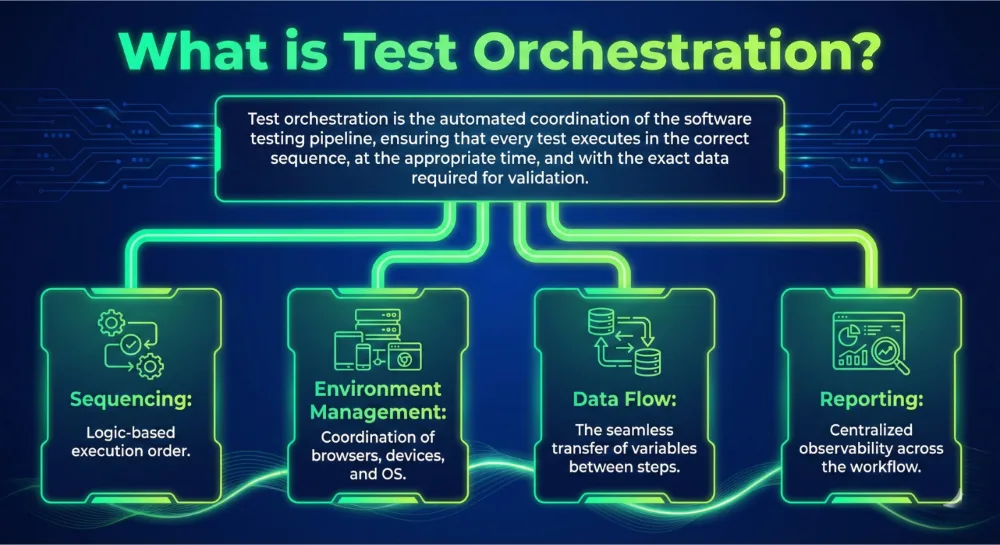
While traditional automation focuses on individual scripts, orchestration acts as the “connective tissue” that manages how those scripts interact across different platforms. Standalone automation validates individual functions, but orchestration manages the broader business outcome across your entire stack. (To explore the nuanced technical and operational contrasts between these two methodologies, read our detailed comparison: Test Orchestration vs Test Automation: What’s the Difference?)
This structural shift requires a focus on four essential components. First, sequencing dictates the logical order of execution. For example, a system must validate a user’s credentials before attempting a complex transaction. Second, environment management handles the allocation of real browsers and mobile devices. Third, data flow allows the system to pass variables, such as session tokens, between disparate tests. Finally, centralized reporting aggregates every pass and failure into a single view for the engineering team.
Transitioning to this model addresses the gaps found in basic frameworks. Research shows that 36.5% of firms still lack any form of orchestration, leaving them vulnerable to environment drift and manual bottlenecks. By implementing workflow-based test automation, you create a synchronized process where tools and data work in harmony. This move transforms testing from a series of disconnected events into a resilient, enterprise-grade pipeline.
Breaking the Script: Why Automation Fails Without Test Orchestration
Standard test automation handles the execution of individual scripts. It checks if a button works or if an API returns a 200 OK status. However, automation on its own lacks the structural logic to manage dependencies between different systems. This lack of coordination explains why 73% of test automation projects fail. Without a broader strategy, scripts become brittle and maintenance costs skyrocket.
Test orchestration takes a different path. While automation focuses on the task, orchestration focuses on the workflow. It manages the entire lifecycle of a test suite across multiple environments. When you use automated test orchestration, you define the logic that guides a release. If an API login fails, the orchestrator stops the subsequent UI tests immediately. This prevents false positives and saves significant infrastructure costs.
Differences Between Test Automation and Test Orchestration
| Feature | Standalone Test Automation | Test Orchestration |
|---|---|---|
| Primary Focus | Execution of individual scripts and tasks. | Coordination of testing workflows and pipelines. |
| Data Management | Often hardcoded or siloed per test. | Dynamic data passing and state persistence. |
| Trigger Mechanism | Manual or scheduled execution. | Event-driven (commits, merges, deployments). |
| Environment Handling | Static, often pre-configured environments. | Dynamic environment provisioning and coordination. |
| Reporting | Fragmented pass/fail logs per tool. | Centralized observability and aggregated insights. |
| Quality Gating | Manual intervention often required to halt pipelines. | Automated conditional progression based on results. |
Enterprise teams require more than just a collection of scripts. They need test orchestration tools that provide visibility into the entire delivery pipeline. Integration with CI/CD is the primary driver here, as 84% of developers now work in DevOps environments where speed is non-negotiable. Workflow-based test automation bridges this gap. It ensures your tests run as a synchronized unit rather than a series of ad-hoc events. Qyrus facilitates this through its visual Flow Master Hub, allowing teams to coordinate these complex sequences without writing additional code.
Core Benefits of Test Orchestration for Enterprises
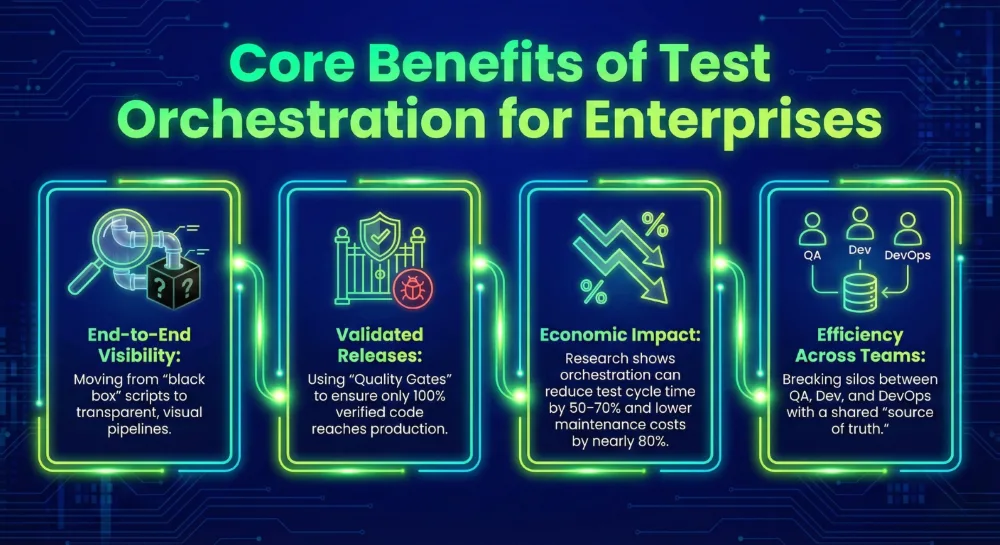
Enterprise leaders often view testing as a necessary drag on momentum. However, shifting your strategy transforms this bottleneck into a strategic asset. By moving beyond isolated scripts, you gain total visibility into the delivery pipeline. This transparency allows development teams to identify risks early. It ensures that only high-quality code reaches your customers.
Shattering the Black Box with Total Visibility
Isolated scripts often create a “black box” where results are difficult to interpret. You might see a failure, but finding the root cause requires manual digging through logs. Automated test orchestration replaces this confusion with a transparent, visual pipeline. You see every step of the user journey as it happens. This clarity allows your team to pinpoint exactly where a process breaks, whether it occurs in an API call or a mobile UI element.
Hardening Production with Intelligent Quality Gates
Moving fast requires guardrails. Validated releases depend on “Quality Gates” that automatically block unstable code from moving forward. Using test orchestration tools, you set specific criteria for success at every stage of the pipeline. If a critical smoke test fails, the orchestrator halts the deployment immediately. This ensures only 100% verified features reach your users, maintaining your brand’s reputation for reliability.
The Economic Impact of Automated Test Orchestration
The financial argument for this shift remains undeniable. Research indicates that organizations adopting these strategies experience shorter test cycles compared to those using fragmented automation. Furthermore, these teams achieve better success rate in production releases. By streamlining the validation process, you reduce maintenance overhead by nearly 80%. This efficiency frees up your budget for innovation rather than constant troubleshooting.
Unifying Engineering through Workflow-Based Test Automation
Traditional testing often happens in a silo, separated from development and operations. Workflow-based test automation breaks down these barriers. It provides a shared “source of truth” that every department can access and understand. When developers, QA engineers, and DevOps professionals look at the same orchestration dashboard, they collaborate more effectively. This alignment accelerates the entire lifecycle. It ensures everyone works toward the same objective: delivering value to the customer.
What Test Orchestration Looks Like in Action
Test orchestration moves beyond the theory of “running tests” and enters the practice of managing business risks at scale. In a modern software environment, a single release often involves an API update, a change to the web checkout UI, and a new promotion in the mobile app. Standalone scripts struggle to bridge these gaps. However, with automated test orchestration, you build a unified flow that treats these separate components as one cohesive journey.
High-Level Workflow Examples
The Smoke Test: Rapid Validation
Teams use smoke tests to perform quick, automated checks of critical functionality. The goal remains simple: verify the application works at a basic level before committing further resources. A well-orchestrated smoke suite should validate critical paths in less than 15 minutes after a deployment. This rapid feedback loop allows you to detect obvious issues immediately, preventing the team from wasting time on a fundamentally broken build.
The Regression Suite: Enterprise-Scale Chaining
As applications grow, so does the risk of “breaking” existing features. A comprehensive regression suite often requires chaining 10 or more workflows to achieve full system validation. Using test orchestration tools, you can organize these workflows into a logical hierarchy. If the “User Authentication” workflow fails, the system automatically halts the “Payment Processing” and “Order History” flows. This prevents the “crushing weight of maintenance” often seen in legacy systems, where most test automation projects fail due to a lack of coordination.
The API-to-Web Journey: Cross-Platform Fluidity
Real users do not live in silos; neither should your tests. An API-to-Web journey mirrors a real-world scenario by creating a user via an API call and immediately verifying that account on the Web UI. This requires seamless data propagation, where the session token or user ID from the first node becomes the input for the next. This workflow-based test automation ensures that your back-end and front-end systems communicate perfectly.
Real-World Architectures: The CI/CD Connection
Effective test orchestration relies on deep integration with your existing DevOps stack. Since more than 80% developers now work in DevOps environments, your orchestration engine must respond instantly to CI/CD triggers.
Whether you use Jenkins, Azure DevOps, or GitLab, the architecture remains consistent. When a developer pushes code to a repository, the CI/CD tool sends a trigger to the orchestration platform. The engine then selects the appropriate environment—be it Staging, UAT, or Production—and begins the execution.
By embedding these checks directly into the pipeline, you create “Quality Gates” that block unstable code. This automated choreography ensures that your release cycle stays fast without sacrificing the reliability your customers expect.
Anatomy of an Orchestrated Test Workflow
Orchestration begins with sequencing. You organize tests into logical units such as authentication, onboarding, or checkout. Traditional methods run scripts one after another in a linear queue. However, modern test orchestration tools enable parallel execution logic, which can reduce execution time by up to 90%. Chaining tests ensures that a subsequent stage only begins after a prior stage succeeds. For example, if the authentication stage fails, the orchestrator halts checkout testing to save compute resources.
Data Management and State Persistence
Data management serves as the fuel for these workflows. Successful test orchestration requires sharing session data, tokens, and identifiers across different platforms. You must pass a customer ID from an account creation step to the purchase validation step without manual entry. Furthermore, environment persistence maintains the application state throughout the entire process. This ensures that database snapshots or session cookies remain valid as the test progresses from an API call to a mobile interface.
Resilience Through Failure Handling
Reliable workflows include robust failure handling to prevent brittle pipelines. If a test fails, you need a strategy beyond simple termination. Automated test orchestration allows you to define specific retry, abort, or skip logic. For instance, if a non-critical UI element fails, the system might skip that step to continue the broader validation. In contrast, a failure in the login stage should abort the entire flow to prevent false positives. Advanced platforms even use self-healing mechanisms to address UI changes, which can slash maintenance efforts by 81%.
Centralized Analytics and Observability
The final piece involves results and analytics. Centralized reporting dashboards aggregate logs, videos, and performance metrics from every tool in the testing suite. You track specific KPIs such as pass/fail trends and execution duration to measure the health of your workflow-based test automation. These insights transform raw outcomes into a clear picture of overall software quality. Qyrus provides this transparency through its Mind Maps, which offer a visual, hierarchical view of the entire test repository and its execution status.
How Test Orchestration Integrates with CI/CD & DevOps
Modern software delivery requires a seamless connection between code changes and validation. When you integrate test orchestration into your DevOps pipeline, you move beyond simple automation. Your CI/CD tools, such as Jenkins or Azure DevOps, no longer just trigger scripts; they manage a sophisticated choreography of validation steps.
Automated test orchestration introduces intelligent quality gates. These gates evaluate the health of a build in real-time. If a critical workflow fails, the orchestrator blocks the deployment immediately. This proactive approach prevents the accumulation of technical debt and protects the user experience.
Effective test orchestration tools also provide immediate observability. Instead of searching through logs, your team receives results directly in Slack or Jira. This rapid feedback loop allows development teams to fix bugs as soon as they appear. Workflow-based test automation ensures that every code commit undergoes a rigorous, multi-environment check before it ever touches a customer.
Selecting the Best Test Orchestration Tools & Platforms
Choosing from the available test orchestration tools requires an understanding of how different architectures impact your long-term maintenance. The market generally splits into three categories. First, built-in orchestration engines exist within larger testing platforms. These offer native integration but may limit your flexibility. Second, plugin tools attach to your existing CI/CD pipeline. While these provide modularity, they often lead to “tool sprawl,” where engineers spend more time managing integrations than writing tests. Finally, full platform orchestration stacks provide a unified environment for cross-platform validation.
Transitioning to a unified platform often reveals the inherent limitations of older, siloed testing models that lack cross-protocol support. (If your team currently relies on older frameworks, you should examine Why Traditional Component Testing Breaks at Scale to understand why a shift to orchestration is mandatory for enterprise growth.)
The debate between code-based orchestration and visual workflow builders also shapes your team’s productivity. Code-based frameworks provide deep customization for highly technical teams. However, they often recreate the “crushing weight of maintenance” that causes test automation projects to fail. In contrast, visual builders democratize the process. They allow manual testers and product owners to contribute to the quality strategy without learning complex syntax. This shift is vital because 35% of companies still struggle with manual testing as their primary bottleneck.
Orchestrating at Scale with Qyrus
Qyrus offers a next-generation approach to automated test orchestration through its dedicated TO module. This platform eliminates the obstacles that hinder team progress by providing a high-performance environment for complex test scenarios.
- Flow Master Hub: This is your command center. Use the advanced drag-and-drop interface to create and edit test flows visually. It handles intricate user journeys across Web, Mobile, API, and Desktop platforms in a single execution.
- The Vault: Scale requires organization. The Vault provides a hierarchical structure to categorize projects by environments like QA, UAT, and Production. Advanced nesting and filtering tools ensure your team never wastes time hunting for the correct files.
- SmartFlow Mapping: Rigid paths lead to fragile tests. This feature adapts to live conditions during execution. If a login fails or a transaction lacks a balance, the mapper reroutes the test automatically to handle the edge case.
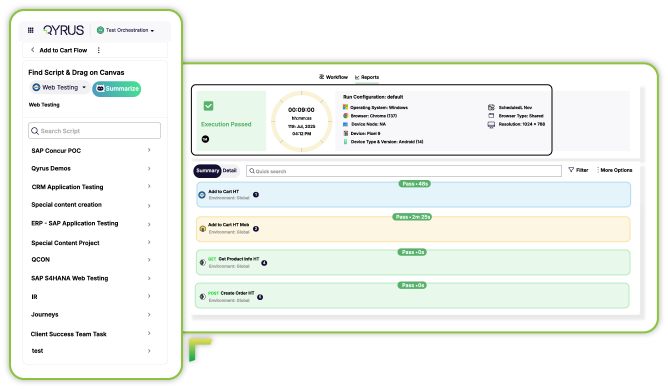
See How Qyrus Orchestrates Complex Test Workflows
Best Practices for Successful Test Orchestration
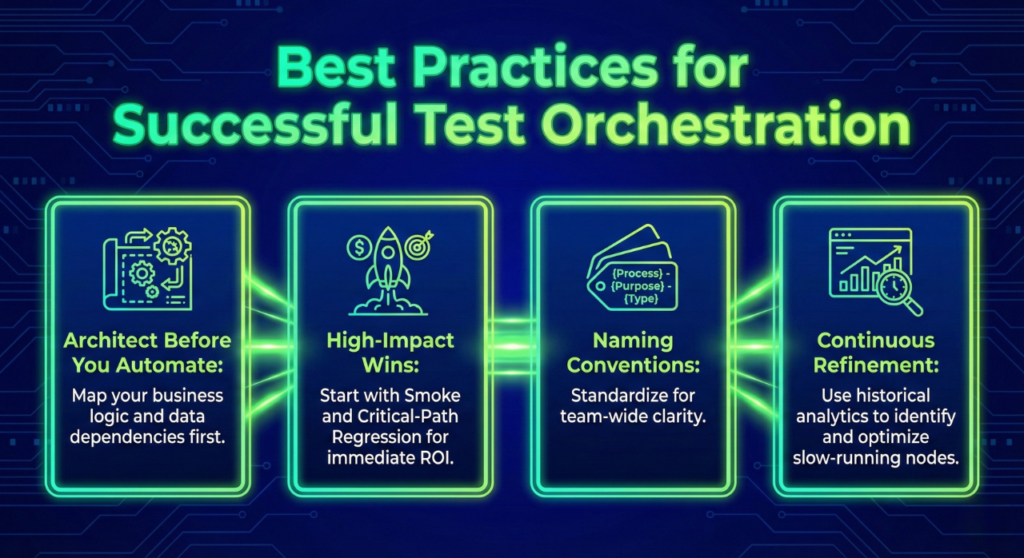
Moving from fragmented automation to a cohesive delivery pipeline requires more than just new software. It demands a shift in how your team perceives the lifecycle of a test. Success depends on treating your quality infrastructure with the same rigor as your production code. By following proven engineering standards, you ensure your test orchestration remains maintainable even as your application grows in complexity.
Architecting the Journey Before Writing a Single Script
Many teams rush into automation without mapping their business logic first. This lack of planning is a primary reason why most test automation projects fail to deliver long-term value. You must define your data contracts and system dependencies before building workflows. Identify which services require session persistence and where data must flow between platforms. Establishing these blueprints early prevents the creation of brittle, “duct-taped” sequences that break during minor updates.
Prioritizing the Critical Path for Immediate Returns
Avoid the temptation to orchestrate every minor feature at once. Start with high-impact workflows that protect your core revenue streams. Focus on building a robust smoke suite that validates critical paths in less than 15 minutes. Once you stabilize these essential checks, expand into complex regression suites. This incremental approach allows your team to demonstrate immediate ROI while gradually reducing the manual testing bottleneck.
Maintaining Integrity Through Centralized Governance
Reliable workflow-based test automation requires strict separation of environments. Never hardcode credentials or URLs within your scripts. Instead, use test orchestration tools to manage environment-specific variables for Dev, Staging, and Production. Centralizing your data management through a “Data Hub” ensures that every team member uses the same verified datasets. This practice eliminates the “it works on my machine” syndrome and ensures your results remain consistent across different infrastructure tiers.
Closing the Loop with Performance-Driven Refinement
Orchestration is not a “set and forget” activity. You must continuously monitor KPIs and failure trends to identify bottlenecks. If a specific node consistently delays your pipeline, use performance optimization patterns like parallel execution to reclaim time. Research shows that refining these sequences can improve execution speed by 40-50%. By analyzing historical reports and adjusting your retry logic, you transform automated test orchestration from a simple execution engine into a high-performance asset.
The Road Ahead: Building a Sustainable Culture of Quality
The shift to test orchestration marks a fundamental change in how enterprises deliver software. While standalone scripts once served a specific purpose, they cannot keep up with the speed of modern code generation. Adopting automated test orchestration is no longer a luxury. It is a prerequisite for survival in a market where many organizations still struggle with fragmented pipelines. By treating your quality layer as a first-class engineering citizen, you achieve the near perfect success rate required for enterprise scale.
Transitioning your team requires a clear roadmap. First, map your core business processes and identify the data dependencies between systems. Second, define your “Quality Gates” to ensure only verified code moves forward. Finally, integrate your workflow-based test automation with your existing CI/CD tools. This incremental approach prevents the “crushing weight of maintenance”.
Qyrus simplifies this journey by offering a unified environment for cross-platform validation. Our platform allows you to move away from rigid, siloed testing and toward a coordinated, visual strategy. Whether you are validating complex banking transfers or e-commerce user journeys, our test orchestration tools provide the precision and control you need to lead your industry. We help you move beyond ad-hoc scripts to build a resilient infrastructure that grows with your organization.
Don’t let legacy testing methods hold back your engineering velocity. Contact us today for a personalized ROI report or schedule a demo to see how Qyrus can transform your testing into a direct driver of business growth.
 February 17, 2026
  15 min