Qyrus Named a Leader in The Forrester Wave™: Autonomous Testing Platforms, Q4 2025 – Read More

Featured_Image-LLM_evaluation[1]

Enterprises rush to deploy Large Language Models (LLMs) to gain a competitive edge. However, speed without control invites disaster. One incorrect answer in a customer support portal or a security flaw in AI-generated code can lead to legal action or a data breach.  

We know that quality assurance defines the success of any software deployment. AI requires even stricter standards. You must treat AI output validation as the steering wheel of your innovation, not the brake pedal. 

Current data highlights a massive gap in enterprise readiness. While healthcare data breaches affected over half the U.S. population in 2024, only 31% of organizations actively monitor their AI systems. This lack of oversight exists. It persists despite evidence that regular assessments triple the likelihood of achieving high value from GenAI.  
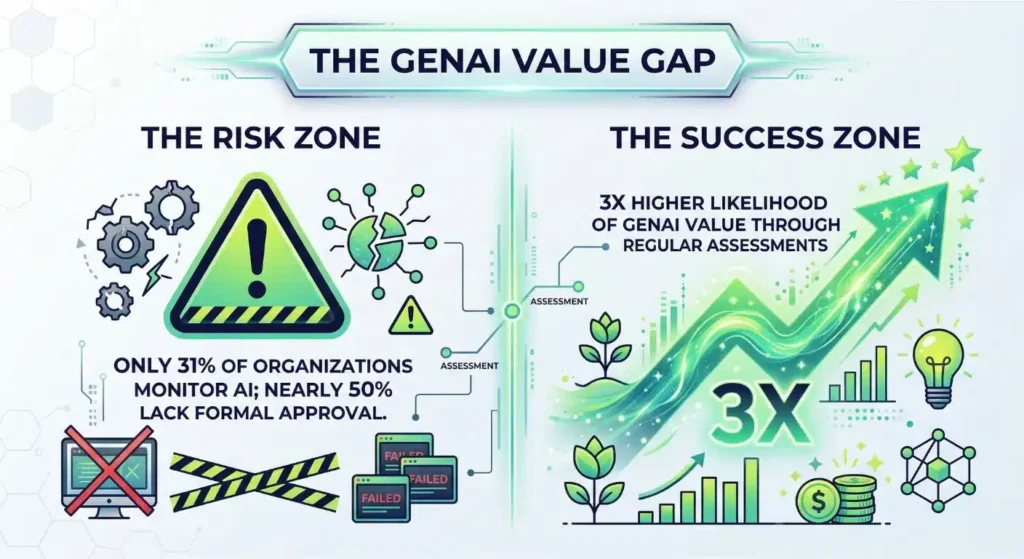
Organizations must implement robust LLM evaluation to bridge this safety gap. You protect your brand only when you prioritize generative AI testing throughout the model’s lifecycle. 

Why Is Simple Keyword Matching Failing Your AI Strategy? 

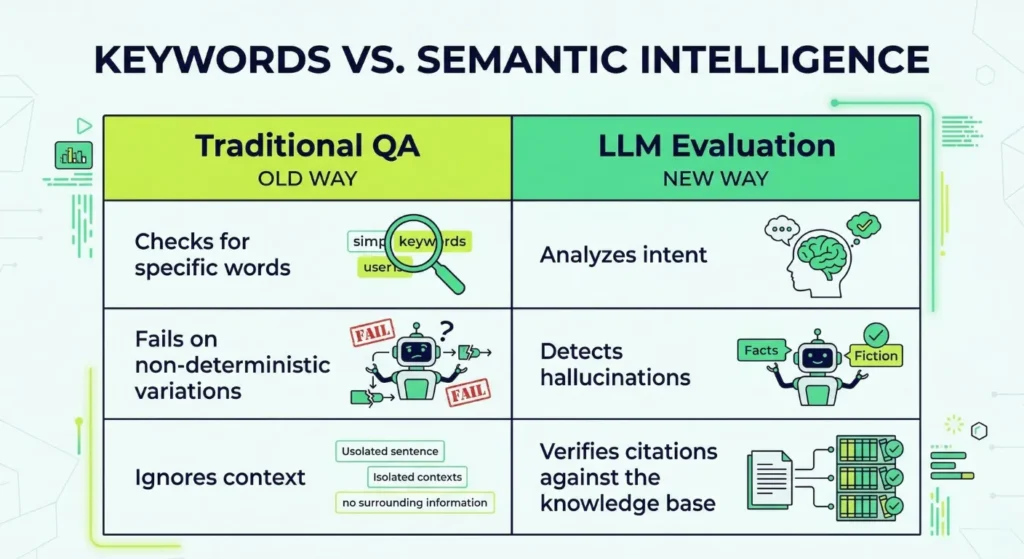
Traditional software testing relies on predictable, binary outcomes. If you input X, the system must return Y. LLMs behave non-deterministically. They produce thousands of variations for the same prompt. This unpredictability creates a massive challenge for AI output validation. If your quality assurance team relies solely on keyword matching, they will miss subtle but dangerous errors. 

Effective LLM evaluation rests on three key pillars:  

  • First, you need deep semantic analysis. You must verify that the AI captures the user’s intent rather than just repeating terms.  
  • Second, rigorous hallucination detection in LLM is non-negotiable. You must confirm that every claim the model makes exists within your trusted knowledge base. Industry analysts expect the market for these observability platforms to reach to about USD 8.07 billion by the early 2030s as companies prioritize safety.  
  • Finally, every response needs citation integrity. If an AI provides financial advice or technical specs, it must link back to a verified source. High-performing teams that automate these checks often see a 25% improvement in complex query accuracy. 
Is Your Generative AI Testing Covering the Whole Architecture? 

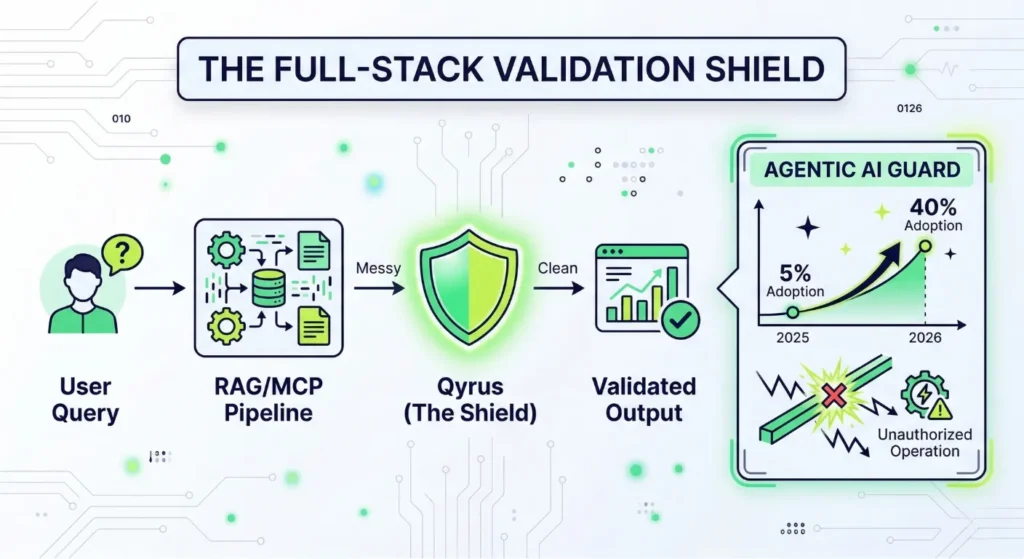
Many teams make the mistake of only checking the model’s final response. This narrow focus misses the technical cracks in your underlying architecture. Enterprise-grade generative AI testing must validate the entire stack. This includes your Retrieval-Augmented Generation (RAG) and Model Context Protocol (MCP) pipelines.  

Qyrus runs deep system-level checks to expose failures that surface-level reviews ignore. You must ensure your retrieval layer gathers the correct context before the model even starts writing. 

Agentic AI introduces even more complexity as autonomous systems take actions on your behalf. Industry forecasts suggest that enterprise applications using task-specific agents will surge from less than 5% in 2025 to 40% by the end of 2026. Without a robust LLM testing strategy that handles autonomous behavior, these agents might perform unauthorized operations.  

Qyrus provides an Agentic AI Guard to keep these systems within defined bounds. It verifies tool selection and blocks risky actions in real-time. Our AI Quality Suite achieves over 98% faithfulness in validated outputs. This level of precision ensures your agents remain reliable as they scale across your organization. Consistent LLM Evaluation ensures your AI stays on-task and secure.
How Do You Audit an AI That Never Gives the Same Answer Twice? 

Traditional testing fails when your software generates unique text for every single user. You cannot write a manual test case for every possible sentence an LLM might produce. Instead, you must build a system that understands intent and accuracy.  
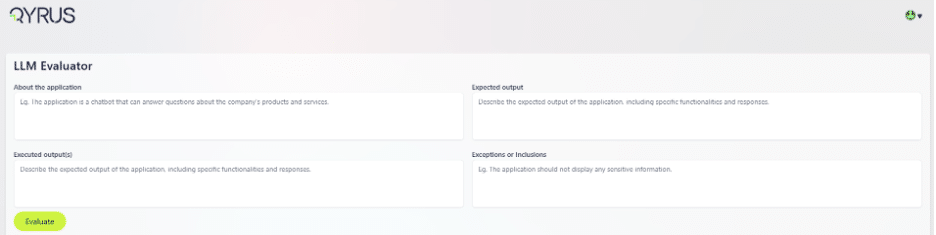
Qyrus LLM Evaluator simplifies this complexity by providing a structured framework for generative AI testing. You begin by defining the “About the Application” section to provide the evaluator with context. Then, you establish the “Expected Output”—your gold standard for what the AI should ideally say. 

The real power lies in defining “Exceptions or Inclusions.” For example, you might command the bot to never disclose account balances over one million dollars or to always include a specific legal disclaimer.  

You then input the “Executed Outputs” from your model. The system instantly analyzes the response, providing a relevance score from one to five and a detailed reasoning for that score.  

Can Your Team Scale LLM Evaluation Without Losing Precision? 

Automation is the only way to keep pace with rapid model updates. Manual reviews simply take too long and introduce human bias. A robust LLM testing strategy uses a “judge” model to verify the primary model’s work. It checks for specific positives and negatives in every response. Did the bot mention the account balance? Did it follow the formatting rules? The evaluator answers these questions in seconds. 

By automating your AI output validation, you achieve a level of consistency that human auditors cannot match. This automated layer provides a safety net that catches errors before they reach your customers. It handles the heavy lifting of hallucination detection in LLM by cross-referencing every generated claim against your source documents.  

When you integrate this into your CI/CD pipeline, LLM Evaluation becomes a continuous process rather than a final hurdle. You gain the confidence to deploy updates daily, knowing your guardrails remain intact and your brand remains protected. 

How Does Industry Context Change Your Validation Strategy? 

Enterprise risk shifts significantly depending on your field. A typo in a blog post might be embarrassing, but a mistake in a medical summary or a legal contract can destroy a company. You must tailor your AI output validation to the specific regulatory and operational pressures of your vertical. 

Will Your Internal Assistant Accidentally Violate Labor Laws? 

Internal HR bots often handle sensitive employee data and policy inquiries. If your AI provides incorrect guidance on overtime pay or hiring practices, you face immediate legal exposure. Quality engineering teams must implement LLM testing to verify that every response stays within corporate and legal guardrails.  

We focus on automated auditing that cross-references AI suggestions against current labor regulations. This prevents the model from exposing personally identifiable information (PII) or suggesting discriminatory practices. Rigorous LLM Evaluation ensures your internal tools protect your employees and your legal standing. 
Could a Helpful Chatbot Cost You $11,000 in a Single Transaction? 

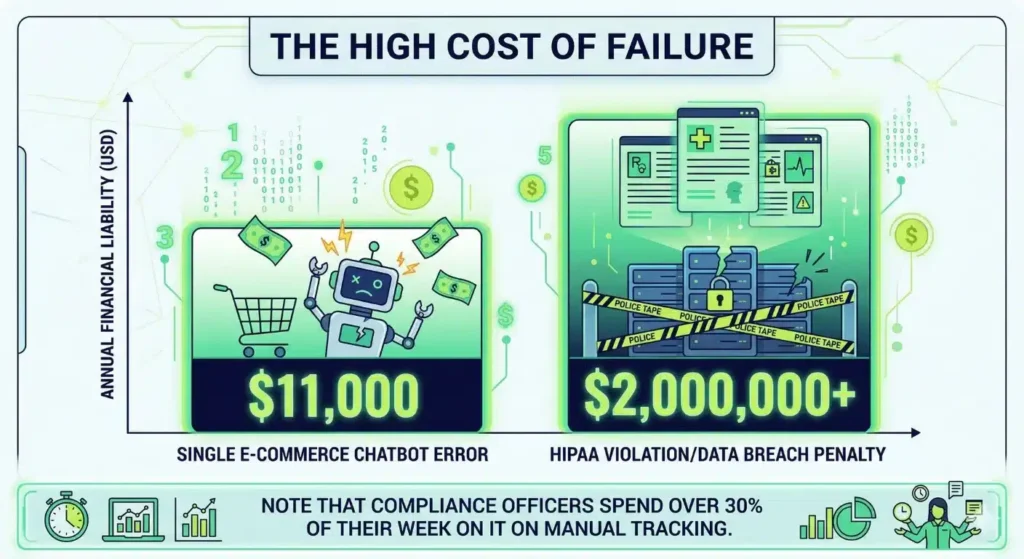
Ecommerce brands often prioritize a “polished” tone, but tone without accuracy creates merchant liability. One chatbot famously offered an 80% discount without any human approval. The resulting order totaled nearly $11,000. This is a real risk. Generative AI testing identifies these outliers by running thousands of simulated interactions before you go live.  

You must ensure your bot hits 95% accuracy against your live product manuals and pricing sheets. We use automated judges to flag any unauthorized promises, ensuring your AI remains a sales asset rather than a financial drain. 

Is Your Clinical AI a Multi-Million Dollar Liability Waiting to Happen? 

Healthcare and finance demand the highest levels of precision. In 2024, data breaches affected over half the U.S. population. Regulators now levy penalties exceeding $2 million annually for HIPAA failures. Meanwhile, financial compliance officers spend over 30% of their week manually tracking enforcement actions. You can automate much of this oversight.  

We implement deep hallucination detection in LLM to ensure clinical summaries or financial advice match verified source documents perfectly. Our platform achieves about 95% faithfulness in these high-stakes environments. This level of control allows you to innovate without fearing a regulatory crackdown. 

Why Automated LLM Testing Is the Key to Your Enterprise Growth 

Software quality defines the modern business. Generative AI testing simply extends those rigorous standards to the next generation of applications. Organizations that conduct regular assessments significantly increase the likelihood of extracting high value from their AI investments. You cannot afford to deploy models that act as black boxes. Qyrus and our LLM Evaluator transform these systems into transparent, reliable assets. 

We believe that quality functions as the steering wheel for your innovation. Our AI Quality Suite automates the most difficult parts of LLM Evaluation and AI output validation. We achieve about 95% faithfulness in validated outputs, allowing your team to move at high velocity without fear. Robust hallucination detection in LLM turns your AI from a liability into a competitive edge. It is time to move past experimental pilots and into governed, measurable operations.  

Secure your enterprise AI today. Reach out to the Qyrus team to schedule a demo and see how our platform safeguards your future. 

Frequently Asked Questions 

How to detect hallucinations in LLMs before they reach your customers? 

You must implement an automated judge that cross-references AI claims against your internal documents. Qyrus uses semantic comparison to identify assertions without evidence. This automated hallucination detection in LLM saves hundreds of manual auditing hours. It ensures every response stays grounded in your data. Relying on human reviewers for thousands of logs is impossible. 

Which LLM response validation methods offer the highest accuracy? 

Semantic scoring outperforms simple keyword matching. You should use LLM response validation methods that assign a score (1-5) based on relevance and faithfulness to the source. Our LLM Evaluation framework provides clear reasoning for every grade. This helps your team identify why a model failed and how to refine the prompt. 

Why is automated testing for generative AI essential for scaling? 

Manual testing cannot keep up with models that update frequently. Automation lets you run thousands of test cases in a single afternoon. Teams that use automated testing for generative AI reduce production time by 50% and see a 30% improvement in data extraction accuracy. 

What are the best tools for LLM evaluation on the market today? 

You need a platform that validates the entire architecture, not just the output. Qyrus Pulse and the LLM Evaluator provide full-stack visibility. We offer the precision required for enterprise-grade LLM testing. Our suite handles everything from simple chatbots to complex autonomous agents. 

How should your team approach validating LLM outputs for enterprise AI? 

Start by defining your “Expected Output” and “Exceptions or Inclusions.” This establishes the rules for the AI. You then compare the “Executed Output” against these rules. Since only 31% of organizations monitor their AI, validating LLM outputs for enterprise AI gives you a major security advantage. It prevents brand liabilities before they happen. 

What is the most effective way of testing RAG pipelines? 

You must run system-level checks on the retrieval layer and the prompt assembly. Testing RAG pipelines involves verifying that the vector search gathered the correct context. Qyrus Pulse exposes failures that surface-level reviews miss. We ensure your RAG system achieves over 98% faithfulness to the original source. 

How to test AI chatbots for legal and financial risks? 

Run adversarial simulations to see if the bot violates your internal policies. How to test AI chatbots requires setting clear “Negatives”—things the AI should never do. For example, you might block the bot from revealing account balances over a certain limit. This type of AI output validation stops costly errors in their tracks. 

Are there specific AI compliance testing tools for regulated sectors? 

Yes, you need tools that specifically address HIPAA and financial regulations. Regulated sectors face penalties exceeding $2 million annually for privacy failures. Qyrus offers specialized AI compliance testing tools that automate the auditing of clinical and legal outputs. We keep your AI within the strict bounds of the law. 

How to scale the momentum of ‘Vibe Coding’ using intelligent test automation to enforce rigorous regression and security guardrails essential for the financial sector.

March 25

8:30 PM IST | 3:00 PM GMT | 10:00 AM EST

Vibe Coding

Software development has entered a new mode: Vibe Coding. It is fast, exploratory, and driven by the question, “Does it work?” rather than “Is it perfect?”. For startups and hackathons, this momentum is a superpower. But in banking, unchecked “vibes” can lead to hidden costs: tech debt, brittle systems, and compliance failures. 

How do financial institutions adapt to this new speed without compromising stability? 

Join our leaders, as they unveil the Hybrid Model for banking software. This session will demonstrate how to operationalize the speed of Vibe Coding by wrapping it in automated, intelligent guardrails that ensure scalability, security, and maintainability. 

What You Will Learn 

  • The “Vibe” vs. “Regulation” Conflict: Why the “code fast, fix later” approach fails in banking—and how to fix it without killing developer velocity. 
  • The Hybrid Model: A practical framework for a two-phase development lifecycle: Phase 1 (Vibe) for rapid prototyping and discovery, followed by Phase 2 (Formalize) for standardization and testing. 
  • Building Qyrus Guardrails: How to utilize the Qyrus platform to automate the “boring correctness” of software delivery: 
    • Contract-First Development: Using API Builder and hosted mocks to define boundaries early. 
    • Automated Test Generation: Using TestGenerator and Qyrus Journeys to create tests directly from real user behaviors and stories. 
    • Data & Orchestration: Leveraging Echo for synthetic boundary data and SEER framework for agentic self-healing and prioritization. 
    • The Vibe-Weighted Pyramid: How to restructure your testing strategy (60% Unit, 30% API, 10% E2E) to support rapid changes while maintaining evidence-driven quality. 

Who Should Attend 

  • Banking CXOs: Seeking faster time-to-value with bounded risk and auditability. 
  • Engineering Leaders: Who need to scale innovation pods and proofs-of-concept into robust, maintainable systems. 
  • QA Architects: Looking to transition from manual scripting to automated quality gates and “fix-forward” workflows. 

Meet Our Experts

Ravi

Ravi Sundaram 

President, Qyrus

Ameet-Deshpande

Ameet Deshpande

SVP, Product Engineering, Qyrus

Yadvendra Rathore

VP, Client Success, Qyrus

Ready to Operationalize Your Vibe?  

Vibe Coding is powerful, but chaotic if unchecked. Don’t let hidden costs like brittle systems and knowledge silos slow you down. See how Qyrus uses AI-driven tools—from API Builder to SEER—to wrap your rapid development in automated quality gates. 

Test Orchestration

Software delivery has hit a structural wall. While AI coding assistants now contribute significantly to software development, most quality assurance teams still struggle with a fragmented process. We see a growing distance between the speed of development and the rigor of validation. This gap creates a dangerous environment where teams launch features quickly, but quality remains a secondary concern because the testing phase cannot keep up. 

Traditional testing often relies on isolated scripts. These scripts perform well for specific checks, but they fail to address the complexity of modern microservices or multi-platform user journeys. Currently, 36.5% of organizations still lack any form of test orchestration. They rely on “duct-taped” manual hand-offs that slow down the entire pipeline. In fact, 35% of companies still report that manual testing represents their most significant time-consuming activity. 

To keep up with modern engineering, you must transform your approach. Automated test orchestration provides the connective tissue required to synchronize your tools and environments. It changes the focus from “did this script pass?” to “is this business process ready for production?” By implementing workflow-based test automation, you eliminate the idle time between tests and ensure every check happens at the right moment with the exact data required for success. 

What is Test Orchestration? Definition & Core Concepts 

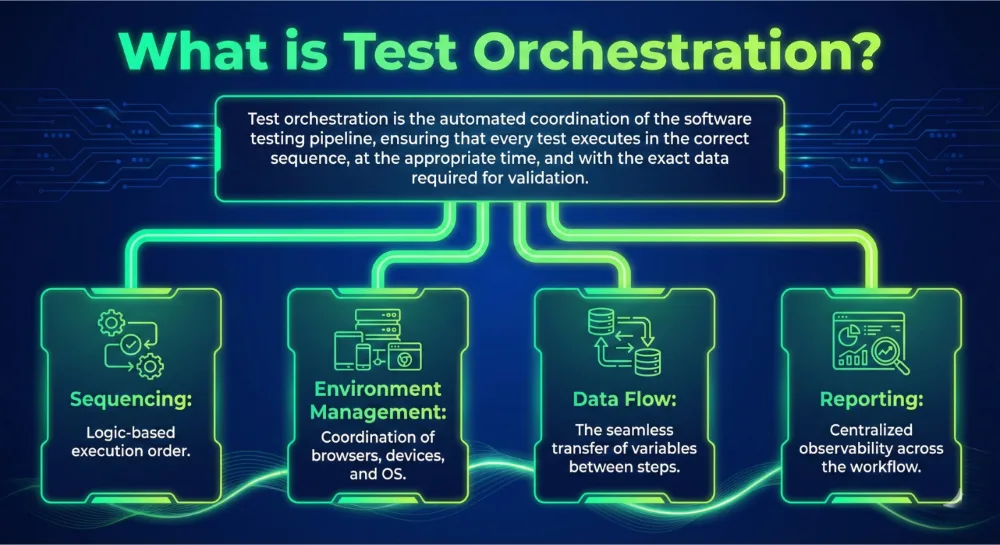
Think of test orchestration as the automated coordination of your entire software testing pipeline. It ensures every test executes in the correct sequence, at the appropriate time, and with the exact data required for validation.  

What is Test Orchestration

While traditional automation focuses on individual scripts, orchestration acts as the “connective tissue” that manages how those scripts interact across different platforms. Standalone automation validates individual functions, but orchestration manages the broader business outcome across your entire stack. (To explore the nuanced technical and operational contrasts between these two methodologies, read our detailed comparison: Test Orchestration vs Test Automation: What’s the Difference?) 

This structural shift requires a focus on four essential components. First, sequencing dictates the logical order of execution. For example, a system must validate a user’s credentials before attempting a complex transaction. Second, environment management handles the allocation of real browsers and mobile devices. Third, data flow allows the system to pass variables, such as session tokens, between disparate tests. Finally, centralized reporting aggregates every pass and failure into a single view for the engineering team. 

Transitioning to this model addresses the gaps found in basic frameworks. Research shows that 36.5% of firms still lack any form of orchestration, leaving them vulnerable to environment drift and manual bottlenecks. By implementing workflow-based test automation, you create a synchronized process where tools and data work in harmony. This move transforms testing from a series of disconnected events into a resilient, enterprise-grade pipeline. 

Breaking the Script: Why Automation Fails Without Test Orchestration 

Standard test automation handles the execution of individual scripts. It checks if a button works or if an API returns a 200 OK status. However, automation on its own lacks the structural logic to manage dependencies between different systems. This lack of coordination explains why 73% of test automation projects fail. Without a broader strategy, scripts become brittle and maintenance costs skyrocket. 

Test orchestration takes a different path. While automation focuses on the task, orchestration focuses on the workflow. It manages the entire lifecycle of a test suite across multiple environments. When you use automated test orchestration, you define the logic that guides a release. If an API login fails, the orchestrator stops the subsequent UI tests immediately. This prevents false positives and saves significant infrastructure costs. 

Differences Between Test Automation and Test Orchestration 

FeatureStandalone Test Automation Test Orchestration
Primary Focus Execution of individual scripts and tasks. Coordination of testing workflows and pipelines.
Data Management Often hardcoded or siloed per test. Dynamic data passing and state persistence.
Trigger Mechanism Manual or scheduled execution. Event-driven (commits, merges, deployments).
Environment Handling Static, often pre-configured environments. Dynamic environment provisioning and coordination.
Reporting Fragmented pass/fail logs per tool. Centralized observability and aggregated insights.
Quality Gating Manual intervention often required to halt pipelines. Automated conditional progression based on results.

Enterprise teams require more than just a collection of scripts. They need test orchestration tools that provide visibility into the entire delivery pipeline. Integration with CI/CD is the primary driver here, as 84% of developers now work in DevOps environments where speed is non-negotiable. Workflow-based test automation bridges this gap. It ensures your tests run as a synchronized unit rather than a series of ad-hoc events. Qyrus facilitates this through its visual Flow Master Hub, allowing teams to coordinate these complex sequences without writing additional code. 

Core Benefits of Test Orchestration for Enterprises 

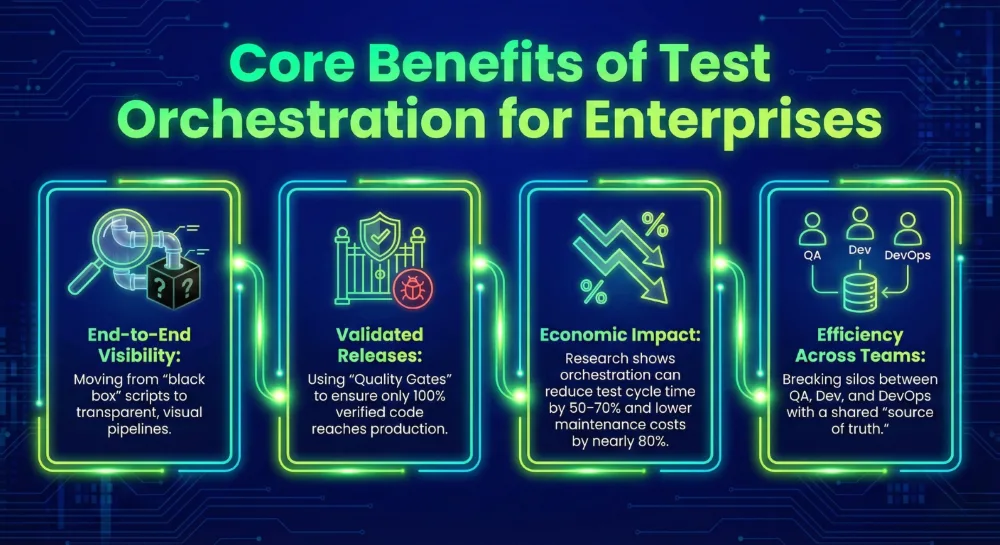
Enterprise leaders often view testing as a necessary drag on momentum. However, shifting your strategy transforms this bottleneck into a strategic asset. By moving beyond isolated scripts, you gain total visibility into the delivery pipeline. This transparency allows development teams to identify risks early. It ensures that only high-quality code reaches your customers. 

Benefits of TO

Shattering the Black Box with Total Visibility 

Isolated scripts often create a “black box” where results are difficult to interpret. You might see a failure, but finding the root cause requires manual digging through logs. Automated test orchestration replaces this confusion with a transparent, visual pipeline. You see every step of the user journey as it happens. This clarity allows your team to pinpoint exactly where a process breaks, whether it occurs in an API call or a mobile UI element. 

Hardening Production with Intelligent Quality Gates 

Moving fast requires guardrails. Validated releases depend on “Quality Gates” that automatically block unstable code from moving forward. Using test orchestration tools, you set specific criteria for success at every stage of the pipeline. If a critical smoke test fails, the orchestrator halts the deployment immediately. This ensures only 100% verified features reach your users, maintaining your brand’s reputation for reliability. 

The Economic Impact of Automated Test Orchestration 

The financial argument for this shift remains undeniable. Research indicates that organizations adopting these strategies experience shorter test cycles compared to those using fragmented automation. Furthermore, these teams achieve better success rate in production releases. By streamlining the validation process, you reduce maintenance overhead by nearly 80%. This efficiency frees up your budget for innovation rather than constant troubleshooting. 

Unifying Engineering through Workflow-Based Test Automation 

Traditional testing often happens in a silo, separated from development and operations. Workflow-based test automation breaks down these barriers. It provides a shared “source of truth” that every department can access and understand. When developers, QA engineers, and DevOps professionals look at the same orchestration dashboard, they collaborate more effectively. This alignment accelerates the entire lifecycle. It ensures everyone works toward the same objective: delivering value to the customer. 

What Test Orchestration Looks Like in Action 

Test orchestration moves beyond the theory of “running tests” and enters the practice of managing business risks at scale. In a modern software environment, a single release often involves an API update, a change to the web checkout UI, and a new promotion in the mobile app. Standalone scripts struggle to bridge these gaps. However, with automated test orchestration, you build a unified flow that treats these separate components as one cohesive journey. 

High-Level Workflow Examples 

The Smoke Test: Rapid Validation  

Teams use smoke tests to perform quick, automated checks of critical functionality. The goal remains simple: verify the application works at a basic level before committing further resources. A well-orchestrated smoke suite should validate critical paths in less than 15 minutes after a deployment. This rapid feedback loop allows you to detect obvious issues immediately, preventing the team from wasting time on a fundamentally broken build. 

The Regression Suite: Enterprise-Scale Chaining  

As applications grow, so does the risk of “breaking” existing features. A comprehensive regression suite often requires chaining 10 or more workflows to achieve full system validation. Using test orchestration tools, you can organize these workflows into a logical hierarchy. If the “User Authentication” workflow fails, the system automatically halts the “Payment Processing” and “Order History” flows. This prevents the “crushing weight of maintenance” often seen in legacy systems, where most test automation projects fail due to a lack of coordination. 

The API-to-Web Journey: Cross-Platform Fluidity  

Real users do not live in silos; neither should your tests. An API-to-Web journey mirrors a real-world scenario by creating a user via an API call and immediately verifying that account on the Web UI. This requires seamless data propagation, where the session token or user ID from the first node becomes the input for the next. This workflow-based test automation ensures that your back-end and front-end systems communicate perfectly. 

Real-World Architectures: The CI/CD Connection 

Effective test orchestration relies on deep integration with your existing DevOps stack. Since more than 80% developers now work in DevOps environments, your orchestration engine must respond instantly to CI/CD triggers. 

Whether you use Jenkins, Azure DevOps, or GitLab, the architecture remains consistent. When a developer pushes code to a repository, the CI/CD tool sends a trigger to the orchestration platform. The engine then selects the appropriate environment—be it Staging, UAT, or Production—and begins the execution.  

By embedding these checks directly into the pipeline, you create “Quality Gates” that block unstable code. This automated choreography ensures that your release cycle stays fast without sacrificing the reliability your customers expect. 

Anatomy of an Orchestrated Test Workflow 

Orchestration begins with sequencing. You organize tests into logical units such as authentication, onboarding, or checkout. Traditional methods run scripts one after another in a linear queue. However, modern test orchestration tools enable parallel execution logic, which can reduce execution time by up to 90%. Chaining tests ensures that a subsequent stage only begins after a prior stage succeeds. For example, if the authentication stage fails, the orchestrator halts checkout testing to save compute resources. 

Data Management and State Persistence 

Data management serves as the fuel for these workflows. Successful test orchestration requires sharing session data, tokens, and identifiers across different platforms. You must pass a customer ID from an account creation step to the purchase validation step without manual entry. Furthermore, environment persistence maintains the application state throughout the entire process. This ensures that database snapshots or session cookies remain valid as the test progresses from an API call to a mobile interface. 

Resilience Through Failure Handling 

Reliable workflows include robust failure handling to prevent brittle pipelines. If a test fails, you need a strategy beyond simple termination. Automated test orchestration allows you to define specific retry, abort, or skip logic. For instance, if a non-critical UI element fails, the system might skip that step to continue the broader validation. In contrast, a failure in the login stage should abort the entire flow to prevent false positives. Advanced platforms even use self-healing mechanisms to address UI changes, which can slash maintenance efforts by 81%. 

Centralized Analytics and Observability 

The final piece involves results and analytics. Centralized reporting dashboards aggregate logs, videos, and performance metrics from every tool in the testing suite. You track specific KPIs such as pass/fail trends and execution duration to measure the health of your workflow-based test automation. These insights transform raw outcomes into a clear picture of overall software quality. Qyrus provides this transparency through its Mind Maps, which offer a visual, hierarchical view of the entire test repository and its execution status. 

How Test Orchestration Integrates with CI/CD & DevOps 

Modern software delivery requires a seamless connection between code changes and validation. When you integrate test orchestration into your DevOps pipeline, you move beyond simple automation. Your CI/CD tools, such as Jenkins or Azure DevOps, no longer just trigger scripts; they manage a sophisticated choreography of validation steps.  

Automated test orchestration introduces intelligent quality gates. These gates evaluate the health of a build in real-time. If a critical workflow fails, the orchestrator blocks the deployment immediately. This proactive approach prevents the accumulation of technical debt and protects the user experience.  

Effective test orchestration tools also provide immediate observability. Instead of searching through logs, your team receives results directly in Slack or Jira. This rapid feedback loop allows development teams to fix bugs as soon as they appear. Workflow-based test automation ensures that every code commit undergoes a rigorous, multi-environment check before it ever touches a customer. 

Selecting the Best Test Orchestration Tools & Platforms 

Choosing from the available test orchestration tools requires an understanding of how different architectures impact your long-term maintenance. The market generally splits into three categories. First, built-in orchestration engines exist within larger testing platforms. These offer native integration but may limit your flexibility. Second, plugin tools attach to your existing CI/CD pipeline. While these provide modularity, they often lead to “tool sprawl,” where engineers spend more time managing integrations than writing tests. Finally, full platform orchestration stacks provide a unified environment for cross-platform validation. 

Transitioning to a unified platform often reveals the inherent limitations of older, siloed testing models that lack cross-protocol support. (If your team currently relies on older frameworks, you should examine Why Traditional Component Testing Breaks at Scale to understand why a shift to orchestration is mandatory for enterprise growth.) 

The debate between code-based orchestration and visual workflow builders also shapes your team’s productivity. Code-based frameworks provide deep customization for highly technical teams. However, they often recreate the “crushing weight of maintenance” that causes test automation projects to fail. In contrast, visual builders democratize the process. They allow manual testers and product owners to contribute to the quality strategy without learning complex syntax. This shift is vital because 35% of companies still struggle with manual testing as their primary bottleneck. 

Orchestrating at Scale with Qyrus 

Qyrus offers a next-generation approach to automated test orchestration through its dedicated TO module. This platform eliminates the obstacles that hinder team progress by providing a high-performance environment for complex test scenarios. 

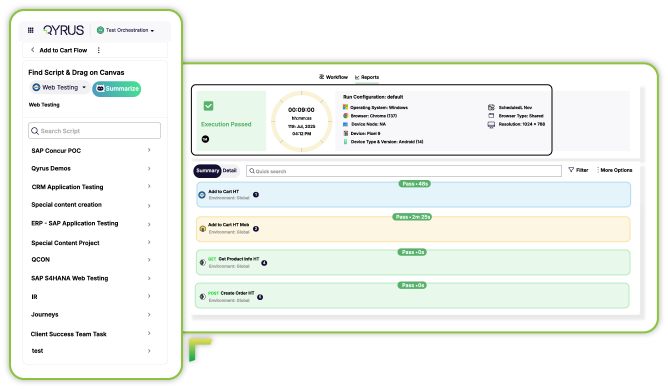
  • Flow Master Hub: This is your command center. Use the advanced drag-and-drop interface to create and edit test flows visually. It handles intricate user journeys across Web, Mobile, API, and Desktop platforms in a single execution. 
  • The Vault: Scale requires organization. The Vault provides a hierarchical structure to categorize projects by environments like QA, UAT, and Production. Advanced nesting and filtering tools ensure your team never wastes time hunting for the correct files. 
  • SmartFlow Mapping: Rigid paths lead to fragile tests. This feature adapts to live conditions during execution. If a login fails or a transaction lacks a balance, the mapper reroutes the test automatically to handle the edge case. 
TEST ORCHESTRATION

See How Qyrus Orchestrates Complex Test Workflows 

Best Practices for Successful Test Orchestration 

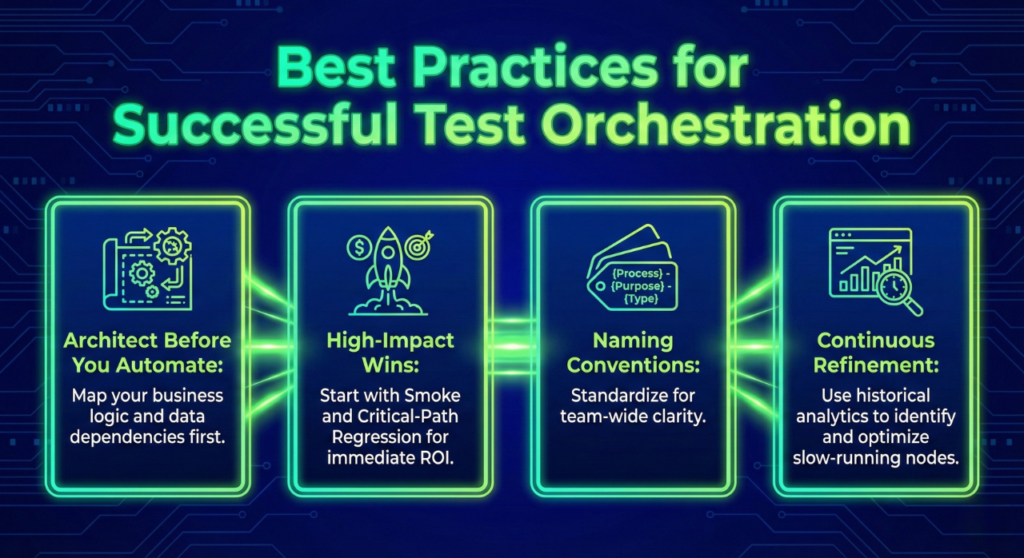
Moving from fragmented automation to a cohesive delivery pipeline requires more than just new software. It demands a shift in how your team perceives the lifecycle of a test. Success depends on treating your quality infrastructure with the same rigor as your production code. By following proven engineering standards, you ensure your test orchestration remains maintainable even as your application grows in complexity. 


TO Best Practices

Architecting the Journey Before Writing a Single Script 

Many teams rush into automation without mapping their business logic first. This lack of planning is a primary reason why most test automation projects fail to deliver long-term value. You must define your data contracts and system dependencies before building workflows. Identify which services require session persistence and where data must flow between platforms. Establishing these blueprints early prevents the creation of brittle, “duct-taped” sequences that break during minor updates. 

Prioritizing the Critical Path for Immediate Returns 

Avoid the temptation to orchestrate every minor feature at once. Start with high-impact workflows that protect your core revenue streams. Focus on building a robust smoke suite that validates critical paths in less than 15 minutes. Once you stabilize these essential checks, expand into complex regression suites. This incremental approach allows your team to demonstrate immediate ROI while gradually reducing the manual testing bottleneck. 

Maintaining Integrity Through Centralized Governance 

Reliable workflow-based test automation requires strict separation of environments. Never hardcode credentials or URLs within your scripts. Instead, use test orchestration tools to manage environment-specific variables for Dev, Staging, and Production. Centralizing your data management through a “Data Hub” ensures that every team member uses the same verified datasets. This practice eliminates the “it works on my machine” syndrome and ensures your results remain consistent across different infrastructure tiers. 

Closing the Loop with Performance-Driven Refinement 

Orchestration is not a “set and forget” activity. You must continuously monitor KPIs and failure trends to identify bottlenecks. If a specific node consistently delays your pipeline, use performance optimization patterns like parallel execution to reclaim time. Research shows that refining these sequences can improve execution speed by 40-50%. By analyzing historical reports and adjusting your retry logic, you transform automated test orchestration from a simple execution engine into a high-performance asset. 

The Road Ahead: Building a Sustainable Culture of Quality 

The shift to test orchestration marks a fundamental change in how enterprises deliver software. While standalone scripts once served a specific purpose, they cannot keep up with the speed of modern code generation. Adopting automated test orchestration is no longer a luxury. It is a prerequisite for survival in a market where many organizations still struggle with fragmented pipelines. By treating your quality layer as a first-class engineering citizen, you achieve the near perfect success rate required for enterprise scale. 

Transitioning your team requires a clear roadmap. First, map your core business processes and identify the data dependencies between systems. Second, define your “Quality Gates” to ensure only verified code moves forward. Finally, integrate your workflow-based test automation with your existing CI/CD tools. This incremental approach prevents the “crushing weight of maintenance”. 

Qyrus simplifies this journey by offering a unified environment for cross-platform validation. Our platform allows you to move away from rigid, siloed testing and toward a coordinated, visual strategy. Whether you are validating complex banking transfers or e-commerce user journeys, our test orchestration tools provide the precision and control you need to lead your industry. We help you move beyond ad-hoc scripts to build a resilient infrastructure that grows with your organization. 

Don’t let legacy testing methods hold back your engineering velocity. Contact us today for a personalized ROI report or schedule a demo to see how Qyrus can transform your testing into a direct driver of business growth. 

Devops Conclave

Save the Date:
📅 March 13th, 2026 
📍 Taj MG Road, Bengaluru 

If you’ve been keeping an eye on how fast DevOps is evolving across the enterprise, you already know one thing for sure: innovation doesn’t slow down for anyone. That’s exactly why we’re excited to share some big news. Qyrus is proud to be a Platinum Sponsor at the 11th Edition of the DevOps Conclave & Awards 2026, happening this March in Bengaluru. 

Over the years, DevOps Conclave has earned its place as a must-attend event for leaders, practitioners, and builders who care deeply about the future of software delivery. It’s not just another conference. It’s a space where real conversations happen, ideas are challenged, and the next phase of DevOps takes shape. 

If this event isn’t already on your calendar, here’s why it should be. DevOps Conclave brings together forward-thinking teams and technology leaders to talk openly about what’s working, what’s broken, and what needs to change. This year’s agenda dives into AI-powered DevOps, platform engineering, cloud-native innovation, GitOps, and the evolving practices that are redefining how software is built and delivered at scale. It’s practical, relevant, and grounded in real-world experience. 

The Big Stage: Ameet Deshpande on the Future of Engineering 

If you’ve spent any time in the product engineering world, you’ve probably heard the word “efficiency” thrown around more times than you can count. Too often, it becomes a catch-all phrase that hides manual effort, fragmented tooling, and growing complexity. We think it’s time to have a more honest conversation. 

That’s where this year gets even more exciting for us. Ameet Deshpande, SVP of Product Engineering at Qyrus, will be delivering a keynote at the Conclave. Ameet has spent years working closely with engineering teams to modernize how they design, test, and ship software. His perspective goes beyond theory. It’s rooted in what teams actually face every day. 

Ameet doesn’t just talk about trends. He challenges assumptions, asks uncomfortable questions, and offers practical ways to move forward. Expect clarity, thoughtful insights, and a dose of healthy disruption that will leave you rethinking how engineering organizations operate. 

Why We’re All In 

DevOps Conclave has always stood out for one reason. It’s a place where leaders share not just their wins, but the hard-earned lessons that come from scaling complex systems. This year’s focus on Platform Engineering and Developer Experience feels especially relevant to us at Qyrus. 

We believe the best tools are the ones that get out of the way, reduce friction, and let teams focus on building great software. As Platinum Sponsor, we’re looking forward to connecting with architects, VPs of Engineering, DevOps leaders, and hands-on practitioners who are shaping the next generation of digital-first operations. 

Whether you’re leading DevOps strategy, working on the front lines of delivery, managing product releases, or exploring how AI is changing automation, there’s real value here. Beyond the sessions, the conversations, debates, case studies, and awards make DevOps Conclave & Awards 2026 a true hub for what’s next. 

So, if you’re planning your DevOps roadmap for the year ahead, join us in Bengaluru. Stop by the Qyrus booth, attend Ameet’s keynote, and let’s talk about the future of quality, automation, and delivery. This isn’t about buzzwords. It’s about meaningful transformation, and we’re proud to be part of it. 

Qyrus, a provider of AI-powered software testing solutions to enterprises, today announced that it has been named a Leader in The Forrester Wave™: Autonomous Testing Platforms, Q4 2025. The report evaluated the 15 most significant providers in the market based on 25 criteria.

As organizations increasingly integrate artificial intelligence into their software development lifecycles, the demand for autonomous testing solutions that can validate both the applications and the AI models within them has surged. In this evaluation, Qyrus received the highest score possible (5.0) in the Roadmap, Testing AI Across Different Dimensions, Testing RAG Pipelines, Level of Autonomous Testing, Pricing Flexibility and transparency, and Testing Agentic Tool Calling criteria.

“We believe being named a Leader in a Forrester report is tremendous evidence of our vision to transform quality engineering through Agentic AI,” said Ravi Sundaram, President at Qyrus. “As enterprises move from simple automation to true autonomy, we are dedicated to providing a platform that not only accelerates release velocity but also ensures trust in the generative AI systems building our future.”

The report notes that Qyrus “excels in AI testing dimensions, using heuristics and LLM to judge faithfulness, relevance, and coverage.” With the rise of agentic workflows, Qyrus has focused heavily on agentic test orchestration. The report states, “Its Sense to Evaluate to Execute to Report (SEER) orchestration framework and excellent agentic tool calling result in an above-par score for autonomous testing”.

Qyrus’ platform enables enterprises to scale their testing efforts across web, mobile, and API layers while addressing the specific complexities of modern AI applications. In the report’s “Forrester’s Take” section, the report concludes that “Qyrus suits enterprises seeking advanced AI-driven testing, multiagent orchestration, and robust validation of genAI outputs at speed and scale”.

Qyrus believes its recognition as a Leader underscores its commitment to innovation and its ability to support customers as they navigate the complexities of testing in an AI-first world.

This News Release is originally published on EIN Presswire

Disclaimer

Forrester does not endorse any company, product, brand, or service included in its research publications and does not advise any person to select the products or services of any company or brand based on the ratings included in such publications. Information is based on the best available resources. Opinions reflect judgment at the time and are subject to change. For more information, read about Forrester’s objectivity here.

The world of software testing moves fast, and staying ahead requires tools that not only keep pace but actively drive innovation. At Qyrus, we’re relentlessly focused on evolving our platform to empower your teams, streamline your workflows, and make achieving quality more intuitive than ever before. May was a busy month behind the scenes, packed with exciting new features and significant enhancements designed to give you even more power and flexibility in your testing journey.
Get ready to explore the latest advancements we’ve rolled out across the Qyrus platform!

Complex Web Tests, Now Powered by AI Genius!

Manual coding for complex calculations in web tests? Consider it a thing of the past! We’re thrilled to introduce a game-changing AI feature that lets you generate custom Java and JS code using simple, natural language descriptions. Just tell Qyrus what you need the code to do, and our AI gets to work, even understanding the variables you’ve already set up in your test. This AI Text-to-Code conversion is seamlessly integrated with our Execute JS, Execute JavaScript, and Execute Java actions, designed to produce accurate, executable snippets right when you need them. You maintain control, of course – easily review, modify, or copy the generated code before using it.
A quick note: This powerful AI code generation is currently a Beta feature, and we’re actively refining it based on your feedback!

Enhanced Run Visibility for Web Tests

But that’s not all for Web Testing this month. For our valued enterprise clients, managing your test runs just got clearer. You now have enhanced visibility into your test execution queues, allowing you to see detailed information, including the exact position of your test run in the queue. Gain better insight, plan more effectively, and stay informed every step of the way.

Sharper Focus for Your Mobile Visuals

Visual testing on mobile is crucial, but sometimes you need to tell your comparison tools to look past dynamic elements or irrelevant areas. This month, we’ve enhanced our Mobile Testing Mobile Testing capabilities to give you more granular control. You can now easily ignore specific areas within your mobile application screens, excluding those regions entirely from visual comparisons.

Additionally, you can ignore the header or footer of the screen meaning that you can easily compare different execution results and not run into issues due to differences in the notification bar or in a footer.
This means cleaner, more relevant results and less noise when you’re ensuring your app looks exactly as it should across devices. Focus on what truly matters for your app’s user interface integrity.

Device Farm: Smoother Streaming, Better Guidance

We know your time on the Device Farm Device Farm streaming screen is valuable, and a smooth experience is key. This month, we’ve rolled out several user experience improvements to make your interactions even more intuitive. The tour guide text has been refined to be more informative, guiding you clearly through the features.
We’ve also added a Global Navbar directly inside the device streaming page, providing consistent navigation right where you need it. Plus, for those times you’re working with a higher zoom percentage, we’ve included a handy scroll bar to make navigating the page much easier. Small changes, big impact on your workflow!

Desktop Testing: Schedule Your Success

We’re excited to announce that test scheduling is now available in Qyrus Desktop Testing. This highly requested feature, already familiar from other modules, brings a new level of automation to your desktop workflows. It’s particularly powerful for those complex end-to-end test cases that span across different modules, perhaps starting in a web portal, moving through a back office, and ending in servicing.
Now, you can schedule these crucial test flows, ensuring your regression suites run automatically, even aligning with deployment schedules. This means no more worrying about desktop availability at the exact moment of execution – Qyrus handles it for you. With this feature, efficiently managing tests for workflows impacting dozens of test cases becomes significantly simpler.

Smarter AI for Broader Test Coverage

Our commitment to leveraging AI to make testing more intelligent continues this month with key improvements to both TestGenerator and TestGenerator+. We’ve been refining these powerful features under the hood, and the result is simple but significant: you should now see more tests built by the AI compared to previous versions.
Remember, TestGenerator is designed to transform your JIRA tickets directly into actionable test scenarios, bridging the gap between development tasks and testing needs. TestGenerator+ takes it a step further, actively exploring untested areas of your application, intelligently identifying gaps, and helping you increase your overall test coverage. These enhancements mean our AI is working even harder to help you achieve comprehensive and efficient testing with less manual effort.

Ready to Experience the May Power-Ups?

This month’s Qyrus updates are all about putting more power, intelligence, and efficiency directly into your hands. From harnessing AI to generate complex web code to gaining sharper insights from mobile visual tests, scheduling your desktop workflows, and boosting the output of our AI test generators – every enhancement is designed with your success in mind. We’re dedicated to providing a platform that adapts to your needs, streamlines your processes, and helps you deliver quality software faster than ever before.
Excited to see these May power-ups in action? There’s no better way to understand the impact Qyrus can have on your testing journey than by experiencing it firsthand.
Ready to learn more or get started?
And don’t forget to explore our documentation for more details on these new features!

We’re constantly building, innovating, and looking for ways to make your testing life easier. Stay tuned for more exciting updates from Qyrus!