Save the Date: 📅 March 13th, 2026 📍 Taj MG Road, Bengaluru
If you’ve been keeping an eye on how fast DevOps is evolving across the enterprise, you already know one thing for sure: innovation doesn’t slow down for anyone. That’s exactly why we’re excited to share some big news. Qyrus is proud to be a Platinum Sponsor at the 11th Edition of the DevOps Conclave & Awards 2026, happening this March in Bengaluru.
Over the years, DevOps Conclave has earned its place as a must-attend event for leaders, practitioners, and builders who care deeply about the future of software delivery. It’s not just another conference. It’s a space where real conversations happen, ideas are challenged, and the next phase of DevOps takes shape.
If this event isn’t already on your calendar, here’s why it should be. DevOps Conclave brings together forward-thinking teams and technology leaders to talk openly about what’s working, what’s broken, and what needs to change. This year’s agenda dives into AI-powered DevOps, platform engineering, cloud-native innovation, GitOps, and the evolving practices that are redefining how software is built and delivered at scale. It’s practical, relevant, and grounded in real-world experience.
The Big Stage: Ameet Deshpande on the Future of Engineering
If you’ve spent any time in the product engineering world, you’ve probably heard the word “efficiency” thrown around more times than you can count. Too often, it becomes a catch-all phrase that hides manual effort, fragmented tooling, and growing complexity. We think it’s time to have a more honest conversation.
That’s where this year gets even more exciting for us. Ameet Deshpande, SVP of Product Engineering at Qyrus, will be delivering a keynote at the Conclave. Ameet has spent years working closely with engineering teams to modernize how they design, test, and ship software. His perspective goes beyond theory. It’s rooted in what teams actually face every day.
Ameet doesn’t just talk about trends. He challenges assumptions, asks uncomfortable questions, and offers practical ways to move forward. Expect clarity, thoughtful insights, and a dose of healthy disruption that will leave you rethinking how engineering organizations operate.
Why We’re All In
DevOps Conclave has always stood out for one reason. It’s a place where leaders share not just their wins, but the hard-earned lessons that come from scaling complex systems. This year’s focus on Platform Engineering and Developer Experience feels especially relevant to us at Qyrus.
We believe the best tools are the ones that get out of the way, reduce friction, and let teams focus on building great software. As Platinum Sponsor, we’re looking forward to connecting with architects, VPs of Engineering, DevOps leaders, and hands-on practitioners who are shaping the next generation of digital-first operations.
Whether you’re leading DevOps strategy, working on the front lines of delivery, managing product releases, or exploring how AI is changing automation, there’s real value here. Beyond the sessions, the conversations, debates, case studies, and awards make DevOps Conclave & Awards 2026 a true hub for what’s next.
So, if you’re planning your DevOps roadmap for the year ahead, join us in Bengaluru. Stop by the Qyrus booth, attend Ameet’s keynote, and let’s talk about the future of quality, automation, and delivery. This isn’t about buzzwords. It’s about meaningful transformation, and we’re proud to be part of it.
The wait is officially over. On June 10, 2025, Google pushed the stable version of Android 16 to the public, marking the earliest major Android launch in over a decade. On June 10th, 2025, Qyrus became the first device farm to support Android 16 for testing. This release wasn’t just early; it was a strategic reset. While many initial reviews have labeled the update “boring” or “lackluster” due to the absence of immediate, dramatic visual changes, that surface-level take misses the entire story.
Beneath the surface, Android 16 “Baklava” is a foundational leap forward. Google has deliberately decoupled the stable platform from splashy feature drops, instead focusing on a massive overhaul designed to create a more agile and secure Android ecosystem. The accelerated release, enabled by a new “Trunk Stable” development model, gives developers and manufacturers a crucial head start. With powerful new APIs for AI and cross-device computing, a hardened security posture, and significant developer mandates, this update is less of a simple refresh and more of a quiet revolution. For app developers, this seemingly simple update introduces a complex new testing landscape.
This is where Qyrus steps in. As a premier automation tool for mobile application testing, we are proud to announce immediate, Day One support for the production release of Android 16. We ensure your team can validate your applications on this transformed platform from the moment it’s available, turning potential compatibility risks into a competitive advantage.
A Tale of Two Releases: The New Era of Android 16 Pixel Customization and Security
Understanding Android 16 requires grasping its unique, two-part release strategy. Google has made a calculated decision to release a stable platform with foundational changes first, while holding back the most significant user-facing features for a future Quarterly Platform Release (QPR). While this might create a confusing initial experience for users, it’s a strategic masterstroke for developers and OEMs, providing a stable API target months earlier than usual to accelerate the entire ecosystem’s update cycle.
This means developers need to prepare for two waves of change: the critical security and developer mandates available today, and the revolutionary UI and productivity features coming soon.
Available Now: Foundational Security and Mandates to Test For
While it may not look different on the surface, the initial release of Android 16 is packed with critical changes that demand immediate testing.
The Advanced Protection Suite: Security is the undeniable centerpiece of this release. Google has consolidated its most powerful security settings into a single, user-friendly toggle called “Advanced Protection.” When enabled, it creates a fortress around the device by activating Theft Detection Lock, blocking insecure 2G and Wi-Fi connections, and enhancing Google Play Protect scanning. It also introduces “Intrusion Logging,” an industry-first feature that backs up device activity logs to aid in forensic analysis after a potential compromise.
Smarter User Protection: To combat modern social engineering, Android 16 introduces “Identity Check,” which requires biometric authentication to change sensitive settings like passwords when the device is away from a trusted location, mitigating the risk of “shoulder surfing” attacks.
Critical Developer Mandates: Google is enforcing a “tough love” strategy to modernize the app ecosystem. For apps targeting API level 36, edge-to-edge display is now mandatory, as the ability to opt-out has been removed. Furthermore, on large screens (tablets, foldables, etc.), apps that previously restricted screen orientation will now be forced to be resizable and work in both portrait and landscape modes by default, making adaptive layouts a non-negotiable requirement.
Coming Soon: The Revolution in UI and Productivity
The most exciting changes are yet to come, but their foundations are already being laid in the OS, making it crucial to prepare for them now.
Material 3 Expressive: This is the future of Android 16 Pixel customization. It represents the next evolution of Google’s design language, moving beyond personalization to create a more dynamic, animated, and emotionally resonant interface. It’s built on principles of fluid, physics-based motion that makes UI elements “jiggle and morph,” expressive typography for “editorial-like moments,” and a richer use of color and shape.
Native Desktop Mode: Google is finally delivering a native, PC-like experience for Android. Developed in close collaboration with Samsung and built “on the foundation of Samsung DeX,” this feature will provide a true windowed environment with a taskbar and resizable apps when a phone is connected to an external monitor.
Live Updates: This new, standardized framework for progress-centric notifications is Android’s answer to Apple’s Live Activities. It will allow apps to show real-time information for ongoing events like food deliveries or ride-shares directly on the lock screen and always on display.
Testing these upcoming dynamic UIs, new form factors like desktop mode, and crucial security workflows is precisely where an advanced automation tool for mobile application testing becomes indispensable.
Tame the Complexity: Why Qyrus is the Essential Automation Tool for Mobile Application Testing on Android 16
The bifurcated release strategy for Android 16 and the significant volume of user-reported bugs on the “stable” version reveal a new reality for development teams. The accelerated release cycle came at the cost of a shorter public beta, effectively shifting the final, most challenging phase of bug discovery onto the public. Simply put, waiting for physical devices or relying on emulators is no longer a viable strategy for quality assurance.
This is why immediate access to a real device cloud is critical, and where Qyrus provides an unparalleled advantage.
Day One Readiness on Real Devices: Qyrus eliminates the waiting game. In continuation to our Android 16 beta release, our users were testing on a fleet of real Pixel devices running the final Android 16 build on its June 10th release date. This is the only way to reliably test for and safeguard against the kind of critical issues real users are reporting, from significant battery drain and system freezes to unstable Wi-Fi connections and widespread app crashes.
Master the New Mandates with Ease: Android 16’s new requirements for adaptive layouts can be a major development hurdle. Qyrus simplifies this process entirely. Our platform allows you to instantly test your app’s response to the now-mandatory resizability on large screens, ensuring it looks and functions perfectly on tablets, foldables, and in the upcoming native Desktop Mode. Testing complex security workflows like the new “Advanced Protection” suite and biometric-gated “Identity Check” becomes streamlined and repeatable.
Future-Proof Your App for the Visual Revolution: The most exciting features are still to come, but you can prepare for them today. With Qyrus, you can begin validating your app against the foundational APIs for features like Material 3 Expressive. This allows you to get ahead of the curve and ensure your app is ready to embrace the new era of Android 16 Pixel customization, with its fluid, physics-based motion and expressive designs, as soon as it rolls out.
Configure devices as your customers do: One of the biggest differentiators of Qyrus is that we offer private, dedicated devices for clients. This means they can configure devices as their customers do – configure an authenticator application for OTPs, setup an email account, or configure any other related 3rd party apps.
As the most adaptable automation tool for mobile application testing, Qyrus empowers your entire team—from manual testers to automation engineers—to tackle the full spectrum of challenges presented by Android 16, ensuring your user experience is flawless from day one and beyond.
Get Started in Minutes: Test on Android 16 Today
Ready to ensure your app is prepared for the most significant Android shift in years? Our platform makes it incredibly simple. You can begin validating your application on real devices running the official production release of Android 16 in just three easy steps:
Upload Your Application: Simply upload your .apk or .aab file.
Select & Test: Choose a real Google Pixel device running the official Android 16 build and instantly begin your manual or automated testing sessions.
It’s that straightforward. You can use your existing test suites to immediately check for regressions or build new ones to validate the new features and security workflows.
Don’t Wait for Bugs to Find You: Secure Your App’s Future
Android 16 “Baklava” is not just another update; it’s a transitional release that represents the launchpad for a faster, more secure, and more cohesive Android ecosystem. The strategic shift in development, the staggered feature releases, and the widespread user-reported stability issues have created a new reality where proactive, early testing is non-negotiable. Ensuring your app is ready is not just about compatibility—it’s about protecting your brand’s reputation and delivering the flawless experience your users’ demand.
With the right automation tool for mobile application testing, you can navigate this new landscape with confidence. Qyrus provides the immediate access, powerful features, and comprehensive support you need to get ahead of the curve and stay there.
Don’t let your application’s performance on Android 16 be an afterthought.
The landscape of enterprise mobility is booming, fundamentally changing how we work and interact with technology. Globally, over half the world’s population now owns a smartphone, a trend that underscores the increasing importance of mobile devices in our daily lives. In the U.S. alone, smartphone penetration is remarkably high, with approximately 91% of adults owning one in 2024. This widespread adoption fuels a massive investment in mobile applications; the global enterprise application market, encompassing mobile, reached approximately US$238 billion in 2020, and is expected to reach at about US$527.40 billion by 2030.
Within this dynamic web and mobile environment, businesses face a critical decision: whether to develop native applications or web apps. This choice carries significant implications for performance, user engagement, and overall success. While web apps offer certain advantages, this blog post will demonstrate why native apps, with their inherent strengths, remain crucial for delivering optimal mobile experiences. We’ll explore the key dimensions that set native applications apart, backing up our analysis with relevant statistics and industry insights.
Native vs. Web: Defining the Mobile Application Landscape
Before we delve deeper into the advantages of native applications, it’s crucial to establish a clear understanding of what differentiates them from their web-based counterparts.
Native Apps:
At their core, native applications are software programs meticulously crafted to operate on a specific mobile operating system. This means a native app built for iOS, Apple’s operating system, won’t run on Android devices, and vice-versa. Developers use the platform’s native programming languages and tools; for instance, Swift or Objective-C for iOS, and Kotlin or Java for Android.
The result is an application tightly integrated with the device’s hardware and software, delivering optimal performance and a truly native user experience. Native apps are distributed through and installed directly from app stores like Apple’s App Store or the Google Play Store.
Web Apps:
In contrast, web apps are not tied to a specific operating system. They are accessed through the mobile device’s web browser, much like any other website. These applications are built using standard web technologies such as HTML, CSS, and JavaScript. Responsive web design techniques enable web apps to adapt their layout and appearance to various screen sizes, ensuring a degree of usability across different devices. While web apps offer cross-platform accessibility, it’s important to recognize that they operate within the browser environment, which can introduce limitations and compromise the end user experience.
It’s also worth mentioning Progressive Web Apps (PWAs). PWAs represent a more advanced evolution of web apps, incorporating features that blur the lines with native app functionality. PWAs can offer offline access and push notifications, providing an enhanced user experience. However, even PWAs fundamentally run within a browser “wrapper” and may not achieve the same level of performance and device integration as a true native application.
The Need for Speed: Native Apps and the Performance Edge
When it comes to mobile applications, performance is a critical battleground. Users demand instantaneous responses, smooth transitions, and overall efficiency. In this arena, native applications consistently demonstrate a compelling advantage.
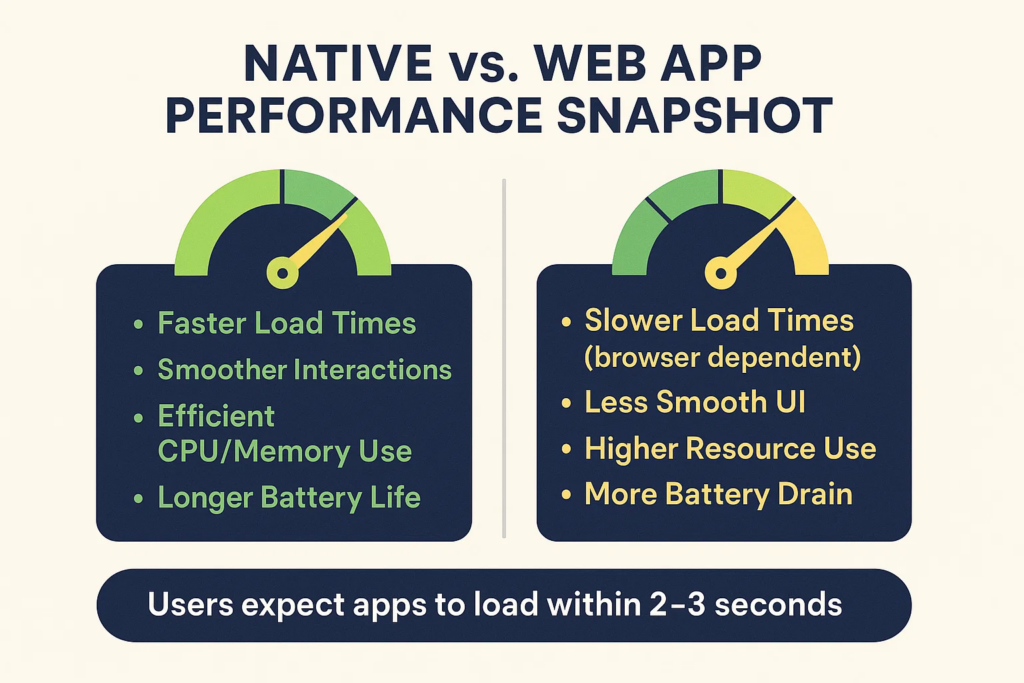
Native apps are purpose-built and compiled to execute directly on the device’s operating system, whether it’s iOS or Android. This close-to-the-metal approach allows them to harness the full power of the device’s CPU and GPU, resulting in optimized performance. Factors like faster load times (expected within 2 seconds), fluid animations, and highly responsive interactions are hallmarks of well-crafted native applications. For resource-intensive tasks such as complex calculations, 3D rendering, or real-time data processing, the performance edge of native applications becomes even more pronounced.
Web apps, in contrast, operate within the mobile browser environment. They rely on web technologies like HTML, CSS, and JavaScript, which must be interpreted and rendered by the browser. This introduces an extra layer of processing, often leading to slower performance and a less responsive user experience, especially under fluctuating or poor network conditions. This performance disparity can have tangible consequences; slow apps can frustrate users and decrease productivity. In fact, studies indicate that users expect apps to load within mere seconds, and failing to meet this expectation can lead to abandonment. Native applications, optimized for speed and efficiency, are better positioned to satisfy these demanding user expectations. Furthermore, research indicates that native apps generally consume less energy and utilize device resources more effectively than web apps, contributing to improved battery life and smoother overall device operation.
Engagement Elevated: The UX Power of Native Apps
Performance is only one piece of the puzzle; user experience (UX) and user interface (UI) are paramount in the competitive mobile landscape; they can significantly influence user engagement and satisfaction. In this critical area, native applications provide distinct advantages.
Because native applications are specifically designed and developed for a particular mobile operating system, they adhere to that platform’s established design guidelines and UI conventions. This platform-specific design creates a sense of familiarity and consistency, making the application feel intuitive, natural, and easy to navigate for the user. Users are accustomed to the look and feel of their operating system, and native apps seamlessly integrate with these expectations. Consider the smooth animations, fluid transitions, and highly responsive interactions that characterize well-designed native apps; these elements contribute substantially to a polished and engaging user experience.
Moreover, native apps possess a greater capacity to leverage device-specific features and hardware. Whether it’s accessing the device’s camera, utilizing GPS for location-based services, integrating with biometric authentication, or employing push notifications for timely updates, native applications can tap into the full potential of the mobile device. This deep integration enables richer, more interactive, and more context-aware experiences than are typically achievable with web apps.
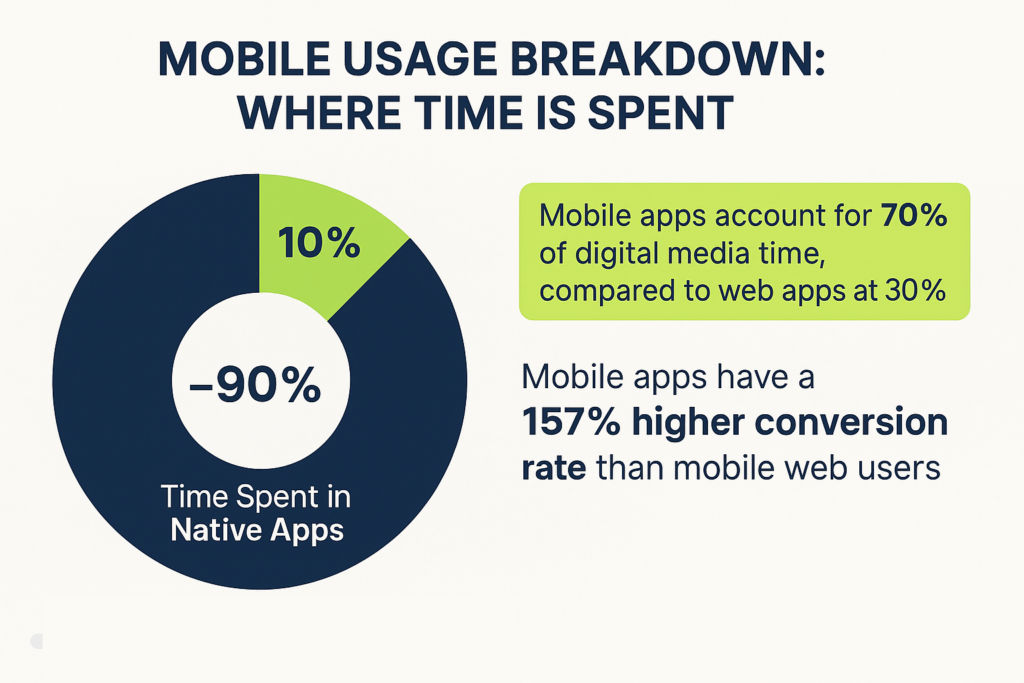
The impact of this superior UX and feature integration is clearly reflected in user behavior and engagement metrics. Statistics consistently demonstrate that a high percentage of mobile internet usage occurs within native applications, with some studies indicating nearly 90% of mobile internet time is spent in apps. Mobile apps also exhibit substantially higher conversion rates compared to web apps, with reports showing rates as much as 157% higher, underscoring their effectiveness in driving desired user actions and achieving business objectives. Furthermore, users spend significantly more time engaged with native mobile apps compared to web applications, highlighting the superior engagement they offer. In the competitive web and mobile landscape, this enhanced engagement and user preference represent a crucial differentiator.
Unlocking Device Potential: Native Apps and Feature Access
A fundamental advantage of native applications lies in their ability to fully harness the power of a mobile device’s hardware and software capabilities. This deep integration is a cornerstone of their value in the web and mobile ecosystem.
Native applications are not constrained by the limitations of a browser; they have direct access to a rich array of device features. Consider the possibilities: native apps can seamlessly integrate with the device’s camera to capture photos and videos, utilize GPS for precise location tracking and navigation, employ the accelerometer and gyroscope for motion-sensing and immersive experiences, and leverage biometric authentication for enhanced security. Furthermore, they can access core functionalities such as the contacts list, calendar, and push notification services, creating a cohesive and intuitive user experience.
This level of access empowers developers to create sophisticated and engaging applications that push the boundaries of what’s possible on mobile devices. For example, augmented reality (AR) applications, which overlay digital information onto the real world, heavily rely on native access to the camera, sensors, and processing power. Similarly, high-performance gaming, which demands optimized use of the device’s graphics capabilities and real-time responsiveness, typically thrives in the native application environment.
In essence, native applications provide the tools and capabilities to craft truly immersive, feature-rich, and deeply integrated mobile experiences. This capability remains a critical factor in their continued importance, even amidst the ongoing evolution of web and mobile technologies.
Always Available: The Power of Offline Functionality in Native Apps
While we live in an increasingly connected world, reliable internet access isn’t always guaranteed. This is particularly true in various enterprise scenarios and mobile-centric workflows. Native applications offer a significant advantage by providing robust offline functionality.
Native mobile apps possess the capability to store data locally on the device, enabling continued operation even without an active internet connection. This is a crucial feature for numerous use cases. Imagine field technicians conducting inspections in remote areas with limited connectivity, warehouse staff managing inventory in facilities with spotty Wi-Fi, or healthcare providers accessing patient records in locations with unreliable networks. Native apps allow these users to perform their tasks, access critical information, and collect data seamlessly, with synchronization occurring automatically once a connection is restored.
In contrast, web apps generally require an active internet connection to load pages and fetch data. Although modern web technologies like service workers and Progressive Web Apps (PWAs) can provide some degree of offline functionality through caching, the implementation is often more complex and the reliability can be less consistent compared to native solutions. In many cases, web apps offer limited functionality or become entirely unusable when offline.
For enterprises with a mobile-enabled workforce, especially those operating in the field or in areas with inconsistent connectivity, the offline capabilities of native applications can be a game-changer. It ensures business continuity, maximizes productivity, and enhances data accuracy, regardless of network availability.
The Native Edge: Choosing Quality in a Mobile-First World
In the ever-evolving landscape of web and mobile technology, the discussion about native applications versus web apps remains relevant. Both approaches have their strengths and weaknesses, and the “best” choice often depends on the specific requirements and objectives of a given project. However, when the goal is to deliver peak performance, create highly engaging user experiences, and fully leverage the capabilities of mobile devices, native applications continue to hold a decisive edge.
While web apps and hybrid app development can offer advantages in terms of cost-effectiveness and cross-platform reach, they frequently involve compromises in crucial areas. Native applications, by their very nature, are optimized for the mobile environment, providing a level of speed, responsiveness, and seamless integration that is often difficult to replicate with other approaches. In today’s mobile-first world, where users expect and demand high-quality, intuitive, and seamless mobile experiences, native applications become a crucial tool for businesses seeking to differentiate themselves and achieve success. User behavior and engagement statistics underscore this point: users spend a significant majority of their mobile time within native applications, and these apps consistently demonstrate higher conversion rates, indicating their effectiveness in driving desired user actions.
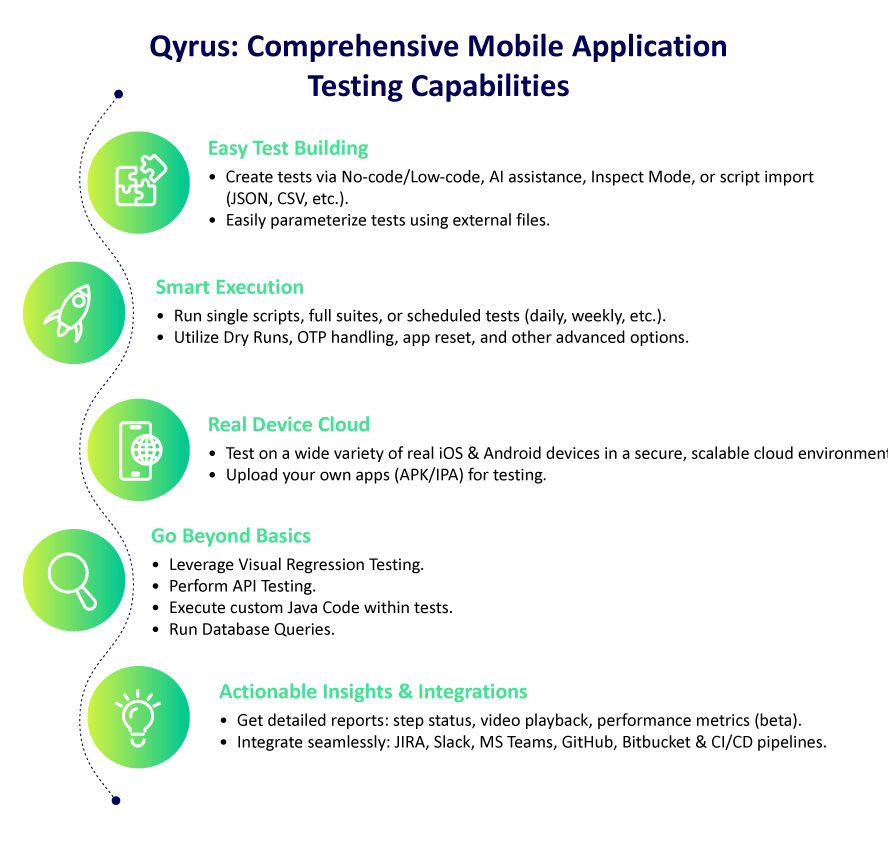
For businesses committed to delivering exceptional mobile experiences and recognizing the importance of high-performing native applications, Qyrus offers a suite of cutting-edge mobile testing solutions. As discussed, although web apps are not ideal for mobile devices, Qyrus also offers the ability to execute web tests on mobile devices. Qyrus empowers development teams to ensure their native applications perform flawlessly across a wide range of mobile devices and operating system versions. Don’t leave the success of your native or web applications to chance; invest in quality and reliability with Qyrus.
Jerin Mathew M M is a seasoned professional currently serving as a Content Manager at Qyrus. He possesses over 10 years of experience in content writing and editing, primarily within the international business and technology sectors. Prior to his current role, he worked as a Content Manager at Tookitaki Technologies, leading corporate and marketing communications. His background includes significant tenures as a Senior Copy Editor at The Economic Times and a Correspondent for the International Business Times UK. Jerin is skilled in digital marketing trends, SEO management, and crafting analytical, research-backed content.