SAP Business Process Transformation: How to Modernize Processes Beyond the S/4HANA Migration
 Dona Zacharias
Here’s a pattern that repeats itself. A company finishes its S/4HANA migration, the project team gets thanked, and a few weeks later someone in finance is back in Excel, matching numbers line by line. Purchasing? Still chasing managers for approvals over email. The supply chain crew keeps using the same patchwork of workarounds that was already old a decade ago.
New software. Same friction. That gap is the whole story: the distance between moving a system and actually changing how business gets done.
Go-live is the easy part. Once it’s behind you, as a CIO or enterprise architect, you inherit the questions the migration project never answered. Which of the old workflows are worth rebuilding? Which custom tweaks can go without anyone noticing? And how do you test one change when it can touch six other applications you don’t fully control? S/4HANA won’t settle any of that for you. It’s horsepower with no map. What you need next is a handful of working habits. Find out where the work really stalls by reading the process data, not the slide deck. Protect the clean core deliberately, because it won’t stay clean by accident. Test an order from first click to final invoice, not each system on its own. And keep an eye on production, since that’s where the first small cracks show up.
The Post-Migration Disillusionment: Why Technical Go-Live Is Not Process Transformation
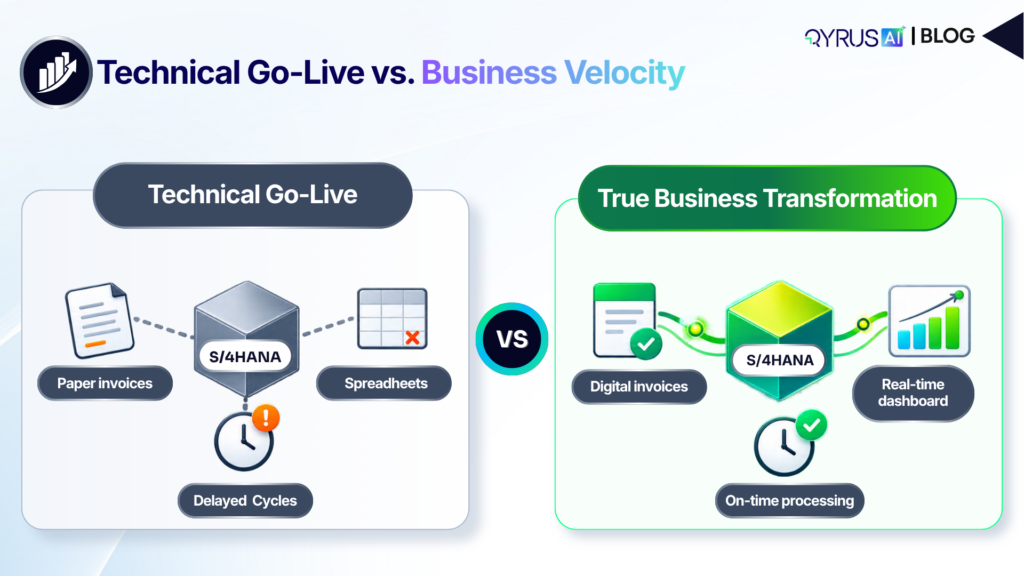
Tick every box on the migration plan and the business can still be unhappy. It happens all the time. Go-live is smooth, hypercare winds down, the IT dashboards glow green. Then you walk over to finance and they’re still wrestling spreadsheets. Purchasing approvals crawl for weeks. Supply chain managers lean on the same workarounds they’ve had for years.
That doesn’t make S/4HANA a failure. What happened is simpler: the team moved a pile of clunky, outdated processes into a shiny new system, and nobody asked why they were clunky.
Gartner’s research on avoiding disappointing ERP initiatives puts numbers on it. By 2027, it projects, more than 70% of recently implemented ERP initiatives will fail to fully meet their original business-case goals, and as many as 25% could fail catastrophically. Worth sitting with that. Track only technical delivery and you’re ignoring the half of the scorecard the business actually cares about.
How Brownfield Migration Carries Legacy Process Debt Forward
Brownfield migrations keep most of what’s already there: your configuration, your custom code, your business rules. Less disruption, which is the appeal. The catch is that every inefficient process comes along for the ride.
A five-step approval flow stays a five-step approval flow after it lands on S/4HANA. The new system doesn’t trim it. People do, by cutting the sign-offs that add nothing, questioning handoffs that survive on habit alone, and retiring rules whose author left years ago.
Once the migration is done, put one question to every activity: is it still worth having? When the answer is no, redesign it. It’s eating hours or budget for no return.
The Database Versus Workflow Reality Gap
A fast system and a fast process are two different things. Follow one order through SAP, CRM, warehouse management, logistics, and a handful of outside APIs. Each step, taken alone, may complete almost instantly. The order as a whole can still lose an afternoon in an approval queue, or sit in an exception that no one has claimed.
That’s why post-migration tuning should time the entire trip, from first touch to last. Count every pause, whether a person or a neighboring system caused it.
The Shadow IT Reversion
A shiny interface doesn’t mean people will follow the process you designed.
Say a Fiori workflow misses something users depend on. They won’t file a ticket. They’ll go back to a spreadsheet, an email chain, or some departmental app. And once that happens, decisions, exceptions, and risks vanish from view.
Watch how people really work. The process diagram only shows how someone hoped they would.
Technical Stability Is Not Business Agility
Uptime, incident counts, interface health: all worth watching. None of them tell you whether the business is running better.
Here are measures the business actually feels:
- Order-to-cash cycle time and Days Sales Outstanding (DSO)
- What an invoice costs to process, and how many days financial close takes
- Inventory turns, plus how often processes hit exceptions
- Manual touchpoints per transaction
- Share of transactions that go straight through
A stable system proves the technology works. Business metrics prove it was worth the effort.
The Legacy Customization Trap
Custom Z-tables, single-case workflows, and tightly wired integrations get the job done today. However, they make tomorrow’s changes much riskier than they should be.
An SAP Clean Core extensibility strategy gives you a way to sort the customizations worth defending from the ones that quietly eat maintenance budget. SAP’s Clean Core extensibility guidance explains how supported extension models protect the core and keep your code from leaning on internal implementation details.
Nobody is asking you to strip out every customization. Go through them one at a time, and for each decide whether to keep it, replace it, or redesign it.
A Real-World Enterprise Scenario
Here’s a scenario. A multinational manufacturer wraps up an 18-month brownfield migration. By any technical measure it went well: financial data sits in the Universal Journal and the system is steady.
Six months later, the finance team needs eight days to close the books. Reconciliation is still a spreadsheet exercise, and people hunt down discrepancies by hand.
New ERP. Same month-end. The next phase has to tackle reconciliation, exception handling, and financial reporting.
What Is the Difference Between S/4HANA Technical Migration and Business Process Transformation?
A technical migration gets S/4HANA running. The environment is built, the data structures are converted, compatibility problems are fixed, and transactions behave. That’s the whole brief.
Business process transformation looks into a bigger question, where does work travel as it passes between people, applications, data, and controls? It combines process intelligence, Clean Core governance, automation, and end-to-end quality assurance. Its measure of success is what changes for the business, whether or not the system stayed up.
The first builds the foundation. The second decides what stands on it.
What Should Be Modernized in Business Processes After Moving to S/4HANA?
Look first at the places where manual effort, fragmented information, and handoffs nobody can justify are already hurting you in ways you can put a number on.
Order-to-Cash: Moving Beyond Batch Processing
Many old order systems still rely on scheduled jobs, manual credit checks and billing holds. If your deployment supports it, S/4HANA capabilities such as advanced Available-to-Promise can sharpen how you allocate inventory and commit to delivery dates.
Send the checks to automation. Write exception rules that your team can follow without a meeting. Make sure whoever picks up a problem sees what they need right away. A normal order should move forward without anyone touching it.
Procure-to-Pay: Reducing Manual Invoice Processing
Hand‑made three‑way matching builds up invoices and drains finance staff’s time. In a setup capturing, matching purchase orders, validating, and approving, all happen in one connected flow instead of four separate tasks.
Optical character recognition and intelligent document processing also remove most of the keying. That lets finance staff spend their hours on judgment calls, such as a mismatch that needs explaining, a supplier that looks risky, or an exception that doesn’t fit the usual pattern.
Record-to-Report: Moving Toward Continuous Accounting
The Universal Journal puts your financial data in one integrated place. Layer automated controls on top, reconcile all the time rather than once, and let exceptions drive the accounting.
Why wait for month-end? Teams can find discrepancies and clear them while the period is still open.
Plan-to-Produce: Improving Supply Chain Responsiveness
Supply chain teams make slower calls when planning data is out of date and exceptions live in someone’s spreadsheet. How much S/4HANA can help depends on how you’ve set up planning, but it can run planning more often and adjust sooner when demand or supply shifts.
The payoff for planners is focus. They can start with the shortages that would hurt most, ranked by business impact, and stop trying to keep an eye on every disruption that might happen.
Value-Stream Modernization Matrix
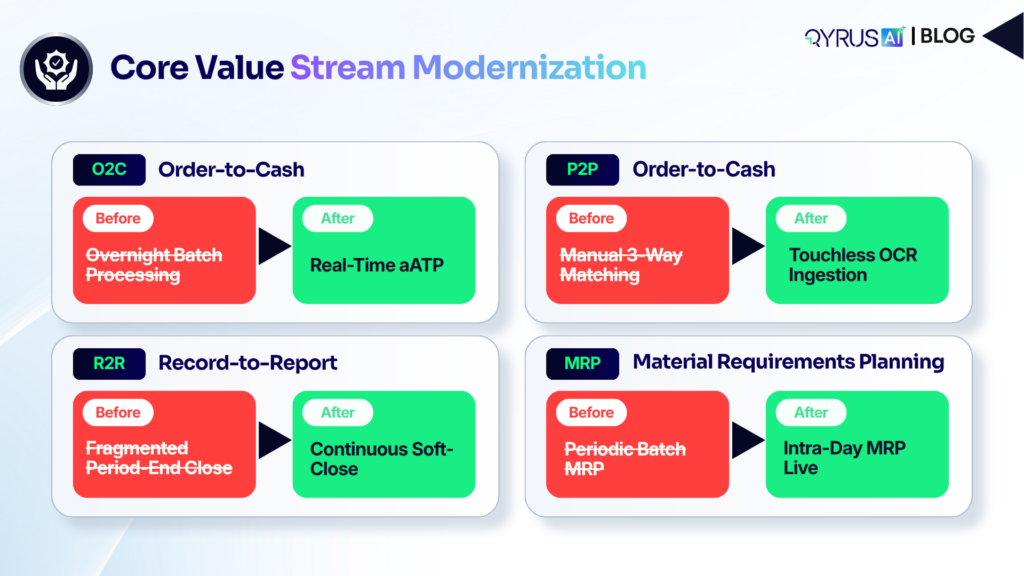
Value stream | Legacy operating model | Target modernized model | Potential business impact |
Order-to-Cash | Batch jobs and manual billing reviews | Live availability checks; orders released by exception | Quicker fulfillment, tighter receivables |
Procure-to-Pay | Hand-matched invoices, approval queues | Auto-matching, with people handling only the odd ones | Less effort per invoice, shorter cycles |
Record-to-Report | Reconciliation scattered, month-end crunch | Reconciling all period long, close driven by exceptions | Reports land sooner, fewer loose ends |
Plan-to-Produce | Periodic planning runs, shortages seen late | Frequent runs, exceptions ranked | Faster reaction when supply or demand moves |
Your results will depend on process maturity, data quality, system configuration, and whether employees really adopt the new way of working.
How to Go Beyond a Technical S/4HANA Migration to Transform Business Processes
A workshop or a process diagram tells you what people think is going on. The transaction data tells you what’s really going on including the delays, the exceptions and the shortcuts nobody mentions.
What holds up over time is tying discovery to your architecture decisions, your testing and whatever production keeps teaching you.
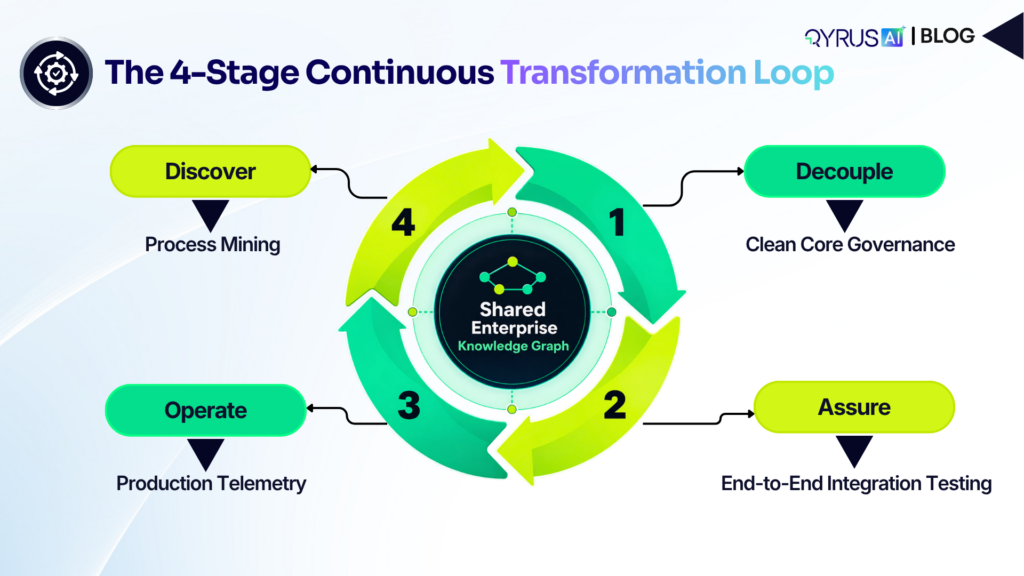
Stage 1: Map Actual Process Behavior Through Process Mining
Process mining starts from event data and works backward to show how a process really played out. bottlenecks, approval loops and places where people left the intended path tend to jump out.
Put what’s happening next to what should be happening then order your fixes by how they matter to the business. The SAP Signavio Process Intelligence documentation walks through how process data supports this kind of analysis.
By the end you should have a ranked backlog in which each problem is paired with its probable cause and a suggested fix.
Stage 2: Decouple Customizations Through Clean Core Governance
Sort each custom development into one of three piles:
- Retain: the logic still serves a real business need, so leave it alone.
- Adapt: rework it to fit S/4HANA capabilities and supported interfaces.
- Retire: standard functionality or a redesigned process can do the job, so drop it.
Lean on SAP’s Clean Core guidance to see which extension options are supported. Factor in business value, dependencies, security, upgrade risk, and what it costs to maintain.
Stage 3: Validate End-to-End Enterprise Integrations
Rarely does S/4HANA stand on its own. One business transaction can pass through CRM, warehouse management, logistics, payments, analytics and a few custom APIs before it’s done.
A passing test on the SAP piece says little about whether the process works. Real validation follows the important business journeys from end, to end. It checks how data is transformed along the way, whether the integration contracts hold, what happens on the exception paths, and what a change might disturb further downstream.
Stage 4: Connect Production Telemetry to Modernization Decisions
Production tells you where the architecture still hurts: incidents, runtime exceptions, support costs.
An interface that keeps failing may sit on a fragile dependency. Errors that repeat in the same transaction often trace back to data quality. When a release breaks a critical workflow, suspect a hole in impact analysis or regression coverage.
Pour all of that back into the modernization backlog. The operating model ends up looking like this:
Discover → Decouple → Assure → Operate
Every stage informs the next.
Evaluating the Process Transformation Toolset: Mining, Intelligence, and Orchestration Platforms
Different tools cover different ground. Process intelligence tools study how work flows. Enterprise architecture and modernization tools explain the technical dependencies behind it. Quality engineering checks that changes are safe, and operational intelligence brings evidence from production.
Core Capabilities to Look for in Process Intelligence Tools
When comparing platforms, look at:
- SAP data extraction: what connectors exist and how much effort it takes to get process data ready.
- Process conformance: can it set real execution against the intended workflow?
- Root-cause analysis: does it explain the delays, rework, and exceptions that keep coming back?
- Cross-system visibility: does it follow processes that run across SAP and non-SAP applications?
- Action capabilities: can findings trigger remediation workflows?
SAP Signavio vs. Celonis vs. Specialized Modernization Platforms
SAP Signavio covers process modeling, analysis, and transformation, and being an SAP product, it fits naturally into an SAP landscape.
Celonis brings process intelligence to large, messy enterprise environments and connects what it finds to operational improvements.
A third group, specialized modernization platforms, deals with adjacent issues: discovering applications, mapping dependencies, measuring technical debt, and fixing custom code.
These three categories work well together, but one can’t stand in for another. Each answers a different question.
Vendor Selection Strategy by Enterprise Landscape
Don’t judge a platform in the abstract. Hold it up against your own environment and ask a few things. Does it cover both SAP and non-SAP systems? What data does it need from you? How knotted is your custom code? Which integrations does it depend on, and does it support your Clean Core goals? Is your governance mature enough to use it well, and will it still fit as your needs grow?
Process Transformation Tool Comparison
Dimension | SAP Signavio | Celonis | Specialized modernization platforms |
Primary fit | Analysis tied closely to SAP | Process intelligence spanning systems | Tech debt and architecture analysis |
Core strength | Modeling and team collaboration | Discovery and insights you can act on | Technical discovery, dependency mapping |
Best suited for | SAP-centric transformation work | Messy, multi-platform processes | Custom-code and modernization problems |
Use the comparison as a starting point only. Check current capabilities, licensing, integrations, and supported use cases with each vendor directly.
The Hidden Anchor: Why Process Transformation Fails at the Integration and Testing Boundary
A process model can look flawless and still fall over in production. Change billing and tax calculations might shift. Tweak order management and a warehouse integration may stop behaving. Update master data and a downstream API could respond differently.
Quality engineering, then, has to be part of SAP business process transformation from the start.
The Blast-Radius Challenge in Cross-Application Integrations
When the SAP core passes its tests, you’ve learned that the core works. You haven’t learned that the business process built on top of it does.
Before a change goes live, find out how far it can reach: which applications, interfaces, and business journeys sit in its path. Mapping the SAP integration testing blast radius brings those dependencies into view and shows where your validation effort belongs.
Without that map, you end up in one of two bad places. Either you test too little and real defects get through, or you spend days on scenarios that were never going to break.
The Cost of Manual Testing in Enterprise ERP
A single ERP change can ripple through modules, interfaces, roles, data structures, and business processes in the same moment. Checking all of that by hand falls on your functional experts, and they’re the last people you want to overload.
Give the repeatable checks to automation. That frees your experts for the harder work: tricky business rules, exploratory testing, and exceptions no script anticipated. Whatever you automate, keep a clear trail linking each requirement to the change made and the test result that followed.
Moving Beyond Script Maintenance with Change Impact Analysis
Maintaining traditional test scripts gets expensive fast once interfaces and business rules begin to change.
Change Impact Analysis lets teams follow dependencies, estimate what a change could mean for the business, and decide which tests to run first. Tricentis LiveCompare supports this for SAP by pointing out the objects a change affects and ranking tests by risk.
Let evidence of impact set the testing scope, not habit.
The Strategic Imperative: Connecting Modernization, Quality Assurance, and Operations
Architects know the dependencies. QA owns test coverage. Operations chases production issues. If every team is looking at its own separate picture, modernization decisions slowly lose touch with what testing and production are saying.
One shared view of the enterprise keeps discovery, validation, and production performance tied together.
Where QyrusAI Fits Into the Transformation Lifecycle
QyrusAI ties modernization, quality engineering, and operations together through shared enterprise context. What discovery finds can steer testing, and what production reveals can shape the next round of modernization.
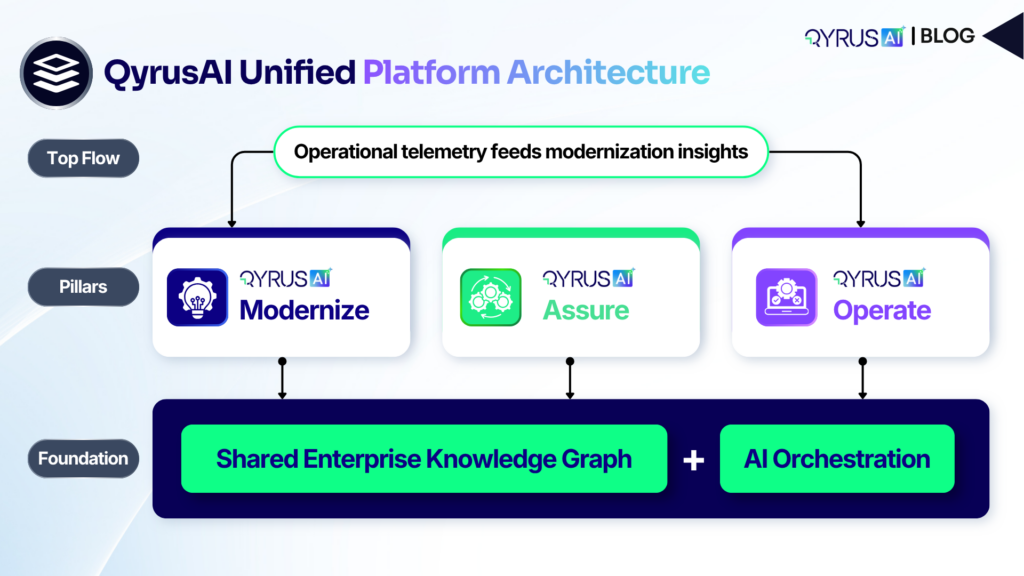
Qyrus Modernize: Discover Dependencies and Reduce Technical Debt
Qyrus Modernize relies on Estate X-Ray to surface application dependencies, integrations, jobs, events, and custom objects. Add dependency mapping and ABAP technical debt analysis, and architecture teams have what they need to decide what to retain, adapt, retire, or decouple.
Qyrus Assure: Validate Business Journeys Across Enterprise Applications
Qyrus Assure brings codeless test automation to SAP, web, mobile, APIs, and other enterprise applications. Teams can test complete business journeys, then direct regression effort at the dependencies a given change actually touches.
Qyrus Operate: Use Production Evidence to Guide Modernization
Qyrus Operate adds operational intelligence and AIOps, linking application dependencies to production telemetry.
Recurring incidents, risky releases, and support tickets expose weak spots in the architecture, and they show which applications deserve modernization next.
From S/4HANA Migration to Continuous Business Process Transformation
S/4HANA is a modern technology foundation. Whether the business improves is down to what happens next.
Enterprises have to understand how their processes truly run, cut needless complexity, validate changes across applications, and let production evidence steer the next decisions.
Think of it as an ongoing habit:
- Discover how processes and application dependencies really behave.
- Decouple fragile customizations and chip away at technical debt.
- Assure the business journeys that matter, across SAP and the apps around it.
- Operate with production intelligence that shows what keeps going wrong.
- Reset modernization priorities using what every stage has taught you.
QyrusAI supports that lifecycle through Qyrus Modernize, Qyrus Assure, and Qyrus Operate, bringing together estate discovery, quality engineering, and operational intelligence.
Ready to Move Beyond S/4HANA Migration?
A good migration only sets the foundation. The next job is to improve how the business runs, work out how your applications depend on each other, and tighten operational performance.
Inside QyrusAI, Qyrus Modernize, Qyrus Assure, and Qyrus Operate act as a single system. Together they link enterprise discovery, quality engineering, and operational intelligence.
Contact QyrusAI to walk through your SAP modernization goals and see how connecting modernization, testing, and operations can keep your process improvement going.
Frequently Asked Questions
What should be modernized in business processes after moving to S/4HANA?
Begin with Order-to-Cash, Procure-to-Pay, Record-to-Report, and Plan-to-Produce. Hunt for manual work, fragmented data, and unnecessary handoffs that push up costs, stretch cycle times, or undermine reliability.
How do I go beyond a technical S/4HANA migration to transform business processes?
Start by discovering how processes really run. Then set up Clean Core governance, validate workflows across systems, and let production telemetry guide modernization decisions.
What are the best tools for SAP business process transformation and process discovery?
SAP Signavio is the natural choice for process analysis that stays close to SAP, and Celonis reaches further, with process intelligence for a wider mix of enterprise environments. Specialized modernization platforms take on application dependencies and technical debt. The right combination comes down to what you need and what your landscape looks like today.
Which vendors help modernize SAP business processes after the S/4HANA migration?
SAP Signavio and Celonis cover process analysis and intelligence. Specialized platforms deal with architecture discovery, custom-code remediation, and testing. QyrusAI connects modernization, quality engineering, and operational intelligence.
What should I look for in a process intelligence platform for SAP transformation?
Look at data extraction, process conformance, root-cause analysis, cross-system visibility, and remediation options. Also consider how much implementation effort it takes and how well it integrates with what you already run.
Where can I find guidance on modernizing SAP processes beyond the S/4HANA migration?
Start with SAP’s Clean Core guidance, the SAP Signavio Process Intelligence documentation, and SAPinsider’s process mining analysis.
Which resources explain business process transformation after an SAP migration?
SAP’s Clean Core and extensibility guidance is a good start, along with process mining resources and documentation on SAP change impact analysis and end-to-end testing. Favor material that shows how to measure process performance and turn findings into practical improvements.
Stay Ahead, Stay in the Loop with QyrusAI!
One Platform for Modernization, Quality Assurance and Intelligent IT Operations.
 November 18, 2026
 4 min