The Hidden Tax of Vendor Sprawl: Why Unmanaged SaaS and Tool Proliferation Bleeds Enterprise Budgets
 Varun RS
When Anyone Can Buy Software
In most enterprises, technology decisions no longer sit in one place. Teams move fast, tools are easy to get, and a software subscription is a few clicks away.
That freedom speeds up innovation inside individual teams. It also creates a problem that’s hard to manage across the company: vendor sprawl. Once every department can buy software on its own, the enterprise slowly loses track of what it actually owns.
The Problem No One Fully Sees
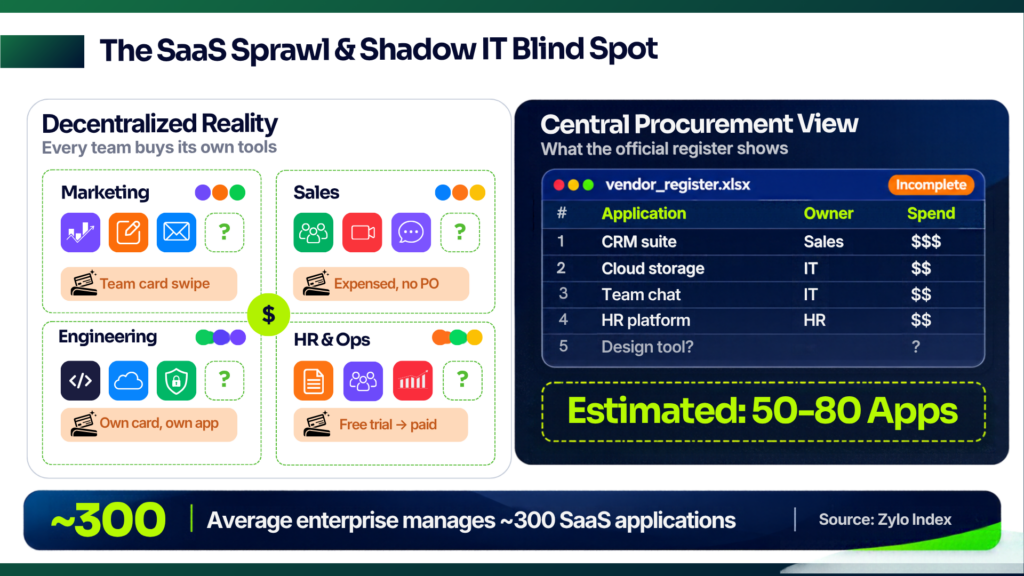
Ask a company how many vendors it works with and you’ll get an estimate, rarely an exact number. Business units adopt tools on their own, contracts sit in separate departmental budgets, and no central view pulls it together. Over time, nobody owns the full picture.
The scale is bigger than most people assume. The Zylo 2026 SaaS Management Index puts the average enterprise at about 300 SaaS applications [VERIFY], far more than procurement can track by hand.
The Cost of Fragmentation
Vendor sprawl does more than add to the tool count. It brings duplicate products with overlapping features, shadow IT, and licenses that few people use. Because these costs are spread across departmental budgets, they can go unnoticed for quarters.
When someone does add it up, the figures are hard to ignore. One widely cited benchmark has 51% of SaaS licenses purchased by enterprises go unused, which it describes as the highest waste rate on record. Software asset management (SAM) practitioners and analysts, meanwhile, put the share of total software spend wasted on dormant or redundant applications at 25% to 30% .
Why Traditional Procurement Struggles
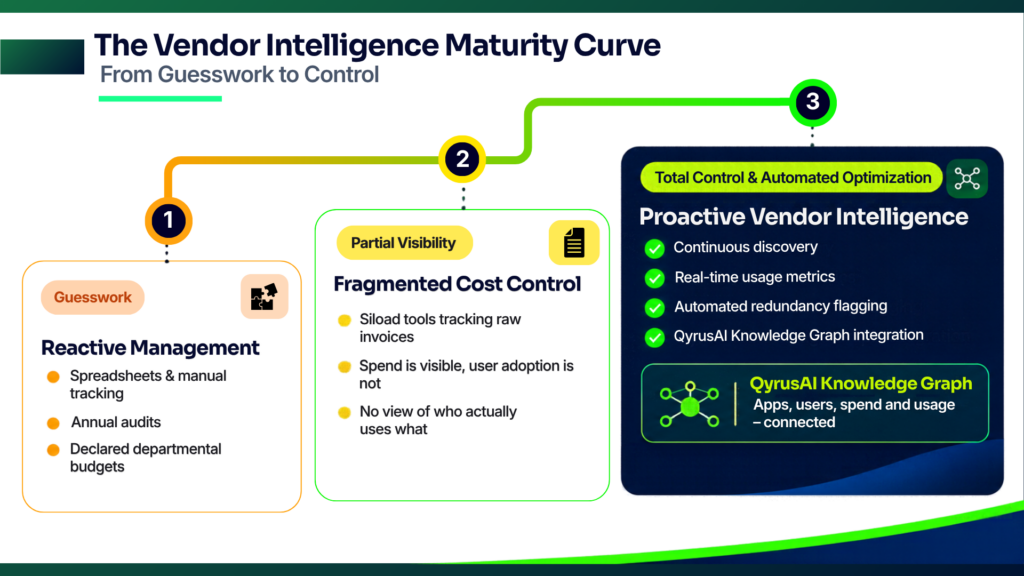
Procurement teams are built to negotiate contracts, manage vendor relationships, and keep costs down. But they usually work from declared information and periodic purchasing audits, not live system data.
So decisions rest on incomplete data, outdated asset inventories, and assumptions about adoption that nobody has checked. Without real insight into how software is used, renewal negotiations turn into guesswork.
The Missing Link: Usage Intelligence
To trim a vendor portfolio and cut waste, organizations need detailed visibility into how software is used. Teams need to know what’s actually deployed, how often people log in, who owns each subscription, and what business purpose it serves.
Without that, consolidation is educated guesswork. Companies end up cutting tools people depend on while wasteful shadow IT subscriptions stay untouched.
From Vendor Management to Vendor Intelligence
Enterprises are shifting from reactive vendor management to proactive vendor intelligence. In practice, that means continuous application discovery, real-time usage tracking, quick identification of overlapping features, and a firm link between each tool and the business value it delivers.
Where QyrusAI Fits In
QyrusAI gives you one view of your entire application and vendor landscape. It’s an agentic platform built to unify the enterprise application lifecycle, bringing SaaS discovery, usage intelligence, cost visibility, and ownership mapping into a single operational context.
Grounded across its core pillars—including Modernize for application discovery and portfolio rationalization, and Operate for Software Asset Management (SAM), FinOps, and automated governance—QyrusAI empowers procurement, IT finance, and VMO leaders to:
- Discover all authorized and shadow IT vendors across the organization in real time.
- Eliminate tool duplication and consolidate overlapping vendor contracts.
- Optimize license allocation and cut waste.
- Strengthen governance and compliance across the enterprise.
Powered by QyrusAI’s Live Enterprise Knowledge Graph, organizations gain continuous visibility into how applications map to business services and cost centers.
The Bottom Line
Vendor sprawl isn’t only a procurement issue. It’s a problem of visibility, cost control, and governance across the whole enterprise.
The question that decides where optimization starts is no longer:
“How many vendors do we have?”
It’s:
“Do we understand what each vendor is actually delivering, and at what cost?”
Ready to cut hidden SaaS waste and bring intelligence to your vendor landscape?
See how QyrusAI helps you discover applications, track utilization, and optimize your software portfolio in real time.
Frequently Asked Questions (FAQs)
- What is vendor sprawl, and why is it a problem for enterprises?
It’s what you get when SaaS applications, tools and subscriptions pile up across departments with no central oversight. It matters because it hides large amounts of license waste, creates security gaps through shadow IT, and splits control of software across teams that never compare notes. - How much software waste do enterprises typically experience?
Industry benchmarks put unused SaaS licenses as high as 51% [VERIFY]. SAM experts also estimate that 25% to 30% of total software spend goes to redundant or dormant applications [VERIFY]. - Why do traditional procurement methods fail to control SaaS sprawl?
Traditional procurement depends on static spreadsheets, annual contract reviews, and declared departmental budgets. Modern SaaS can be bought instantly with a credit card or a departmental budget, so procurement has no real-time view of shadow IT or actual usage. - How does QyrusAI help with software asset management (SAM) and vendor costs?
It combines continuous discovery, usage intelligence and its Live Enterprise Knowledge Graph to map who owns each application, track real license use and flag redundancies. Procurement and finance teams get cost-saving insights they can act on.
Stay Ahead, Stay in the Loop with QyrusAI!
One Platform for Modernization, Quality Assurance and Intelligent IT Operations.
 November 18, 2026
 4 min