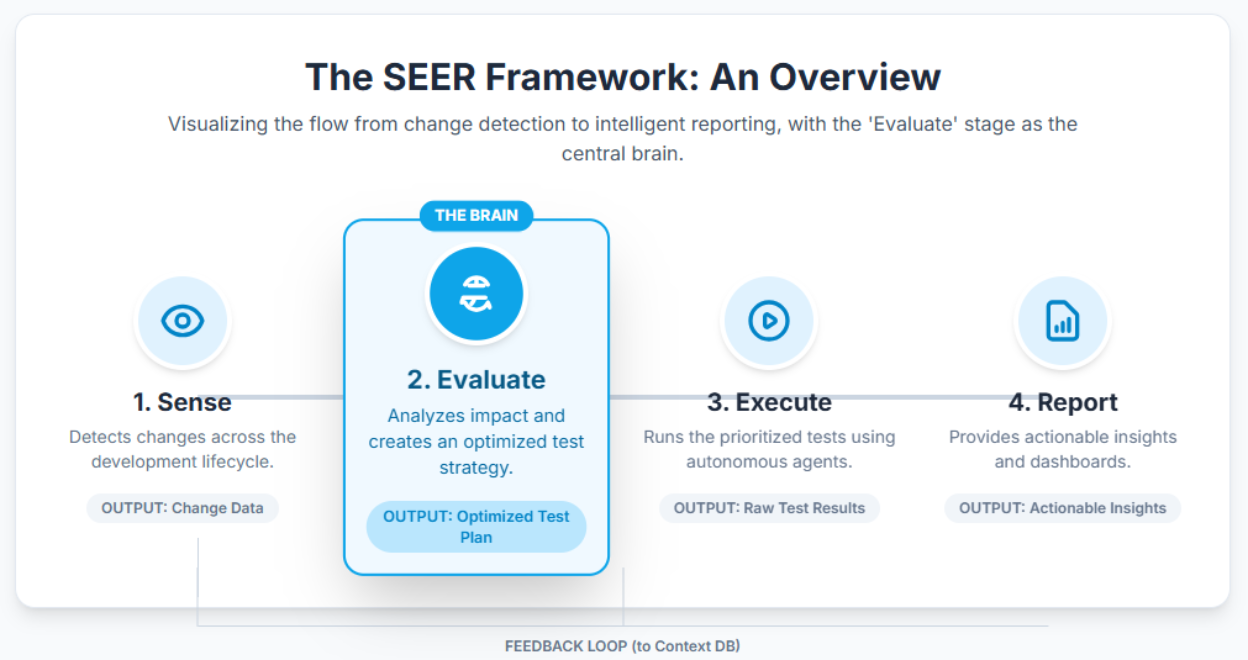
Welcome to the fourth chapter of our Agentic Orchestration series. So far, we’ve seen how the Qyrus SEER framework uses its ‘Eyes and Ears’ to Sense changes and its ‘Brain’ to Evaluate the impact. Now, it’s time to put that intelligence into action. In this post, we’ll explore the ‘Muscle’ of the operation: the powerful test execution stage. If you’re new to the series, we recommend starting with Part 1 to understand the full journey.
How the Qyrus SEER Framework Redefines Test Execution
The Test Strategy is set. The impact analysis is complete. In the last stage of our journey, the ‘Evaluate stage’ in the Qyrus SEER framework acted as the strategic brain, crafting the perfect testing plan. Now, it’s time to unleash the hounds. Welcome to the ‘Execute’ stage—where intelligent plans transform into decisive, autonomous action.
In today’s hyper-productive environment, where AI assistants contribute to as much as 25% of new code, development teams operate at an unprecedented speed. Yet, QA often struggles to keep up, creating a “velocity gap” where traditional testing becomes the new bottleneck. It’s a critical business problem. To solve it, you need more than just automation; you need intelligent agentic orchestration.
This is where the SEER framework truly shines. It doesn’t just run a script. It conducts a sophisticated team of specialized Single Use Agents (SUAs), launching an intelligent and targeted attack on quality. This is the dawn of true autonomous test execution, an approach that transforms QA from a siloed cost center into a strategic business accelerator.
Unleashing the Test Agents: A Multi-Agent Attack on Quality
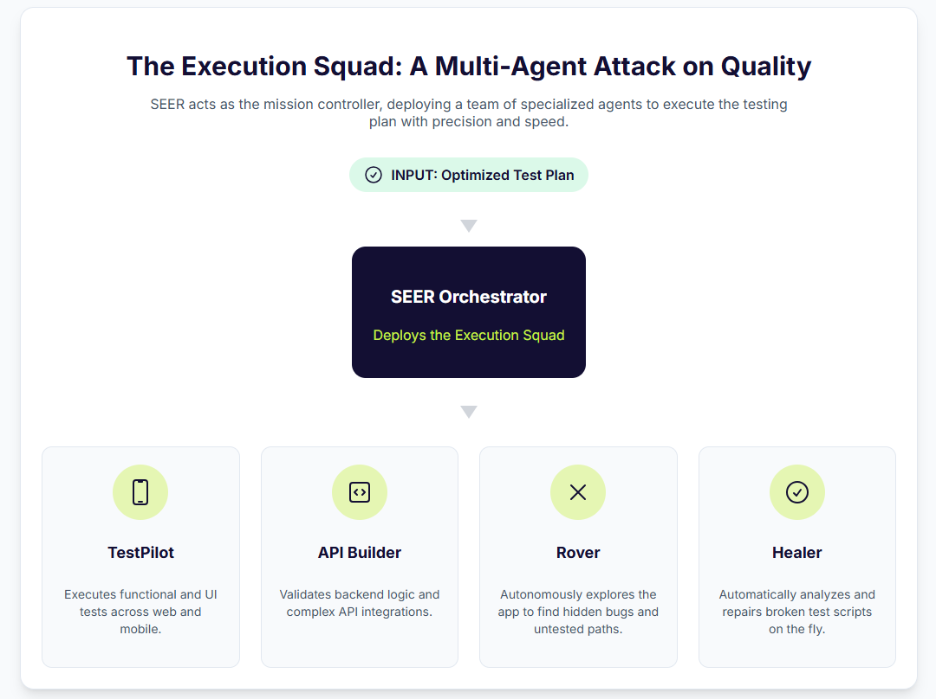
The Qyrus SEER framework’s brilliance lies in its refusal to use a one-size-fits-all approach. Instead of a single, monolithic tool, SEER acts as a mission controller for its agentic orchestration, deploying a squad of highly specialized Single Use Agents (SUAs) to execute the perfect test, every time. This isn’t just automation; this is a coordinated, multi-agent attack on quality.
The UI Specialist – TestPilot: When the user interface needs validation, SEER deploys TestPilot. This agent acts as your AI co-pilot, creating and executing functional tests across both web and mobile platforms. It simulates real user interactions with precision, ensuring your application’s UI testing is thorough and that the front-end experience is not just functional, but flawless.
The Backend Enforcer – API Builder: For the core logic of your application, API Builder gets the call. This powerful agent executes deep-level API testing to validate your backend services, microservices, and complex integration points. It can even instantly virtualize APIs based on user requirements, allowing for robust and isolated testing that isn’t dependent on other systems being available.
The Autonomous Explorer – Rover: What about the bugs you didn’t think to look for? SEER deploys Rover, an autonomous AI scout that explores your application to uncover hidden bugs and untested pathways that scripted tests would inevitably miss. Rover’s exploratory work is a crucial part of our AI test execution, ensuring comprehensive coverage and building a deep confidence in your release.
The Maintenance Expert – Healer: Perhaps the most revolutionary agent in the squad is Healer. Traditional test automation’s greatest weakness is maintenance; scripts are brittle and break when an application’s UI changes. Healer solves this problem. When a test fails due to a legitimate application update, this agent automatically analyzes the change and updates the test script, delivering true self-healing tests. It single-handedly eliminates the endless cycle of fixing broken tests.
Behind the Curtain: The Technology Driving Autonomous Execution
This squad of intelligent agents doesn’t operate in a vacuum. They are powered by a robust and scalable engine room designed for one purpose: speed. The Qyrus SEER framework integrates deeply into your development ecosystem to make autonomous test execution a seamless reality.
First, Qyrus plugs directly into your existing workflow through flawless continuous integration. The moment a developer merges a pull request or a new build is ready, the entire execution process is triggered automatically within your CI/CD pipeline, whether it’s Jenkins, Azure DevOps, or another provider. This eliminates manual hand-offs and ensures that testing is no longer a separate phase, but an integrated part of development itself.
Next, Qyrus shatters the linear testing bottleneck with massive parallel testing. Instead of running tests one by one, our platform dynamically allocates resources, spinning up clean, temporary environments to run hundreds of tests simultaneously across a secure and scalable browser and device farm. It’s the difference between a single-lane road and a 100-lane superhighway. This is how we transform test runs that used to take hours into a process that delivers feedback in minutes.
The Bottom Line: Measuring the Massive ROI of Agentic Orchestration
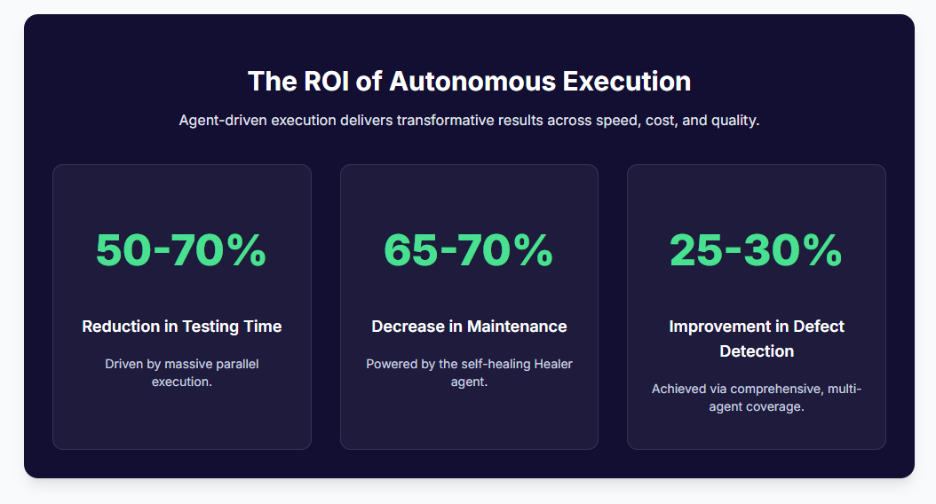
A sophisticated platform is only as good as the results it delivers, and this is where the Qyrus SEER framework truly changes the game. By replacing slow, manual processes and brittle scripts with an autonomous team of agents, this approach delivers a powerful and measurable test automation ROI. This isn’t about incremental improvements; it’s about a fundamental transformation of speed, cost, and quality.
Slash Testing Time and Accelerate Delivery: By orchestrating parallel testing across a scalable cloud infrastructure, Qyrus shatters the testing bottleneck. This allows organizations to shorten release cycles and dramatically increase developer productivity. Teams that embrace this model see a staggering 50-70% reduction in overall testing time. What once took an entire night of regression testing now delivers feedback in minutes, giving your business a significant competitive advantage.
Eliminate Maintenance Costs and Reallocate Talent: The Healer agent directly attacks the single largest hidden cost in most QA organizations: script maintenance. By automatically fixing broken tests, Healer allows organizations to reduce the time and effort spent on test script maintenance by an incredible 65-70%. This frees your most valuable engineers from low-value repair work, allowing you to reallocate their expertise toward innovation and complex quality challenges that truly move the needle.
Enhance Quality and Deploy with Bulletproof Confidence: Speed is meaningless without quality. By intelligently deploying agents like Rover to explore untested paths, the Qyrus SEER framework dramatically improves the effectiveness of your testing. This smarter approach leads to a 25-30% improvement in defect detection rates, catching critical bugs long before they can impact your customers. This allows your teams to release with absolute confidence, knowing that quality and speed are finally working in perfect harmony.
Conclusion: The Dawn of Autonomous, Self-Healing QA
The Qyrus ‘Execute’ stage fundamentally redefines what it means to run tests. It transforms the process from a slow, brittle, and high-maintenance chore into a dynamic, intelligent, and self-healing workflow. This is where the true power of agentic orchestration comes to life. No longer are you just running scripts; you are deploying a coordinated squad of autonomous agents that execute, explore, and even repair tests with a level of speed and efficiency that was previously unimaginable.
This is the engine of modern quality assurance—an engine that provides the instant, trustworthy feedback necessary to thrive in a high-velocity, CI/CD-driven world.
But the mission isn’t over yet. Our autonomous agents have completed their tasks and gathered a wealth of data. So, how do we translate those raw results into strategic business intelligence?
In the final part of our series, we will dive into the ‘Report’ stage. We’ll explore how the Qyrus SEER framework synthesizes the outcomes from its multi-agent attack into clear, actionable insights that empower developers, inform stakeholders, and complete the virtuous cycle of intelligent, autonomous testing.
Ready to Explore Qyrus’ Autonomous Test Execution? Contact us today!
APIs are no longer just pipes connecting systems. They’re the backbone of digital business. And as AI continues to dominate conversations in every industry, one thing is becoming clear: there’s no AI without APIs. That’s exactly why we’re heading to API Days London next month.
This year’s theme hits close to home: “No AI Without API Management.” Over three days, the conference will dig into how API-first architecture, scalability, security, and AI-enhanced management are shaping the way modern businesses build intelligent systems. For the qAPI team, powered by Qyrus, where API testing and quality assurance meet real-world AI workflows, it’s the perfect place to learn, share, and connect.
Why We’re Excited About API Days London
API Days is a tech event where the global API community shows up. You’ll see product owners, API architects, developers, and QA leaders all tackling the same challenges: how do we make APIs faster, safer, smarter, and ready for AI-driven environments?
The sessions are designed to go beyond theory. Think hands-on workshops, real-world case studies, and discussions that don’t just tell you what’s possible but show you how to do it. For us, it’s a chance to explore how API management ties directly into quality engineering, and how testing practices need to evolve if businesses want to stay competitive in an AI-first world.
Our qAPI team is especially excited to jump into the tracks focused on scaling, governance, and AI-driven API strategies. We’re looking forward to coming back with fresh ideas on how to embed API-centered QA into AI workflows because if APIs are powering intelligent systems, they need the same intelligent approach to testing.
Two Sessions You Can’t Miss with Raoul Kumar
We’re proud that Raoul Kumar, our Director of Platform Development & Success at Qyrus and qAPI, will be taking the stage not once, but twice.
📍 COMMERCIAL 2 📅 September 22, 2025 ⏰ 4:05 – 4:55 PM Workshop: Test APIs in the Cloud — No Code. Just Chrome.
This hands-on session strips API testing back to its essentials. Forget complicated frameworks or clunky setups, Raoul will walk you through how to run tests directly from your browser. No code, no hassle. Just Chrome and the cloud. You’ll see how this approach makes testing simpler for both devs and QA teams while fitting seamlessly into modern CI/CD pipelines.
And that’s just the start.
📍 COMMERCIAL 2 📅 September 24, 2025 ⏰ 9:30 AM – 9:55 AM Keynote: The Future of API Testing: No Code, Just Cloud and Chrome
In this keynote, Raoul will zoom out from the technical details to talk about the bigger picture: how QA needs to evolve in the age of AI and why APIs are at the center of it all. Expect to hear about the challenges enterprises are facing, the opportunities no-code brings to the table, and how qAPI, Powered by Qyrus, is helping organizations future-proof their API testing strategy.
Come Meet Us at the qAPI (powered by Qyrus) Booth
Of course, we’re not just speaking, we’re setting up camp on the show floor too. Swing by the qAPI/Qyrus booth to meet our team, see live demos of our platform, and chat about your QA challenges.
And because no conference is complete without some fun, we’ll also be running a raffle with special prizes throughout the event. Stop in, say hi, and you just might walk away with more than new API testing ideas.
Why This Matters for You
If you’re working in product, development, or QA, you know the pressure. Release cycles are shrinking. Expectations are rising. And AI is amplifying both the opportunity and the complexity of building great digital experiences. That’s why events like API Days London are so important.
For us, it’s about connecting with peers who are asking the same questions we are: How do we embed testing into API-first, AI-driven ecosystems? How do we make quality a competitive advantage instead of a bottleneck? And how do we simplify testing so teams can actually move at the speed of innovation?
See You in London
We couldn’t be more excited for Apidays London 2025. Between Raoul’s workshop on September 22, his keynote on September 23 at 9:30 AM, and our booth filled with demos, raffles, and great conversations, we’re looking forward to connecting with as many of you as possible.
For us, the takeaway is simple: No AI without APIs. And no innovation without quality.
Software development has hit hyperdrive. Groundbreaking AI tools like Devin, GitHub Copilot, and Amazon Code Whisperer are transforming the SDLC landscape, with AI assistants now contributing to a substantial volume of code. But as engineering teams rocket forward, a critical question emerges: what about QA?
While development speeds accelerate, traditional quality assurance practices are struggling to keep up, creating a dangerous bottleneck in the delivery pipeline. Legacy methods, bogged down by time-consuming manual testing and automation scripts that demand up to 50% of an engineer’s time just for maintenance, simply cannot scale. This widening gap doesn’t just cause delays; it creates a massive test debt that threatens to derail your innovation engine.
The answer isn’t to hire more testers or to simply test more. The answer is to test smarter.
This is where a new paradigm, agentic orchestration, comes into play. We’d like to introduce you to Qyrus SEER, an intelligent, autonomous testing framework built on this principle. SEER is designed to close the gap permanently, leveraging a sophisticated AI orchestration model to ensure your quality assurance moves at the speed of modern development.
The QA Treadmill: Why Old Methods Fail in the New Era
Developers are not just coding faster; they are building in fundamentally new ways. At tech giants like Google and Microsoft, AI already writes between 20-40% of all new code, turning tasks that once took hours into scaffolds that take mere minutes. This has created a massive velocity gap, and traditional QA teams are caught on the wrong side of it, running faster just to stand still.
The Widening Gap: Is Your QA Keeping Pace?
AI is revolutionizing development, but traditional QA methods are struggling to keep up.
AI-Accelerated Development
67% of developers are using AI assistants, according to a survey.
At major tech companies, AI already accounts for 20-40% of new code.
Moving at unprecedented speed.
GAP
Traditional QA
35% of companies say manual testing is their most time-consuming activity.
Up to 50% of test engineering time is lost to script maintenance.
Running faster just to stand still.
The breakdown happens across three critical fronts:
The Manual Testing Bottleneck: The first casualty in this new race is manual testing. It’s an anchor in a sea of automation. When developers deploy AI-generated code with unprecedented speed, manual processes simply cannot keep up. It’s no surprise that 35% of companies identify manual testing as the single most time-consuming activity in their test cycles, making it a guaranteed chokepoint.
The Crushing Weight of Maintenance: For those who have embraced automation, a different nightmare emerges. Traditional, script-based automation is incredibly brittle. As AI-accelerated development causes applications to change more rapidly, the maintenance burden becomes unsustainable. Teams spend more time fixing old, broken tests than they do creating new ones to cover emerging features, trapping them in a reactive, inefficient cycle.
The Growing Skills Gap Crisis: Perhaps the most significant barrier is the human one. There’s a stark paradox in the industry: while a massive 82% of QA professionals recognize that AI skills will be critical in the coming years, a full 42% of today’s QA engineers lack the machine learning expertise needed to adopt these new tools. This crisis delays the implementation of effective agent orchestration, leaving teams without the internal champions required to lead the charge.
The AI Skills Gap: A House Divided
There’s a disconnect between acknowledging the need for AI skills and possessing them.
The Acknowledged Need
82%
Of QA professionals agree that AI skills will be critical for their careers in the next 3-5 years.
The Current Reality
42%
Of QA engineers currently lack the machine learning and AI expertise required for implementation.
Intelligent Agentic AI Orchestration: Meet the Conductor of Chaos
The old model is broken. So, what’s the solution? You can’t fight an AI-driven problem with manual-driven processes. You need to fight fire with fire.
This is where Qyrus SEER introduces a new paradigm. This isn’t just another tool to add to your stack; it is a fundamental shift in how quality is managed, built upon one of the most advanced AI agent orchestration frameworks available today. Think of SEER not as a single instrument, but as the conductor of your entire testing orchestra. It intelligently manages the end-to-end workflow, ensuring every component of your testing process performs in perfect harmony and at the right time. This is the future of testing, a trend underscored by the fact that 70% of organizations are on track to integrate AI for test creation, execution, and maintenance by 2025.
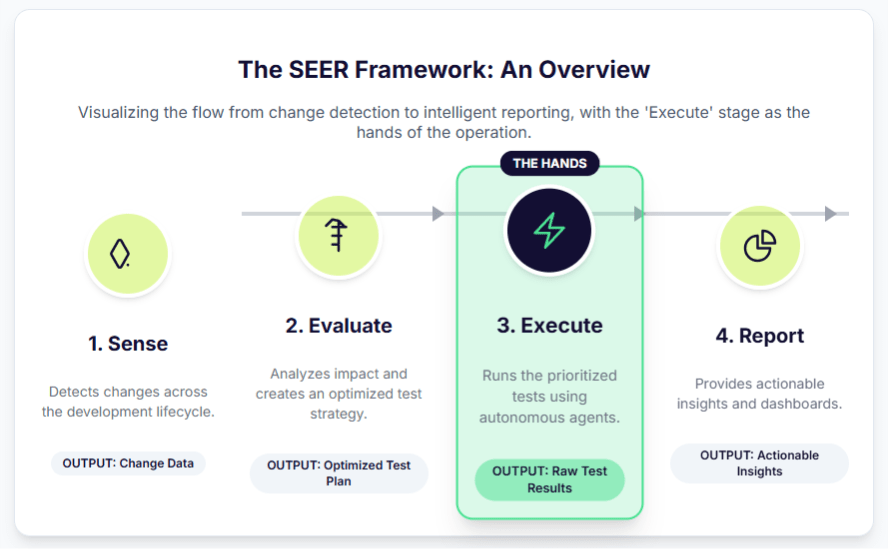
At its core, SEER’s power comes from a simple yet profound four-stage cycle:
Sense → Evaluate → Execute → Report
This framework dismantles the old, linear process of test-then-fix. Instead, it creates a dynamic, continuous feedback loop that intelligently responds to the rhythm of your development lifecycle. It’s a system designed not just to find bugs, but to anticipate needs and act on them with autonomous precision.
The SEER Framework: How Agentic Orchestration Works
A continuous, intelligent cycle that automates testing from end to end.
SENSE
Proactively monitors GitHub for code commits and Figma for design changes in real-time.
EVALUATE
Intelligently analyzes the impact of changes to identify affected APIs and UI components.
EXECUTE
Deploys the right testing agents (API Bots, UI Test Pilots) for a precision strike.
REPORT
Delivers actionable insights and integrates results directly into the development workflow.
Inside the Engine of Agentic AI Orchestration
SEER operates on a powerful, cyclical principle that transforms testing from a rigid, scheduled event into a fluid, intelligent response. This is the agentic orchestration framework in action, where each stage feeds into the next, creating a system that is constantly learning and adapting.
Sense: The Ever-Watchful Sentry
It all begins with listening. SEER plugs directly into the heart of your development ecosystem, acting as an ever-watchful sentry. It doesn’t wait to be told a change has occurred; it observes it in real-time. This includes:
Monitoring your repositories like GitHub for every code commit, merge, and pull request.
Observing design platforms such as Figma to detect UI and UX modifications as they happen.
This proactive monitoring means that the testing process is triggered by actual development activity, not by an arbitrary schedule. It’s the first step in aligning the pace of QA with the pace of development.
Evaluate: From Change to Actionable Insight
This is where the intelligence truly shines. Once SEER senses a change, it doesn’t just react; it analyzes the potential impact. It uses predictive intelligence to understand the blast radius of every modification, enabling it to pinpoint where defects are most likely to occur. For instance:
When a developer commits code, SEER parses the changes to identify precisely which APIs and backend services are affected.
When a designer updates a layout in Figma, SEER maps those visual changes to the corresponding user journeys and test scenarios.
This deep analysis is what sets AI agent orchestration frameworks apart. Instead of forcing your team to run a massive, time-consuming regression suite for a minor change, SEER eliminates the guesswork and focuses testing efforts only where they are needed most.
Execute: The Precision Strike
Armed with a clear understanding of the impact, SEER launches a precision strike. It orchestrates and deploys the exact testing agents required to validate the specific change. This is adaptive automation at its best.
For backend changes, it can deploy API Bots to conduct targeted tests on the impacted services.
For frontend modifications, it uses the Qyrus Test Pilot (QTP) to execute UI tests that reflect the new designs.
Crucially, these are not brittle, old-fashioned scripts. SEER’s execution is built on modern AI principles, where tests can automatically adapt to UI changes without human intervention, solving one of the biggest maintenance challenges in test automation.
Report: Closing the Loop with Clarity
The final stage is to deliver feedback that is both rapid and insightful. SEER generates clear, concise reports that detail test outcomes, code coverage, and performance metrics. But it doesn’t just send an email. It integrates these results directly into your CI/CD pipeline and development workflows, creating a seamless, continuous feedback loop. This ensures developers and stakeholders get the information they need instantly, allowing them to make confident decisions and accelerate the entire release cycle.
The Old Way vs. The SEER Way
Feature
Traditional QA (The Bottleneck)
Qyrus SEER (Agentic Orchestration)
Trigger
Manual start or fixed schedules
Real-time, triggered by code commits & design changes
Scope
Run entire regression suite; “test everything” approach
Intelligent impact analysis; tests only what’s affected
Maintenance
High; brittle scripts constantly break (up to 50% of engineer’s time)
Low; self-healing and adaptive automation
Feedback Loop
Slow; often takes hours or days
Rapid; real-time insights integrated into the CI/CD pipeline
Effort
High manual effort, high maintenance
Low manual effort, autonomous operation
Outcome
Slow releases, test debt, missed bugs
Accelerated releases, high confidence, improved coverage
The SEER Payoff: Unlocking Speed, Confidence, and Quality
Adopting a new framework is not just about better technology; it’s about achieving better outcomes. By implementing an intelligent agentic orchestration system like SEER, you move your team from a state of constant reaction to one of confident control. The benefits are not just theoretical; they are measurable.
Reclaim Your Time with Adaptive Automation
Imagine freeing your most skilled engineers from the soul-crushing task of constantly fixing broken test scripts. SEER’s ability to adapt to changes in your application’s code and UI without manual intervention directly combats maintenance overhead. This is not a small improvement. Organizations that implement this level of intelligent automation see a staggering 65-70% decrease in the effort required for test script maintenance. That is time your team gets back to focusing on innovation and complex quality challenges.
Enhance Coverage and Boost Confidence
True test coverage isn’t about running thousands of tests; it’s about running the right tests. SEER’s intelligent evaluation engine ensures your testing is laser-focused on the areas impacted by change. This smarter approach dramatically improves quality and boosts confidence in every deployment. The results speak for themselves, with teams achieving up to an 85% improvement in test coverage using AI-generated test cases and a 25-30% improvement in defect detection rates. You catch more critical bugs with less redundant effort.
Accelerate Your Entire Delivery Pipeline
When QA is no longer a bottleneck, the entire development lifecycle accelerates. SEER’s rapid feedback loop provides the insights your team needs in minutes, not days. This radical acceleration allows you to shrink release cycles and improve developer productivity. Companies leveraging intelligent automation are achieving a 50-70% reduction in overall testing time. This is the power of true agent orchestration—it doesn’t just make testing faster; it makes your entire business more agile.
Riding the AI Wave: Why Agentic Orchestration Is No Longer Optional
The move towards intelligent testing isn’t happening in a vacuum; it’s part of a massive, industry-wide transformation. The numbers paint a clear picture: the AI in testing market is experiencing explosive growth, with analysts forecasting a compound annual growth rate of nearly 19%. AI-powered testing is rapidly moving from an exploratory technology to a mainstream necessity. This isn’t a future trend—it’s the reality of today.
The AI Testing Market at a Glance
Market Indicator
Projection
Implication for Your Business
Market Growth (CAGR)
~19%
The industry is rapidly shifting; waiting means falling behind.
AI Tool Adoption by 2027
80% of Enterprises
AI-augmented testing will soon be the industry standard.
Current Tester Adoption
78% of testers have already adopted AI in some form.
Your team members are ready for more powerful tools.
Primary Driver
Need for Continuous Testing in DevOps/Agile
AI orchestration is essential to keep pace with modern CI/CD.
This wave is fueled by the relentless demands of modern software delivery. Agile and DevOps methodologies require a state of continuous testing that older tools simply cannot support. Modern CI/CD pipelines are increasingly embedding AI-powered tools to automate test creation and execution, enabling the speed and quality the market demands. Organizations are no longer asking if they should adopt AI in testing, but how quickly they can integrate it.
The trajectory is clear: the industry is moving beyond simple augmentation and toward fully autonomous solutions. Research predicts that by 2027, a remarkable 80% of enterprises will have AI-augmented testing tools. The future of quality assurance lies in sophisticated ai agent orchestration frameworks that can manage the entire testing lifecycle with minimal human intervention. Adopting a solution like SEER is not just about keeping up; it’s about positioning your organization for the next evolution of software development.
Your Next Move: Evolve or Become the Bottleneck
Quality assurance is at a crossroads. The evidence is undeniable: traditional testing methods cannot survive the speed and complexity of AI-enhanced software development. Sticking with the old ways is no longer a strategy; it’s a choice to become the bottleneck that slows down your entire organization.
Qyrus SEER offers a clear path forward. This isn’t about replacing human insight but augmenting it with powerful, intelligent automation. True AI orchestration frees your skilled QA professionals from the frustrating tasks of script maintenance and manual regression, allowing them to focus on what they do best: ensuring deep, contextual quality. By embracing this strategic shift, organizations are already achieving 50-70% improvements in testing efficiency and 25-30% better defect detection rates.
The window for competitive advantage is narrowing. The question is no longer if your organization should adopt AI in testing, but how quickly you can transform your practices to lead the pack.
Stop letting your testing pipeline be a bottleneck. Join our waitlist and be an early tester and discover how Qyrus SEER can bring intelligent, autonomous orchestration to your team.
Welcome to our August update! At Qyrus, we are driven by the goal of making every aspect of your testing journey more efficient, powerful, and intuitive. This August, we’ve delivered a host of significant upgrades with a special focus on overhauling the entire API testing experience, creating more powerful and resilient test automation, and enhancing overall platform reliability. From simplifying how you create and preview APIs to making your automated tests smarter and more robust, these updates are designed to remove friction and accelerate your path to delivering quality.
New Feature
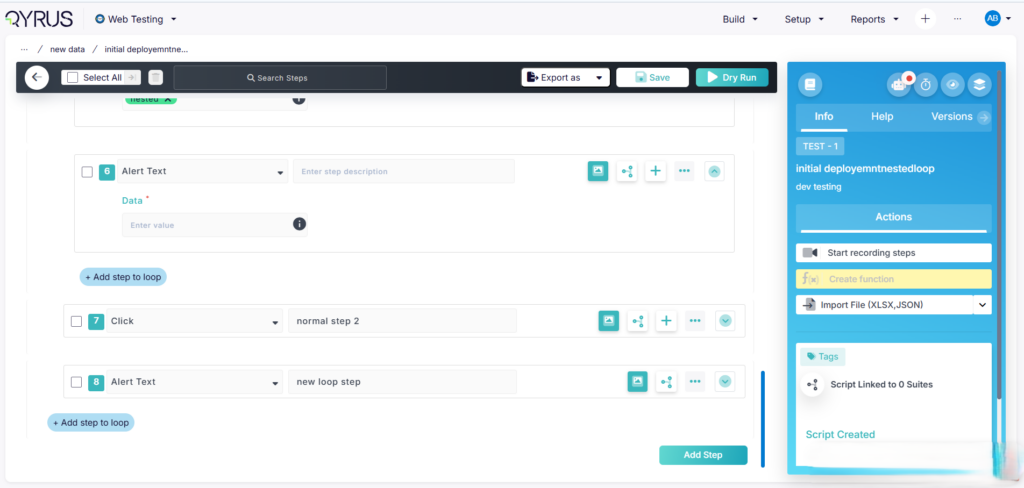
Power Up Your Iterations: Introducing Nested Loops for Web Testing!
The Challenge:
Previously, users could not place one loop inside another, which made it difficult to automate complex scenarios requiring nested iterations. For example, testing every available size (inner loop) for every T-shirt style in a list (outer loop) would require complicated test structures or manual duplication of steps, which was inefficient and hard to maintain.
The Fix:
We have now introduced support for one-level nested loops in Web Testing. This allows users to place one loop directly inside another loop, enabling a more powerful and intuitive way to structure tests that need to iterate through multiple, related data sets.
How will it help?
This feature significantly enhances your ability to automate complex test scenarios. It helps you:
Automate Complex Scenarios: Easily handle tests that involve multiple, dependent data sets, like checking all links within each section of a webpage.
Save Time: Avoid duplicating test steps by creating elegant, nested loop structures that are more efficient to build and maintain.
Ensure Better Test Coverage: Systematically test all combinations between two sets of data, leading to more thorough and comprehensive test coverage with less effort.
Improvement
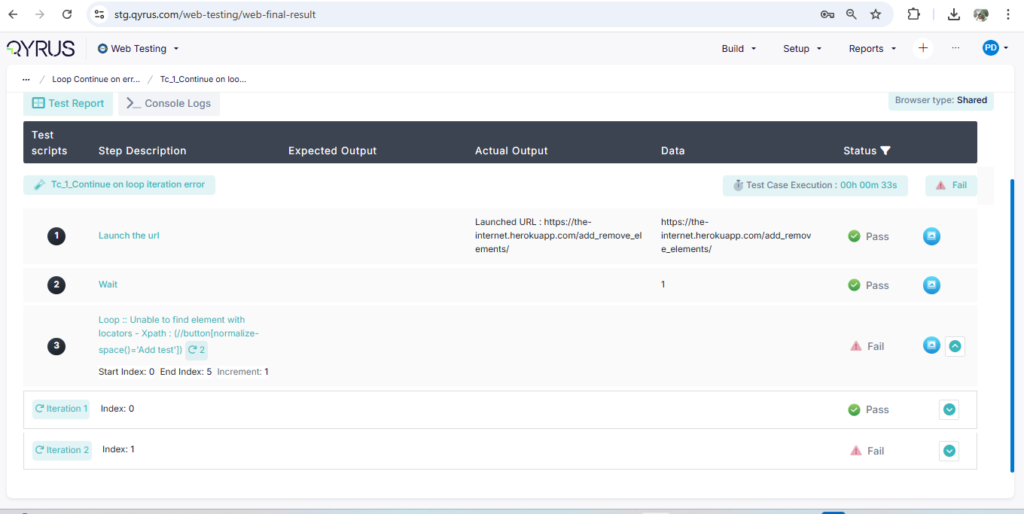
Resilient Loops: Gather All Results, Even with Failures!
The Challenge:
Previously, if a single step failed within a loop iteration, the entire loop would stop executing. This was problematic for data-driven tests where the goal is to process an entire dataset and see results for every item, as a single failure would prevent subsequent iterations from running and leave you with an incomplete report.
The Fix:
We have introduced a “Continue on Failure” option for loops in Web Testing. When this setting is enabled, a failure in one iteration will be logged in the report, but it will not halt the execution. The loop will proceed to the next iteration until all have been attempted.
How will it help?
This feature makes your automated tests more resilient and your results more comprehensive. It ensures that all iterations of your loop will run even if some fail, which is crucial for testing with dynamic data sets. This allows for complete, uninterrupted automation and provides a full execution report detailing the success or failure of every single iteration, giving you a complete picture of your test outcomes.
New Feature
Rock-Solid iOS Recordings: Video Service Upgraded for High-Volume Testing!
The Challenge:
Our iOS video recording service could become unstable under sustained, high usage. When a large number of parallel sessions were run (e.g., 500+ recordings over a few days), the service would sometimes stop accepting new recording requests. This resulted in situations where test reports were generated without the crucial corresponding video recording, hindering debugging and analysis.
The Fix:
Instead of relying on temporary server restarts, we have permanently addressed the root cause by re-architecting and optimizing the iOS video recording service. This enhancement ensures the service can now robustly handle a high volume of concurrent recording requests without degrading.
How will it help?
This update delivers significantly improved reliability and stability for iOS video recordings in Device Farm. You can now run numerous parallel test sessions with the confidence that a video recording will be successfully generated for each one, even during periods of peak usage. This ensures you always have the complete visual artifacts you need for thorough debugging and analysis.
Improvement
Reliable iOS Manual Sessions with Improved Connectivity
The Challenge:
Users attempting to start a manual testing session with an iOS device would sometimes encounter errors that prevented the session from launching successfully. These failures were often caused by underlying connectivity issues between our servers and the physical iOS devices in our device farm.
The Fix:
We have implemented and deployed key configuration changes on our backend servers to specifically address and resolve these connectivity problems. These adjustments create a more stable and robust connection pathway to our iOS devices.
How will it help?
This fix significantly improves the reliability of initiating manual sessions for iOS devices. You should now experience fewer session creation failures, allowing you to start your manual testing sessions more quickly and dependably, leading to a smoother and more efficient testing experience.
Improvement
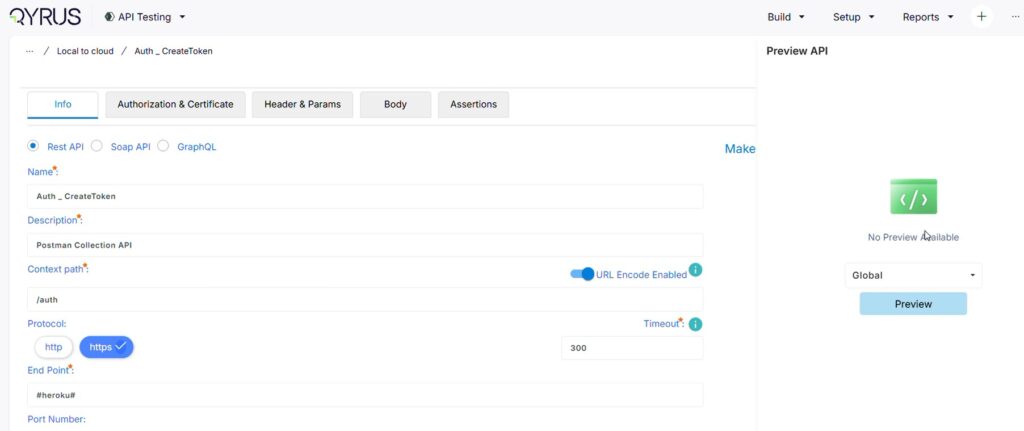
API Previews, Unblocked: Seamlessly Preview APIs & Generate Assertions!
The Challenge:
Previously, users were unable to preview all their APIs directly within the platform. Technical limitations, particularly Cross-Origin Resource Sharing (CORS) issues, could often prevent a seamless preview experience, especially when attempting to check APIs from a local environment. This made it difficult to quickly inspect responses and validate endpoints before building out full test cases.
The Fix:
We have implemented new logic that enhances the API preview functionality, specifically enabling seamless previews from a local environment to our CloudClient. This change effectively resolves the underlying CORS issues. As part of this improvement, users can also now generate Nova assertions directly from the previewed API response.
How will it help?
This update provides a much smoother and more powerful API test design workflow. Users can now reliably preview all APIs without being blocked by CORS errors, allowing for quick and easy inspection of responses. The ability to generate Nova assertions directly from this preview dramatically accelerates test creation, reducing manual effort and helping you build comprehensive API validation steps faster than ever before.
New Feature
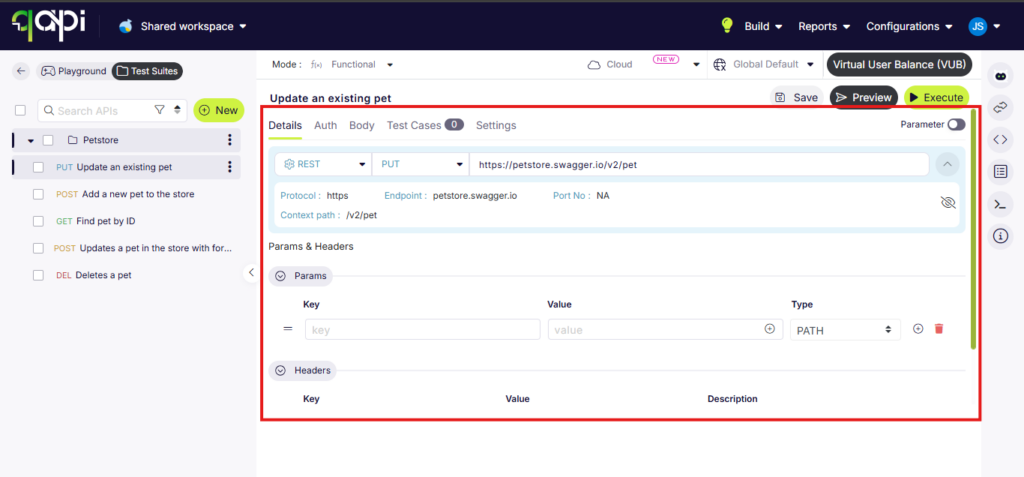
Effortless API Setup: Introducing the New, Intuitive qAPI Form!
The Challenge:
The previous form for manually entering API details could sometimes be complex or less than intuitive, especially for users who were not deeply technical. This could slow down the process of adding new APIs to the platform and might have presented a barrier for team members like manual testers or business analysts.
The Fix:
We have completely redesigned the form where users enter API details in qAPI. The new design streamlines the entire process from start to finish, with a strong focus on making it more intuitive and user-friendly for everyone.
How will it help?
This revamp significantly improves the user experience for manually creating APIs. The new, intuitive layout guides users through the process more clearly, making it faster and easier to add and configure APIs. This is especially beneficial for non-technical users, as it lowers the barrier to entry and empowers more team members to participate in setting up API tests, reducing errors and saving time.
Improvement
Enhanced API Versatility: Full Support for x-www-form-urlencoded
The Challenge:
Previously, our API testing capabilities did not include native support for the x-www-form-urlencoded body type. This is a common data format used by web applications, especially for submitting form data. Users who needed to test APIs that required this specific content type had to rely on custom workarounds or external tools, creating an efficiency gap in their workflow.
The Fix:
We have now added native support for the application/x-www-form-urlencoded body type within our API testing service. Users can now select this option and easily build their request using key-value pairs, just as they would with a standard web form.
How will it help?
This enhancement significantly expands the range of APIs you can test directly on our platform. It simplifies the process of testing endpoints that mimic web form submissions, eliminating the need for complex workarounds. This makes our API testing tool more versatile and ensures you can cover a broader spectrum of your application’s endpoints with ease and efficiency.
New Feature
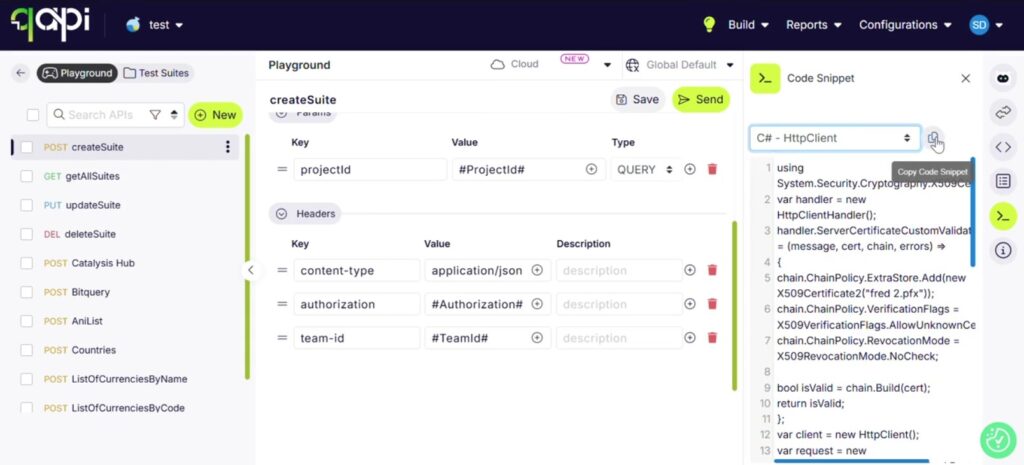
From API to IDE: C# HttpClient Code Snippets Now Available!
The Challenge:
Previously, while our code snippet feature supported various languages, it lacked an option for C# developers using the standard HttpClient library. This meant C# developers had to manually translate the API requests they designed or tested on our platform into the necessary C# code, a process that could be time-consuming and prone to manual error.
The Fix:
We are expanding our code snippet generation capabilities with the addition of a new target: C# (HttpClient). Now, with a single click, users can instantly generate the C# code required to execute their configured API request using this popular library.
How will it help?
This feature provides a significant productivity boost for C# and .NET developers. It eliminates the need to write boilerplate HttpClient code for API requests, saving time and reducing the chance of transcription errors. Developers can now quickly generate and integrate tested API calls directly into their applications, streamlining the workflow from API design and testing to implementation.
Improvement
QAPI – under— Your Test Results, Delivered: Email Reports for Scheduled Executions!
The Challenge:
Previously, after scheduling a test execution, users had to manually return to the platform to check its status and retrieve the report once it was finished. There was no automated notification system to inform them of a successful completion or, more critically, if a test failed to start due to issues like an insufficient Virtual User Balance (VUB).
The Fix:
We have implemented an automated email notification system for all scheduled test executions. Now, when a scheduled test completes successfully, users will automatically receive an email with a downloadable report attached. Additionally, if a test fails to run because of an insufficient Virtual user balance, a specific alert email will be sent to notify the user of the issue.
How will it help?
This feature makes monitoring your scheduled tests effortless and proactive. You no longer need to manually check on test progress; results are delivered directly to your inbox for easy access and sharing. The immediate failure alerts for VUB issues are crucial for quickly resolving resource problems and ensuring your testing schedule proceeds without interruption, saving time and preventing missed test runs.
Ready to Accelerate Your Testing with August’s Upgrades?
We are dedicated to evolving Qyrus into a platform that not only anticipates your needs but also provides practical, powerful solutions that help you release top-quality software with greater speed and confidence.
Curious to see how these August enhancements can benefit your team? There’s no better way to understand the impact of Qyrus than to see it for yourself.
Save the Date 📅 September 3–5, 2025 📍 Santa Clara, CA
Get ready, Santa Clara!Qyrus is hitting the floor at API World 2025 from September 3–5, and we’re bringing the full power of our qAPI solution to the world’s largest API and microservices conference.
API World is where developers, architects, and enterprise teams come to learn, build, and connect. From sessions on API lifecycle best practices to deep dives into AI integration and API security, this year’s event is packed with insights, innovation, and action.
You’ll find the Qyrus team at Booth #400, led by Raoul Kumar, Director of Platforms for both Qyrus and qAPI. We’ll be showcasing how Qyrus delivers faster, smarter, and more scalable API testing and monitoring with automation, AI, and real-time visibility built into the platform.
Whether you’re launching a new API or scaling microservices across teams, we’ll show you how to test with confidence, cut down on debugging, and reduce release cycles.
Live platform walkthroughs
Real-time test case generation
Intelligent monitoring in action
Come see what next-gen API quality looks like, and how Qyrus is leading the charge.
Save the date and swing by Booth #400 at API World 2025, Santa Clara Convention Center. We’re ready to talk about testing, transformation, and what’s next in APIs.
Tired of automation that adds complexity without catching the critical defects that matter? It’s time to move beyond brittle scripts and firefighting. This whitepaper provides a strategic framework for orchestrating a truly intelligent quality process, turning your QA team from a bottleneck into a business accelerator.
The Automation Blind Spot: Why Are Critical Defects Still Slipping Through?
You’ve invested in automation. You’ve adopted AI tools. Yet, your team is still walking a difficult tightrope between the demand for unprecedented speed and the mandate for quality. The modern development lifecycle—an explosion of code changes from developers and AI assistants—creates a widening chasm between the pressure to accelerate and the need to protect the end-user experience.
This challenge is intensified by a very real talent bottleneck and the complexities of legacy system integration. The result? A reactive, late-cycle testing model that is fundamentally broken.
Exponential Costs: A defect found in production is exponentially more disruptive and expensive to fix than one caught in design.
Resource Drain: Developer time is diverted from innovation to firefighting emergency patches.
Business Risk: Customer churn and brand reputation are directly at risk with every escaped defect.
If this sounds familiar, it’s because incremental improvements are no longer enough. It’s time for a fundamental shift in strategy.
Assemble Your AI-Powered Quality Team
The answer isn’t more automation; it’s smarter, orchestrated automation. This whitepaper, The QA Leader’s Playbook, demonstrates how to move from a reactive testing posture to a proactive, predictive, and profitable one by augmenting your team with a suite of collaborative, intelligent agents.
The Transformative Impact of AI-Powered QA
80%
Reduction in Costly Production Defects
36%
Acceleration in Time-to-Market
20%
Decrease in Manual UAT Effort
Learn how to build a digital crew of AI colleagues, each with a distinct expertise, working tirelessly to handle the repetitive tasks and empower your engineers to focus on high-value, strategic problem-solving.
Inside the Whitepaper, You Will Discover:
The AI-Powered Team Blueprint: Meet our specialist agents—from TestGenerator to Healer—that form your new quality team.
The Shift-Left Framework in Practice: A step-by-step guide to embedding quality across the entire SDLC, from initial requirements to post-release maintenance.
The Unmistakable ROI: A breakdown of the Forrester TEI study results, showcasing a 213% ROI and a <6 month payback period driven by the Qyrus platform.
A Phased Adoption Roadmap: A clear, three-phase plan to de-risk your investment and guide your journey from a small pilot program to enterprise-wide AI orchestration.
Lead the Future of Quality
Adopting an AI-driven testing strategy is more than a solution to today’s challenges; it is a forward-thinking decision that future-proofs your entire quality assurance department.
Download your complimentary copy of The QA Leader’s Playbook and get the strategic framework needed to transform your QA function into a center of innovation.
Welcome to the third installment of our series on Agentic Orchestration. In our previous post, we explored the ‘Eyes and Ears’ of the operation—the Sense stage, which detects every change across the development ecosystem. But what happens next? In this chapter, we’re diving into the ‘Brain’ of the SEER framework: the intelligent Evaluate stage. If you’re just joining us, we recommend starting with Part 1 to grasp the foundational concepts.
How Qyrus Evaluates Change and Optimizes Testing
In software development, change is the only constant. But every change, no matter how small, introduces risk. How can you be confident that a minor code tweak won’t trigger a major application failure?
This is where the “Evaluate” stage of Qyrus’s SEER framework (Sense, Evaluate, Execute, Report) takes command. Building on the “Sense” stage which acts as the eyes and ears, the “Evaluate” stage is the strategic brain. It transforms raw data about changes into an intelligent, optimized testing strategy.
In this third installment, we’ll dissect how Qyrus performs its cognitive heavy lifting: analyzing the ripple effect of changes, generating the precise tests needed, and ensuring your testing efforts deliver maximum impact with minimum overhead.
Cognitive Crunch Time: From ‘What Changed?’ to ‘What Do We Do?’
The ‘Evaluate’ stage is where Qyrus flexes its AI muscle. Its primary goal is to answer the critical question that follows any detected change: “What is the smartest way to test this?” It achieves this through a sophisticated process of impact analysis, test creation, and strategy optimization.
Think of it as a lead detective arriving at a scene. The “Sense” stage has reported a change. Now, the “Evaluate” stage meticulously examines the evidence, traces potential connections, and formulates a precise plan of action. This ensures your testing is always laser-focused on the highest-risk areas, saving time and dramatically improving coverage.
Inside the Brain: How Evaluation Unfolds
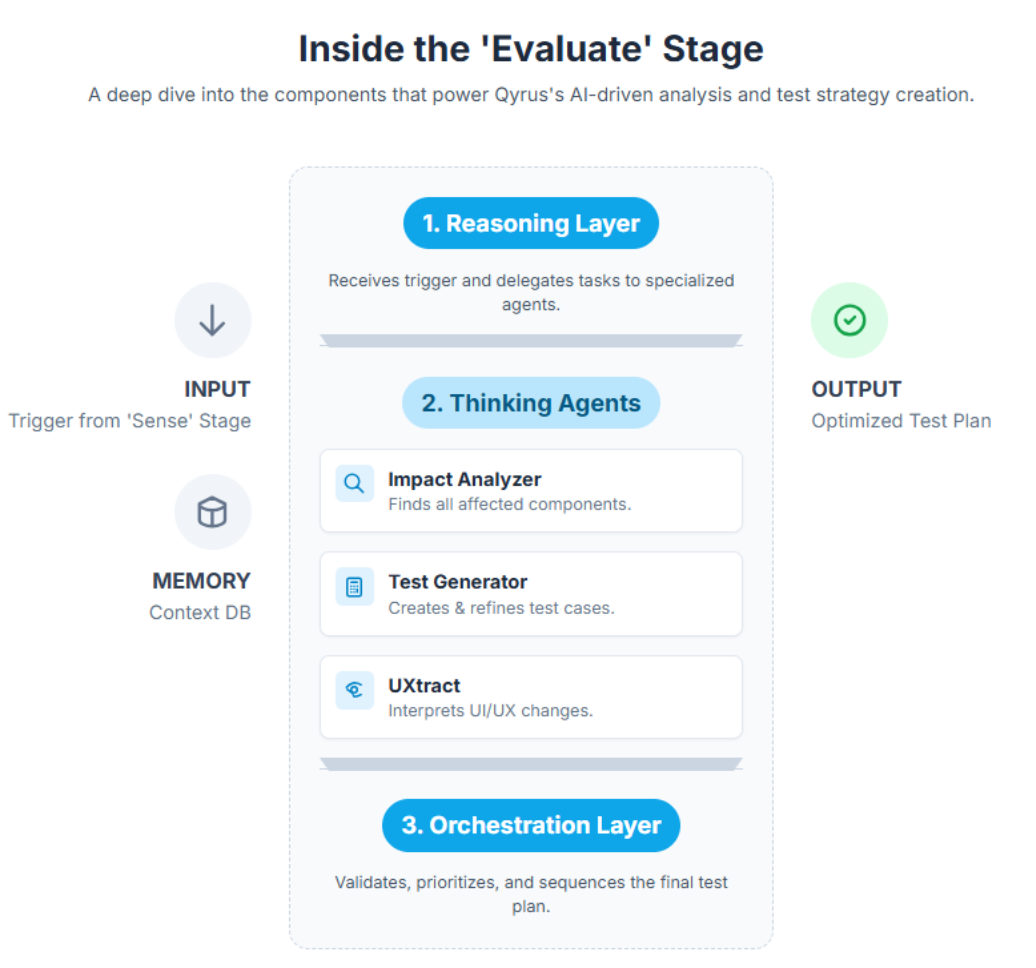
The evaluation process isn’t a single action but a coordinated symphony of specialized AI components. It begins with a trigger and flows through a logical sequence to produce a master test plan.
1. The Reasoning Layer: The Command Center
The Reasoning Layer is the control center of the ‘Evaluate’ stage, orchestrating logical decision-making upon receiving a trigger from the Watch Towers. It acts as the brain of the operation, directing the flow of information and coordinating the actions of the Thinking Agents.
Imagine a conductor leading an orchestra. The reasoning layer analyzes the incoming information about the changes, assesses their potential impact, and then delegates tasks to specialized “Thinking” agents. It determines which agent is best suited to analyze the change, generate relevant test cases, and optimize the testing strategy. This intelligent delegation of tasks ensures that the evaluation process is efficient, effective, and focused on the areas that matter most.
2. The Thinking Agents: A Squad of AI Specialists
These are the specialized AI-driven models, or Single Use Agents (SUAs), that perform specific tasks within the ‘Evaluate’ stage. They are experts in their respective domains, working together to analyze the impact of changes, generate relevant test cases, and optimize the testing strategy.
Think of them as specialized detectives, each with their own unique skills and expertise. Some are experts in analyzing code, others in understanding user flows, and yet others in generating test cases. This specialization ensures that every aspect of the change is thoroughly evaluated, and the most effective testing strategy is devised.
The thinking agents include:
Impact Analyzer: This agent acts as the forensic expert. Using static analysis, dependency graphs, and historical data, it maps out the potential ripple effect of a code change. It answers the question: “If this line of code changes, which other modules, components, or APIs could be affected?”
Test Generator: Leveraging Natural Language Processing (NLP), this agent functions as the strategist. It compares updated requirements and the impact analysis against existing tests. It then dynamically generates new, relevant test cases and refines existing ones to ensure complete coverage.
UXtract: This agent is the visual design expert. It meticulously extracts and interprets UI/UX changes, mapping differences between design files (like Figma versions) to specific user flows and test steps. This guarantees that visual integrity and accessibility are never compromised.
3. The Context DB: The System’s Long-Term Memory
The Context DB serves as the memory bank of the ‘Evaluate’ stage, a central data store containing historical test results, system configurations, defect trends, and traceability data. The SUAs use the data in the Context DB as one of the inputs for their reasoning.
Imagine a detective’s case files, filled with past experiences, insights, and knowledge. The Context DB provides the Thinking Agents with valuable context and information to make informed decisions. This historical data helps them analyze the impact of changes more accurately, generate more relevant test cases, and optimize the testing strategy for maximum effectiveness.
4. The Orchestration Layer: The Conductor of the Evaluation Symphony
This layer’s objective is to coordinate and validate decisions from the Thinking Agents. Its function is to serve as an orchestrator or “meta-controller” that confirms which test sets should be executed and in which sequence, applying business rules and testing policies.
Imagine a conductor leading an orchestra, ensuring that each musician plays their part in harmony with the others. The Orchestration Layer takes the recommendations from the Thinking Agents and creates a cohesive testing strategy. It ensures that the tests are executed in the right order, with the right resources, and in line with the overall testing policies and business rules. This coordination and validation ensure that the testing process is efficient, effective, and aligned with the organization’s goals.
The Payoff: Intelligent, Optimized, and Comprehensive Testing
The ‘Evaluate’ stage provides several benefits that greatly improve the testing process:
Intelligent Test Creation: By dynamically generating relevant test cases based on changes and requirements, the ‘Evaluate’ stage reduces the manual effort required to create and maintain tests. The Test Generator considers existing scenarios and suggests new ones, ensuring comprehensive test coverage. This AI test generator not only saves time but also ensures that your tests are always relevant and up to date.
Optimized Test Execution: The stage prioritizes and sequences tests for maximum efficiency. This ensures that the most important tests are run first, allowing for faster feedback and quicker identification of critical defects. With test optimization, you can be confident that your testing efforts are focused on the areas that matter most.
Comprehensive Impact Analysis: The Impact Analyzer identifies affected components, ensuring complete test coverage. This helps to focus testing efforts on the areas most likely to be impacted by a change, reducing the risk of overlooking critical issues. Impact analysis ensures that no stone is left unturned in your quest for quality software.
By combining intelligent test generation, optimized test execution, and comprehensive impact analysis, the ‘Evaluate’ stage empowers teams to achieve unparalleled efficiency and effectiveness in their AI-driven testing efforts. It’s like having a team of expert testers and strategists working tirelessly behind the scenes, ensuring that your testing process is always one step ahead. With Qyrus SEER, you can say goodbye to guesswork and embrace a data-driven approach to testing, where every decision is backed by intelligent insights and optimized for maximum impact.
Conclusion: Evaluate to Elevate
The ‘Evaluate’ stage is the strategic heart of the Qyrus SEER framework, transforming raw change data into an actionable intelligence blueprint. It’s how we move from reactive testing to a predictive, optimized, and truly AI-driven strategy.
But a brilliant strategy is only as good as its execution. In the next part of our series, we’ll explore the ‘Execute’ stage, where this carefully crafted plan is put into action. Stay tuned to see how Qyrus orchestrates a fleet of agents to seamlessly run tests, gather results, and bring you one step closer to fully autonomous testing.
Qyrus, a leading AI-powered test automation platform, has been recognized in the latest Forrester report, “The Autonomous Testing Platforms Landscape, Q3 2025”.
Autonomous Testing Platforms (ATPs) leverage AI-driven test automation to accelerate time to value, mitigate strategic risk, enhance governance quality, and promote democratized testing and cross-team collaboration. The report emphasizes that organizations must choose from a diverse range of vendors to realize these advantages.
Forrester defines ATPs as “Platforms that combine traditional automation with AI and genAI agents to continuously perform increasingly autonomous testing tasks”. These platforms are capable of generating and executing a broad spectrum of functional and nonfunctional end-to-end tests across various products and applications, including those infused with AI, ensuring comprehensive and adaptive quality validation.
At Qyrus, we proactively embrace critical industry trends like AI and GenAI to best serve our customers. Our inclusion in Forrester’s “The Autonomous Testing Platforms Landscape, Q3 2025” reflects our commitment to leveraging cutting-edge technology for customer success and satisfaction, particularly as the market evolves towards increasingly autonomous and intelligent testing solutions.
At Qyrus, our suite of AI agents, including TestPilot, TestGenerator, TestGenerator+, Rover, Eval, API Builder, Echo, and Healer, are designed to transform the testing lifecycle. These agents automate critical tasks such as test creation, exploration, data generation, and self-healing, directly from URLs, application screens, or even JIRA tickets. This empowers teams to achieve greater efficiency and ensure superior software quality through intelligent, autonomous testing.
Explore This Research To:
Understand Forrester’s perspective on the value of ATPs: Learn how autonomous testing platforms can accelerate time to value through AI-driven test automation, reduce strategic risk, increase the quality of governance, and democratize testing and cross-team collaboration.
Discover why Qyrus is recognized in the Autonomous Testing Platforms Landscape: Gain insights into Qyrus’s focus, deployment models, and impact within the ATP market.
Learn about the key benefits ATPs offer product and application testers: Understand how ATPs help accelerate time to value by leveraging AI, reduce strategic risk through intelligent test orchestration, and democratize testing with no-code/low-code interfaces and natural language test authoring.
Gain insights into the evolving market dynamics and future of autonomous testing: Understand the shift from traditional scripting to AI-driven, agentic, and intent-based testing, and the challenges buyers face in this transforming market
Forrester, The Autonomous Testing Platforms Landscape, Q3 2025, Diego Lo Giudice with Chris Gardner, Angela Lozada, Kara Hartig, July 25, 2025.
To win, teams must stop treating quality assurance as a final hurdle and start embedding it into the very DNA of their applications. This approach, centered on strategic mobile testing automation, is the key to delivering the quality users demand at the speed the market requires.
By designing for automated testing from day one, you build a foundation for continuous, reliable feedback that accelerates bug detection and transforms the test automation of mobile apps from a challenge into your greatest competitive advantage. This article is your blueprint for achieving that, detailing the core best practices for the modern testing of mobile applications.
Digital Fingerprints: Mastering Element Identification for Mobile Automated Testing
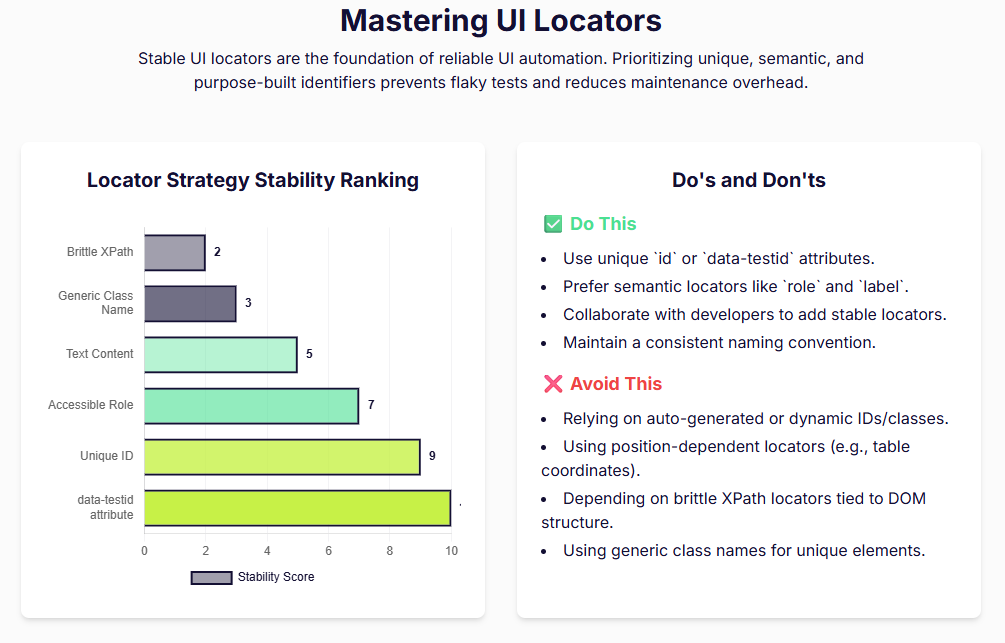
Think of your automation script as a detective and UI elements as its key witnesses. If the detective can’t reliably identify a witness every single time, the entire case falls apart. The same is true for mobile automated testing. Stable UI element locators are the foundational bedrock of reliable automation. Without them, even minor UI changes can cause your tests to fail, leading to endless maintenance and eroding confidence in your automation suite.
Your North Star: Why Unique and Accessibility IDs Reign Supreme
Developers should make unique Accessibility IDs the gold standard for identifying elements. A truly unique Accessibility ID acts like a permanent address, making your automation tests independent of the app’s underlying structure and therefore far more resilient. For cross-platform test automation of mobile apps, accessibility IDs are the most reliable locators you can use. They work consistently across both iOS and Android, which makes them perfect for crafting robust, reusable automation scripts. Additionally, by utilizing Accessibility IDs, you are ensuring that users who have visual impairments can use your applications with ease – whether your developers realize or not this may also be a compliance issue.
The Architectural Sin of Deep Nesting
Developers must avoid the temptation to deeply nest interactive elements. This common practice creates a tangled web that complicates automation and severely hinders accessibility. Both screen readers and automation tools struggle to navigate nested interactive controls. For example, if you place a clickable link inside a button, assistive technologies will often ignore the inner link because the parent button is the only focusable item. This makes the child element effectively invisible to both users who rely on assistive tech and your automation scripts.
Clarity and Consistency: The Golden Rules of Naming
Every single interactive element needs a unique, descriptive identifier. More importantly, you must ensure these IDs remain consistent across all future app versions. This discipline ensures that your automation scripts don’t break every time you release an update. Adopting a consistent naming convention for locators helps your entire team easily locate and interact with elements, creating a smoother workflow for everyone involved in the testing of mobile applications.
Choreographing the Code: Ensuring Predictable UI Behavior
A predictable UI is a testable UI. When your application behaves consistently, your automation scripts can execute their tasks with precision. However, when elements shift, disappear, or load erratically, it introduces chaos that even the most well-written test script cannot handle. You must engineer predictability into your application’s design to build a truly effective mobile testing automation framework. It is the only way to ensure your tests are stable, reliable, and meaningful.
Follow the Leader: The Power of Consistent Navigation
Your development team should use standard navigation components and interaction patterns whenever possible. Automation tools are designed to recognize and interact with these standard components easily. By sticking to established patterns, you create a logical and intuitive user flow that is just as easy for a script to follow as it is for a human. This simple discipline removes a significant layer of complexity from the test automation of mobile apps.
Standing on Solid Ground: Why Element Stability Is Non-Negotiable
Your app’s elements must maintain consistent positioning and attributes from one test run to the next. Avoid dynamic layout changes that might cause automation scripts to fail because they can no longer find what they’re looking for. It is especially critical that you do not use locators derived from an element’s on-screen position, as any minor layout adjustment will break these tests instantly. Instead, always tie locators to the inherent data or logical function of the element itself.
Taming the Flow: How to Handle Dynamic Content
When your app loads content dynamically, it must provide clear indicators that automation can detect. These signals tell the test script precisely when the page is fully rendered and ready for interaction. Elements that change frequently, like timestamps or ads, are notorious for introducing flakiness into tests. You can manage this instability by implementing strategies to hide these dynamic elements during screenshots or by controlling their state directly within the test environment.
Taming the Motion: Strategies for Handling Animations in Test Automation
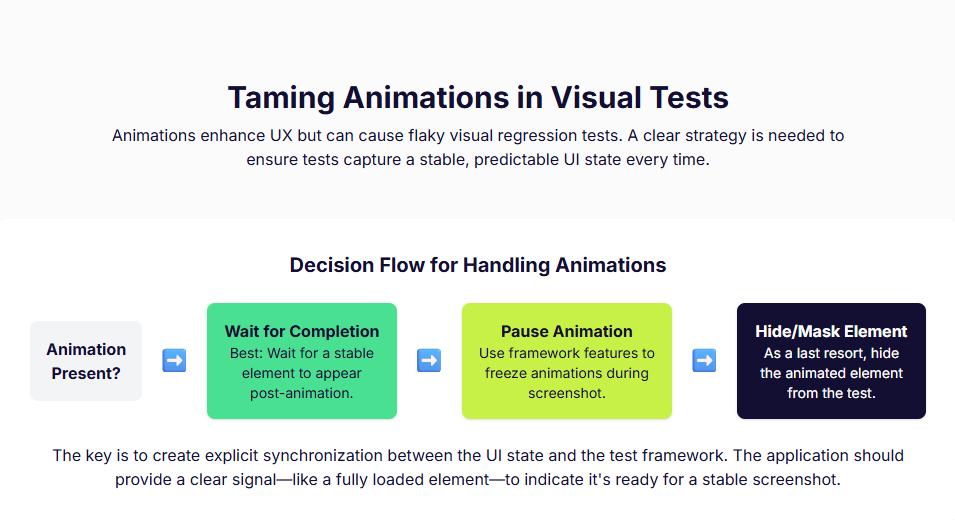
Animations create a dynamic and engaging user experience, but they can be a nightmare for automation. They are a primary cause of flaky tests, especially in visual regression testing where pixel-perfect comparisons are key. When your script captures a screenshot mid-animation, it will almost certainly fail the comparison against a baseline image, even if no real bug exists. This constant stream of false positives undermines the reliability of your entire mobile automated testing effort. To conquer this, you must give your application a way to tell your tests when to stand by and when to act.
The Flicker of Failure: Why Animations Cause Chaos
Visual regression testing works by comparing a baseline screenshot with a current one to detect unintended changes. This process demands a stable and static UI. Animations, by their very nature, create a transient state. Capturing an image while an element is fading, sliding, or resizing will inevitably lead to a failed test because the visual state is different from the baseline. These flaky tests create significant maintenance overhead and erode your team’s confidence in the automation suite.
Signaling Stillness: How to Wait for the Perfect Shot
You can eliminate animation-induced flakiness by implementing explicit synchronization mechanisms. The most straightforward approach is to ensure animations have fully completed before your test proceeds to the next step or captures a screenshot. Your team can achieve this in a few ways:
Wait for a Stable Element: A robust method involves waiting for a specific, non-animated element on the subsequent screen to become visible. You can configure this element to load only after the animation sequence has concluded, providing a reliable signal that the UI is static and ready for validation.
Use Completion Handlers: Many animation APIs and CSS event listeners offer completion handlers (like “animationend”) that execute a function once the animation finishes. Your test scripts can hook into these events to trigger the screenshot capture at the perfect moment.
Provide a “Disable” Switch: For maximum control, you can include options to disable or reduce animations specifically within your test environments. This ensures a consistent visual state for every single test run.
Building with Blocks: The Power of Modular Design in Mobile Testing Automation
A strong architectural foundation makes every aspect of development easier, and this is especially true for the testing of mobile applications. While many complex design patterns exist, one simple principle delivers an enormous return on investment for automation: modularity. When you build your application from small, independent, and reusable components, you create a structure that is inherently easier to test and maintain.
Isolate and Conquer: How Modularity Simplifies Testing
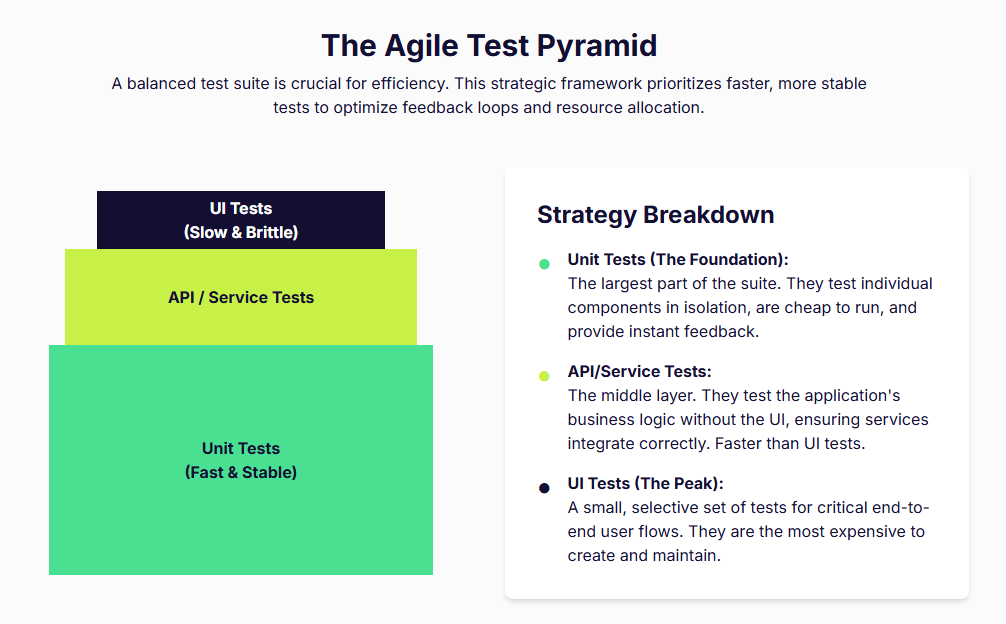
A modular design allows your team to test individual components in isolation. This is a massive advantage. Instead of needing to navigate through multiple screens and complex setups to validate a single piece of functionality, you can write focused tests that target a singular component. This approach makes your automation scripts simpler, faster, and far more reliable. If a change in one module breaks its dedicated tests, you know exactly where the problem lies without having to debug a massive, end-to-end test failure. This practice of actively breaking the application into small, reusable modules is a cornerstone of building testable software.
The Sterile Lab: Mastering the Environment for Test Automation of Mobile Apps
Your testing environment is the laboratory where you validate your application’s quality. If the lab is contaminated or inconsistent, your experimental results—your test outcomes—will be worthless. To achieve reliable results from the test automation of mobile apps, you must exert precise control over every aspect of the testing environment, from the server it runs on to the data it consumes.
A Room of One’s Own: The Case for Dedicated Environments
Your team must maintain dedicated environments exclusively for automated testing. This is non-negotiable. Running automated tests in the same space as manual testing or active development work creates conflicts and instability that will inevitably lead to false negatives. A separate, clean environment ensures that your test results are based on the code being tested, not on some random interference from other activities.
Feeding the Machine: Smart Data Management
You must implement clear strategies for managing test data so it doesn’t interfere with your automation scripts. The cardinal rule is to avoid hardcoded values in your tests. Instead, use parameterized data inputs, which allow you to run the same test with different data sets, making your scripts far more flexible and powerful. For apps with dynamic content, use stable data fixtures or mock your network requests to ensure the data displayed in the application is identical for every test run.
The Device Matrix: Conquering Configuration Chaos
A critical part of the testing of mobile applications is ensuring your app works flawlessly across a vast landscape of device configurations, screen sizes, and operating systems. Verifying this consistency is a monumental task. To manage this chaos, you should standardize your test execution within a CI/CD pipeline. This ensures that every test runs under the exact same conditions, which is crucial for achieving stable and repeatable results that build confidence in your automation suite.
From Blueprint to Brilliance: Your Path to Automation Excellence
Building an automation-friendly application is not a matter of chance; it is a deliberate act of architectural precision. When you commit to this blueprint, you fundamentally shift your team’s capabilities. You empower them to move faster, catch bugs earlier, and release products with unshakable confidence. By forging stable element IDs, engineering predictable UI behavior, taming erratic animations, embracing modular design, and mastering your testing environment, you create a virtuous cycle of quality and speed. These practices are the pillars of modern mobile testing automation.
Adhering to these best practices is the most important step, and equipping your team with the right platform can dramatically accelerate your journey.
This is where Qyrus comes in.
Qyrus provides a comprehensive mobile testing platform built for teams that prioritize quality and efficiency. It is designed to support the very best practices detailed here. While you focus on building a testable app, Qyrus provides a powerful toolkit to execute your automation strategy at scale.
To conquer the immense challenge of device fragmentation, Qyrus offers a robust, real Device Farm. This approach is a proven, mainstream strategy for success, with real device cloud testing already accounting for 22% of the testing services market. With Qyrus, you can instantly validate your app’s consistency across a vast matrix of real device configurations, screen sizes, and operating systems, ensuring your application delivers a flawless experience for every user, everywhere.
Stop wrestling with unstable scripts and endless device maintenance. Elevate your test automation of mobile apps and start building with brilliance.
Book a demo today to discover how the Qyrus Mobile Testing platform and its extensive Device Farm can help you implement these best practices and achieve seamless, reliable automation today.
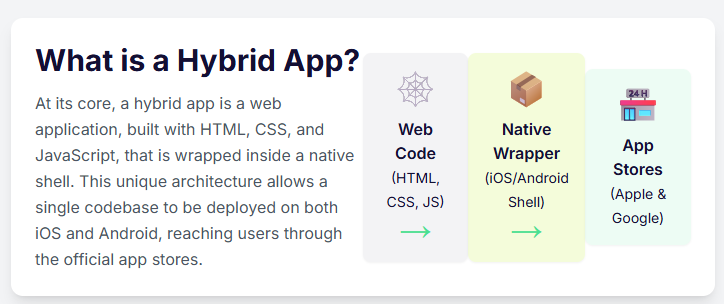
The world of mobile applications is no longer a simple choice of native vs web apps. A large number of businesses are now turning to hybrid solutions for their mobile needs, and it’s easy to see why. This strategic approach to hybrid app development combines the cost-efficiency and speed of web technology with the power of a native application shell, allowing a single codebase to conquer multiple platforms at once.
But this power comes with a price: complexity. Testing these intricate applications, with their constant dance between a native container and an embedded web view, has been a persistent source of headaches, flaky tests, and frustration for QA teams. Until now.
Qyrus is excited to announce a revolutionary suite of enhancements to our mobile testing platform, engineered specifically to cut through this complexity and make testing hybrid apps more reliable, stable, and efficient than ever before.
Why Hybrid App Development is Winning the Mobile Race
The massive shift toward hybrid apps isn’t just a trend; it’s a strategic business decision rooted in powerful, tangible advantages. For years, the native vs hybrid app debate centered on performance trade-offs, but today’s businesses are prioritizing efficiency and reach. The benefits are simply too compelling to ignore.
Radical Cost-Efficiency: The most significant advantage is the impact on the bottom line. By leveraging a single codebase for multiple platforms, companies can save up to 40% of their development budget. This eliminates the need to fund and manage separate, specialized development teams for iOS and Android, freeing up crucial resources.
Unmatched Speed-to-Market: In today’s competitive landscape, getting to market first is critical. Hybrid app development dramatically shortens development cycles. The “write once, run anywhere” philosophy means businesses can launch their app on the Apple App Store and Google Play Store simultaneously, capturing a wider audience from day one.
Maximum Market Penetration: Why choose one audience when you can have them all? With Android holding a 71.65% market share and iOS holding 27.62%, hybrid apps provide an immediate path to address nearly the entire mobile market with a single product.
This isn’t just a theory. The proof is likely already on your phone. Globally recognized applications utilize hybrid technology to power their services, demonstrating their scalability and success at the highest level.
The Core Testing Hurdle: Why Hybrid App Development Complicates QA
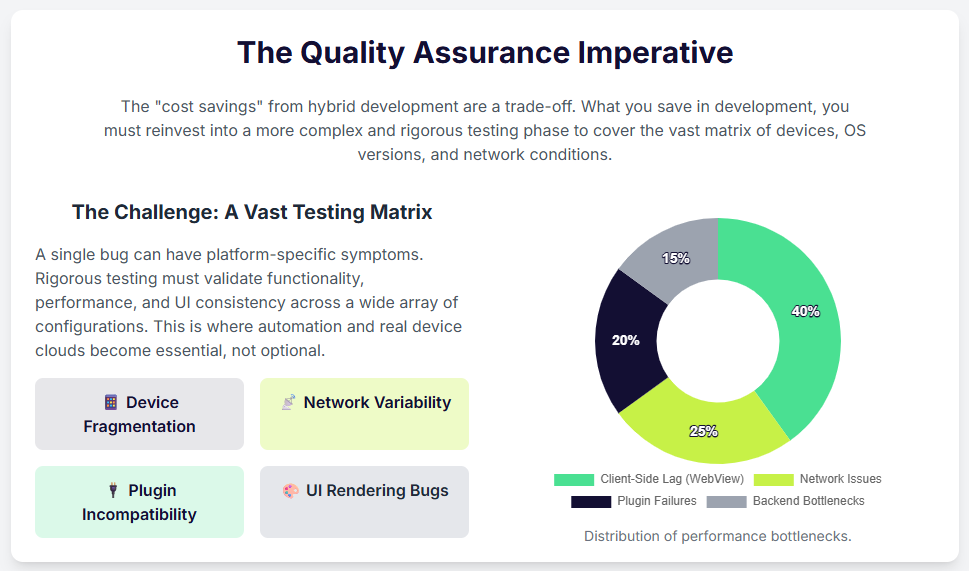
While the advantages of hybrid app development are clear, they introduce a layer of complexity that can bring testing efforts to a grinding halt. The very architecture that makes these apps so versatile is also what makes them notoriously difficult to test. A hybrid app isn’t a single entity; it’s a three-part system working in tandem, and a bug can originate in any layer.
The Native Shell: This is the lightweight, platform-specific container built with native code (like Swift for iOS or Kotlin for Android). It’s the “app” you download from the store, and its main job is to host the component where all the trouble starts.
The WebView: This is the heart of the hybrid app. It’s essentially a full-screen, in-app web browser that renders all the web-based content—the HTML, CSS, and JavaScript that make up the app’s user interface. For a test automation script, this is a completely separate world from the native shell.
The Bridge: This critical communication layer allows the web code inside the WebView to access native device features like the camera, GPS, or push notifications. This bridge is a frequent source of complex, platform-specific bugs.
This three-layer system creates the ultimate challenge for quality assurance: context switching. An automated test script must constantly jump between the native app context and the WebView context to perform actions and validations. This single activity is the number one cause of flaky, unreliable tests. A script that fails to switch context can prevent a locator from being properly identified, and the entire test run grinds to a halt. Worse, a single failure within the WebView can throw the test driver into an invalid state, derailing an entire suite execution and leaving QA teams to pick up the pieces. This is the frustrating reality that hybrid app testers face every day.
The Qyrus Solution: Intelligent and Resilient Hybrid Testing
Understanding these deep-rooted challenges is one thing; solving them is another. At Qyrus, we believe that the testing platform should adapt to the app’s complexity, not the other way around. That’s why we’ve gone beyond generic support and engineered a suite of intelligent enhancements that directly target and eliminate the most common points of failure in hybrid app development testing.
Feature 1: Automated Web View Detection
The Problem: Your test script needs to interact with an element inside a WebView, but it first needs to switch contexts. This is a notoriously flaky step where tests often fail, especially on iOS.
The Qyrus Solution: Forget manual guesswork. We’ve introduced a new ‘Switch to Web View’ action type that does the heavy lifting for you. It intelligently searches for the available web view and automatically switches the driver’s context. It’s a simple, powerful action that builds resilience directly into your tests.
Feature 2: Automatic Context Reset for Ultimate Stability
The Problem: A single test fails while the driver is in the WebView context. Because the driver is now “stuck,” every subsequent test in the suite also fails, creating a cascade of false negatives and wasting valuable time.
The Qyrus Solution: We’ve built a failsafe. After any test case scenario is executed—whether it passes or fails—Qyrus automatically resets the driver’s context back to Native. This ensures each test starts with a clean slate, isolating any single failure and allowing the rest of your suite to run to completion. The result is cleaner reports and more trustworthy results.
Feature 3: Proactive Safeguards for Critical App Actions
The Problem: Your script, still in a WebView context, attempts to execute a core application function like ‘Launch App’ or ‘Reset App’. This mismatch can cause unexpected errors and test instability.
The Qyrus Solution: Our platform now provides intelligent safeguards. Before executing critical application actions, Qyrus automatically checks and switches the driver to the Native context. This proactive measure prevents context-related errors before they can happen, ensuring your test environment remains stable and your commands execute flawlessly.
The Qyrus Advantage: What This Means for Your Team
These aren’t just minor updates; they are fundamental improvements designed to give your QA team their most valuable resource back: time. By building intelligence directly into the platform, Qyrus removes the most common obstacles in hybrid testing, allowing your team to move faster and with greater confidence.
Here’s what you can expect:
Dramatically Increased Reliability: Say goodbye to entire test runs failing because of a single, flaky context switch. Your automated tests will be more robust and resilient than ever.
Unprecedented Efficiency: Your engineers will spend less time debugging the testing tool and more time focused on what matters—improving the quality of your application.
Faster, More Trustworthy Results: With stable suite executions, you get accurate results you can depend on, allowing you to release with greater speed and confidence.
True Cross-Platform Confidence: Stop avoiding the hard-to-test areas. Your team will now have the power to easily and reliably automate the complex native-to-web interactions that are at the very core of your hybrid app development strategy.
Embrace the Future of Hybrid Testing
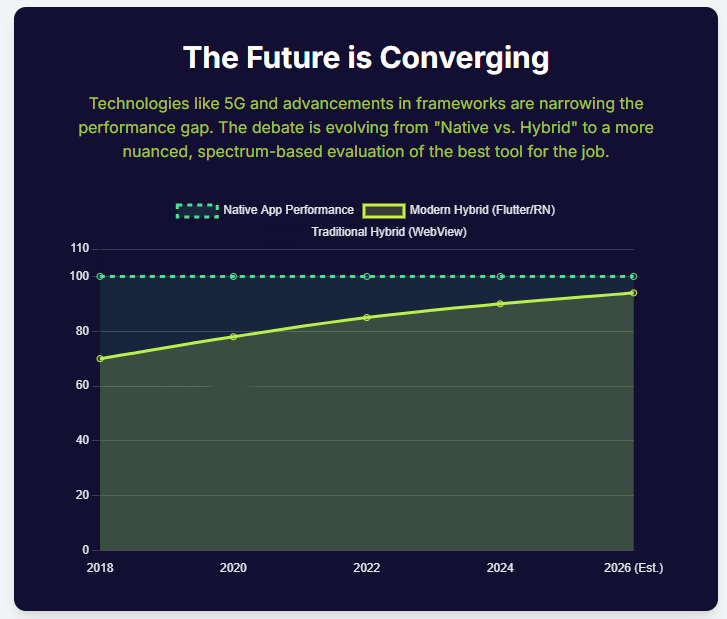
The debate between native vs hybrid app development has evolved. Today, the real question is not which development path you choose, but whether you have the right tools to ensure quality regardless of the underlying architecture. Hybrid applications are the present and future of mobile strategy, offering unparalleled speed and efficiency.
Hybrid apps demand a testing platform that is just as sophisticated and adaptable. Qyrus is committed to providing that platform. We believe in building intelligent solutions that tackle modern development challenges head-on, empowering you to build, test, and release better apps, faster.
Ready to stop fighting your tools and start testing flawlessly? Request a Demo and Experience the Future of Hybrid App Testing with Qyrus.
Jerin Mathew
Manager
Jerin Mathew M M is a seasoned professional currently serving as a Content Manager at Qyrus. He possesses over 10 years of experience in content writing and editing, primarily within the international business and technology sectors. Prior to his current role, he worked as a Content Manager at Tookitaki Technologies, leading corporate and marketing communications. His background includes significant tenures as a Senior Copy Editor at The Economic Times and a Correspondent for the International Business Times UK. Jerin is skilled in digital marketing trends, SEO management, and crafting analytical, research-backed content.