Let’s confront the reality of mobile testing right now. It is messy. It is expensive. And for most teams, it is a constant battle against entropy.
We aren’t just writing tests anymore; we are fighting to keep them alive. The sheer scale of hardware diversity creates a logistical nightmare. Consider the Android ecosystem alone: it now powers over 4.2 billion active smartphones produced by more than 1,300 different manufacturers. When you combine this hardware chaos with OS fragmentation—where Android 15 holds only 28.5% market share while older versions cling to relevance—you get a testing matrix that breaks traditional scripts.
But the problem isn’t just the devices. It’s the infrastructure.
If you use real-device clouds, you know the frustration of “hung sessions” and dropped connections. You lose focus. You lose context. You lose time. These infrastructure interruptions force testers to restart sessions, re-establish state, and waste hours distinguishing between a buggy app and a buggy cloud connection.
This chaos creates a massive, invisible tax on your engineering resources. Instead of building new features or exploring edge cases, your best engineers are stuck in the “maintenance trap.” Industry data reveals that QA teams often spend 65-70% of their time maintaining existing tests rather than creating new ones.
That is not a sustainable strategy. It is a slow leak draining your return on investment (ROI). To fix this, we didn’t just need a software update; we needed a complete architectural rebuild.
The Zero-Migration Paradox: Innovation Without the Demolition
When a software vendor announces a “complete platform rebuild,” seasoned QA leaders usually panic.
We know what that phrase typically hides. It implies “breaking changes.” It signals weeks or months of refactoring legacy scripts to fit new frameworks. It means explaining to stakeholders why regression testing is stalled while your team migrates to the “new and improved” version.
We chose a harder path for the upcoming rebuild of the Qyrus Mobility platform.
We refused to treat your existing investment as collateral damage. Our engineering team made one non-negotiable promise during this rebuild: 100% backwards compatibility from Day 1.
This is the “Zero Migration” paradox. We completely re-imagined the building, managing, and running of mobile tests to be faster and smarter, yet we ensured that zero migration effort is required from your team. You do not need to rewrite a single line of code.
Those complex, business-critical test scripts you spent years refining? They will work perfectly the moment you log in. We prioritized this stability to ensure you get the power of a modern engine without the downtime of a mechanic’s overhaul. Your ROI remains protected, and your team keeps moving forward, not backward.
Stop Fixing the Same Script Twice: The Modular Revolution
We need to talk about the “Copy-Paste Trap.”
In the early days of a project, linear scripting feels efficient. You record a login flow, then record a checkout flow, and you are done. But as your suite grows to hundreds of tests, that linear approach becomes a liability. If your app’s login button ID changes from #submit-btn to #btn-login, you don’t just have one problem; you have 50 problems scattered across 50 different scripts.
This is the definition of Test Debt. It is the reason why teams drown in maintenance instead of shipping quality code.
With the new Qyrus Mobility update, we are handing you the scissors to cut that debt loose. We are introducing Step Blocks.
Think of Step Blocks as the LEGO® bricks of your testing strategy. You build a functional sequence—like a “Login” flow or an “Add to Cart” routine—once. You save it. Then, you reuse that single block across every test in your suite.
The magic happens when the application changes. When that login button ID inevitably updates, you don’t hunt through hundreds of files. You open your Login Step Block, update the locator once, and it automatically propagates to every test script that uses it.
This shift from linear to modular design is not just a convenience; it is a mathematical necessity for scaling. Industry research confirms that adopting modular, component-based frameworks can reduce maintenance costs by 40-80%.
By eliminating the redundancy in your scripts, you free your team from the drudgery of repetitive fixes. You stop maintaining the past and start testing the future.
Reclaiming Focus: Banish the “Hung Session”
We need to address the most frustrating moment in a tester’s day.
You are forty minutes into a complex exploratory session. You have almost reproduced that elusive edge-case bug. You are deep in the flow state. Then, the screen freezes. The connection drops. Or perhaps you hit a hard limit; standard cloud infrastructure often enforces strict 60-minute session timeouts.
The session dies, and with it, your context. You have to reconnect, re-install the build, navigate back to the screen, and hope you remember exactly what you were doing. Industry reports confirm that cloud devices frequently go offline unexpectedly, forcing testers to restart entirely.
We designed the new Qyrus Mobility experience to eliminate these interruptions.
We introduced Uninterrupted Editing because we know testing is iterative. You can now edit steps, fix logic, or tweak parameters without closing the device window. You stay connected. The app stays open. You fix the test and keep moving.
We also solved the context-switching problem with Rapid Script Switching. If you need to verify a different workflow, you don’t need to disconnect and start a new session. You simply load the new script file into the active window. The device stays with you.
We even removed the friction at the very start of the process. With our “Zero to Test” workflow, you can upload an app and start building a test immediately—no predefined project setup required. We removed the administrative hurdles so you can focus on the quality of your application, not the stability of your tools.
Future-Proofing with Data & AI: From Static Inputs to Agentic Action
Mobile applications do not live in a static vacuum. They exist in a chaotic, dynamic world where users switch time zones, calculate different currencies, and demand personalized experiences. Yet, too many testing tools still rely on static data—hardcoded values that work on Tuesday but break on Wednesday.
We have rebuilt our data engine to handle this reality.
The new Qyrus Mobility platform introduces advanced Data Actions that allow you to calculate and format variables directly within your test flow. You can now pull dynamic values using the “From Data Source” option, letting you plug in complex datasets seamlessly. This is critical because modern apps handle 180+ different currencies and complex date formats that static scripts simply cannot validate. We are giving you the tools to test the app as it actually behaves in the wild, not just how it looks in a spreadsheet.
But we are not stopping at data. We are preparing for the next fundamental shift in software quality.
You have heard the hype about Generative AI. It writes code. It generates scripts. But it is reactive; it waits for you to tell it what to do. The future belongs to Agentic AI.
In Wave 3 of our roadmap, we will introduce AI Agents designed for autonomous execution. Unlike Generative AI, which focuses on content creation, Agentic AI focuses on outcomes. These agents will not just follow a script; they will autonomously explore your application, identifying edge cases and validating workflows that a human tester might miss. We are building the foundation today for a platform that doesn’t just assist you—it actively works alongside you.
Practical Testing: Generative AI Vs. Agentic AI
Dimension
Generative AI
Agentic AI
Core Function
Generates test code and suggestions
Autonomously executes and optimizes testing
Decision-Making
Reactive; requires prompts
Proactive; makes independent decisions
Error Handling
Cannot fix errors autonomously; requires human correction
Automatically detects, diagnoses, and fixes errors
Maintenance
Generates new tests; humans maintain existing tests
Actively uses tools, APIs, and systems to accomplish tasks
Feedback Loops
None; static output until new prompt
Continuous; learns and adapts from every execution
Outcome Focus
Process-oriented (did I generate good code?)
Results-oriented (did I achieve quality objectives?)
Conclusion: The New Standard for 2026
This update is not a facelift. It is a new foundation.
We rebuilt the Qyrus Mobility platform to solve the problems that actually keep you awake at night: the maintenance burden, the flaky sessions, and the fear of breaking what already works. We did it while keeping our promise of 100% backwards compatibility.
You get the speed of a modern engine. You get the intelligence of modular design. And you keep every test you have ever written.
Get Ready. The future of mobile testing arrives in 2026. Stay tuned for the official release date—we can’t wait to see what you build.
You’ve built a powerful mobile app. Your team has poured months into coding, designing, and refining it. Then, the launch day reviews arrive: “Crashes on my Samsung.” “The layout is broken on my Pixel tablet.” “Doesn’t work on the latest iOS.” Sounds familiar?
Welcome to the chaotic world of mobile fragmentation that hampers mobile testing efforts.
As of 2024, an incredible 4.88 billion people use a smartphone, making up over 60% of the world’s population. With more than 7.2 billion active smartphone subscriptions globally, the mobile ecosystem isn’t just a market—it’s the primary way society connects, works, and plays.
This massive market is incredibly diverse, creating a complex matrix of operating systems, screen sizes, and hardware that developers must account for. Without a scalable way to test across this landscape, you risk releasing an app that is broken for huge segments of your audience.
This is where a mobile device farm enters the picture. No matter how much we talk about AI automating the testing processes, testing range of devices and versions is still a challenge.
A mobile device farm (or device cloud) is a centralized collection of real, physical mobile devices used for testing apps and websites. It is the definitive solution to fragmentation, providing your QA and development teams with remote access to a diverse inventory of iPhones, iPads, and Android devices including Tabs for comprehensive app testing. This allows you to create a controlled, consistent, and scalable environment for testing your app’s functionality, performance, and usability on the actual hardware your customers use.
This guide will walk you through everything you need to know. We’ll cover what a device farm is, why it’s a competitive necessity for both manual tests and automated tests, the different models you can choose from, and what the future holds for this transformative technology.
Why So Many Bugs? Taming Mobile Device Fragmentation
The core reason mobile device farms exist is to solve a single, massive problem: device fragmentation. This term describes the vast and ever-expanding diversity within the mobile ecosystem, creating a complex web of variables that every app must navigate to function correctly. Without a strategy to manage this complexity, companies risk launching apps that fail for huge portions of their user base, leading to negative reviews, high user churn, and lasting brand damage.
Let’s break down the main dimensions of this challenge.
Hardware Diversity
The market is saturated with thousands of unique device models from dozens of manufacturers. Each phone or tablet comes with a different combination of screen size, pixel density, resolution, processor (CPU), graphics chip (GPU), and memory (RAM). An animation that runs smoothly on a high-end flagship might cause a budget device to stutter and crash. A layout that looks perfect on a 6.1-inch screen could be unusable on a larger tablet. Effective app testing must account for this incredible hardware variety.
Operating System (OS) Proliferation
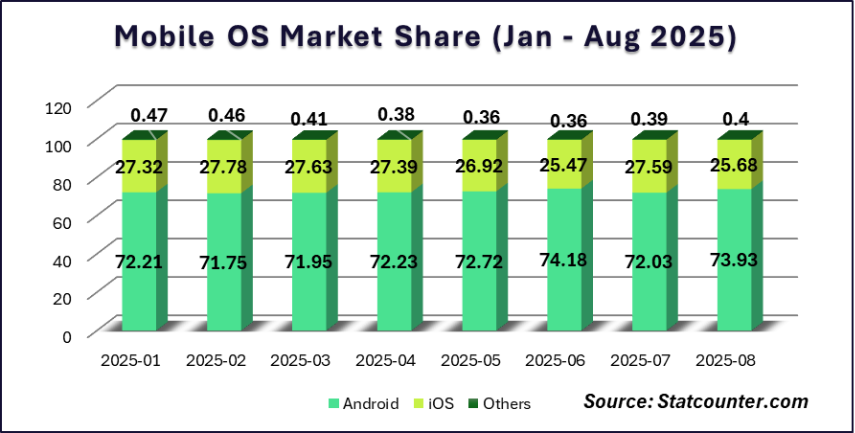
As of August 2025, Android holds the highest market share at 73.93% among mobile operating systems, followed by iOS (25.68%). While the world runs on Android and iOS, simplicity is deceptive. At any given time, there are numerous active versions of each OS in the wild, and users don’t always update immediately. The issue is especially challenging for Android devices, where manufacturers like Samsung apply their own custom software “skins” (like One UI) on top of the core operating system. These custom layers can introduce unique behaviors and compatibility issues that don’t exist on “stock” Android, creating another critical variable for your testing process.
This is the chaotic environment your app is released into. A mobile device farm provides the arsenal of physical devices needed to ensure your app delivers a flawless experience, no matter what hardware or OS version your customers use.
Can’t I Just Use an Emulator? Why Real Physical Devices Win
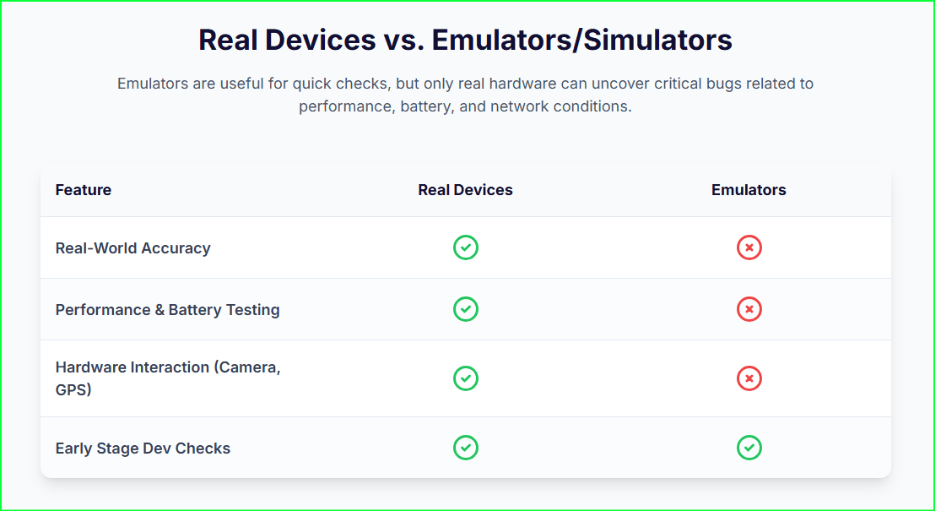
In the world of app development, emulators and simulators—software that mimics mobile device hardware—are common tools. They are useful for quick, early-stage checks directly from a developer’s computer. But when it comes to ensuring quality, relying on them exclusively is a high-risk gamble.
Emulators cannot fully replicate the complex interactions of physical hardware, firmware, and the operating system. Testing on the actual physical devices your customers use is the only way to get a true picture of your app’s performance and stability. In fact, a 2024 industry survey found that only 19% of testing teams rely solely on virtual devices. The overwhelming majority depend on real-device testing for a simple reason: it finds more bugs.
What Emulators and Simulators Get Wrong
Software can only pretend to be hardware. This gap means emulators often miss critical issues related to real-world performance. They struggle to replicate the nuances of:
CPU and Memory Constraints: An emulator running on a powerful developer machine doesn’t accurately reflect how an app performs on a device with limited processing power and RAM.
Battery Drain: You can’t test an app’s impact on battery life without a real battery. This is a crucial factor for user satisfaction that emulators are blind to.
Hardware Interactions: Features that rely on cameras, sensors, or Bluetooth connections behave differently on real hardware than in a simulated environment.
Network Interruptions: Real devices constantly deal with fluctuating network conditions and interruptions from calls or texts—scenarios that emulators cannot authentically reproduce.
Using a device cloud with real hardware allows teams to catch significantly more app crashes simply by simulating these true user conditions.
When to Use Emulators (and When Not To)
Emulators have their place. They are great for developers who need to quickly check a new UI element or run a basic functional check early in the coding process.
However, for any serious QA effort—including performance testing, regression testing, and final pre-release validation—they are insufficient. For that, you need a mobile device farm.
Public, Private, or Hybrid? How to Choose Your Device Farm Model
Once you decide to use a mobile device farm, the next step is choosing the right model. This is a key strategic decision that balances your organization’s specific needs for security, cost, control, and scale. Let’s look at the three main options.
Public Cloud Device Farms
Public cloud farms are services managed by third-party vendors like Qyrus that provide on-demand access to a large, shared pool of thousands of real mobile devices.
Pros: This model requires no upfront hardware investment and eliminates maintenance overhead, as the vendor handles everything. You get immediate access to the latest devices and can easily scale your app testing efforts up or down as needed.
Cons: Because the infrastructure is shared, some organizations have data privacy concerns, although top vendors use rigorous data-wiping protocols. You are also dependent on internet connectivity, and you might encounter queues for specific popular devices during peak times.
Private (On-Premise) Device Farms
A private farm is an infrastructure that you build, own, and operate entirely within your own facilities. This model gives you absolute control over the testing environment.
Pros: This is the most secure option, as all testing happens behind your corporate firewall, making it ideal for highly regulated industries. You have complete control over device configurations and there are no recurring subscription fees after the initial setup.
Cons: The drawbacks are significant. This approach requires a massive initial capital investment for hardware and ongoing operational costs for maintenance, updates, and repairs. Scaling a private farm is a slow and expensive manual process, making it difficult to keep pace with the market.
Hybrid Device Farms
As the name suggests, a hybrid model is a strategic compromise that combines elements of both public and private farms. An organization might maintain a small private lab for its most sensitive manual tests while using a public cloud for large-scale automated tests and broader device coverage. This approach offers a compelling balance of security and flexibility.
Expert Insight: Secure Tunnels Changed the Game
A primary barrier to using public clouds was the inability to test apps on internal servers behind a firewall. This has been solved by secure tunneling technology. Features like “Local Testing” create an encrypted tunnel from the remote device in the public cloud directly into your company’s internal network. This allows a public device to safely act as if it’s on your local network, making public clouds a secure and viable option for most enterprises.
Quick Decision Guide: Which Model is Right for You?
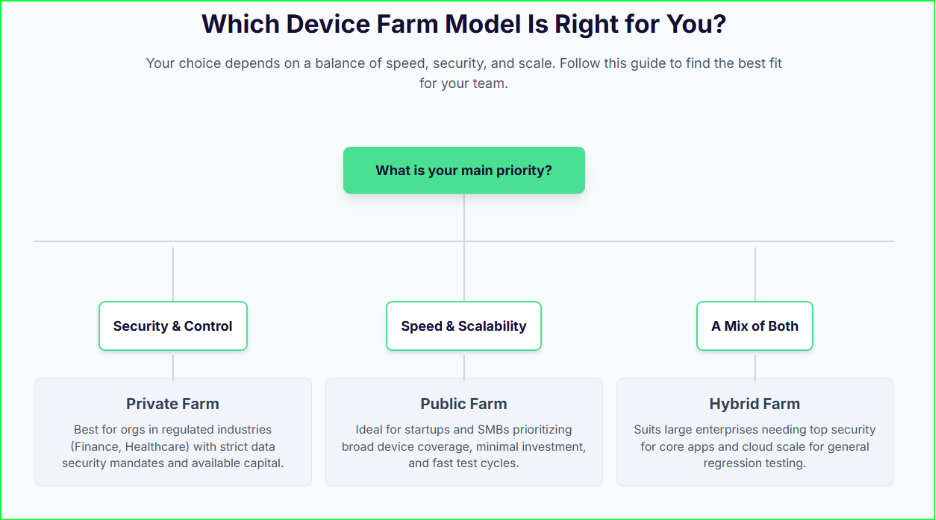
You need a Public Farm if: You prioritize speed, scalability, and broad device coverage. This model is highly effective for startups and small-to-medium businesses (SMBs) who need to minimize upfront investment while maximizing flexibility.
You need a Private Farm if: You operate under strict data security and compliance regulations (e.g., in finance or healthcare) and have the significant capital required for the initial investment.
You need a Hybrid Farm if: You’re a large enterprise that needs a balance of maximum security for core, data-sensitive apps and the scalability of the cloud for general regression testing.
6 Must-Have Features of a Modern Mobile Device Farm
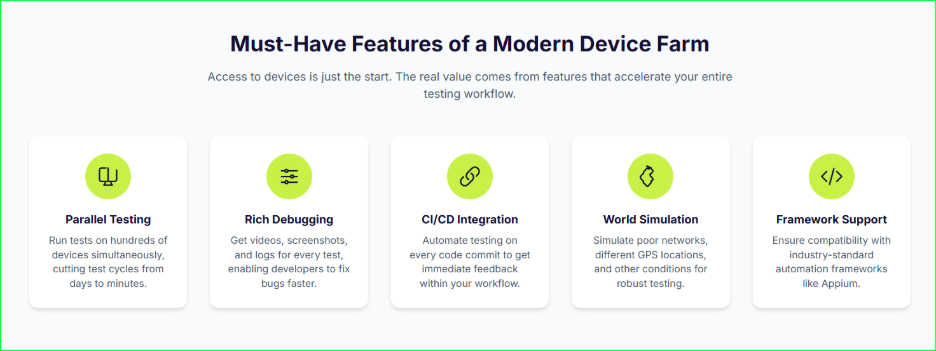
Getting access to devices is just the first step. The true power of a modern mobile device farm comes from the software and capabilities that turn that hardware into an accelerated testing platform. These features are what separate a simple device library from a tool that delivers a significant return on investment.
Here are five essential features to look for.
1. Parallel Testing
This is the ability to run your test suites on hundreds of device and OS combinations at the same time. A regression suite that might take days to run one-by-one can be finished in minutes. This massive parallelization provides an exponential boost in testing throughput, allowing your team to get feedback faster and release more frequently.
2. Rich Debugging Artifacts
A failed test should provide more than just a “fail” status. Leading platforms provide a rich suite of diagnostic artifacts for every single test run. This includes full video recordings, pixel-perfect screenshots, detailed device logs (like logcat for Android), and even network traffic logs. This wealth of data allows developers to quickly find the root cause of a bug, dramatically reducing the time it takes to fix it.
3. Seamless CI/CD Integration
Modern device farms are built to integrate directly into Continuous Integration/Continuous Deployment (CI/CD) pipelines like Jenkins or GitLab CI. This allows automated tests on real devices to become a standard part of your development process. With every code change, tests can be triggered automatically, giving developers immediate feedback on the impact of their work and catching bugs within minutes of their introduction.
4. Real-World Condition Simulation
Great testing goes beyond the app itself; it validates performance in the user’s environment. Modern device farms allow you to simulate a wide range of real-world conditions. This includes testing on different network types (3G, 4G, 5G), simulating poor or spotty connectivity, and setting the device’s GPS location to test geo-specific features. This is essential for ensuring your app is responsive and reliable for all users, everywhere.
5. Broad Automation Framework Support
Your device farm must work with your tools. Look for a platform with comprehensive support for major mobile automation frameworks, especially the industry-standard test framework, Appium. Support for native frameworks like Espresso (Android) and XCUITest (iOS) is also critical. This flexibility ensures that your automation engineers can write and execute scripts efficiently without being locked into a proprietary system.
6. Cross Platform Testing Support
Modern businesses often perform end-to-end testing of their business processes across various platforms such as mobile, web and desktop. Device farms should seamlessly support such testing requirements with session persistence while moving from one platform to another.
Qyrus Device Farm: Go Beyond Access, Accelerate Your Testing
Access to real devices is the foundation, but the best platforms provide powerful tools that accelerate the entire testing process. The Qyrus Device Farm is an all-in-one platform designed to streamline your workflows and supercharge both manual tests and automated tests on real hardware. It delivers on all the “must-have” features and introduces unique tools to solve some of the biggest challenges in mobile QA.
Our platform is built around three core pillars:
Comprehensive Device Access: Test your applications on a diverse set of real hardware, including the smartphones and tablets your customers use, ensuring your app works flawlessly in their hands.
Powerful Manual Testing: Interactively test your app on a remote device in real-time. Qyrus gives you full control to simulate user interactions, identify usability issues, and explore every feature just as a user would.
Seamless Appium Automation: Automate your test suites using the industry-standard Appium test framework. Qyrus enables you to run your scripted automated tests in parallel to catch regressions early and often, integrating perfectly with your CI/CD pipeline.
Bridge Manual and Automated Testing with Element Explorer
A major bottleneck in mobile automation is accurately identifying UI elements to create stable test scripts. The Qyrus Element Explorer is a powerful feature designed to eliminate this problem.
How it Works: During a live manual test session, you can activate the Element Explorer to interactively inspect your application’s UI. By simply clicking on any element on the screen—a button, a text field, an image—you can instantly see its properties (IDs, classes, text, XPath) and generate reliable Appium locators.
The Benefit: This dramatically accelerates the creation of automation scripts. It saves countless hours of manual inspection, reduces script failures caused by incorrect locators, and makes your entire automation effort more robust and efficient.
Simulate Real-World Scenarios with Advanced Features
Qyrus allows you to validate your app’s performance under complex, real-world conditions with a suite of advanced features:
Network Reshaping: Simulate different network profiles and poor connectivity to ensure your app remains responsive and handles offline states gracefully.
Interrupt Testing: Validate that your application correctly handles interruptions from incoming phone calls or SMS messages without crashing or losing user data.
Biometrics Bypass: Test workflows that require fingerprint or facial recognition by simulating successful and failed authentication attempts, ensuring your secure processes are working correctly.
Test Orchestration: Qyrus device farm is integrated into its Test Orchestration module that performs end-to-end business process testing across web, mobile, desktop and APIs.
Ready to accelerate your Appium automation and empower your manual testing? Explore the Qyrus Device Farm and see these features in action today.
The Future of Mobile Testing: What’s Next for Device Farms?
The mobile device farm is not a static technology. It’s rapidly evolving from a passive pool of hardware into an “intelligent testing cloud”. Several powerful trends are reshaping the future of mobile testing, pushing these platforms to become more predictive, automated, and deeply integrated into the development process.
AI and Machine Learning Integration
Artificial Intelligence (AI) and Machine Learning (ML) are transforming device farms from simple infrastructure into proactive quality engineering platforms. This shift is most visible in how modern platforms now automate the most time-consuming parts of the testing lifecycle.
AI-Powered Test Generation and Maintenance: A major cost of automation is the manual effort required to create and maintain test scripts. Qyrus directly addresses this with Rover, a reinforcement learning bot that automatically traverses your mobile application. Rover explores the app on its own, visually testing UI elements and discovering different navigational paths and user journeys. As it works, it generates a complete flowchart of the application’s structure. From this recorded journey, testers can instantly build and export mobile test scripts, dramatically accelerating the test creation process.
Self-Healing Tests: As developers change the UI, traditional test scripts often break because element locators become outdated. AI-driven tools like Qyrus Healer can intelligently identify an element, like a login button, even if its underlying code has changed. This “self-healing” capability dramatically reduces the brittleness of test scripts and lowers the ongoing maintenance burden.
Predictive Analytics: By analyzing historical test results and code changes, AI platforms can predict which areas of an application are at the highest risk of containing new bugs. This allows QA teams to move away from testing everything all the time and instead focus their limited resources on the most critical and fragile parts of the application, increasing efficiency.
Preparing for the 5G Paradigm Shift
The global deployment of 5G networks introduces a new set of testing challenges that device farms are uniquely positioned to solve. Testing for 5G readiness involves more than just speed checks; it requires validating:
Ultra-low latency for responsive apps like cloud gaming and AR.
Battery consumption under the strain of high data throughput.
Seamless network fallback to ensure an app functions gracefully when it moves from a 5G network to 4G or Wi-Fi.
Addressing Novel Form Factors like Foldables
The introduction of foldable smartphones has created a new frontier for mobile app testing. These devices present a unique challenge that cannot be tested on traditional hardware. The most critical aspect is ensuring “app continuity,” where an application seamlessly transitions its UI and state as the device is folded and unfolded, without crashing or losing user data. Device farms are already adding these complex devices to their inventories to meet this growing need.
Your Next Steps in Mobile App Testing
The takeaway is clear: in today’s mobile-first world, a mobile device farm is a competitive necessity. It is the definitive market solution for overcoming the immense challenge of device fragmentation and is foundational to delivering the high-quality, reliable, and performant mobile applications your users demand.
As you move forward, remember that the right solution—whether public, private, or hybrid—depends on your organization’s unique balance of speed, security, and budget.
Ultimately, the future of quality assurance lies not just in accessing devices, but in leveraging intelligent platforms that provide powerful tools. Features like advanced element explorers for automation and sophisticated real-world simulations are what truly accelerate and enhance the entire testing lifecycle, turning a good app into a great one.
Welcome to our September update! As we continue to evolve the Qyrus platform, our focus remains squarely on enhancing your productivity and empowering your team to achieve more, faster. We believe in removing friction from the testing lifecycle, and this month’s updates are a direct reflection of that commitment.
We are excited to introduce powerful new capabilities centered around dramatic workflow acceleration, intelligent AI-driven assistance, and seamless CI/CD integration. From features that eliminate repetitive tasks to an AI co-pilot that can fix your scripts on the fly, every enhancement is designed to save you valuable time and make your testing efforts more intuitive and powerful.
New Feature
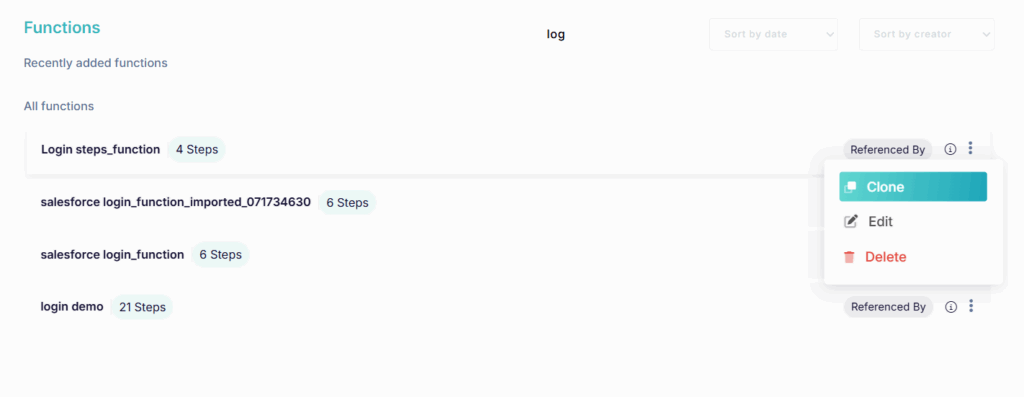
Build Faster, Not from Scratch: Now Clone Your Web Testing Functions!
The Challenge:
Users often need to create functions (e.g. File Uploads, Global Software Quality Assurance) that are very similar to ones they have already built. Previously, this required repetitive manual effort to recreate these similar functions from scratch, step by step, which was inefficient and time-consuming.
The Fix:
We have now introduced a “Clone” option for functions for project set-up in Web Testing. With a single click, users can create an exact copy of any existing function, which they can then rename and modify as needed.
How will it help?
This feature directly addresses the need for efficiency in test creation. It saves significant time and effort by allowing you to quickly duplicate complex, existing functions instead of recreating them. This allows you to build out your function library much faster and focus on tweaking the logic for new scenarios rather than on repetitive setup.
Improvement
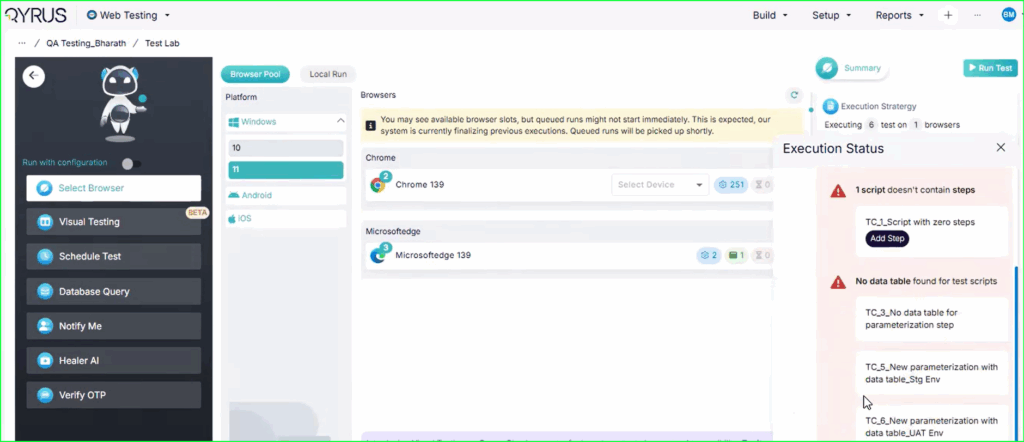
Fix It Right the First Time: Introducing Detailed Error Handling!
The Challenge:
Previously, when users encountered an error during a test, the error messages could sometimes be generic. This lack of specific guidance increased the chances of making mistakes again when re-entering information, leading to a frustrating trial-and-error process.
The Fix:
We have implemented a more detailed and intelligent error handling system within Web Testing. Now, when the system detects an error, it will provide a clear, specific, and actionable message (e.g. “Test Scrip 3, No data table for parameterization step”) that pinpoints exactly what is wrong and often suggests how to correct it.
How will it help?
This enhancement provides immediate, clear guidance that helps you fix issues faster. It ensures consistency in your configurations and reduces manual errors by preventing guesswork. This ultimately speeds up project setup and improves your overall workflow efficiency, allowing you to build tests with greater confidence and speed.
New Feature
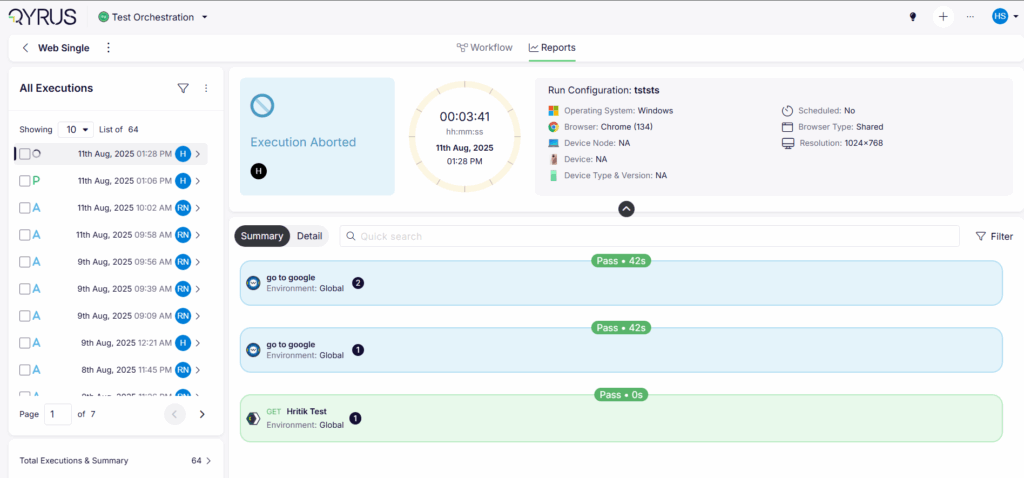
Take Control of Your Pipeline: Stop Executions on Demand!
The Challenge:
Previously, once a test execution was triggered in Test Orchestration, there was no way to stop it before it got completed. This lack of control meant that if a long-running suite was started by mistake, or if a low-priority job was tying up resources when a critical test needed to run, users had no choice but to wait.
The Fix:
We have now introduced a “Stop Execution” feature in Test Orchestration. Users will now see an option on any in-progress execution that allows them to immediately terminate the test run.
How will it help?
This feature gives you crucial, real-time control over your testing pipeline. You can now instantly:
Correct Mistakes: Immediately stop an execution that was triggered with the wrong configuration or data.
Prioritize with Agility: Free up valuable execution resources from a lower-priority task to run a more urgent, high-priority test.
This leads to more efficient use of your resources, prevents wasted time on incorrect runs, and provides the flexibility needed to manage a dynamic testing schedule.
Improvement
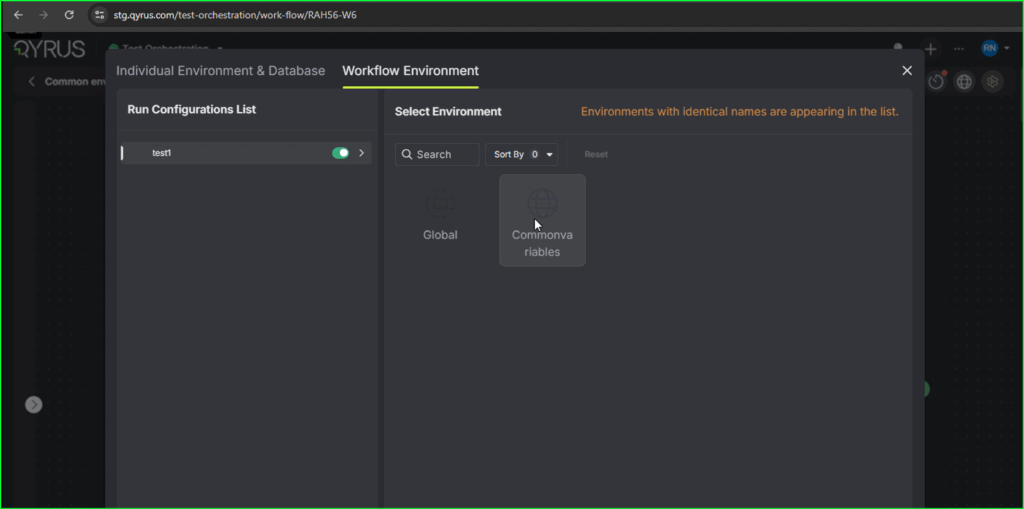
Set It Once: Unified Environment Selection for Test Orchestration!
The Challenge:
In the Service TO (Test Orchestration) section, users were required to select the environment individually for each script within a test. This process was time-consuming and repetitive, especially for tests containing a large number of scripts that all needed to run on the same environment. This also created an inconsistent experience, as other parts of the platform already offered a more efficient, test-level selection method.
The Fix:
We have updated the behavior in Service TO to align with user expectations and improve efficiency. You can now make a single environment selection at the test level, and this choice will automatically apply to all scripts contained within that test.
How will it help?
This enhancement significantly streamlines the test setup process. It eliminates unnecessary manual work by removing the need to select the same environment repeatedly for each script. This not only saves you a considerable amount of time, especially with large tests, but also provides a more consistent, intuitive, and user-friendly experience across the entire Test Orchestration module.
Improvement
Recorder Now Intelligently Fixes and Completes Your Tests!
The Challenge:
Test scripts, whether created manually or generated by AI, can sometimes be imperfect. They might contain incorrect or outdated locators, or they might be missing crucial steps needed to achieve the test’s objective. When these scripts were executed, they would simply fail, forcing the user into a difficult and time-consuming manual process of debugging, finding the broken locators, and identifying the missing logic.
The Fix:
We have introduced Context Based Execution, a powerful new AI-driven capability in Qyrus Recorder. Now, you can provide your high-level objective along with a potentially flawed test script. The AI engine (QTP) will then intelligently:
Heal incorrect locators by finding the correct elements on the page.
Add relevant missing steps by understanding the logical gaps in your test flow.
Proceed to complete the execution successfully using the corrected and completed script.
How will it help?
This feature acts as an AI co-pilot, dramatically accelerating your test creation and maintenance efforts.
Massively Reduce Maintenance: It goes beyond simple self-healing by fixing entire test flows, saving countless hours you would have spent debugging.
Create Tests Faster: You can start with an imperfect or incomplete script and let the AI intelligently correct and complete it, turning rough drafts into robust tests.
Increase Test Reliability: By fixing issues on the fly, it makes your test executions far more resilient to minor application changes or script errors.
Empower Your Team: It lowers the technical barrier for creating successful automated tests, allowing every team member to be more productive.
Improvement
Record Like a Human: Copy/Paste, TAB & ENTER Now Captured!
The Challenge: Previously, the Qyrus Recorder did not capture several common user actions when filling out web forms. Pasting text into a field was not recorded as a clean input, and crucial keyboard navigation like pressing TAB to move between fields or ENTER to submit a form was ignored. This forced users to manually add these steps after the recording was finished, which was time-consuming and made the recording process less intuitive.
The Fix:
We have significantly enhanced the Qyrus Recorder to make the recording experience more natural and complete. The recorder now automatically captures:
Copy & Paste: When you paste text into an input field, it is now recorded as a clean SET operation.
Keyboard Actions: Pressing the TAB and ENTER keys are now recognized and recorded as distinct steps in your script.
How will it help?
This update will save you a tremendous amount of time, especially when recording interactions with login pages or other large forms. You can now record the workflow exactly as you would perform it manually—pasting long values, tabbing between fields, and hitting enter to submit. This eliminates the need for numerous manual clicks and post-recording edits, creating a more accurate and complete test script from the very beginning and streamlining your entire automation workflow.
Improvement
At-a-Glance Clarity: qAPI Functional Reports Get a Major Upgrade!
The Challenge:
Previously, our qAPI functional reports had two main areas for improvement. First, an API test executed without any assertions could be ambiguously reported, not clearly indicating that no actual validation occurred. Second, users had to click into a detailed report to see the crucial HTTP status code of an API response, making it difficult to quickly assess results from the main overview page.
The Fix:
We have introduced two significant improvements to the functional reports page:
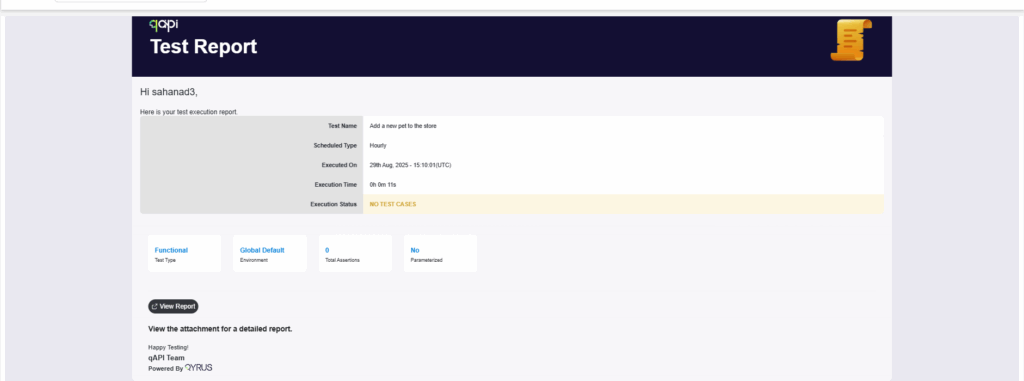
New “No Test Cases” Status: A new status, “No Test Cases,” will now be displayed for any API test that is run without any assertions.
New “Status Code” Column: We’ve added a “Status Code” column that provides an at-a-glance view of the API response. It includes a tooltip explaining the code’s meaning and uses a smart icon to indicate when an execution contains multiple APIs with the same or different status codes.
How will it help?
These enhancements provide you with richer, more actionable reports.
The “No Test Cases” status encourages better testing practices by clearly highlighting tests that need validation criteria to be meaningful.
The “Status Code” column saves you valuable time by providing critical response information directly on the main reports page, allowing for faster analysis and quicker identification of potential issues without needing to dig into detailed reports.
New Feature
From Complex to Clear: AI-Generated Summaries for Your API Workflows!
The Challenge:
Complex, multi-step API workflows, especially those created by automated features like Automap, can be difficult to understand at a glance. When a team member creates a new workflow, others in the workspace might have to manually analyze each step to grasp its overall purpose and logic, which can hinder collaboration and slow down reviews.
The Fix:
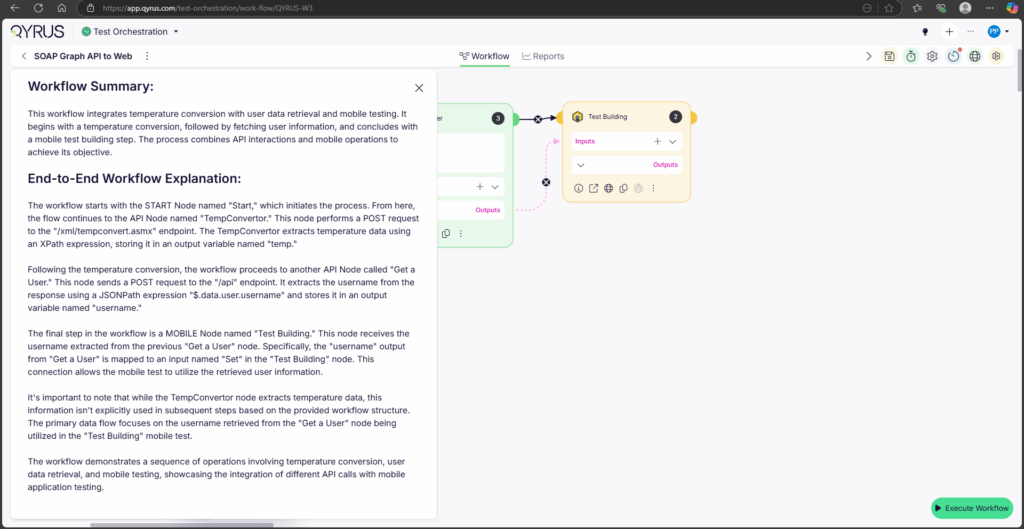
We have introduced a new AI Summary feature for qAPI workflows. This powerful feature automatically generates a concise, human-readable summary that explains the purpose and flow of the operations within a workflow. This summary provides an immediate, high-level overview of the test asset.
How will it help?
This feature significantly improves collaboration and understanding within your workspace.
Instant Clarity: It makes it easy for any team member to quickly understand what a workflow does without dissecting it.
AI Transparency: It works perfectly with features like Automap, providing a clear explanation of what the AI has built.
Faster Reviews: Peer reviews are more efficient, as the context is clear from the start.
Auto-Documentation: The summary acts as instant documentation, ensuring the purpose of your test assets is always well-understood.
New Feature
Power Up Your Pipeline: Trigger qAPI Functional Tests Directly from Jenkins!
The Challenge:
Previously, users who rely on Jenkins for their CI/CD pipelines lacked a simple, native way to trigger their qAPI functional tests. Integrating these tests required complex workarounds like custom API scripts, creating a disconnect between the build/deployment process in Jenkins and the API testing process in Qyrus, and hindering true end-to-end automation. The Fix:
We have now released a dedicated Jenkins plugin for qAPI. This plugin provides a simple and configurable build step that allows users to easily select and trigger their qAPI functional tests directly from within any Jenkins pipeline job.
How will it help?
This plugin provides seamless CI/CD integration, enabling true Continuous Testing. You can now:
Fully Automate Testing: Automatically trigger your API functional tests as a standard part of your build and deployment process.
Get Faster Feedback: Immediately validate your services post-deployment to catch issues earlier in the development cycle.
Eliminate Manual Work: Remove the need for brittle, custom scripts, saving significant time for your DevOps and development teams.
Ready to Accelerate Your Testing with August’s Upgrades?
We are dedicated to evolving Qyrus into a platform that not only anticipates your needs but also provides practical, powerful solutions that help you release top-quality software with greater speed and confidence.
Curious to see how these August enhancements can benefit your team? There’s no better way to understand the impact of Qyrus than to see it for yourself.
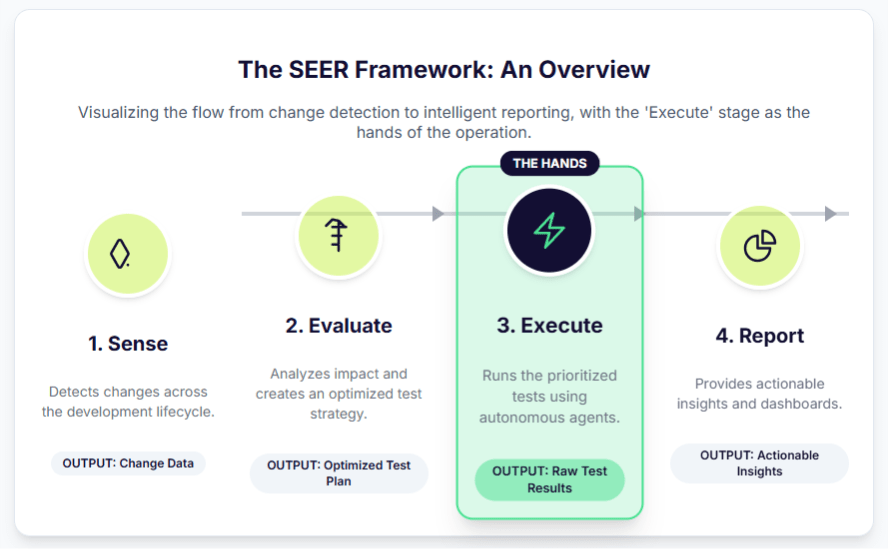
Welcome to the fourth chapter of our Agentic Orchestration series. So far, we’ve seen how the Qyrus SEER framework uses its ‘Eyes and Ears’ to Sense changes and its ‘Brain’ to Evaluate the impact. Now, it’s time to put that intelligence into action. In this post, we’ll explore the ‘Muscle’ of the operation: the powerful test execution stage. If you’re new to the series, we recommend starting with Part 1 to understand the full journey.
How the Qyrus SEER Framework Redefines Test Execution
The Test Strategy is set. The impact analysis is complete. In the last stage of our journey, the ‘Evaluate stage’ in the Qyrus SEER framework acted as the strategic brain, crafting the perfect testing plan. Now, it’s time to unleash the hounds. Welcome to the ‘Execute’ stage—where intelligent plans transform into decisive, autonomous action.
In today’s hyper-productive environment, where AI assistants contribute to as much as 25% of new code, development teams operate at an unprecedented speed. Yet, QA often struggles to keep up, creating a “velocity gap” where traditional testing becomes the new bottleneck. It’s a critical business problem. To solve it, you need more than just automation; you need intelligent agentic orchestration.
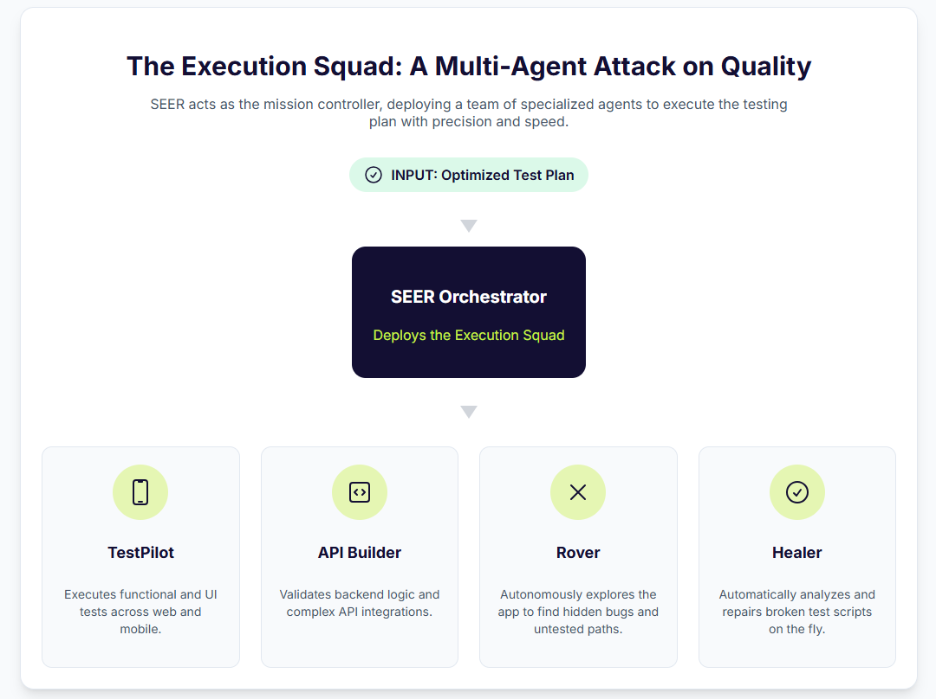
This is where the SEER framework truly shines. It doesn’t just run a script. It conducts a sophisticated team of specialized Single Use Agents (SUAs), launching an intelligent and targeted attack on quality. This is the dawn of true autonomous test execution, an approach that transforms QA from a siloed cost center into a strategic business accelerator.
Unleashing the Test Agents: A Multi-Agent Attack on Quality
The Qyrus SEER framework’s brilliance lies in its refusal to use a one-size-fits-all approach. Instead of a single, monolithic tool, SEER acts as a mission controller for its agentic orchestration, deploying a squad of highly specialized Single Use Agents (SUAs) to execute the perfect test, every time. This isn’t just automation; this is a coordinated, multi-agent attack on quality.
The UI Specialist – TestPilot: When the user interface needs validation, SEER deploys TestPilot. This agent acts as your AI co-pilot, creating and executing functional tests across both web and mobile platforms. It simulates real user interactions with precision, ensuring your application’s UI testing is thorough and that the front-end experience is not just functional, but flawless.
The Backend Enforcer – API Builder: For the core logic of your application, API Builder gets the call. This powerful agent executes deep-level API testing to validate your backend services, microservices, and complex integration points. It can even instantly virtualize APIs based on user requirements, allowing for robust and isolated testing that isn’t dependent on other systems being available.
The Autonomous Explorer – Rover: What about the bugs you didn’t think to look for? SEER deploys Rover, an autonomous AI scout that explores your application to uncover hidden bugs and untested pathways that scripted tests would inevitably miss. Rover’s exploratory work is a crucial part of our AI test execution, ensuring comprehensive coverage and building a deep confidence in your release.
The Maintenance Expert – Healer: Perhaps the most revolutionary agent in the squad is Healer. Traditional test automation’s greatest weakness is maintenance; scripts are brittle and break when an application’s UI changes. Healer solves this problem. When a test fails due to a legitimate application update, this agent automatically analyzes the change and updates the test script, delivering true self-healing tests. It single-handedly eliminates the endless cycle of fixing broken tests.
Behind the Curtain: The Technology Driving Autonomous Execution
This squad of intelligent agents doesn’t operate in a vacuum. They are powered by a robust and scalable engine room designed for one purpose: speed. The Qyrus SEER framework integrates deeply into your development ecosystem to make autonomous test execution a seamless reality.
First, Qyrus plugs directly into your existing workflow through flawless continuous integration. The moment a developer merges a pull request or a new build is ready, the entire execution process is triggered automatically within your CI/CD pipeline, whether it’s Jenkins, Azure DevOps, or another provider. This eliminates manual hand-offs and ensures that testing is no longer a separate phase, but an integrated part of development itself.
Next, Qyrus shatters the linear testing bottleneck with massive parallel testing. Instead of running tests one by one, our platform dynamically allocates resources, spinning up clean, temporary environments to run hundreds of tests simultaneously across a secure and scalable browser and device farm. It’s the difference between a single-lane road and a 100-lane superhighway. This is how we transform test runs that used to take hours into a process that delivers feedback in minutes.
The Bottom Line: Measuring the Massive ROI of Agentic Orchestration
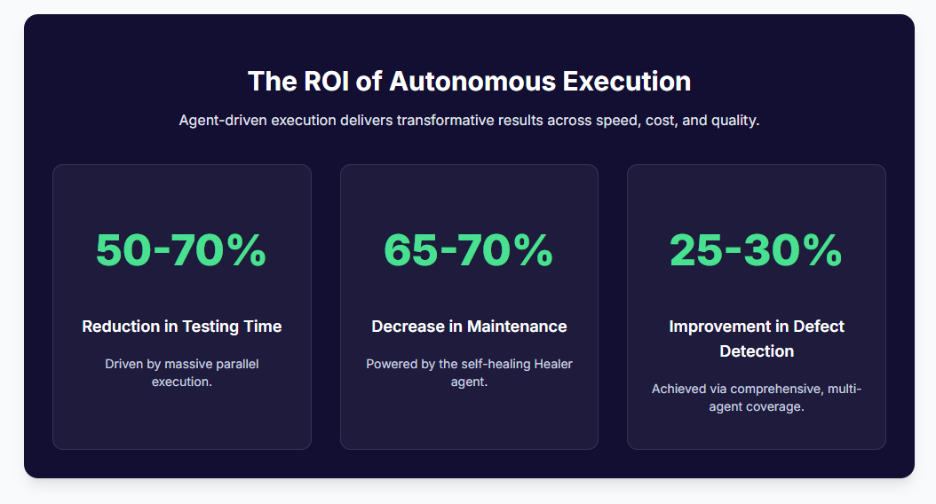
A sophisticated platform is only as good as the results it delivers, and this is where the Qyrus SEER framework truly changes the game. By replacing slow, manual processes and brittle scripts with an autonomous team of agents, this approach delivers a powerful and measurable test automation ROI. This isn’t about incremental improvements; it’s about a fundamental transformation of speed, cost, and quality.
Slash Testing Time and Accelerate Delivery: By orchestrating parallel testing across a scalable cloud infrastructure, Qyrus shatters the testing bottleneck. This allows organizations to shorten release cycles and dramatically increase developer productivity. Teams that embrace this model see a staggering 50-70% reduction in overall testing time. What once took an entire night of regression testing now delivers feedback in minutes, giving your business a significant competitive advantage.
Eliminate Maintenance Costs and Reallocate Talent: The Healer agent directly attacks the single largest hidden cost in most QA organizations: script maintenance. By automatically fixing broken tests, Healer allows organizations to reduce the time and effort spent on test script maintenance by an incredible 65-70%. This frees your most valuable engineers from low-value repair work, allowing you to reallocate their expertise toward innovation and complex quality challenges that truly move the needle.
Enhance Quality and Deploy with Bulletproof Confidence: Speed is meaningless without quality. By intelligently deploying agents like Rover to explore untested paths, the Qyrus SEER framework dramatically improves the effectiveness of your testing. This smarter approach leads to a 25-30% improvement in defect detection rates, catching critical bugs long before they can impact your customers. This allows your teams to release with absolute confidence, knowing that quality and speed are finally working in perfect harmony.
Conclusion: The Dawn of Autonomous, Self-Healing QA
The Qyrus ‘Execute’ stage fundamentally redefines what it means to run tests. It transforms the process from a slow, brittle, and high-maintenance chore into a dynamic, intelligent, and self-healing workflow. This is where the true power of agentic orchestration comes to life. No longer are you just running scripts; you are deploying a coordinated squad of autonomous agents that execute, explore, and even repair tests with a level of speed and efficiency that was previously unimaginable.
This is the engine of modern quality assurance—an engine that provides the instant, trustworthy feedback necessary to thrive in a high-velocity, CI/CD-driven world.
But the mission isn’t over yet. Our autonomous agents have completed their tasks and gathered a wealth of data. So, how do we translate those raw results into strategic business intelligence?
In the final part of our series, we will dive into the ‘Report’ stage. We’ll explore how the Qyrus SEER framework synthesizes the outcomes from its multi-agent attack into clear, actionable insights that empower developers, inform stakeholders, and complete the virtuous cycle of intelligent, autonomous testing.
Ready to Explore Qyrus’ Autonomous Test Execution? Contact us today!
APIs are no longer just pipes connecting systems. They’re the backbone of digital business. And as AI continues to dominate conversations in every industry, one thing is becoming clear: there’s no AI without APIs. That’s exactly why we’re heading to API Days London next month.
This year’s theme hits close to home: “No AI Without API Management.” Over three days, the conference will dig into how API-first architecture, scalability, security, and AI-enhanced management are shaping the way modern businesses build intelligent systems. For the qAPI team, powered by Qyrus, where API testing and quality assurance meet real-world AI workflows, it’s the perfect place to learn, share, and connect.
Why We’re Excited About API Days London
API Days is a tech event where the global API community shows up. You’ll see product owners, API architects, developers, and QA leaders all tackling the same challenges: how do we make APIs faster, safer, smarter, and ready for AI-driven environments?
The sessions are designed to go beyond theory. Think hands-on workshops, real-world case studies, and discussions that don’t just tell you what’s possible but show you how to do it. For us, it’s a chance to explore how API management ties directly into quality engineering, and how testing practices need to evolve if businesses want to stay competitive in an AI-first world.
Our qAPI team is especially excited to jump into the tracks focused on scaling, governance, and AI-driven API strategies. We’re looking forward to coming back with fresh ideas on how to embed API-centered QA into AI workflows because if APIs are powering intelligent systems, they need the same intelligent approach to testing.
Two Sessions You Can’t Miss with Raoul Kumar
We’re proud that Raoul Kumar, our Director of Platform Development & Success at Qyrus and qAPI, will be taking the stage not once, but twice.
📍 COMMERCIAL 2 📅 September 22, 2025 ⏰ 4:05 – 4:55 PM Workshop: Test APIs in the Cloud — No Code. Just Chrome.
This hands-on session strips API testing back to its essentials. Forget complicated frameworks or clunky setups, Raoul will walk you through how to run tests directly from your browser. No code, no hassle. Just Chrome and the cloud. You’ll see how this approach makes testing simpler for both devs and QA teams while fitting seamlessly into modern CI/CD pipelines.
And that’s just the start.
📍 COMMERCIAL 2 📅 September 24, 2025 ⏰ 9:30 AM – 9:55 AM Keynote: The Future of API Testing: No Code, Just Cloud and Chrome
In this keynote, Raoul will zoom out from the technical details to talk about the bigger picture: how QA needs to evolve in the age of AI and why APIs are at the center of it all. Expect to hear about the challenges enterprises are facing, the opportunities no-code brings to the table, and how qAPI, Powered by Qyrus, is helping organizations future-proof their API testing strategy.
Come Meet Us at the qAPI (powered by Qyrus) Booth
Of course, we’re not just speaking, we’re setting up camp on the show floor too. Swing by the qAPI/Qyrus booth to meet our team, see live demos of our platform, and chat about your QA challenges.
And because no conference is complete without some fun, we’ll also be running a raffle with special prizes throughout the event. Stop in, say hi, and you just might walk away with more than new API testing ideas.
Why This Matters for You
If you’re working in product, development, or QA, you know the pressure. Release cycles are shrinking. Expectations are rising. And AI is amplifying both the opportunity and the complexity of building great digital experiences. That’s why events like API Days London are so important.
For us, it’s about connecting with peers who are asking the same questions we are: How do we embed testing into API-first, AI-driven ecosystems? How do we make quality a competitive advantage instead of a bottleneck? And how do we simplify testing so teams can actually move at the speed of innovation?
See You in London
We couldn’t be more excited for Apidays London 2025. Between Raoul’s workshop on September 22, his keynote on September 23 at 9:30 AM, and our booth filled with demos, raffles, and great conversations, we’re looking forward to connecting with as many of you as possible.
For us, the takeaway is simple: No AI without APIs. And no innovation without quality.
Welcome to our August update! At Qyrus, we are driven by the goal of making every aspect of your testing journey more efficient, powerful, and intuitive. This August, we’ve delivered a host of significant upgrades with a special focus on overhauling the entire API testing experience, creating more powerful and resilient test automation, and enhancing overall platform reliability. From simplifying how you create and preview APIs to making your automated tests smarter and more robust, these updates are designed to remove friction and accelerate your path to delivering quality.
New Feature
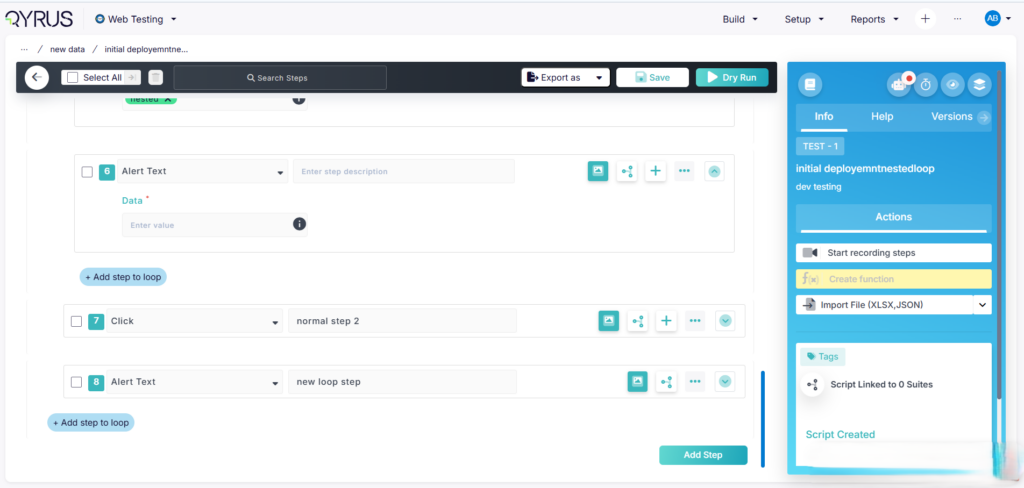
Power Up Your Iterations: Introducing Nested Loops for Web Testing!
The Challenge:
Previously, users could not place one loop inside another, which made it difficult to automate complex scenarios requiring nested iterations. For example, testing every available size (inner loop) for every T-shirt style in a list (outer loop) would require complicated test structures or manual duplication of steps, which was inefficient and hard to maintain.
The Fix:
We have now introduced support for one-level nested loops in Web Testing. This allows users to place one loop directly inside another loop, enabling a more powerful and intuitive way to structure tests that need to iterate through multiple, related data sets.
How will it help?
This feature significantly enhances your ability to automate complex test scenarios. It helps you:
Automate Complex Scenarios: Easily handle tests that involve multiple, dependent data sets, like checking all links within each section of a webpage.
Save Time: Avoid duplicating test steps by creating elegant, nested loop structures that are more efficient to build and maintain.
Ensure Better Test Coverage: Systematically test all combinations between two sets of data, leading to more thorough and comprehensive test coverage with less effort.
Improvement
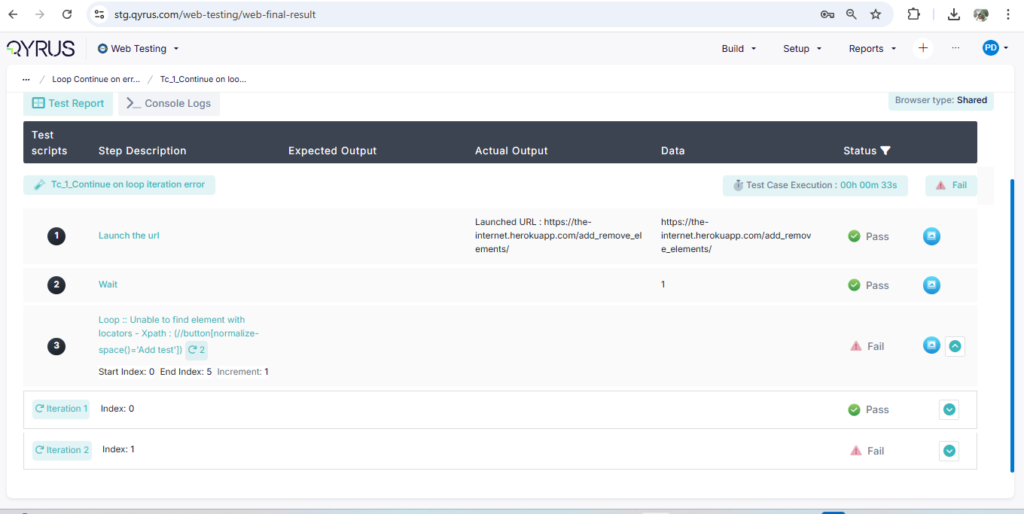
Resilient Loops: Gather All Results, Even with Failures!
The Challenge:
Previously, if a single step failed within a loop iteration, the entire loop would stop executing. This was problematic for data-driven tests where the goal is to process an entire dataset and see results for every item, as a single failure would prevent subsequent iterations from running and leave you with an incomplete report.
The Fix:
We have introduced a “Continue on Failure” option for loops in Web Testing. When this setting is enabled, a failure in one iteration will be logged in the report, but it will not halt the execution. The loop will proceed to the next iteration until all have been attempted.
How will it help?
This feature makes your automated tests more resilient and your results more comprehensive. It ensures that all iterations of your loop will run even if some fail, which is crucial for testing with dynamic data sets. This allows for complete, uninterrupted automation and provides a full execution report detailing the success or failure of every single iteration, giving you a complete picture of your test outcomes.
New Feature
Rock-Solid iOS Recordings: Video Service Upgraded for High-Volume Testing!
The Challenge:
Our iOS video recording service could become unstable under sustained, high usage. When a large number of parallel sessions were run (e.g., 500+ recordings over a few days), the service would sometimes stop accepting new recording requests. This resulted in situations where test reports were generated without the crucial corresponding video recording, hindering debugging and analysis.
The Fix:
Instead of relying on temporary server restarts, we have permanently addressed the root cause by re-architecting and optimizing the iOS video recording service. This enhancement ensures the service can now robustly handle a high volume of concurrent recording requests without degrading.
How will it help?
This update delivers significantly improved reliability and stability for iOS video recordings in Device Farm. You can now run numerous parallel test sessions with the confidence that a video recording will be successfully generated for each one, even during periods of peak usage. This ensures you always have the complete visual artifacts you need for thorough debugging and analysis.
Improvement
Reliable iOS Manual Sessions with Improved Connectivity
The Challenge:
Users attempting to start a manual testing session with an iOS device would sometimes encounter errors that prevented the session from launching successfully. These failures were often caused by underlying connectivity issues between our servers and the physical iOS devices in our device farm.
The Fix:
We have implemented and deployed key configuration changes on our backend servers to specifically address and resolve these connectivity problems. These adjustments create a more stable and robust connection pathway to our iOS devices.
How will it help?
This fix significantly improves the reliability of initiating manual sessions for iOS devices. You should now experience fewer session creation failures, allowing you to start your manual testing sessions more quickly and dependably, leading to a smoother and more efficient testing experience.
Improvement
API Previews, Unblocked: Seamlessly Preview APIs & Generate Assertions!
The Challenge:
Previously, users were unable to preview all their APIs directly within the platform. Technical limitations, particularly Cross-Origin Resource Sharing (CORS) issues, could often prevent a seamless preview experience, especially when attempting to check APIs from a local environment. This made it difficult to quickly inspect responses and validate endpoints before building out full test cases.
The Fix:
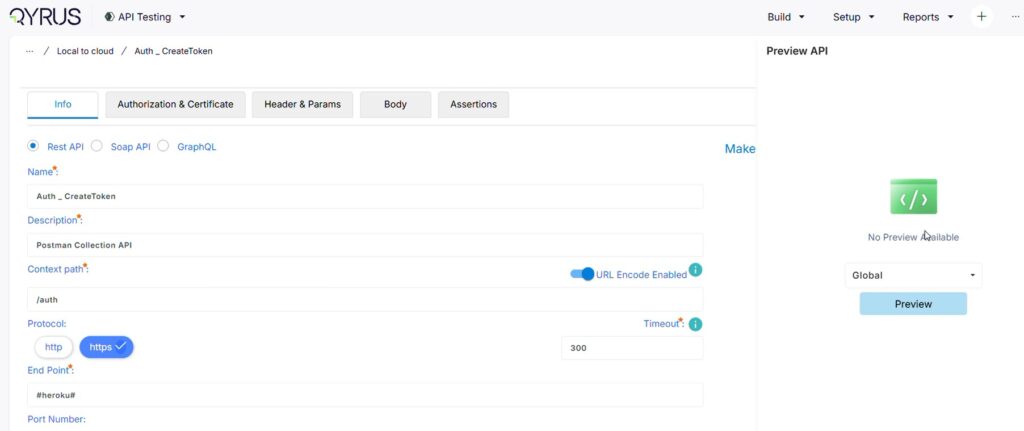
We have implemented new logic that enhances the API preview functionality, specifically enabling seamless previews from a local environment to our CloudClient. This change effectively resolves the underlying CORS issues. As part of this improvement, users can also now generate Nova assertions directly from the previewed API response.
How will it help?
This update provides a much smoother and more powerful API test design workflow. Users can now reliably preview all APIs without being blocked by CORS errors, allowing for quick and easy inspection of responses. The ability to generate Nova assertions directly from this preview dramatically accelerates test creation, reducing manual effort and helping you build comprehensive API validation steps faster than ever before.
New Feature
Effortless API Setup: Introducing the New, Intuitive qAPI Form!
The Challenge:
The previous form for manually entering API details could sometimes be complex or less than intuitive, especially for users who were not deeply technical. This could slow down the process of adding new APIs to the platform and might have presented a barrier for team members like manual testers or business analysts.
The Fix:
We have completely redesigned the form where users enter API details in qAPI. The new design streamlines the entire process from start to finish, with a strong focus on making it more intuitive and user-friendly for everyone.
How will it help?
This revamp significantly improves the user experience for manually creating APIs. The new, intuitive layout guides users through the process more clearly, making it faster and easier to add and configure APIs. This is especially beneficial for non-technical users, as it lowers the barrier to entry and empowers more team members to participate in setting up API tests, reducing errors and saving time.
Improvement
Enhanced API Versatility: Full Support for x-www-form-urlencoded
The Challenge:
Previously, our API testing capabilities did not include native support for the x-www-form-urlencoded body type. This is a common data format used by web applications, especially for submitting form data. Users who needed to test APIs that required this specific content type had to rely on custom workarounds or external tools, creating an efficiency gap in their workflow.
The Fix:
We have now added native support for the application/x-www-form-urlencoded body type within our API testing service. Users can now select this option and easily build their request using key-value pairs, just as they would with a standard web form.
How will it help?
This enhancement significantly expands the range of APIs you can test directly on our platform. It simplifies the process of testing endpoints that mimic web form submissions, eliminating the need for complex workarounds. This makes our API testing tool more versatile and ensures you can cover a broader spectrum of your application’s endpoints with ease and efficiency.
New Feature
From API to IDE: C# HttpClient Code Snippets Now Available!
The Challenge:
Previously, while our code snippet feature supported various languages, it lacked an option for C# developers using the standard HttpClient library. This meant C# developers had to manually translate the API requests they designed or tested on our platform into the necessary C# code, a process that could be time-consuming and prone to manual error.
The Fix:
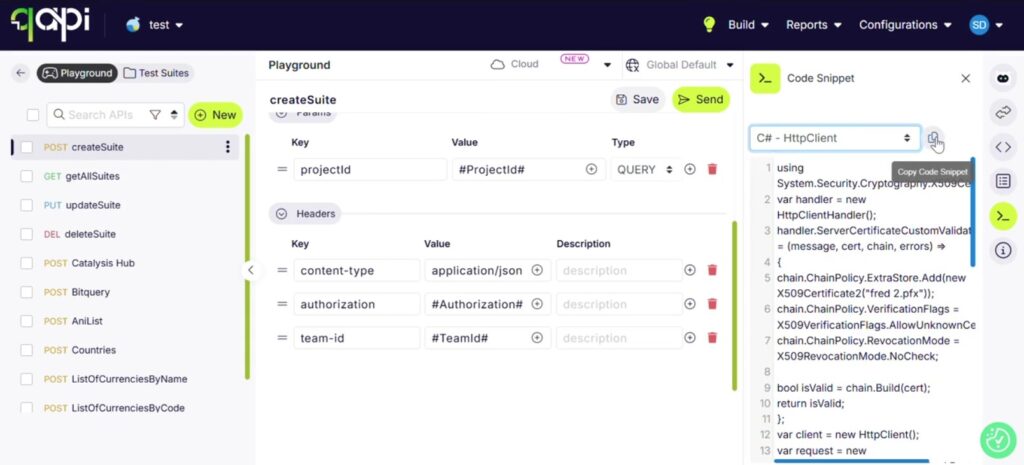
We are expanding our code snippet generation capabilities with the addition of a new target: C# (HttpClient). Now, with a single click, users can instantly generate the C# code required to execute their configured API request using this popular library.
How will it help?
This feature provides a significant productivity boost for C# and .NET developers. It eliminates the need to write boilerplate HttpClient code for API requests, saving time and reducing the chance of transcription errors. Developers can now quickly generate and integrate tested API calls directly into their applications, streamlining the workflow from API design and testing to implementation.
Improvement
QAPI – under— Your Test Results, Delivered: Email Reports for Scheduled Executions!
The Challenge:
Previously, after scheduling a test execution, users had to manually return to the platform to check its status and retrieve the report once it was finished. There was no automated notification system to inform them of a successful completion or, more critically, if a test failed to start due to issues like an insufficient Virtual User Balance (VUB).
The Fix:
We have implemented an automated email notification system for all scheduled test executions. Now, when a scheduled test completes successfully, users will automatically receive an email with a downloadable report attached. Additionally, if a test fails to run because of an insufficient Virtual user balance, a specific alert email will be sent to notify the user of the issue.
How will it help?
This feature makes monitoring your scheduled tests effortless and proactive. You no longer need to manually check on test progress; results are delivered directly to your inbox for easy access and sharing. The immediate failure alerts for VUB issues are crucial for quickly resolving resource problems and ensuring your testing schedule proceeds without interruption, saving time and preventing missed test runs.
Ready to Accelerate Your Testing with August’s Upgrades?
We are dedicated to evolving Qyrus into a platform that not only anticipates your needs but also provides practical, powerful solutions that help you release top-quality software with greater speed and confidence.
Curious to see how these August enhancements can benefit your team? There’s no better way to understand the impact of Qyrus than to see it for yourself.
Jerin Mathew M M is a seasoned professional currently serving as a Content Manager at Qyrus. He possesses over 10 years of experience in content writing and editing, primarily within the international business and technology sectors. Prior to his current role, he worked as a Content Manager at Tookitaki Technologies, leading corporate and marketing communications. His background includes significant tenures as a Senior Copy Editor at The Economic Times and a Correspondent for the International Business Times UK. Jerin is skilled in digital marketing trends, SEO management, and crafting analytical, research-backed content.