The $100 Billion QA Shift: 5 Trends Defining Software Testing in 2026 and Beyond
 Jerin Mathew

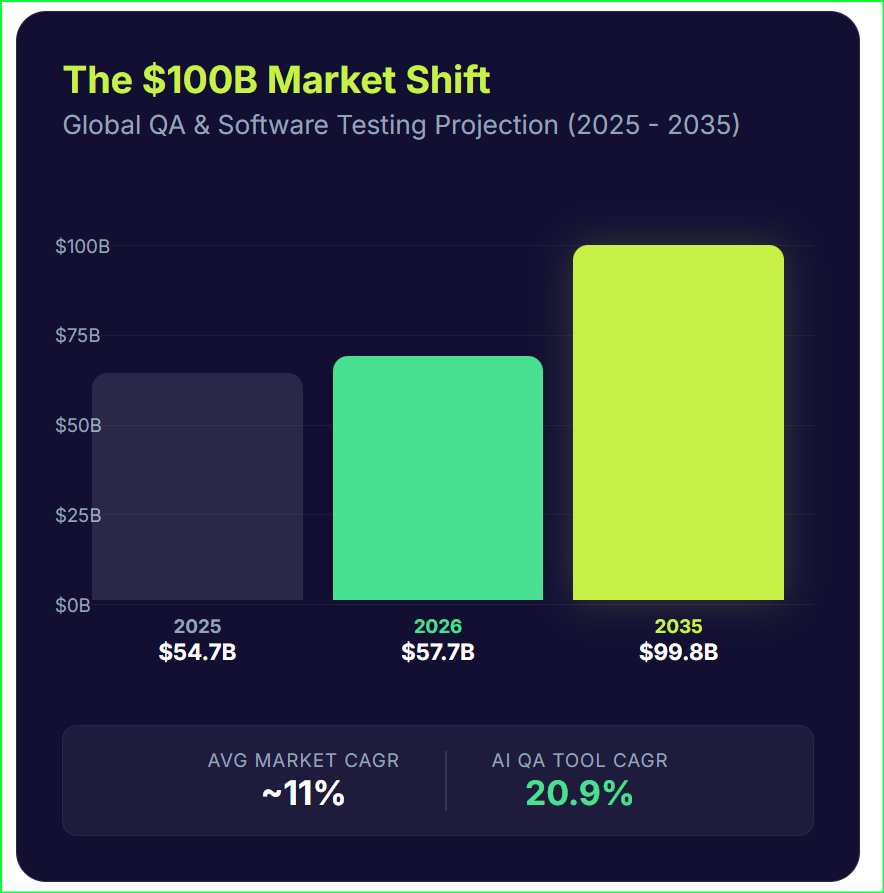
The gatekeeper model of Quality Assurance just broke. For years, we treated QA as a final checkbox before a release. We wrote static scripts and waited for results. But the math has changed. By 2026, the global testing market will hit approximately $57.7 billion. Looking further out, experts project a climb toward $100 billion by 2035.
We are witnessing a massive capital reallocation. Organizations are freezing manual headcount and moving those funds into intelligent test automation. It is a pivot from labor-intensive validation to AI-augmented intelligence. You see it in the numbers: while the general market grows at roughly 11%, AI trends in software testing show an explosive 20% annual growth rate.
This is more than a budget update. It is a fundamental dismantling of the traditional software development lifecycle. Quality is no longer a distinct phase. It is an intelligence function that permeates every microsecond of the digital value chain.
Autonomous Intent: Leaving the Brittle Script Behind
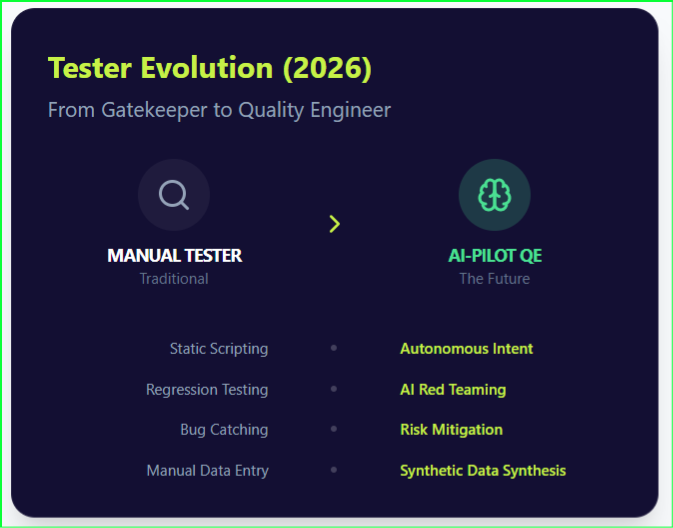
The era of writing static, fragile test cases is nearing its end. Traditional automation relies on Selenium-based scripts that break the moment a developer changes a button ID or moves a div. This “flakiness” is an expensive trap, often consuming up to 40% of a QA team’s capacity just for maintenance. We are moving toward a future where software testing predictions 2026 suggest the complete obsolescence of these brittle scripts.
Instead of following a rigid Step A to Step B path, we are deploying autonomous agents. These agents do not just execute code; they understand intent. You give an agent a goal—such as “Complete a guest checkout for a red sweater”—and it navigates the UI dynamically. It handles unexpected pop-ups and A/B test variations without crashing. This shift is so significant that analysts expect 80% of test automation frameworks to incorporate AI-based self-healing capabilities by late 2025.
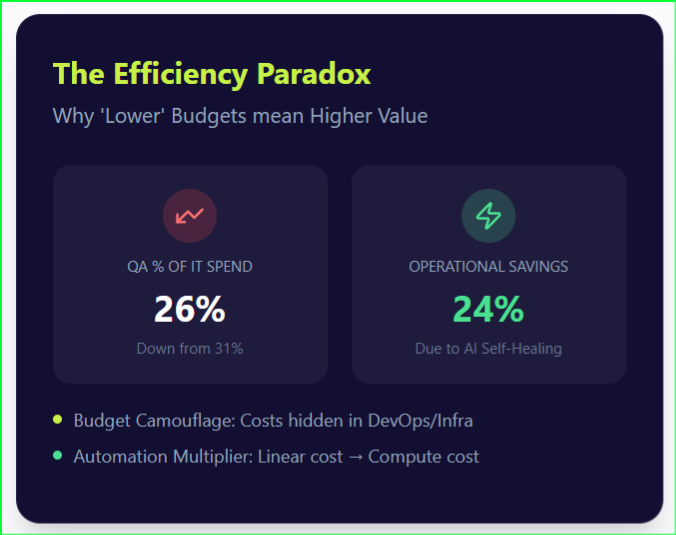
Self-healing tools use computer vision and dynamic locators to identify elements by context. If an element ID changes, the AI finds the button that “looks like” the intended target and updates the test definition on the fly. The economic impact is clear: organizations using these mature AI-driven test automation trends report 24% lower operational costs. By removing the drudgery of maintenance, your engineers finally focus on expanding coverage rather than fixing what they already built.
Intelligent Partners: The Rise of AI Copilots and the Strategic Tester
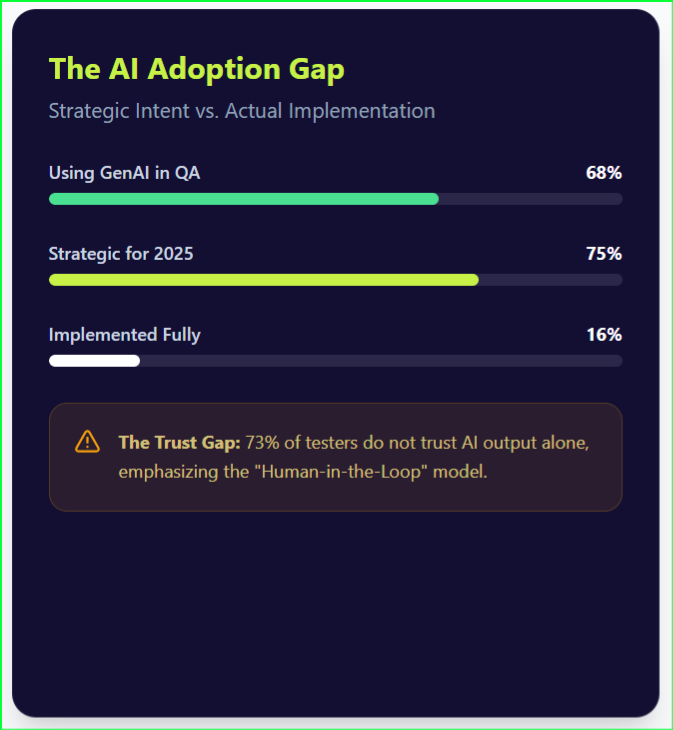
The narrative that AI will replace the human tester is incomplete. In reality, AI trends in software testing indicate a transition toward a “Human-in-the-Loop” model where AI serves as a force multiplier. Roughly 68% of organizations now utilize Generative AI to advance their quality engineering agendas. However, a significant “trust gap” remains. While 82% of professionals view AI as essential, nearly 73% of testers do not yet trust AI output without human verification.
AI copilots now handle the high-volume, repetitive tasks that previously bogged down release cycles. These tools generate comprehensive test cases from user stories in minutes, addressing the “blank page problem” for many large organizations. They also write boilerplate code for modern frameworks like Playwright and Cypress. This assistance allows future of QA automation to focus on high-level strategy rather than syntax.
The role of the manual tester is not dying; it is gentrifying into an elite skill set. We are seeing a sharp decline of manual regression testing, as 46% of teams have already replaced half or more of their manual efforts with intelligent test automation. The modern Quality Engineer acts as a strategic auditor and “AI Red Teamer,” using human cunning to trick AI systems into failure—a task no script can perform. This evolution demands deeper domain knowledge and AI literacy, as testers must now verify the probabilistic logic of LLMs.
The Efficiency Paradox: Shifting Quality Everywhere
One of the most counter-intuitive software testing predictions 2026 is the visible contraction of dedicated QA budgets. Historically, as software complexity grew, organizations funneled up to 35% of their IT spend into testing. Recent data reveals a reversal, with QA budgets dropping to approximately 26% of IT spend. This decline does not signal a deprioritization of quality; rather, it represents a “deflationary dividend” powered by intelligent test automation.
We are seeing the rise of a hybrid “Shift-Left and Shift-Right” model that embeds quality into every phase of the lifecycle. The economic logic for shifting left is irrefutable: fixing a defect during the design phase costs pennies, while fixing it post-release can cost 15 times more. By 2025, nearly all DevOps-centric organizations will have adopted shift-left practices, making developers responsible for writing unit and security tests directly within their IDEs.
Simultaneously, the industry is embracing shift-right strategies to validate software in the chaos of live production. Teams now use observability and chaos engineering to monitor real-user behavior and system resilience in real time. This constant testing loop causes a phenomenon known as “budget camouflage”.
When a developer configures a security scan in a CI/CD pipeline, the cost is often filed under “Engineering” or “Infrastructure” rather than a dedicated QA line item. The result is a leaner, more distributed future of QA automation that delivers higher reliability at a lower visible cost.
Guardians of the Model: QA’s Critical Role in AI Governance and Risk
As enterprises rush to deploy Large Language Models (LLMs) and Generative AI, a new challenge emerges: the “trust gap”. While the potential of AI is immense, nearly 73% of testers do not trust AI output alone. This skepticism stems from the probabilistic nature of LLMs, which are prone to hallucinations—generating test cases for non-existent features or writing functionally flawed code. Consequently, AI-driven test automation trends are shifting the QA focus from simple bug-hunting to robust AI governance.
Testing GenAI-based applications requires a fundamental change in methodology. Traditional deterministic testing, where a specific input always yields the same output, does not apply to LLMs. Instead, QA teams must now perform “AI Red Teaming”—deliberately trying to trick the model into producing biased, insecure, or incorrect results. This role is vital for compliance with emerging regulations like the EU AI Act, which is expected to create new, stringent testing requirements for companies deploying AI in Europe by 2026.
Modern quality engineering must also address the “Data Synthesis” challenge. Organizations are increasingly using GenAI to create synthetic test data that mimics production environments while remaining strictly compliant with privacy laws like GDPR and CCPA. This practice ensures that future of QA automation remains secure and ethical. By 2026, the primary metric for QA success will move beyond defect counts to “Risk Mitigation Efficiency,” measuring how effectively the team identifies and neutralizes the subtle logic gaps inherent in AI-driven systems.
Specialized Frontiers: Navigating 5G, IoT, and the Autonomous Horizon
The final piece of the 2026 puzzle lies in the physical world. As software expands into specialized hardware, the global 5G testing market is surging toward $8.39 billion by 2034. We are moving beyond web browsers into massive IoT ecosystems where connectivity and latency are the primary failure points. Network slicing—where operators create virtual networks optimized for specific tasks—introduces a level of complexity that traditional tools simply cannot handle.
In these high-stakes environments, such as medical IoT or autonomous vehicles, the margin for error is non-existent. While a consumer web app might tolerate three defects per thousand lines of code, critical IoT targets less than 0.1 defects per KLOC. This demand for absolute reliability is driving a massive spike in security testing, which has become the top spending priority in the IoT lifecycle. We are also seeing the explosive growth of blockchain testing, with a CAGR exceeding 50% as enterprises adopt immutable ledgers for supply chains.
Qyrus: Orchestrating the Autonomous Quality Frontier
Qyrus does not just follow AI trends in software testing; it builds the infrastructure to make them operational. As the industry moves toward agentic autonomy, Qyrus acts as the bridge. Through NOVA, our autonomous test generation engine, and Sense-Evaluate-Execute-Report (SEER), our agentic orchestration layer, we enable teams to transition from manual script-writing to goal-oriented intelligent test automation. These tools do more than suggest code; they navigate complex application logic to achieve business outcomes, fulfilling the software testing predictions 2026 that favor intent over static steps.
To solve the maintenance crisis—where “flakiness” consumes 40% of team capacity—Qyrus provides Healer AI. This self-healing technology automatically repairs brittle scripts by identifying UI changes through context and computer vision. By automating the drudgery of maintenance, Healer AI frees your engineers for high-value exploratory work.
Furthermore, Qyrus modernizes the entire stack by providing Data Testing capabilities and a unified cloud-native environment. Whether it is Web, Mobile, API, or Desktop, our platform allows developers and business users to collaborate seamlessly, making the future of QA automation a “shift-left” reality.
For specialized frontiers like BFSI and IoT, Qyrus offers enterprise-grade solutions like our Real Device Farm and dedicated SAP Testing modules. These tools are designed for high-stakes environments where reliability targets are often stricter than 0.1 defects per KLOC.
Finally, as organizations face the “trust gap” in GenAI adoption, Qyrus introduces Determinism on Demand. This ensures that while you leverage the power of probabilistic AI, your testing remains grounded in verifiable logic. Qyrus provides the governance and risk mitigation needed to turn AI-driven test automation trends into a secure, competitive advantage.
Finalizing Your Strategy: The Road to 2030
The transition from “Quality Assurance” to “Quality Engineering” is not just a change in title—it is a change in survival strategy. As we head toward 2030, the organizations that thrive will be those that treat quality as a strategic intelligence function rather than a release-day hurdle. By leveraging intelligent test automation and autonomous agents, you can bridge the “trust gap” and deliver digital experiences that are not just functional, but fundamentally trustworthy.
Looking toward, the vision is one of complete autonomy. We expect intelligent test automation to manage the entire testing lifecycle—from discovery to self-healing—without explicit human intervention. The U.S. Bureau of Labor Statistics projects a 15% growth for testers through 2034, but the roles will look very different. The successful Quality Engineer of the future will be a pilot of AI agents, focusing on strategic business value and delightful user experiences rather than manual validation.
Stop Testing the Past. Start Engineering the Future.
The leap to autonomous quality doesn’t have to be a leap into the unknown. Whether you are battling brittle scripts, scaling for 5G, or navigating the risks of GenAI, Qyrus provides the AI-native infrastructure to help you lead the shift.
Book a Demo with Qyrus Today and see how we can transform your testing lifecycle into a competitive advantage.
 February 24, 2026
  11 min