SAP Test Automation: The Complete 2026 Guide
 Varun RS

Enterprise resource planning ecosystems have evolved from being standalone databases controlled by singular architectures. Contemporary SAP ecosystems reflect highly interconnected digital structures where a solitary configuration adjustment in the Financial Accounting and Controlling (FI/CO) module can immediately cause unexpected disturbances throughout Materials Management (MM), Sales and Distribution (SD), and Human Capital Management (HCM).
The structural interdependence, when paired with SAP’s continuous release schedule, which includes significant cloud version upgrades, Feature Package Stacks (FPS), Support Package Stacks (SPS), and localized emergency transports, renders the conventional quality engineering model completely ineffective.
Manual testing is structurally and mathematically incapable of keeping pace with this release velocity.
Automation isn’t optional so much as a mandatory response to a scheduling problem: SAP ships continuous changes faster than human teams can manually re-validate the complex business processes those changes touch.
That is why SAP test automation is no longer just a clever way to cut QA costs. Today, it’s a hard requirement. To maintain stable production, manage your release timelines, and successfully execute significant system migrations without disrupting the business, manual processes are not an option.
To attain genuine test resilience, it is essential to move beyond fragile script-based validations. Today’s quality leaders must deploy scalable, workflow-driven orchestration that bridges disparate technologies, unifies legacy protocols with cloud-native web architectures, and seamlessly validates the next generation of enterprise workflows.
What Is SAP Test Automation & How It Works
At its core, SAP test automation involves utilizing dedicated software platforms to automatically carry out, verify, and oversee business processes throughout the whole SAP application environment. Instead of depending on manual operators to navigate through Transaction Codes (T-codes), input parameters, and check database conditions, automated testing performs comprehensive validation with complete consistency, traceability, and rapidity.
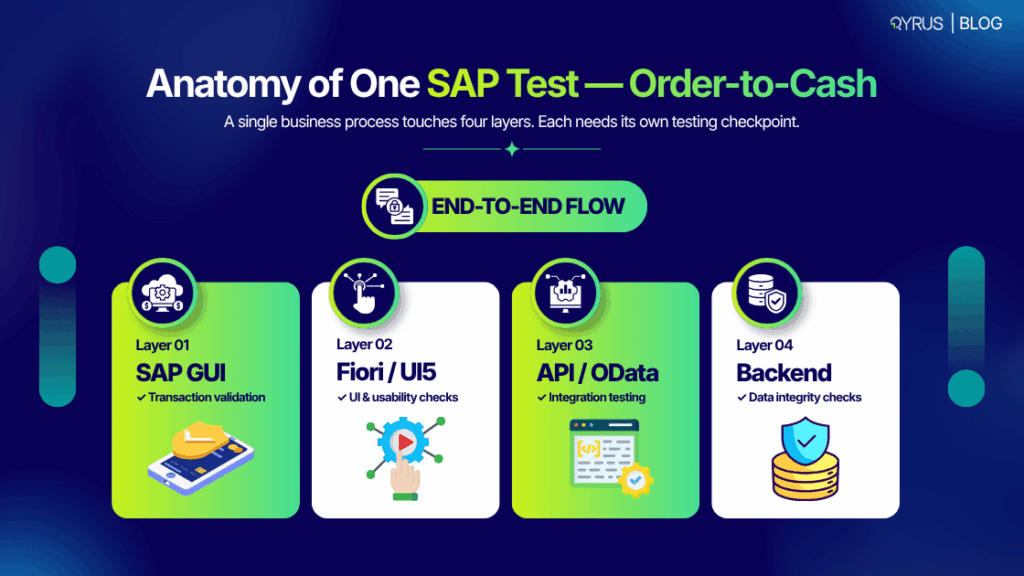
Nonetheless, automating an enterprise SAP environment is inherently more complicated than automating a typical web application. An effective SAP test automation framework for businesses should operate simultaneously across diverse UI technologies, communication protocols, and architectural layers:
- Legacy SAP GUI (WinGUI / JavaGUI): Based on proprietary SAP protocols and ActiveX-based rendering, validating the desktop GUI necessitates unique hook mechanisms that can interpret low-level SAP Scripting APIs instead of conventional web Document Object Model (DOM) elements.
- Modern SAP Fiori (SAPUI5): Testing Fiori is notoriously difficult because the underlying web framework is constantly shifting. You’re dealing with nested shadow roots, fluid CSS classes, and element IDs that regenerate every time a new session starts. If you try to rely on traditional XPath or coordinate-based selectors, your scripts will break almost instantly.
- API & Middleware Integration Layers: Core business logic frequently bypasses the UI entirely via Remote Function Calls (RFCs), Business Application Programming Interfaces (BAPIs), Intermediate Documents (IDocs), and modern OData / REST web services.
- Backend Database Validation: A test isn’t actually complete until you prove the data landed exactly where it belongs. True end-to-end validation means querying your underlying SAP HANA tables (like BSEG, BKPF, VBAK, or VBAP) to ensure financial ledgers are balanced and inventory counts are mathematically correct.
For years, teams tried to manage this technical complexity using SAP’s bundled tools, like eCATT and CBTA. Those native utilities are fine if your processes never leave the core ABAP stack.
But in the real world, enterprise workflows rarely stay inside a neat SAP bubble. The moment a transaction crosses over into Salesforce, a custom e-commerce frontend, or a third-party logistics API, those legacy tools hit a brick wall.
Modern enterprises are replacing legacy tools with specialized third-party platforms. These platforms approach quality engineering not through isolated script execution, but by treating business processes as interconnected, node-based workflows.
To understand how contemporary architectures compare across capabilities, review our technical guide to choosing the right SAP testing tools.
Why Manual SAP Testing Breaks Down
Depending on manual testing for a complicated ERP system is an inherently flawed approach, and the difficulties only increase with each new version. When an update is released and there’s no clear method to understand what it affects, QA teams find themselves in a difficult position.
They’re forced to choose between two bad options: run a quick round of basic smoke tests and just hope nothing critical breaks in production, or grind through months of manual regression testing that brings your release schedule to a dead stop.
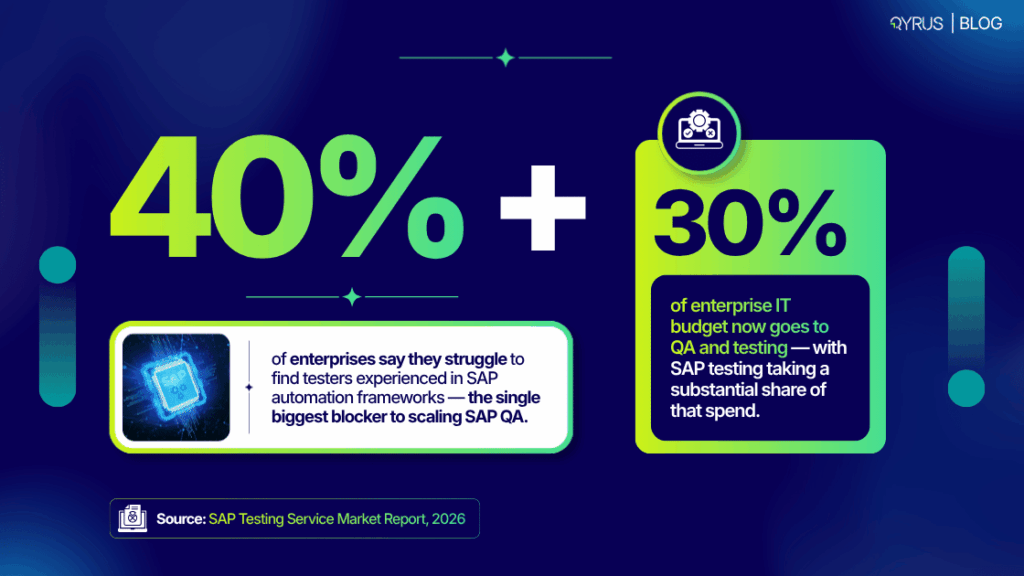
The worldwide demand for SAP testing services and software showcases the immediacy of this change. Independent market reports anticipate market valuations between USD 0.97 billion in 2026 and USD 1.79 billion by 2034, while some predictions expect growth reaching USD 4.7 billion by 2033. More than 3,000 service providers currently function within the SAP QA ecosystem, as companies dedicate as much as 30% of their total IT budgets specifically to QA and testing.
The primary reason for this expenditure is an expanding skills gap. Industry statistics indicate that over 40% of companies face challenges in locating and keeping testers with extensive expertise in intricate SAP automation frameworks.
Creating and sustaining conventional test scripts demands a rare combination of business process understanding, ABAP programming knowledge, and proficiency in test automation engineering. When scripts fail because of regular UI changes, manual testers are returned to typical execution, increasing technical debt and exhausting engineering resources.
This human-capacity issue is encountering an unchangeable architectural deadline: SAP has announced that standard support for SAP ECC ends in 2027. Sticking with a legacy ERP means paying a steep premium for extended maintenance, but moving to S/4HANA is no walk in the park. It isn’t a simple in-place software update, it is a massive architectural tear-down.
If your team doesn’t have a reliable sap test automation tool locked in before you start, your migration timeline will inevitably derail. You will find yourself trapped in endless manual regression cycles, and surprise production bugs will stall the project for months.
Core Testing Types & What to Automate First
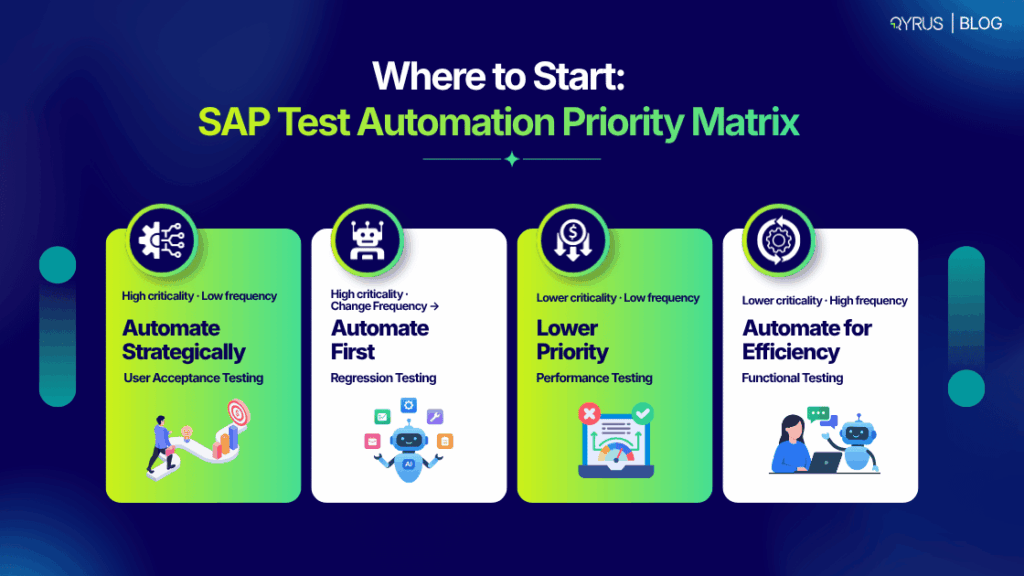
- Implementing a company-wide automation strategy doesn’t entail trying to automate every individual manual test case from the outset. Achieving sustainable success necessitates segmenting the testing area into separate functional categories and utilizing a risk-based prioritization framework.
- SAP Functional Testing: Ensuring that individual transactions, user interfaces, custom ABAP applications, and system computations operate precisely as per technical requirements. This involves confirming both positive and negative validation rules, field dependencies, currency conversions, and automatic tax calculations across separate modules. Automated functional tests act as foundational components for larger regression suites.
- SAP Regression Testing: Confirming that newly implemented transports, custom code improvements, security role changes, or support package stacks do not interfere with existing business operations. Due to the close interconnection of SAP systems, modifying an inventory valuation approach may unintentionally disrupt subsequent billing timelines or financial reports. Automated regression suites need to be designed to operate consistently in distributed environments.
- Performance & Load Testing: Moving to S/4HANA or rolling out a major Feature Package Stack isn’t just a software update. It completely rewires your underlying infrastructure, memory usage, and database query execution. Performance testing is how you prove this new architecture won’t buckle under real-world pressure. It guarantees the system stays online when it actually counts whether you are pushing through a heavy month-end financial close, handling a brutal Black Friday transaction spike, or running critical overnight payroll batch runs.
- User Acceptance Testing (UAT): We need to make sure that the whole process works the way the business teams need it to be. With tools that use low-code and node-based automation, the business analysts and the team leaders can set up and record real-life business situations without having to write any code. This makes the UAT validation into tests that we can reuse and are automated. This way, it becomes easier and saves time.
For organizations evaluating current testing methods, the most common mistake is attempting to automate edge cases too soon. Successful implementation demands precise prioritization. Begin by automating the primary “happy paths” of your crucial, high-risk business processes, the pathways that directly impact revenue or compliance, such as Order-to-Cash (O2C) or Procure-to-Pay (P2P).
Once the core processes are stabilized, extend the focus to address edge cases and integrate the suite into a more extensive SAP CI/CD testing pipeline. Approaching it incrementally is the sole method to demonstrate ROI swiftly and gain the trust of the rest of the business in the automation.
The 2026 Shift: AI Agents in your Workflow
The discipline of enterprise software quality assurance is experiencing an architectural paradigm shift. Testing has traditionally been deterministic: if a user clicks a button, the system must produce an exact, predictable output. Nonetheless, SAP’s Hannover Messe 2026 agenda has officially verified that autonomous AI agents are now functioning directly within essential enterprise transactional processes.
These smart agents are capable of making operational choices, such as adjusting purchase order routing according to live supplier risk ratings or independently addressing invoice discrepancies. This shift fundamentally expands the scope of modern quality assurance. AI-driven SAP testing is no longer restricted to using machine learning models to accelerate script authoring; it now requires validating the actual business logic and operational decisions made by autonomous AI agents operating within SAP itself.
To manage this evolving landscape, modern orchestration platforms are advancing across three essential capabilities:
| Enterprise Testing Requirement | Legacy Automation Approach | 2026 Orchestration Standard |
| Test Scope Selection | Blindly retesting massive regression suites after every transport import, wasting time and compute resources. | SAP change impact analysis inspects ABAP code and transport layers to pinpoint the exact processes at risk, enabling risk-targeted validation.
|
| UI Updates & Maintenance | Static scripts break immediately when SAP Fiori updates dynamic element IDs or CSS classes, causing massive technical debt.
| Self-healing test automation uses dynamic computer vision and DOM heuristics to fix broken object locators in real-time during execution.
|
| Test Data Provisioning | Copying static, sensitive production data into non-production environments, creating GDPR/CCPA compliance risks.
| Automated synthetic test data generation creates realistic, parameterized scenarios without exposing actual customer datasets.
|
As these technologies converge, expect the enterprise software category to keep splitting into two tiers: native, bundled tooling covering basic Fiori web scenarios, versus specialized cross-system platforms needed for anything touching the SAP GUI, complex APIs, or genuine end-to-end business workflows. For an evaluation of modern synthetic data generation tools, explore KiwiQA’s breakdown of SAP test tools.
How Qyrus Handles SAP Test Automation
Moving beyond legacy point solutions requires a fundamental shift in how organizations approach quality engineering. Traditional tools frequently stumble when attempting to link legacy desktop protocols with modern web interfaces. Test orchestration is the company solution provided by Qyrus to seamlessly validate these cross-system business flows. Qyrus serves as both the company name and the comprehensive product platform designed specifically to handle the most demanding enterprise ecosystems.
Rather than treating automated testing as isolated script files, Qyrus delivers deep architectural integration through purpose-built capabilities:
- SAP Scribe: A low-code, visual process authoring engine that allows technical QA architects and non-technical functional analysts to capture, parameterize, and orchestrate complex SAP business workflows without writing lines of brittle script code.
- ARS (Auto Recovery System) & Healer: Enterprise environments cannot tolerate test suite crashes caused by intermittent network latency or minor UI modifications. Qyrus’s ARS and Healer engines dynamically resolve broken element paths, handle unexpected system modal popups, and automatically realign object locators in real time during execution, virtually eliminating the maintenance burden.
- Cross-System End-to-End Orchestration: Real-world enterprise processes span far beyond the boundaries of an SAP application. A single automated test on Qyrus can originate in a third-party API, execute a transaction in the SAP GUI, validate the approval in SAP Fiori, and confirm the database entry in the backend without breaking session continuity.
- DataChain Technology: Resolves the test data bottleneck by automatically generating, conditioning, and injecting synthetic data entities into active test pipelines, ensuring that data availability never delays a release cycle.
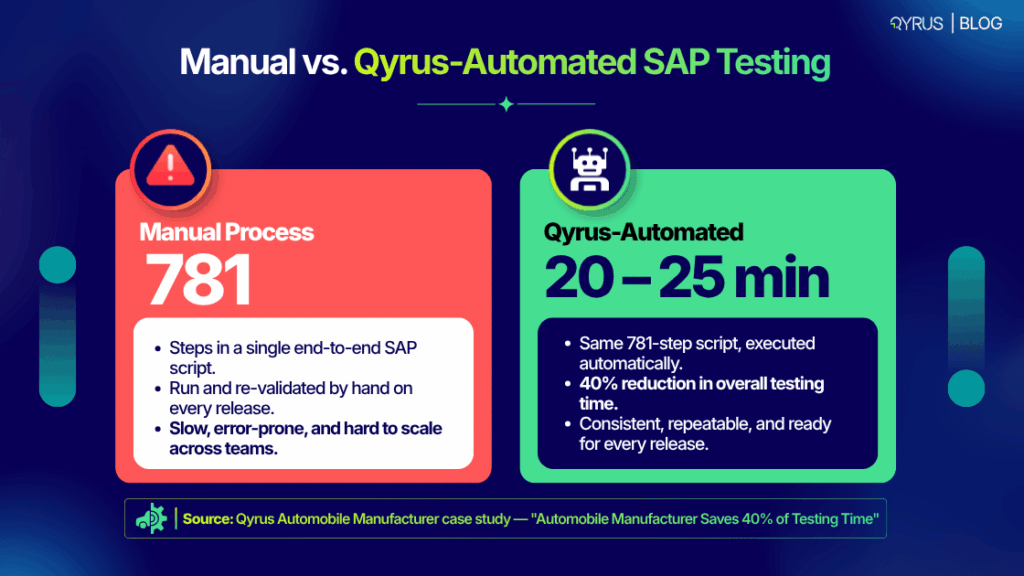
The real-world operational impact of this orchestration approach is proven across complex enterprise environments. A premier global automobile manufacturer utilized Qyrus to automate a massive, multi-departmental SAP business process comprising a 781-step end-to-end workflow. Building the complete automated test flow required just 7 to 8 hours of total authoring time on the Qyrus platform. During active release cycles, full execution was slashed to just 20 to 25 minutes, achieving a 40% total reduction in testing time compared to their manual baseline.
To read more on how this methodology scales, explore turning nightmares into triumphs with an SAP test automation tool.
Frequently Asked Questions
What’s the difference between SAP test automation and regular test automation?
Regular automation generally targets standalone web or mobile applications using standard DOM selectors. SAP automation requires specialized protocols to interact with proprietary SAP GUI scripting environments, complex ABAP-level integrations, and dynamic SAP Fiori architectures within a single test flow.
Can you automate SAP GUI and Fiori together?
Yes. Contemporary cross-system orchestration platforms enable the creation of smooth workflows that transition seamlessly between traditional SAP GUI desktop settings and modern SAP Fiori web interfaces, maintaining execution continuity.
What’s eCATT vs. CBTA?
eCATT (Extended Computer Aided Test Tool) is an older, native SAP tool primarily used for testing backend ABAP processes. CBTA (Component-Based Test Automation) is a newer native tool designed to test SAP business processes more modularly. Both often require third-party augmentation for true end-to-end testing across non-SAP enterprise applications.
What does SAP test automation cost?
Expenses differ significantly based on the scale of deployment, with options from subscription-based SaaS pricing for nimble teams to extensive enterprise site licensing. When assessing platforms, organizations need to consider typical obstacles such as significant initial setup effort and continuous script upkeep, which frequently surpass the initial software license expense.
How long does implementation take?
Traditional frameworks that rely heavily on scripts may require several months for deployment, whereas contemporary node-based orchestration platforms can frequently outline essential business processes and start running valuable regression suites in merely a few weeks.
Does it work with S/4HANA migrations?
Absolutely. Implementing a robust automation strategy is a prerequisite for migration. Automated test orchestration ensures you can run continuous validation as you move from ECC to the new data architecture. For further reading on validation requirements, see our complete guide to SAP S/4HANA migration performance testing.
Conclusion
The intersection of SAP’s 2027 ECC mainstream support cutoff, ongoing cloud release rhythms, and the integration of autonomous AI agents into transactional processes has fundamentally transformed enterprise quality engineering. Manual testing is no longer a practical operational approach; it subjects the organization to significant system failures, postponed transformation efforts, and unmanageable increases in QA budgets.
To create a robust enterprise quality framework, QA leaders need to advance past isolated tool script automation and adopt comprehensive test orchestration. By utilizing a smart platform that can validate traditional SAP GUI screens, contemporary Fiori interfaces, intricate APIs, and their underlying databases within a self-healing framework, organizations can convert testing from a hindrance in deployment into a fundamental catalyst for business speed and release assurance.
Test orchestration is the company solution provided by Qyrus to manage this exact complexity, accelerating your SAP s4hana testing release cycles while drastically reducing maintenance overhead. Request a demo to see how Qyrus automates SAP testing across GUI, Fiori, API, and backend in one flow.
Stay Ahead, Stay in the Loop with QyrusAI!
One Platform for Modernization, Quality Assurance and Intelligent IT Operations.

 October 16, 2026
  6 min
6 min