Qyrus Named a Leader in The Forrester Wave™: Autonomous Testing Platforms, Q4 2025 – Read More

Test Orchestration

Software delivery has hit a structural wall. While AI coding assistants now contribute significantly to software development, most quality assurance teams still struggle with a fragmented process. We see a growing distance between the speed of development and the rigor of validation. This gap creates a dangerous environment where teams launch features quickly, but quality remains a secondary concern because the testing phase cannot keep up. 

Traditional testing often relies on isolated scripts. These scripts perform well for specific checks, but they fail to address the complexity of modern microservices or multi-platform user journeys. Currently, 36.5% of organizations still lack any form of test orchestration. They rely on “duct-taped” manual hand-offs that slow down the entire pipeline. In fact, 35% of companies still report that manual testing represents their most significant time-consuming activity. 

To keep up with modern engineering, you must transform your approach. Automated test orchestration provides the connective tissue required to synchronize your tools and environments. It changes the focus from “did this script pass?” to “is this business process ready for production?” By implementing workflow-based test automation, you eliminate the idle time between tests and ensure every check happens at the right moment with the exact data required for success. 

What is Test Orchestration? Definition & Core Concepts 

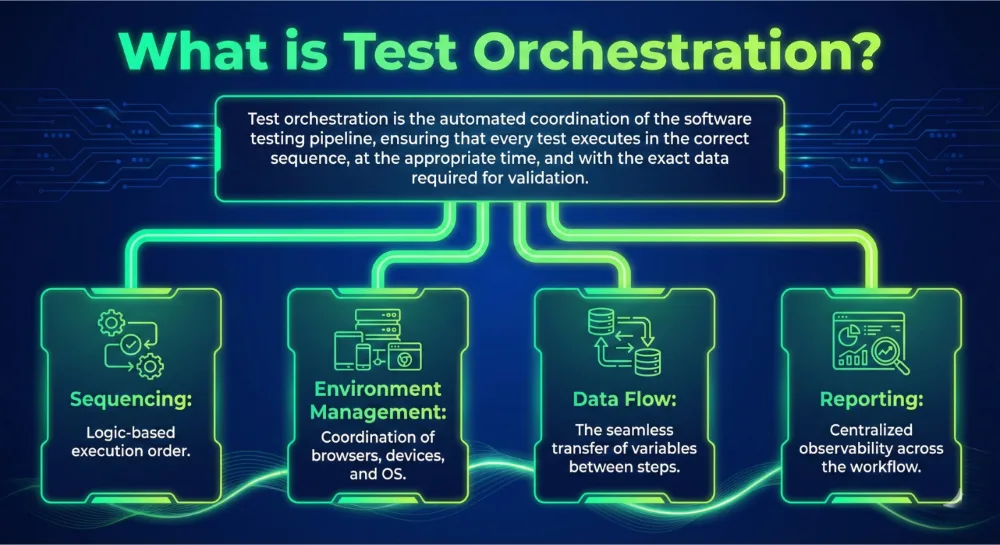
Think of test orchestration as the automated coordination of your entire software testing pipeline. It ensures every test executes in the correct sequence, at the appropriate time, and with the exact data required for validation.  
What is Test Orchestration

While traditional automation focuses on individual scripts, orchestration acts as the “connective tissue” that manages how those scripts interact across different platforms. Standalone automation validates individual functions, but orchestration manages the broader business outcome across your entire stack. (To explore the nuanced technical and operational contrasts between these two methodologies, read our detailed comparison: Test Orchestration vs Test Automation: What’s the Difference?) 

This structural shift requires a focus on four essential components. First, sequencing dictates the logical order of execution. For example, a system must validate a user’s credentials before attempting a complex transaction. Second, environment management handles the allocation of real browsers and mobile devices. Third, data flow allows the system to pass variables, such as session tokens, between disparate tests. Finally, centralized reporting aggregates every pass and failure into a single view for the engineering team. 

Transitioning to this model addresses the gaps found in basic frameworks. Research shows that 36.5% of firms still lack any form of orchestration, leaving them vulnerable to environment drift and manual bottlenecks. By implementing workflow-based test automation, you create a synchronized process where tools and data work in harmony. This move transforms testing from a series of disconnected events into a resilient, enterprise-grade pipeline. 

Breaking the Script: Why Automation Fails Without Test Orchestration 

Standard test automation handles the execution of individual scripts. It checks if a button works or if an API returns a 200 OK status. However, automation on its own lacks the structural logic to manage dependencies between different systems. This lack of coordination explains why 73% of test automation projects fail. Without a broader strategy, scripts become brittle and maintenance costs skyrocket. 

Test orchestration takes a different path. While automation focuses on the task, orchestration focuses on the workflow. It manages the entire lifecycle of a test suite across multiple environments. When you use automated test orchestration, you define the logic that guides a release. If an API login fails, the orchestrator stops the subsequent UI tests immediately. This prevents false positives and saves significant infrastructure costs. 

Differences Between Test Automation and Test Orchestration 

FeatureStandalone Test Automation Test Orchestration
Primary Focus Execution of individual scripts and tasks. Coordination of testing workflows and pipelines.
Data Management Often hardcoded or siloed per test. Dynamic data passing and state persistence.
Trigger Mechanism Manual or scheduled execution. Event-driven (commits, merges, deployments).
Environment Handling Static, often pre-configured environments. Dynamic environment provisioning and coordination.
Reporting Fragmented pass/fail logs per tool. Centralized observability and aggregated insights.
Quality Gating Manual intervention often required to halt pipelines. Automated conditional progression based on results.

Enterprise teams require more than just a collection of scripts. They need test orchestration tools that provide visibility into the entire delivery pipeline. Integration with CI/CD is the primary driver here, as 84% of developers now work in DevOps environments where speed is non-negotiable. Workflow-based test automation bridges this gap. It ensures your tests run as a synchronized unit rather than a series of ad-hoc events. Qyrus facilitates this through its visual Flow Master Hub, allowing teams to coordinate these complex sequences without writing additional code. 

Core Benefits of Test Orchestration for Enterprises 

Enterprise leaders often view testing as a necessary drag on momentum. However, shifting your strategy transforms this bottleneck into a strategic asset. By moving beyond isolated scripts, you gain total visibility into the delivery pipeline. This transparency allows development teams to identify risks early. It ensures that only high-quality code reaches your customers. 
Benefits of TO

Shattering the Black Box with Total Visibility 

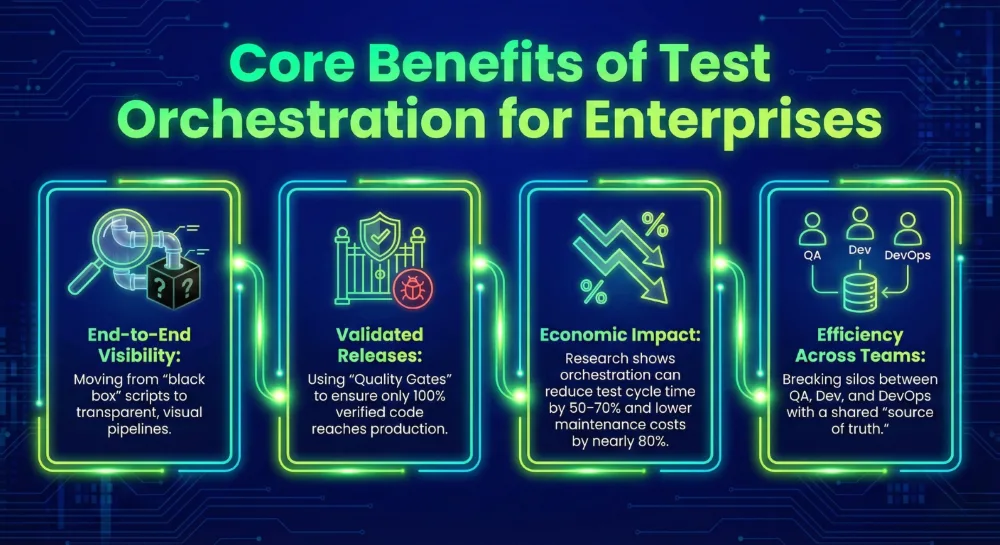
Isolated scripts often create a “black box” where results are difficult to interpret. You might see a failure, but finding the root cause requires manual digging through logs. Automated test orchestration replaces this confusion with a transparent, visual pipeline. You see every step of the user journey as it happens. This clarity allows your team to pinpoint exactly where a process breaks, whether it occurs in an API call or a mobile UI element. 

Hardening Production with Intelligent Quality Gates 

Moving fast requires guardrails. Validated releases depend on “Quality Gates” that automatically block unstable code from moving forward. Using test orchestration tools, you set specific criteria for success at every stage of the pipeline. If a critical smoke test fails, the orchestrator halts the deployment immediately. This ensures only 100% verified features reach your users, maintaining your brand’s reputation for reliability. 

The Economic Impact of Automated Test Orchestration 

The financial argument for this shift remains undeniable. Research indicates that organizations adopting these strategies experience shorter test cycles compared to those using fragmented automation. Furthermore, these teams achieve better success rate in production releases. By streamlining the validation process, you reduce maintenance overhead by nearly 80%. This efficiency frees up your budget for innovation rather than constant troubleshooting. 

Unifying Engineering through Workflow-Based Test Automation 

Traditional testing often happens in a silo, separated from development and operations. Workflow-based test automation breaks down these barriers. It provides a shared “source of truth” that every department can access and understand. When developers, QA engineers, and DevOps professionals look at the same orchestration dashboard, they collaborate more effectively. This alignment accelerates the entire lifecycle. It ensures everyone works toward the same objective: delivering value to the customer. 

What Test Orchestration Looks Like in Action 

Test orchestration moves beyond the theory of “running tests” and enters the practice of managing business risks at scale. In a modern software environment, a single release often involves an API update, a change to the web checkout UI, and a new promotion in the mobile app. Standalone scripts struggle to bridge these gaps. However, with automated test orchestration, you build a unified flow that treats these separate components as one cohesive journey. 

High-Level Workflow Examples 

The Smoke Test: Rapid Validation  

Teams use smoke tests to perform quick, automated checks of critical functionality. The goal remains simple: verify the application works at a basic level before committing further resources. A well-orchestrated smoke suite should validate critical paths in less than 15 minutes after a deployment. This rapid feedback loop allows you to detect obvious issues immediately, preventing the team from wasting time on a fundamentally broken build. 

The Regression Suite: Enterprise-Scale Chaining  

As applications grow, so does the risk of “breaking” existing features. A comprehensive regression suite often requires chaining 10 or more workflows to achieve full system validation. Using test orchestration tools, you can organize these workflows into a logical hierarchy. If the “User Authentication” workflow fails, the system automatically halts the “Payment Processing” and “Order History” flows. This prevents the “crushing weight of maintenance” often seen in legacy systems, where most test automation projects fail due to a lack of coordination. 

The API-to-Web Journey: Cross-Platform Fluidity  

Real users do not live in silos; neither should your tests. An API-to-Web journey mirrors a real-world scenario by creating a user via an API call and immediately verifying that account on the Web UI. This requires seamless data propagation, where the session token or user ID from the first node becomes the input for the next. This workflow-based test automation ensures that your back-end and front-end systems communicate perfectly. 

Real-World Architectures: The CI/CD Connection 

Effective test orchestration relies on deep integration with your existing DevOps stack. Since more than 80% developers now work in DevOps environments, your orchestration engine must respond instantly to CI/CD triggers. 

Whether you use Jenkins, Azure DevOps, or GitLab, the architecture remains consistent. When a developer pushes code to a repository, the CI/CD tool sends a trigger to the orchestration platform. The engine then selects the appropriate environment—be it Staging, UAT, or Production—and begins the execution.  

By embedding these checks directly into the pipeline, you create “Quality Gates” that block unstable code. This automated choreography ensures that your release cycle stays fast without sacrificing the reliability your customers expect. 

Anatomy of an Orchestrated Test Workflow 

Orchestration begins with sequencing. You organize tests into logical units such as authentication, onboarding, or checkout. Traditional methods run scripts one after another in a linear queue. However, modern test orchestration tools enable parallel execution logic, which can reduce execution time by up to 90%. Chaining tests ensures that a subsequent stage only begins after a prior stage succeeds. For example, if the authentication stage fails, the orchestrator halts checkout testing to save compute resources. 

Data Management and State Persistence 

Data management serves as the fuel for these workflows. Successful test orchestration requires sharing session data, tokens, and identifiers across different platforms. You must pass a customer ID from an account creation step to the purchase validation step without manual entry. Furthermore, environment persistence maintains the application state throughout the entire process. This ensures that database snapshots or session cookies remain valid as the test progresses from an API call to a mobile interface. 

Resilience Through Failure Handling 

Reliable workflows include robust failure handling to prevent brittle pipelines. If a test fails, you need a strategy beyond simple termination. Automated test orchestration allows you to define specific retry, abort, or skip logic. For instance, if a non-critical UI element fails, the system might skip that step to continue the broader validation. In contrast, a failure in the login stage should abort the entire flow to prevent false positives. Advanced platforms even use self-healing mechanisms to address UI changes, which can slash maintenance efforts by 81%. 

Centralized Analytics and Observability 

The final piece involves results and analytics. Centralized reporting dashboards aggregate logs, videos, and performance metrics from every tool in the testing suite. You track specific KPIs such as pass/fail trends and execution duration to measure the health of your workflow-based test automation. These insights transform raw outcomes into a clear picture of overall software quality. Qyrus provides this transparency through its Mind Maps, which offer a visual, hierarchical view of the entire test repository and its execution status. 

How Test Orchestration Integrates with CI/CD & DevOps 

Modern software delivery requires a seamless connection between code changes and validation. When you integrate test orchestration into your DevOps pipeline, you move beyond simple automation. Your CI/CD tools, such as Jenkins or Azure DevOps, no longer just trigger scripts; they manage a sophisticated choreography of validation steps.  

Automated test orchestration introduces intelligent quality gates. These gates evaluate the health of a build in real-time. If a critical workflow fails, the orchestrator blocks the deployment immediately. This proactive approach prevents the accumulation of technical debt and protects the user experience.  

Effective test orchestration tools also provide immediate observability. Instead of searching through logs, your team receives results directly in Slack or Jira. This rapid feedback loop allows development teams to fix bugs as soon as they appear. Workflow-based test automation ensures that every code commit undergoes a rigorous, multi-environment check before it ever touches a customer. 

Selecting the Best Test Orchestration Tools & Platforms 

Choosing from the available test orchestration tools requires an understanding of how different architectures impact your long-term maintenance. The market generally splits into three categories. First, built-in orchestration engines exist within larger testing platforms. These offer native integration but may limit your flexibility. Second, plugin tools attach to your existing CI/CD pipeline. While these provide modularity, they often lead to “tool sprawl,” where engineers spend more time managing integrations than writing tests. Finally, full platform orchestration stacks provide a unified environment for cross-platform validation. 

Transitioning to a unified platform often reveals the inherent limitations of older, siloed testing models that lack cross-protocol support. (If your team currently relies on older frameworks, you should examine Why Traditional Component Testing Breaks at Scale to understand why a shift to orchestration is mandatory for enterprise growth.) 

The debate between code-based orchestration and visual workflow builders also shapes your team’s productivity. Code-based frameworks provide deep customization for highly technical teams. However, they often recreate the “crushing weight of maintenance” that causes test automation projects to fail. In contrast, visual builders democratize the process. They allow manual testers and product owners to contribute to the quality strategy without learning complex syntax. This shift is vital because 35% of companies still struggle with manual testing as their primary bottleneck. 

Orchestrating at Scale with Qyrus 

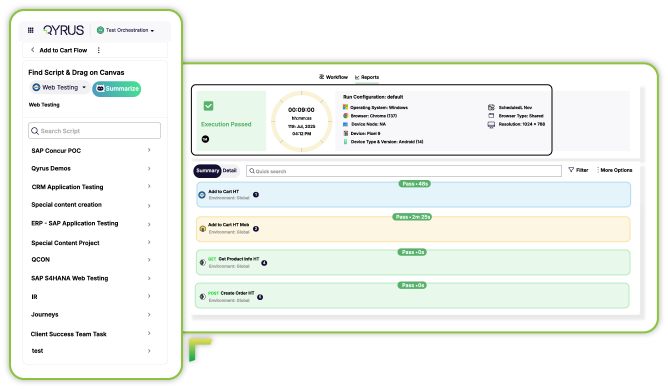
Qyrus offers a next-generation approach to automated test orchestration through its dedicated TO module. This platform eliminates the obstacles that hinder team progress by providing a high-performance environment for complex test scenarios. 

  • Flow Master Hub: This is your command center. Use the advanced drag-and-drop interface to create and edit test flows visually. It handles intricate user journeys across Web, Mobile, API, and Desktop platforms in a single execution. 
  • The Vault: Scale requires organization. The Vault provides a hierarchical structure to categorize projects by environments like QA, UAT, and Production. Advanced nesting and filtering tools ensure your team never wastes time hunting for the correct files. 
  • SmartFlow Mapping: Rigid paths lead to fragile tests. This feature adapts to live conditions during execution. If a login fails or a transaction lacks a balance, the mapper reroutes the test automatically to handle the edge case. 
TEST ORCHESTRATION

See How Qyrus Orchestrates Complex Test Workflows 

Best Practices for Successful Test Orchestration 

Moving from fragmented automation to a cohesive delivery pipeline requires more than just new software. It demands a shift in how your team perceives the lifecycle of a test. Success depends on treating your quality infrastructure with the same rigor as your production code. By following proven engineering standards, you ensure your test orchestration remains maintainable even as your application grows in complexity. 
 

TO Best Practices

Architecting the Journey Before Writing a Single Script 

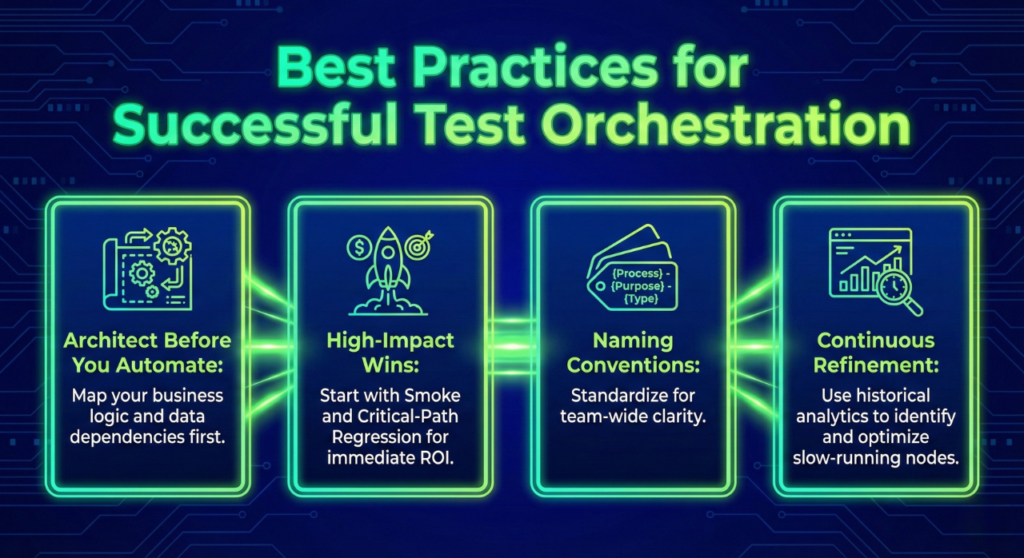
Many teams rush into automation without mapping their business logic first. This lack of planning is a primary reason why most test automation projects fail to deliver long-term value. You must define your data contracts and system dependencies before building workflows. Identify which services require session persistence and where data must flow between platforms. Establishing these blueprints early prevents the creation of brittle, “duct-taped” sequences that break during minor updates. 

Prioritizing the Critical Path for Immediate Returns 

Avoid the temptation to orchestrate every minor feature at once. Start with high-impact workflows that protect your core revenue streams. Focus on building a robust smoke suite that validates critical paths in less than 15 minutes. Once you stabilize these essential checks, expand into complex regression suites. This incremental approach allows your team to demonstrate immediate ROI while gradually reducing the manual testing bottleneck. 

Maintaining Integrity Through Centralized Governance 

Reliable workflow-based test automation requires strict separation of environments. Never hardcode credentials or URLs within your scripts. Instead, use test orchestration tools to manage environment-specific variables for Dev, Staging, and Production. Centralizing your data management through a “Data Hub” ensures that every team member uses the same verified datasets. This practice eliminates the “it works on my machine” syndrome and ensures your results remain consistent across different infrastructure tiers. 

Closing the Loop with Performance-Driven Refinement 

Orchestration is not a “set and forget” activity. You must continuously monitor KPIs and failure trends to identify bottlenecks. If a specific node consistently delays your pipeline, use performance optimization patterns like parallel execution to reclaim time. Research shows that refining these sequences can improve execution speed by 40-50%. By analyzing historical reports and adjusting your retry logic, you transform automated test orchestration from a simple execution engine into a high-performance asset. 

The Road Ahead: Building a Sustainable Culture of Quality 

The shift to test orchestration marks a fundamental change in how enterprises deliver software. While standalone scripts once served a specific purpose, they cannot keep up with the speed of modern code generation. Adopting automated test orchestration is no longer a luxury. It is a prerequisite for survival in a market where many organizations still struggle with fragmented pipelines. By treating your quality layer as a first-class engineering citizen, you achieve the near perfect success rate required for enterprise scale. 

Transitioning your team requires a clear roadmap. First, map your core business processes and identify the data dependencies between systems. Second, define your “Quality Gates” to ensure only verified code moves forward. Finally, integrate your workflow-based test automation with your existing CI/CD tools. This incremental approach prevents the “crushing weight of maintenance”. 

Qyrus simplifies this journey by offering a unified environment for cross-platform validation. Our platform allows you to move away from rigid, siloed testing and toward a coordinated, visual strategy. Whether you are validating complex banking transfers or e-commerce user journeys, our test orchestration tools provide the precision and control you need to lead your industry. We help you move beyond ad-hoc scripts to build a resilient infrastructure that grows with your organization. 

Don’t let legacy testing methods hold back your engineering velocity. Contact us today for a personalized ROI report or schedule a demo to see how Qyrus can transform your testing into a direct driver of business growth. 

Devops Conclave

Save the Date:
📅 March 13th, 2026 
📍 Taj MG Road, Bengaluru 

If you’ve been keeping an eye on how fast DevOps is evolving across the enterprise, you already know one thing for sure: innovation doesn’t slow down for anyone. That’s exactly why we’re excited to share some big news. Qyrus is proud to be a Platinum Sponsor at the 11th Edition of the DevOps Conclave & Awards 2026, happening this March in Bengaluru. 

Over the years, DevOps Conclave has earned its place as a must-attend event for leaders, practitioners, and builders who care deeply about the future of software delivery. It’s not just another conference. It’s a space where real conversations happen, ideas are challenged, and the next phase of DevOps takes shape. 

If this event isn’t already on your calendar, here’s why it should be. DevOps Conclave brings together forward-thinking teams and technology leaders to talk openly about what’s working, what’s broken, and what needs to change. This year’s agenda dives into AI-powered DevOps, platform engineering, cloud-native innovation, GitOps, and the evolving practices that are redefining how software is built and delivered at scale. It’s practical, relevant, and grounded in real-world experience. 

The Big Stage: Ameet Deshpande on the Future of Engineering 

If you’ve spent any time in the product engineering world, you’ve probably heard the word “efficiency” thrown around more times than you can count. Too often, it becomes a catch-all phrase that hides manual effort, fragmented tooling, and growing complexity. We think it’s time to have a more honest conversation. 

That’s where this year gets even more exciting for us. Ameet Deshpande, SVP of Product Engineering at Qyrus, will be delivering a keynote at the Conclave. Ameet has spent years working closely with engineering teams to modernize how they design, test, and ship software. His perspective goes beyond theory. It’s rooted in what teams actually face every day. 

Ameet doesn’t just talk about trends. He challenges assumptions, asks uncomfortable questions, and offers practical ways to move forward. Expect clarity, thoughtful insights, and a dose of healthy disruption that will leave you rethinking how engineering organizations operate. 

Why We’re All In 

DevOps Conclave has always stood out for one reason. It’s a place where leaders share not just their wins, but the hard-earned lessons that come from scaling complex systems. This year’s focus on Platform Engineering and Developer Experience feels especially relevant to us at Qyrus. 

We believe the best tools are the ones that get out of the way, reduce friction, and let teams focus on building great software. As Platinum Sponsor, we’re looking forward to connecting with architects, VPs of Engineering, DevOps leaders, and hands-on practitioners who are shaping the next generation of digital-first operations. 

Whether you’re leading DevOps strategy, working on the front lines of delivery, managing product releases, or exploring how AI is changing automation, there’s real value here. Beyond the sessions, the conversations, debates, case studies, and awards make DevOps Conclave & Awards 2026 a true hub for what’s next. 

So, if you’re planning your DevOps roadmap for the year ahead, join us in Bengaluru. Stop by the Qyrus booth, attend Ameet’s keynote, and let’s talk about the future of quality, automation, and delivery. This isn’t about buzzwords. It’s about meaningful transformation, and we’re proud to be part of it. 

The integrity of a data pipeline often depends on more than just the number of connections you can make. Engineering leaders frequently get caught in a “connector race,” assuming that more source integrations equate to better protection. In reality, poor data quality remains a massive financial leak, costing organizations an average of $12.9 million every single year. 

Choosing between a deep specialist and a unified platform requires a strategic look at your entire software lifecycle. QuerySurge serves as a high-precision tool for ETL specialists, offering a massive library of 200+ data store connections and a mature DevOps for Data solution with 60+ API calls.  

Conversely, Qyrus Data Testing acts as a modern “TestOS,” designed for teams that need to validate the entire user journey—from a mobile app click to the final database record. While QuerySurge secures its reputation through sheer connectivity, Qyrus wins by eliminating the silos between Web, Mobile, API, and Data testing. 

The Rolodex vs. The Pulse: Rethinking the Value of Connector Count 

Connectivity often serves as a vanity metric that masks actual utility. QuerySurge dominates this category with a library of 200+ data store connections, providing a bridge to almost any legacy database an ETL developer might encounter. This massive reach makes it a powerful specialist for deep data warehouse validation. 

Data Source Connectivity

FeatureQyrus Data TestingTricentis Data Integrity

SQL Databases

MySQL
PostgreSQL
MS SQL Server
Oracle
IBM DB2
Snowflake
AWS Redshift
Azure Synapse
Google BigQuery
Netezza

NoSQL Databases

MongoDB
DynamoDB
Cassandra
Hadoop/HDFS

Cloud Storage & Files

AWS S3
Azure Data Lake (ADLS)
Google Cloud Storage
SFTP
CSV/Flat Files
JSON Files
XML Files
Excel Files
Parquet

APIs & Applications

REST APIs
SOAP APIs
GraphQL
SAP Systems
Salesforce

Legend: ✓ Full Support | ◐ Partial/Limited | ✗ Not Available 

However, most engineering teams find that the Pareto Principle governs their pipelines. Research shows that 80% of enterprise integration needs require only 20% of available prebuilt connectors. Qyrus focuses its 10+ core SQL connectors on this “vital few,” including high-traffic environments like Snowflake and Amazon Redshift. 

The true danger lies in the “integration gap.” Large enterprises manage hundreds of apps but only integrate 29% of them, leaving vast amounts of data unmonitored at the source. Qyrus closes this gap by validating the REST, SOAP, and GraphQL APIs that feed your warehouse. You gain visibility into the data journey before it reaches the storage layer. QuerySurge builds a bridge to every destination, but Qyrus puts a pulse on the application layer where the data actually lives. 


The Scalpel vs. The Shield: Precision Testing for Modern Pipelines 

Validation logic determines whether your data warehouse becomes a strategic asset or a digital graveyard. Organizations lose an average of $12.9 million annually because they fail to catch structural and logical errors before they impact downstream analytics. Choosing between QuerySurge and Qyrus Data Testing depends on whether you need a specialized surgical tool or a broad, integrated safety net. 

QuerySurge operates as a precision instrument for the deep ETL layers. It masters high-complexity tasks like validating Slowly Changing Dimensions (SCD) and maintaining Data Lineage Tracking. Engineers use its specialized query wizards to perform exhaustive source-to-target comparisons and column-level mapping across massive datasets. While it handles the heavy lifting of data warehouse validation, its BI report testing for platforms like Tableau or Power BI requires a separate add-on. This makes QuerySurge a powerhouse for teams whose world revolves strictly around the storage layer. 

Testing & Validation Capabilities

Feature Qyrus Data Testing Tricentis Data Integrity

Comparison Testing

Source-to-Target Comparison
Full Data Comparison
Column-Level Mapping
Cross-Platform Comparison
Reconciliation Testing
Aggregate Comparison (Sum, Count)

Single Source Validation

Row Count Verification
Data Type Verification
Null Value Checks
Duplicate Detection
Regex Pattern Validation
Custom Business Logic/Functions
Referential Integrity Checks
Schema Validation

Advanced Testing

Transformation Testing
ETL Process Testing
Data Migration Testing
BI Report Testing
Tableau/Power BI Testing
Pre-Screening / Data Profiling
Data Lineage Tracking

Qyrus takes a more expansive approach by securing the logic across the entire software stack. It provides robust source-to-target and transformation testing, but its true strength lies in its Lambda function support. You can write custom code to validate complex business rules that standard SQL checks might miss. This flexibility allows teams to verify single-column and multi-column transformations with surgical precision. By bridging the gap between APIs and databases, Qyrus ensures that your data validation doesn’t just stop at the table but starts at the initial point of entry. 

Relying on simple row counts is like checking a bank’s vault while ignoring the identity theft at the front desk. Your data quality validation in ETL must secure the logic, not just the volume. 

Velocity vs. Variety: Scaling Your Pipeline Without the Scripting Tax 

Automation serves as the engine that moves quality from a bottleneck to a competitive advantage. When teams rely on manual scripts, they often spend more time maintaining tests than building features. Efficient ETL testing automation tools must do more than just execute code; they must reduce the cognitive load on the engineers who build them. 

QuerySurge addresses this through its “DevOps for Data” framework. It provides 60+ API calls and comprehensive Swagger documentation to support highly technical teams. This maturity allows engineers to bake data testing directly into their CI/CD pipelines with surgical control. QuerySurge also includes AI-powered test generation from mappings, which helps bridge the gap between initial design and execution. It remains a favorite for teams that want to manage their data integrity as code. 

Automation and Integration 

Feature Qyrus Data Testing Tricentis Data Integrity

Test Automation

No-Code Test Creation
Low-Code Options
SQL Query Support
Visual Query Builder
Test Scheduling
Reusable Test Components
Parameterized Testing

AI/ML Capabilities

AI-Powered Test Generation
Auto-Mapping of Columns
Self-Healing Tests
Generative AI for Test Cases

DevOps/CI-CD Integration

REST API
Jenkins Integration
Azure DevOps
GitLab CI
GitHub Actions
Webhooks

Issue & Test Management

Jira Integration
ServiceNow Integration
Slack/Teams Notifications
Email Notifications

Qyrus prioritizes democratization and speed through its Nova AI engine. Instead of requiring manual mapping for every scenario, the platform uses machine learning to identify data patterns and generate test functions automatically. This approach allows teams to build test cases 70% faster than traditional scripting methods. Qyrus also integrates natively with Jira, Jenkins, and Azure DevOps, ensuring that quality remains a shared responsibility across the software lifecycle. While QuerySurge empowers the specialist with a robust API, Qyrus empowers the entire organization with an intelligent, no-code TestOS. 

Velocity requires more than just running tests fast. It requires a platform that minimizes technical debt and maximizes the reach of every test case. 

The Forensic Lens: Turning Raw Rows into Actionable Insights 

Visibility transforms a silent database into a strategic asset. Without clear reporting, teams often overlook the underlying causes of the $12.9 million annual loss attributed to poor data quality. Choosing between QuerySurge and Qyrus depends on whether you value deep forensic snapshots or a live, unified pulse of your entire stack. 

Reporting and Analytics 

Feature Qyrus Data Testing Tricentis Data Integrity
Real-Time Dashboards
Drill-Down Analysis
Root Cause Analysis
PDF Report Export
Excel Report Export
Trend Analysis
Data Quality Metrics
Custom Report Templates
BI Tool Integration (Tableau, Power BI)
Audit Trail

QuerySurge offers a mature reporting engine designed for the deep ETL specialist. Its “DevOps for Data” solution leverages 60+ API calls to push detailed validation results directly into your existing management tools. While it provides comprehensive drill-down analysis into data discrepancies, testing BI reports like Tableau requires a separate BI Tester add-on. This makes it a powerful forensic tool for those who need to document every byte of the transformation process. 

Qyrus delivers visibility through a unified dashboard that tracks the health of Web, Mobile, API, and Data layers in a single view. By consolidating these signals, the platform helps organizations eliminate the fragmentation. Qyrus uses its Nova AI engine to flag anomalies and provide real-time metrics that allow for immediate corrective action. It removes the guesswork from quality assurance by presenting a 360-degree mirror of your digital operations. 

Actionable intelligence must move faster than the data it monitors. Whether you require the detailed documentation of QuerySurge or the unified agility of Qyrus, your reporting should reveal the truth before a defect reaches production. 

Scaling the Wall: Choosing an Architecture for Absolute Data Trust 

Your deployment strategy dictates the long-term agility and security of your testing operations. Both platforms provide the essential flexibility of Cloud (SaaS), On-Premises, and Hybrid models. However, the underlying infrastructure philosophies differ to meet distinct organizational needs. 

Platform and Deployment 

Feature Qyrus Data Testing Tricentis Data Integrity
Cloud (SaaS)
On-Premises
Hybrid Deployment
Docker Support
Kubernetes Support
Multi-Tenant
SSO/LDAP
Role-Based Access Control
Data Encryption (AES-256)
SOC 2 Compliance

QuerySurge provides a battle-tested environment optimized for enterprise-grade security. It employs a per-user licensing model with a minimum five-user package, ensuring a dedicated footprint for professional data teams. Its mature security framework supports SSO/LDAP and RBAC to maintain strict access control over sensitive data environments. This makes it a natural fit for traditional enterprises that require a stable, proven infrastructure for their deep warehouse validation. 

Qyrus Data Testing prioritizes modern, containerized workflows for teams that demand rapid scaling. The platform fully supports Docker and Kubernetes. This allows you to manage your ETL testing automation tools within your own private cloud or local environment with minimal friction. Qyrus uses AES-256 encryption and holds a solid platform score. Qyrus empowers cloud-native teams to move fast without the heavy overhead of legacy setup requirements. 

Infrastructure should never act as a bottleneck for quality. Whether you choose the established maturity of QuerySurge or the containerized flexibility of Qyrus, your platform must align with your broader IT strategy. 

The Final Verdict: Choosing Your Data Sentinel 

The choice between these two powerhouses depends on the focus of your engineering team. 

Qyrus vs. QuerySurge: Strategic Differentiators 

VendorUnique Strengths Best For
Qyrus Data Testing
  • Unified testing platform (Web, Mobile, API, Data)
  • AI-powered function generation
  • Lambda function support for validations
  • Single-column & multi-column transformations
  • Part of comprehensive TestOS ecosystem
Organizations looking for unified testing across all layers; Teams already using Qyrus for other testing needs.
QuerySurge
  • 200+ data store connections
  • Strongest DevOps for Data (60+ APIs)
  • AI-powered test generation from mappings
  • Query Wizards for non-technical users
  • Best ETL testing focus
Data warehouse teams; ETL developers; Organizations with highly diverse data sources.

Choose QuerySurge if your primary mission involves deep ETL testing and data warehouse validation across hundreds of legacy sources. Its 200+ data store connections and mature DevOps APIs make it the ultimate specialist for data-centric organizations. It delivers the forensic precision required for massive transformation projects. 

Choose Qyrus if you want to consolidate your quality strategy into a single “TestOS” that covers Web, Mobile, API, and Data. By leveraging Nova AI to build test cases 70% faster, Qyrus helps you eliminate the “fragmentation tax” that drains millions from modern QA budgets. It offers a unified path to data trust for organizations that value full-stack visibility. 

Stop managing icons and start mastering the journey. Begin your 30-day sandbox evaluation today to verify your integrity across every layer of the stack. 


Qyrus Data Testing and Tricentis compare

Modern business depends entirely on the integrity of the information flowing through its systems. Poor data quality costs organizations an average of $12.9 million annually, making the choice of validation tools a high-stakes executive decision.  

Tricentis Data Integrity stands as the established player. Meanwhile, Qyrus Data Testing emerges as a unified “TestOS” challenger, designed for teams that prioritize full-stack agility and AI-driven efficiency. Qyrus offers a streamlined testing experience with a focus on consolidating Web, Mobile, API, and Data testing into one environment.  

The Connectivity Illusion: Why 200 Connectors Might Still Leave You Blind 

Volume often acts as a smokescreen for actual utility in the enterprise testing market. 

Tricentis commands the lead in sheer breadth, offering a massive library of 50+ SQL connectors and deep, specialized support for SAP systems and Salesforce. This exhaustive reach positions them big in the data connectivity category. Large organizations with legacy-heavy footprints view this as a non-negotiable safety net for complex IT environments. 

Data Source Connectivity

FeatureQyrus Data TestingTricentis Data Integrity

SQL Databases

MySQL
PostgreSQL
MS SQL Server
Oracle
IBM DB2
Snowflake
AWS Redshift
Azure Synapse
Google BigQuery
Netezza

NoSQL Databases

MongoDB
DynamoDB
Cassandra
Hadoop/HDFS

Cloud Storage & Files

AWS S3
Azure Data Lake (ADLS)
Google Cloud Storage
SFTP
CSV/Flat Files
JSON Files
XML Files
Excel Files
Parquet

APIs & Applications

REST APIs
SOAP APIs
GraphQL
SAP Systems
Salesforce

Legend: ✓ Full Support | ◐ Partial/Limited | ✗ Not Available 

However, the Pareto Principle reveals a different reality for modern data teams. 

Research indicates that 80% of enterprise data integration needs require only 20% of available connectors. While platforms like Airbyte offer up to 600 options, the vast majority of high-value workloads concentrate on a “vital few”: MySQL, PostgreSQL, MongoDB, Snowflake, Amazon Redshift, and Amazon S3. 

Qyrus focuses its 75% connectivity score exactly on these critical hubs. It masters the SQL connectors and cloud storage platforms that drive current digital transformations. 

The integration gap is real. Large enterprises manage an average of 897 applications yet only 29% of them are actually integrated. Qyrus bridges this gap by validating the REST, SOAP, and GraphQL APIs that feed your pipelines. It prioritizes the connections that matter most to your daily operations rather than maintaining a list of nodes you will never use. 

Securing the Core: Why Data Validation is the New Standard for Quality 

Precision in data validation determines the difference between a high-performing enterprise and a costly financial sinkhole. While connectivity creates the bridge, validation ensures the cargo remains intact. Organizations currently lose a staggering $12.9 million annually due to poor data quality, making advanced testing capabilities more critical than ever. 

Tricentis Data Integrity excels in deep-layer requirements like slowly changing dimensions (SCD) and data lineage tracking, which are vital for regulated industries needing to prove data history.  

Its “Pre-screening wizard” acts as a high-speed filter, catching structural defects before they enter the processing pipeline. Large, SAP-centric organizations rely on this model-based approach to prioritize risks across complex, multi-layered environments.  

Testing & Validation Capabilities

Feature Qyrus Data Testing Tricentis Data Integrity

Comparison Testing

Source-to-Target Comparison
Full Data Comparison
Column-Level Mapping
Cross-Platform Comparison
Reconciliation Testing
Aggregate Comparison (Sum, Count)

Single Source Validation

Row Count Verification
Data Type Verification
Null Value Checks
Duplicate Detection
Regex Pattern Validation
Custom Business Logic/Functions
Referential Integrity Checks
Schema Validation

Advanced Testing

Transformation Testing
ETL Process Testing
Data Migration Testing
BI Report Testing
Tableau/Power BI Testing
Pre-Screening / Data Profiling
Data Lineage Tracking

Qyrus Data Testing takes an agile path, focusing on most core validation tasks that drive daily business decisions. It provides unique value through Lambda function support, allowing teams to inject custom business logic directly into its automated data quality checks. This “TestOS” approach bridges the gap between different layers, enabling you to verify that a mobile app transaction accurately reflects in your cloud warehouse. While it currently skips BI report testing, Qyrus offers a faster, no-code route for teams wanting to eliminate the “garbage in” problem at the point of entry. 

Precision testing must move beyond simple row counts to secure your strategic truth. If your ETL data testing framework cannot see the logic within the transformation, you are only protecting half of your pipeline. 

Beyond the Script: Scaling Quality with Intelligent Velocity 

Automation serves as the engine that moves data quality from a reactive chore to a proactive strategy. Organizations that fail to automate their pipelines see maintenance costs consume up to 70% of their total testing budget. Modern teams now demand more than just recorded scripts; they need platforms that think. 

Tricentis utilizes a model-based approach that decouples the technical steering from the test logic, allowing for resilient automation that doesn’t break with every UI change. With over 100 API calls and native support for the entire SAP ecosystem, it fits seamlessly into the most rigid enterprise CI/CD pipelines. Its “Pre-screening wizard” further accelerates the process by identifying early data errors before heavy testing begins.

Automation and Integration  

Feature Qyrus Data Testing Tricentis Data Integrity

Test Automation

No-Code Test Creation
Low-Code Options
SQL Query Support
Visual Query Builder
Test Scheduling
Reusable Test Components
Parameterized Testing

AI/ML Capabilities

AI-Powered Test Generation
Auto-Mapping of Columns
Self-Healing Tests
Generative AI for Test Cases

DevOps/CI-CD Integration

REST API
Jenkins Integration
Azure DevOps
GitLab CI
GitHub Actions
Webhooks

Issue & Test Management

Jira Integration
ServiceNow Integration
Slack/Teams Notifications
Email Notifications

Qyrus Data Testing counters with a heavy focus on democratization through Nova AI. This intelligent engine automatically generates testing functions and identifies data patterns, helping teams build test cases 70% faster than manual methods. Qyrus emphasizes a “no-code” philosophy that allows manual testers to contribute to the ETL data testing framework without learning complex coding languages. It integrates directly with Jira, Jenkins, and Azure DevOps to ensure that automated data quality checks remain part of every code push. 

True velocity requires a platform that minimizes technical debt while maximizing coverage. Whether you lean on Tricentis’ enterprise-grade models or Qyrus’ AI-powered speed, your ETL testing automation tools must remove the human bottleneck from the pipeline. 

The Digital Mirror: Transforming Raw Data into Strategic Intelligence 

Visibility acts as the final safeguard for your information integrity. Without robust analytics, even the most sophisticated automated data quality checks remain silent. Organizations that lack transparent reporting struggle to identify the root cause of data corruption, often treating symptoms while the underlying disease persists. 

Tricentis Data Integrity secures a perfect score for reporting and analytics. It provides deep-drill analysis that allows engineers to trace a failure from a high-level dashboard down to the specific row and column. This platform excels at Root Cause Analysis (RCA), helping teams determine if a failure stems from a physical hardware fault, a human configuration error, or an organizational process breakdown. Furthermore, it offers complete integration with BI tools like Tableau and Power BI, ensuring your executive reports are as verified as the data they display. 

Reporting and Analytics

Feature Qyrus Data Testing Tricentis Data Integrity
Real-Time Dashboards
Drill-Down Analysis
Root Cause Analysis
PDF Report Export
Excel Report Export
Trend Analysis
Data Quality Metrics
Custom Report Templates
BI Tool Integration (Tableau, Power BI)
Audit Trail

Qyrus Data Testing earns a 72% category score with its modern, real-time approach. Its dashboards focus on “Operational Intelligence,” providing immediate access to KPIs so you can react to changing conditions in seconds. Qyrus emphasizes automated audit trails to ensure compliance without manual paperwork. While its root cause and trend analysis features are currently in Beta, the platform provides the essential visibility needed for high-velocity teams to act with confidence. 

A real-time dashboard is not just a display; it is a tool that shortens the time to a decision. Whether you require the deep forensic reporting of Tricentis or the agile, live signals of Qyrus, your data quality testing tools must turn your pipeline into an open book. 

Fortresses and Clouds: Choosing Your Infrastructure Architecture 

Your choice of deployment model dictates the ultimate control you maintain over your sensitive information. Both platforms offer the flexibility of Cloud (SaaS), On-Premises, and Hybrid deployment models. However, the maturity of their security frameworks marks a significant divergence for regulated industries. 

Platform and Deployment

Feature Qyrus Data Testing Tricentis Data Integrity
Cloud (SaaS)
On-Premises
Hybrid Deployment
Docker Support
Kubernetes Support
Multi-Tenant
SSO/LDAP
Role-Based Access Control
Data Encryption (AES-256)
SOC 2 Compliance

Qyrus Data Testing earns a strong platform score by prioritizing modern, containerized workflows. The platform fully supports Docker and Kubernetes for teams that want to manage their ETL testing automation tools within a private, scalable infrastructure. It employs AES-256 encryption and Single Sign-On (SSO) for secure authentication. This makes Qyrus an excellent fit for agile, cloud-native organizations that value technical flexibility over legacy certifications. 

If your team demands a lightweight, containerized environment that scales with your code, Qyrus provides the modern edge. 

The Verdict: Architecting Your Truth in a Data-First World 

The decision between Tricentis Data Integrity and Qyrus Data Testing ultimately hinges on the scope of your quality mission. Both platforms eliminate the risk of manual error, but they serve different strategic masters. 

Tricentis Data Integrity provides an exhaustive, enterprise-grade fortress. It remains the clear choice for global organizations with complex, SAP-centric landscapes that require every possible certification and deep forensic validation. If your primary goal is risk-based prioritization and you manage a sprawling legacy footprint, Tricentis offers the most complete safety net on the market. 

Qyrus Data Testing counters with a vision for total platform consolidation. It functions as a specialized module within a broader “TestOS,” making it the ideal choice for agile teams that need to verify quality across Web, Mobile, and API layers simultaneously. Choose Qyrus if you want to empower your existing staff with AI-powered automation and move from pilot to production in weeks rather than months. 

Data quality is not a static checkbox; it is the heartbeat of your digital transformation. Secure your strategic integrity by selecting the engine that matches your operational speed. Whether you need the massive breadth of an enterprise leader or the unified agility of a modern TestOS, stop the $12.9 million drain today. 

Secure your data integrity now by starting a 30-day sandbox evaluation. 

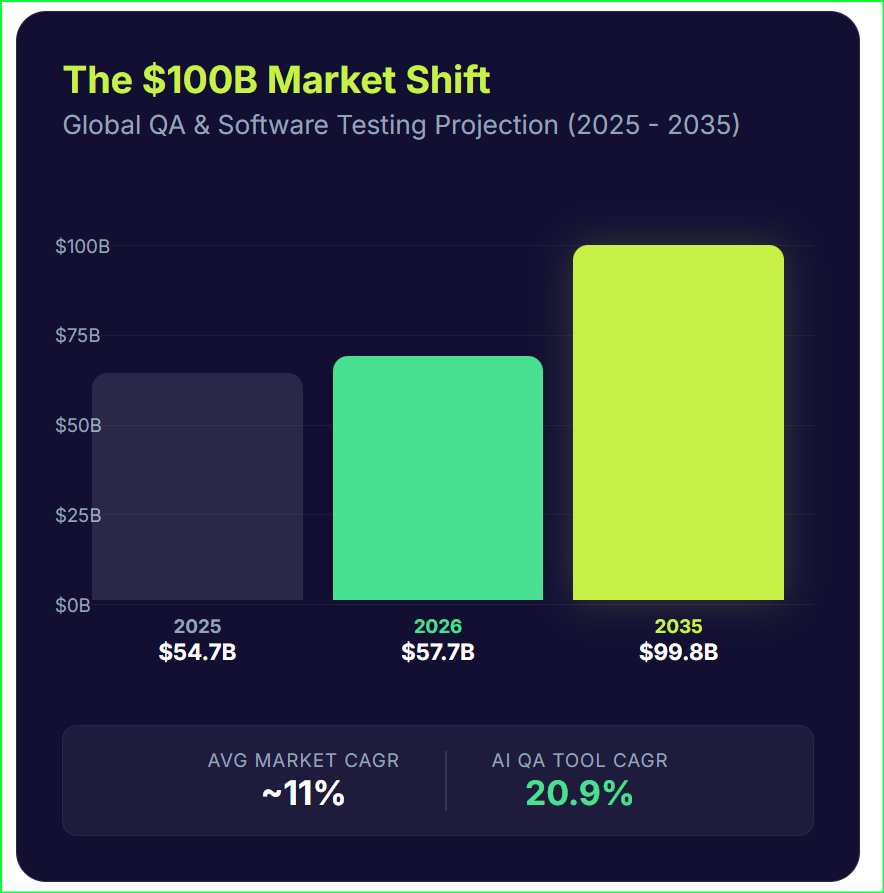
The gatekeeper model of Quality Assurance just broke. For years, we treated QA as a final checkbox before a release. We wrote static scripts and waited for results. But the math has changed. By 2026, the global testing market will hit approximately $57.7 billion. Looking further out, experts project a climb toward $100 billion by 2035. 

We are witnessing a massive capital reallocation. Organizations are freezing manual headcount and moving those funds into intelligent test automation. It is a pivot from labor-intensive validation to AI-augmented intelligence. You see it in the numbers: while the general market grows at roughly 11%, AI trends in software testing show an explosive 20% annual growth rate. 

This is more than a budget update. It is a fundamental dismantling of the traditional software development lifecycle. Quality is no longer a distinct phase. It is an intelligence function that permeates every microsecond of the digital value chain.

Market shift

Autonomous Intent: Leaving the Brittle Script Behind 

The era of writing static, fragile test cases is nearing its end. Traditional automation relies on Selenium-based scripts that break the moment a developer changes a button ID or moves a div. This “flakiness” is an expensive trap, often consuming up to 40% of a QA team’s capacity just for maintenance. We are moving toward a future where software testing predictions 2026 suggest the complete obsolescence of these brittle scripts. 

Instead of following a rigid Step A to Step B path, we are deploying autonomous agents. These agents do not just execute code; they understand intent. You give an agent a goal—such as “Complete a guest checkout for a red sweater”—and it navigates the UI dynamically. It handles unexpected pop-ups and A/B test variations without crashing. This shift is so significant that analysts expect 80% of test automation frameworks to incorporate AI-based self-healing capabilities by late 2025. 

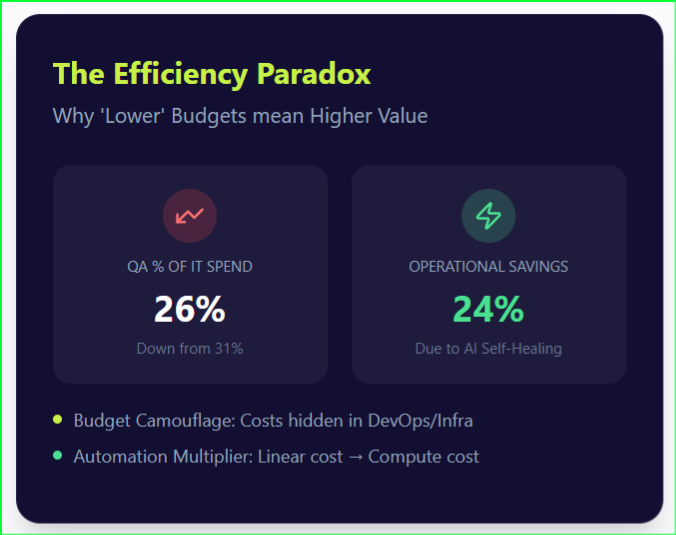
Self-healing tools use computer vision and dynamic locators to identify elements by context. If an element ID changes, the AI finds the button that “looks like” the intended target and updates the test definition on the fly. The economic impact is clear: organizations using these mature AI-driven test automation trends report 24% lower operational costs. By removing the drudgery of maintenance, your engineers finally focus on expanding coverage rather than fixing what they already built. 

Intelligent Partners: The Rise of AI Copilots and the Strategic Tester 

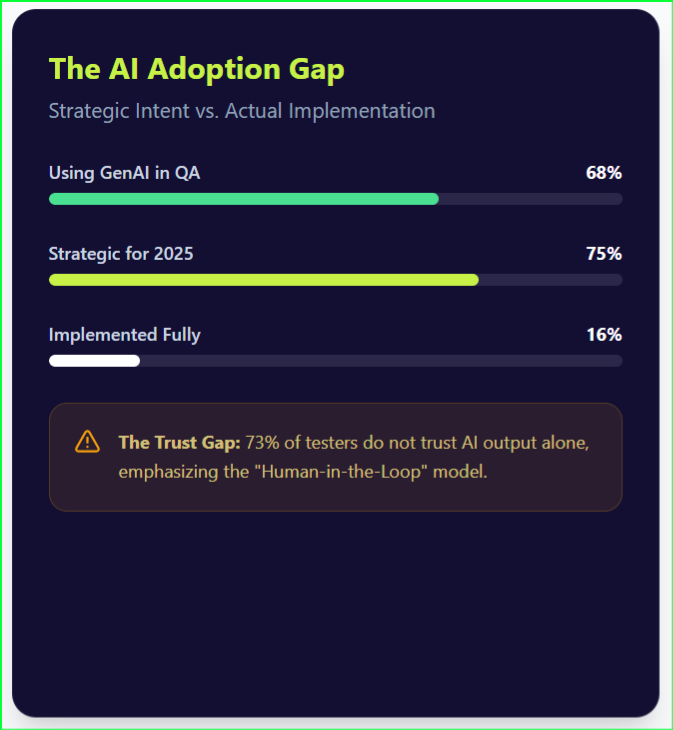
The narrative that AI will replace the human tester is incomplete. In reality, AI trends in software testing indicate a transition toward a “Human-in-the-Loop” model where AI serves as a force multiplier. Roughly 68% of organizations now utilize Generative AI to advance their quality engineering agendas. However, a significant “trust gap” remains. While 82% of professionals view AI as essential, nearly 73% of testers do not yet trust AI output without human verification. 

AI Adoption Gap

AI copilots now handle the high-volume, repetitive tasks that previously bogged down release cycles. These tools generate comprehensive test cases from user stories in minutes, addressing the “blank page problem” for many large organizations. They also write boilerplate code for modern frameworks like Playwright and Cypress. This assistance allows future of QA automation to focus on high-level strategy rather than syntax. 

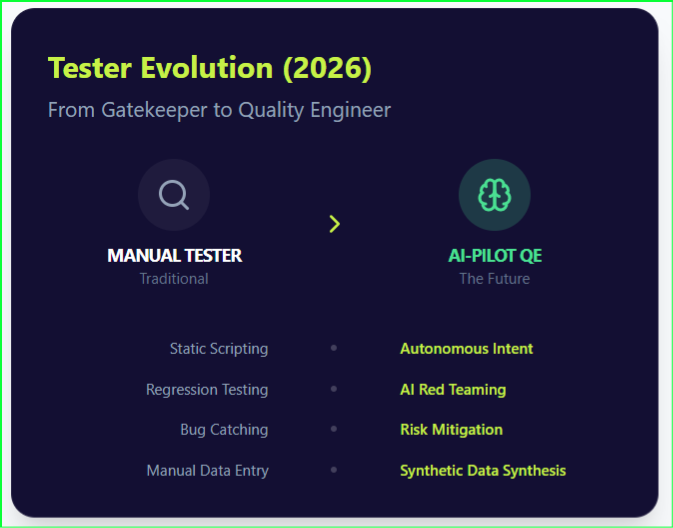
The role of the manual tester is not dying; it is gentrifying into an elite skill set. We are seeing a sharp decline of manual regression testing, as 46% of teams have already replaced half or more of their manual efforts with intelligent test automation. The modern Quality Engineer acts as a strategic auditor and “AI Red Teamer,” using human cunning to trick AI systems into failure—a task no script can perform. This evolution demands deeper domain knowledge and AI literacy, as testers must now verify the probabilistic logic of LLMs. 

The Efficiency Paradox: Shifting Quality Everywhere 

One of the most counter-intuitive software testing predictions 2026 is the visible contraction of dedicated QA budgets. Historically, as software complexity grew, organizations funneled up to 35% of their IT spend into testing. Recent data reveals a reversal, with QA budgets dropping to approximately 26% of IT spend. This decline does not signal a deprioritization of quality; rather, it represents a “deflationary dividend” powered by intelligent test automation. 

Efficiency Paradox

We are seeing the rise of a hybrid “Shift-Left and Shift-Right” model that embeds quality into every phase of the lifecycle. The economic logic for shifting left is irrefutable: fixing a defect during the design phase costs pennies, while fixing it post-release can cost 15 times more. By 2025, nearly all DevOps-centric organizations will have adopted shift-left practices, making developers responsible for writing unit and security tests directly within their IDEs. 

Simultaneously, the industry is embracing shift-right strategies to validate software in the chaos of live production. Teams now use observability and chaos engineering to monitor real-user behavior and system resilience in real time. This constant testing loop causes a phenomenon known as “budget camouflage”.  

When a developer configures a security scan in a CI/CD pipeline, the cost is often filed under “Engineering” or “Infrastructure” rather than a dedicated QA line item. The result is a leaner, more distributed future of QA automation that delivers higher reliability at a lower visible cost. 

Guardians of the Model: QA’s Critical Role in AI Governance and Risk 

As enterprises rush to deploy Large Language Models (LLMs) and Generative AI, a new challenge emerges: the “trust gap”. While the potential of AI is immense, nearly 73% of testers do not trust AI output alone. This skepticism stems from the probabilistic nature of LLMs, which are prone to hallucinations—generating test cases for non-existent features or writing functionally flawed code. Consequently, AI-driven test automation trends are shifting the QA focus from simple bug-hunting to robust AI governance. 

Testing GenAI-based applications requires a fundamental change in methodology. Traditional deterministic testing, where a specific input always yields the same output, does not apply to LLMs. Instead, QA teams must now perform “AI Red Teaming”—deliberately trying to trick the model into producing biased, insecure, or incorrect results. This role is vital for compliance with emerging regulations like the EU AI Act, which is expected to create new, stringent testing requirements for companies deploying AI in Europe by 2026. 

Modern quality engineering must also address the “Data Synthesis” challenge. Organizations are increasingly using GenAI to create synthetic test data that mimics production environments while remaining strictly compliant with privacy laws like GDPR and CCPA. This practice ensures that future of QA automation remains secure and ethical. By 2026, the primary metric for QA success will move beyond defect counts to “Risk Mitigation Efficiency,” measuring how effectively the team identifies and neutralizes the subtle logic gaps inherent in AI-driven systems. 

Specialized Frontiers: Navigating 5G, IoT, and the Autonomous Horizon 

The final piece of the 2026 puzzle lies in the physical world. As software expands into specialized hardware, the global 5G testing market is surging toward $8.39 billion by 2034. We are moving beyond web browsers into massive IoT ecosystems where connectivity and latency are the primary failure points. Network slicing—where operators create virtual networks optimized for specific tasks—introduces a level of complexity that traditional tools simply cannot handle. 

In these high-stakes environments, such as medical IoT or autonomous vehicles, the margin for error is non-existent. While a consumer web app might tolerate three defects per thousand lines of code, critical IoT targets less than 0.1 defects per KLOC. This demand for absolute reliability is driving a massive spike in security testing, which has become the top spending priority in the IoT lifecycle. We are also seeing the explosive growth of blockchain testing, with a CAGR exceeding 50% as enterprises adopt immutable ledgers for supply chains. 

Qyrus: Orchestrating the Autonomous Quality Frontier 

Qyrus does not just follow AI trends in software testing; it builds the infrastructure to make them operational. As the industry moves toward agentic autonomy, Qyrus acts as the bridge. Through NOVA, our autonomous test generation engine, and Sense-Evaluate-Execute-Report (SEER), our agentic orchestration layer, we enable teams to transition from manual script-writing to goal-oriented intelligent test automation. These tools do more than suggest code; they navigate complex application logic to achieve business outcomes, fulfilling the software testing predictions 2026 that favor intent over static steps. 

To solve the maintenance crisis—where “flakiness” consumes 40% of team capacity—Qyrus provides Healer AI. This self-healing technology automatically repairs brittle scripts by identifying UI changes through context and computer vision. By automating the drudgery of maintenance, Healer AI frees your engineers for high-value exploratory work.  

Furthermore, Qyrus modernizes the entire stack by providing Data Testing capabilities and a unified cloud-native environment. Whether it is Web, Mobile, API, or Desktop, our platform allows developers and business users to collaborate seamlessly, making the future of QA automation a “shift-left” reality. 

For specialized frontiers like BFSI and IoT, Qyrus offers enterprise-grade solutions like our Real Device Farm and dedicated SAP Testing modules. These tools are designed for high-stakes environments where reliability targets are often stricter than 0.1 defects per KLOC.  

Finally, as organizations face the “trust gap” in GenAI adoption, Qyrus introduces Determinism on Demand. This ensures that while you leverage the power of probabilistic AI, your testing remains grounded in verifiable logic. Qyrus provides the governance and risk mitigation needed to turn AI-driven test automation trends into a secure, competitive advantage. 

Tester Evolution

Finalizing Your Strategy: The Road to 2030 

The transition from “Quality Assurance” to “Quality Engineering” is not just a change in title—it is a change in survival strategy. As we head toward 2030, the organizations that thrive will be those that treat quality as a strategic intelligence function rather than a release-day hurdle. By leveraging intelligent test automation and autonomous agents, you can bridge the “trust gap” and deliver digital experiences that are not just functional, but fundamentally trustworthy. 

Looking toward, the vision is one of complete autonomy. We expect intelligent test automation to manage the entire testing lifecycle—from discovery to self-healing—without explicit human intervention. The U.S. Bureau of Labor Statistics projects a 15% growth for testers through 2034, but the roles will look very different. The successful Quality Engineer of the future will be a pilot of AI agents, focusing on strategic business value and delightful user experiences rather than manual validation. 

Stop Testing the Past. Start Engineering the Future. 

The leap to autonomous quality doesn’t have to be a leap into the unknown. Whether you are battling brittle scripts, scaling for 5G, or navigating the risks of GenAI, Qyrus provides the AI-native infrastructure to help you lead the shift. 

Book a Demo with Qyrus Today and see how we can transform your testing lifecycle into a competitive advantage. 

We stopped asking “can we automate this?” in 2025. Instead, we started asking a much harder question: “How much can the system handle on its own?” 

This year changed the rules for software quality. We witnessed the industry pivot from simple script execution to genuine autonomy, where AI doesn’t just follow orders—it thinks, heals, and adapts. The numbers back this shift. The global software testing market climbed to a valuation of USD 50.6 billion , and 72% of corporate entities embraced AI-based mobile testing methodologies to escape the crushing weight of manual maintenance. 

At Qyrus, we didn’t just watch these numbers climb. We spent the last twelve months building the infrastructure to support them. From launching our SEER (Sense-Evaluate-Execute-Report) orchestration framework to engaging with thousands of testers in Chicago, Houston, Santa Clara, Anaheim, London, Bengaluru, and Mumbai, our focus stayed sharp: helping teams navigate a world where real-time systems demand a smarter approach. 

This post isn’t just a highlight reel. It is a report on how we listened to the market, how we answered with agentic AI, and where the industry goes next. 

The Pulse of the Industry vs. The Qyrus Answer 

We saw the gap between “what we need” and “what tools can do” narrow significantly this year. We aligned our roadmap directly with the friction points slowing down engineering teams, from broken scripts to the chaos of microservices. 

The GenAI & Autonomous Shift 

The industry moved past the novelty of generative AI. It became an operational requirement. Analysts estimate the global software testing market will reach a value of USD 50.6 billion in 2025, driven largely by intelligent systems that self-correct rather than fail. Self-healing automation became a primary focus for reducing the maintenance burden that plagues agile teams. 

We responded by handing the heavy lifting to the agents. 

  • Healer 2.0 arrived in July, fundamentally changing how our platform interacts with unstable UIs. It doesn’t just guess; it prioritizes original locators and recognizes unique attributes like data-testid to keep tests running when developers change the code. 
  • We launched AI Genius Code Generation to eliminate the blank-page paralysis of writing custom scripts. You describe the calculation or logic, and the agent writes the Java or JavaScript for you. 
  • Most importantly, we introduced the SEER framework (Sense, Evaluate, Execute, Report). This isn’t just a feature; it is an orchestration layer that allows agents to handle complex, multi-modal workflows without constant human hand-holding. 

Democratization: Testing is Everyone’s Job  

The wall between “testers” and “business owners” crumbled. With manual testing still commanding 61.47% of the market share, the need for tools that empower non-technical users to automate complex scenarios became undeniable. 

We focused on removing the syntax barrier. 

  • TestGenerator now integrates directly with Azure DevOps and Rally. It reads your user stories and bugs, then automatically builds the manual test steps and script blueprints. 
  • We embedded AI into the Qyrus Recorder, allowing users to generate test scenarios simply by typing natural language descriptions. The system translates intent into executable actions. 

The Microservices Reality Check

Monolithic applications are dying, and microservices took their place. This shift made API testing the backbone of quality assurance. As distributed systems grew, teams faced a new problem: testing performance and logic across hundreds of interconnected endpoints. 

We upgraded qAPI to handle this scale. 

  • We introduced Virtual User Balance (VUB), allowing teams to simulate up to 1,000 concurrent users for stress testing without needing expensive, external load tools. 
  • We added AI Automap, a feature where the system analyzes your API definitions, identifies dependencies, and autonomously constructs the correct workflow order. 

Feature Flashback 

We didn’t just chase the AI headlines in 2025. We spent thousands of engineering hours refining the core engines that power your daily testing. From handling complex loops in web automation to streamlining API workflows, we shipped updates designed to solve the specific, gritty problems that slow teams down. 

Here is a look at the high-impact capabilities we delivered across every module. 

Web Testing: Smarter Looping & Debugging 

Complex logic often breaks brittle automation. We fixed that by introducing Nested Loops and Loops Inside Functions, allowing you to automate intricate scenarios involving multiple related data sets without writing a single line of code. 

  • Resilient Execution: We added a Continue on Failure option for loops. Now, a single failed iteration won’t halt your entire run, giving you a complete report for every data item. 
  • Crystal Clear Reports: Debugging got faster with Step Descriptions on Screenshots. We now overlay the specific action (like “go to url”) directly on the execution image, so you know exactly what happened at a glance. 
  • Instant Visibility: You no longer need to re-enter “record mode” just to check a technical detail. We made captured locator values immediately visible on the step page the moment you stop recording. 

API Testing: Developer-Centric Workflows  

We focused on making qAPI speak the language of developers. 

  • Seamless Hand-offs: We expanded our code generation to include C# (HttpClient) and cURL snippets, allowing developers to drop your test logic directly into their environment. 
  • Instant Migration: Moving from manual checks to automation is now instant. The Import via cURL feature lets you paste a raw command to create a fully configured API test in seconds. 
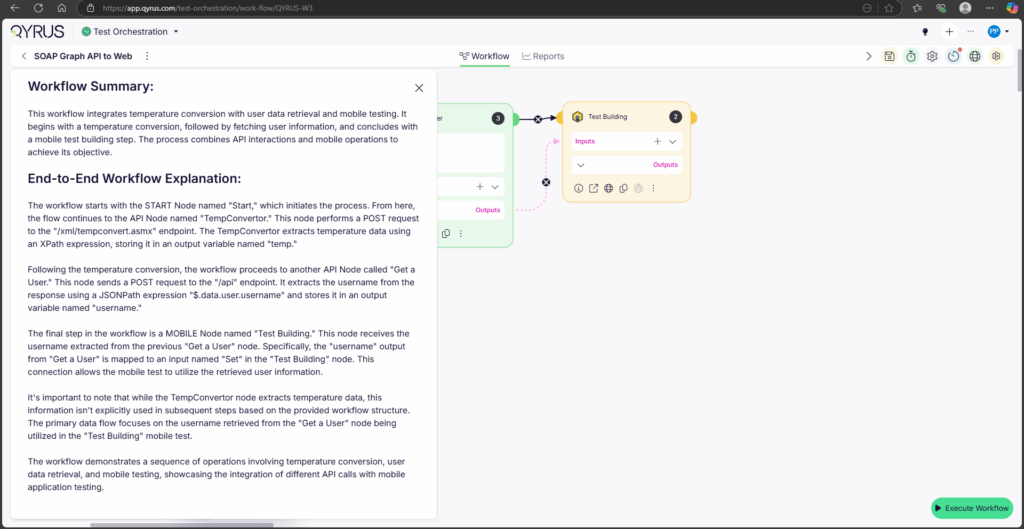
  • AI Summaries: Complex workflows can be confusing. We added an AI Summary feature that generates a concise, human-readable explanation of your API workflow’s purpose and flow. 
  • Expanded Support: We added native support for x-www-form-urlencoded bodies, ensuring you can test web form submissions just as easily as JSON payloads. 

Mobile Testing: The Modular & Agentic Leap  

Mobile testing has long been plagued by device fragmentation and flaky infrastructure. We overhauled the core experience to eliminate “maintenance traps” and “hung sessions.” 

  • Uninterrupted Editing: We solved the context-switching problem. You can now edit steps, fix logic, or tweak parameters without closing the device window or losing your session state. 
  • Modular Design: Update a “Login Block” once, and it automatically propagates to every test script that uses it. This shift from linear to component-based design reduces maintenance overhead by up to 80%. 
  • Agentic Execution: We moved beyond simple generation to true autonomy. Our new AI Agents focus on outcomes—detecting errors, self-healing broken tests, and executing multi-step workflows without constant human prompts. 
  • True Offline Simulation: Beyond basic throttling, we introduced True Offline Simulation for iOS and a Zero Network profile for Android. These features simulate a complete lack of internet connectivity to prove your app handles offline states gracefully. 

Desktop Testing: Security & Automation  

For teams automating robust desktop applications, we introduced features to harden security and streamline execution. 

  • Password Masking: We implemented automatic masking for global variables marked as ‘password’, ensuring sensitive credentials never appear in plain text within execution reports. 
  • Test Scheduling: We brought the power of “set it and forget it” to desktop apps. You can now schedule complex end-to-end desktop tests to run automatically, ensuring your heavy clients are validated nightly without manual intervention. 

Test Orchestration: Control & Continuity  

Managing end-to-end tests across different platforms used to be disjointed. We unified it. 

  • Seamless Journeys: We introduced Session Persistence for web and mobile nodes. You can now run a test case that spans 24 hours without repeated login steps, enabling true “day-in-the-life” scenarios. 
  • Unified Playback: Reviewing cross-platform tests is now a single experience. We generate a Unified Workflow Playback that stitches together video from both Web and Mobile services into one consolidated recording. 
  • Total Control: Sometimes you need to pull the plug. We added a Stop Execution on Demand feature, giving you immediate control to terminate a wayward test run instantly. 

Data Testing: Modern Connectivity  

Data integrity is the silent killer of software quality. We expanded our reach to modern architectures. 

  • NoSQL Support: We released a MongoDB Connector, unlocking support for semi-structured data and providing a foundation for complex nested validations. 
  • Cloud Data: We built a direct Azure Data Lake (ADLS) Connector, allowing you to ingest and compare data residing in your Gen2 storage accounts without moving it first. 
  • Efficient Validation: We added support for SQL LIMIT & OFFSET clauses. This lets you configure “Dry Run” setups that fetch only small data slices, speeding up your validation cycles significantly. 

Analyst Recognition 

Innovation requires validation. While we see the impact of our platform in our customers’ success metrics every day, independent recognition from the industry’s top analysts confirms our trajectory. This year, two major firms highlighted Qyrus’ role in defining the future of quality. 

Leading the Wave in Autonomous Testing  

We secured a position as a Leader in The Forrester Wave™: Autonomous Testing Platforms, Q4 2025. 

This distinction matters because it evaluates execution, not just vision. We received the highest possible score (5.0) in critical criteria including RoadmapTesting AI Across Different Dimensions, and Testing Agentic Tool Calling. The report specifically noted our orchestration capabilities, stating that our SEER framework (Sense, Evaluate, Execute, Report) and “excellent agentic tool calling result in an above-par score for autonomous testing”. 

For enterprises asking if agentic AI is ready for production, this report offers a clear answer: the technology is mature, and Qyrus is driving it. 

Defining GenAI’s Role in the SDLC  

Earlier in the year, Gartner featured Qyrus in their report, How Generative AI Impacts the Software Delivery Life Cycle (April 2025). 

As developers adopt GenAI to write code faster—reporting productivity gains of 10-15%—testing often becomes the bottleneck. Gartner identified Qyrus as an example vendor for AI-augmented testing, recognizing our ability to keep pace with these accelerated development cycles. We don’t just test the code humans write; we validate the output of the generative models themselves, ensuring that speed does not come at the cost of reliability. 

Community & Connection 

We didn’t spend 2025 behind a desk. We spent it in conference halls, hackathons, and boardrooms, listening to the engineers and leaders who are actually building the future. From Chicago to Bengaluru, the conversations shifted from “how do we automate?” to “how do we orchestrate?” 

Empowering the SAP Community  

We started our journey with the ASUG community, where the focus was squarely on modernizing the massive, complex landscapes that run global business. In Houston, Ravi Sundaram challenged the room to look at agentic SAP testing not as a future luxury, but as a current necessity for improving ROI. The conversation deepened in New England and Chicago, where we saw firsthand that teams are struggling to balance S/4HANA migration with daily execution. The consensus across these chapters was clear: SAP teams need strategies that reduce overhead while increasing confidence across integrated landscapes. 

We wrapped up our 2025 event journey at SAP TechEd Bengaluru in November with two energizing days that put AI-led SAP testing front and center. As a sponsor, we brought a strong mix of thought leadership and real-world execution. Sessions from Ameet Deshpande and Amit Diwate broke down why traditional SAP automation struggles under modern complexity and demonstrated how SEER enables teams to stop testing everything and start testing smart. The booth buzzed with discussions on navigating S/4HANA customizations, serving as a powerful reminder that the future of SAP quality is intelligent, adaptive, and already taking shape. 

Leading the Global Conversation

In August, we took the conversation global with an exclusive TestGuild webinar hosted by Joe Colantonio. Ameet Deshpande, our SVP of Product Engineering, tackled the industry-wide struggle of fragmentation—where AI accelerates development, but QA falls behind due to disjointed tools. This session marked the public unveiling of Qyrus SEER, our autonomous orchestration framework designed to balance the Dev–QA seesaw. The strong live attendance and post-event engagement reinforced that the market is ready for a shift toward unified, autonomous testing. 

The momentum continued in September at StarWest 2025 in Anaheim, where we were right in the middle of the conversations shaping the future of software testing. Our booth became a go-to spot for QA leaders looking to understand how agentic, AI-driven testing can keep up with an increasingly non-deterministic world. A standout moment was Ameet Deshpande’s keynote, where he challenged traditional QA thinking and unpacked what “quality” really means in an AI-powered era—covering agentic pipelines, semantic validation, and AI-for-AI evaluation. 

Redefining Financial Services (BFSI) 

Banking doesn’t sleep, and neither can its quality assurance. At the BFSI Innovation & Technology Summit in Mumbai, Ameet Deshpande introduced our orchestration framework, SEER, to leaders facing the pressure of instant payments and digital KYC. Later in London at the QA Financial Forum, we tackled a tougher reality: non-determinism. As financial institutions embed AI deeply into their systems, rule-based testing fails. We demonstrated how multi-modal orchestration validates these adaptive systems without slowing them down, proving that “AI for AI” is already reshaping how financial products are delivered. 

The Developer & API Ecosystem  

APIs drive the modern web, yet they often get tested last. We challenged this at API World in Santa Clara, where we argued that API quality deserves a seat at the table. Raoul Kumar took this message to London at APIdays, showing how no-code workflows allow developers to adopt rigorous testing without the friction. In Bengaluru, we saw the scale of this challenge up close. At APIdays India, we connected with architects building for one of the world’s fastest-growing digital economies, validating that the future of APIs relies on autonomous, intelligent quality. 

Inspiring the Next Generation  

Innovation starts early. We closed the year as the Technology Partner for HackCBS 8.0 in New Delhi, India’s largest student-run hackathon. Surrounded by thousands of student builders, we didn’t just hand out swag. We put qAPI in their hands, showing them how to validate prototypes instantly so they could focus on creativity. Their curiosity reinforced a core belief: when you give builders the right tools, they ship better software from day one. 

Conclusion: Ready for 2026 

2025 was the year we stopped treating “Autonomous Testing” as a theory. We proved it is operational, scalable, and essential for survival in a market where software complexity outpaces human capacity. 

We are entering 2026 with a platform that understands your code, predicts your failures, and heals itself. Whether you need to validate generative AI models, streamline a massive SAP migration, or ensure your APIs hold up under peak load, Qyrus has built the infrastructure for the AI-first world. 

The tools are ready. The agents are waiting. Let’s build the future of quality together. 

Book a Demo 

Welcome to our September update! As we continue to evolve the Qyrus platform, our focus remains squarely on enhancing your productivity and empowering your team to achieve more, faster. We believe in removing friction from the testing lifecycle, and this month’s updates are a direct reflection of that commitment.

We are excited to introduce powerful new capabilities centered around dramatic workflow acceleration, intelligent AI-driven assistance, and seamless CI/CD integration. From features that eliminate repetitive tasks to an AI co-pilot that can fix your scripts on the fly, every enhancement is designed to save you valuable time and make your testing efforts more intuitive and powerful.


Ready to Accelerate Your Testing with August’s Upgrades?

We are dedicated to evolving Qyrus into a platform that not only anticipates your needs but also provides practical, powerful solutions that help you release top-quality software with greater speed and confidence.

Curious to see how these August enhancements can benefit your team? There’s no better way to understand the impact of Qyrus than to see it for yourself.

Ready to dive deeper or get started?


Save the Date 
📅 September 22–24, 2025 

📍 London, UK 

APIs are no longer just pipes connecting systems. They’re the backbone of digital business. And as AI continues to dominate conversations in every industry, one thing is becoming clear: there’s no AI without APIs. That’s exactly why we’re heading to API Days London next month. 

This year’s theme hits close to home: “No AI Without API Management.” Over three days, the conference will dig into how API-first architecture, scalability, security, and AI-enhanced management are shaping the way modern businesses build intelligent systems. For the qAPI team, powered by Qyrus, where API testing and quality assurance meet real-world AI workflows, it’s the perfect place to learn, share, and connect. 

Why We’re Excited About API Days London 

API Days is a tech event where the global API community shows up. You’ll see product owners, API architects, developers, and QA leaders all tackling the same challenges: how do we make APIs faster, safer, smarter, and ready for AI-driven environments? 

The sessions are designed to go beyond theory. Think hands-on workshops, real-world case studies, and discussions that don’t just tell you what’s possible but show you how to do it. For us, it’s a chance to explore how API management ties directly into quality engineering, and how testing practices need to evolve if businesses want to stay competitive in an AI-first world. 

Our qAPI team is especially excited to jump into the tracks focused on scaling, governance, and AI-driven API strategies. We’re looking forward to coming back with fresh ideas on how to embed API-centered QA into AI workflows because if APIs are powering intelligent systems, they need the same intelligent approach to testing. 

Two Sessions You Can’t Miss with Raoul Kumar 

We’re proud that Raoul Kumar, our Director of Platform Development & Success at Qyrus and qAPI, will be taking the stage not once, but twice. 

📍 COMMERCIAL 2 
📅 September 22, 2025 
4:05 – 4:55 PM 
Workshop: Test APIs in the Cloud — No Code. Just Chrome. 

This hands-on session strips API testing back to its essentials. Forget complicated frameworks or clunky setups, Raoul will walk you through how to run tests directly from your browser. No code, no hassle. Just Chrome and the cloud. You’ll see how this approach makes testing simpler for both devs and QA teams while fitting seamlessly into modern CI/CD pipelines. 

And that’s just the start. 

📍 COMMERCIAL 2 
📅 September 24, 2025 
9:30 AM9:55 AM 
Keynote: The Future of API Testing: No Code, Just Cloud and Chrome 

In this keynote, Raoul will zoom out from the technical details to talk about the bigger picture: how QA needs to evolve in the age of AI and why APIs are at the center of it all. Expect to hear about the challenges enterprises are facing, the opportunities no-code brings to the table, and how qAPI, Powered by Qyrus, is helping organizations future-proof their API testing strategy. 

Come Meet Us at the qAPI (powered by Qyrus) Booth 

Of course, we’re not just speaking, we’re setting up camp on the show floor too. Swing by the qAPI/Qyrus booth to meet our team, see live demos of our platform, and chat about your QA challenges. 

And because no conference is complete without some fun, we’ll also be running a raffle with special prizes throughout the event. Stop in, say hi, and you just might walk away with more than new API testing ideas. 

Why This Matters for You 

If you’re working in product, development, or QA, you know the pressure. Release cycles are shrinking. Expectations are rising. And AI is amplifying both the opportunity and the complexity of building great digital experiences. That’s why events like API Days London are so important. 

For us, it’s about connecting with peers who are asking the same questions we are: How do we embed testing into API-first, AI-driven ecosystems? How do we make quality a competitive advantage instead of a bottleneck? And how do we simplify testing so teams can actually move at the speed of innovation? 

See You in London 

We couldn’t be more excited for Apidays London 2025. Between Raoul’s workshop on September 22, his keynote on September 23 at 9:30 AM, and our booth filled with demos, raffles, and great conversations, we’re looking forward to connecting with as many of you as possible. 

For us, the takeaway is simple: No AI without APIs. And no innovation without quality. 

API World, Santa Clara

Save the Date 
📅 September 3–5, 2025 
📍 Santa Clara, CA 

Get ready, Santa Clara! Qyrus is hitting the floor at API World 2025 from September 3–5, and we’re bringing the full power of our qAPI solution to the world’s largest API and microservices conference. 

API World is where developers, architects, and enterprise teams come to learn, build, and connect. From sessions on API lifecycle best practices to deep dives into AI integration and API security, this year’s event is packed with insights, innovation, and action. 

You’ll find the Qyrus team at Booth #400, led by Raoul Kumar, Director of Platforms for both Qyrus and qAPI.  We’ll be showcasing how Qyrus delivers faster, smarter, and more scalable API testing and monitoring with automation, AI, and real-time visibility built into the platform. 

Whether you’re launching a new API or scaling microservices across teams, we’ll show you how to test with confidence, cut down on debugging, and reduce release cycles. 

Come see what next-gen API quality looks like, and how Qyrus is leading the charge. 

Save the date and swing by Booth #400 at API World 2025, Santa Clara Convention Center. We’re ready to talk about testing, transformation, and what’s next in APIs.