Qyrus Named a Leader in The Forrester Wave™: Autonomous Testing Platforms, Q4 2025 – Read More

Agentic Orchestration Platform-Featured Image

Modern software development moves faster than most QA teams can validate. Generative AI now contributes directly to code creation, and CI/CD pipelines push changes into production at high frequency. Testing has not kept up. Teams still depend on script-heavy automation, fragmented tools, and manual validation cycles. As release velocity increases, validation becomes the primary enterprise bottleneck. 

This widening velocity gap between development and validation is forcing enterprises to rethink how quality is engineered. Early enterprise AI adoption focused on chat-based assistance. These systems generated answers and suggested code in isolation. They did not execute end-to-end workflows. They required constant human direction and offered limited impact on actual delivery speed. 

An agentic orchestration platform changes that model. It introduces a coordinated execution layer that connects development activity to continuous validation. Instead of isolated tools, it enables AI agent coordination across the testing lifecycle. Autonomous agents generate tests, execute them, and maintain coverage without manual intervention. This forward-looking framing of a self-orchestrating QA system ensures quality keeps pace with the speed of innovation. 

What Is an Agentic Orchestration Platform? 

Legacy test automation often behaves like a house of cards. A minor UI change can break entire regression suites, forcing teams into constant maintenance. This platform replaces that fragile model with a resilient, AI-driven coordination layer designed for continuous adaptation. 
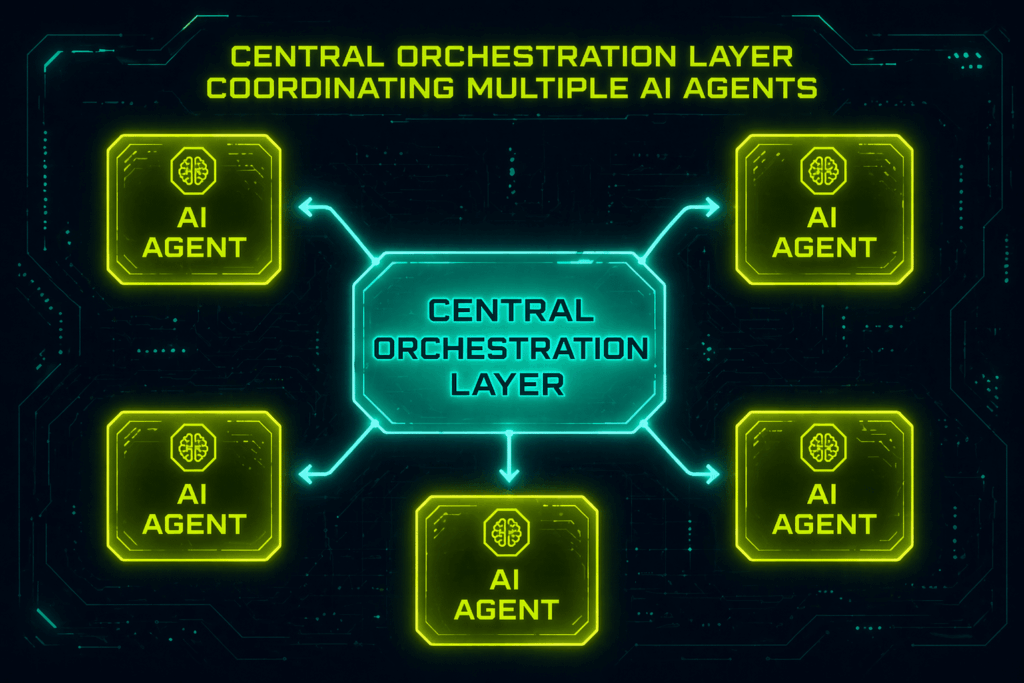
An agentic orchestration platform is a centralized execution layer that coordinates autonomous AI agents, enterprise systems, and workflows. It dynamically orchestrates test generation, execution, validation, and reporting based on real-time system changes. This marks a clear shift from rules-based automation to adaptive, agentic workflows. Traditional testing depends on anticipating every failure path. In contrast, an orchestration platform enables objective-based testing. Teams define what needs to be validated, and the system determines how to test it. 

Specialized agents operate with defined roles within this multi-agent system. Some focus on UI validation, while others handle API virtualization or exploratory testing. These agents execute in parallel and collaborate to handle complex workflows that span multiple systems. The orchestration layer synchronizes their activities and integrates them with CI/CD pipelines and broader enterprise systems. This shifts human intervention from operational tasks like writing scripts to strategic governance and policy definition. 

Why Traditional QA and Automation Are Breaking at Scale 

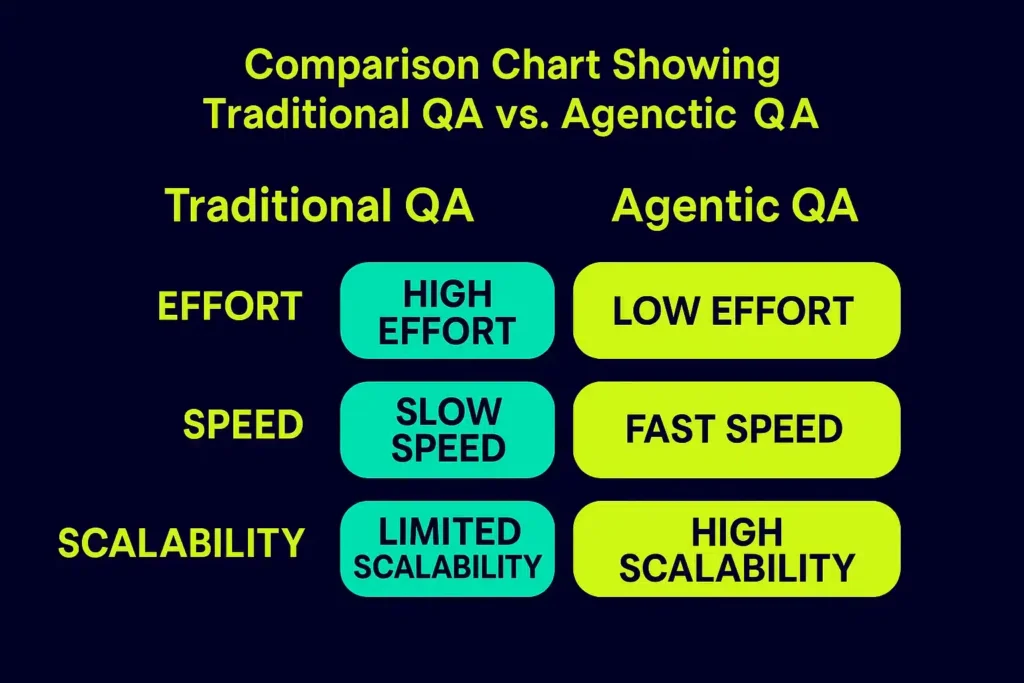
Traditional automation has hit a ceiling. Most enterprises rely on rigid, predefined scripts that crumble the moment a developer changes a UI element. This fragility forces teams into a cycle of constant maintenance. Testers often spend more time fixing old tests than validating new features. 

The resulting accumulation of test debt creates a massive bottleneck that cancels out the gains made by high-velocity development teams. Regression suites become harder to maintain at scale, and result analysis often requires manual triaging across disconnected tools. Organizations face significant ROI & Maturity Challenges as they try to scale these legacy systems. Fragmented toolchains lack the unified AI Agent Coordination necessary for modern, cross-system workflows. 

The impact is undeniable: slower release cycles and inconsistent user experiences. Teams need Self-Healing Workflows that adapt to environmental changes in real time. Moving to this model can significantly improve testing efficiency and reduce maintenance effort, especially in fast-changing UI environments. 
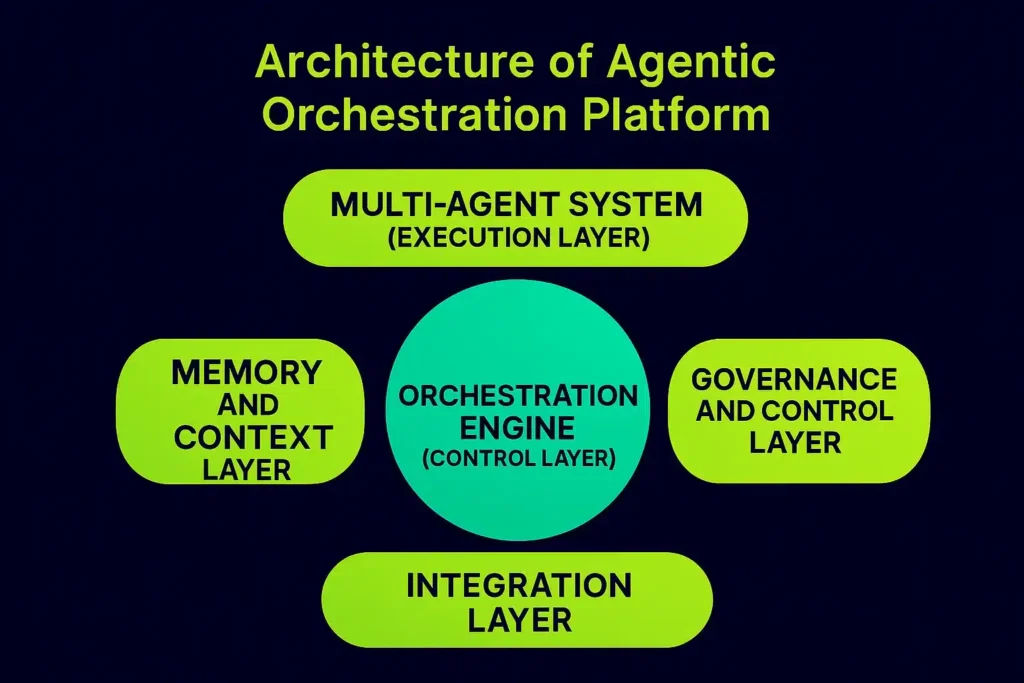
Core Architecture of an Agentic Orchestration Platform 

Modern enterprise software needs a structured environment where intelligence can scale. This architectural necessity drives the AI orchestration market toward a projected USD 30.23 billion valuation by 2030 (MarketsandMarkets, 2025). 

Orchestration Engine (Control Layer) 

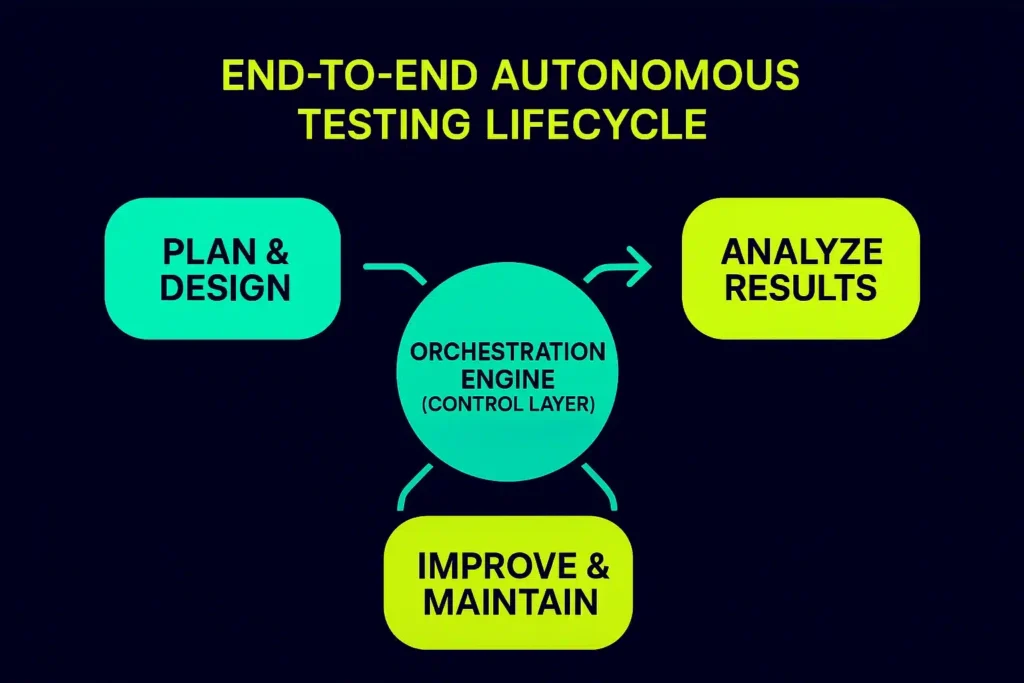
The Orchestration Engine acts as the central coordinator of all workflows. It processes high-level business objectives and deconstructs them into discrete, executable tasks. Rather than following a linear path, it supports sequential workflows, parallel execution, and event-driven triggers. The engine continuously monitors the execution state, allowing it to adjust workflows dynamically if it encounters environmental shifts.  

Multi-Agent System (Execution Layer) 

This layer consists of autonomous AI agents with specialized roles. You might deploy UI testing agents to simulate real user interactions or API agents to verify backend microservices. These units collaborate to solve complex, cross-system problems. This enables massive parallel testing across diverse environments. 

Memory and Context Layer 

Retention separates sophisticated agents from simple automation bots. This layer manages both short-term session data and long-term context retention. By maintaining a history of previous runs and system states, the platform facilitates continuous learning and adaptation. This is particularly critical for long-running workflows where the system must remember the outcomes of early stages to make informed decisions during later validation steps.  

Integration Layer 

True orchestration requires a connected stack. The integration layer hooks directly into your CI/CD pipelines, including GitHub, Jenkins, and Azure DevOps. It synchronizes data across microservices and legacy enterprise systems, ensuring seamless communication.  

Governance and Control Layer 

The governance layer defines the rules, policies, and guardrails that keep autonomous agents within enterprise boundaries. It enables human-in-the-loop approvals for high-stakes actions, ensuring traceability and auditability in a production-grade environment.
From Automation to Autonomy: How Agentic Workflows Operate 

An agentic orchestration platform operates on a continuous loop that starts the moment an event occurs. The workflow begins with the “Sense” phase, where sentinels identify the location of a change. The platform then enters “Cognitive Crunch Time” to perform a deep impact analysis. 

Instead of running a full regression suite, the platform determines the “blast radius” of the update. It then dynamically generates only the scenarios required to validate that specific change. If an agent encounters a minor UI shift that does not break functionality, it implements Self-Healing Workflows to update the logic on the fly. 

This adaptability can help organizations reduce test maintenance substantially. A continuous feedback loop feeds every result into the system memory. This enables adaptive optimization over time, as the platform learns which testing strategies yield the highest quality with the least effort. 
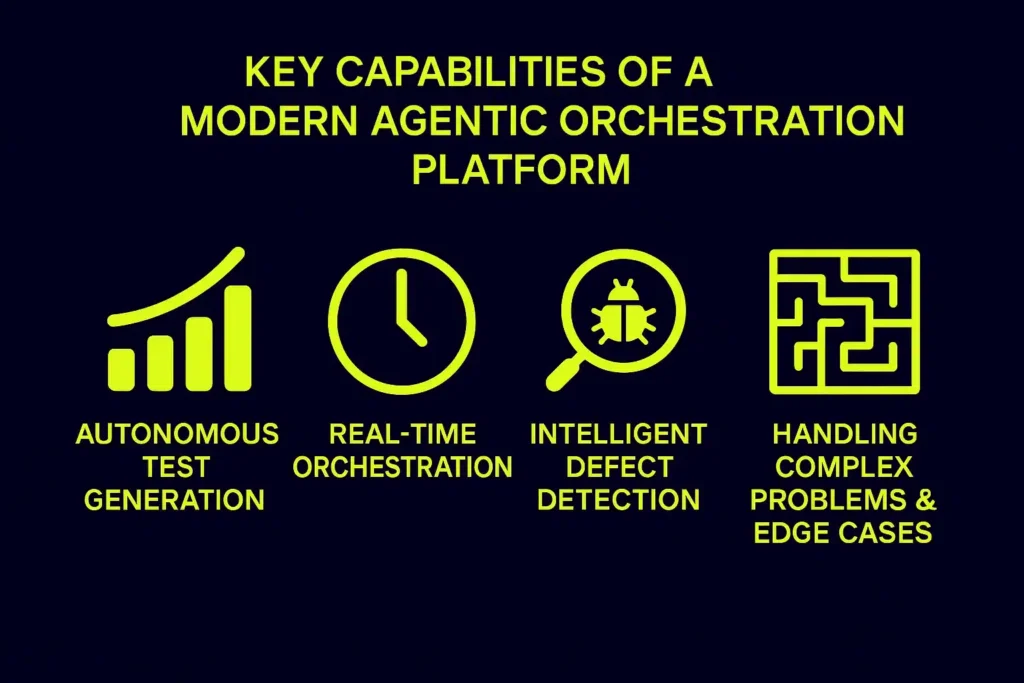
Key Capabilities of a Modern Agentic Orchestration Platform 

An agentic orchestration platform turns static quality checks into goal-oriented intelligence. This shift ensures that engineering teams do not sacrifice reliability for speed. 

  • Autonomous Test Generation: The platform analyzes application blueprints to create comprehensive test suites automatically, often reducing test creation effort significantly for repeatable flows. 
  • Real-Time Orchestration: The system manages multi-agent coordination across systems and workflows as changes happen, rather than waiting for scheduled runs. 
  • Intelligent Defect Detection: Agents perform automated root cause analysis to pinpoint the likely source of a break, improving triage speed and consistency. 
  • Handling Complex Problems & Edge Cases: Autonomous explorers uncover hidden bugs and untested pathways that traditional scripted tests miss. 
Business Impact: Eliminating Test Debt and Accelerating Releases 

The core value of an agentic orchestration platform lies in crushing the weight of test debt. Organizations often report major reductions in test creation effort because the system generates scenarios from requirements. Self-Healing Workflows allow the platform to adapt to UI changes automatically, resulting in lower maintenance costs and better operational efficiency. 

Speed increases through massive parallel testing on cloud infrastructure. This cuts execution time from hours to minutes and significantly reduces release cycles. High-velocity development no longer waits for a manual QA bottleneck. Users experience more stable releases and fewer post-launch incidents. This agility is vital as the AI orchestration sector surges toward its USD 30.23 billion target. 

Transforming QA Roles in an Agentic Testing Model 

Adopting an agentic orchestration platform redefines daily contributions. The organization shifts toward a model of “testing without manual testing effort,” where humans focus on innovation rather than repetitive tasks. 

  • Testers: Move from manual execution to strategy, acting as quality architects who define objectives. 
  • Developers: Receive faster feedback loops, allowing them to fix defects while code context is fresh. 
  • QA Leaders: Gain unprecedented visibility and control through centralized dashboards and predictive risk analytics. 

Challenges in Adopting Agentic Orchestration Platforms 

Integration with legacy enterprise systems remains a common hurdle. Connecting to decades-old software requires careful planning and robust middleware. Data shows that legacy integration is a barrier for 60% of AI leaders. 

Data governance and security also demand attention. Only 21% of companies currently possess mature AI governance models for autonomous agents (Deloitte, State of AI in the Enterprise, 2026). Managing AI unpredictability is a specific risk factor, as non-deterministic results can impact the reliability of automated checks. Furthermore, infrastructure costs can be significant. Many organizations find that over 40% of their agentic AI projects risk cancellation due to escalating costs, unclear business value, or inadequate risk controls (Gartner, 2025). 

The Future of Agentic Orchestration Platforms in QA 

The future belongs to more autonomous ecosystems. We are witnessing a convergence where AI platforms and DevOps pipelines merge into a single intelligent fabric. Recent surveys suggest rapid momentum: 62% of respondents report their organizations are at least experimenting with AI agents (McKinsey, 2025), and 74% of companies plan to deploy agentic AI within two years. 

The platform will become the operating layer of enterprise QA, using AI-driven decision systems to manage quality. Teams will move from manual oversight to strategic governance. As these workflows become standard, the broader agentic AI market is projected to surge toward USD 199.05 billion by 2034 (Precedence Research, 2025). 

The Competitive Landscape: True Orchestration vs. Feature-Led AI 

Most enterprise testing platforms now claim AI capabilities. The real distinction lies in execution depth and how a platform handles the entire execution lifecycle. 

Qyrus outranks competitors by delivering a true agentic orchestration platform and framework named SEER (Sense-Evaluate-Execute-Report), built around autonomous execution. Its architecture focuses on multi-agent coordination across the entire testing lifecycle, from sensing changes to reporting risk insights. While others offer AI as a feature, Qyrus provides a strategic solution to eliminate test debt. 

  • UiPath and Tricentis: Offer robust enterprise automation with integrated testing. However, many workflows still rely on predefined logic rather than fully autonomous execution. 
  • ACCELQ and Functionize: Emphasize AI-assisted testing and generative capabilities. These improve efficiency but often focus on specific layers like UI or API, rather than orchestrating multi-agent systems across the full lifecycle. 

The ability to coordinate multiple agents, adapt in real time, and execute without manual intervention determines whether AI becomes an incremental improvement or a foundational capability. 

Frequently Asked Questions 

  1. What is an agentic orchestration platform?  
    An agentic orchestration platform coordinates autonomous AI agents, systems, and workflows to execute complex tasks like testing without manual intervention. It acts as a policy-driven coordination layer that connects human goals to system-level actions.  
  2. How is agentic orchestration different from traditional automation?  
    Traditional automation follows predefined scripts that often break during UI or API changes. Agentic orchestration uses adaptive AI agents to dynamically generate and execute workflows, moving beyond rules-based limitations.  
  3. What are multi-agent systems in testing?  
    They are collections of specialized AI agents that collaborate to perform different testing tasks such as generation, execution, and validation. Each agent focuses on a specific domain like UI, API, or security.  
  4. How does agentic orchestration reduce test debt?  
    By enabling Self-Healing Workflows and adaptive test generation, it minimizes script maintenance and eliminates brittle test cases. This closes the gap between software creation and reliable validation.  
  5. Can agentic orchestration integrate with CI/CD pipelines?  
    Yes, it integrates seamlessly with modern systems like GitHub, Jenkins, and Azure DevOps to enable continuous, automated testing workflows triggered by code commits.  
  6. Which industries benefit most from these platforms?
    Enterprises across finance, healthcare, telecom, and SaaS benefit most due to their complex workflows and large-scale systems requiring rigorous audit trails.  

Conclusion: Moving Toward an Autonomous Quality Future 

Agentic orchestration platforms represent a fundamental shift toward true autonomy. They transform quality assurance into a continuous, AI-driven execution layer. This architecture enables intelligent testing across complex systems by replacing manual bottlenecks with governed actions. 

The Forrester Wave report recognized Qyrus as a ‘Leader in the autonomous testing market, highlighting its ability to operationalize these advanced agentic workflows at scale. For organizations looking to accelerate releases and eliminate test debt, Qyrus provides the strategic muscle needed for the modern SDLC. 

Ready to see it in action? Request a demo to see how Qyrus can help you achieve autonomous, end-to-end testing at enterprise scale. 
Featured Image-How AI Agents Are Redefining Software Testing

Software delivery is breaking. It isn’t a loud failure or a single high-profile incident; rather, it’s a quiet divergence between development speed and testing capacity.  It happened gradually, then all at once: AI coding tools got good enough that developers started shipping code at a pace testing teams were never built to match. 

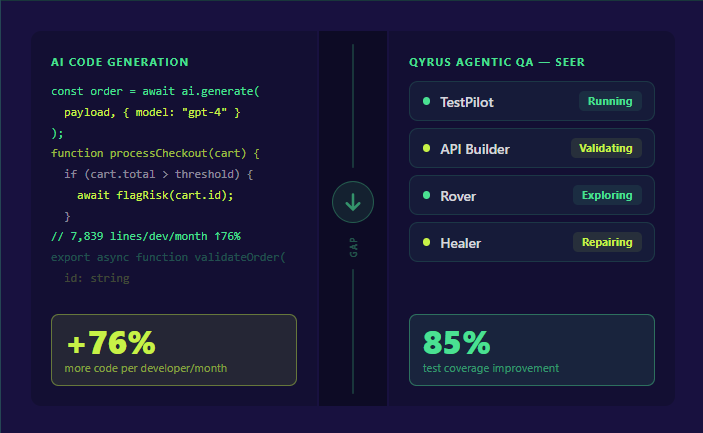
By 2025, 90% of engineering teams were using AI coding assistants to accelerate delivery. Industry experts confirmed at Transform 2025 that over 40% of all code written that year was AI-generated. Individual developer output surged — one analysis found the average developer now submits 7,839 lines of code per month1, up from 4,450 just two years prior. 

The downstream consequence? A study of 273 QA decision-makers2, published in January 2026, found that 60% of organizations had already experienced quality failures because development moved faster than testing could validate. Critically, 92% of those teams still tested manually, despite 87% having some automation in place. Existing automation was no longer keeping up. 

Forrester captured the structural problem precisely: the industry has plateaued at roughly 25% automated test coverage.  Traditional automation has been plateaued. The same AI revolution that widened the velocity gap is now the only force capable of closing it. That force is agentic QA. 

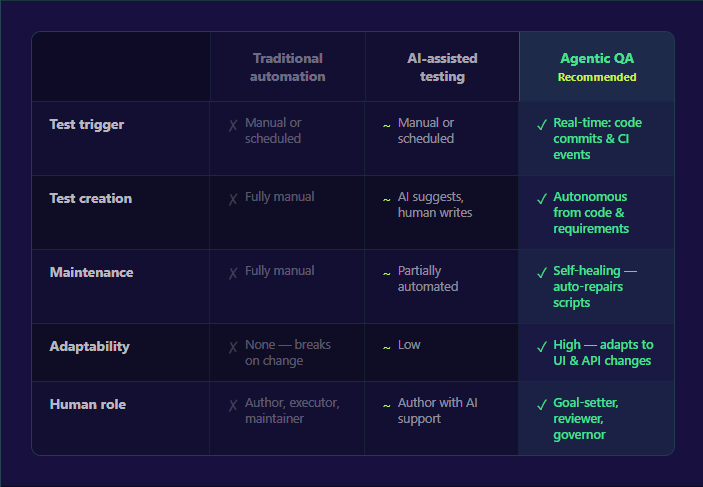
Comparison of traditional automation, AI-assisted testing, and agentic QA

One question comes up immediately: does this replace QA engineers? The data says no. The Stack Overflow 2025 Developer Survey found 70% of developers do not see AI as a threat to their jobs. What changes is the nature of the work. Agents handle the repetitive 80% of work, including regression suites, smoke tests, selector maintenance, and visual comparison. Human testers focus on the strategic 20%: defining quality objectives, exploratory testing, edge case discovery, and ensuring AI-generated results align with business intent. Agentic QA does not eliminate the QA function. It elevates it. 

 How AI Agents for QA Testing Actually Work 

Understanding agentic QA in principle is one thing. Understanding what AI agents for software testing actually do inside a real development pipeline is where the concept becomes actionable. 

A mature agentic QA system operates across five interconnected capabilities. These are not features bolted onto an existing automation tool. They are the architectural building blocks that make autonomous, self-improving testing possible.

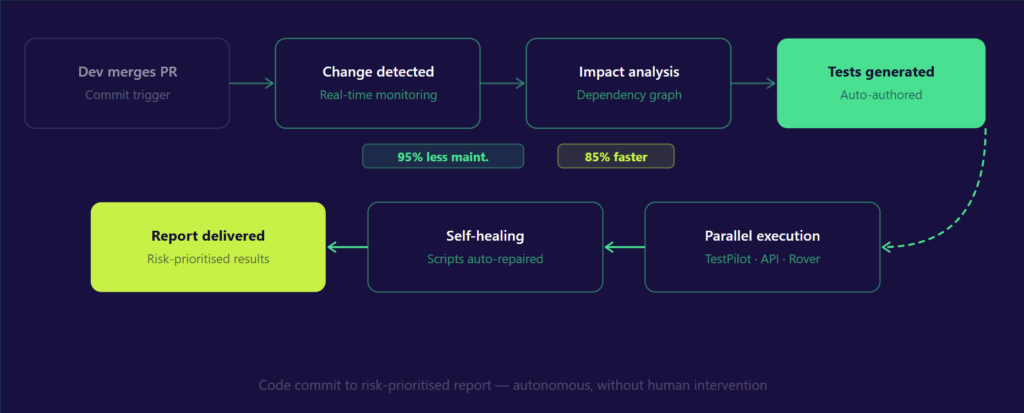
Agentic QA Cycle Flow Diagram

1. Autonomous Test Generation 

When a developer merges a pull request, an agentic system does not wait for a human to decide which tests to write or run. The system analyzes code changes, identifies coverage gaps, and automatically generates test cases for functional scenarios and regression paths that manual processes often overlook.  Teams adopting this capability report up to an 80% reduction in test creation effort, freeing engineers to focus on higher-value validation work. 

2. Self-Healing Tests 

Brittle scripts are the single largest hidden cost in traditional automation. Forrester research notes that over 60% of QA leaders identify automation maintenance as a key bottleneck in DevOps success. When a UI element shifts — a button ID changes, a form field moves, an API endpoint is renamed — traditional scripts fail silently or noisily, and a human has to diagnose and repair them. Self-healing agents detect the change, identify the correct new locator using DOM structure, visual matching, or semantic analysis, and update the test automatically. One global retailer deploying this approach achieved a 95% reduction in script maintenance while doubling the speed of regression cycles. 

3. Risk-Based Test Selection 

Running every test on every commit is unsustainable at scale. Google learned this building one of the largest CI/CD infrastructures in the world, executing over 150 million test cases daily required ML-driven test selection to identify the smallest effective test set, reducing computational waste by over 30% while maintaining a 99.9% confidence level. Agentic QA brings this capability to any team. Agents analyze what changed in a commit, assess which components are affected using dependency graphs, and run only the tests with genuine relevance to that change. There are reports that AI-powered impact analysis reduces testing timelines by up to 85% while maintaining complete risk coverage. 

4. Real-Time Adaptive Testing 

Traditional automation runs on schedules. Agentic QA reacts to events — a code commit, a Jira ticket update, a Figma design change, a failed deployment. This shift from batch-mode to real-time adaptive testing is what allows quality assurance to finally match the pace of modern development cycles. Feedback that once took hours arrives in minutes, enabling development teams to catch and fix defects before they compound. 

5. Multi-Agent Orchestration 

No single agent handles everything. A mature agentic QA system deploys specialized agents in parallel: one focused on UI interactions, another validating API responses, a third exploring untested pathways autonomously, and a fourth consolidating results into prioritized reports. This coordinated squad model, with a central orchestration layer routing work between agents. is what enables comprehensive test coverage across web, mobile, API, and backend layers simultaneously, rather than sequentially. 

🔄 In Practice: A developer merges a feature update to a checkout flow. The agentic system detects the commit in real time, evaluates which user journeys and API endpoints are affected, generates new test cases for the updated flow, dispatches UI and API agents to execute them in parallel across multiple browsers and devices, self-heals any scripts broken by the UI change, and delivers a risk-prioritized report, all before the developer’s next meeting. That is not a future state. It is what production deployments of agentic QA systems are delivering today. 

The Business Case — What the Numbers Say 

Agentic QA is not a research project. Organizations deploying it are generating measurable, reportable returns — and the numbers are significant enough to reframe how executives think about the cost of quality engineering. 

Start with the cost of inaction. Poor software quality costs the US economy an estimated $2.41 trillion annually, according to research from CISQ and Carnegie Mellon’s Software Engineering Institute. That figure encompasses failed projects, legacy system failures, cybersecurity incidents, and operational disruptions. Meanwhile, software testing already consumes 15–25% of a typical project budget — among the first line items cut when AI is assumed to close the gap automatically. It does not close the gap automatically. Agentic QA does. 

On the delivery side, the returns compound across multiple dimensions simultaneously: 

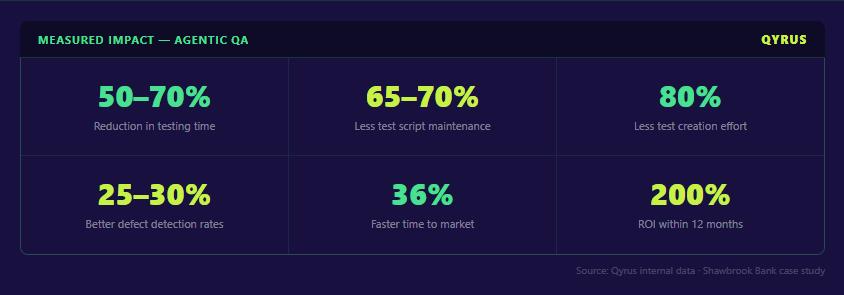
ROI metrics from agentic QA adoption
  • Speed: Teams adopting agentic orchestration achieve a 50–70% reduction in overall testing time. Regression cycles that once occupied entire sprint days compress into hours. One ERP enterprise reduced regression testing from over 25 hours to under 8 hours per cycle after deploying agentic QA — with more issues caught pre-production and more predictable releases as a direct result. 
  • Maintenance: The largest hidden cost in traditional automation is not test creation — it is upkeep. Agentic QA’s self-healing capability delivers a 65–70% decrease in the engineering effort required to maintain test scripts. For a mid-size QA team spending 50% of sprint capacity on broken test maintenance, that recovery represents significant bandwidth redirected toward coverage expansion and exploratory testing. 
  • Creation velocity: With agents generating test cases from requirements, user stories, and code changes autonomously, teams see an 80% reduction in test creation effort. Tests that previously took days to author and validate are produced and ready for review in minutes. 
  • Quality outcomes: Faster testing and less maintenance would mean nothing if defect detection suffered. It does not. Organizations adopting agentic QA report a 25–30% improvement in defect detection rates, with AI-generated test cases achieving up to 85% improvement in test coverage — catching more critical bugs before they reach customers. 
  • Business impact: These improvements compound into outcomes that matter at the board level: an 80% reduction in defect leakage, a 36% faster time to market, and a ~40% improvement in project turnaround time. A Shawbrook Bank deployment of Qyrus demonstrated 200% ROI within 12 months — a figure that shifts the conversation from “what does this cost?” to “what does waiting cost?” 

Broader market data reinforces the direction. Companies using AI agents across business functions report 55% higher operational efficiency and average cost reductions of 35%. In QA specifically, organizations implementing AI-powered testing solutions report a 40% reduction in overall testing costs while achieving productivity gains of up to 30%. 

How Qyrus Approaches Agentic QA — The SEER Framework 

Most platforms describe agentic QA as a capability. Qyrus built a purpose-designed architecture around it. 

In Q4 2025, Forrester named Qyrus a Leader in its inaugural Autonomous Testing Platforms Wave — the report that replaced the former Continuous Automation Testing Platforms category and evaluated 15 vendors on their ability to deliver genuinely autonomous, AI-driven quality assurance. Qyrus received the highest possible score of 5.0 in critical criteria including Roadmap, Testing AI Across Different Dimensions, and Testing Agentic Tool Calling. The report specifically cited the SEER framework and “excellent agentic tool calling” as the basis for an above-par score in autonomous testing. For enterprises asking whether agentic QA is production-ready, that evaluation offers a clear answer. 

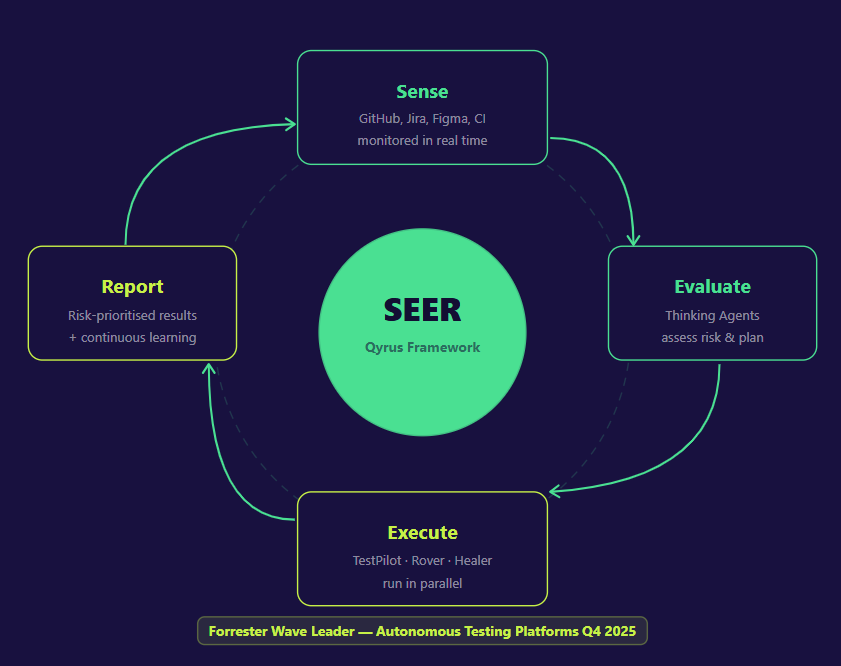
The SEER framework — Sense, Evaluate, Execute, Report — is the operational engine behind Qyrus’s agentic QA approach. It is a continuous, closed-loop cycle designed to align the pace of quality assurance with the pace of modern software development.

The Qyrus SEER agentic QA framework

Sense 

The cycle begins with awareness. Qyrus Watch Towers monitor code repositories like GitHub for commits and pull request merges, project management tools like Jira and Azure DevOps for story and requirement changes, design platforms like Figma for UI and UX updates, and CI pipeline events in real time. Testing does not start on a schedule. It starts the moment a change is detected. 

Evaluate 

Once a change is detected, a Reasoning Layer assesses its potential impact and deploys specialized Thinking Agents to formulate a response. The Impact Analyzer traces the ripple effect of a code change across modules, components, and APIs using dependency graphs. TestGenerator+ uses natural language processing to dynamically generate new test cases based on what changed and what coverage already exists — constantly expanding the test surface without human authoring. UXtract interprets design changes from Figma and maps them to the relevant test steps and user flows. The output of this stage is a precise, risk-prioritized testing plan, not a blanket instruction to run everything. 

Execute 

The plan is handed to an autonomous execution squad. TestPilot handles UI and functional testing across web and mobile platforms, simulating real user interactions across a browser and device farm. The API Builder agent validates backend services and complex integration points, with the ability to virtualize APIs on demand. Rover explores the application autonomously, surfacing untested pathways and hidden defects that scripted tests would never reach. Healer — built on US Patent 11,205,041 B2 — monitors execution in real time and automatically repairs any test script broken by a legitimate UI or structural change. These agents operate in parallel, not in sequence, compressing execution time without sacrificing coverage. 

For enterprise teams running SAP testing, this same squad extends into ERP-aware validation — analyzing transport requests, mapping business process impact, and executing regression tests autonomously across S/4HANA landscapes. 

Report 

Raw results become actionable intelligence. AnalytiQ aggregates logs and metrics from the entire execution squad. Eval, a sophisticated AI analyst, evaluates test outputs for deep contextual analysis that goes far beyond a binary pass/fail. The final output — a risk-prioritized defect list, a coverage summary, and an instant notification to the right stakeholders via Slack, email, or Jira — arrives in minutes, not hours. Every outcome is fed back into the Context DB, making the Thinking Agents smarter and more predictive with every cycle. 

This is what distinguishes Qyrus from platforms that bolt agentic labels onto existing automation tools. SEER is not a feature. It is a continuously learning system — and the results it delivers compound over time. 

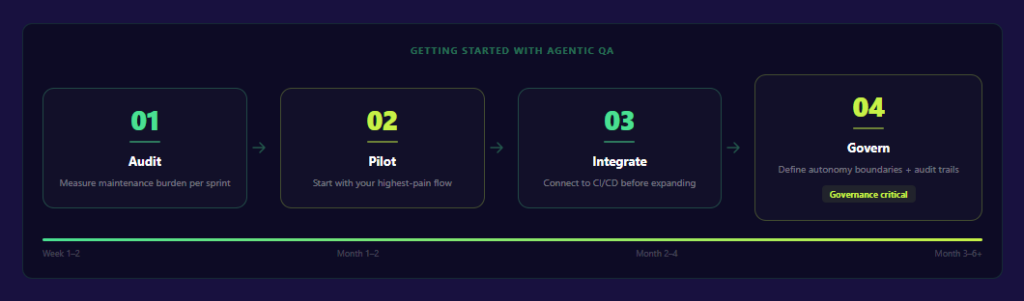
Getting Started with Agentic QA — A Practical Roadmap 

Most organizations stall between interest and implementation. The World Quality Report 2025, drawing on responses from over 2,000 executives across 22 countries, found that 89% of organizations are piloting or deploying AI-augmented QA workflows — but only 15% have achieved enterprise-wide implementation. That 74-point gap is not a technology problem. It is an execution problem. 

Gartner adds a sharper warning: over 40% of agentic AI projects will be cancelled by end of 2027 due to escalating costs, unclear business value, and inadequate risk controls. The organizations that avoid this fate share one trait — they defined measurable goals and governance structures before they expanded scope. The ones that fail treat agentic QA as a plug-in rather than a system change. 

Four steps separate the teams getting results from the ones stuck in perpetual pilots.

Four-step roadmap to implementing agentic QA

Step 1: Quantify Maintenance Latency Prior to Implementation 

Before evaluating platforms or running proofs of concept, measure where your team’s time actually goes. How many hours per sprint does your QA function spend fixing broken tests that failed because of a UI change — not because of an actual product defect? Industry benchmarks suggest this figure consumes 20–30% of a QA team’s working week in traditional automation environments. That number is your baseline. It is also your first ROI target. If you cannot measure it before deployment, you cannot prove improvement after. 

Step 2: Start With Your Highest-Pain Flow, Not Your Entire Pipeline 

The instinct to modernize everything at once is where projects collapse under their own weight. Pick one regression suite or smoke test suite — ideally one that breaks frequently, consumes disproportionate maintenance time, or sits on a critical user journey. Run your agentic QA pilot there. Let it prove value in a constrained, measurable environment before expanding. Teams that start small and iterate build the internal confidence — and the data — needed to justify broader rollout. Those that start broad rarely finish. 

Step 3: Integrate Into Your Existing CI/CD Before Adding New Capabilities 

Agentic QA delivers its full value when it operates as a continuous, event-driven layer inside your development pipeline — not as a separate testing tool you run on demand. Before unlocking advanced capabilities like exploratory agents or multi-surface orchestration, ensure your agentic platform is connected to your existing infrastructure: GitHub or Bitbucket for version control triggers, Jenkins, Azure DevOps, or TeamCity for CI pipeline integration, and Jira or Azure DevOps for defect tracking and traceability. Integration before innovation is the sequencing that separates production deployments from permanent pilots. 

Step 4: Govern From Day One 

Autonomy without governance is where agentic AI projects generate the most risk — and the most expensive failures. Before agents operate independently in your pipeline, define three things explicitly: what the agent is authorized to act on without human review, what requires human approval before proceeding, and how every agent action is logged for audit. UC Berkeley’s CLTC published the first Agentic AI Risk Management Profile in February 2026, recommending proportional oversight calibrated to the autonomy level of each deployed agent. That framework is a practical starting point. The teams succeeding with agentic QA in 2026 are not those that maximized autonomy fastest — they are those that built trust incrementally, expanded scope based on demonstrated accuracy, and kept human judgment at the decision points that carry the most business risk. 

Agentic QA is not a one-time implementation. It is a system that gets smarter with every cycle — but only if the governance structures exist to let it operate reliably at scale. 

The Shift Has Already Happened 

AI agents bridging the gap between development velocity and QA validation speed

Agentic QA is not approaching. It is here. And the organizations treating it as a future consideration are already falling behind the ones running it in production. 

Forrester’s Q4 2025 Autonomous Testing Platforms Wave was not a prediction. It was a verdict: autonomous, AI-driven quality assurance has crossed from experimental to essential infrastructure. The teams winning today are not those with the largest QA headcounts or the most elaborate script libraries. They are the ones that stopped asking “how do we test faster?” and started asking “how do we set better quality goals and let intelligent agents pursue them?” 

That is the real shift agentic QA delivers. From writing scripts to defining outcomes. From managing test maintenance to governing autonomous systems. From QA as a bottleneck to QA as a continuous, self-improving competitive advantage embedded directly in the development cycle. 

The velocity gap is real. The tools to close it exist. The only remaining question is whether your organization moves now, while the gap between early adopters and the rest of the market is still recoverable, or later, when it is not. 

Book a demo with Qyrus → 

Devops Conclave

Save the Date:
📅 March 13th, 2026 
📍 Taj MG Road, Bengaluru 

If you’ve been keeping an eye on how fast DevOps is evolving across the enterprise, you already know one thing for sure: innovation doesn’t slow down for anyone. That’s exactly why we’re excited to share some big news. Qyrus is proud to be a Platinum Sponsor at the 11th Edition of the DevOps Conclave & Awards 2026, happening this March in Bengaluru. 

Over the years, DevOps Conclave has earned its place as a must-attend event for leaders, practitioners, and builders who care deeply about the future of software delivery. It’s not just another conference. It’s a space where real conversations happen, ideas are challenged, and the next phase of DevOps takes shape. 

If this event isn’t already on your calendar, here’s why it should be. DevOps Conclave brings together forward-thinking teams and technology leaders to talk openly about what’s working, what’s broken, and what needs to change. This year’s agenda dives into AI-powered DevOps, platform engineering, cloud-native innovation, GitOps, and the evolving practices that are redefining how software is built and delivered at scale. It’s practical, relevant, and grounded in real-world experience. 

The Big Stage: Ameet Deshpande on the Future of Engineering 

If you’ve spent any time in the product engineering world, you’ve probably heard the word “efficiency” thrown around more times than you can count. Too often, it becomes a catch-all phrase that hides manual effort, fragmented tooling, and growing complexity. We think it’s time to have a more honest conversation. 

That’s where this year gets even more exciting for us. Ameet Deshpande, SVP of Product Engineering at Qyrus, will be delivering a keynote at the Conclave. Ameet has spent years working closely with engineering teams to modernize how they design, test, and ship software. His perspective goes beyond theory. It’s rooted in what teams actually face every day. 

Ameet doesn’t just talk about trends. He challenges assumptions, asks uncomfortable questions, and offers practical ways to move forward. Expect clarity, thoughtful insights, and a dose of healthy disruption that will leave you rethinking how engineering organizations operate. 

Why We’re All In 

DevOps Conclave has always stood out for one reason. It’s a place where leaders share not just their wins, but the hard-earned lessons that come from scaling complex systems. This year’s focus on Platform Engineering and Developer Experience feels especially relevant to us at Qyrus. 

We believe the best tools are the ones that get out of the way, reduce friction, and let teams focus on building great software. As Platinum Sponsor, we’re looking forward to connecting with architects, VPs of Engineering, DevOps leaders, and hands-on practitioners who are shaping the next generation of digital-first operations. 

Whether you’re leading DevOps strategy, working on the front lines of delivery, managing product releases, or exploring how AI is changing automation, there’s real value here. Beyond the sessions, the conversations, debates, case studies, and awards make DevOps Conclave & Awards 2026 a true hub for what’s next. 

So, if you’re planning your DevOps roadmap for the year ahead, join us in Bengaluru. Stop by the Qyrus booth, attend Ameet’s keynote, and let’s talk about the future of quality, automation, and delivery. This isn’t about buzzwords. It’s about meaningful transformation, and we’re proud to be part of it. 

Beyond the Syntax

 In the last thirty days, the software industry didn’t just advance; it underwent a structural collapse and a total rebirth. For twenty years, developers lived by the sword of Linus Torvalds: “Talk is cheap. Show me the code.” This filter prioritized the grueling labor of implementation over the “vapor” of ideas. But as of February 2026, that sword has been blunted. We have entered an era where products no longer look like assistants—they look like colleagues. 

The tectonic plates of the technology sector shifted during this past month. Market volatility proved the reality of this transition. In a single week, India’s Nifty IT index plunged nearly 6%, erasing over $22 billion in market value. Investors didn’t see productivity; they saw substitution. This sudden repricing stems from a simple realization: code is no longer scarce. According to Gartner, 75% of enterprise software engineers will use AI code assistants by 2028, moving the needle from manual implementation to high-level orchestration. 

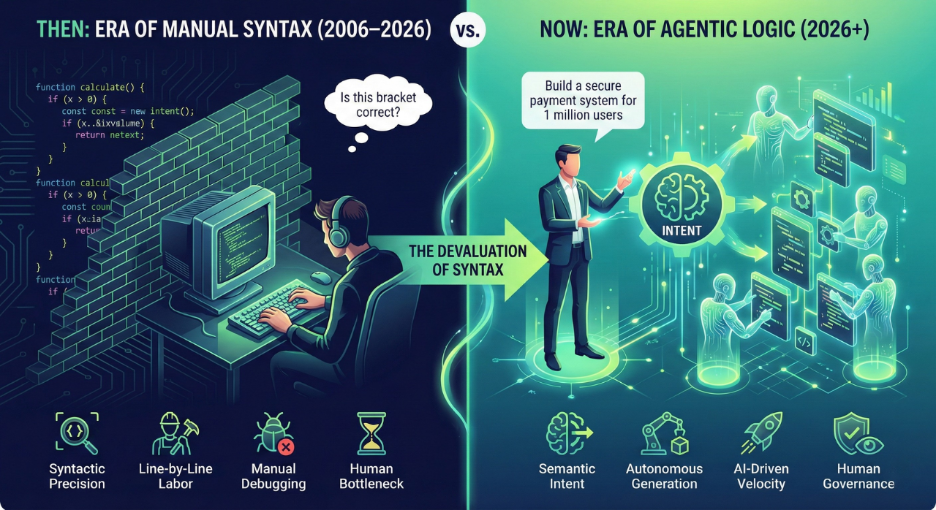
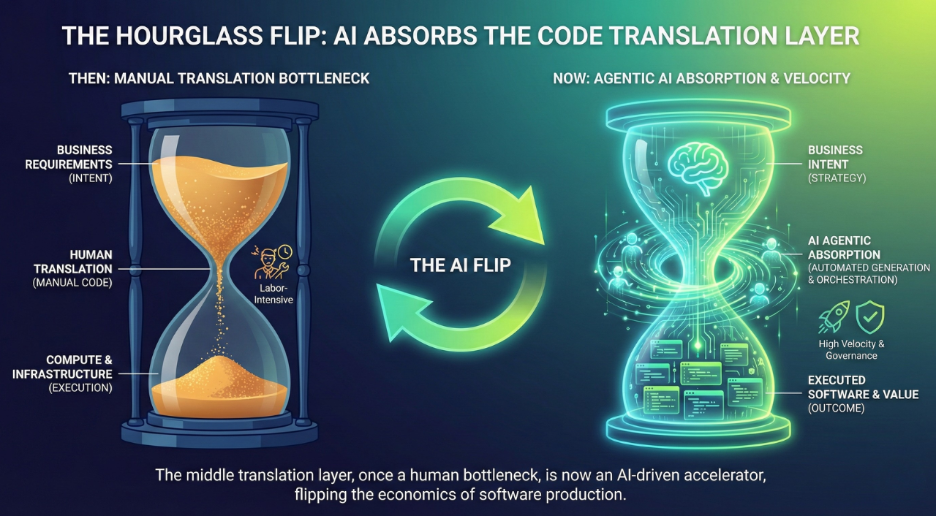
The hourglass of our industry has flipped. For decades, business requirements sat at the top, compute sat at the bottom, and a thin middle layer of human translators connected them. Today, that translation layer is evaporating. 

Era of Agentic Logic

When Poetry Outran Python 

If a generative model can write English poetry with structure, rhythm, and intent, then code—with its rigid grammar and predictable scaffolding—was never the hard part. Engineers once viewed syntax as mystical because humans found it difficult to type. For a machine, the constraints of Rust or Python provide a far simpler path than the non-deterministic mess of human language. 

“We used to treat code as mystical because it was hard for us to type. We now realize the machine finds Python easier than it finds a messy human conversation.” 

The industry finally stopped pretending we were building “coding tools” and started building a production line for logic. Recent data supports this shift. As of early 2026, AI generates roughly 41% of all code, a number climbing as agentic systems move from suggesting snippets to orchestrating entire modules. The “mystical” element was never the brackets or the indentation; it was the judgment. We now prioritize the ability to choose what to build and knowing what “correct” means when reality refuses to be neat. 

Agentic Ai Absorption

The Trillion-Dollar Reality Check 

The timeline of the last thirty days reads like a controlled demolition of the old software development lifecycle. On January 8, 2026, Anthropic released Claude Code v2.1.0, explicitly framing it as an “agentic” environment. This update wasn’t just a better prompt box. It included 1,096 commits oriented around workflow portability and agentic “handshakes.” The system now spins up agents, controls their lifecycle, and carries context across sessions. 

Then came the moment Wall Street heard the subtext. When Anthropic launched “Claude Cowork” on January 12, investors didn’t see productivity—they saw substitution. The resulting panic wiped off nearly $22 billion in market value in just three days. The market absorbed the reality that LLMs are moving “up the stack” into the application layer. 

Apple made the shift inevitable on February 3, 2026. Xcode 26.3 now adds native AI coding agents from OpenAI and Anthropic directly into the environment. These agents don’t just suggest code. They operate within the IDE—updating settings, searching documentation, and verifying work visually via SwiftUI Previews. The IDE no longer acts as a tool; it serves as an agent host. 

“In this new economy, we aren’t losing engineers; we are losing typists. We are gaining governors who must manage an industrial scale of logic production.” 

The Day the Billable Hour Broke 

The market panic wasn’t an irrational fear of “robots taking jobs.” It was a sudden repricing of an old assumption: that software and services companies sit behind defensible complexity. For two decades, the industry worked like an hourglass. At the top were business requirements; at the bottom was compute. In the thin middle sat the precious layer: people who could translate intent into software. This month, the hourglass flipped. Translation stopped being scarce. 

The impact hit India, the world’s largest labor-intensive software engine, with particular force. On February 4, 2026, Reuters reported that Anthropic’s new plugins and other AI developments rattled the staffing-intensive IT model, wiping off close to $1 trillion in total market value globally. Indian Software services companies felt the shock acutely as the NIFTY IT index fell 6%—the steepest drop since the 2020 pandemic. Over $22.5 billion in value vanished in a single week. 

Regional anxieties vary but remain interconnected. In the US, the conversation focuses on product margins and platform moats. In the EU, anxiety clusters around compliance-heavy services and data businesses fearing replacement by agentic extraction. In India, the crisis is existential because the business model historically monetized hours and headcounts. When an agent performs the first 80% of routine work, staffing becomes a cost center rather than a competitive moat. 

The Architect-Governor: Why “The Talk” is the Only Scarcity Left 

The coding workforce isn’t doomed, but the old identity of the “typist” is dead. On January 30, 2026, Kailash Nadh, CTO of Zerodha, flipped the industry script: “Code is cheap. Show me the talk.” This simple phrase captures the new reality. Writing syntactically correct logic no longer counts as a scarce skill. Scarcity now lives in the service the code provides. We have shifted the bottleneck from production to judgment. 

This transition elevates a different kind of engineer—the Architect-Governor. These leaders hold the entire problem in their heads, negotiate tradeoffs, and communicate intent so clearly that the machine executes it perfectly. But speed brings a new danger. If code generation accelerates, failure creation follows right behind it. Data from the field confirms this anxiety. While developers use AI in roughly 60% of their daily work, only 0–20% of those tasks can be fully delegated without oversight. 

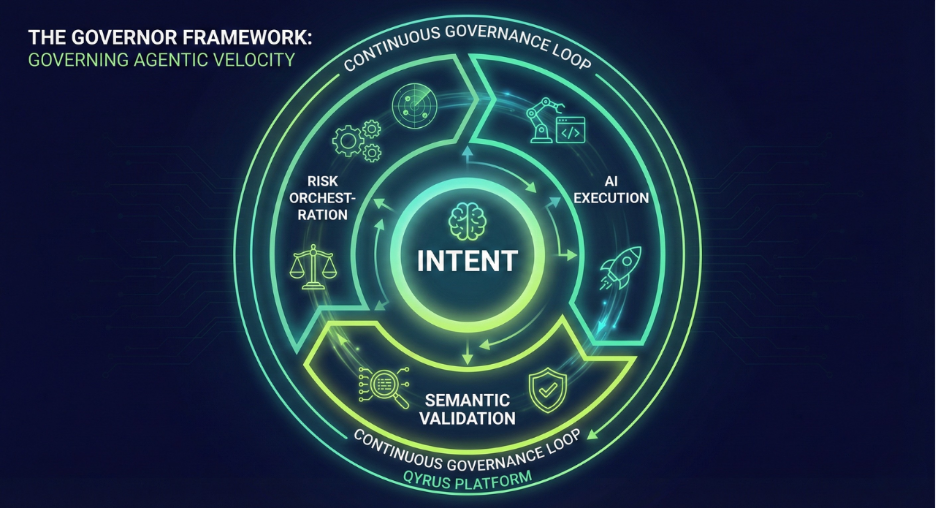
Quality Engineering now serves as the “governor” of this industrial-scale velocity. We no longer check for exact strings; we validate outcomes semantically. Organizations move from asking “Did the feature work once?” to “Do we trust this system to keep working after a hundred AI-assisted edits?” Recent surveys highlight the stakes: 88% of developers lack the confidence to deploy AI-generated code without explicit verification. The winners won’t just “use AI to code.” They will use AI to govern coding through automated evaluation and risk-based orchestration. 

Governor Framework

Engineering the High-Velocity Guardrail 

Velocity without governance creates a “black box” of risk. When AI agents generate code at industrial speeds, traditional testing methods crumble. For years, QA teams relied on checking exact strings—verifying that a button had a specific ID or that a database returned an exact character set. In a world of agentic code, those static checks are useless. You cannot catch a semantic hallucination with a literal string match. 

The industry now faces a “Quality Gap.” While AI can increase code volume by up to 40%, it also introduces subtle logic errors that traditional unit tests often miss. We transition from “checking strings” to “validating semantic outcomes.” This means the testing engine must understand the intent of the software, not just its syntax. If an AI agent modifies a checkout flow, the Governor doesn’t just check if the “Buy” button exists; it validates that the entire transaction logic remains sound across a hundred different edge cases. 

“If you increase the speed of the engine without upgrading the brakes, you aren’t building a faster car—you’re building a more dangerous one. In 2026, Quality is the brakes.” 

This is where risk-based orchestration changes the game. Instead of running every test for every minor AI edit—a process that would paralyze development—we use automated evaluation to identify high-risk changes. Qyrus employs this “Governor” logic to prioritize testing where the agents are most likely to fail. By mapping the relationship between AI-generated components and business-critical logic, we ensure that speed never compromises integrity. We turn the testing suite into an active monitor that understands reality’s messiness. 

The New Social Contract: Human Intent, Machine Scale 

The events of early 2026 have drafted a new social contract for the modern organization. In this framework, humans speak intent and bear the ultimate responsibility, while machines produce the first draft at an industrial scale. We are witnessing the final departure from an era where code was the only proof of seriousness. Today, code is plentiful, but trust is rare. 

In this new economy, the ultimate proof of value is whether you can define the right product to build—and whether you can prove it is safe to ship. The demand for “Analytical Thinking and Quality Governance” is going up as technical implementation roles undergo automation. The focus has moved from the “how” of development to the “what” and “why” of system integrity. 

At Qyrus, we recognize that as agentic velocity accelerates, the role of the Quality Architect becomes the most critical seat in the house. We build the tools that empower you to be the Governor, not the typist. Our platform provides the semantic validation and risk-based orchestration needed to turn “agentic logic” into reliable, enterprise-grade software. The talk is no longer cheap—it is the only thing that defines the future. 

Stop fighting the surge of agentic code with brittle manual scripts. Contact Qyrus today to see how we help your team transition to semantic governance and secure your software’s integrity at scale. 

A version of this article originally appeared on LinkedIn, authored by Ameet Deshpande, Senior Vice President – Product Engineering at Qyrus. 

Welcome to the second post in our series on Agentic Orchestration. In our introduction, we explained why the future of QA requires a shift from simple automation to an intelligent, agent-driven framework. Now, we’ll dive into the first step of that process: the ‘Eyes and Ears’ of the operation, the SEER Sense stage. If you missed our first post, we suggest starting there to get the full context.

How Qyrus Senses Change and Kickstarts Autonomous Testing 

In the ever-evolving world of software development, change is the only constant. New features are added, bugs are fixed, and designs are tweaked, all at a breakneck pace. Traditional testing methods often struggle to keep up with this constant flux, leading to missed bugs, delayed releases, and frustrated developers. But what if your testing process could automatically adapt to change, like a chameleon blending seamlessly into its environment? This is the power of agentic orchestration, and at the heart of this revolution lies the “Sense” stage of the SEER framework (Sense, Evaluate, Execute, Report).    

In this second installment of our series, we’ll explore how Qyrus Agentic acts as the eyes and ears of your development process, constantly monitoring for changes and triggering the appropriate testing actions. It’s like having a vigilant guardian constantly watching over your software, ensuring that no update goes unnoticed.    

The ‘Sense’ Stage Explained 

The ‘Sense’ stage is the foundation of Qyrus’ Agentic AI capabilities, designed to transition software testing from a reactive approach to a proactive one. It ensures high-quality software with minimal effort by detecting changes across various platforms and tools.    

Change is in the Air: Detecting the When and Where 

The primary objective of the ‘Sense’ stage is to identify precisely when and where a change occurs within the software development lifecycle. This involves continuously monitoring various sources for updates that could potentially impact the software’s quality, acting as the eyes and ears of your development process.    

Imagine a radar system constantly scanning the horizon for potential threats. The ‘Sense’ stage acts in a similar fashion, vigilantly monitoring code repositories, project management tools, design platforms, and even user journey maps for any modifications. This proactive approach ensures that no change goes unnoticed, no matter how small or seemingly insignificant. By detecting changes early on, Qyrus SEER enables a shift from reactive to proactive testing, allowing teams to address potential issues before they escalate into major problems. 

Watch Towers: The Guardians of Change 

Watch Towers are the sentinels of the ‘Sense’ stage, constantly monitoring various sources for any changes that could impact the software’s quality. They act as the eyes and ears of Qyrus SEER, ensuring that no update goes unnoticed. 

These Watch Towers are strategically positioned across the development landscape, keeping a close watch on platforms like: 

These components enable Qyrus Agentic to maintain a comprehensive overview of the software development lifecycle, ensuring that all relevant changes are captured and addressed. 

The ‘Sense’ Stage Under the Hood: Technical Mechanisms for Change Detection 

To effectively capture changes across diverse platforms, the ‘Sense’ stage employs several technical mechanisms. These mechanisms ensure that Qyrus Agentic is promptly notified of any updates that may impact software quality: 

By combining these technical mechanisms, Qyrus SEER achieves unparalleled continuous testing capabilities. It’s like having a network of sensors constantly monitoring your development environment, instantly detecting any changes and triggering the appropriate testing actions. This proactive approach ensures that no bug goes unnoticed, no matter how small or subtle. 

The ‘Sense’ Stage: Eyes and Ears

How Qyrus uses ‘Watch Towers’ to monitor the entire development ecosystem for changes.

Code Repos
Git, SVN
Design Tools
Figma, Sketch
Requirement Docs
Jira, Confluence
API Specs
Swagger, Postman

The ‘Sense’ Stage

Aggregates all change data into a single trigger.

OUTPUT: Change Data Trigger → Sent to ‘Evaluate’ Stage

Benefits of the ‘Sense’ Stage: Proactive, Real-Time, and Comprehensive 

The ‘Sense’ stage offers several key benefits that enhance the efficiency and effectiveness of software testing: 

With its proactive, real-time, and comprehensive monitoring capabilities, the ‘Sense’ stage lays the foundation for a truly autonomous and efficient testing process. It’s like having a vigilant watchdog constantly guarding your software, ensuring that no change goes unnoticed, and no bug slips through the cracks. 

Conclusion: Sense the Change, Embrace the Future 

The ‘Sense’ stage is a critical component of Qyrus SEER, enabling proactive, real-time, and comprehensive monitoring of changes across the software development lifecycle. By identifying when and where changes occur, Qyrus ensures that testing efforts are always aligned with the latest code, requirements, and designs, resulting in more robust and reliable software. 

But the journey doesn’t end here. Once changes are sensed, they need to be evaluated for their impact on the software. In the next part of this series, we’ll dive deep into the ‘Evaluate’ stage, exploring how Qyrus SEER uses Single Use Agents (SUAs) to assess the impact of these changes, generate or adapt test cases, and optimize testing strategies. Stay tuned to discover how Qyrus transforms detected changes into actionable insights, ensuring comprehensive test coverage and efficient resource allocation. 

Other Blog Posts in the Series 

The Agentic Orchestration Series, Part 5: Test Insights – The Voice of the Operation

The Agentic Orchestration Series, Part 4: How Autonomous Test Execution is the Muscle of the Operation 

The Agentic Orchestration Series, Part 3: Brains of the Operation 

The Agentic Orchestration Series, Part 1: Beyond Automation

agentic orchestration

For years, software development teams have relied on a mix of manual and automated testing methods, hoping to catch those pesky bugs before they wreak havoc on users. But let’s face it, this approach is like trying to navigate a busy city with a tattered map and a broken compass. You might get to your destination eventually, but it’s going to be a bumpy ride. Traditional testing methods often lead to inconsistent coverage, inefficient release timelines, and sky-high maintenance costs.  

Manual testing requires a small army of testers, while conventional automation tools lack the intelligence to manage comprehensive end-to-end testing across various types and stages. It’s like trying to assemble a complex puzzle with only half the pieces – frustrating and ultimately unproductive. This outdated approach is screaming for a change, begging for a solution that can navigate the complexities of modern software development with intelligence and precision.  

Agentic Orchestration: The Self-Driving Revolution of Software Testing 

Imagine a world where software tests itself, where intelligent agents tirelessly work behind the scenes to ensure quality at every stage of development. This is the promise of agentic orchestration, an AI-driven, fully autonomous system that manages test case creation, execution, and reporting. It’s like having a self-driving car for your software testing process – you set the destination, and the system takes care of the rest.  

Agentic orchestration empowers development and testing teams to achieve exceptional results without the traditional overhead. It’s a paradigm shift from reactive to proactive testing, ensuring high-quality software with minimal effort. No more sleepless nights worrying about missed bugs or delayed releases. With agentic orchestration, you can finally shift gears and focus on what matters most – building amazing software that delights your users.  

The Evolution of Testing

From rigid, linear pipelines to a dynamic, intelligent, and cyclical orchestration framework.

Traditional Automation

P
C
B
T
D

Agentic Orchestration

SEERFramework
Code
APIs
UX/UI
Docs

Qyrus SEER: Your Co-Pilot for Autonomous Testing 

Qyrus SEER (Sense, Evaluate, Execute and Report) is a framework for AI-powered agent orchestration. It features AIVerse, a comprehensive suite of Single Use Agents (SUAs) – specialized GenAI-driven models designed to address specific problems or scenarios within the quality assurance process. These agents act like a team of expert testers, each with their own unique skills and knowledge, collaborating to ensure your software is rock solid.  

SUAs can collaborate or operate independently, enhancing test automation with an extraordinary level of intelligence and speed. They can generate test cases, discover APIs, create realistic test data, and even self-heal when things go wrong. It’s like having a team of tireless testers working around the clock, catching bugs before they even have a chance to rear their ugly heads.  

With Qyrus SEER, you can finally say goodbye to the headaches of traditional testing and embrace a new era of self-driving quality. It’s time to shift gears, accelerate your release cycles, and steer your software development towards a brighter future. 

What is Agent Orchestration? 

Agent orchestration represents a paradigm shift in software testing, using AI-driven agents to automate and optimize the entire testing process. Unlike traditional methods that often require extensive manual intervention or fall short in end-to-end coverage, AI agent orchestration leverages intelligent automation to create a dynamic, self-improving testing ecosystem. It enables a move from reactive to proactive testing, ensuring superior software quality with less effort.  

Think of it as an orchestra, where each musician plays a specific instrument to create a harmonious symphony. In agentic orchestration, each AI agent is a specialized musician, playing its part to ensure a flawless performance. The agent orchestration framework acts as the conductor, coordinating the agents to work together seamlessly.  

Qyrus Agentic, a leading AI agent orchestration platform, takes this concept to the next level with its unique approach.

Our Features  

With its AI-powered agents, intelligent orchestration, and continuous feedback loops, Qyrus Agentic offers a comprehensive solution for multi-agent orchestration in software testing. It’s like having a self-learning orchestra, constantly improving its performance to deliver a flawless symphony of software quality.  

The Benefits of Agentic Orchestration: Unleashing a Tidal Wave of Efficiency and Quality 

Qyrus Agentic offers a multitude of benefits that address the key challenges of traditional software testing, resulting in a more efficient, reliable, and cost-effective approach to quality assurance. By automating and optimizing the testing process, agentic orchestration enables organizations to achieve faster releases, improved test coverage, and significant cost savings.

Advantages of adopting Qyrus SEER

In essence, agentic orchestration empowers software development teams to break free from the shackles of outdated testing methods and embrace a new era of efficiency, quality, and speed. It’s like having a team of expert testers working tirelessly behind the scenes, ensuring your software is always at its best. With Qyrus Agentic, you can finally say goodbye to the headaches of manual testing and embrace a future where quality is not just a goal, but a guarantee. 

SEER: The Brain Behind the Machine 

Qyrus SEER is an agentic AI orchestration framework to automate and orchestrate testing activities. SEER is designed to automate and orchestrate testing activities based on incoming triggers, such as new code commits, updates to user stories, or design changes.  

The agent orchestration framework uses SUAs across structured Reasoning and Orchestration layers, each focusing on a distinct set of responsibilities. The main goal is to continuously track changes, analyze their impact, generate or adapt test cases, execute these tests, and report findings.  

AlVerse: The Powerhouse of Specialized Agents 

Qyrus AlVerse is a key component of Qyrus SEER, comprising a suite of SUAs designed to address specific testing challenges. These specialized GenAl-driven models can work together or independently to elevate test automation with intelligence and speed.  

The AlVerse, combined with SUAs, advances software test automation towards objective-based testing, providing an automated testing continuum. Each SUA serves a distinct purpose: 

Qyrus AlVerse has SUAs deployed at every phase of the SDLC, designed to ‘Shift Left’, find defects early, reduce costs and improve overall quality. 

Every agent has tools, such as functions to parse JSON, build tests, or something else. 

Qyrus SEER: A Symphony of Benefits for Every Role 

Qyrus SEER is designed to provide value to everyone involved in the software development lifecycle, from testers and developers to executives. By addressing the unique challenges and priorities of each role, Qyrus SEER ensures that the entire organization benefits from a more efficient, reliable, and cost-effective approach to software testing. 

Conclusion: The Dawn of Autonomous Testing 

Agentic orchestration signals a transformative shift in software testing, moving away from traditional, often inefficient methods, towards an AI-driven, fully autonomous system. Qyrus SEER, powered by the Qyrus AIVerse, orchestrates SUAs to achieve unparalleled results in test automation. This innovative approach promises faster releases, improved test coverage, and significant cost savings, ensuring high-quality software with minimal effort. 

This series will delve into how SEER enhances each stage of the testing process. 

But how does it all begin? The answer lies in the first critical step: Sense

In the next part, we’ll explore how SEER’s “Watch Towers” act as vigilant sentinels, identifying when and where changes occur across your development landscape, from GitHub and Jira to Figma and Qyrus Journeys. Discover how Qyrus SEER knows exactly when to spring into action, ensuring that no code commit, user story update, or design tweak goes unnoticed.

Other Blog Posts in the Series 

The Agentic Orchestration Series, Part 5: Test Insights – The Voice of the Operation

The Agentic Orchestration Series, Part 4: How Autonomous Test Execution is the Muscle of the Operation 

The Agentic Orchestration Series, Part 3: Brains of the Operation 

The Agentic Orchestration Series, Part 2: Eyes and Ears