

















Application Discovery · Dependency Mapping · Legacy Modernization
Know It Before
You Change It.
Most modernization projects fail not because the technology was wrong, but because the estate was never fully understood.
QyrusAI Modernize continuously discovers every application, maps every dependency, and scores every modernization decision against real operational data — so you transform with confidence, not guesswork.
CORE FEATURES
Built to Handle the
Full Complexity of Enterprise Modernization
Unify real-time application discovery, dependency mapping, technical debt analysis, and digital twin simulation across your entire enterprise estate. Discover how data-backed insights turn complex modernization initiatives into predictable, risk-free execution.
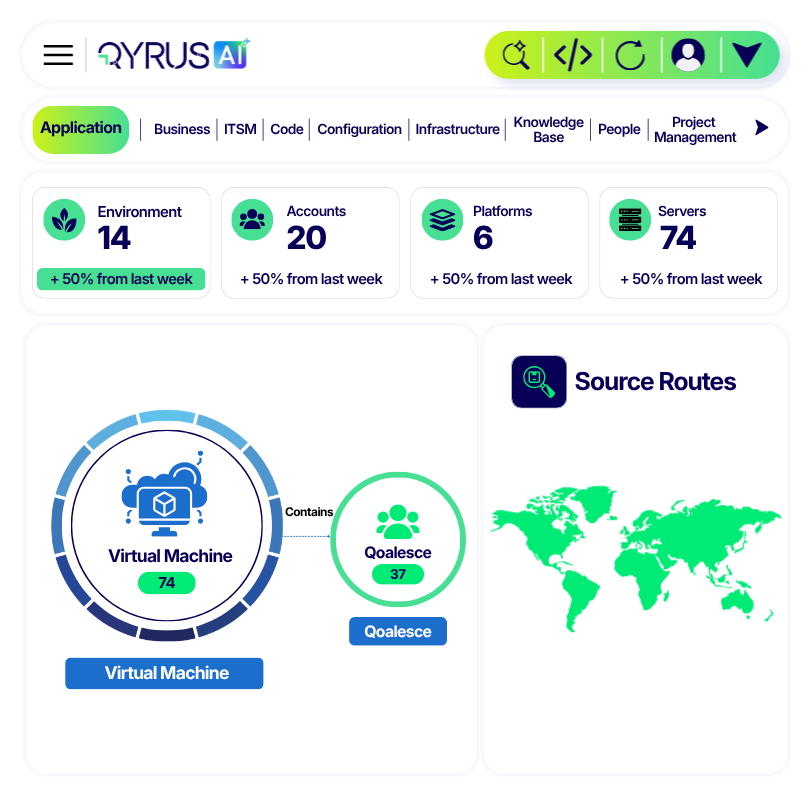
Continuous Application Discovery
Auto-discovers your full IT estate in real time — no manual inventory, no stale spreadsheet. Finds what your CMDB has missed.
Dependency Mapping
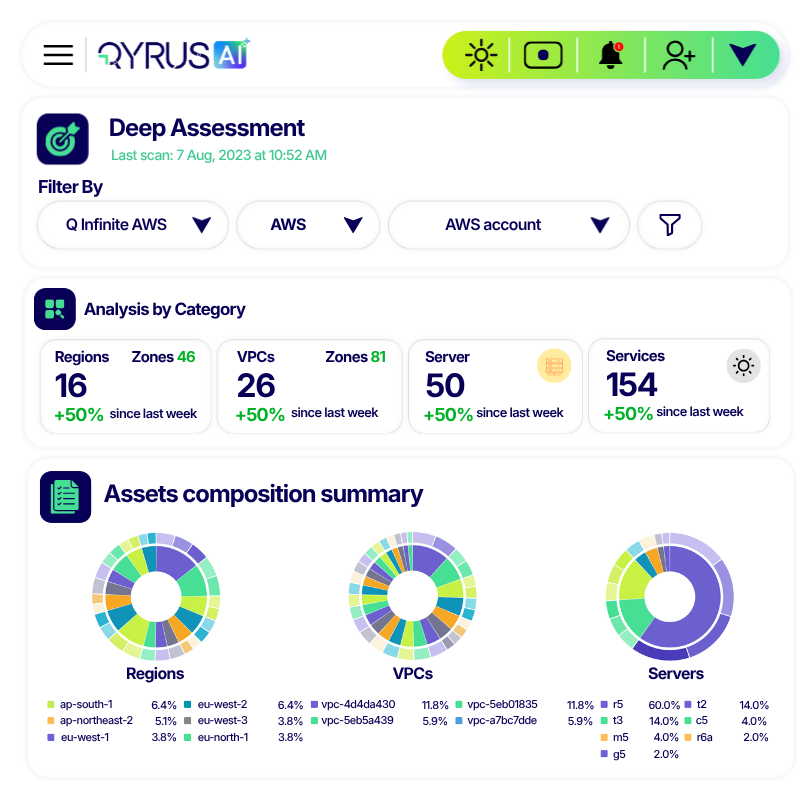
Maps every application-to-application, API, and business-service dependency. Produces a blast-radius score before any change is approved.
Application Rationalization
Scores every application by run cost, technical debt, business value, and dependency risk. Identifies what to retire, re-platform, or renegotiate — with evidence.
Technical Debt Analysis
Quantifies technical debt per application against operational cost and security risk. Makes the business case for modernization from data, not gut feel
Cloud Migration Intelligence
Sequences cloud migration waves from observed dependency data. Prevents cascade failures from undiscovered cross-system connections.
Intelligent Twin
Simulates the impact of any planned change in a digital twin before it runs in production. The blast-radius check that prevents go-live incidents.
Legacy Code Conversion
Converts legacy code in the optimal sequence determined by the dependency map. Context-aware conversion that understands what the code does, not just what it says.
Knowledge Graph (shared layer)
A continuously-observed model of every application, dependency, business service, and cost line in your estate. Every pillar reads from it. Every action writes back to it.
HOW IT WORKS
See the Estate. Map the Connections.
Sequence the Work.
Prove the Change.
Understand the four pillars of our modernization engine: discovering your entire estate in real time, mapping deep architectural dependencies, prioritizing portfolios with objective data, and transforming legacy systems safely with built-in validation.
Continuously discover your full IT estate — automatically.
QyrusAI reads your environment in real time — applications, APIs, data flows, infrastructure, and business services. No agent installation on every system. No manual inventory. The estate is observed, not surveyed — which means it stays current as your systems change.
- Discovers on-premise, cloud, hybrid, and SaaS environments from one platform
- Maps every application to the business service it supports and the infrastructure it depends on
- Detects shadow IT, undocumented systems, and CMDB drift automatically
Understand what connects to what — before you touch anything.
Every dependency between applications, APIs, databases, and business services is mapped and scored. Blast-radius analysis shows exactly which downstream systems are affected by any proposed change — so your architects work from observed reality, not drawn assumptions.
- Application-to-application, application-to-infrastructure, and application-to-business-service dependency mapping
- Blast-radius scoring: confidence level, criticality, and number of downstream consumers per change
- Intelligent Twin simulation: model the impact of any change before it runs in production
Score your modernization portfolio from evidence — not a Gantt chart.
Every application in your estate is scored by a composite of run cost, technical debt, business value, and dependency risk. The highest-cost, highest-risk applications surface to the top. The wave plan is sequenced from the dependency map — not from political priority or consultant recommendation.
- Application Rationalization: retire, re-platform, or renegotiate — with dependency evidence behind every decision
- Technical Debt Analysis: scored per application against business risk and operational cost
- Cloud Migration Intelligence: sequence your cloud migration waves from observed dependency data, not from a migration assessment spreadsheet
Execute each modernization slice — validated, sequenced, and safe.
QyrusAI converts legacy code, transforms data models, and re-platforms applications in the optimal sequence determined by the dependency map. Every slice is validated against the same business processes the legacy system ran — equivalence proof before any release decision is made.
- Optimal conversion path intelligence: figure out what to modernize first, what to retire, what to retain
- Legacy code conversion for standard programming languages with context from the Knowledge Graph
- Every converted slice tested for equivalence by Assure before it enters production
CHALLENGES
The Modernization Problem
Every Enterprise Knows.
Hidden Dependencies
Every enterprise has applications no one fully understands — systems built over decades, dependencies documented nowhere, and blast radius unknown until something breaks at go-live.
Transformation Without Evidence
Modernization roadmaps are built on spreadsheets, consultant assessments, and assumptions. When wave 1 executes, the surprises arrive — because the dependency map was never observed.
Legacy Knowledge Loss
The people who know how your legacy systems actually work are retiring. When they leave, the tacit knowledge goes with them — and no CMDB, documentation, or consulting engagement can recover it.
Technical Debt as an Invisible Tax
Every year of deferred modernization adds complexity, security risk, and run cost. But without a scored, dependency-aware view of the portfolio, it is impossible to know which debt is costing the most.
A GLIMPSE ON THE NUMBERS
Outcomes & Benefits
Explore the proven metrics of data-driven modernization: achieving total estate transparency instantly, optimizing run budgets to fund change, and executing complex overhauls with unprecedented speed and safety.
IT estate visible on first discovery
Run cost reduction — capacity for change
Lower migration volume with Phase Zero
Faster modernization programme execution
Continuous testing. Continuous learning. Continuous value.
Integrations
Works With Your Existing Enterprise Stack.
QyrusAI Modernize connects to your existing tools — CMDBs, ITSM platforms, cloud providers, and enterprise architecture repositories — so discovery enriches the tools you already use rather than replacing them.
CUSTOMER TESTIMONIALS
Enterprises running the loop
in their own words.
Real Teams. Real Outcomes. Real Confidence in what ships next.
Qyrus not only supports the testing of our Web, Mobile, and API components as part of our CI/CD processes, but also in ongoing regression-testing across our partner ecosystem. The real power of Qyrus is that we have this extremely broad testing capability in one tool, run in the cloud, and reusable across all our development teams.

The transition to Qyrus has marked a significant turning point for us. By embracing automation, we not only streamlined our SAP test automation process but also achieved a remarkable reduction in overall project testing time by 40%.
... the Qyrus platform have been a great addition to Monument's product delivery capabilities. Within a few months, we have been able to create a comprehensive test suite of complex end-to-end test scenarios spanning multiple platforms and channels. The Quinnox team has helped us embed the Qyrus solution, and the supporting processes around it, into our agile delivery methodology.
Resources
Explore our curated library of expert blog posts, in-depth whitepapers, and real-world case studies, designed to help you stay ahead in the world of AI-driven application lifecycle management.
September 4, 2026 |
14 min
How to Write Effective Test Scripts: A Straightforward Guide
Read More
September 4, 2026 |
12 min
SAP Test Automation: The Complete 2026 Guide
Read More
August 19, 2026 |
18 min
User Acceptance Testing Best Practices: A Complete UAT Strategy Guide for SAP Teams
Read More
August 13, 2026 |
2 min
Qyrus Named in Gartner’s Market Overview for API and MCP Testing Tools
Read More
August 13, 2026 |
2 min
Qyrus Named in Gartner’s Market Overview for API and MCP Testing Tools
Read More
Blog
September 4, 2026 |
14 min
How to Write Effective Test Scripts: A Straightforward Guide
Read More
September 4, 2026 |
12 min
SAP Test Automation: The Complete 2026 Guide
Read More
August 19, 2026 |
18 min
User Acceptance Testing Best Practices: A Complete UAT Strategy Guide for SAP Teams
Read MoreCase Study
Events
Reports
August 13, 2026 |
2 min
Qyrus Named in Gartner’s Market Overview for API and MCP Testing Tools
Read More
Whitepaper
August 13, 2026 |
2 min
Qyrus Named in Gartner’s Market Overview for API and MCP Testing Tools
Read More
FREQUENTLY ASKED QUESTIONS
Common Questions About QyrusAI Modernization
How is this different from a CMDB or an EA repository like LeanIX?
Does Qyrus Modernize work with SAP S/4HANA migrations?
Yes — and SAP migrations are one of the highest-urgency use cases. QyrusAI reads your SAP environment in read-only mode, inventories all RFCs, IDocs, OData services, SOAP connections, CPI integrations, background jobs, and Z-objects, and produces a blast-radius score for every proposed S/4HANA change. The Estate X-Ray and Phase Zero governance workflow are specifically designed for ECC-to-S/4HANA programmes with fixed cutover dates.
How long does the initial discovery scan take?
The first scan of a mid-market estate (200–400 applications) typically produces an initial topology map within 48–72 hours. The map enriches continuously from that point — adding confidence detail, business-service attribution, and dependency validation as more signals are observed. A Phase Zero engagement (discovery, dependency mapping, and modernization prioritization) is typically scoped at 4–6 weeks.
Does it require agent installation on every system?
No. QyrusAI reads from APIs, connectors, log streams, and cloud provider metadata — it does not require an agent on every application or server. For some legacy on-premise environments a lightweight collector may be deployed, but this is scoped per engagement and never required across the full estate before value is delivered.
What happens to the modernization plan if the estate changes while the programme is running?
The Knowledge Graph is continuously updated. If a new application is deployed, a dependency changes, or a system is decommissioned mid-programme, the change is reflected in the graph and the modernization wave plan is re-scored automatically. Your transformation plan is always based on the current estate, not the estate as it was when the programme started.
Does Qyrus Modernize integrate with Assure for testing?
Yes — this is the core joint value of the two pillars. Every modernization slice Modernize produces is automatically handed to Assure for equivalence testing. Assure generates test cases from the code analysis output, runs them against the modernized slice, and produces an evidence record before any release decision is made. The conversion is never marked complete until Assure has proved it works.
• STAY AHEAD, STAY IN THE LOOP.