
Application Discovery | Dependency Mapping | Legacy Modernization
Legacy Modernization
Starts Here.
Take a step ahead to intelligently prioritize what to retain, transform, or retire.
Accelerate your legacy modernization journey with QyrusAI. Reduce migration risks, lower costs, and seamlessly transform outdated IT systems.
Challenges
Why Most
Modernization Efforts Fail.
It's not about execution. It's about clarity.
Most organizations modernize without truly understanding what they have, what's connected, and what should actually be modernized.
The Legacy Landscape Problem
Over time, IT environments evolve into complex ecosystems with dependencies such as hundreds (sometimes thousands) of applications, multiple generations of technology, interconnected systems with hidden dependencies, and limited documentation.
Why it’s Not Working
Most strategies rely on outdated methods such as static inventories, manual assessments, stakeholder inputs (business context is missing), and assumptions (decisions are subjective, not data-driven).
The Visibility Gap
Basic questions such as which applications are still actively used, which ones are redundant or obsolete, how are systems connected, and what's the impact of changing or retiring a system become impossible to answer with confidence.
The Cost of Getting It Wrong
Without clarity, organizations end up modernizing applications that should be retired, migrating redundant systems instead of decommissioning them, discovering critical dependencies too late, and making investments without clear business value alignment.
How can we help you?
We understand your application landscape, map dependencies, and connect applications to infrastructure and business context. To create a living system of intelligence where modernization decisions are based on your data.
Continuous Application Discovery
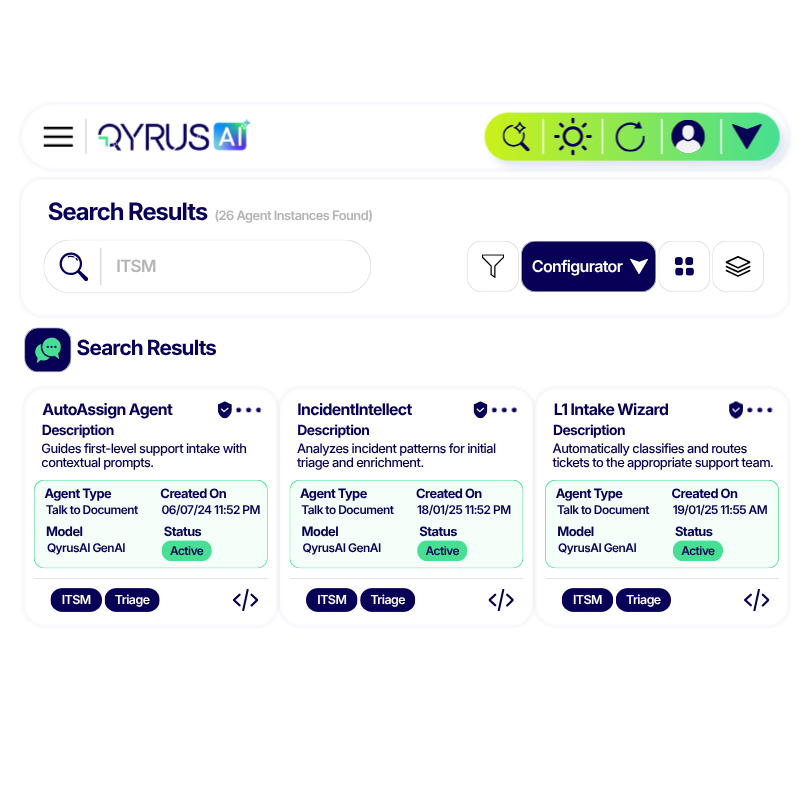
Automatically discover applications across legacy, cloud, and hybrid environments.
Dependency Mapping
Understand how applications interact across systems to avoid unintended impact during modernization.
Application Portfolio Intelligence (APR)
Analyze usage, redundancy, and business value to identify what to retain, modernize, or retire.
Business Impact Analysis
Connect applications to business services to prioritize modernization efforts effectively.
Agentic AI–Driven Recommendations
Leverage AI to identify modernization opportunities and guide decision-making with human-in-the-loop control.
How it works
Built to Turn Modernization .
Into a Strategic Advantage.
Scan Every Environment Continuously
Qyrus continuously scans legacy, cloud, and hybrid environments to build a live picture of the application landscape. There’s no reliance on outdated inventories or manual documentation to know what’s actually running. This continuous view is the starting point every modernization decision downstream depends on.
Cover Legacy and Cloud Alike
Discovery spans both legacy systems and modern cloud-native environments without treating them as separate problems. Teams get one unified picture instead of stitching together views from different tools. That single picture is what makes cross-environment modernization planning possible in the first place.
Uncover What's Hidden
Discovery surfaces applications and dependencies that manual documentation typically misses — the assets nobody remembered were still running. Reducing these blind spots is essential before committing to any modernization roadmap. What isn’t discovered can’t be planned for, and what isn’t planned for tends to break mid-migration.
Establish a Trusted Baseline
Everything Legacy Modernization recommends downstream rests on this discovered baseline being accurate and current. (See the Application Discovery page for the full continuous-discovery architecture.) A trusted foundation here is what keeps every later recommendation grounded in reality rather than assumption.
Analyze Usage and Cost
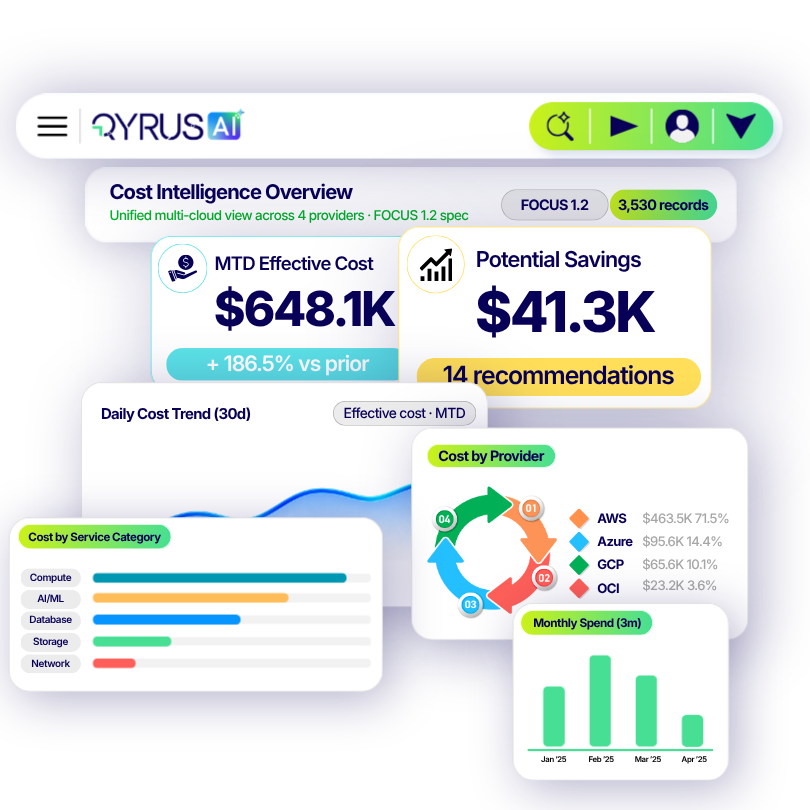
Every application is evaluated against how it’s actually used and what it costs to keep running. This turns portfolio decisions into something measurable rather than a debate based on institutional memory. Usage and cost data are the two inputs that matter most when deciding an application’s fate.
Identify Redundant Applications
Qyrus flags applications that duplicate capability elsewhere in the portfolio, often invisible until they’re compared side by side. Redundancy is one of the largest hidden costs in a legacy estate. Surfacing it directly is what makes consolidation a realistic option instead of a theoretical one.
Decide Each App's Fate
Every application is sorted into one of four dispositions: retain, modernize, consolidate, or retire. This gives portfolio decisions a consistent framework instead of a case-by-case judgment call. Clear disposition categories are what let large portfolios move from analysis to action.
Reduce Complexity at Scale
Portfolio-wide rationalization is what actually reduces the operational complexity and cost that accumulate in a legacy estate over time. Fewer, better-understood applications are the direct output of this work.
Visualize System Interactions
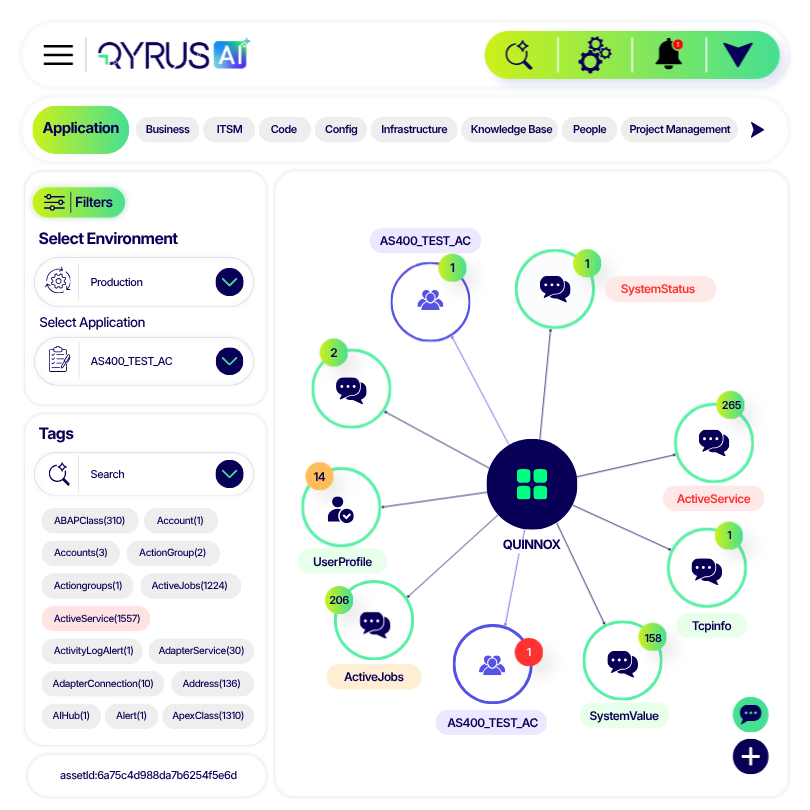
Qyrus visualizes how applications, data, and infrastructure depend on and influence one another across the ecosystem. This dependency view replaces guesswork with a direct picture of what’s actually connected. Visibility here is what determines whether a change is safe or risky before it’s made.
Link Data to Infrastructure
Dependencies aren’t limited to applications — data flows and infrastructure paths are mapped with the same rigor. This gives a complete picture of what a system relies on, not just an application-level summary. Complete linkage is what prevents the “unknown unknowns” that derail migrations.
Prevent Disruption Proactively
By understanding how systems interact ahead of time, teams can anticipate service disruptions before a change is made rather than diagnosing them after an outage. Proactive visibility is what shifts modernization from reactive firefighting to planned, controlled execution.
Lower Migration Risk
Accurate dependency mapping is the single biggest lever for reducing risk during a modernization initiative. (See the Dependency Mapping page for the full Knowledge Graph and correlation architecture.) Knowing what’s connected to what is what keeps a migration plan from unraveling mid-execution.
Learn From Every Action
Agents operate on a perception → planning → action → reflection loop, capturing signals, reasoning through next steps, and refining their outputs based on what happens. Each modernization effort makes the next recommendation more accurate. This self-learning loop is what turns Legacy Modernization from a one-time push into a continuously improving capability.
Apply Policy-Driven Logic
Recommendations are shaped by defined decision frameworks and organizational policy, not left to open-ended AI judgment. This ensures modernization suggestions align with governance requirements and risk tolerance set by the organization itself. Policy-driven logic is what makes AI recommendations something teams can actually trust and act on.
Keep Humans in Control
AI augments decision-making rather than replacing it — every recommendation passes through human oversight before action is taken. This governance model prevents the risk of AI deciding in isolation on consequential modernization moves. Human-in-the-loop control is what makes speed and safety compatible rather than a trade-off.
A GLIMPSE ON THE NUMBERS
Outcomes & Benefits
Qyrus automatically maps every dependency across your application landscape—in real time.
Reduced Modernization Effort
Smaller Migration Scope
Faster Time to Value
Cost Savings
Surprise Breakages
Decision Confidence
Continuous testing. Continuous learning. Continuous value.
Join leading enterprises
driving the loop forward.
Integration
Works With Your Existing Enterprise Stack.
QyrusAI Modernize connects to your existing tools — CMDBs, ITSM platforms, cloud providers, and enterprise architecture repositories — so discovery enriches the tools you already use rather than replacing them.
CUSTOMER TESTIMONIALS
Enterprises running the loop
in their own words.
Real Teams. Real Outcomes. Real Confidence in what ships next.
Qyrus not only supports the testing of our Web, Mobile, and API components as part of our CI/CD processes, but also in ongoing regression-testing across our partner ecosystem. The real power of Qyrus is that we have this extremely broad testing capability in one tool, run in the cloud, and reusable across all our development teams.

The transition to Qyrus has marked a significant turning point for us. By embracing automation, we not only streamlined our SAP test automation process but also achieved a remarkable reduction in overall project testing time by 40%.
... the Qyrus platform have been a great addition to Monument's product delivery capabilities. Within a few months, we have been able to create a comprehensive test suite of complex end-to-end test scenarios spanning multiple platforms and channels. The Quinnox team has helped us embed the Qyrus solution, and the supporting processes around it, into our agile delivery methodology.
Resources
Go Deeper on QyrusAI for Legacy Modernization
October 16, 2026 |
6 min
The Blind Spot of Observability: Why IT Visibility Without Business Context Fails
Read More
October 15, 2026 |
4 min
Data-Rich, Context-Poor: Why Enterprise AI Fails Without Context—And How to Fix It
Read More
October 14, 2026 |
5 min
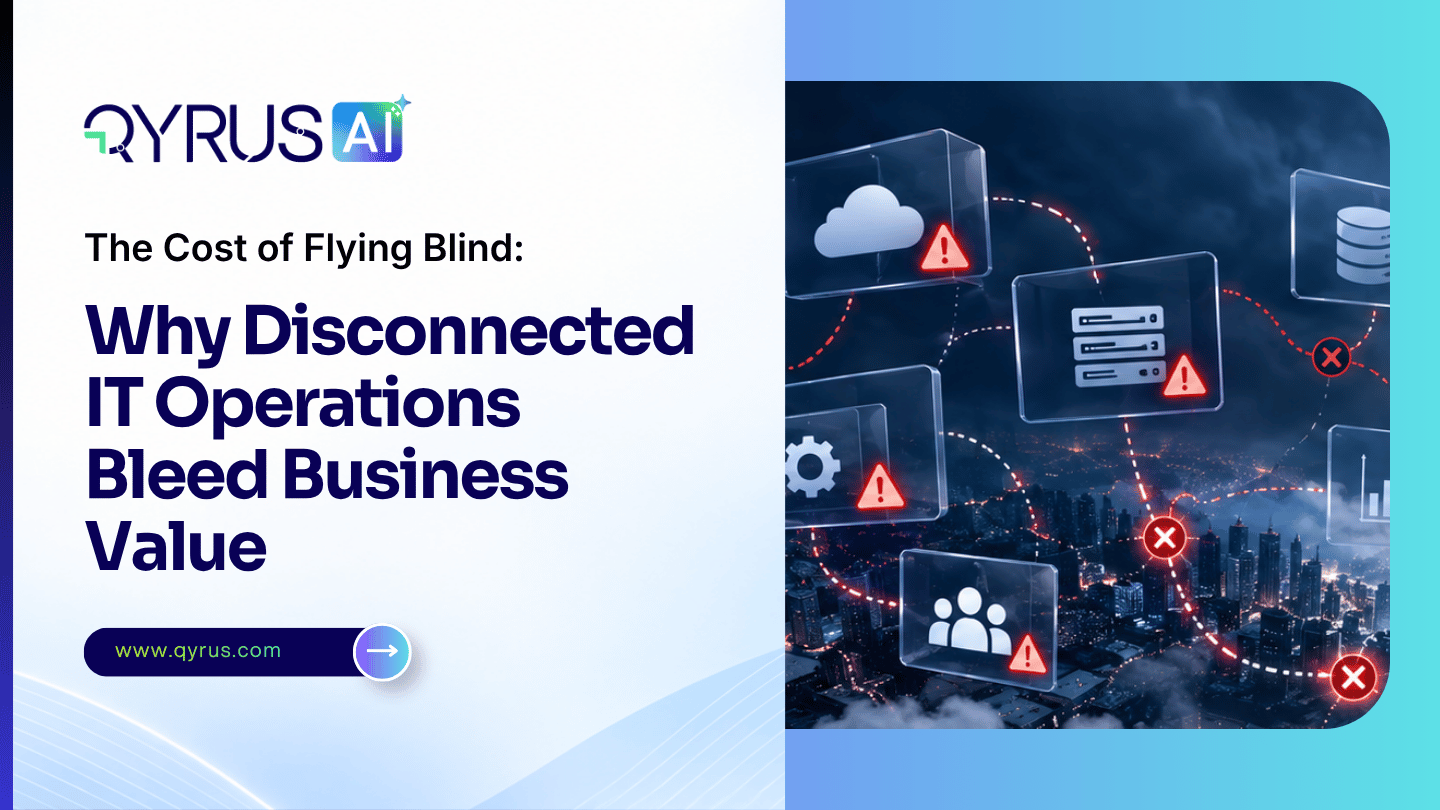
The Cost of Flying Blind: Why Disconnected IT Operations Bleed Business Value
Read More
October 19, 2026 |
3 min
Accelerating Network Modernization Through Intelligent IT Discovery With QyrusAI
Read More
September 24, 2026 |
6 min
How a Global Data & Analytics Leader Scaled SAP GUI and Fiori Test Automation for Complex BRIM Workflows
Read More
September 17, 2025 |
5 min
From Bottlenecks to Breakthroughs: A Coca-Cola Bottler’s Quality Transformation
Read MoreBlog
October 16, 2026 |
6 min
The Blind Spot of Observability: Why IT Visibility Without Business Context Fails
Read More
October 15, 2026 |
4 min
Data-Rich, Context-Poor: Why Enterprise AI Fails Without Context—And How to Fix It
Read More
October 14, 2026 |
5 min
The Cost of Flying Blind: Why Disconnected IT Operations Bleed Business Value
Read MoreCase Study
October 19, 2026 |
3 min
Accelerating Network Modernization Through Intelligent IT Discovery With QyrusAI
Read More
September 24, 2026 |
6 min
How a Global Data & Analytics Leader Scaled SAP GUI and Fiori Test Automation for Complex BRIM Workflows
Read More
September 17, 2025 |
5 min
From Bottlenecks to Breakthroughs: A Coca-Cola Bottler’s Quality Transformation
Read MoreReports
Whitepaper
FREQUENTLY ASKED QUESTIONS
Common Questions About QyrusAI Modernization
Lorem ipsum dolor sit amet, consectetur adipiscing elit, sed do eiusmod tempor
incididunt ut labore et dolore magna aliqua. Ut enim ad minim veniam, quis nostrud.
How is this different from a CMDB or an EA repository like LeanIX?
Does Qyrus Modernize work with SAP S/4HANA migrations?
Yes — and SAP migrations are one of the highest-urgency use cases. QyrusAI reads your SAP environment in read-only mode, inventories all RFCs, IDocs, OData services, SOAP connections, CPI integrations, background jobs, and Z-objects, and produces a blast-radius score for every proposed S/4HANA change. The Estate X-Ray and Phase Zero governance workflow are specifically designed for ECC-to-S/4HANA programmes with fixed cutover dates.
How long does the initial discovery scan take?
The first scan of a mid-market estate (200–400 applications) typically produces an initial topology map within 48–72 hours. The map enriches continuously from that point — adding confidence detail, business-service attribution, and dependency validation as more signals are observed. A Phase Zero engagement (discovery, dependency mapping, and modernization prioritization) is typically scoped at 4–6 weeks.
Does it require agent installation on every system?
No. QyrusAI reads from APIs, connectors, log streams, and cloud provider metadata — it does not require an agent on every application or server. For some legacy on-premise environments a lightweight collector may be deployed, but this is scoped per engagement and never required across the full estate before value is delivered.
What happens to the modernization plan if the estate changes while the programme is running?
The Knowledge Graph is continuously updated. If a new application is deployed, a dependency changes, or a system is decommissioned mid-programme, the change is reflected in the graph and the modernization wave plan is re-scored automatically. Your transformation plan is always based on the current estate, not the estate as it was when the programme started.
Does Qyrus Modernize integrate with Assure for testing?
Yes — this is the core joint value of the two pillars. Every modernization slice Modernize produces is automatically handed to Assure for equivalence testing. Assure generates test cases from the code analysis output, runs them against the modernized slice, and produces an evidence record before any release decision is made. The conversion is never marked complete until Assure has proved it works.
• STAY AHEAD, STAY IN THE LOOP.
Ready to See What You've Been Missing?
Explore how enterprises are moving beyond reactive modernization to intelligent, data-driven transformation strategies.