Welcome to our October update! As we move into the final quarter of the year, our focus sharpens on refining the details that make a world of difference in your daily workflows. At Qyrus, we are continually committed to evolving our platform not just with big new features, but with smart enhancements that make your testing processes faster, simpler, and more powerful.
This month, we are excited to roll out a series of updates centered on intelligent workflow automation, enhanced user control, and advanced mobile testing capabilities. We’ve streamlined how you import, export, and manage test assets, unlocked a powerful new way to simulate offline conditions for iOS, and expanded our AI-driven analytics to cover your core API test suites. These improvements are all designed to give you more time back in your day and greater confidence in your results.
Let’s explore the latest enhancements now available on the Qyrus platform!
Improvement
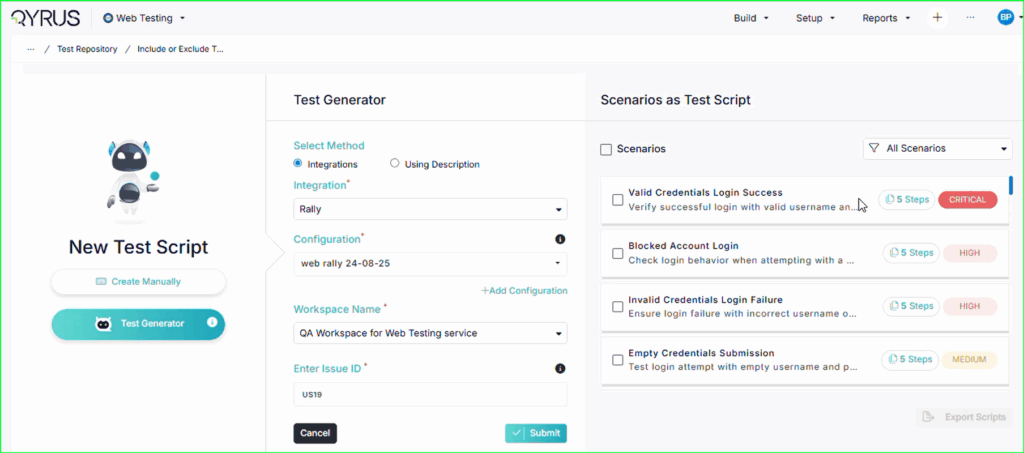
Your Scenarios, Your Way: New Controls for TestGenerator Imports
The Challenge:
Previously, when importing scenarios from TestGenerator, the system would import assets in a predefined way. This lacked the flexibility for users who might only want high-level scenario titles for test planning. Additionally, creating these test assets in both the Qyrus platform and a management tool like Rally requires two separate, repetitive actions.
The Fix:
We have introduced significant enhancements to the TestGenerator import process to give you more control and improve efficiency. You now have the option to choose whether to import “Only the scenarios” or the complete “Scenarios along with their test steps.” You can now choose to import your generated test assets into both the Qyrus platform and Rally at the same time, in a single action.
How will it help?
These updates provide you with more precise control and a more streamlined workflow:
You can now choose the level of detail you want, whether it’s just high-level scenarios for creating a test plan or the full, detailed steps for immediate automation.
The simultaneous import to Qyrus and Rally eliminates a repetitive step, saves you valuable time, and ensures your test cases are perfectly synchronized with your project management tool from the moment they are created.
Improvement
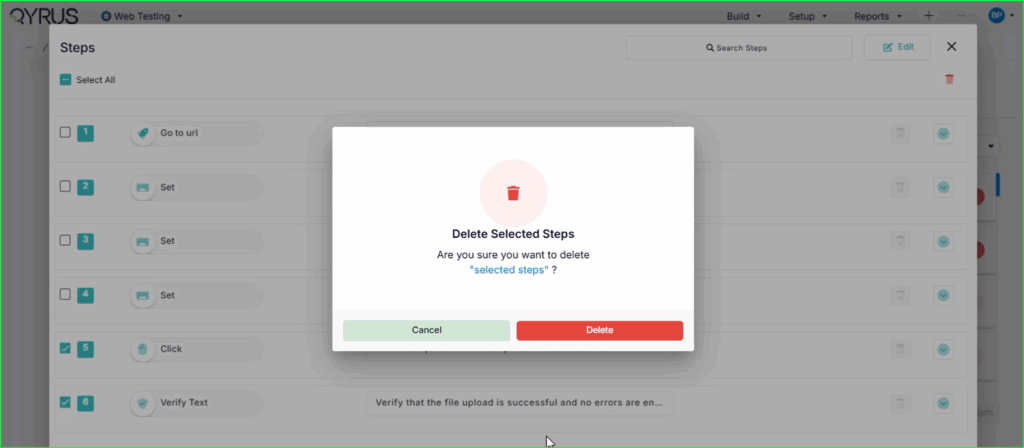
Swiftly Edit Your Scenarios: Delete One Step or Delete Them All!
The Challenge:
Previously, managing steps within the Test Steps Editor could be inefficient. Deleting a single, unwanted step might have been a cumbersome process, and clearing an entire test scenario to start fresh required the tedious task of removing each step one by one, which was especially frustrating for long test cases.
The Fix:
We have significantly improved the Test Steps Editor with new, highly requested features:
Per-Step Delete: Each test step now has its own dedicated delete option.
Delete All: A new “Delete All” feature has been added to instantly clear all steps from a scenario with a single click.
How will it help?
These updates make managing and refining your test scenarios much faster and more intuitive. The per-step delete option allows for quick, precise edits, while the “Delete All” feature is a massive time-saver when you need to reset a test case. This gives you more efficient control over your test steps and improves your overall workflow within the editor
Improvement
One Selection, Two Destinations: Streamlined Exports to Rally and Qyrus!
The Challenge:
Previously, the workflow for exporting scripts to both Rally and the Qyrus platform was tedious. After a user carefully selected a group of scripts and exported them to Rally, the selection would reset. To then import those exact same scripts into Qyrus, the user was forced to manually re-select all of them, which we found out was inefficient and nearly impossible to do accurately from memory with a large number of scripts.
The Fix:
We have refactored this export process to be more intelligent and user-friendly. Now, after you select a set of scenarios and export them to Rally, your script selection will be maintained. You can then immediately proceed to import that same selected group into the Qyrus module without having to re-select anything.
How will it help?
This enhancement creates a seamless, logical, and efficient workflow for managing test assets across platforms. It eliminates the frustrating and time-consuming task of re-selecting scripts, saving you significant manual effort. This ensures consistency between what is exported to Rally and what is imported to Qyrus, removing the risk of human error and dramatically speeding up the entire process.
Improvement
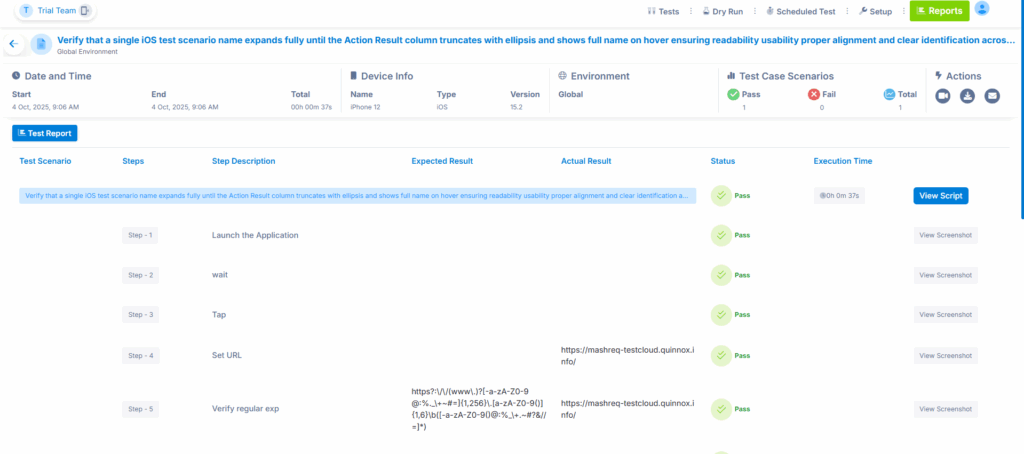
At-a-Glance Clarity: Longer Suite Names in Mobile Test Reports!
The Challenge:
Previously, on the execution results page for Mobile Testing, long test suite names were often truncated to fit in the designated space. This made it difficult for users to quickly identify which suite a report belonged to without hovering their mouse over the text to reveal the full name, creating a minor but persistent usability issue.
The Fix:
We have adjusted the user interface to increase the length of text displayed for the suite name in the execution report. This change allows for longer, more descriptive suite names to be shown without being cut off.
How will it help?
This is a straightforward quality-of-life improvement that enhances readability and usability. You can now identify your test suites at a glance without needing to hover, making it faster and easier to navigate and find the specific mobile execution report you are looking for.
New Feature
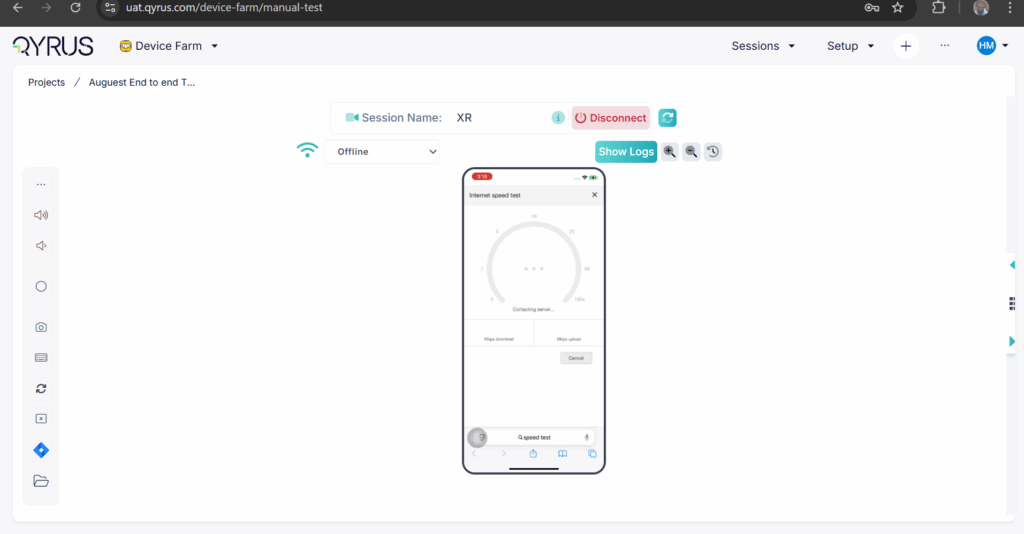
The Unviewable, Now Viewable: True Offline Simulation for iOS Devices!
The Challenge:
Accurately simulating a complete loss of internet connectivity on iOS devices presents a major technical hurdle: how do you continue to view and interact with a device’s video stream after you’ve taken its network offline? This made it incredibly difficult to test the real-time behavior of an app at the exact moment it loses connection.
The Fix:
We have implemented a sophisticated solution for offline network throttling on iOS devices. We’ve created a new “Offline” network profile that effectively simulates zero network speed. To overcome the viewing challenge, our system now seamlessly switches the video stream in the background: it uses low-latency WebRTC when the device is online and intelligently switches to a different stream (via FFmpeg/Ant Media) the moment you go offline, ensuring you never lose sight of the device screen.
How will it help?
This powerful new feature allows you to reliably and accurately test how your iOS application behaves in a true “no internet” scenario, while still being able to watch the app’s response in real-time. You can now easily validate:
Offline functionality and data caching.
Graceful error handling and user messaging during connection loss.
The application’s behavior when transitioning between online and offline states.
This makes a previously difficult-to-test condition simple and accessible, enabling you to build more resilient and robust iOS applications.
New Feature
From Suite to Sequence: AI Now Auto-Builds Workflows From Your APIs!
The Challenge:
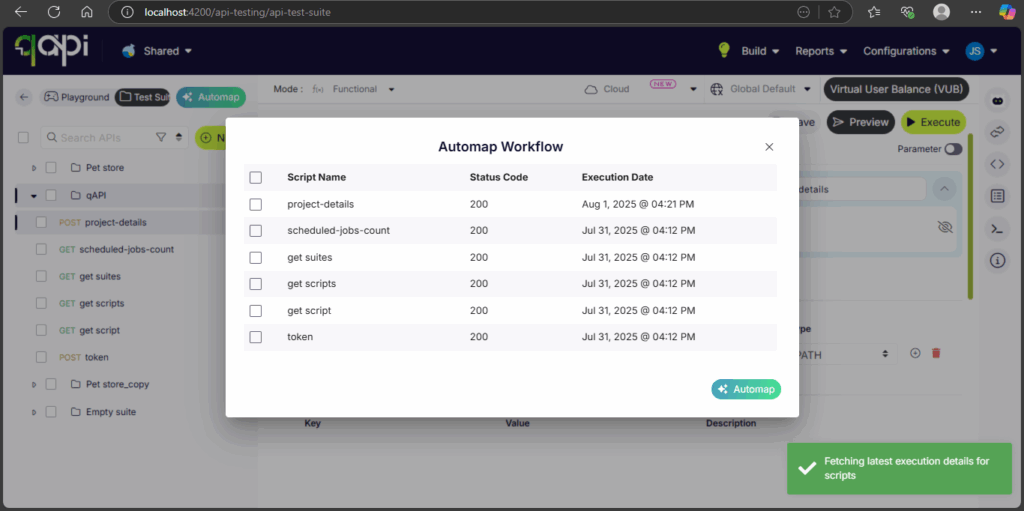
Previously, a user might have a Test Suite containing all the necessary APIs for a complete end-to-end test, but they existed as a simple, unordered list. To turn this list into a functional workflow, the user had to manually drag and drop each API into the correct sequence and painstakingly map the data dependencies between them (e.g., passing an auth token from a login API to subsequent requests). This manual process was time-consuming and prone to errors.
The Fix:
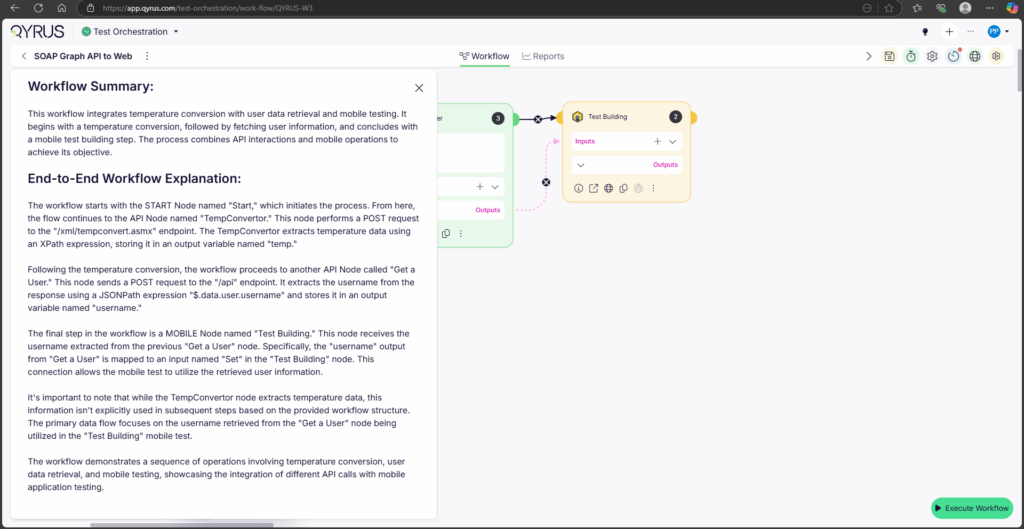
We have introduced a powerful new AI capability for Test Suites. Users can now use an “auto-map” or “build workflow” feature on their existing Test Suites. The AI will analyze all the APIs within the suite, intelligently identify their relationships and dependencies, and automatically construct a complete, ordered workflow with the data mappings already configured.
How will it help?
This feature dramatically accelerates the creation of complex API workflows. It saves a significant amount of time and effort by automating the most tedious parts of the process—sequencing the steps and mapping the data. This not only reduces the chance of manual errors but also empowers users to instantly convert their existing collections of APIs into powerful, executable end-to-end tests with a single click.
Improvement
Consistent Clarity: Key Diagnostics Now in All qAPI Report Views
The Challenge:
Users needed a consistent and immediate way to diagnose API test results across different reporting interfaces. Key information like the HTTP Status Code was often hidden within detailed views, and tests that ran without any actual assertions could be ambiguously reported, making it difficult to get a quick, clear picture of the test outcomes.
The Fix:
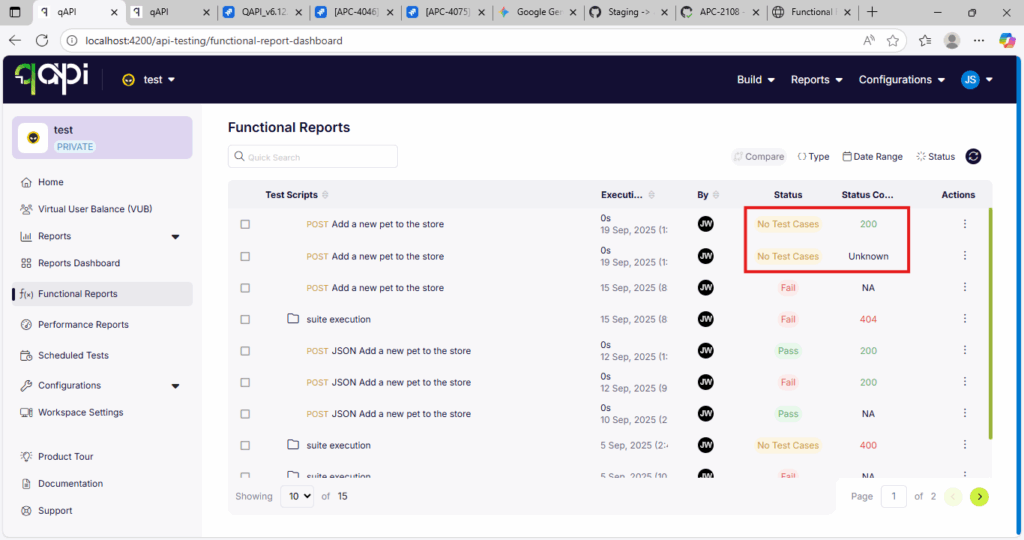
We have rolled out a comprehensive reporting enhancement that is now consistently applied across all qAPI report views (including the Reports Table, Reports Summary, and Quick Summary). This update introduces:
A new “Status Code” column for at-a-glance diagnostics of the API response.
A new, explicit status to clearly identify any execution that was run without assertions (test cases).
How will it help?
This update provides a unified and much richer reporting experience. You can now instantly see crucial diagnostic information, like HTTP status codes, no matter which report view you are using, dramatically speeding up your analysis. The new status for tests without assertions eliminates ambiguity and encourages better testing practices, ensuring you have a clear and consistent understanding of your test results across the entire platform.
New Feature
Retry with Confidence: Improved Interactions with Local Agents!
The Challenge:
Previously, the “retry” functionality for functional test executions could sometimes be inconsistent, particularly when those tests were running on a local agent. The interaction between the platform and the agent during a retry attempt was not as smooth as it could be, occasionally leading to unreliable or clunky re-executions.
The Fix:
We have refactored and improved the logic behind our retry options for functional reports. These enhancements specifically optimize the communication protocol between the Qyrus platform and your local agents, ensuring that retry commands are handled more efficiently and reliably.
How will it help?
This update provides a significantly smoother and more dependable experience when re-running failed tests on a local agent. You can now retry with confidence, knowing that the re-execution will be triggered smoothly and reliably. This is crucial for an efficient debugging workflow, allowing you to quickly distinguish between transient environment issues and genuine application bugs.
New Feature
Test Smarter, Not Harder: Impact Analyzer Now Supports Your qAPI Suites!
The Challenge:
Previously, our powerful Java and Python Impact Analyzers were limited in scope and could only analyze tests generated through DeepAPITesting. This meant that users could not leverage this smart, targeted testing capability for their primary, user-created functional test suites within the qAPI Workspace, missing out on the opportunity to optimize their regression cycles.
The Fix:
We have now fully integrated our Impact Analyzers (both Java and Python) with the tests you create and manage in the qAPI Workspace and Test Suites. The analyzer can now scan your codebase for changes and intelligently map those changes to the specific qAPI tests that cover the affected areas.
How will it help?
This integration unlocks a much smarter and more efficient way to run your regression tests. Instead of executing an entire qAPI test suite after every small code change, the Impact Analyzer will now tell you exactly which specific tests you need to run. This enables:
Targeted Test Execution: Dramatically reduce the scope of your regression runs.
Massive Time & Resource Savings: Get faster feedback by running only the necessary tests.
Smarter Regression Analysis: Confidently validate your changes without the overhead of a full regression cycle.
Ready to Accelerate Your Testing with October’s Upgrades?
We are dedicated to evolving Qyrus into a platform that not only anticipates your needs but also provides practical, powerful solutions that help you release top-quality software with greater speed and confidence.
Curious to see how these October enhancements can benefit your team? There’s no better way to understand the impact of Qyrus than to see it for yourself.
In the modern digital economy, the user experience is the primary determinant of success or failure. Your app or website is not just a tool; the interface through which a customer interacts with your brand is the brand itself. Consequently, delivering a consistent, functional, and performant experience is a fundamental business mandate.
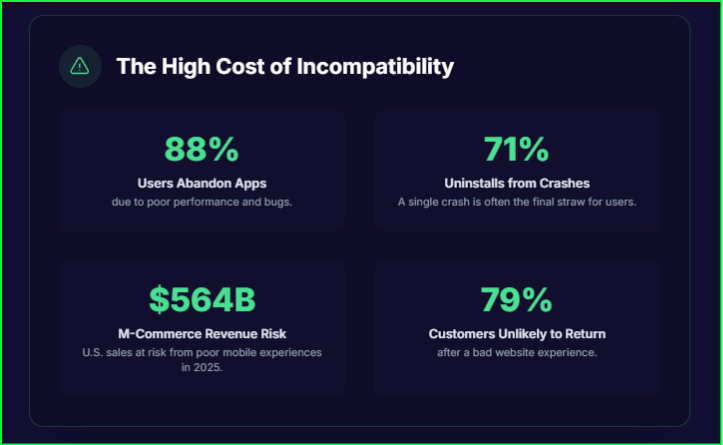
Ignoring this mandate carries a heavy price. Poor performance has an immediate and brutal impact on user retention. Data shows that approximately 80% of users will delete an application after just one use if they encounter usability issues. On the web, the stakes are just as high. A 2024 study revealed that 15% of online shoppers abandon their carts because of website errors or crashes, which directly erodes your revenue.
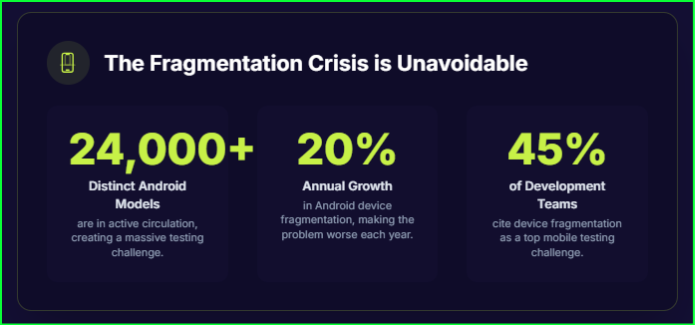
This challenge is magnified by the immense fragmentation of today’s technology. Your users access your product from a dizzying array of environments, including over 24,000 active Android device models and a handful of dominant web browsers that all interpret code differently.
This guide provides the solution. We will show you how to conduct comprehensive device compatibility testing and cross-browser testing with a device farm to conquer fragmentation and ensure your application works perfectly for every user, every time.
The Core Concepts: Device Compatibility vs. Cross-Browser Testing
To build a winning testing strategy, you must first understand the two critical pillars of quality assurance: device compatibility testing and cross-browser testing. While related, they address distinct challenges in the digital ecosystem.
What is Device Compatibility Testing?
Device compatibility testing is a type of non-functional testing that confirms your application runs as expected across a diverse array of computing environments. The primary objective is to guarantee a consistent and reliable user experience, no matter where or how the software is accessed. This process moves beyond simple checks to cover a multi-dimensional matrix of variables.
Its scope includes validating performance on:
A wide range of physical hardware, including desktops, smartphones, and tablets.
Different hardware configurations, such as varying processors (CPU), memory (RAM), screen sizes, and resolutions.
Major operating systems like Android, iOS, Windows, and macOS, each with unique architectures and frequent update cycles.
A mature strategy also incorporates both backward compatibility (ensuring the app works with older OS or hardware versions) and forward compatibility (testing against upcoming beta versions of software) to retain existing users and prepare for future platform shifts.
What is Cross-Browser Testing?
Cross-browser testing is a specific subset of compatibility testing that focuses on ensuring a web application functions and appears uniformly across different web browsers, such as Chrome, Safari, Edge, and Firefox.
The need for this specialized testing arises from a simple technical fact: different browsers interpret and render web technologies—HTML, CSS, and JavaScript—in slightly different ways. This divergence stems from their core rendering engines, the software responsible for drawing a webpage on your screen.
Google Chrome and Microsoft Edge use the Blink engine, Apple’s Safari uses WebKit, and Mozilla Firefox uses Gecko. These engines can have minor differences in how they handle CSS properties or execute JavaScript, leading to a host of visual and functional bugs that break the user experience.
The Fragmentation Crisis of 2025: A Problem of Scale
The core concepts of compatibility testing are straightforward, but the real-world application is a logistical nightmare. The sheer scale of device and browser diversity makes comprehensive in-house testing a practical and financial impossibility for any organization. The numbers from 2025 paint a clear picture of this challenge.
The Mobile Device Landscape
A global view of the mobile market immediately highlights the first layer of complexity.
Android dominates the global mobile OS market with a 70-74% share, while iOS holds the remaining 26-30%. This simple two-way split, however, masks a much deeper issue.
The “Android fragmentation crisis” is a well-known challenge for developers and QA teams. Unlike Apple’s closed ecosystem, Android is open source, allowing countless manufacturers to create their own hardware and customize the operating system. This has resulted in some staggering figures:
This device fragmentation is growing by 20% every year as new models are released with proprietary features and OS modifications.
Nearly 45% of development teams cite device fragmentation as a primary mobile-testing challenge, underlining the immense resources required to address it.
The Browser Market Landscape
The web presents a similar, though slightly more concentrated, fragmentation problem. A handful of browsers command the majority of the market, but each requires dedicated testing to ensure a consistent experience.
On the desktop, Google Chrome is the undisputed leader, holding approximately 69% of the global market share. It is followed by Apple’s Safari (~15%) and Microsoft Edge (~5%). While testing these three covers the vast majority of desktop users, ignoring others like Firefox can still alienate a significant audience segment.
On mobile devices, the focus becomes even sharper.
Chrome and Safari are the critical targets, together accounting for about 90% of all mobile browser usage. This makes them the top priority for any mobile web testing strategy.
Table 1: The 2025 Digital Landscape at a Glance
This table provides a high-level overview of the market share for key platforms, illustrating the need for a diverse testing strategy.
Platform Category
Leader 1
Leader 2
Leader 3
Other Notable
Mobile OS
Android (~70-74%)
iOS (~26-30%)
–
–
Desktop OS
Windows (~70-73%)
macOS (~14-15%)
Linux (~4%)
ChromeOS (~2%)
Web Browser
Chrome (~69%)
Safari (~15%)
Edge (~5%)
Firefox (~2-3%)
The Strategic Solution: Device Compatibility and Cross-Browser Testing with a Device Farm
Given that building and maintaining an in-house lab with every relevant device is impractical, modern development teams need a different approach. The modern, scalable solution to the fragmentation problem is the device farm, also known as a device cloud.
What is a Device Farm (or Device Cloud)?
A device farm is a centralized, cloud-based collection of real physical devices that QA teams can access remotely to test their applications. This service abstracts away the immense complexity of infrastructure management, allowing teams to focus on testing and improving their software. Device farms make exhaustive compatibility testing both feasible and cost-effective by giving teams on-demand, scalable access to a wide diversity of hardware.
Key benefits include:
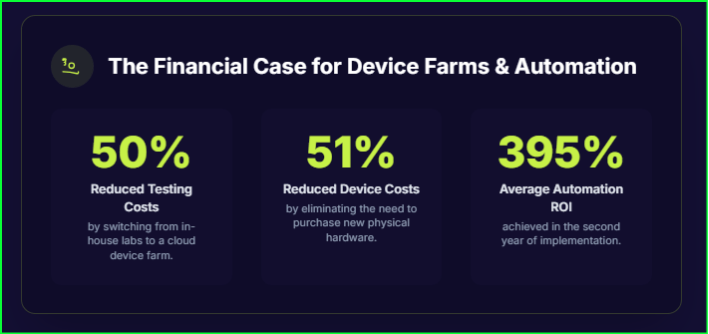
Massive Device Access: Instantly test on thousands of real iOS and Android devices without the cost of procurement.
Cost-Effectiveness: Eliminate the significant capital and operational expenses required to build and run an internal device lab.
Zero Maintenance Overhead: Offload the burden of device setup, updates, and physical maintenance to the service provider.
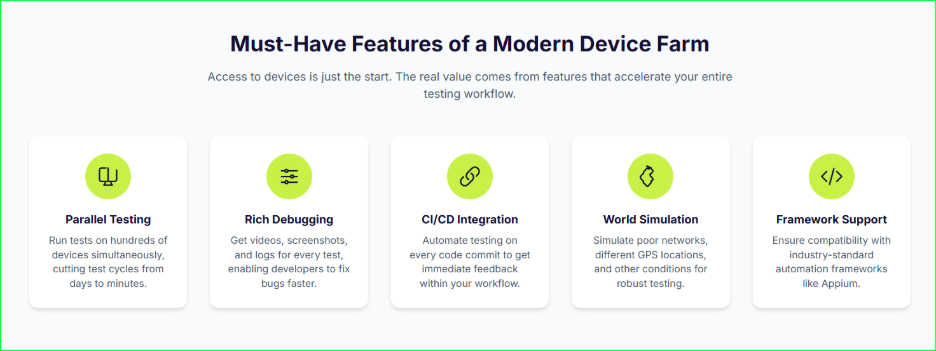
Scalability: Run automated tests in parallel across hundreds of devices simultaneously to get feedback in minutes, not hours.
Real Devices vs. Emulators/Simulators: The Testing Pyramid
Device farms provide access to both real and virtual devices, and understanding the difference is crucial.
Real Devices are actual physical smartphones and tablets housed in data centers. They are the gold standard for testing, as they are the only way to accurately test nuances like battery consumption, sensor inputs (GPS, camera), network fluctuations, and manufacturer-specific OS changes.
Emulators (Android) and Simulators (iOS) are software programs that mimic the hardware and/or software of a device. They are much faster than real devices, making them ideal for rapid, early-stage development cycles where the focus is on UI layout and basic logic.
Table 2: Real Devices vs. Emulators vs. Simulators
This table provides the critical differences between testing environments and justifies a hybrid “pyramid” testing strategy.
Feature
Real Device
Emulator (e.g., Android)
Simulator (e.g., iOS)
Definition
Actual physical hardware used for testing.
Mimics both the hardware and software of the target device.
Mimics the software environment only, not the hardware.
Moderate. Good for OS-level debugging but cannot perfectly replicate hardware.
Lower. Not reliable for performance or hardware-related testing.
Speed
Faster test execution as it runs on native hardware.
Slower due to binary translation and hardware replication.
Fastest, as it does not replicate hardware and runs directly on the host machine.
Hardware Support
Full support for all features: camera, GPS, sensors, battery, biometrics.
Limited. Can simulate some features (e.g., GPS) but not others (e.g., camera).
None. Does not support hardware interactions.
Ideal Use Case
Final validation, performance testing, UAT, and testing hardware-dependent features.
Early-stage development, debugging OS-level interactions, and running regression tests quickly.
Rapid prototyping, validating UI layouts, and early-stage functional checks in an iOS environment.
Experts emphasize that you cannot afford to rely on virtual devices alone; a real device cloud is required for comprehensive QA. A mature, cost-optimized strategy uses a pyramid approach: fast, inexpensive emulators and simulators are used for high-volume tests early in the development cycle, while more time-consuming real device testing is reserved for critical validation, performance testing, and pre-release sign-off.
Deployment Models: Public Cloud vs. Private Device Farms
Organizations must also choose a deployment model that fits their security and control requirements.
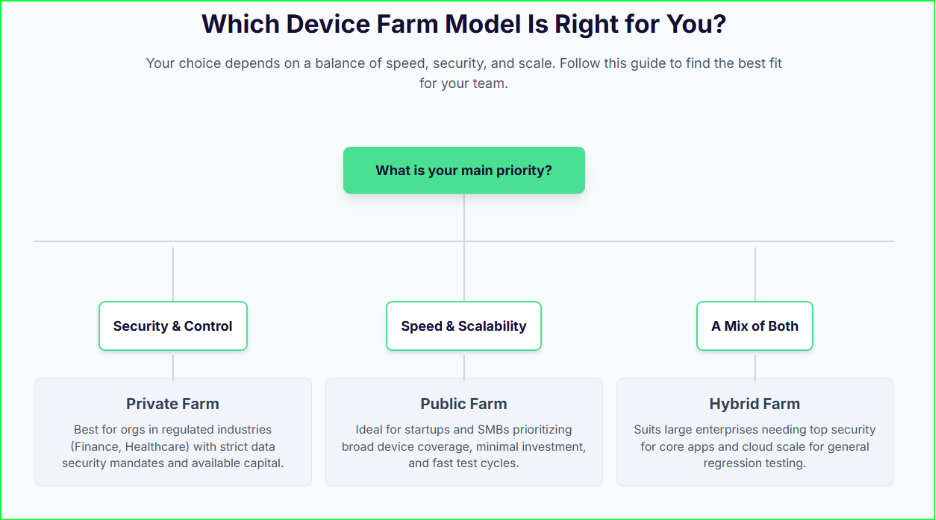
Public Cloud Farms provide on-demand access to a massive, shared inventory of devices. Their primary advantages are immense scalability and the complete offloading of maintenance overhead.
Private Device Farms provide a dedicated set of devices for an organization’s exclusive use. The principal advantage is maximum security and control, which is ideal for testing applications that handle sensitive data. This model guarantees that devices are always available and that sensitive information never leaves a trusted environment.
From Strategy to Execution: Integrating a Device Farm into Your Workflow
Accessing a device farm is only the first step. To truly harness its power, you need a strategic, data-driven approach that integrates seamlessly into your development process. This operational excellence ensures your testing efforts are efficient, effective, and aligned with business objectives.
Step 1: Build a Data-Driven Device Coverage Matrix
The goal of compatibility testing is not to test every possible device and browser combination—an impossible task—but to intelligently test the combinations that matter most to your audience. This is achieved by creating a device coverage matrix, a prioritized list of target environments built on rigorous data analysis, not assumptions.
Follow these steps to build your matrix:
Start with Market Data: Use global and regional market share statistics to establish a broad baseline of the most important platforms to cover.
Incorporate User Analytics: Overlay the market data with your application’s own analytics. This reveals the specific devices, OS versions, and browsers your actual users prefer.
Prioritize Your Test Matrix: A standard industry best practice is to give high priority to comprehensive testing for any browser-OS combination that accounts for more than 5% of your site’s traffic. This ensures your testing resources are focused on where they will have the greatest impact.
Step 2: Achieve “Shift-Left” with CI/CD Integration
To maximize efficiency and catch defects when they are exponentially cheaper to fix, compatibility testing must be integrated directly into your Continuous Integration/Continuous Deployment (CI/CD) pipeline. This “shift-left” approach makes testing a continuous, automated part of development rather than a separate final phase.
Integrating your device farm with tools like Jenkins or GitLab allows you to run your automated test suite on every code commit. A key feature of device clouds that makes this possible is parallel execution, which runs tests simultaneously across multiple devices to drastically reduce the total execution time and provide rapid feedback to developers.
Step 3: Overcome Common Challenges
As you implement your strategy, be prepared to address a few recurring operational challenges. Proactively managing them is key to maximizing the value of your investment.
Cost Management: The pay-as-you-go models of some providers can lead to unpredictable costs. Control expenses by implementing the hybrid strategy of using cheaper virtual devices for early-stage testing and optimizing automated scripts to run as quickly as possible.
Security: Using a public cloud to test applications with sensitive data is a significant concern. For these applications, the best practice is to use a private cloud or an on-premise device farm, which ensures that sensitive data never leaves your organization’s secure network perimeter.
Test Flakiness: “Flaky” tests that fail intermittently for non-deterministic reasons can destroy developer trust in the pipeline. Address this by building more resilient test scripts and implementing automated retry mechanisms for failed tests within your CI/CD configuration.
Go Beyond Testing: Engineer Quality with the Qyrus Platform
Following best practices is critical, but having the right platform can transform your entire quality process. While many device farms offer basic access, Qyrus provides a comprehensive, AI-powered quality engineering platform designed to manage and accelerate the entire testing lifecycle.
Unmatched Device Access and Enterprise-Grade Security
The foundation of any great testing strategy is reliable access to the right devices. The Qyrus Device Farm and Browser Farm offer a vast, global inventory of real Android and iOS mobile devices and browsers, ensuring you can test on the hardware your customers actually use.
Qyrus also addresses the critical need for security and control with a unique offering: private, dedicated devices. This allows your team to configure devices with specific accounts, authenticators, or settings, perfectly mirroring your customer’s environment. All testing occurs within a secure, ISO 27001/SOC 2 compliant environment, giving you the confidence to test any application.
Accelerate Testing with Codeless Automation and AI
Qyrus dramatically speeds up test creation and maintenance with intelligent automation. The platform’s codeless test builder and mobile recorder empower both technical and non-technical team members to create robust automated tests in minutes, not days.
This is supercharged by powerful AI capabilities that solve the most common automation headaches:
Rover AI: Deploys autonomous, curiosity-driven exploratory testing to intelligently discover new user paths and automatically generate test cases you might have missed.
AI Healer: Provides AI-driven script correction to automatically identify and fix flaky tests when UI elements change. This “self-healing” technology can reduce the time spent on test maintenance by as much as 95%.
Advanced Features for Real-World Scenarios
The platform includes a suite of advanced tools designed to simulate real-world conditions and streamline complex testing scenarios:
Biometric Bypass: Easily automate and streamline the testing of applications that require fingerprint or facial recognition.
Network Shaping: Simulate various network conditions, such as a slow 3G connection or high latency, to understand how your app performs for users in the real world.
Element Explorer: Quickly inspect your application and generate reliable locators for seamless Appium test automation.
The Future of Device Testing: AI and New Form Factors
The field of quality engineering is evolving rapidly. A forward-looking testing strategy must not only master present challenges but also prepare for the transformative trends on the horizon. The integration of Artificial Intelligence and the proliferation of new device types are reshaping the future of testing.
The AI Revolution in Test Automation
Artificial Intelligence is poised to redefine test automation, moving it from a rigid, script-dependent process to an intelligent, adaptive, and predictive discipline. The scale of this shift is immense. According to Gartner, an estimated 80% of enterprises will have integrated AI-augmented testing tools into their workflows by 2027—a massive increase from just 15% in 2023.
This revolution is already delivering powerful capabilities:
Self-Healing Tests: AI-powered tools can intelligently identify UI elements and automatically adapt test scripts when the application changes, drastically reducing maintenance overhead by as much as 95%.
Predictive Analytics: By analyzing historical data from code changes and past results, AI models can predict which areas of an application are at the highest risk for new bugs, allowing QA teams to focus their limited resources where they are needed most.
Testing Beyond the Smartphone
The challenge of device fragmentation is set to intensify as the market moves beyond traditional rectangular smartphones. A future-proof testing strategy must account for these emerging form factors.
Foldable Devices: The rise of foldable phones introduces new layers of complexity. Applications must be tested to ensure a seamless experience as the device changes state from folded to unfolded, which requires specific tests to verify UI behavior and preserve application state across different screen postures.
Wearables and IoT: The Internet of Things (IoT) presents an even greater challenge due to its extreme diversity in hardware, operating systems, and connectivity protocols. Testing must address unique security vulnerabilities and validate the interoperability of the entire ecosystem, not just a single device.
The proliferation of these new form factors makes the concept of a comprehensive in-house testing lab completely untenable. The only practical and scalable solution is to rely on a centralized, cloud-based device platform that can manage this hyper-fragmented hardware.
Conclusion: Quality is a Business Decision, Not a Technical Task
The digital landscape is more fragmented than ever, and this complexity makes traditional, in-house testing an unfeasible strategy for any modern organization. The only viable path forward is a strategic, data-driven approach that leverages a cloud-based device farm for both device compatibility and cross-browser testing.
As we’ve seen, neglecting this crucial aspect of development is not a minor technical oversight; it is a strategic business error with quantifiable negative impacts. Compatibility issues directly harm revenue, increase user abandonment, and erode the trust that is fundamental to your brand’s reputation.
Ultimately, the success of a quality engineering program should not be measured by the number of bugs found, but by the business outcomes it enables. Investing in a modern, AI-powered quality platform is a strategic business decision that protects revenue, increases user retention, and accelerates innovation by ensuring your digital experiences are truly seamless.
Frequently Asked Questions (FAQs)
What is the main difference between a device farm and a device cloud?
While often used interchangeably, a “device cloud” typically implies a more sophisticated, API-driven infrastructure built for large-scale, automated testing and CI/CD integration. A “device farm” can refer to a simpler collection of remote devices made available for testing.
How many devices do I need to test my app on?
There is no single number. The best practice is to create and maintain a device coverage matrix based on a rigorous analysis of market trends and your own user data. A common industry standard is to prioritize comprehensive testing for any device or browser combination that constitutes more than 5% of your user traffic.
Is testing on real devices better than emulators?
Yes, for final validation and accuracy, real devices are the gold standard. Emulators and simulators are fast and ideal for early-stage development feedback. However, only real devices can accurately test for hardware-specific issues like battery usage and sensor functionality, genuine network conditions, and unique OS modifications made by device manufacturers. A hybrid approach that uses both is the most cost-effective strategy.
Can I integrate a device farm with Jenkins?
Absolutely. Leading platforms like Qyrus are designed for CI/CD integration and provide robust APIs and command-line tools to connect with platforms like Jenkins, GitLab CI, or GitHub Actions. This allows you to “shift-left” by making automated compatibility tests a continuous part of your build pipeline.
Your dinner is “out for delivery,” but the map shows your driver has been stuck in one spot for ten minutes. Is the app frozen? Did the GPS fail? We’ve all been there. These small glitches create frustrating user experiences and can damage an app’s reputation. The success of a delivery app hinges on its ability to perform perfectly in the unpredictable real world.
This is where real device testing for delivery apps become the cornerstone of quality assurance. This approach involves validating your application on actual smartphones and tablets, not just on emulators or simulators. Delivery apps are uniquely complex; they juggle real-time GPS tracking, process sensitive payments, and must maintain stable network connectivity as a user moves from their Wi-Fi zone to a cellular network.
Each failed delivery costs companies an average of $17.78 in losses, underscoring the financial and reputational impact of glitches in delivery operations.
An effective app testing strategy recognizes that these features interact directly with a device’s specific hardware and operating system in ways simulators cannot fully replicate. While emulators are useful for basic checks, they often miss critical issues that only surface on physical hardware, such as network glitches, quirky sensor behavior, or performance lags on certain devices.
A robust mobile app testing plan that includes a fleet of real devices is the only way to accurately mirror your customer’s experience, ensuring everything from map tracking to payment processing works without a hitch.
Building Your Digital Fleet: Crafting a Device-Centric App Testing Strategy
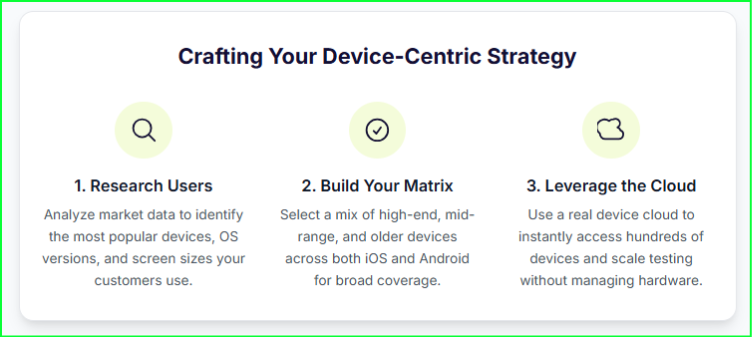
You can’t test on every smartphone on the planet, so a smart app testing strategy is essential. The goal is to focus your efforts where they matter most—on the devices your actual customers are using. This begins with market research to understand your user base. Identify the most popular devices, manufacturers, and operating systems within your target demographic to ensure you cover 70-80% of your users. You should also consider the geographic distribution of your audience, as device preferences can vary significantly by region.
With this data, you can build a formal device matrix—a checklist of the hardware and OS versions your testing will cover. A strong matrix includes:
Diverse Platform Coverage: Select a mix of popular Android devices from various manufacturers (like Samsung and Google Pixel) and several iPhone models.
Multiple OS Versions: Include the latest major OS releases for both Android and iOS, as well as some widely used older versions.
A Range of Device Tiers: Test on recent flagship phones, popular midrange models, and older, less powerful devices to catch device-specific UI bugs and performance bottlenecks.
Acquiring and managing such a diverse collection of hardware is a significant challenge. This is where a real device cloud becomes invaluable. Services like AWS Device Farm provide remote access to thousands of physical iOS and Android devices, allowing you to run manual or automated mobile testing on a massive scale without purchasing every handset.
However, even with the power of the cloud, it’s a good practice to keep some core physical devices in-house. This hybrid approach ensures you have handsets for deep, hands-on debugging while leveraging the cloud for broad compatibility checks.
Putting the App Through Its Paces: Core Functional Testing
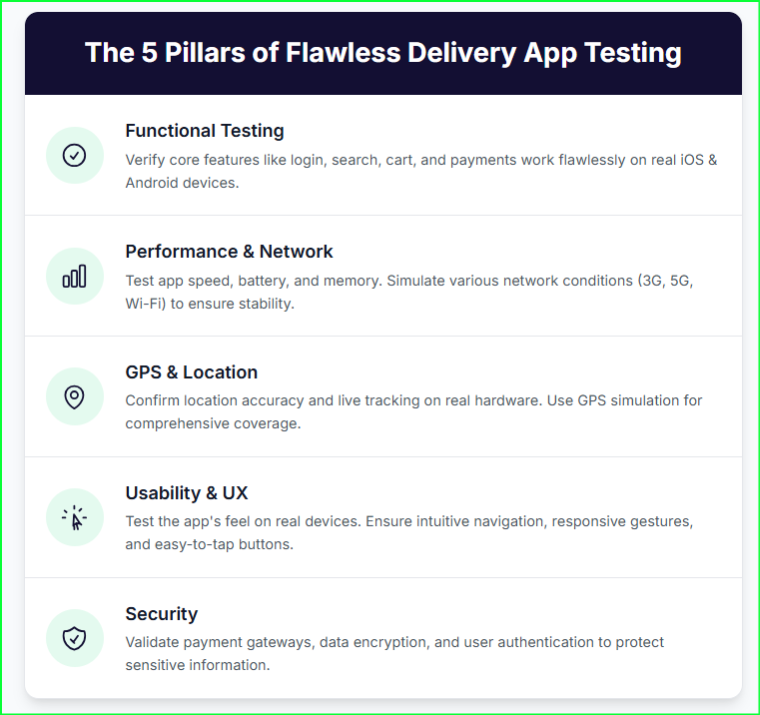
Once your device matrix is set, it’s time to test the core user workflows on each physical device. Functional testing ensures every feature a user interacts with works exactly as intended. These delivery app test cases should be run manually and, where possible, through automated mobile testing to ensure consistent coverage.
Account Registration & Login
A user’s first impression is often the login screen. Your testing should validate every entry point.
Test the standard email and SMS signup processes.
Verify that social logins (Google, Apple, Facebook) work seamlessly.
Check the password recovery flow.
Attempt to log in with incorrect credentials and invalid multi-factor authentication codes to ensure the app handles errors gracefully.
Menu Browsing & Search
The core of a delivery app is finding food. Simulate users browsing restaurant menus and using the search bar extensively. Test with valid and invalid keywords, partial phrases, and even typos. A smart search function should be able to interpret “vgn pizza” and correctly display results for a vegan pizza.
Cart and Customization
This is where users make decisions that lead to a purchase.
Add items to the cart, adjust quantities, and apply every available customization, like “no onions” or “extra cheese”.
Confirm that the cart’s contents persist correctly if you switch to another app and then return, or even close and reopen the app.
Validate that all calculations—item price, taxes, tips, and promotional coupon codes—update accurately with every change.
Checkout & Payment
The checkout process is a mission-critical flow where failures can directly lead to lost revenue.
Execute a complete order using every supported payment method, including credit/debit cards, digital wallets, and cash-on-delivery.
Test edge cases relentlessly, such as switching payment methods mid-transaction, entering invalid card details, or applying an expired coupon.
Simulate a network drop during the payment process to see if the app recovers without incorrectly charging the user.
Verify that the final price, including all fees and tips, is correct.
Ensure all payment data is transmitted securely over HTTPS/TLS and that sensitive information is properly masked on-screen.
Real-Time Tracking & Status Updates
After an order is placed, the app must provide accurate, real-time updates.
Confirm that order statuses like “Preparing,” “Out for Delivery,” and “Delivered” appear at the appropriate times.
Watch the driver’s location on the map to ensure the pin moves smoothly and corresponds to the actual delivery route. Discrepancies here are a major source of user frustration.
You can test this without physically moving a device by using GPS simulation tools, which are available in frameworks like Appium and on real device cloud platforms.
Notifications & Customer Support
Finally, test the app’s communication channels. Verify that push notifications for key order events (e.g., “Your courier has arrived”) appear correctly on both iOS and Android. Tapping a notification should take the user to the relevant screen within the app. Also, test any in-app chat or customer support features by sending common queries and ensuring they are handled correctly.
It is vital to perform all these functional tests on both platforms. Pay close attention to OS-specific behaviors, such as the Android back button versus iOS swipe-back gestures, to ensure neither path causes the app to crash or exit unexpectedly.
Beyond Functionality: Testing the Human Experience (UX)
A delivery app can be perfectly functional but still fail if it’s confusing or frustrating to use. Usability testing shifts the focus from “Does it work?” to “Does it feel right?” Real-device testing is essential here because it is the only way to accurately represent user gestures and physical interactions with the screen.
To assess usability, have real users—or QA team members acting as users—perform common tasks on a variety of physical phones. Ask them to complete a full order, from browsing a menu to checkout, and observe where they struggle.
Is the navigation intuitive? Can users easily find the search bar, add toppings to an item, or locate the customer support section?
Are interactive elements clear and accessible? Are buttons large enough to tap confidently without accidentally hitting something else? Do sliders and carousels respond smoothly to swipes?
Does the app feel fast and responsive? Check that load times, screen transitions, and animations are smooth on all target devices, not just high-end models.
Does the UI adapt properly? Verify that the layout adjusts correctly to different screen sizes and orientations without breaking or hiding important information.
Is the app globally ready? If your app is multilingual, test different language and locale settings to ensure that dates, currency formats, and text appear correctly without getting cut off.
Beta testing with a small group of real users is an invaluable practice. These users will inevitably uncover confusing screens and awkward workflows that scripted test cases might miss. Ultimately, the goal is to use real devices to feel the app exactly as your customers do, catching UX problems that emulators often hide.
Testing Under Pressure: Performance and Network Scenarios
A successful app must perform well even when conditions are less than ideal. An effective app testing strategy must account for both heavy user loads and unpredictable network connectivity. Using real devices is the only way to measure how your app truly behaves under stress.
App Performance and Load Testing
Your app needs to be fast and responsive, especially during peak hours like the dinner rush.
Simulate Concurrent Users: Use tools like JMeter to simulate thousands of users browsing menus and placing orders simultaneously, while you monitor backend server response times. One food-delivery case study found that with ~2,300 concurrent users, their system could still process 98 orders per minute with a minimal 0.07% error rate—this is the level of performance to strive for.
Measure On-Device Metrics: On each device in your matrix, record key performance indicators like how long the app takes to launch, how smoothly the menus scroll, and the response time for critical API calls.
Monitor Resource Usage: Keep an eye on battery and memory consumption, especially during power-intensive features like live map tracking, to ensure your app doesn’t excessively drain the user’s device.
Network Condition Testing
Delivery apps live and die by their network connection. Users and drivers are constantly moving between strong Wi-Fi, fast 5G, and spotty 4G or 3G coverage. Your app must handle these transitions gracefully.
Test on Various Networks: Manually test the app’s performance on different network types to see how it handles latency and limited bandwidth.
Simulate Network Drops: A critical test is to put a device in airplane mode in the middle of placing an order. The app should fail gracefully by displaying a clear error message or queuing the action to retry, rather than crashing or leaving the user in a state of confusion.
Use Simulation Tools: Services like the real device cloud provider Qyrus allow you to automate these tests by setting specific network profiles.
Check Network Switching: Confirm that the user’s session remains active and the app reconnects smoothly when switching between Wi-Fi and a cellular network.
By performing this level of real device testing for delivery apps, you will uncover issues like slower load times on devices with weaker processors or unexpected crashes that only occur under real-world stress.
Final Checks: Nailing Location, Security, and Automation
With the core functionality, usability, and performance validated, the final step in your app testing strategy is to focus on the specialized areas that are absolutely critical for a delivery app’s success: location services, payment security, and scalable automation.
GPS and Location Testing
A delivery app’s mapping and geolocation features must be flawless. On real devices, your testing should confirm:
Accuracy: Addresses are geocoded correctly and the proposed routes are sensible.
Live Tracking: The driver’s icon updates smoothly on the map. If possible, physically walk or drive a short distance with a device to observe this in a real-world setting.
Edge Cases: The app correctly handles users who are outside the delivery zone or scenarios where dynamic pricing should apply.
GPS Signal Loss: The app behaves predictably and recovers gracefully if the GPS signal is temporarily lost.
You can test many of these scenarios without leaving the office. Most real device cloud platforms and automation frameworks like Appium allow you to simulate or “spoof” GPS coordinates. This lets you check if the ETA updates correctly when a courier is far away or test location-based features without physically being in that region.
Payment and Security Testing
Handling payments means handling sensitive user data, making this a mission-critical area where trust is everything.
Validate All Payment Flows: Test every payment gateway and method you support, including digital wallets and cash-on-delivery.
Simulate Failures: Check how the app responds to a payment gateway outage or API timeout. It should roll back the transaction and display a clear error, never leaving the user wondering if they were charged.
Verify Encryption: Use real devices to confirm that all transactions are secured with HTTPS/TLS and that sensitive data like credit card numbers are properly masked on all screens.
Check Authentication: Ensure the app requires users to re-authenticate payments or has appropriate session timeouts to protect user accounts.
Tools and Automation
While manual testing is essential for usability and exploration, automated mobile testing is the key to achieving consistent and scalable coverage.
Automation Frameworks: Use frameworks to automate your regression tests. Appium is a popular choice for writing a single set of tests that can run on both iOS and Android. For platform-specific testing, you can use Espresso for Android and XCTest/XCUITest for iOS.
Cloud Integration: You can run these automated test scripts across hundreds of devices on a real device cloud, dramatically increasing the scope of your mobile app testing without repetitive manual work.
CI/CD Pipeline: The ultimate goal is to integrate these automated tests into your Continuous Integration/Continuous Deployment (CI/CD) pipeline. Using tools like Jenkins or GitHub Actions, you can ensure that every new code change is automatically tested on a matrix of real devices before it ever reaches your customers.
By combining comprehensive functional checks, usability testing, and rigorous performance validation with a sharp focus on location, security, and automation, you create a robust quality assurance process. This holistic approach to real device testing for delivery apps ensures you ship a product that is not only functional but also reliable, secure, and delightful for users in the field.
Streamline Your Delivery App Testing with Qyrus
Managing a comprehensive testing process—across hundreds of devices, platforms, and test cases—can overwhelm even the most skilled QA teams, slowing down testing efforts. Delivery apps face unique complexities, from device fragmentation to challenges in reproducing defects.
A unified, AI-powered solution can simplify and accelerate this process. The Qyrus platform is an end-to-end test automation solution designed for the entire product development lifecycle. It provides a comprehensive platform for mobile, web, and API testing, infused with next-generation AI to enhance the quality and speed of testing.
Here is how Qyrus helps:
Codeless Automation: Drastically reduce the time it takes to create automated tests. Qyrus offers a no-code/low-code mechanism, including a mobile recorder that captures user actions and converts them into test steps in minutes. Your team can automate the entire user journey—from login to payment to order tracking—without writing extensive code.
True Cross-Platform Testing: Use a single, comprehensive platform to test your mobile applications (iOS & Android), web portals, and APIs, ensuring seamless integration and consistency.
Integrated Real Device Farm: Get instant access to a vast library of real devices to achieve maximum device coverage without the overhead of an in-house lab. Qyrus provides a diverse set of real smartphones and tablets, providing over 2,000 device-browser combinations, with 99.9% availability.
AI-Powered Autonomous Testing with Rover AI: Go beyond scripted tests. Deploy Qyrus’s Rover AI, a curiosity-driven autonomous solution, to explore your app, identify bugs, and uncover critical user paths you might have missed.
Seamless CI/CD Pipeline Integration: Integrate Qyrus directly into your CI/CD pipeline. The platform connects with tools like Jenkins, Azure DevOps, and Bitrise to run a full suite of regression tests on real devices with every new build, catching bugs before they reach customers.
Best Practices for Automation and CI/CD Integration
For teams looking to maximize efficiency, integrating automation into the development lifecycle is key. A modern approach ensures that quality checks are continuous, not just a final step.
Leverage Frameworks
For teams that have already invested in building test scripts, there’s no need to start from scratch. The Qyrus platform allows you to execute your existing automated test scripts on its real device cloud. It supports popular open-source frameworks, with specific integrations for Appium that allow you to run scripted tests to catch regressions early in the development process. You can generate the necessary configuration data for your Appium scripts directly from the platform to connect to the devices you need.
The Power of CI/CD
The true power of automation is realized when it becomes an integral part of your Continuous Integration and Continuous Deployment (CI/CD) pipeline. Integrating automated tests ensures that every new build is automatically validated for quality. Qyrus connects with major CI/CD ecosystems like Jenkins and Azure DevOps to automate your workflows. This practice helps agile development teams speed up release cycles by reducing defects and rework, allowing you to release updates faster and with more confidence.
Conclusion: Delivering a Flawless App Experience
Real device testing isn’t just a quality check; it’s a critical business investment. Emulators and simulators are useful, but they cannot replicate the complex and unpredictable conditions your delivery app will face in the real world. Issues arising from network glitches, sensor quirks, or device-specific performance can only be caught by testing on the physical hardware your customers use every day.
A successful testing strategy for delivery mobile applications must cover the full spectrum of the user experience. This includes validating all functional flows, measuring performance under adverse network and battery conditions, securing payment and user data, and ensuring the app is both usable and accessible to everyone.
In the hyper-competitive delivery market, a seamless and reliable user experience is the ultimate differentiator. Thorough real device testing is how you guarantee that every click, swipe, and tap leads to a satisfied customer.
Don’t let bugs spoil your customer’s appetite. Ensure a flawless delivery experience with Qyrus. Schedule a Demo Today!
Why 2026 Testing Needs One Platform, Not Many
A TestGuild x Qyrus Webinar Recording
The pace of software development has never been faster. AI-driven coding assistants like Devin, Copilot, and CodeWhisperer are accelerating release velocity, but QA hasn’t kept up.
Dev and Testing today are like two sides of a seesaw:
On one side → Dev teams are racing ahead with AI-powered speed.
On the other → QA teams overwhelmed by code explosion, flaky automation, disconnected tools, and brittle pipelines.
In the middle → The imbalance that slows releases and compromises quality.
On August 5, 2025, Qyrus teamed up with Joe Colantonio, founder of TestGuild, to explore how testing teams can finally bring balance back.
Why Watch the Recording?
In this session, Ameet Deshpande (SVP, Product Engineering at Qyrus) revealed why traditional testing stacks collapse at scale, and why agentic test orchestration — not tool count — is the real game changer.
You’ll learn:
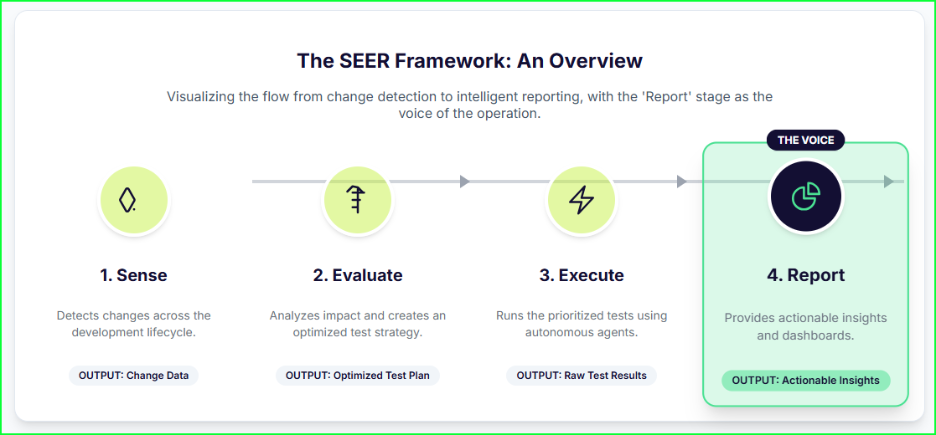
✔️ The hidden costs of multi-tool chaos in QA ✔️ How AI Agents are reshaping automation and triage ✔️ Why agentic orchestration matters more than adding “just another tool” ✔️ How Qyrus SEER (Sense, Evaluate, Execute, Report) introduces a new era of autonomous testing
Meet the Experts
Ameet Deshpande
Senior Vice President, Product Engineering, Qyrus A technology leader with 20+ years in Quality & Product Engineering, Ameet is building the next generation of agentic, AI-driven quality platforms that deliver true autonomy at scale.
Ameet Deshpande
Senior Vice President, Product Engineering, Qyrus A technology leader with 20+ years in Quality & Product Engineering, Ameet is building the next generation of agentic, AI-driven quality platforms that deliver true autonomy at scale.
Access the Recording
This exclusive session has already taken place, but the insights are more relevant than ever. Fill out the form to watch the recording and discover how Qyrus SEER balances the Dev-QA seesaw once and for all.
[wpcode id=”7656″]
Save the Date 📅 October 8–9, 2025
📍 Bengaluru, India
India is leading one of the most ambitious digital transformations in the world, and APIs are at the center of that shift. From payments to healthcare, logistics to customer experience, APIs are the invisible engines driving billions of interactions every day. That’s why API Days India 2025 is the event to watch—and we’re excited to share that Qyrus will be there as a Silver Sponsor.
The event takes place at the Chancery Pavilion in Bengaluru, bringing together 800+ API experts, CTOs, product leaders, and developers from leading organizations. This year’s theme, “Future-proof APIs for billions: Powering India’s digital economy,” could not be more relevant.
qAPI, Powered by Qyrus
With qAPI, powered by Qyrus, APIs aren’t just about connecting systems. They’re about building digital experiences that are scalable, resilient, and rooted in quality.
qAPI is our end-to-end API testing platform designed to simplify and strengthen the way enterprises validate, monitor, and secure their APIs. From functional and performance testing to security and contract validation, qAPI helps teams accelerate releases, reduce risks, and deliver APIs that perform reliably at scale. By combining automation, intelligence, and real-time insights, qAPI empowers businesses to keep pace with innovation while ensuring flawless digital experiences.
Don’t Miss Our Keynote with Ameet Deshpande
We’re especially proud to share that Ameet Deshpande, Senior Vice President of Product Engineering at Qyrus, will deliver a keynote session at API Days India.
📅 October 8, 2025 ⏰ 4:00 PM – 4:20 PM IST 📍 Grand Ballroom 2, Chancery Pavilion 🎤 Session: “Rethinking Software Quality: Why API Testing Needs to Change”
In this session, Ameet will explore the unique challenges of API-driven ecosystems and explain why traditional QA strategies are no longer enough. With over two decades of experience leading large-scale transformation across financial services, cloud, and SaaS platforms, Ameet will share how enterprises can:
Move beyond outdated QA approaches
Adopt agentic orchestration
Leverage intelligence-driven automation for speed and resilience
If you’re looking to future-proof your API testing strategy, this is a session you won’t want to miss.
Meet the Qyrus Team at Booth #6
The conversation doesn’t stop at the keynote. Our team will be at Booth 6, ready to connect with API enthusiasts, developers, and enterprise leaders. Whether you’re curious about no-code, end-to-end API testing with qAPI, want to explore real-world solutions to API challenges, or simply want to exchange ideas, we’d love to meet you.
And here’s the fun part, visit our booth for surprise raffles and giveaway prizes. We promise it’ll be worth your time.
See You in Bengaluru
API Days India is the tech conference where the future of India’s digital economy takes shape, and we’re thrilled to be part of it.
Mark your calendar for October 8–9, 2025 and join us at the Chancery Pavilion.
Catch our keynote with Ameet Deshpande on October 8 at 4 PM.
Visit us at Booth 6 for conversations, demos, and giveaways.
We can’t wait to meet you in Bengaluru and start rethinking the future of API testing together.
The world of software testing moves fast, and staying ahead requires tools that not only keep pace but actively drive innovation. At Qyrus, we’re relentlessly focused on evolving our platform to empower your teams, streamline your workflows, and make achieving quality more intuitive than ever before. May was a busy month behind the scenes, packed with exciting new features and significant enhancements designed to give you even more power and flexibility in your testing journey.
Get ready to explore the latest advancements we’ve rolled out across the Qyrus platform!
Complex Web Tests, Now Powered by AI Genius!
Manual coding for complex calculations in web tests? Consider it a thing of the past! We’re thrilled to introduce a game-changing AI feature that lets you generate custom Java and JS code using simple, natural language descriptions. Just tell Qyrus what you need the code to do, and our AI gets to work, even understanding the variables you’ve already set up in your test. This AI Text-to-Code conversion is seamlessly integrated with our Execute JS, Execute JavaScript, and Execute Java actions, designed to produce accurate, executable snippets right when you need them. You maintain control, of course – easily review, modify, or copy the generated code before using it.
A quick note: This powerful AI code generation is currently a Beta feature, and we’re actively refining it based on your feedback!
Enhanced Run Visibility for Web Tests
But that’s not all for Web Testing this month. For our valued enterprise clients, managing your test runs just got clearer. You now have enhanced visibility into your test execution queues, allowing you to see detailed information, including the exact position of your test run in the queue. Gain better insight, plan more effectively, and stay informed every step of the way.
Sharper Focus for Your Mobile Visuals
Visual testing on mobile is crucial, but sometimes you need to tell your comparison tools to look past dynamic elements or irrelevant areas. This month, we’ve enhanced our Mobile Testing Mobile Testing capabilities to give you more granular control. You can now easily ignore specific areas within your mobile application screens, excluding those regions entirely from visual comparisons.
Additionally, you can ignore the header or footer of the screen meaning that you can easily compare different execution results and not run into issues due to differences in the notification bar or in a footer.
This means cleaner, more relevant results and less noise when you’re ensuring your app looks exactly as it should across devices. Focus on what truly matters for your app’s user interface integrity.
Device Farm: Smoother Streaming, Better Guidance
We know your time on the Device Farm Device Farm streaming screen is valuable, and a smooth experience is key. This month, we’ve rolled out several user experience improvements to make your interactions even more intuitive. The tour guide text has been refined to be more informative, guiding you clearly through the features.
We’ve also added a Global Navbar directly inside the device streaming page, providing consistent navigation right where you need it. Plus, for those times you’re working with a higher zoom percentage, we’ve included a handy scroll bar to make navigating the page much easier. Small changes, big impact on your workflow!
Desktop Testing: Schedule Your Success
We’re excited to announce that test scheduling is now available in Qyrus Desktop Testing. This highly requested feature, already familiar from other modules, brings a new level of automation to your desktop workflows. It’s particularly powerful for those complex end-to-end test cases that span across different modules, perhaps starting in a web portal, moving through a back office, and ending in servicing.
Now, you can schedule these crucial test flows, ensuring your regression suites run automatically, even aligning with deployment schedules. This means no more worrying about desktop availability at the exact moment of execution – Qyrus handles it for you. With this feature, efficiently managing tests for workflows impacting dozens of test cases becomes significantly simpler.
Smarter AI for Broader Test Coverage
Our commitment to leveraging AI to make testing more intelligent continues this month with key improvements to both TestGenerator and TestGenerator+. We’ve been refining these powerful features under the hood, and the result is simple but significant: you should now see more tests built by the AI compared to previous versions.
Remember, TestGenerator is designed to transform your JIRA tickets directly into actionable test scenarios, bridging the gap between development tasks and testing needs. TestGenerator+ takes it a step further, actively exploring untested areas of your application, intelligently identifying gaps, and helping you increase your overall test coverage. These enhancements mean our AI is working even harder to help you achieve comprehensive and efficient testing with less manual effort.
Ready to Experience the May Power-Ups?
This month’s Qyrus updates are all about putting more power, intelligence, and efficiency directly into your hands. From harnessing AI to generate complex web code to gaining sharper insights from mobile visual tests, scheduling your desktop workflows, and boosting the output of our AI test generators – every enhancement is designed with your success in mind. We’re dedicated to providing a platform that adapts to your needs, streamlines your processes, and helps you deliver quality software faster than ever before.
Excited to see these May power-ups in action? There’s no better way to understand the impact Qyrus can have on your testing journey than by experiencing it firsthand.
We’re constantly building, innovating, and looking for ways to make your testing life easier. Stay tuned for more exciting updates from Qyrus!
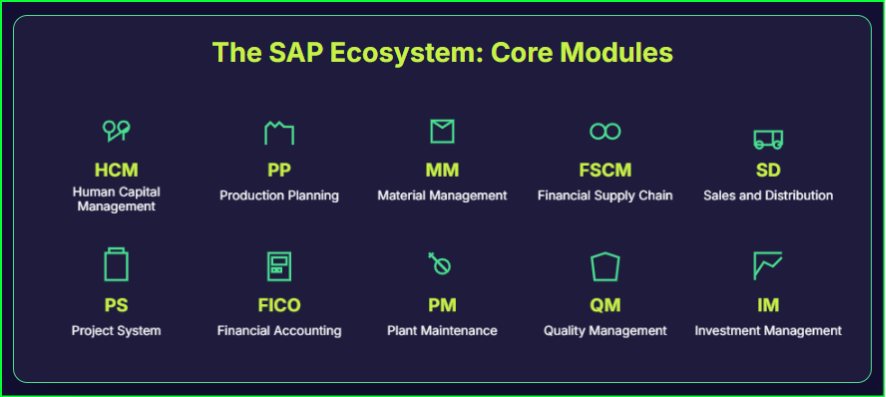
One of North America’s leading Coca-Cola bottlers manages a massive logistics network, operating more than 10 state-of-the-art manufacturing plants and over 70 warehouses. Their complex business processes—spanning sales, distribution, finance, and warehouse management—rely on SAP S/4HANA as the central ERP, connected to over 30 satellite systems for functions like last-mile delivery.
Before partnering with Qyrus, the company’s quality assurance process was a fragmented and manual effort that struggled to keep pace. Testing across their SAP desktop, internal web portals, and mobile delivery apps was siloed, slow, and inconsistent.
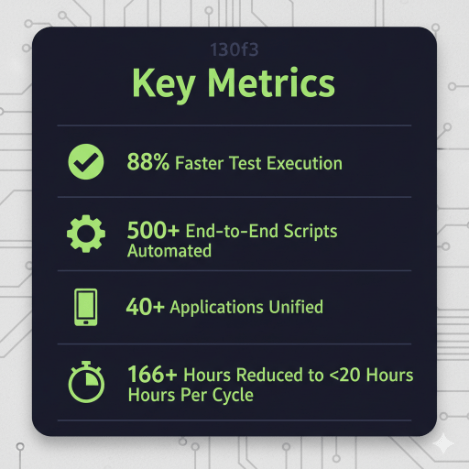
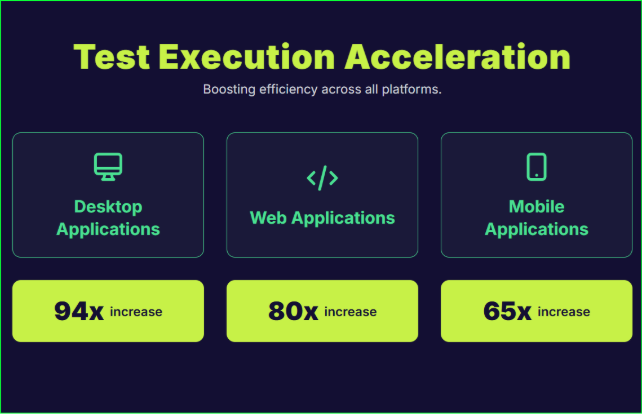
Qyrus provided a single, unified platform to automate their business-critical workflows from end to end. The results were immediate and dramatic. The bottler successfully automated over 500 test scripts, covering more than 19,000 individual steps across 40+ applications. This strategic shift slashed overall test execution time from over 10,020 minutes down to just 1,186 minutes—an 88% reduction that turned their quality process into a strategic accelerator.
The High Cost of Disconnected Quality
Before implementing Qyrus, the bottler’s quality assurance environment faced significant operational challenges that created friction and risk. The core issue was a testing process that could not match the integrated nature of their business. This disconnect led to several critical pain points.
Fragmented and Slow Manual Testing: Functional testing was performed manually across SAP GUI, internal web portals, and mobile delivery applications. This approach resulted in slow regression cycles and inconsistent test coverage across platforms.
Lack of End-to-End Confidence: There was limited integration between the desktop SAP modules and the mobile Last Mile Delivery workflows. This gap prevented true end-to-end testing, reducing confidence that a complete business journey would work correctly in production.
Burdensome Evidence Collection: Gathering evidence for audits and defect analysis was a manual, time-consuming process. This practice significantly slowed down both compliance checks and the ability to triage and fix bugs quickly.
Operational Drain on Experts: Frequent change requests continuously increased the testing burden. As a result, critical subject matter experts (SMEs) were constantly pulled away from their primary operational duties to participate in tedious test cycles.
The client needed a single platform that could automate their real business journeys across SAP, web, and mobile while producing audit-ready evidence on demand.
Connecting the Dots: A Unified Automation Strategy
Qyrus replaced the client’s fragmented tools with a single, centralized platform designed to mirror their real-world business journeys. Instead of testing applications in isolation, the bottler could now execute complete, end-to-end workflows that spanned their entire technology ecosystem, including SAP, Greenmile, WinSmart, VendSmart, BY, and Osapiens LMD. This was made possible by leveraging several key features of the Qyrus platform.
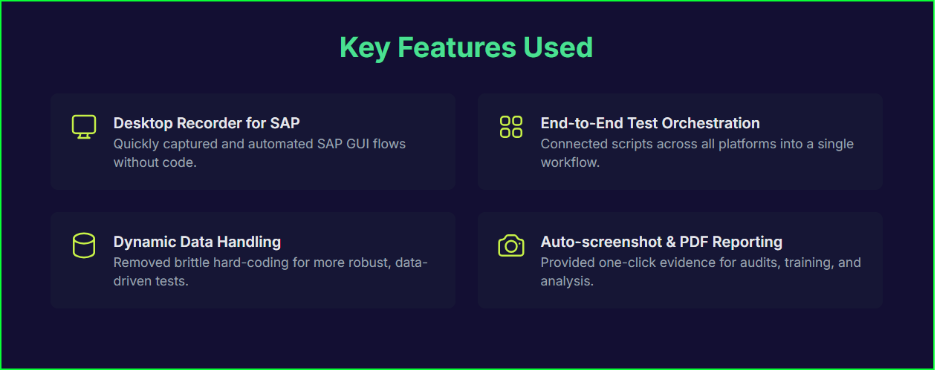
Codeless SAP Automation: Using the Desktop Recorder for SAP, the team quickly captured and automated critical SAP GUI flows without writing any code. Processes like order creation, delivery planning, and route allocation were automated and then reused across multiple tests with parameterized data, saving countless hours of scripting and maintenance.
End-to-End Test Orchestration: Qyrus connected individual scripts across SAP, web, desktop, and mobile into a single, cohesive workflow. Built-in waits ensured that backend updates from one system, like a shipment creation in SAP, were correctly synchronized before the next step began in another system, such as a mobile delivery app.
Dynamic Data Handling: The automation scripts were built to be resilient. The platform captured critical data like shipment IDs, driver assignments, and warehouse keys at runtime. This approach eliminated brittle, hard-coded values and enabled robust, data-driven test runs.
One-Click Audit and Evidence Trails: Every test step was automatically documented with screenshots and compiled into detailed PDF reports. This feature was used extensively for faster defect analysis, end-user training, and providing auditors with clear, irrefutable evidence of system validation.
This unified approach finally gave the client a true, top-down view of their quality, allowing them to test the way their business actually operates.
Speed, Scale, and Unshakable Confidence
The implementation of Qyrus delivered immediate, measurable results that fundamentally transformed the bottler’s quality assurance process. The automation initiative achieved a scale and speed that was previously impossible with manual testing, leading to significant gains in efficiency, risk reduction, and operational governance.
The most significant outcome was a dramatic 88% reduction in test execution time. A full regression cycle that once took over 10,020 minutes (more than 166 hours) to complete manually now finishes in just 1,186 minutes (under 20 hours) with automation.
This newfound speed was applied across a massive scope:
The client successfully automated over 500 test scripts.
These scripts encompassed more than 19,000 individual steps.
The automation suite provided coverage for over 40 distinct SAP, mobile, and web applications, including critical systems for route optimization, delivery, and warehouse management.
Beyond speed, the centralized execution and one-click PDF reports provided full traceability for every process. This comprehensive evidence proved invaluable not only for audit preparedness but also for end-user training, ultimately reducing time, effort, and operational risk across all platforms.
Beyond Automation: A Future-Proof Quality Partnership
With the foundation of a highly successful automation suite now in place, the bottler is looking to the future. As of mid-2025, with over 500 test cases and 19,000 steps automated, the client’s immediate goal is to complete the remaining functional automation by December 2025 through a fixed-price engagement. The objective is to establish a steady-state model where a fully automated regression suite is maintained without new scripting costs, seamlessly integrating script maintenance, and the addition of new test cases under their existing managed services.
Building on that foundation, the long-term vision is to evolve the partnership by leveraging AI to increase testing speed and intelligence. The client envisions a future state that includes:
AI-Driven Test Selection: Using AI to automatically select the most relevant test cases to run based on specific code and configuration changes.
Intelligent Impact Analysis: Applying AI to analyze the potential impact of changes across SAP and other connected applications.
AI-Assisted Test Creation: Generating new test cases automatically from support tickets and business process documentation.
Autonomous Continuous Testing: Implementing AI for autonomous test healing and the automatic triage of flaky tests.
Smarter Regression Cycles: Receiving AI-powered recommendations on when to run a full regression versus more targeted, modular testing.
By embedding Qyrus deeply into their release cycles, the client aims to reduce risk, accelerate delivery, and strengthen quality governance across every product touchpoint. Ultimately, they see Qyrus not just as a testing tool, but as an end-to-end quality platform capable of supporting their enterprise agility for years to come.
Experience Your Own Transformation
The challenges of manual testing across SAP and modern applications are universal, but the solution is simple. Qyrus provided this client with the speed and end-to-end confidence needed to thrive.
You’ve built a powerful mobile app. Your team has poured months into coding, designing, and refining it. Then, the launch day reviews arrive: “Crashes on my Samsung.” “The layout is broken on my Pixel tablet.” “Doesn’t work on the latest iOS.” Sounds familiar?
Welcome to the chaotic world of mobile fragmentation that hampers mobile testing efforts.
As of 2024, an incredible 4.88 billion people use a smartphone, making up over 60% of the world’s population. With more than 7.2 billion active smartphone subscriptions globally, the mobile ecosystem isn’t just a market—it’s the primary way society connects, works, and plays.
This massive market is incredibly diverse, creating a complex matrix of operating systems, screen sizes, and hardware that developers must account for. Without a scalable way to test across this landscape, you risk releasing an app that is broken for huge segments of your audience.
This is where a mobile device farm enters the picture. No matter how much we talk about AI automating the testing processes, testing range of devices and versions is still a challenge.
A mobile device farm (or device cloud) is a centralized collection of real, physical mobile devices used for testing apps and websites. It is the definitive solution to fragmentation, providing your QA and development teams with remote access to a diverse inventory of iPhones, iPads, and Android devices including Tabs for comprehensive app testing. This allows you to create a controlled, consistent, and scalable environment for testing your app’s functionality, performance, and usability on the actual hardware your customers use.
This guide will walk you through everything you need to know. We’ll cover what a device farm is, why it’s a competitive necessity for both manual tests and automated tests, the different models you can choose from, and what the future holds for this transformative technology.
Why So Many Bugs? Taming Mobile Device Fragmentation
The core reason mobile device farms exist is to solve a single, massive problem: device fragmentation. This term describes the vast and ever-expanding diversity within the mobile ecosystem, creating a complex web of variables that every app must navigate to function correctly. Without a strategy to manage this complexity, companies risk launching apps that fail for huge portions of their user base, leading to negative reviews, high user churn, and lasting brand damage.
Let’s break down the main dimensions of this challenge.
Hardware Diversity
The market is saturated with thousands of unique device models from dozens of manufacturers. Each phone or tablet comes with a different combination of screen size, pixel density, resolution, processor (CPU), graphics chip (GPU), and memory (RAM). An animation that runs smoothly on a high-end flagship might cause a budget device to stutter and crash. A layout that looks perfect on a 6.1-inch screen could be unusable on a larger tablet. Effective app testing must account for this incredible hardware variety.
Operating System (OS) Proliferation
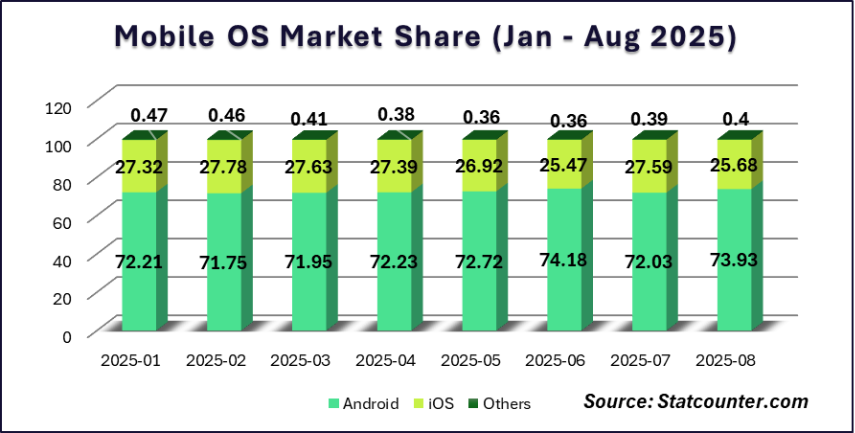
As of August 2025, Android holds the highest market share at 73.93% among mobile operating systems, followed by iOS (25.68%). While the world runs on Android and iOS, simplicity is deceptive. At any given time, there are numerous active versions of each OS in the wild, and users don’t always update immediately. The issue is especially challenging for Android devices, where manufacturers like Samsung apply their own custom software “skins” (like One UI) on top of the core operating system. These custom layers can introduce unique behaviors and compatibility issues that don’t exist on “stock” Android, creating another critical variable for your testing process.
This is the chaotic environment your app is released into. A mobile device farm provides the arsenal of physical devices needed to ensure your app delivers a flawless experience, no matter what hardware or OS version your customers use.
Can’t I Just Use an Emulator? Why Real Physical Devices Win
In the world of app development, emulators and simulators—software that mimics mobile device hardware—are common tools. They are useful for quick, early-stage checks directly from a developer’s computer. But when it comes to ensuring quality, relying on them exclusively is a high-risk gamble.
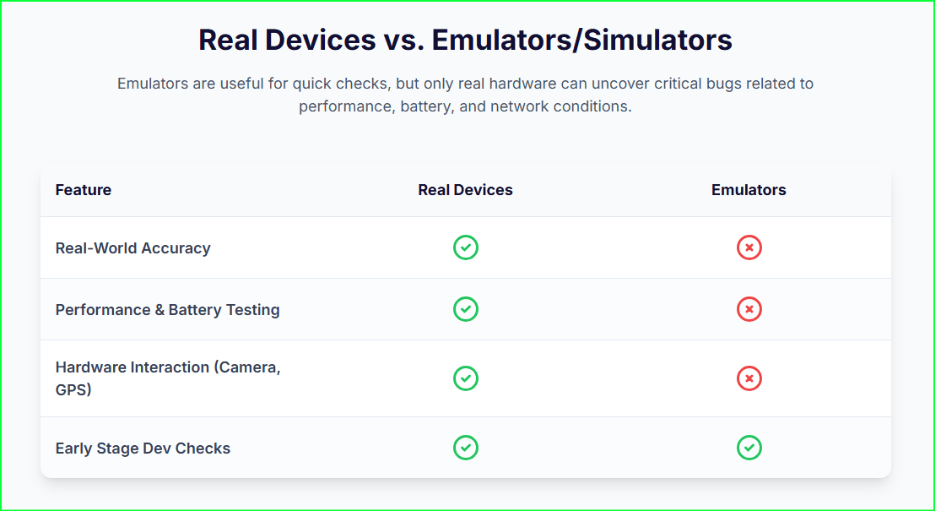
Emulators cannot fully replicate the complex interactions of physical hardware, firmware, and the operating system. Testing on the actual physical devices your customers use is the only way to get a true picture of your app’s performance and stability. In fact, a 2024 industry survey found that only 19% of testing teams rely solely on virtual devices. The overwhelming majority depend on real-device testing for a simple reason: it finds more bugs.
What Emulators and Simulators Get Wrong
Software can only pretend to be hardware. This gap means emulators often miss critical issues related to real-world performance. They struggle to replicate the nuances of:
CPU and Memory Constraints: An emulator running on a powerful developer machine doesn’t accurately reflect how an app performs on a device with limited processing power and RAM.
Battery Drain: You can’t test an app’s impact on battery life without a real battery. This is a crucial factor for user satisfaction that emulators are blind to.
Hardware Interactions: Features that rely on cameras, sensors, or Bluetooth connections behave differently on real hardware than in a simulated environment.
Network Interruptions: Real devices constantly deal with fluctuating network conditions and interruptions from calls or texts—scenarios that emulators cannot authentically reproduce.
Using a device cloud with real hardware allows teams to catch significantly more app crashes simply by simulating these true user conditions.
When to Use Emulators (and When Not To)
Emulators have their place. They are great for developers who need to quickly check a new UI element or run a basic functional check early in the coding process.
However, for any serious QA effort—including performance testing, regression testing, and final pre-release validation—they are insufficient. For that, you need a mobile device farm.
Public, Private, or Hybrid? How to Choose Your Device Farm Model
Once you decide to use a mobile device farm, the next step is choosing the right model. This is a key strategic decision that balances your organization’s specific needs for security, cost, control, and scale. Let’s look at the three main options.
Public Cloud Device Farms
Public cloud farms are services managed by third-party vendors like Qyrus that provide on-demand access to a large, shared pool of thousands of real mobile devices.
Pros: This model requires no upfront hardware investment and eliminates maintenance overhead, as the vendor handles everything. You get immediate access to the latest devices and can easily scale your app testing efforts up or down as needed.
Cons: Because the infrastructure is shared, some organizations have data privacy concerns, although top vendors use rigorous data-wiping protocols. You are also dependent on internet connectivity, and you might encounter queues for specific popular devices during peak times.
Private (On-Premise) Device Farms
A private farm is an infrastructure that you build, own, and operate entirely within your own facilities. This model gives you absolute control over the testing environment.
Pros: This is the most secure option, as all testing happens behind your corporate firewall, making it ideal for highly regulated industries. You have complete control over device configurations and there are no recurring subscription fees after the initial setup.
Cons: The drawbacks are significant. This approach requires a massive initial capital investment for hardware and ongoing operational costs for maintenance, updates, and repairs. Scaling a private farm is a slow and expensive manual process, making it difficult to keep pace with the market.
Hybrid Device Farms
As the name suggests, a hybrid model is a strategic compromise that combines elements of both public and private farms. An organization might maintain a small private lab for its most sensitive manual tests while using a public cloud for large-scale automated tests and broader device coverage. This approach offers a compelling balance of security and flexibility.
Expert Insight: Secure Tunnels Changed the Game
A primary barrier to using public clouds was the inability to test apps on internal servers behind a firewall. This has been solved by secure tunneling technology. Features like “Local Testing” create an encrypted tunnel from the remote device in the public cloud directly into your company’s internal network. This allows a public device to safely act as if it’s on your local network, making public clouds a secure and viable option for most enterprises.
Quick Decision Guide: Which Model is Right for You?
You need a Public Farm if: You prioritize speed, scalability, and broad device coverage. This model is highly effective for startups and small-to-medium businesses (SMBs) who need to minimize upfront investment while maximizing flexibility.
You need a Private Farm if: You operate under strict data security and compliance regulations (e.g., in finance or healthcare) and have the significant capital required for the initial investment.
You need a Hybrid Farm if: You’re a large enterprise that needs a balance of maximum security for core, data-sensitive apps and the scalability of the cloud for general regression testing.
6 Must-Have Features of a Modern Mobile Device Farm
Getting access to devices is just the first step. The true power of a modern mobile device farm comes from the software and capabilities that turn that hardware into an accelerated testing platform. These features are what separate a simple device library from a tool that delivers a significant return on investment.
Here are five essential features to look for.
1. Parallel Testing
This is the ability to run your test suites on hundreds of device and OS combinations at the same time. A regression suite that might take days to run one-by-one can be finished in minutes. This massive parallelization provides an exponential boost in testing throughput, allowing your team to get feedback faster and release more frequently.
2. Rich Debugging Artifacts
A failed test should provide more than just a “fail” status. Leading platforms provide a rich suite of diagnostic artifacts for every single test run. This includes full video recordings, pixel-perfect screenshots, detailed device logs (like logcat for Android), and even network traffic logs. This wealth of data allows developers to quickly find the root cause of a bug, dramatically reducing the time it takes to fix it.
3. Seamless CI/CD Integration
Modern device farms are built to integrate directly into Continuous Integration/Continuous Deployment (CI/CD) pipelines like Jenkins or GitLab CI. This allows automated tests on real devices to become a standard part of your development process. With every code change, tests can be triggered automatically, giving developers immediate feedback on the impact of their work and catching bugs within minutes of their introduction.
4. Real-World Condition Simulation
Great testing goes beyond the app itself; it validates performance in the user’s environment. Modern device farms allow you to simulate a wide range of real-world conditions. This includes testing on different network types (3G, 4G, 5G), simulating poor or spotty connectivity, and setting the device’s GPS location to test geo-specific features. This is essential for ensuring your app is responsive and reliable for all users, everywhere.
5. Broad Automation Framework Support
Your device farm must work with your tools. Look for a platform with comprehensive support for major mobile automation frameworks, especially the industry-standard test framework, Appium. Support for native frameworks like Espresso (Android) and XCUITest (iOS) is also critical. This flexibility ensures that your automation engineers can write and execute scripts efficiently without being locked into a proprietary system.
6. Cross Platform Testing Support
Modern businesses often perform end-to-end testing of their business processes across various platforms such as mobile, web and desktop. Device farms should seamlessly support such testing requirements with session persistence while moving from one platform to another.
Qyrus Device Farm: Go Beyond Access, Accelerate Your Testing
Access to real devices is the foundation, but the best platforms provide powerful tools that accelerate the entire testing process. The Qyrus Device Farm is an all-in-one platform designed to streamline your workflows and supercharge both manual tests and automated tests on real hardware. It delivers on all the “must-have” features and introduces unique tools to solve some of the biggest challenges in mobile QA.
Our platform is built around three core pillars:
Comprehensive Device Access: Test your applications on a diverse set of real hardware, including the smartphones and tablets your customers use, ensuring your app works flawlessly in their hands.
Powerful Manual Testing: Interactively test your app on a remote device in real-time. Qyrus gives you full control to simulate user interactions, identify usability issues, and explore every feature just as a user would.
Seamless Appium Automation: Automate your test suites using the industry-standard Appium test framework. Qyrus enables you to run your scripted automated tests in parallel to catch regressions early and often, integrating perfectly with your CI/CD pipeline.
Bridge Manual and Automated Testing with Element Explorer
A major bottleneck in mobile automation is accurately identifying UI elements to create stable test scripts. The Qyrus Element Explorer is a powerful feature designed to eliminate this problem.
How it Works: During a live manual test session, you can activate the Element Explorer to interactively inspect your application’s UI. By simply clicking on any element on the screen—a button, a text field, an image—you can instantly see its properties (IDs, classes, text, XPath) and generate reliable Appium locators.
The Benefit: This dramatically accelerates the creation of automation scripts. It saves countless hours of manual inspection, reduces script failures caused by incorrect locators, and makes your entire automation effort more robust and efficient.
Simulate Real-World Scenarios with Advanced Features
Qyrus allows you to validate your app’s performance under complex, real-world conditions with a suite of advanced features:
Network Reshaping: Simulate different network profiles and poor connectivity to ensure your app remains responsive and handles offline states gracefully.
Interrupt Testing: Validate that your application correctly handles interruptions from incoming phone calls or SMS messages without crashing or losing user data.
Biometrics Bypass: Test workflows that require fingerprint or facial recognition by simulating successful and failed authentication attempts, ensuring your secure processes are working correctly.
Test Orchestration: Qyrus device farm is integrated into its Test Orchestration module that performs end-to-end business process testing across web, mobile, desktop and APIs.
Ready to accelerate your Appium automation and empower your manual testing? Explore the Qyrus Device Farm and see these features in action today.
The Future of Mobile Testing: What’s Next for Device Farms?
The mobile device farm is not a static technology. It’s rapidly evolving from a passive pool of hardware into an “intelligent testing cloud”. Several powerful trends are reshaping the future of mobile testing, pushing these platforms to become more predictive, automated, and deeply integrated into the development process.
AI and Machine Learning Integration
Artificial Intelligence (AI) and Machine Learning (ML) are transforming device farms from simple infrastructure into proactive quality engineering platforms. This shift is most visible in how modern platforms now automate the most time-consuming parts of the testing lifecycle.
AI-Powered Test Generation and Maintenance: A major cost of automation is the manual effort required to create and maintain test scripts. Qyrus directly addresses this with Rover, a reinforcement learning bot that automatically traverses your mobile application. Rover explores the app on its own, visually testing UI elements and discovering different navigational paths and user journeys. As it works, it generates a complete flowchart of the application’s structure. From this recorded journey, testers can instantly build and export mobile test scripts, dramatically accelerating the test creation process.
Self-Healing Tests: As developers change the UI, traditional test scripts often break because element locators become outdated. AI-driven tools like Qyrus Healer can intelligently identify an element, like a login button, even if its underlying code has changed. This “self-healing” capability dramatically reduces the brittleness of test scripts and lowers the ongoing maintenance burden.
Predictive Analytics: By analyzing historical test results and code changes, AI platforms can predict which areas of an application are at the highest risk of containing new bugs. This allows QA teams to move away from testing everything all the time and instead focus their limited resources on the most critical and fragile parts of the application, increasing efficiency.
Preparing for the 5G Paradigm Shift
The global deployment of 5G networks introduces a new set of testing challenges that device farms are uniquely positioned to solve. Testing for 5G readiness involves more than just speed checks; it requires validating:
Ultra-low latency for responsive apps like cloud gaming and AR.
Battery consumption under the strain of high data throughput.
Seamless network fallback to ensure an app functions gracefully when it moves from a 5G network to 4G or Wi-Fi.
Addressing Novel Form Factors like Foldables
The introduction of foldable smartphones has created a new frontier for mobile app testing. These devices present a unique challenge that cannot be tested on traditional hardware. The most critical aspect is ensuring “app continuity,” where an application seamlessly transitions its UI and state as the device is folded and unfolded, without crashing or losing user data. Device farms are already adding these complex devices to their inventories to meet this growing need.
Your Next Steps in Mobile App Testing
The takeaway is clear: in today’s mobile-first world, a mobile device farm is a competitive necessity. It is the definitive market solution for overcoming the immense challenge of device fragmentation and is foundational to delivering the high-quality, reliable, and performant mobile applications your users demand.
As you move forward, remember that the right solution—whether public, private, or hybrid—depends on your organization’s unique balance of speed, security, and budget.
Ultimately, the future of quality assurance lies not just in accessing devices, but in leveraging intelligent platforms that provide powerful tools. Features like advanced element explorers for automation and sophisticated real-world simulations are what truly accelerate and enhance the entire testing lifecycle, turning a good app into a great one.
Welcome to our September update! As we continue to evolve the Qyrus platform, our focus remains squarely on enhancing your productivity and empowering your team to achieve more, faster. We believe in removing friction from the testing lifecycle, and this month’s updates are a direct reflection of that commitment.
We are excited to introduce powerful new capabilities centered around dramatic workflow acceleration, intelligent AI-driven assistance, and seamless CI/CD integration. From features that eliminate repetitive tasks to an AI co-pilot that can fix your scripts on the fly, every enhancement is designed to save you valuable time and make your testing efforts more intuitive and powerful.
New Feature
Build Faster, Not from Scratch: Now Clone Your Web Testing Functions!
The Challenge:
Users often need to create functions (e.g. File Uploads, Global Software Quality Assurance) that are very similar to ones they have already built. Previously, this required repetitive manual effort to recreate these similar functions from scratch, step by step, which was inefficient and time-consuming.
The Fix:
We have now introduced a “Clone” option for functions for project set-up in Web Testing. With a single click, users can create an exact copy of any existing function, which they can then rename and modify as needed.
How will it help?
This feature directly addresses the need for efficiency in test creation. It saves significant time and effort by allowing you to quickly duplicate complex, existing functions instead of recreating them. This allows you to build out your function library much faster and focus on tweaking the logic for new scenarios rather than on repetitive setup.
Improvement
Fix It Right the First Time: Introducing Detailed Error Handling!
The Challenge:
Previously, when users encountered an error during a test, the error messages could sometimes be generic. This lack of specific guidance increased the chances of making mistakes again when re-entering information, leading to a frustrating trial-and-error process.
The Fix:
We have implemented a more detailed and intelligent error handling system within Web Testing. Now, when the system detects an error, it will provide a clear, specific, and actionable message (e.g. “Test Scrip 3, No data table for parameterization step”) that pinpoints exactly what is wrong and often suggests how to correct it.
How will it help?
This enhancement provides immediate, clear guidance that helps you fix issues faster. It ensures consistency in your configurations and reduces manual errors by preventing guesswork. This ultimately speeds up project setup and improves your overall workflow efficiency, allowing you to build tests with greater confidence and speed.
New Feature
Take Control of Your Pipeline: Stop Executions on Demand!
The Challenge:
Previously, once a test execution was triggered in Test Orchestration, there was no way to stop it before it got completed. This lack of control meant that if a long-running suite was started by mistake, or if a low-priority job was tying up resources when a critical test needed to run, users had no choice but to wait.
The Fix:
We have now introduced a “Stop Execution” feature in Test Orchestration. Users will now see an option on any in-progress execution that allows them to immediately terminate the test run.
How will it help?
This feature gives you crucial, real-time control over your testing pipeline. You can now instantly:
Correct Mistakes: Immediately stop an execution that was triggered with the wrong configuration or data.
Prioritize with Agility: Free up valuable execution resources from a lower-priority task to run a more urgent, high-priority test.
This leads to more efficient use of your resources, prevents wasted time on incorrect runs, and provides the flexibility needed to manage a dynamic testing schedule.
Improvement
Set It Once: Unified Environment Selection for Test Orchestration!
The Challenge:
In the Service TO (Test Orchestration) section, users were required to select the environment individually for each script within a test. This process was time-consuming and repetitive, especially for tests containing a large number of scripts that all needed to run on the same environment. This also created an inconsistent experience, as other parts of the platform already offered a more efficient, test-level selection method.
The Fix:
We have updated the behavior in Service TO to align with user expectations and improve efficiency. You can now make a single environment selection at the test level, and this choice will automatically apply to all scripts contained within that test.
How will it help?
This enhancement significantly streamlines the test setup process. It eliminates unnecessary manual work by removing the need to select the same environment repeatedly for each script. This not only saves you a considerable amount of time, especially with large tests, but also provides a more consistent, intuitive, and user-friendly experience across the entire Test Orchestration module.
Improvement
Recorder Now Intelligently Fixes and Completes Your Tests!
The Challenge:
Test scripts, whether created manually or generated by AI, can sometimes be imperfect. They might contain incorrect or outdated locators, or they might be missing crucial steps needed to achieve the test’s objective. When these scripts were executed, they would simply fail, forcing the user into a difficult and time-consuming manual process of debugging, finding the broken locators, and identifying the missing logic.
The Fix:
We have introduced Context Based Execution, a powerful new AI-driven capability in Qyrus Recorder. Now, you can provide your high-level objective along with a potentially flawed test script. The AI engine (QTP) will then intelligently:
Heal incorrect locators by finding the correct elements on the page.
Add relevant missing steps by understanding the logical gaps in your test flow.
Proceed to complete the execution successfully using the corrected and completed script.
How will it help?
This feature acts as an AI co-pilot, dramatically accelerating your test creation and maintenance efforts.
Massively Reduce Maintenance: It goes beyond simple self-healing by fixing entire test flows, saving countless hours you would have spent debugging.
Create Tests Faster: You can start with an imperfect or incomplete script and let the AI intelligently correct and complete it, turning rough drafts into robust tests.
Increase Test Reliability: By fixing issues on the fly, it makes your test executions far more resilient to minor application changes or script errors.
Empower Your Team: It lowers the technical barrier for creating successful automated tests, allowing every team member to be more productive.
Improvement
Record Like a Human: Copy/Paste, TAB & ENTER Now Captured!
The Challenge: Previously, the Qyrus Recorder did not capture several common user actions when filling out web forms. Pasting text into a field was not recorded as a clean input, and crucial keyboard navigation like pressing TAB to move between fields or ENTER to submit a form was ignored. This forced users to manually add these steps after the recording was finished, which was time-consuming and made the recording process less intuitive.
The Fix:
We have significantly enhanced the Qyrus Recorder to make the recording experience more natural and complete. The recorder now automatically captures:
Copy & Paste: When you paste text into an input field, it is now recorded as a clean SET operation.
Keyboard Actions: Pressing the TAB and ENTER keys are now recognized and recorded as distinct steps in your script.
How will it help?
This update will save you a tremendous amount of time, especially when recording interactions with login pages or other large forms. You can now record the workflow exactly as you would perform it manually—pasting long values, tabbing between fields, and hitting enter to submit. This eliminates the need for numerous manual clicks and post-recording edits, creating a more accurate and complete test script from the very beginning and streamlining your entire automation workflow.
Improvement
At-a-Glance Clarity: qAPI Functional Reports Get a Major Upgrade!
The Challenge:
Previously, our qAPI functional reports had two main areas for improvement. First, an API test executed without any assertions could be ambiguously reported, not clearly indicating that no actual validation occurred. Second, users had to click into a detailed report to see the crucial HTTP status code of an API response, making it difficult to quickly assess results from the main overview page.
The Fix:
We have introduced two significant improvements to the functional reports page:
New “No Test Cases” Status: A new status, “No Test Cases,” will now be displayed for any API test that is run without any assertions.
New “Status Code” Column: We’ve added a “Status Code” column that provides an at-a-glance view of the API response. It includes a tooltip explaining the code’s meaning and uses a smart icon to indicate when an execution contains multiple APIs with the same or different status codes.
How will it help?
These enhancements provide you with richer, more actionable reports.
The “No Test Cases” status encourages better testing practices by clearly highlighting tests that need validation criteria to be meaningful.
The “Status Code” column saves you valuable time by providing critical response information directly on the main reports page, allowing for faster analysis and quicker identification of potential issues without needing to dig into detailed reports.
New Feature
From Complex to Clear: AI-Generated Summaries for Your API Workflows!
The Challenge:
Complex, multi-step API workflows, especially those created by automated features like Automap, can be difficult to understand at a glance. When a team member creates a new workflow, others in the workspace might have to manually analyze each step to grasp its overall purpose and logic, which can hinder collaboration and slow down reviews.
The Fix:
We have introduced a new AI Summary feature for qAPI workflows. This powerful feature automatically generates a concise, human-readable summary that explains the purpose and flow of the operations within a workflow. This summary provides an immediate, high-level overview of the test asset.
How will it help?
This feature significantly improves collaboration and understanding within your workspace.
Instant Clarity: It makes it easy for any team member to quickly understand what a workflow does without dissecting it.
AI Transparency: It works perfectly with features like Automap, providing a clear explanation of what the AI has built.
Faster Reviews: Peer reviews are more efficient, as the context is clear from the start.
Auto-Documentation: The summary acts as instant documentation, ensuring the purpose of your test assets is always well-understood.
New Feature
Power Up Your Pipeline: Trigger qAPI Functional Tests Directly from Jenkins!
The Challenge:
Previously, users who rely on Jenkins for their CI/CD pipelines lacked a simple, native way to trigger their qAPI functional tests. Integrating these tests required complex workarounds like custom API scripts, creating a disconnect between the build/deployment process in Jenkins and the API testing process in Qyrus, and hindering true end-to-end automation. The Fix:
We have now released a dedicated Jenkins plugin for qAPI. This plugin provides a simple and configurable build step that allows users to easily select and trigger their qAPI functional tests directly from within any Jenkins pipeline job.
How will it help?
This plugin provides seamless CI/CD integration, enabling true Continuous Testing. You can now:
Fully Automate Testing: Automatically trigger your API functional tests as a standard part of your build and deployment process.
Get Faster Feedback: Immediately validate your services post-deployment to catch issues earlier in the development cycle.
Eliminate Manual Work: Remove the need for brittle, custom scripts, saving significant time for your DevOps and development teams.
Ready to Accelerate Your Testing with August’s Upgrades?
We are dedicated to evolving Qyrus into a platform that not only anticipates your needs but also provides practical, powerful solutions that help you release top-quality software with greater speed and confidence.
Curious to see how these August enhancements can benefit your team? There’s no better way to understand the impact of Qyrus than to see it for yourself.
Welcome to the final chapter of our five-part series on Agentic Orchestration. We’ve journeyed through the entire SEER framework—from the ‘Eyes and Ears’ of Sense, to the ‘Brain’ of Evaluate, and the ‘Muscle’ of Execute. If you’re just joining us, we invite you to start from the beginning to see how this transformative approach is reshaping the future of QA.
The Final Verdict: From Raw Data to Decisive Action with Agentic Orchestration
The tests have run. The agents have completed their mission. But in modern quality assurance, a simple “pass/fail” is no longer enough. The most critical part of the process is answering the question: “What did we learn, and what do we do next?” This is the final, crucial step where the entire value of the testing process is realized.
For too long, teams have been trapped by the failure of traditional test reporting. They face a flood of raw data—endless logs, fragmented dashboards from multiple tools, and noisy results that create more confusion than clarity. This data overload forces engineers to spend valuable time manually triaging issues instead of innovating. It’s a process that delivers data, but not decisions.
Welcome to the ‘Report’ stage, the intelligence layer of the Qyrus SEER framework. This is where we close the loop. Here, Agentic AI Orchestration moves beyond simple reporting and transforms raw test outcomes into strategic business intelligence. We will show you how the system delivers true Test Reporting & Test Insights that empower your team to act with speed and confidence.
Decoding the Data: Meet SEER’s Reporting Agents
To deliver true Test Reporting & Test Insights, the Qyrus SEER framework relies on a specialized unit of Single Use Agents (SUAs). These agents work in concert to sift through the raw outcomes from the execution stage, analyze the results, and present a clear, intelligent picture of your application’s quality. They are the analysts and translators of the operation.
The AI Analyst: Eval
At the heart of the reporting process is Eval. This sophisticated agent intelligently evaluates the outputs from all the tests, including those from complex AI models within your application.
Eval goes far beyond a simple pass/fail; it provides a deeper, more contextual analysis of the results, ensuring you understand the nuances of the test outcome. It’s the expert analyst that finds the signal in the noise.
The Mission Control Dashboard: AnalytiQ
AnalytiQ is the agent that brings everything together. It aggregates the logs and metrics from the entire execution squad—TestPilot, Rover, API Builder, and more—into a single, comprehensive dashboard. This provides your entire team, from developers to business leaders, with a centralized, single source of truth for quality, tracking trends and stability over time.
The Conversational Specialist: BotMetrics
Showcasing the platform’s flexibility, specialized agents like BotMetrics can be deployed for unique reporting needs. BotMetrics provides an expert, AI-driven evaluation of a chatbot’s conversational skills, analyzing interactions and providing recommendations to enhance the user experience. This demonstrates how Agentic AI Orchestration can provide deep insights for any component of your digital ecosystem.
The Assembly Line of Intelligence: How SEER Crafts Your Test Insights
Generating a truly valuable report is a deliberate, multi-step process. Agentic AI Orchestration doesn’t just dump raw data into a folder; it guides the results through a sophisticated assembly line of analysis to ensure the final output is concise, relevant, and immediately actionable. This is how the system produces world-class Test Reporting & Test Insights.
Step 1: Consolidate Test Coverage: Before analyzing failures, the system first confirms success. It automatically cross-checks the completed test runs with the specific components and user stories that were impacted by the initial change. This crucial first step ensures that the test scope was complete, providing immediate confidence that you tested everything that mattered.
Step 2: Perform AI-Driven Risk Assessment: Next, the agents evaluate the severity and potential business impact of any defects or anomalies that were found. They intelligently prioritize issues, categorizing them into high, medium, and low severity so your team knows exactly where to focus their attention first. This moves the conversation from “what broke?” to “what is the most critical thing to fix right now?”
Step 3: Deliver Instant, Actionable Feedback: Finally, the system delivers the verdict. A concise API Testing Report, a summary of UI validation, or a list of prioritized defects is sent instantly to the right stakeholders through automated notifications on Slack, email, or via updates to Jira tickets. The feedback loop that used to take days of manual triage is now closed in minutes.
Closing the Loop: The Transformative Benefits of Agentic Reporting
This intelligent reporting workflow does more than just save time; it creates a virtuous cycle of continuous improvement that fundamentally enhances your entire quality assurance process. The benefits of this Agentic AI Orchestration extend far beyond a simple dashboard, providing a clear competitive advantage.
Actionable Insights, Not Data Dumps: The system provides a deeper understanding of software quality by delivering insights that empower your team, not overwhelm them. Specialized agents like Eval intelligently assess outputs to provide smarter, more contextual results. This transforms your Test Reporting & Test Insights from a reactive log of what happened into a proactive guide for what to do next.
Predictive Analytics for Proactive Quality: By analyzing historical test results, defect trends, and risk profiles stored in the Context DB, the framework begins to predict potential failures before they happen. It identifies patterns and high-risk areas in your application. This allows your team to shift from a reactive to a proactive stance, optimizing test strategies to address issues long before they can impact your customers.
A Learning Loop for Continuous Improvement: This is the most powerful benefit of the entire framework. The system creates a continuous feedback loop. Every test outcome, coverage gap, and updated risk analysis is fed back into the Context DB, enriching the system’s knowledge base. This new knowledge makes the entire Qyrus SEER framework smarter and more efficient with every single test run, ensuring your QA process constantly evolves and adapts.
From Theory to Bottom Line: The Tangible ROI of Agentic Orchestration
AI in testing has officially reached its tipping point. Industry studies confirm that this is no longer a future concept but a present-day reality. A remarkable 68% to 71% of organizations now report that they have integrated or are utilizing Generative AI in their operations to advance Quality Engineering. The industry has spoken, and the move toward AI-driven quality is accelerating.
However, adopting AI is only the first step. The true measure of success lies in the tangible results it delivers. This is where the Qyrus SEER framework moves beyond the hype, translating the power of Agentic AI Orchestration into a measurable test automation ROI that transforms your bottom line.
Unprecedented Speed and Efficiency: By eliminating manual hand-offs and orchestrating targeted tests with specialized agents, the Qyrus platform dramatically accelerates the entire testing cycle. This allows organizations to shorten release timelines and increase developer productivity. Teams leveraging this intelligent automation see a 50-70% reduction in overall testing time. This translates directly to a faster time-to-market for new features, giving your business a significant competitive advantage.
Drastically Reduced Costs and Reallocated Talent: The autonomous, agent-driven nature of the SEER framework directly attacks the largest hidden costs in most QA organizations: maintenance and tool sprawl. By deploying the Healer agent to automatically fix broken scripts, organizations reduce the time and effort spent on test script maintenance by a staggering 65-70%. This frees your most valuable and expensive engineering talent from low-value repair work, allowing you to reallocate their expertise toward innovation and complex quality challenges.
Enhanced Quality and Deployment Confidence: Speed and cost savings are meaningless without quality. By intelligently analyzing changes and deploying agents like Rover and TestGenerator+ to explore untested paths, the Qyrus platform improves the effectiveness of your testing. AI-driven test generation can improve test coverage by up to 85%, ensuring that more of your application is validated before release. This smarter approach also leads to a 25-30% improvement in defect detection rates, catching more critical bugs before they impact your customers.
Conclusion: The SEER Saga—A New Era of Autonomous Quality
Our journey through the Qyrus SEER framework is now complete. We’ve seen how Agentic AI Orchestration builds a truly autonomous system, moving intelligently from one stage to the next. It begins with the “Eyes and Ears” of the Sense stage, which detects every change in your development ecosystem. It then moves to the “Brain” of the Evaluate stage, where it analyzes the impact and crafts a perfect testing strategy. Next, the “Muscle” of the Execute stage unleashes a squad of agents to perform the work with speed and precision.
Finally, we arrive at the “Voice” of the Report stage. This is where the system closes the loop, transforming raw data into the critical insights that drive your business forward. This is far more than just a new set of tools; it’s a fundamental paradigm shift that transforms QA from a bottleneck into a strategic accelerator. It’s how you can finally achieve faster releases, comprehensive coverage, and a significant reduction in costs, all while delivering higher-quality software.
Ready to Explore Qyrus’ Autonomous SEER Framework? Contact us today!
Jerin Mathew M M is a seasoned professional currently serving as a Content Manager at Qyrus. He possesses over 10 years of experience in content writing and editing, primarily within the international business and technology sectors. Prior to his current role, he worked as a Content Manager at Tookitaki Technologies, leading corporate and marketing communications. His background includes significant tenures as a Senior Copy Editor at The Economic Times and a Correspondent for the International Business Times UK. Jerin is skilled in digital marketing trends, SEO management, and crafting analytical, research-backed content.