Welcome to this week’s Feature Friday, where we take a journey through the captivating history of Qyrus. Today, we delve into the roots and inspiration behind the name of this innovative platform, drawing from ancient Greek mythology and the concepts of luck, opportunity, and the perfect moment. Join us as we explore the humble beginnings and the driving force that fuels Qyrus to push the boundaries of software automation testing.
Where does the name “Qyrus” come from?
Tim: Qyrus, a name derived from the ancient Greek words “Caerus” or “Kairos,” holds deep significance in its mythological origins. Caerus was the god of luck and opportunity, embodying the belief in seizing the right moment to achieve success. Likewise, Qyrus seeks to provide businesses with the perfect opportunity to accelerate the growth of their products through software automation testing. We embrace the “spirit” of Caerus, constantly striving to help businesses thrive.
Suraj: The name Qyrus also resonates with the concept of “kairos” in Greek, meaning “the right, critical, or opportune moment.” This idea aligns perfectly with our mission to empower organizations to harness the power of automated software testing in the most impactful way. We understand that the success of a product often hinges on seizing the opportune moment to deliver flawless user experiences and maximize efficiency.
Tim: But beyond that, we also understand the seemingly boundless digital growth that’s coming to the marketplace. Even before COVID, the shift was happening. Now, because of COVID, the shift has been accelerated. Practically everything is at some level digital. Qyrus comes along at the “right” or “opportune” moment to help with this shift.
What has been the driving force behind Qyrus’ innovation?
Tim: From our humble beginnings, Qyrus has always been driven by a passion for pushing the boundaries of automated software testing. We recognized the need for a platform that would enable businesses to overcome testing challenges and optimize their development and release cycles. This ignited a spark within us to create a solution that combines cutting-edge technology with a user-centric approach.
Suraj: And, our platform is no code. Users are not required to have coding knowledge prior to getting started on Qyrus. We are committed to staying at the forefront of the industry, continuously adapting, and evolving to meet the constantly evolving demands of software testing. We firmly believe that by embracing emerging technologies and listening closely to our users’ needs, we can help shape the future of software automation testing.
How has Qyrus transformed the landscape of software automation testing?
Suraj: Qyrus has revolutionized the way businesses approach software automation testing. By providing a comprehensive and intuitive platform, we have empowered organizations to streamline their testing processes, increase efficiency, and deliver higher-quality software products. Our commitment to simplicity, reliability, and continuous improvement has enabled us to build a community of users who trust Qyrus to accelerate their growth and achieve their testing goals.
Tim: With Qyrus, businesses no longer have to navigate the complexities of software automation testing alone. We have created a platform that combines cutting-edge technology with user-friendly interfaces that enable testers, developers, and business technologists to collaborate with one another seamlessly. By being a no-code-focused platform and simplifying the testing process, Qyrus has opened up new possibilities and opportunities for organizations to achieve excellence in their software development lifecycle.
Now you know a little more about the history of Qyrus and its profound connection to ancient Greek mythology. The name “Qyrus” symbolizes the essence of luck and opportunity, encapsulating our mission to provide businesses with the perfect platform to accelerate their growth through software automation testing. Join us next week as we learn more about this amazing platform and its wide array of capabilities and features. Thanks!
User expectations from apps, websites, and their associated brands are at an all-time high. For instance, 79% of your users are unlikely to return if your website performance is subpar.
It is essential to make every micro-moment count!
Smartphone adoption is witnessing a constant rise worldwide. The number of smartphone users grew from 3.6 billion in 2016, to 6.6 billion as of 2022. As per industry projections, we will have 7.6 billion smartphone users worldwide by 2027. If we consider just the U.S. population, these users check their smartphones 352 times every day. That is almost every three minutes. At the same time, over 255 billion mobile app downloads have been made across the world in 2022.
Amid this competition, your app or website has just one shot at making the cut. This is where customer experience and optimal app performance differentiate your role as a tester or developer.
Intelligent testing capabilities significantly improve customer experience. Such capabilities enable business change with lower risk and higher quality levels. This is where testing options like device farms enhance your QA team’s toolkit.
That Elusive CX Factor Today, development and testing teams face stringent release turnaround expectations. User experience is a common casualty of the relentless pressure to introduce new features and updates. Software testing using device farms delivers optimal user experiences in such environments.
Poor software quality is expensive from a financial standpoint as well. Recent estimates indicate that the cost of poor software quality in the U.S. amounts to USD 2.41 Trillion as of 2022. The average cost of an hour’s IT downtime can be around USD 336,00 for businesses. Emerging legislation and industry guidelines will further escalate tangible losses attributable to poor software quality.
Unwavering quality standards and the need to reduce risk are given to software testers. In addition to the ever-increasing shortage of skilled QA professionals, multiple testing challenges hinder such objectives.
On the app and website fronts, the issues that impact customer experience testing includes:
Mobile device fragmentation due to different OS versions
Different screen resolutions
Frequent new device launches
Varying software upgrade cycles
Challenges with early comprehensive testing (in the dev stage)
Mobile application security
Simulation of real user conditions (for example, network bandwidth, permissions testing, or geolocation scenarios)
Different application types (Native and hybrid)
Consistent user experience
Device farms, aka device clouds, offer a fantastic way to ease app testing requirements. A case in point is the ready access to a live Android device farm for app functionality testing. Such a mobile device farm ensures that CX issues in a proactive manner.
The use of device farm testing for mobile and Web app testing is not a new concept. However, recent developments like AI’s inclusion in the device farm have been a game changer.
Transform CX with Device Farms Dedicated hosting setups like device farms offer substantial advantages – especially when compared to manual and automated testing on device infrastructure environments. It offers possibilities for developers and testers to explore every usage scenario using live devices.
For instance, an Android device farm is ideal to test software consistency across the highly fragmented Android OS. Legacy methods like manual testing are insufficient for testing mobile application functionality at such a scale.
The main challenges associated with manual and automated testing using self-owned device infrastructure are detailed in the following table.
Manual testing challenges in self-owned device infrastructure
Automated testing challenges in self-owned device infrastructure
Cost-heavy and time intensive
Flaky tests and complexity
Probability of human errors and inconsistency
Cost and maintenance issues
Lack of scalability and automation
Limited coverage and integration bottlenecks
Difficult to track, report, and reproduce defects
Test script creation and test data management
Challenges Associated with Manual and Outdated Automated Testing Processes
Device farm testing offers instant access to a wide range of real-world conditions, devices, OS versions, simulators, and emulators for testers. The on-demand nature of these services eliminates issues like maintenance and CAPEX associated with self-owned infrastructure. At the same time, these environments are optimized for highly scalable testing – at a global level. For instance, the option to have a mixed mobile device farm or a dedicated Android device farm that can scale on demand is a boon for software testers.
Many older device farm models suffer from scalability, cost, and reporting functionality constraints. The lack of a seamless user interface aggravates these issues. Insufficient comprehensive test coverage is another setback in legacy device farms. Such deficiencies manifest themselves during customer experience improvement necessities like functional or visual testing requirements.
The AI Advantage Next-generation device farms like Qyrus Device Infrastructure address the limitations of other approaches in an end-to-end manner. Our AI-powered device farm testing service uses a three-pillared design philosophy – those of power, performance, and privacy.
The cloud-based service from Qyrus features a full-fledged, highly secure device farm at the backend. Your QA team has 24×7 access to a wide range of smartphones, tablets, mobile devices, and more. An intuitive and feature-rich UI ensures seamless interaction with these live devices.
Qyrus Device Infrastructure service supports testing on legacy 2G and 3G networks to ensure holistic test coverage. This is backed by automated parallel testing features that scale up QA productivity levels. The service also enables your QA team in scenarios like in-depth testing of edge cases. Such use cases can benefit from Qyrus’ test bed features like the Android device farm.
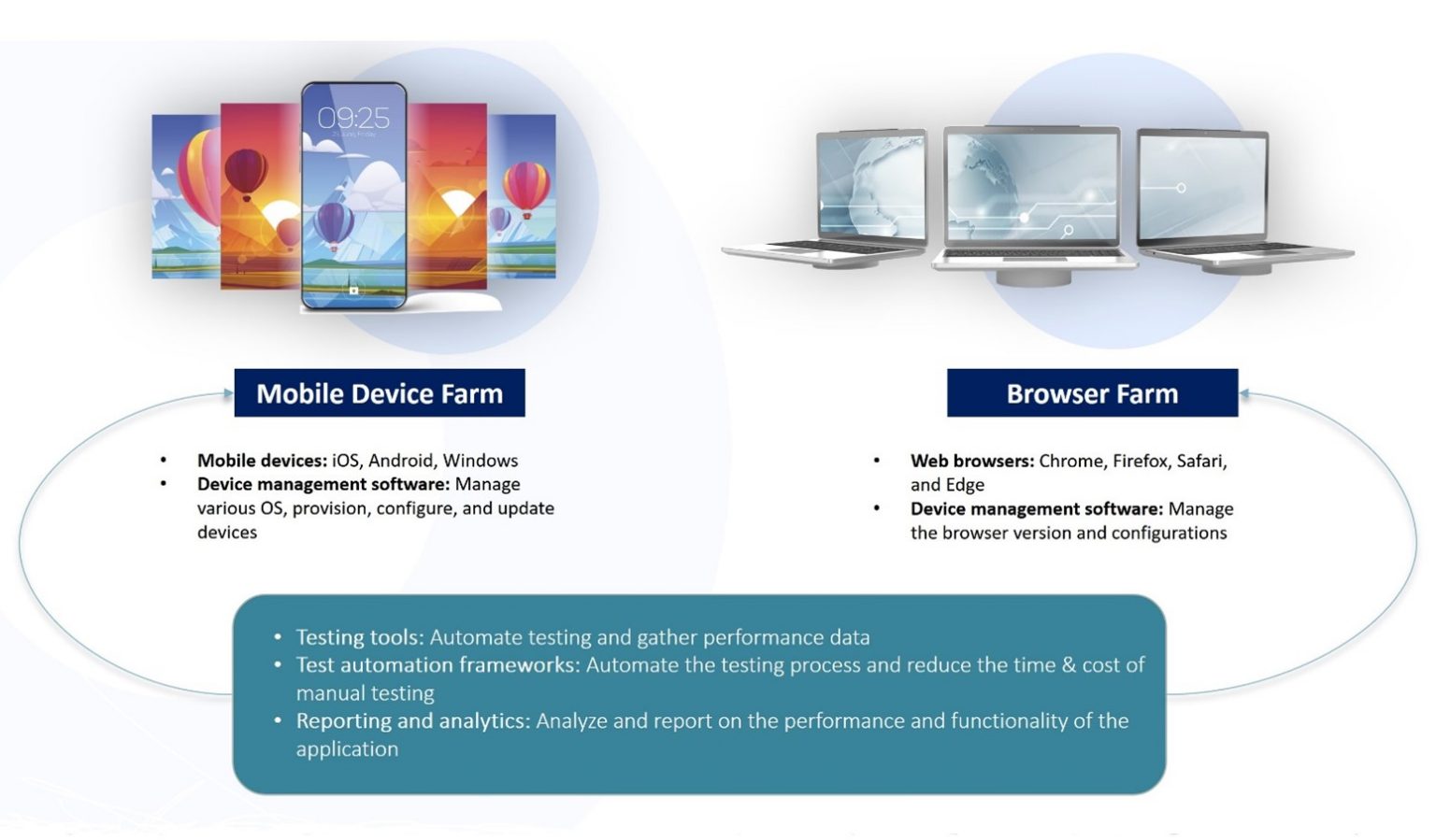
The Figure – Qyrus Device Infrastructure: An Overview provides a quick behind-the-scenes perspective of our service.
Qyrus Device Infrastructure: An Overview End-to-end device management, test automation, access controls, advanced analytics tools, and reporting capabilities set Qyrus Device Infrastructure service apart from the competition. The salient features of Qyrus Device Infrastructure include:
AI-powered actionable insights for accurate troubleshooting
Rich visual and data-driven reporting
Unique interruption testing to account for real-world usage
Highly scalable and dedicated mobile device farm with granular test management
Intuitive system administration to accommodate every use case
SOC 2 and ISO 27000 compliant platform
Support for popular open-source frameworks
Enhance every micro-moment Selection of the right device farm testing service is a major step towards increased shift left capabilities. For example, integration of Qyrus Device Infrastructure with your development workflow is a fantastic way to accelerate end-to-end test automation.
The ready availability of comprehensive AI-powered insights for predictive action is another game changer. It enables the design of new tests based on the issues identified using a mobile device farm. This timely intervention mitigates issues that affect customer experience. Comprehensive test automation platforms like Qyrus provide a codeless interface that streamlines such exercises.
Drive the quest for an exceptional user experience in every interaction with Qyrus Device Infrastructure. Contact us today to learn how you can exponentially increase the coverage of digital experience tests with device farms.
In the dynamic arena of software testing, where teams strive for peak performance, Qyrus unveils a game-changing feature that brings the spirit of sportsmanship to the world of quality assurance. Imagine Qyrus as a formidable sports team, with each member assigned a specific role and purpose. Just as athletes specialize in their positions, Qyrus introduces User Roles, a lineup of players that excel in their respective domains. From the versatile Admin, who orchestrates the team’s strategy, to the agile Developer, who executes precise moves, and the System User, a powerhouse integrating cutting-edge tools, and the astute Viewer, the avid spectator observing the game unfold. Together, they form a cohesive unit, elevating the game of software testing to new heights. Join Steven Schultz and Suraj Patel as they step onto the virtual field, exploring the thrilling world of User Roles in Qyrus, where teamwork, efficiency, and victory are the ultimate goals. Welcome to this week’s Feature Friday, where we kick off the match, diving into the exhilarating dynamics of User Roles in Qyrus and their real-life parallels in the realm of sports.
Tell us more about User Roles offered by Qyrus and its use cases.
Steven: Qyrus has introduced an enhanced feature called User Roles, which offers greater flexibility and control over user access and permissions within the Qyrus app. This feature allows organizations to define four distinct user roles: Admin, Developer, System User, and Viewer, each with their own set of privileges and capabilities. These roles grant specific privileges and capabilities tailored to the unique responsibilities of each user. The Admin role represents the gatekeeper, wielding full control and authority over the Qyrus app. They possess the ability to create teams, manage environments, and orchestrate licenses. Developers assume the role of masters of their craft, equipped with the tools and permissions to build and execute Qyrus tests with precision. Suraj, do you want to speak more about System Users and Viewers on Qyrus?
Suraj: Absolutely! System Users, like skilled coaches, leverage integration tools such as CI/CD to optimize workflows and maximize efficiency. They possess specialized privileges that enable them to streamline processes and foster seamless collaboration. Lastly, Viewers are granted access to view tests and reports, allowing them to gain valuable insights without the need for a license. User Roles in Qyrus revolutionize user management, offering organizations a structured approach to access control, ensuring that individuals have the appropriate privileges to carry out their tasks effectively and securely.
What is the overall impact of User Roles on the testing process?
Steven: With User Roles, the testing process becomes more streamlined and efficient. The division of roles and permissions enables better collaboration, reduces the risk of unauthorized access, and enhances overall security.
Suraj: By assigning specific roles to different team members, organizations can ensure that testers, developers, and system users have the necessary access rights to perform their respective tasks, while viewers can access and review test results without requiring a license.
How might User Roles help testers, developers, and business technologists? What value can this feature bring?
Steven: User Roles cater to the unique needs of various stakeholders. Testers can focus on creating and executing tests, developers can build and maintain test suites, system users can leverage integration tools like CI/CD, and viewers can review test results without needing a license. This targeted approach ensures optimized productivity and supports effective collaboration among team members.
Suraj: User Roles bring value by providing a granular level of control over access and permissions, empowering organizations to enforce security protocols, meet compliance requirements, and effectively manage their testing operations.
Does the same or similar functionality exist without Qyrus, and how do competitors address similar problems?
Steven: While other testing platforms may offer user roles and permissions to some extent, Qyrus stands out with its comprehensive and flexible approach. The four distinct user roles in Qyrus cater to the specific needs of testers, developers, system users, and viewers, providing a fine-grained level of control that aligns with industry best practices.
Suraj: Qyrus’s user roles go beyond basic access management, offering a tailored solution that ensures efficient collaboration and enhances overall testing processes. Competitors may have similar functionality, but Qyrus’s comprehensive feature set and user-friendly interface set it apart in the market.
How do you see User Roles impacting day-to-day operations across organizations?
Steven: User Roles have the potential to transform day-to-day operations within organizations. By providing role-based access and permissions, organizations can establish a clear hierarchy, enhance team collaboration, and improve accountability. This streamlined approach to user management simplifies administrative tasks and ensures that individuals have the appropriate level of access to perform their responsibilities effectively.
Suraj: User Roles in Qyrus facilitate seamless coordination among testers, developers, system users, and viewers, leading to increased productivity and smoother workflows. The ability to assign roles and permissions based on user responsibilities optimizes resource allocation and fosters better teamwork, ultimately resulting in improved testing outcomes and business success.
User Roles in Qyrus bring a new level of flexibility and control to user management in the testing process. By assigning distinct roles with specific privileges, organizations can enhance collaboration, ensure security, and optimize productivity. The comprehensive feature set and tailored approach set Qyrus apart from competitors, offering a user-friendly solution that aligns with industry best practices. Embracing User Roles enables organizations to streamline their day-to-day operations, empower their teams, and drive better testing outcomes.
In the ever-changing realm of Salesforce testing, where waves of dynamic applications crash upon the shores, stability becomes the anchor that keeps us grounded. Picture the Salesforce Web Recorder as a sturdy ship, sailing through turbulent waters with confidence. The latest updates act as skillful navigators, steering us away from the treacherous currents of constantly changing IDs and locator values. Like a lighthouse guiding us through the storm, these updates stabilize the ship, ensuring smooth sailing as we navigate the intricate waves of web testing. Join us aboard this seafaring adventure as we explore the transformative updates that set Salesforce testing on a course for success. Welcome to this week’s Feature Friday, where we will explore the latest updates to Qyrus’s Salesforce Web Recorder in Web Testing. We have Adhi Pathak and Timothy Miller, who will dive into the enhanced features and use cases of this valuable tool.
Tell us more about the new Updates to Salesforce Web Recorder offered by Qyrus and its use cases.
Adhi: Qyrus’s Salesforce Web Recorder in Web Testing has received exciting updates that we’re thrilled to share with you. These enhancements allow users to efficiently record and automate test scenarios within the Salesforce platform with more ease. Recording test scenarios has become a breeze, eliminating the need for manual and error-prone processes. We’ll discuss how these updates benefit testers, developers, and organizations as a whole.
Tim: Indeed, the latest improvements to the Salesforce Web Recorder empower users to create robust and reliable test scripts with ease. The tool simplifies the testing process by automating repetitive tasks and providing a seamless testing experience within the Salesforce ecosystem.
What is the overall impact of the Updates to Salesforce Web Recorder in Web Testing on the testing process?
Adhi: The updates to the Salesforce Web Recorder have a significant impact on the testing process. Testers can now create complex test scenarios more efficiently, reducing the time and effort required for manual testing. This enhancement improves overall test coverage and accelerates the software development lifecycle.
Tim: I completely agree. The streamlined and intuitive interface of the updated Salesforce Web Recorder allows testers to navigate and record test scenarios effortlessly. This enhancement significantly improves productivity, enabling testers to focus on more critical aspects of testing and providing more accurate and reliable results.
How might Updates to the Salesforce Web Recorder help testers, developers, and business technologists? What value can this feature bring?
Adhi: The Updates to Salesforce Web Recorder bring immense value to testers, developers, and business technologists alike. Testers can increase test coverage, identify issues more effectively, and ensure the quality of Salesforce-based applications. Developers can leverage the recorded test scenarios for continuous integration and automated regression testing. Business technologists benefit from improved software reliability, faster time to market, and enhanced customer satisfaction. What makes it even better is you don’t need to invest time in finding or making a stable locator for these dynamic applications. Qyrus does that for you with a click of a button. We are thrilled to announce a groundbreaking addition to Qyrus’s Salesforce Web Recorder: the all-new “QPath” locator type. QPath, short for “Qyrus Path,” introduces an advanced level of automation and precision in locating elements within dynamic applications, specifically designed to enhance testing efficiency in Salesforce Lightning.
QPath takes test automation to new heights by automatically recommending the best locator value based on a comprehensive analysis of all available locators. Leveraging a confidence score mechanism, it intelligently determines the most reliable locator that maximizes the likelihood of test success in dynamic Salesforce environments.
Tim: Absolutely. Not only does QPath suggest the optimal locator value, but it also allows users to effortlessly incorporate their own custom-made locators directly within the Salesforce Web Recorder. This flexibility ensures that testers can adapt to unique scenarios and align with their specific requirements. This feature enables seamless collaboration between testers, developers, and business technologists. Testers can provide valuable insights on application behavior, developers can address issues proactively, and business technologists can make data-driven decisions based on reliable test results. It fosters efficient cross-functional teamwork and boosts the overall quality of Salesforce-powered solutions.
Does the same or similar functionality exist without Qyrus, and how do competitors address similar problems?
Adhi: When it comes to Salesforce testing solutions, it’s worth noting that while some competitors offer similar functionality, the Updates to Salesforce Web Recorder by Qyrus shine brightly in a league of their own. With a user-friendly interface, comprehensive capabilities, and seamless integration within the Salesforce platform, these updates set a new standard for efficient and reliable Salesforce web testing.
Tim: Qyrus’s Updates to Salesforce Web Recorder go above and beyond, providing a holistic solution perfectly tailored to meet the unique needs of Salesforce testing. With advanced features like QPath and robust integration options, Qyrus outpaces the competition. Their unwavering commitment to innovation and customer satisfaction truly sets them apart in the market.
How do you see the Updates to Salesforce Web Recorder in Web Testing impacting day-to-day operations across organizations?
Adhi: The Updates to Salesforce Web Recorder will revolutionize day-to-day testing operations across organizations. It will enhance the efficiency and accuracy of test execution, improve collaboration between teams, and accelerate the delivery of high-quality Salesforce applications. These updates will have a transformative impact on organizations’ ability to meet customer expectations and drive business success.
Tim: I envision the Updates to Salesforce Web Recorder becoming an integral part of organizations’ testing processes, driving significant improvements in productivity and outcomes. By providing a user-friendly interface and advanced capabilities, these updates will empower testers to work more efficiently, reducing the time and effort required for test creation and execution. The streamlined collaboration between testing teams and other stakeholders will foster better communication and alignment, resulting in faster feedback loops and quicker issue resolution. Ultimately, the impact will extend beyond the testing realm, as organizations can deliver high-quality Salesforce applications more rapidly, enhancing customer satisfaction and gaining a competitive edge in the market.
In conclusion, the updates to Salesforce Web Recorder mark a turning point in Salesforce web testing, ushering in a new era of efficiency, precision, and collaboration. With the power of QPath and other enhanced features, organizations can navigate the complexities of dynamic Salesforce applications with ease, ensuring reliable and resilient tests. As these updates become an integral part of day-to-day operations, organizations will witness a transformative impact on their ability to deliver top-notch Salesforce Testing solutions, meet customer demands, and achieve business success. Embrace these updates, harness their potential, and set sail toward a future of exceptional Salesforce testing.
Welcome to this week’s Feature Friday, where we delve into the world of Rover script building, a groundbreaking feature offered by Qyrus. Today, we have Dan and Joyal from the Qyrus team to shed light on the use cases and benefits of this innovative tool. Rover script building revolutionizes the test-building process, allowing users to visually analyze their mobile application’s user journeys and effortlessly generate test scripts. Say goodbye to manual coding and tedious scripting, as Qyrus simplifies and accelerates the entire test-building experience.
Tell us more about Rover script building offered by Qyrus and its use cases.
Dan: The Rover AI tool explores your mobile application and provides an activity map at the end of all possible user journeys that can take place on the application. Given that activity map, users can then build tests off of it. Simply clicking each node on the map – or each screen – the user can build out a test script for their mobile applications at lightning speeds.
Joyal: This feature enables a user to visually analyze any possible test cases that may have been missed in the test building. On top of being a feature built into the Rover tool itself, it is super easy to use and intuitive.
What is this feature’s overall impact on the testing process?
Dan: Overall, it has a major impact on test building. Prior to Qyrus, test building was a hassle when it came to automated testing. Learning a coding language, the correlating automated testing library, and actually scripting everything out is a long process. With Qyrus, the amount of time it takes to get from ground zero to test execution is less than half the time.
Joyal: And when you add on top of that, Rover and its script-building feature, the time taken to build tests can be cut even further! It also provides important insights into how your application is performing in general. Test coverage is improved through the ability to see the numerous different customer journeys and paths that may have been missed in initial testing.
How might script building using Rover help testers, developers, and business technologists? What value can this feature bring?
Joyal: A tester and developer could use Rover to check their test coverage on a specific application. Seeing the bigger picture can sometimes be hard. When it comes to super complex applications, the task becomes even more challenging. And when an organization has multiple complex applications that interconnect and can have business processes that stretch across those multiple applications, that’s when things get really hectic. Understanding every possible user journey seems like an impossible task. But it is one that can be made easier when using Rover.
Dan: Testers can check out their current test scripts and compare the paths that those take to the possible different paths found on Rover. Some people might find that they are only covering a fraction of their total possible test coverage. Furthermore, the user no longer has to be connected to a device on Qyrus in order to build out a test script. Instead, they just have to have the Rover exploration.
Joyal: And of course, business technologists can quickly run Rover explorations and build a series of test scripts based on that exploration. It’s super simple, user-friendly, and intuitive. With the Rover script builder, building test scripts is all visual, removing a large majority of the complexity from test building.
Does the same or similar functionality exist without Qyrus, and how do competitors address similar problems?
Joyal: Rover is a feature unique to Qyrus. There are no real comparable tools out there to Rover, especially with all the benefits that come along with it. And this is also taking into consideration the benefits that Rover provides outside just the script building.
How do you see this feature impacting day-to-day operations across organizations?
Dan: Well, as we’ve mentioned, it will drastically change the way that testers build test scripts. It will change the amount of test coverage that a testing team might have. But the script builder is super easy to use and makes things remarkably faster in terms of test building. Joyal: Visual representations of your test flows are always helpful, as it creates a new way of looking at your test-building process. By using both a big-picture and detail-oriented process in the script-building feature, users are able to start with better test coverage.
As we conclude this Feature Friday, we have explored the remarkable impact of Rover script building on the testing landscape. Qyrus’ visionary approach empowers testers, developers, and business technologists to enhance their test coverage, uncover unexplored user journeys, and streamline the test-building process. With Rover’s intuitive visual interface, organizations can achieve better test coverage and improved overall application performance. Qyrus continues to redefine the testing paradigm, providing a cutting-edge solution that brings immense value to the testing community.
Software testing myths are common in many teams. For example, your key stakeholders might feel that software testing is an unnecessary, time-intensive expense. Or your peers may think that tests are required only at the end of the SDLC.
API testing is a case in point. Our recent survey indicates that 78% of businesses consider API testing to be a highly complex process. Such testing myths negatively impact project outcomes and the resultant ROI. The prevalence of such can be a setback for the entire software testing lifecycle. In this e-book, we examine actual software testing facts to dispel such concerns.
Advances like codeless automated testing eliminate the complexities and resource-intensive nature of legacy software testing models. It is possible to reduce test execution times by 40% using the Qyrus codeless test automation platform.
Our e-book presents a detailed overview of the myths and facts of software testing. It also offers takeaways to:
Reduce software testing lifecycle costs and complexity
Enhance software testing with codeless test automation
Boost test efficiency and coverage
Roll out unique test cases in a faster manner
Realize the need for agile DevOps environments
Increase collaboration to achieve goals of software testing
The use of mobile devices is ubiquitous. Upwards of a billion smartphones were shipped globally in 2022. This massive figure gives you an idea of the extent of the global penetration of mobile devices. This figure is also significant from the testing perspective. If your testing strategy is not configured to test for mobile devices, it will come undone sooner than you think.
Cross-device website testing or cross-device app testing is imperative for rolling out powerful and bug-free websites or apps that deliver a seamless experience. Not doing so means bugs fall through the cracks and will impact mobile users’ ability to maximize the software’s potential. Also, being unable to test on all devices means your software can experience limited adoption, as it won’t work as expected on some mobile devices.
The Importance of a Device Farm in the Testing Ecosystem The mobile devices landscape is not consistent. It is extremely varied, comprising of multiple types of devices. These devices differ in brand, power, performance, and functionality.
Also, this landscape is evolving rapidly, with newer updates and features rolled out regularly. The expectation is that:
Software should be able to deliver a seamless functional and user experience irrespective of the updates.
Software should leverage performance improvements to deliver better outcomes. This ensures long-term compatibility, and the software delivers tangible ROI regardless of the devices used.
The growing fragmentation in the mobile device ecosystem makes mobile testing complex and time-consuming. You need a reliable way to test your software. This will make sure it works well, no matter what conditions it faces. This is where a device farm enters the picture to facilitate a seamless mobile testing strategy.
Limitations of Existing Device Farm Testing Testers have the unenviable job of addressing issues like device fragmentation, different screen resolutions, varying upgrade cycles, etc. Also, while testing for performance in the real-world environment, they need to navigate complexities such as testing mobile network bandwidth issues, permission testing, and testing for various geolocation app scenarios.
Manual testing or legacy automation testing cannot address the difficulties arising out of a continuously evolving landscape. These come with their own specific limitations:
Manual testing conducted on mobile device farms is expensive, time-consuming, error-prone, cannot scale quickly, and makes test monitoring and defect reproduction difficult.
Traditional or outdated automated testing on in-house device farms can prove to be very complex, has high device farm maintenance costs, can result in flaky tests, and offer limited coverage; also, test script creation and data management can pose a significant challenge.
The Right Device Infrastructure Organizations should transition to a cloud device farm that is highly scalable and can offer the latest tools to test their apps and devices on a large number of mobile devices. Such a device farm delivers the right mobile testing environment because it is scalable on demand.
To go beyond the limitation of manual or outdated automated testing in your device infrastructure, your testing strategy must:
Leverage a virtual device farm available on-demand
Utilize the device farm’s vast and increasing availability of the necessary mobile devices, and OS and offer parallel testing capabilities
Use available test automation tools and frameworks to automate the testing process
Optimize the potential of innovative analytics tools to understand the strengths and weaknesses of the applications, which facilitates accelerated remediation.
A Simple Yet Comprehensive Approach to Mobile Testing Testing for a mobile environment takes work. Therefore, it is imperative to choose a testing tool that simplifies and accelerates this process for you and, at the same time, facilitates comprehensive testing.
The Qyrus device farm hosts real physical Android and iOS devices on the cloud and supports both manual and automated testing of native and web applications. Developers can go through extensive results available in the form of videos, performance profiling metrics, screenshots, and more to remedy any bug.
Subscribing to a manual process of setting up on-premises device farms increases the possibility of missing out on various features and functionalities. With Qyrus, testers save time setting up and maintaining the devices required for thorough testing.
One of the critical features that Qyrus brings to the table is extensive reporting and enabling testing across not only older Android and iOS versions but also beta versions.
Differentiating advantages of Qyrus’ device farm:
Powered by advanced AI algorithms
Real-time dashboards
Complete device control and setting access
Automated testing on multiple real devices, OS, and desktop browsers
Supports testing 2G and 3G networks
Supports testing 2G and 3G networks.
With Qyrus, you adopt a forward-looking approach toward testing for mobile devices and take long strides in making your business more competitive by improving efficiency and accelerating time to market. Qyrus’ mobile testing backed by Qyrus device infrastructure can be a critical driver in your business success over the long term.
Topic: Web Testing using Qyrus Date: 22nd June 2023 Time: 12 pm Eastern Time
Speaker:
Timothy Miller, Platform Expert and Senior Consultant, Qyrus
High-quality code, faster updates, and shorter development cycles are the norm for today’s Web testers. As if these aren’t enough, trends like shift left testing in SDLCs further increase these pressures.
Comprehensive Web application testing automation platforms are ideal to streamline all your testing needs. Adoption of these solutions is on the rise, with 80% of businesses expected to use AI-augmented testing tools by 2027.
With features right from predictive step building to parallel execution, website test automation delivers multiple benefits. Help your team achieve its time-to-market goals with codeless Web testing using Qyrus.
Watch this 15-minute Lunch and Learn Webinar on Web Testing for a quick overview of the latest website test automation possibilities.
This Webinar will help you understand how to:
Simplify testing with end-to-end Web application test automation
Optimize user experiences using performance testing
Expand testing coverage using Web application test automation
Stabilize Web application functionality using AI
Speaker Bio:
Tim Miller is a Platform Expert and Senior Consultant for Qyrus. He is a professional in the field of automated software testing and quality engineering. Tim has developed a deep understanding of various testing methodologies and frameworks. His passion for quality engineering is evident in his meticulous attention to detail and his commitment to delivering robust and reliable software. With a strong analytical mindset, Tim excels in identifying potential defects and vulnerabilities in complex software systems.
Welcome to this week’s Feature Friday, where we dive into the world of beta operating systems and the role they play in software testing. Today, we shine the spotlight on Qyrus and its offering of beta operating systems, which are instrumental in ensuring compatibility, performance, and user satisfaction. We have Prajwal and Tim from the Qyrus team here to guide us through the use cases and benefits of leveraging beta operating systems for efficient and effective testing. Get ready to explore how Qyrus is revolutionizing the testing process with its seamless integration of beta operating systems.
Tell us more about beta operating systems offered by Qyrus and the use cases behind testing using beta operating systems. Prajwal: As the world is getting used to more and more frequent application and operating system releases, it’s very important that products adapt to the latest versions in terms of operating systems or the platforms they’re being executed on. Beta operating systems are useful in such cases where the compatibility of the application is tested before the release of any such operating system.
Tim: Beta operating systems can be thought of as pre-release versions. These are made public before the final version is released. And the main target of using these beta operating systems is to enable developers or testers to run their applications and find compatibility issues, performance issues, or critical errors.
What is the overall impact this feature has on the testing process? Prajwal: Well, testing with beta operating systems gives the developers and testers a heads-up to see what happens when their application is tested and ran on newer operating systems.
Tim: That being said, this has more to do with test execution and coverage than anything. Testing with beta operating systems allows us to have a wider test coverage than usual and better preparedness.
How might this feature help testers, developers, and business technologists? What value can this feature bring? Prajwal: For testers and developers, the ability to test on beta operating systems means they can address issues much earlier in the testing cycle. This also enables them to handle these issues prior to new operating system releases, compared to having to wait for the release to see what might be wrong.
Tim: Business technologists can run the product with very minimal downtime and issues. This is all thanks to testing earlier on the beta operating system pre-release. Doing so helps to reduce the user impact to provide a seamless user experience despite the operating system version.
Does the same or similar functionality exist without Qyrus, and how do competitors address similar problems? Prajwal: Well, due to the nature of Qyrus and how seamless and easy it is to get the required infrastructure, we operate a little differently compared to our competitors. The point is that if one requires a beta operating system for testing, all one has to do is add the infrastructure to their plan from their account services.
Tim: Due to this, the turnaround time for allocating these beta operating systems is much faster compared to competitors. And prior to using a platform like Qyrus, a tester would have to install the beta operating system on their own hardware and test it on their own infrastructure. This can be a time-consuming task, acquiring and allocating new infrastructure.
How do you see beta operating system testing impacting day-to-day operations across organizations? Tim: Well, this feature reduces the turnaround time for updating and installing the beta operating system alongside regular testing by the testing team.
Prajwal: And the number of issues a developer has to address during a regular release is drastically reduced due to this. Beta operating system testing is an optimal solution for mitigating the issues which regular testing cycles do not foresee. Testing cycles in general are much faster and more organized due to this, and hence the impact on business is huge in terms of application availability and functionality.
As we wrap up this Feature Friday, we have gained valuable insights into the power of beta operating systems and how they contribute to enhancing the testing process. Qyrus’s provision of beta operating systems allows testers, developers, and business technologists to stay one step ahead, enabling them to address compatibility issues, optimize performance, and provide exceptional user experiences. By leveraging Qyrus’s infrastructure and streamlined processes, organizations can navigate the evolving software landscape with confidence and deliver high-quality products to their users.
Welcome to this week’s Feature Friday! We’re excited to talk about Qyrus Bot, an advanced chatbot that simplifies the entire testing process. As the world becomes increasingly digitized, testing software has become a crucial part of many organizations’ software development lifecycle. However, the process of creating, running, scheduling, and managing tests can be complex and time-consuming.
That’s where Qyrus Bot comes in. This chatbot offers a range of features that help users create and manage tests with ease using natural language and an intuitive interface. With Qyrus Bot, testing becomes a hassle-free process, enabling users to focus on what really matters: delivering high-quality software products. In this Feature Friday, we’ll take a closer look at Qyrus Bot’s advanced capabilities with Rohith and Tim from the Qyrus team! Let’s learn more about how Qyrus Bot can revolutionize the testing process for businesses of all sizes.
What is Qyrus Bot and what is its purpose?
Rohith: Qyrus Bot is an advanced chatbot that simplifies the entire testing process by offering a range of features that help users create, run, schedule, and manage tests with ease. With Qyrus Bot, users can create tests using natural language, without the need for technical expertise.
Tim: Qyrus Bot specifically targets features related to simplifying the testing process and enhancing the user experience. Its main goal is to make the entire testing process easier and more efficient for users, regardless of their technical expertise or how much experience they have with automated testing in general.
What is Qyrus Bot’s overall impact on the testing process?
Rohith: Qyrus Bot is a game-changer for the testing process overall. It streamlines the entire process, making it faster and more efficient. Users can streamline the creation of tests without needing any coding or technical expertise due to Qyrus Bot’s natural language capabilities. This means that testing is more accessible overall.
Tim: The chatbot’s ability to schedule and run tests automatically means that developers can focus on other tasks while Qyrus Bot carries out the test executions. Some other things it can do in general include test creation, test execution, test scheduling, test management, reporting, and providing device and infrastructure availability.
How might Qyrus Bot help testers, developers, and business technologists? What value can this feature bring?
Tim: A tester can in general use this feature to streamline the testing process, as we’ve mentioned previously. From a tester’s perspective, they might find the most use with using Qyrus Bot to help them create, execute, and manage their test scripts. From a developer’s point of view, it allows the developers to have more information overall and more access to the testing process in general.
Rohith: Qyrus Bot helps business technologists make informed decisions about the final product. It enables them to better understand what’s going on from an automated testing perspective which can often be extremely difficult to understand given the person’s technical literacy on the topic. Qyrus Bot can facilitate collaboration between different teams within the organization, including developers, testers, and business stakeholders.
Does the same or similar functionality exist without Qyrus, and how do competitors address similar problems?
Rohith: Qyrus Bot is different from other test automation products in that it leverages natural language processing and chatbot technology to simplify the testing process and make it more accessible to a wider range of users. While traditional test automation products require users to have programming and technical expertise, a testing chatbot allows users to create and manage tests using simple and intuitive language, without the need for specialized skills. It is like ChatGPT for testing.
Tim: Qyrus Bot enables you to test your mobile applications through a simple natural language interaction, similar to how you might request a song on Alexa. Rather than having to write out code or follow complex testing procedures, you can simply specify which parts of the screen you want to test, and Qyrus Bot will take care of the rest.
In what way does this feature utilize AI/ML, if at all?
Rohith: Qyrus Bot in itself is an AI product. There are three main parts where AI is involved. Firstly, there is understanding the action the user intends to perform such as a tap or enter text. Secondly, getting all the information provided by user in his prompt or utterance like a username. And lastly, identifying and locating the elements. To achieve this there are 7 deep learning models that are working in parallel. Qyrus Bot uses natural language understanding and computer vision to make predictions.
Thanks for tuning in to learn more about Qyrus Bot! With its advanced capabilities, natural language interface, and user-friendly design, Qyrus Bot is revolutionizing the way we approach software testing. Whether you’re a seasoned pro or a newbie in the world of software testing, Qyrus Bot is here to help you streamline your workflow and achieve better results. Now go and enjoy the beautiful weekend as summer approaches and blue skies await! We’ll catch you next week on Feature Friday!
Jerin Mathew
Manager
Jerin Mathew M M is a seasoned professional currently serving as a Content Manager at Qyrus. He possesses over 10 years of experience in content writing and editing, primarily within the international business and technology sectors. Prior to his current role, he worked as a Content Manager at Tookitaki Technologies, leading corporate and marketing communications. His background includes significant tenures as a Senior Copy Editor at The Economic Times and a Correspondent for the International Business Times UK. Jerin is skilled in digital marketing trends, SEO management, and crafting analytical, research-backed content.