In our last blog on the Great Resignation, we covered the implications of time to market for businesses and how test automation can best address test ecosystem bottlenecks and assist businesses in launching flawless, smart, and secure web and mobile applications.
As per our last blog discussing the Great Resignation and time to market, businesses often find themselves compromising user experience for the sake of hasty deployment schedules or looming release dates. In this blog, we will be guiding the readers to better understand the implications of user experience (UX) and how ensuring top-notch UX has the potential to make or break a business’s growth trajectory.
How User Interaction Dictates Customer Engagement and Retention
Let’s put ourselves in a customer scenario. Imagine you are attempting to load an application and it takes longer than 3 seconds. As per studies done by Google, over 53% of users would have already left to seek out the next relevant web page. Beyond just load time delays there are bugs, errors, and application inconsistencies which directly affect whether a user is satisfied with their experience. This is another alarming example of how user experience can impact a business’s visibility and affinity.
Regardless of application aesthetic, functionality, or feature richness, application success is highly governed by end-user response. Given the shifting attention spans of users, providing a high-quality, positive experience has never been more essential. With application requirements spanning multiple platforms, browsers, and devices, releasing applications on time surely has its perks. However, maintaining end-to-end user experience can be a factor that makes or breaks application success.
Let’s learn why businesses need to make the user experience of their application the number one priority.
Creating Brand Differentiation
High quality user experience assists in customer retention and brand recognition. Differentiating your brand is vital as customer experience slowly becomes more important than product or price. Quality UX (User Experience) helps you build trust amongst your users, who can depend on your product to consistently deliver.
Great UX backed by robust performance, functionality, and load testing is essential for today’s enterprises to not only sustain but succeed in the ever-competitive application market landscape. Mapping out each of these factors is essential to enhance the user experience:
Adaptability. Responsive design for web and mobile applications should be leveraged so that you can ensure proper application functionality regardless of the device your audience uses.
Design. The attention-grabbing, aesthetic design of any web and mobile application plays an important role in UX. While your development and QA teams are striving to ensure functional performances, let your UX design team develop engaging front-ends.
Functionality. Whether it’s a button or a link, every element within your web and mobile application should work as expected and have a purpose.
Navigation. Great UX facilitates site navigation that helps your users easily identify what they are looking for rather than having to click multiple links or search endlessly.
Usability. Your application’s structure should be catered to your user’s needs long before they even know they need something.
Value. Your application’s design should clearly communicate the value of the service or product.
Testing your application from all the above prospects by leveraging automation can help enterprises succeed.
Fostering User Retention
Customer acquisition, engagement, and retention have always been primary objectives for enterprises. All of these can be ensured by implementing great UX strategies which have a positive impact on customer loyalty. A web and mobile application that’s user-centric, reliable, intuitive, smart, and provides value for your audience can help foster trust and reliability to keep your audience returning for more. Some things you can do to keep your application user-oriented include:
Ensuring ease of use across the platform. Performing basic, everyday actions should be simple and streamlined.
Creating and maintaining documentation. Having up-to-date information about the application and its functionality can make it or break it when it comes to user retention.
Implementing customer feedback. Whether it’s through a survey or a one-on-one discussion, ensuring that you have an avenue for critical feedback and a system in place to implement those suggestions is vital to keeping customers using the application.
Starting a customer education program. Whether it’s through demos, videos, or implementing some kind of online university/learning platform, giving an avenue for users to learn the intricacies of the application will help greatly.
Keep Your Audience on Your Application Longer
If it’s too challenging to navigate a site or an application, your audience will flock to the competition to find what they need. But, with good UX ensured by superior UX testing, you can improve bounce rates and keep users on your application longer. Thus, it’s key to ensure great UX that simplifies common tasks and keeps users engaged with the application.
The Way Forward
We’re embarking on a future driven by automation. As per reports, by 2029, computers are likely to be more intelligent than humans. Artificial intelligence (AI) and machine learning (ML) are ensuring high levels of synchronization between human and machine intelligence. They are opening new avenues for designers to create personalized, intricate user experiences capable of satisfying an individual user’s needs. On top of that, AI/ML can help reduce time and effort by assisting designers in crafting and maintaining customer services and allowing them to receive fast and quality feedback on designs.
As automation has paved its way into every aspect of our lives, it is anticipated to play a pivotal role in the future of UX for applications as well. Automation may be the next big thing to impact the entire industry of UX design, which will ultimately influence product or application development. Automation can be a catalyst in creating compelling products with business-driven yet customer-centric testing and development strategies.
The Great Resignation and Its Impact on User Experience
You might think of the Great Resignation as being more about employee experience rather than user experience. Here are some interesting insights:
Employees are the biggest assets any organization has with them as they are critical in ensuring organizational short, and long-term vision, and objectives. The same is applicable for organizations in the testing sphere too. These enterprises need their in-house pool of QA resources to ensure better testing and development synchrony which is essential for ensuring the product or application hits the market on time in all its features, and glory.
It is evident that the need for testing efficiency and scalability has been following an upward trend. While the future may seem promising, testing professionals will have a broader learning curve. Enterprises need to adopt a strategic approach when it comes to equipping their in-house QA resources with the latest AI, ML, and automation knowledge base.
From an alternate perspective, with test automation being in trend and demand, the growth opportunities are massive. Enterprises might have to work hard to retain their best testing talent and this can get cost-intensive.
All of the insights listed above are going to influence the enterprise’s testing and application development processes, workflows, and timelines. And, even though the products might launch on time, without robust testing, the user experience of the application is at substantial risk.
While the Great Resignation may last beyond 2022 and the post-pandemic period, how do enterprises ensure top-notch user experience of their mobile and web applications? Qyrus, a simple, smart, secure, and scalable test automation platform seems the best possible game plan.
Though these benefits are expansive, test automation can play a pivotal role in crafting, streamlining, and enhancing an application’s user experience. Let’s learn how Qyrus can assist enterprises in their quest for contextual and consistent user experience.
Delivering Customer-Centric Applications with Qyrus
During the pandemic, remote work and support caused extreme dependence on web and mobile applications for otherwise offline and routine tasks. And, without test automation, launching flawless applications on time and at scale will be more difficult.
Qyrus is a one-of-its-kind, and truly low-code/no-codetest automationplatform that leverages advanced AI/MLcapabilities to offer greater testing efficiency. It allows users to easily maintain application quality and user experience.
With its visual testing, rich test reporting, and comprehensive testing specifications, Qyrus enables enterprises to simulate user journeys and establish proper functionality for enhanced customer experience. Qyrus offers:
Recorders for real devices and local browsers (interact directly with your application while testing mirroring and maintaining common user interactions)
Screenshot & Video Reporting (watch the test run – and screenshots to note step by step what a user sees across their journey)
Rover (exploratory robot that will autonomously traverse mobile applications using reinforcement learning models trained with over 80,000+ hours of humans interacting with mobile applications)
Enterprises can enable a shift-left approach and hold an aggressive position in the market centered around an amazing customer experience validated through automated testing with Qyrus. Keeping a leg up over the competition has never been more important!
How Can Qyrus Help You Make Your Automation Testing Endeavor Cost-Efficient?
So far in our blogs around the theme of great resignation, we have highlighted how test automation can address time to market, often influenced by skilled resource gaps and customer experience. Now, the question is, can enterprises keep their application development and testing endeavors truly cost, and resource-efficient? How is automation going to be a deciding factor, and how can Qyrus help?
Great Resignation and Time to Market – Overview
In our last article discussing the Great Resignation, we talked about the major employment shift occurring and how the Great Resignation is emerging as one of many key challenges organizations are dealing with. In this article, we continue the discussion on the Great Resignation by specifically looking at one business objective making a visible impact – time to market.
Let’s delve deeper!
Time to Market – Contextual Importance within the Great Resignation?
It is a common business objective to maintain prominence in the minds of your target audience. With an increasing demand for digital solutions, being timely has never been more important. Coordinated launch strategies enable businesses to do just that, releasing application updates or feature implementations in a timely manner, often surrounded by marketing and social media promotions for maximum business visibility, sales, and revenue.
However, before the grand reveal and marketing releases of these updates and features, they must be developed and tested thoroughly. One of the most common oversights in the race to being first is Quality Assurance (QA), often to the detriment of the business, as they struggle with complaints due to incorrect functionality or a broken user interface. “Time to market” is an essential factor to product success which requires optimizing the balance between speed and quality.
Let’s learn all about what “time to market” means, why businesses need to have a perfect plan in place, and how to navigate various bottlenecks.
Time to market (TTM) is the duration needed to bring a product from ideation to fruition. This includes the generation of an idea for the product, its whole design cycle, development, and launch in the market.
Proper time to market evaluations come down to consistent and effective product development and testing processes. Understanding the product’s developmental requirements, monitoring sprint objectives, and implementing QA testing throughout the development process can quickly validate functionality for product rollouts. Knowing the product development cycle is essential in optimizing time to market. However, the lack of specialized automation engineers can hinder this process. Inconsistent and unpredictable development processes become a substantial problem that manifests into two larger issues – compromised product quality and extended time to market.
Also known as speed to market (STM), the concept is also one of the key factors in determining the success of innovation for several reasons. Delaying the monetization of your ideas and improvements gives your competitors the opportunity to reach your potential users, cash in on it, and eventually pull ahead of you in the market. Businesses that are not able to optimize speed to market are likely to lose opportunities and struggle to survive.
Testing Needs AI-Driven Automation
With the emergence of the Great Resignation, businesses need to minimize risk of losing corporate memory and stay prepared for the future. Technological innovations, especially automation, have been paving the way for large shifts in the business ecosystems and how operations are being managed. Qyrus, an automated testing platform, can bring this shift to reality. Codeless test building enables even brand-new users to easily understand how to build comprehensive test scripts in no time at all. For automation experts Qyrus empowers users to increase coverage at an even quicker pace. Also, advanced AI capabilities further improve efficiency of script creation and the maintenance.
Organizations are increasingly adopting technology that lends them a competitive edge over others. The same is true for automated QA testing which is highly dependent on skilled and trained resources. As application dependency increases, so does the need for QA. A diminishing employee pool for qualified test engineers leaves businesses with two options – spend substantial sums of money for inefficient manual testing or invest in a long-term automated testing solution capable of scaling effectively with increasing development and QA requirements.
Qyrus, the codeless automated testing platform, simplifies all facets of testing, providing seamless automation across all application types – Web, Mobile, API, and end to end business processes testing. Utilizing taxonomy-driven step creation and sophisticated recorders, Qyrus enables fast test building without prior coding knowledge or a technical background. Furthermore, Qyrus offers customizable browser selections, Android and iOS devices, and parallel testing. This means zero infrastructure set up or maintenance is required, all of it is taken care of by Qyrus. Collaborative work is made easy with Qyrus through our test case management solutions, easy integrations with defect tracking and CI/CD tools, and our sharable reports through PDF and email.
Utilizing AI and ML in testing has a potential to change automated testing as we know it. At Qyrus we have developed a few solutions including Healer to autonomously heal your web and mobile scripts as your UI changes as well as Rover – a robot that will autonomously explore your applications using reinforcement learning to discover bugs and highlight changes across releases. This enables steadfast development and testing and promotes quality products with faster speed time to market.
Augment The Capability of Your Testing Teams with Qyrus
Qyrus is a one-of-its-kind low-code/no-code test automation platform that can be the solution for businesses to launch flawless, properly functioning products, software, and web/mobile applications. Businesses can rest their worries regarding their TTM strategies with Qyrus in place. Here are a few features and capabilities that is built into the Qyrus platform that can help achieve faster TTM:
Codeless test building
Web and Mobile test recorders
AI Tools Healer and Rover
Simplified test data management & synthetic data generation
How can Qyrus Help You in Your Quest to Delivering Exceptional Customer Experiences?
Now that we have established the efficacy of Qyrus in influencing faster TTM, let’s talk about another business objective that is impacted by the Great Resignation. It is important to consider customer experience on the road to optimizing TTM. It is not always clear what kind of roadblocks lie ahead. Learn how Qyrus can assist in managing these roadblocks and optimizing customer experience in our next blog post on the Great Resignation!
Breathe easy, ladies and gentlemen, it’s Friday! As we, the collective workforce, slowly sign off into the aura of the weekend, it is important to note that Mondays are inevitable. Yes, we know, who dares dampen the Friday glow? We get it, Monday’s problems are for Monday. In today’s Feature Friday, we will be addressing a very Monday problem – test flakiness, brittleness, and fragmentation. Today’s feature we will be discussing revolves around Healer, an AI/ML-enabled Qyrus proprietary feature that may stand to save your Monday from ruin!
To take a deeper dive into the feature, we interviewed Tim and Suraj, part of our Client Development team based in Chicago, asking them a few questions about Healer and how it works.
Tell us about Healer, its use cases, and general impact on testing processes?
Tim: Healer is Qyrus’ AI tool that is used to help prevent against test flakiness and brittleness. What’s really neat about it is it saves testers a lot of time when it comes to refactoring/modifying and maintaining scripts.
Suraj: Imagine this scenario: I just put out a new version of my app but all of my regression tests fail during my login process. After checking the reports to see what the error was, I find out that the development team changed the ID value of the login button. Currently, I would have to manually update all of the locator values for that button in my scripts or go back and ask development to change the ID back. Healer takes care of it for you in that it will provide you the correct value to use.
Tim: Exactly. From there you would be able to have Healer take charge by monitoring and making changes to the scripts when necessary. It impacts test maintenance and execution, automating another time-consuming and costly process.
Murphy’s Law and Mondays, two concepts that seem to go hand in hand, as everything that can go wrong seemingly does on a Monday. If Healer does seem to offer a solution to the Monday blues, we should begin by noting the problem and prior solutions.
Does the same or similar functionality exist without Qyrus, and how do competitors address similar problems?
Tim: Simply put, competitors don’t have many features comparable to Healer. And for those that do, they operate differently in how they present the information back to the user. Most of the time, a few different locator values are given back and a confidence score is given for each. The system isn’t 100% sure on whether the value given would work.
Suraj: Alternatively, Healer works on 100% certainty. It doesn’t provide a value unless it establishes functionality. Healer goes a step further than anything that’s out there. To make something remotely similar to Healer would take an enormous amount of effort.
Tim: And without Healer, users have to manually deal with “object not found” errors. That means firstly identifying that it is an actual “object not found” error, then identifying which object it is on the page, and finally getting the correct locator value. After all that is done, tests need to be executed again and verifications need to take place.
Healer is a versatile feature that can bring value to multiple different types of users. Healer is not only helpful for traditional testers but can also expand across multiple roles.
How might Healer help testers, developers, and business technologists? What value can it bring?
Suraj: Obviously, Healer is most helpful to testers. Like we’ve mentioned before, it cuts maintenance time and saves effort and resources. Developers won’t have to worry about the integrity of element attributes. Healer will account for these changes that take place without breaking automation. Just like that, the clock keeps on ticking.
Tim: Furthermore, business technologists gain access to valuable reporting. A Healer report is given back to the user which will provide the locator information. In reality, BTs should be able to maintain test scripts on their own using Healer. Once it is set up, validating customizations to your SaaS applications becomes effortless.
Integrated into the testing space itself, it is important to note the major impact Healer has on the testing and QA (Quality Assurance) process.
What is Healer’s overall impact on the testing process?
Suraj: Overall, Healer has a huge impact in terms of effort reduction. This can snowball into other bonuses such as further cost reduction and reusability, and often prevents the need to create a whole new test script.
Tim: Healer also makes testing easier, faster, and smarter. Like Suraj said, it reduces effort and can help mitigate the need to modify and maintain test scripts. This automatically lends toward making testing easier and faster. Furthermore, by automatically taking care of errors for the user it makes testing smarter.
Suraj: Not to mention Healer works on both web automation and mobility automation!
We know a lot about Healer now including its capabilities, use cases, and the value it can bring to different types of users. Like anything digital, improvements and changes never stop coming.
What can we expect to see in Healer’s future roadmap?
Suraj: Healer is an ever-changing tool. We’re always looking for improvements and enhancements. One thing we hope to see in its future is an increase in speed.
Tim: The quicker we can get responses and reports back to the end user, the better. But we also hope to make every aspect of it automated. Not only will you get a report giving the correct locator value, but also Healer will implement the changes for you into the script. That way, it is truly a hands-off tool.
That concludes our interview with Tim and Suraj about Healer, an AI/ML-enabled solution against test flakiness and brittleness. We’ve discussed use cases and specifics, life without Healer, and Healer’s overall impact on the QA process. That should leave you with one question to conclude this week’s Feature Friday. In light of the madness surrounding March, would you consider Healer in the starting lineup against Mondays?
In the digital world, organizations look to achieve the trifecta of speed, quality, and cost to keep a competitive edge. Automating mobile application testing is key to speeding up testing, extending test coverage, and saving money. Mobile application automation is notoriously complex and often indecipherable to the untrained eye, we are here to shed some light on the topic.
What is Mobile Automation?
Mobile automation, as the name suggests, refers to the streamlining of basic processes that are executed on handheld devices such as phones and tablets. As a mobile application evolves, so too does the product flow, as well as the user interface requirements and specific features. More so, adding another layer of complexity, is the evolution of mobile devices themselves. In the past couple decades, people have gone from holding bricks in their hands to flipping devices and eventually small, thin touch screen cellular phones. As time moves forward, device designs change as well. Checking for backwards-compatibility and performing regression tests has never been more complex yet necessary.
Mobile Automation Testing Using Selenium
At its core, Selenium is a toolset for web browser automation. It remotely controls browser instances and emulates user interaction with elements on the browser’s page.
Some common activities that can be emulated:
Entering text into text fields
Selecting drop down selections
Checking boxes
Clicking buttons and links
Mouse movements and page scrolls
One of the guiding principles of Selenium is to support a common interface for all major browser technologies. Web browsers are incredibly complex and often different browsers perform operations in vastly different ways, even if on surface level it seems not. Selenium then takes these differences and abstracts them so that the same code written to be executed on Chrome also works on Firefox and other supported browsers. Furthermore, Selenium’s infrastructure provides users with the tools to create a grid of browsers to execute their tests on. This gives users the ability to test based on different browsers, browser versions, operating systems, and machines.
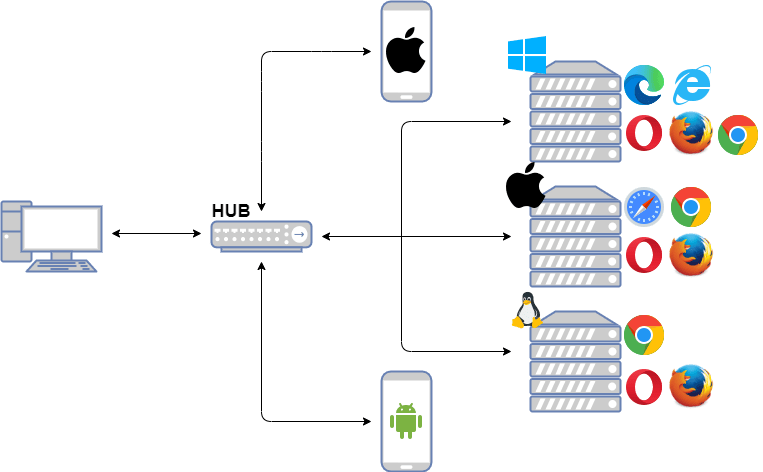
Graphical representation of how Selenium works:
A user executes a test on their local machine which then triggers hub, which is where all tests are sent. The hub is connected to nodes which are different instances that will execute tests on computer systems. The hub determines where this test is supposed to be sent and the nodes are where the individual executions happen.
Mobile Automation Testing Using Appium
Appium is a mobile test automation framework and tool for native, hybrid and mobile web applications for iOS and Android operating systems. It uses JSON Wire Protocol to interact with iOS and Android applications using Selenium’s WebDriver. These tools laid the foundation for mobile automation.
Appium follows four tenets to help it meet mobile automation needs:
1. It should not be required to recompile or modify the app in order to automate it.
This is ensured by Appium through their use of vendor-provided automation frameworks under the hood. No third-party frameworks are needed to be compiled, so this means that the same app being tested is the same app being shipped. Appium utilizes Apple’s XCUITest and UIAutomation, Android’s UiAutomator and UiAutomator2, and Microsoft’s WinAppDriver frameworks.
2. Specific languages or frameworks should not be required to write and run tests.
All of the aforementioned vendor-provided frameworks are then wrapped into a singular API, the Selenium WebDriver API. This API utilizes the JSON Wire Protocol which allows clients written in any language to be used to send the HTTP requests to the server. Popular languages already have clients written for them such as Java, JavaScript, C#, and Python.
3. A mobile automation framework should not reinvent the wheel when it comes to automation APIs.
WebDriver has become the standard when it comes to automating web browsers and is even a WC3 Recommendation. The idea is that just because it is mobile testing the same APIs in WebDriver should also be utilized. Appium extends the protocol with extra API methods specific to mobile automation.
4. A mobile automation framework should be open source, in spirit and practice as well as in name!
Appium is open source. This means that any developer can utilize the power of Appium in creating their own mobile test frameworks, applications, and scripts.
How Appium Works
At its heart, Appium is a webserver that exposes as REST API. Appium receives connections from clients which start sessions, listens for and executes commands on a mobile device, and responds with an HTTP response detailing the result of the execution.
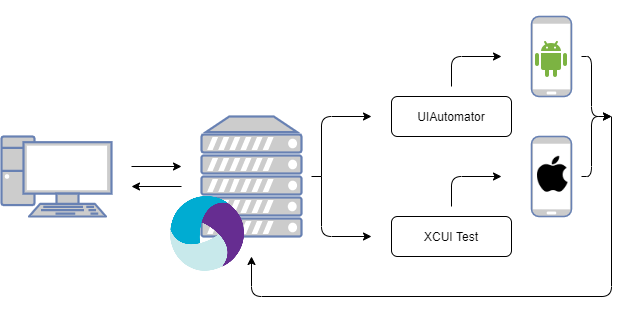
Graphical representation of how Appium works:
A user executes some test on their machine which gets communicated to the Appium server. The Appium server determines where to send the execution based on the information given: Android vs iOS, version 10 vs version 9 OS, and so on and so forth. Once this is finished the results are communicated to the Appium server which then relays the information to the end user.
Because of how Appium incorporates a client-server architecture, many possibilities are introduced:
Test code can be written in any language, so long as that language has a HTTP client API
The server hosting Appium can be on an entirely different machine than the one tests are running on
Test code can be written and then executed on devices on the cloud or on local machines
To help with testing efforts, here are some strategies that can be worked towards:
Involve the testing team with business/product talks earlier in development
Testing does not start at the testing phase of the Software Development Life Cycle (SDLC). In actuality, it should be included from the start of the design phase. While designing what the final product will look like and how it will function, it is important for the testing team to take note of test cases and scenarios. Keeping teams aligned as to what needs to be tested and how ensures that all requirements are met during testing.
Plan ahead of time what OS types and versions, devices, and network speeds the application will run on
Paying attention to details such as what OS types and versions the application is meant to be run on is important. Studying the target market of the application can help with planning which OS versions to be tested.
Planning what devices the application runs on is next. This is important because the more devices that need to be tested on the longer the testing phase can become. Limiting which devices the application can be run on is an easy solution but can ostracize users of other devices. Utilizing emulators can be cost-effective but won’t perfectly replicate the behavior of a physical device. It is essential to set up a device testing strategy early on in the process. When possible, the use of a hybrid model is the most effective.
Lastly, paying attention to network connectivity is crucial. It is easy for developers to assume all is well while on their high-speed office networks, but in reality, not everyone has access to such network speeds. Ensuring the application works on all types of network speeds from 1G to 5G and Wi-Fi connections.
Think about security testing and keep in mind data being shared
As more data gets sent back and forth with applications data security starts to become of utmost concern. Mobile application security is typically terrible. It is very important that early on in the process security testing is taken into mind. Pay attention to any data leakages and make sure there are no vulnerabilities or security exploits.
Progressive application rollout
Choosing to rollout the application over phases can make a big difference when it comes to testing. Often times, not all of the bugs in an application can be caught during the testing phase. Considering using different rollout strategies such as regional or beta testing can help with catching bugs and inconsistencies. This way, if there are any glaring issues, they will only trouble a handful of users instead of all users.
Automate testing of the application
Automated testing allows users to write scripts to cover a wide range of test cases and scenarios. These scripts can be reused over and over again. A lot of time is saved automating versus manually testing every single scenario. Consistency comes to mind, as well. In automation, the same script is being ran every single time with no human error between tests. Initial investments may be somewhat costly, but in the long run it saves a lot of resources and manpower.
Automated Mobile Application Testing Benefits
Automated testing enables developers of applications to quickly and efficiently catch bugs in new features being developed. These bugs can range from smaller errors to large performance inefficiencies or security breaches. m
Here are a few more benefits of automated testing listed out:
Ability to execute tests quickly
Test scripts run at a very efficient rate, performing tasks that might take a significant time longer if done manually. Not only that, but human error is taken out of the equation.
Tests can be run on multiple devices simultaneously
Setting up a grid can speed up processes even faster. One script can be executed across dozens of devices all in parallel.
Tests are reusable and can be utilized to cover multiple scenarios
Scripts used in one scenario can also work to accomplish another. A script to test the login capabilities of an application can be used to both test for positive and negative outcomes.
Scripts can be directly linked to a CI/CD pipeline like Azure DevOps and Jenkins. This allows for thinks like scheduling test script executions, consolidating reporting, and getting analytical data about the application.
Lower manpower and resources
Automating tests require overall less manpower and a fewer amount of resources once everything is set up and in place. Now, a handful of people can handle the testing of a single application.
Faster application development and quicker go-to-market
The reality of automating is that applications are able to be developed at a higher speed and more efficiently and at a lower cost. Now that the SDLC is shortened, new doors open up for new features to be developed, old or outdated services to be refactored, and resources to be moved elsewhere.
Conclusion
In conclusion, we can see how automating mobile application testing provides a faster, more efficient testing process with a wider range of coverage and better test results. Test automation is inevitable if organizations wish to streamline workflows. As mobile applications continue to become a bigger and bigger part of our day-to-day lives whether it be personal or business-related, testing these applications becomes even more important. Those that choose to not at doomed to have slow development lifecycles and time-consuming testing practices.
The products and services identified on this page are third party products or services. Qyrus is not affiliated, sponsored, or endorsed by any of the owners of those third party products or services or the corresponding trademarks.
What is “The Great Resignation”?
Before we even begin, let’s look at some fascinating numbers: a record number of 4.5 million Americans quit their jobs in November 2021. Another 4.3 million Americans, or 2.9% of workers quit their jobs in December 2021 according to the U.S. Bureau of Labor Statistics. According to a study conducted by Harvard Business Review, resignations in the tech industry increased by 4.5%.
In the wake of the extraordinary crisis brought about by the Coronavirus pandemic, a new trend is sweeping across labor markets worldwide. This tidal wave of people quitting their jobs, which is being called the Great Resignation, is severely impairing business continuity forcing companies to rapidly adapt to more frequent and longer staffing shortages..
Negative Business Impact and Burden on Brand Performance
A Gallup report estimates that even before the pandemic, employee turnover was costing businesses more than $1 trillion per year. With the Great Resignation, the cost of recruiting, on boarding, and training new employees has have soared unprecedentedly and impacts are being felt in other critical areas of operations as well.
Customer Experience
The ramifications of the ‘big quit’ can be witnessed in multiple areas of customer experience, as staffing shortages often resulting in poor customer service and inconsistent digital experiences. Organizations that have created new digital experiences overnight just to offset the lack of resources are now facing the heat from customers who are increasingly frustrated with challenging interactions and inconsistent customer journeys.
With robust visual reporting including step by step screenshots and full length videos of test executions and your customer journey, discover how Qyrus test automation can play a pivotal role in enhancing customer experience in a holistic manner here.
Time to Market
However innovative a product may be, the failure to be first to market can provide competitors a winning advantage. The ability to hit the market hard and first requires optimal utilization of resources in the entire production pipeline. Employee shortages can be a substantial impediment leaving companies with little choice but to either push inferior products to customers or suffer crippling delays.
Check out more insights on how Qyrus features such as in-sprint test automationand automatic test scheduling capabilities can help businesses achieve faster time to market without sacrificing quality.
Cost Implications
The cost of replacing an employee can range anywhere between 50 to 200 percent of their salary. To avoid these substantial costs and to plug the leak, robust retention programs are essential. Without them, companies risk losing their best people which can mean losing your effective leaders, persistent innovators, and effective problem solvers.
While businesses will continue to rely on human intelligence, problem-solving skills, and tenacity, Qyrus test automation can assist businesses with more routine activities. Qyrus’ sophisticated recorders streamline test building for web and mobile applications ensuring your team can build more and build faster with fewer resources. Learn more!
Innovation Gap
Innovation is not an act of serendipity but an outcome of knowledge and purpose by dedicated individuals or teams to create something enterprising. More often than not, common innovation goals are pushed down to employees without equipping them with necessary tools to implement the ideas. Organizations embarking on all-encompassing digital transformation must align their spending strategy not only towards adopting new technology but also on closing the digital talent gap, a prerequisite for innovation and digital transformation programs.
A cloud based solution with browsers, Android, and iOS devices around the world, Qyrus provides on demand scalability with comprehensive codeless testing. Qyrus is an transformation ready platform that is bridging the innovation gapin software testing, enabling businesses to generate higher ROI in the short, and long run.
Employee Skill Mismatch
Last but not least, people quitting their jobs is leading to an substantial skill shortage. Employees leaving in record numbers and leaves companies battling to find replacements while having a negative impact on effective operations and the bottom line.
Qyrus’ test automation and machine learning algorithms are a solution to address this employee skill mismatch. The codeless platform provides Healer AI to reduce maintenance for web and mobile automated tests as your application changes. Read this blog to learn more about how Qyrus offers a solution!
Why is Automation Your Safe Harbor?
As companies continue to face staffing issues, automation has become the area of focus once again. Automation does not remove humans from the picture, it only means solutions and tools that enable a better allocation of resources in key business functions. Qyrus is a simple solution that provides codeless automation for testing that can be used to augment the skills of an expert automation engineer or empower a manual tester to start automating.
A few benefits of automation with Qyrus include:
It saves time and cost
It standardizes processes and promotes scalability
It empowers organizations with auditable records
It enables a better customer experience
It ensures better compliance
Automation in Testing is a No Brainer
The crux of the matter is anything that can be automated, should be automated and that’s true for testing as well. If your company’is pushing new software releases in rapid succession, testing must rely more heavily on automation tools. Let’s just put it out there even if it is an uncomfortable truth, artificial intelligence and robots can help businesses accomplish many things faster, more accurately, and more efficiently than with people alone.
Qyrus is a codeless, intuitive, and collaborative testing automation toolthat deploys innovative AI and ML to augment human ingenuity. By leveraging the power of Qyrus, your development and testing teams will produce higher-quality products with minimal human intervention delivering an exceptional user experience with each rollout while boosting your team’s productivity and efficiency.
What is Chaos Testing?
Chaos Testing or Chaos Engineering is the discipline of experimenting on a system in order to build confidence in the system’s capability to withstand turbulent conditions in production.
What does this mean for software testing? And how can chaos engineering be implemented?
Traditionally most of the research and principles of chaos engineering and testing have been on physical chaos – network disruptions, over-consumption of memory, CPU, etc.; we believe there is much more to chaos testing and engineering.
Qyrus has always focused on reusability and with many of our newer features, we are also focusing on repurposing. For example, repurposing a functional web test into a load-generating performance test, “repurpose a virtualized API into a chaos inducing agent.”
Chaos Testing with Qyrus API Process Testing
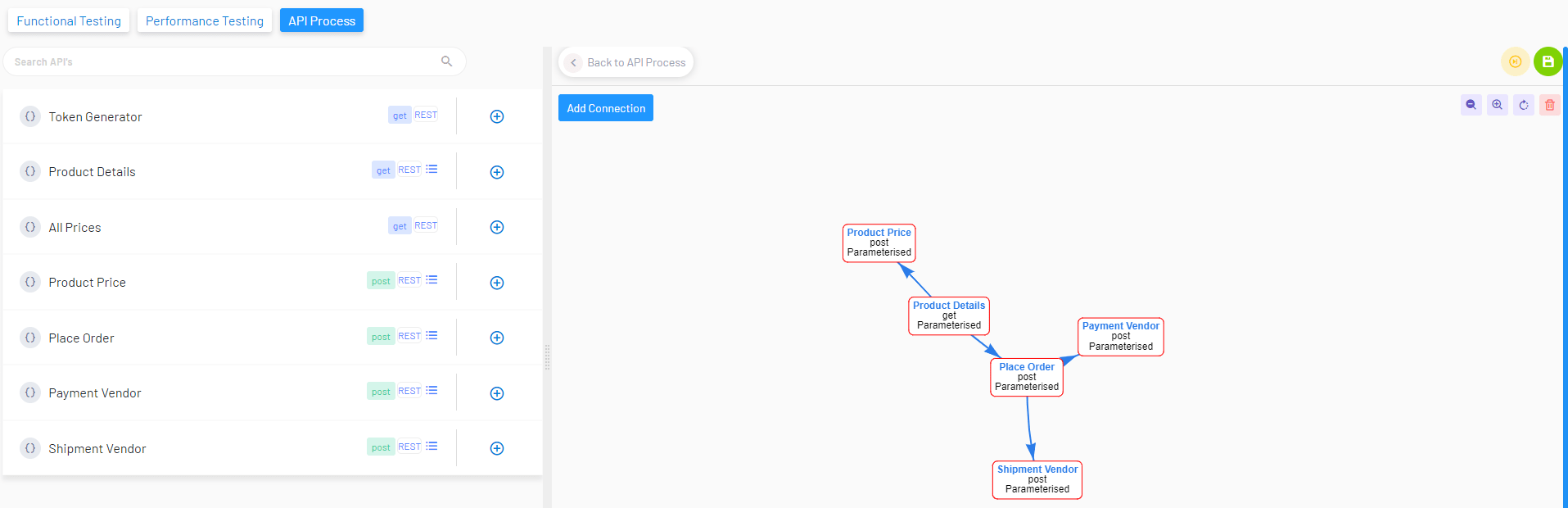
An ecommerce API process test on Qyrus
In the image above, you can see an ecommerce API process test on Qyrus which represents a set of orchestrated API calls that are made when an order is placed. As you can see, to successfully place an order after the user submits it from the UI, the system has to check for payment status, inventory, shipment dates, CRM, etc. All of these APIs must function as expected, in time, and in correct order for this transaction to be successful.
If you are responsible for testing the above system, here are just a few of the possible things that can go wrong:
The individual APIs don’t respond in time or in other words, they don’t stick to the SLA.
Any one or multiple APIs violate the contract. For example, the OrderID was supposed to be an integer which is 9 digits long and one of the APIs sends an alphanumeric 9 digits.
An API Schema is changed without notice.
In a well-orchestrated system with hundreds of APIs working in sync, one API going rogue by having any one or more of the 3 issues mentioned above can induce enough functionalchaos in the system. As a result, this affects many other processes than just placing an order. How well is this system designed to handle such conditions gracefully?
Qyrus SV + API Process Testing = Functional Chaos Testing
The critical question here is, how are testing teams equipped today to test for the above situations? At Qyrus, we have solved this exact problem through a combination of API Process Testing and Service Virtualization (test doubles).
Building an API process test is simple – just reuse functional tests and create connections to transfer data between endpoints to represent a real-world workflow; any of the APIs in this test can be virtualized by building and hosting it through our Service Virtualization module.
Service Virtualization in Qyrus, unlike a standard approach, gives freedom to teams using it to build their virtualized APIs with no code and have complete control of request – response pairs, persistence of data, delay induction, codeless schema design, and synthetic data generation.
The virtual API in the process test can be programmed to go rogue by delaying the response, violating the contract based on a certain request from other real APIs in the system, or passing incoherent data. By doing so, teams can perform a “What if?” on all the 3 conditions above and ensure the system handles the situations gracefully with proper error codes and statuses.
As traditional industry and business lines blur in the rapid pursuit of customer-centric ecosystems, there is mounting pressure on developers to release new capabilities, features, and changes quickly. The overall quality of the software is more critical than ever before. If these integrated, inter-dependent ecosystems are to survive and eventually thrive, they may want to look to automated software testing.
Common Misconceptions About Test Automation
Although software drives big ideas and massive changes across numerous business models, quality and testing continue to be the last innovators. Often, organizations view software testing as a necessary evil. Instead, they should embrace it as a strategic driver in a competitive world with limited second chances. In those instances, where organizations see testing and automated testing as an essential element of the overall solution and market strategy, they often succumb to continuous challenges that typically don’t lend themsleves to flexible and straightforward testing processes.
Consider this statement, “Well implemented automated software testing improves development output and speed to market.” 65% of organizations saw a reduction in test cycle time with automated testing and 62% saw reductions in test costs with automated testing (Sogeti, World Quality Report 2020-21). Speed to market through rapid product release cycles is a basic expectation in today’s market. Although this is true, users won’t forgive or, more importantly, are quick to punish buggy and poor-quality software. These issues caused by poor or inadequate automated testing and technical/skill challenges can have a debilitating impact on delivering software.
Key benefits of automated testing:
Shorten development cycles: Automated testing saves time through faster processes and increases the pace of high-quality development.
Improved testing efficiency: The reusability introduced by automation improves overall testing and development efficiencies. It also means more test coverage where required, which is impossible in manual mode.
Implement CI/CD and DevOps: Automation testing is an essential element of Continuous Delivery and DevOps practices. It shortens the loop between developers and test results, allowing for faster feedback on quality. Automated testing can eliminate the burden of automating routine, labor-intensive tests that take up a tester’s time. The time saved can be spent automating more tests, designing, and monitoring test execution.
Reduce cost: There is a prevalent view that automated testing is cost-intensive. On the contrary, unlike manual testing methods, automated tests can be executed more frequently, faster, and allow testers to increase coverage. Test automation implemented correctly will significantly reduce costs.
How to Select the Right Automation Platform?
The importance of platform selection cannot be over-emphasized. It must fit the environment, skills, and objectives of future product roadmaps and is the essential core of your automated testing practice. Furthermore, its value is further enhanced by coordinating test execution with other delivery tools to create a software delivery pipeline best suited for your organization’s needs.
Consider these points while selecting a platform:
Current Environment: Align the platform to your environment. How will it integrate with the ecosystem that’s already in place?
Type: Is the platform SaaS or on-premise? Will it test your future enterprise solution?
Integrated: Is the platform an integrated testing suite? Is it capable of testing web apps, APIs, business processes, and mobile device? Is there a need for an integrated device and browser farm?
No Code or Coding Model: Align with your team’s skillsets but also future-proof to the extent possible. Do you want to invest in a multitude of coding models?
Support: Is there product onboarding and testing process support?
Types of Automated Testing:
Modular Testing
Define and manage your tests as small, functional-based modules tested independently or efficiently grouped into functional or end-to-end business process test suites. Start automating small, simple test cases and increase the complexity of your scripts by identifying tests prone to human error, that use multiple data sets, and that require repetitive test runs on numerous builds.
Self-Healing Tests
Automation scripts are often flaky and brittle when the configurations, objects, and test data change since the last test execution. Even when scripts are maintained – which is often not the case – the changes are not continuously updated in the test script. This can cause erroneous test results. In many cases, it is impossible to fix scripts in a timely, cost-effective manner manually. Self-healing tests identify and remedy these issues, which often can be as simple as a button that has moved somewhere else on the page.
Mock and Stub
Reduce variability around test failures. Tests should fail when there is a bug. You can design and implement mocks and stubs until real system components are available for end-to-end testing.
Govern Automated Testing
Create a governance structure for automation testing. Make transparency a core element of the automation strategy. That way, all stakeholders – developers, database teams, business analysts – can contribute to the success and take advantage of the value provided by the platform.
What is Qyrus and how it can help you:
Qyrus is an on-demand SaaS codeless automated testing platform that deploys machine learning algorithms, an intuitive user experience, and a collaborative codeless approach to test automation. It not only empowers developers and testers with automation testing, but, just as important, the business team. When you partner with Qyrus, you can expect an exceptional user experience and greater productivity from your development and testing teams.
We are excited to share some test automation news – Qyrus is now officially SOC 2 Type 2 certified! We understand how our client’s tests, results, and other artifacts are vital to their business. This is one of the key reasons we’re thrilled to take our operational excellence and data security to the next level; Qyrus is now officially SOC 2 Type 2 certified!
We at Qyrus take customer data security seriously. This is why we have updated our security measures. This certification, which is facilitated by an independent third-party certified audit firm, is the standard for how we conduct our business presently, as well as into the future.
At Qyrus, we are committed to the highest security standards, including:
Regular vulnerability scans
Periodic third-party penetration testing
Strict code quality and mandatory security reviews
Stringent SOC 2 compliance vetting for all critical vendors
Enforcement of data security best practices across the Qyrus organization
Jerin Mathew
Manager
Jerin Mathew M M is a seasoned professional currently serving as a Content Manager at Qyrus. He possesses over 10 years of experience in content writing and editing, primarily within the international business and technology sectors. Prior to his current role, he worked as a Content Manager at Tookitaki Technologies, leading corporate and marketing communications. His background includes significant tenures as a Senior Copy Editor at The Economic Times and a Correspondent for the International Business Times UK. Jerin is skilled in digital marketing trends, SEO management, and crafting analytical, research-backed content.