As the go-to event for QA and testing leaders across banking, insurance, capital markets, and payments, this year’s forum puts a sharp focus on technology risk, AI in QA, and the upcoming impact of the EU’s Digital Operational Resilience Act (DORA).
And Qyrus will be right in the middle of it all.
Joining us on the grounds will be our Qyrus crew led by Raoul Kumar, Director of Platforms for both Qyrus and qAPI, and Ameet Deshpande, our SVP of Product Engineering who will also be delivering a keynote session at the event.
Ameet will take the stage to share how AI-driven test automation is helping financial institutions stay resilient, accelerate delivery, and ensure compliance without compromising speed or security.
From API and end-to-end testing to mobile, web, and AI validations, Qyrus empowers QA teams with a single platform built for continuous, intelligent testing at scale.
If you’re attending, come meet our team and see how we’re helping global financial firms modernize their QA strategy and stay ahead of regulatory change.
We’re proud to be part of the conversations shaping the future of QA in finance and e-commerce.
Let’s connect in London!
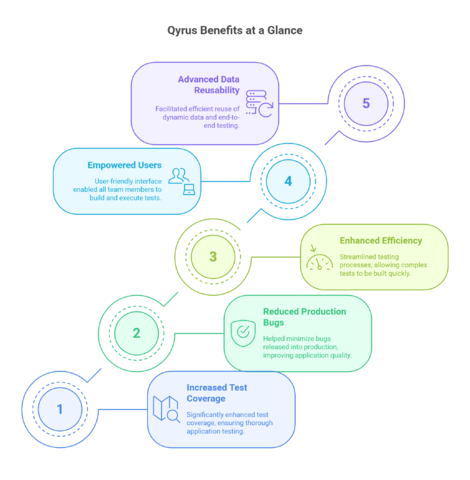
This case study explores how a leading global beverage business, one of the largest players in the consumer-packaged goods (CPG) industry, revolutionized its testing processes by transitioning from entirely manual methods to an advanced, AI-powered automated testing approach with Qyrus.
Facing persistent challenges such as lengthy testing cycles, inconsistent quality, declining test coverage, and difficulties in reusing dynamic data, the company sought an innovative solution. This article will detail how the implementation of Qyrus led to a significant increase in test coverage, a substantial reduction in production bugs, and a remarkable enhancement in overall testing efficiency and quality within their operations.
About the Client
This consumer-packaged goods company is a leading global beverage business, formed through the merger of several bottling companies and distribution companies. It operates in multiple markets across the globe. The company is known for marketing, producing, and distributing a wide range of beverages, including energy drinks, still and sparkling waters, juices, sports drinks, and ready-to-drink teas. It is recognized as the world’s largest independent bottler for a major beverage brand, boasting significant annual revenues and a large consumer base. The company focuses on sustainable growth, innovation, and meeting the specific needs of local markets while leveraging its scale and capabilities to drive growth.
The Challenge
When starting with Qyrus, the client was only performing manual testing. This was an issue since it was taking a large amount of time to complete the testing process and as a result quality was suffering overall. Taking too much time manually testing various processes and features on their app had caused test coverage to slip, as well, introducing virtual cracks to the foundation of their software.
The client had difficulty with automating their testing using traditional or conventional automation methods. Some of the testers were more experienced than others, and this was causing a gap in the quality of the manual tests being done. They also wanted to make sure that they were making use of reusing dynamic data throughout the test scripts.
Life with Qyrus
The client working in consumer-packaged goods is making use of multiple services on the Qyrus platform. Currently, Web Testing and Mobile Testing services are being used to build out web and mobile test scripts. Then, the client is able to perform end-to-end business process testing, chaining the web and mobile test scripts together and enabling test data to be transferred downstream between the individual web and mobile components.
Overall, the client feels that Qyrus is pretty easy to use and grasp. Implementing Qyrus’ testing strategy is not difficult at all and getting set up is as easy as recording your test or asking our AI to help you with test generation. A mixture of both technical and non-technical end users for the client are building and executing test scripts on Qyrus.
Key Features Used
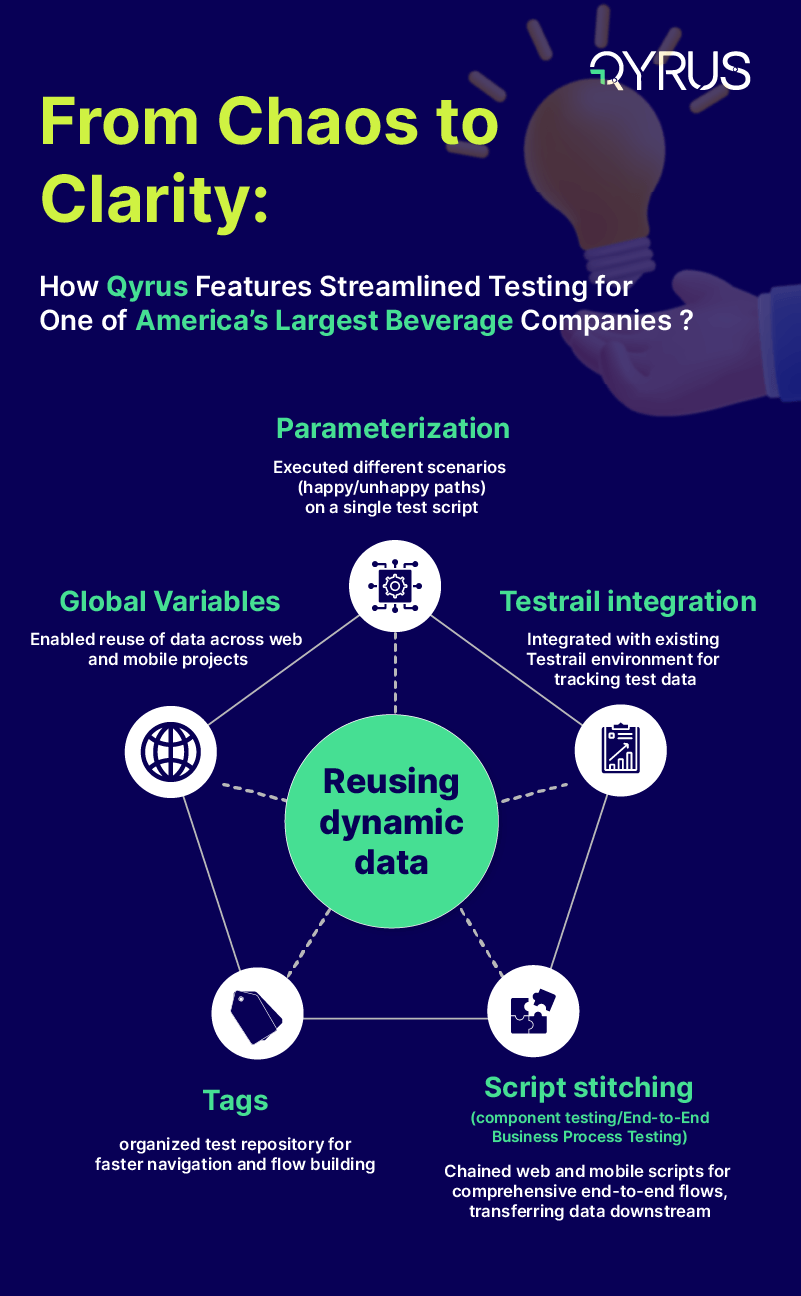
Global Variables: The client was able to make use of global variables to help with reusing data across their various web and mobile projects. This aided in their quest to reuse dynamic data across their scripts.
End-to-End Business Process Testing: The client stitched together the web and mobile scripts into comprehensive business process tests that executed end-to-end flows for a complete picture into the behavior and performance of your various processes across your applications.
Parameterization: The client was able to parameterize specific test steps in their scripts to aid with reusing data and executing different scenarios on a single test script. They were able to execute both happy and unhappy path test scenarios using this method.
Script Tagging: By tagging their scripts, the client was able to better organize their test repository and scripts. This allowed for faster navigation around the app and quicker building of end-to-end flows.
TestRail Integration: The client integrated Qyrus with their TestRail environment for the tracking of various test data and information.
Future Dreams
The client envisions a future where their automated testing processes continue to evolve and improve. They plan to explore advanced AI-driven testing techniques to further enhance the accuracy and efficiency of their test scripts. By integrating machine learning algorithms, they aim to predict potential issues before they arise, thus ensuring even higher quality and reliability in their applications.
In addition, the client is committed to expanding their use of Qyrus across all their global operations. They intend to leverage the platform’s capabilities to support continuous integration and continuous delivery (CI/CD) pipelines, enabling faster and more frequent releases of new features and updates. This will not only reduce time-to-market but also ensure that their products consistently meet the highest standards of quality.
Results & Outcomes
A PoC was originally done in August of 2024 where the client took Qyrus on a test drive for 6 weeks total. In the end, the client was able to achieve a significant increase in test coverage when implementing Qyrus’ automated test scripts when compared to their manual testing being performed. Data around how long it took team members to perform manual tests varies due to a differing level of knowledge and expertise on their team. And for the same reason the comfort level on Qyrus differed.
However, after a little more than 1 month, users reported being very comfortable with the platform. In total, it took the team 45 minutes to build a complex test of over 40+ steps.
The client had acquired 4 web licenses and 5 mobile licenses to spread across their team. As a result of using Qyrus, there has been a noticeable reduction in bugs spread into production by the client team.
Conclusion
Through the adoption of automated testing with Qyrus, the client working in consumer-packaged goods was able to significantly enhance their testing efficiency and quality. The ease of use and the comprehensive features of the Qyrus platform enabled both technical and non-technical team members to build and execute complex test scripts effectively. As a result, the client saw a marked increase in test coverage and a substantial reduction in production bugs. The successful implementation of Qyrus not only streamlined their testing processes but also allowed them to focus on delivering high-quality products to their consumers in the consumer-packaged goods industry. This transformation underscores the importance of embracing innovative solutions to overcome traditional testing challenges and drive sustainable growth.
Save the Date 📅 August 7th, 2025 📍 JW Marriott, Juhu, Mumbai
We’re thrilled to announce that Qyrus is joining the 29th Edition of the BFSI Innovation & Technology Summit as a Gold Partner!
This year’s theme — “Shaping the Future of Financial Innovation”couldn’t be more aligned with our mission. With automation, AI, and compliance reshaping the BFSI landscape, the summit brings together changemakers, regulators, and innovators who are driving real impact across India’s financial ecosystem.
Our Qyrus crew will be there front and center. Ameet Deshpande, Senior Vice President of Product Engineering, will take the stage to share how Qyrus is helping leading BFSI organizations transform QA into a strategic advantage. From agentic automation to regulatory-ready testing, he’ll walk through how Qyrus enables financial teams to test faster, smarter, and safer.
Every minute your SAP system is down, the clock starts ticking – money is being lost. For the average organization using SAP, that clock rings up an astonishing $9,000 per minute in losses, translating to over half a million dollars an hour. In some industries, that figure skyrockets to nearly $9 million per hour. These aren’t just numbers; they represent stalled production lines, failed customer transactions, and a direct hit to your bottom line. In this high-stakes environment, your only safety net is robust testing. Effective regression testing in SAP is the critical process that ensures the system changes you implement today don’t break the essential business processes you rely on tomorrow.
Given the risks, it’s no surprise that the SAP testing market is booming, projected to swell to $2.5 billion by 2033. Organizations clearly recognize the strategic value of getting this right. Yet, for many, the reality of testing falls dangerously short of the goal. The very safety net designed to protect business continuity has become a primary source of project delays, budget overruns, and immense frustration.
The core problem is that traditional approaches to SAP regression testing are fundamentally broken. They are slow, incredibly resource-intensive, and demand a level of specialized expertise that is increasingly hard to find. While teams struggle to keep up, they are forced to make a difficult choice between delaying critical go-lives and risking catastrophic post-production failures. But what if there was a better way? A new, agentic approach powered by AI is emerging, designed to dismantle these age-old challenges and transform one of the most critical SAP regression testing tools from a bottleneck into a business accelerator.
Anatomy of a Bottleneck: The Core Challenges of SAP Regression Testing
If you feel like your SAP testing efforts are an uphill battle, you are not alone. The challenges are not just technical; they are systemic, stemming from the very nature of SAP environments. Most organizations grapple with the same four major hurdles that turn a critical quality assurance process into a resource-draining gauntlet.
1. The Sheer Complexity of Customization and Integration
SAP systems are the opposite of “one-size-fits-all.” They are incredibly complex landscapes, typically heavily customized with bespoke code to meet specific business needs. This high degree of tailoring means standard test cases are often useless. Worse, modules are deeply interconnected; a minor configuration change in Finance can have unforeseen ripple effects across your entire supply chain or HR processes. This web of dependencies demands comprehensive end-to-end testing scenarios that are themselves a massive challenge to design and maintain.
2. The Manual Testing Quagmire
A surprisingly large number of organizations are still trying to fight this modern battle with outdated weapons. With some reports indicating that as few as 25% have adopted automated testing, many teams are stuck in the manual testing quagmire. This approach is not only agonizingly slow—manual execution of a full regression suite can stretch for weeks or even months—but it’s also dangerously prone to human error. It’s a laborious process that struggles to keep pace with the frequent updates common in today’s IT landscape, directly contributing to project delays and inflated costs.
3. The Data and Environment Black Hole
Before a single test case can run, a stage must be set. Unfortunately, creating this stage—a realistic, production-like test environment—is a monumental task that consumes enormous time and resources. In fact, many QA teams spend a staggering 30-50% of their time just on environment setup and data management, causing an estimated 74% of SAP projects to be delayed. Creating and maintaining a consistent set of high-quality, production-like test data is its own significant challenge, complicated by the need to anonymize sensitive information while preserving data integrity.
4. The Squeeze of Limited Skills, Time, and Budgets
Compounding every other issue is the relentless pressure of constraints. There is a well-documented shortage of SAP testing expertise, leaving many teams without the specialized skills needed to navigate the system’s complexity. At the same time, organizations report being pressured to do more with fewer resources. This isn’t just a feeling; it’s a budget reality. Testing activities can consume a massive 30-45% of the budget for a global SAP deployment. When projects face delays, testing timelines are often the first to be cut, significantly increasing the risk of defects slipping into the live environment. This creates a vicious cycle of being under-resourced, under-skilled, and perpetually short on time.
The End of Endless Scripting: A Smarter Path with Qyrus Agentic Regression
After navigating the labyrinth of traditional testing challenges, the path forward isn’t about working harder—it’s about working smarter. The solution to a problem rooted in complexity and manual effort isn’t a slightly better script recorder; it’s a fundamental paradigm shift. This is where a modern SAP regression testing best practice emerges: moving from manual execution to agentic, AI-driven automation. Qyrus Agentic Regression for SAP (ARS) is engineered specifically to dismantle the hurdles of complexity, time, and skill shortages that hold businesses back.
Instead of forcing your teams into a rigid, code-heavy framework, Qyrus ARS offers a more intelligent and intuitive approach.
1. Eliminate Scripting with AI-Infused, Visual Test Building
Imagine building complex regression tests without writing a single line of code. Qyrus makes this possible with a script-less, AI-infused platform where test flows are built using simple drag-and-drop functionality. This visual approach instantly removes the primary barrier to entry for most teams: the need for specialized scripting knowledge in tools like UFT or Selenium. It directly attacks the manual testing quagmire, replacing a tedious, error-prone process with a fast and repeatable one.
2. Start Testing in Days, Not Weeks, with Pre-Built Suites
One of the biggest drains on resources is building a test suite from scratch. Qyrus eliminates this bottleneck by providing a comprehensive library of pre-built regression suites for all major SAP processes, including Order-to-Cash (O2C), Procure-to-Pay (P2P), and Hire-to-Retire (H2R). Your team can reuse and customize these existing flows immediately, enabling you to create a basic regression framework in a matter of minutes. This means you can move from project kickoff to active testing in days, not the weeks or months required for manual creation.
3. Empower Your Business Experts, Not Just Your Coders
The chronic shortage of SAP technical specialists creates significant delays. Qyrus ARS is one of the only SAP regression testing tools designed specifically for business users who understand the processes best. With its business-friendly interface and natural language capabilities, a functional analyst can easily create, modify, and execute tests. This democratizes the testing process, reducing the reliance on a handful of expert SMEs and technical resources by 60%, according to Qyrus estimates.
4. Leverage True AI to Understand and Build Your Tests
This is the core of the “Agentic” approach. Qyrus doesn’t just automate clicks; it understands intent. Users can generate an entire end-to-end test flow simply by writing a prompt in plain English. The AI interprets the business logic and proposes a complete test outline for review. Need to understand a complex, existing test? The “Explain Test with AI” feature generates a clear explanation, making test maintenance and knowledge transfer seamless. This AI-led approach means deep business process knowledge is no longer a prerequisite to creating meaningful tests, fundamentally changing how regression suites are built and maintained.
The Old Way vs. The New Way: A Side-by-Side Look at SAP Test Automation
To truly grasp the shift that agentic automation represents, it’s helpful to place it side-by-side with traditional test automation. The difference isn’t just incremental; it’s a complete overhaul of the process, speed, and skills required to ensure quality in your SAP environment.
Setup Time and Test Creation
The Old Way: Traditional automation begins with a long and complex setup phase. This involves time-consuming environment preparation, building scripting frameworks from scratch, and extensive tool configurations. Test creation itself is a highly technical task, requiring users to write detailed scripts in languages specific to tools like UFT or Selenium. This process is often dependent on fragile screen recordings and manual mapping of UI flows.
The New Way with Qyrus ARS: The process is designed to be quick from the start, requiring minimal setup. Test creation is entirely script-less and infused with AI, relying on drag-and-drop actions to build flows5. Because it uses a combination of AI and APIs to construct tests, it has no dependency on screen recording, making the entire process faster and more resilient to UI changes.
Required Expertise and Usability
The Old Way: This approach is built for, and by, technical users. The learning curve for business users is incredibly high, and creating meaningful test cases requires a deep, expert-level understanding of the underlying business processes. This creates a dependency on a small pool of highly skilled (and expensive) resources.
The New Way with Qyrus ARS: The platform is fundamentally business-friendly and designed for non-technical users. Thanks to its visual interface and the AI engine’s ability to interpret logic, only a minimal understanding of the business process is needed to get started. This puts the power of testing directly into the hands of the people who know the business best.
Test Maintenance and Scalability
The Old Way: This is often where traditional automation projects fail. Maintenance effort is extremely high, as scripts require constant and often complex updates whenever SAP screens or workflows change. This complexity severely limits scalability; as the number of test cases grows, the maintenance burden can become unmanageable.
The New Way with Qyrus ARS: Maintenance effort is low. Because tests are built from reusable, API-based components, they are less brittle and far easier to modify. This makes the entire test suite highly scalable, allowing you to expand your regression coverage without exponentially increasing your maintenance workload.
Execution Speed
The Old Way: Test execution is often slow because it relies on interacting with the front-end user interface, replicating a human’s clicks and keystrokes step-by-step.
The New Way with Qyrus ARS: Execution is significantly faster because it operates primarily via APIs and backend validation. By interacting with the system at a deeper level, it bypasses the UI bottleneck, providing much quicker feedback on the health of your system after a change.
By the Numbers: The Tangible ROI of Qyrus Agentic Regression
The conceptual differences between traditional and agentic automation are clear, but the practical impact is what truly matters to your bottom line. Shifting to an AI-led approach delivers measurable improvements in speed, efficiency, and cost, transforming testing from a cost center into a value driver. The savings are not marginal; they are game-changing.
When you implement an agentic solution like Qyrus ARS, we estimate the below benefits:
Shrink Preparation Time: Regression prep time per release plummets by approximately 65%, from a typical 15–20 days down to just 3–5 days. This allows your team to be more agile and responsive to business needs.
Reduce Reliance on Experts: The need for deep, specialist SAP knowledge is drastically reduced. You can lessen your reliance on expert SAP SMEs by around 60%, empowering your existing functional teams to handle testing. Additionally, reliance on coding experts is also reduced as analysts can automate SAP tests on their own.
Accelerate Team Onboarding: Training time for new testers shrinks dramatically. A new team member can be onboarded and productive in just 2–3 days, a ~60% improvement over the 3–5 weeks required for traditional tools.
Massively Expand Test Coverage: Your ability to mitigate risk grows exponentially. Where manual methods might cover 10-20 variants of a process, an agentic approach can easily handle 50-100+ variants, giving you at least twice the test breadth and much greater confidence at go-live.
Build More with Less: The efficiency gains are enormous. You can build a test suite of 50 scenarios ~55% faster and with ~50% fewer people. This frees up your most valuable resources to focus on innovation rather than repetitive manual tasks.
These platform-specific benefits directly translate into the incredible financial returns seen across the industry for modern SAP testing solutions.
Stop Managing Risk, Start Driving Value: Future-Proof Your SAP Landscape
For too long, regression testing in SAP has been treated as a necessary evil—a slow, expensive, and resource-heavy insurance policy against system failure. As we’ve seen, the traditional approach is often a bottleneck in itself, fraught with complexity, manual effort, and a constant skills gap that leaves businesses struggling to keep pace with change. This old model forces a choice between speed and quality, leaving you to manage risk rather than drive value.
But a new way is not only possible; it’s here. By embracing an agentic, AI-driven platform like Qyrus ARS, you can fundamentally change the equation. This is a shift from writing fragile scripts to building resilient, AI-generated test flows; from relying on a few overburdened experts to empowering your entire business team; and from spending weeks on preparation to executing comprehensive tests in just days. It’s the definitive SAP regression testing best practice for the modern enterprise.
The ultimate goal isn’t just to find more bugs, faster. It’s about reclaiming resources, accelerating project timelines, and giving your organization the confidence to innovate freely. When your testing is no longer a roadblock, you can deploy updates, migrate to S/4HANA, and adapt to new business demands with true agility. You can finally move from simply managing risk to actively delivering stable, high-quality experiences that drive business value.
A top bank in the United Kingdom, committed to delivering secure and seamless digital banking experiences, faced a critical challenge to its growth. As its digital banking applications grew more complex, the institution faced significant testing challenges that slowed innovation and increased operational costs.
The existing infrastructure suffered from limited device and browser coverage, while time-consuming manual testing processes delayed release cycles. Legacy methods were inefficient, failing to adequately cover critical use cases.
To overcome these hurdles and enhance its digital customer experience, the bank partnered with Qyrus, implementing a modern device farm automated testing strategy to transform its quality assurance process.
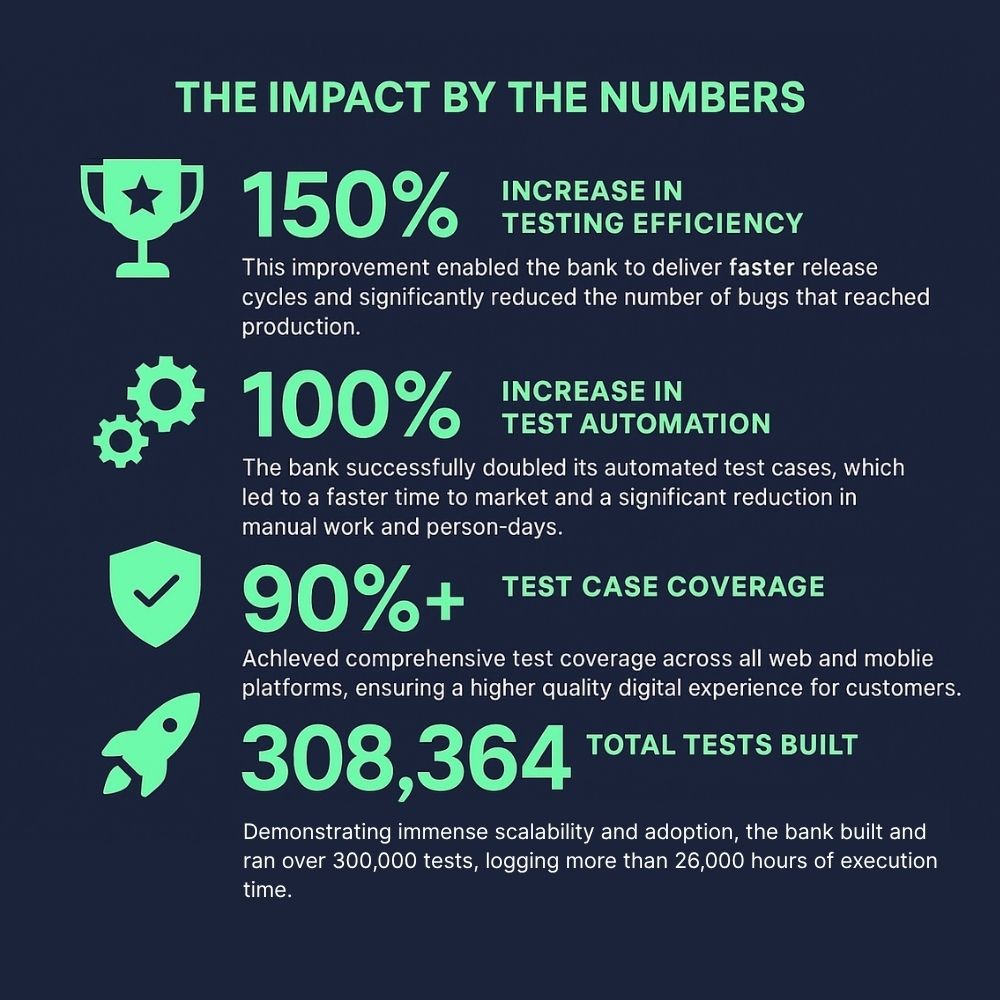
Demonstrating immense scalability and adoption, the bank built and ran over 300,000 tests, logging more than 26,000 hours of execution time.
About the Client
The client, a top bank in the United Kingdom, provides safe and easy digital banking experiences. As the financial sector changes, the client has focused on innovation. This helps meet the rising expectations of its customers.
The organization focuses on improving the digital customer experience. It has invested in updating its infrastructure. This is especially true for software development and quality assurance.
To support its digital transformation, the client has adopted new technologies. These technologies make its mobile and web platforms reliable, secure, and easy to use.
As digital banking applications became more complex, the need for a better testing solution grew. This made the client look into better mobile software testing tools. They decided to implement a strong device farm automated testing strategy to ensure quality and speed at scale.
Why Legacy Testing Failed to Deliver a Premier Digital Customer Experience
Before partnering with Qyrus, the bank’s ability to deliver a flawless digital customer experience was compromised by several significant roadblocks. The existing testing methods were ill-equipped for the demands of modern digital banking, leading to inefficiencies that impacted everything from release speed to operational costs. The core challenges included:
Inadequate Device and Browser Coverage: The testing environment was restricted to a limited number of devices and browsers. This posed a significant risk to the digital customer experience, as bugs and performance issues on the wide variety of platforms used by customers could easily go undetected.
Time-Consuming Manual Processes: Labor-intensive manual testing was slow, prone to human error, and significantly delayed product release cycles. These inefficient processes not only slowed down innovation but also contributed to rising operational costs and resource constraints.
Inefficient Legacy Systems: The bank’s previous testing method, CITS, was inefficient and slow. This outdated approach was unable to keep up with the demands of complex banking applications, leaving critical use cases untested.
Lack of Actionable Insights: Reporting capabilities were basic and lacked the necessary tools for deep analysis, such as comprehensive screenshots, video playback, and analytics dashboards. This made it difficult for teams to diagnose and resolve issues quickly.
Difficulty Scaling On-Demand: The client struggled to scale testing efforts to align with the rapid pace of digital product development. It became clear that without adopting superior mobile software testing tools and a robust strategy for device farm automated testing, the organization could not efficiently ensure quality at scale.
Life with Qyrus: Scalable, Reliable, and Automated Testing
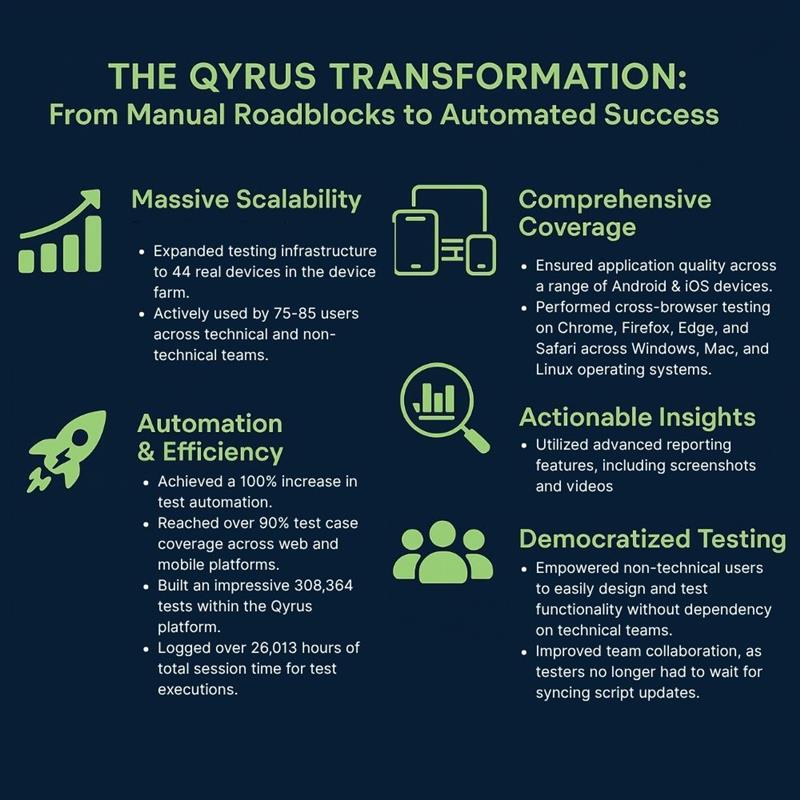
The choice to use Qyrus’ device farm for automated testing changed the client’s digital strategy. What started as a small trial quickly grew into a large deployment. It involved 44 devices and 75 to 85 active users.
This expansion allowed the client to test its apps on Android and iOS devices. They also were able to test with major browsers like Chrome, Firefox, Safari, and Edge on Windows, Mac, and Linux.
The Qyrus platform provided the client with powerful reporting and analytics tools that significantly improved visibility into test performance. Detailed reports, complete with screenshots, video logs, and advanced dashboards, allowed teams to quickly diagnose and resolve issues. This led to a substantial reduction in production bugs and a more stable, reliable digital platform.
Automation became a core component of the client’s testing strategy. With Qyrus, the client doubled their automated test cases.
They also reached over 90% test coverage on web and mobile platforms. Testers executed more than 308,000 tests, logging over 26,000 hours of test execution time. These results highlight the scalability and efficiency of the device farm automated testing approach.
Non-technical users can contribute to test creation and execution because of the simplicity of Qyrus. This method of testing helped bridge the gap between business and technical teams. This further helped to foster a more collaborative and agile development environment.
The client also benefited from the ability to simulate real-world scenarios across different devices and browsers. This comprehensive testing approach ensured that the digital products were robust and user-friendly. This would be regardless of the platform used by the customers.
Security and Compliance
In the financial services industry, security and compliance are paramount. The client required a testing solution that could meet stringent regulatory standards while supporting its need for scalability. Qyrus delivered on both fronts. The secure infrastructure protected sensitive financial data, while the flexible architecture allowed the client to expand its testing capabilities without compromising compliance.
The client decided to deepen its partnership with Qyrus because it can keep high security standards while growing operations. The platform’s enterprise-grade security certifications provided the assurance needed to innovate confidently in a highly regulated environment.
Moreover, Qyrus’ stringent security compliance gave the peace of mind that the client needed. Qyrus ensured a seamless and secure testing environment. This integration further strengthened the client’s ability to protect data and maintain regulatory compliance.
Results So Far
The results of implementing device farm automated testing have been impactful for the client. The organization reported a 150% increase in testing efficiency, enabling faster release cycles and significantly reducing the number of bugs in production. This improvement has directly affected the digital customer experience. Users now enjoy more reliable and responsive digital services.
Workflows have become automated, teams have become more agile, and collaboration between them is on a rise. Teams are now able to respond more quickly to changing requirements and deliver high-quality software at scale. The move to automation has led to significant cost savings. It has greatly reduced manual testing work and person-days.
The client has also seen improvements in team morale and productivity. With fewer repetitive tasks and clearer insights into testing outcomes, teams can focus more on innovation and continuous improvement.
Additionally, the client has been able to leverage the detailed analytics provided by Qyrus to make data-driven decisions. These insights have helped the client optimize its testing processes and identify areas for further improvement.
What’s Next for the Client
The client plans to build on its success. They will add AI-powered testing tools to their current system. These tools will allow for smarter automation, better analytics, and real-time issue detection. This will improve the efficiency of its device farm testing strategy.
The organization also aims to expand the involvement of non-technical teams in the testing process. Thanks to Qyrus’ easy low-code and no-code features, business users can help with test design and execution. This creates a more collaborative and inclusive way to ensure quality.
Compliance testing will remain a top priority. As rules change, the client promises to stay ahead by using Qyrus’ advanced security features. The organization will keep working to lower costs and increase test coverage.
The client is also exploring the use of machine learning algorithms to predict potential issues before they occur. This proactive approach to testing will further enhance the reliability and performance of their digital products.
Furthermore, the client is considering expanding its device farm to include more devices and browsers. This is to ensure even greater coverage and more comprehensive testing. This expansion will help the client stay ahead of the curve.
Why Qyrus?
The client selected Qyrus after a comprehensive evaluation of available solutions. Qyrus’ real device cloud impressed the organization. It offered the flexibility needed to test on many platforms.
The platform has an easy-to-use interface. Its low-code and no-code features make it accessible for everyone. It also integrates well with current workflows, ensuring a smooth transition.
Qyrus provided strong security and reporting features. These were important for the client to stay compliant and protect customer data. This combination of scalability, usability, and security made Qyrus the ideal partner for the client’s digital transformation journey.
By using device farm automated testing and advanced mobile software testing tools, the client has improved its operations. This change has also enhanced the digital customer experience. The organization is now better equipped to innovate, adapt, and lead in the competitive world of digital banking.
The client also values Qyrus’ commitment to continuous improvement and customer support. The Qyrus team has been responsive and proactive in addressing any issues and providing guidance on best practices. This strong partnership has been instrumental in the client’s success and will continue to drive future innovations.
We live in a world dominated by small screens. It’s the first thing we check in the morning and the last thing we see at night. This mobile-first reality has created a staggering digital economy, with mobile apps generating over $935 billion in revenue in 2024 and users spending a combined 4.2 trillion hours glued to their applications. In this hyper-competitive arena, your native mobile app isn’t just another channel; it is your brand, your store, and your relationship with the customer.
But here’s the stark reality: user tolerance for mistakes is virtually zero. In a market with endless choices, a single bug can have devastating consequences. Consider that a staggering 88% of users will abandon an app after a bad experience , and 71% will uninstall it simply because it crashes or has errors. The stakes are clear. For any business to thrive, delivering flawless native experience through robust mobile application automation testing is not just an advantage—it’s a fundamental requirement for survival.
This post explores why a strategic investment in an intelligent automation tool for mobile application testing is critical, and how a next-generation platform can be the key to unlocking success.
The Bedrock of Quality: How Mobile Testing Automation Pays for Itself
To keep up with the demands of the modern market, development teams have learned that treating testing as an afterthought is a recipe for failure. Smart organizations perceive automation not merely as a project-specific expense but as a capital investment in their quality assurance process. It’s a strategic imperative that delivers compounding returns in speed, cost-effectiveness, and reliability.
The most immediate benefit is a dramatic increase in speed. While manual testing is slow, tedious, and vulnerable to human error; automated scripts can run around the clock, executing hundreds of test cases in a fraction of the time without missing a single issue. This is especially true for repetitive but crucial tasks like regression testing, where companies report slashing test times by a massive 70-80%. By integrating mobile app automation testing tools into their development pipeline, teams can shrink feedback cycles by up to 80%, reducing QA time from days to mere hours and empowering developers to fix bugs faster than ever before.
This efficiency translates directly into significant long-term cost savings. While automation requires an initial investment in tools and setup, these costs are consistently offset by long-term gains. Consider the incredible returns: one report found that every dollar invested in user experience—a direct result of high-quality testing—can yield up to $100 in return, yielding an staggering 9,900% ROI.
Finally, automation provides a level of accuracy that humans simply cannot match. Manual testing, especially for repetitive tasks, is highly prone to fatigue and error. Automated scripts, however, execute the exact same steps with perfect consistency every time, free from distractions or oversight. This eliminates human error, leading to more reliable results and a higher-quality product that users can trust.
Meeting the “Native Expectation” in Mobile Application Automation Testing
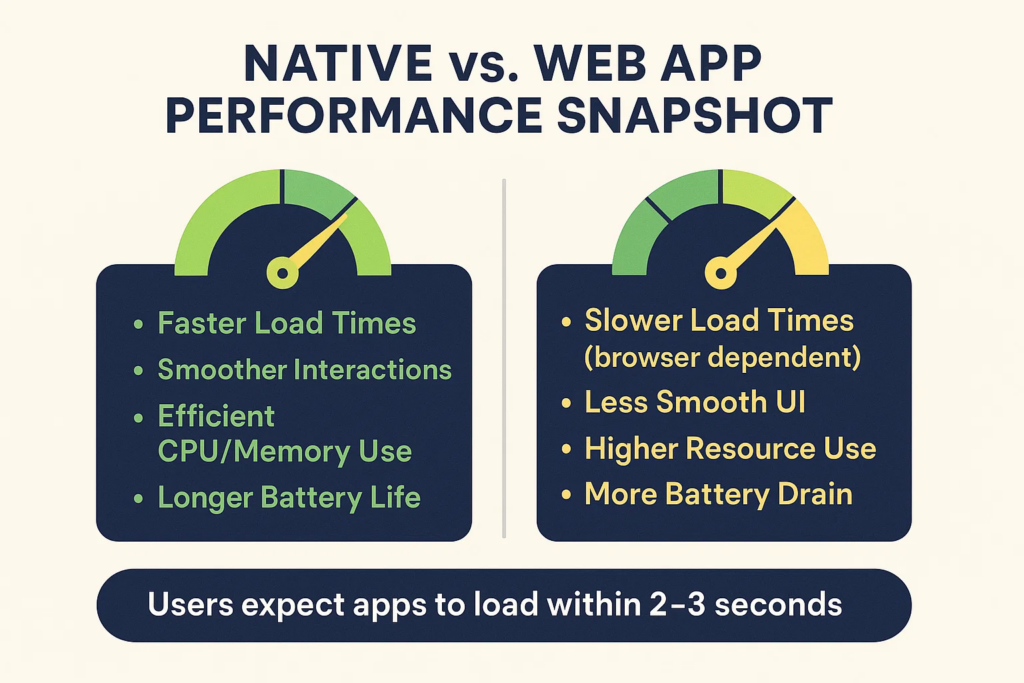
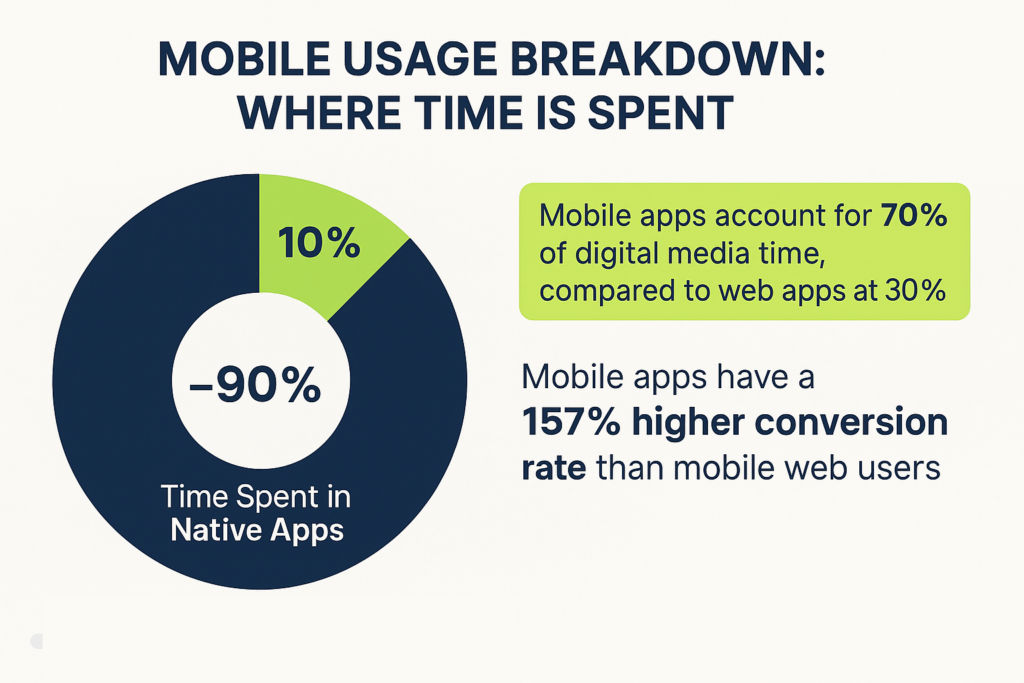
The general shift to mobile phones is only half the story. To truly understand the landscape, you must recognize that the world isn’t just mobile-first; it’s native-app-first. Users don’t just prefer native applications; they live inside them, creating an incredibly high standard for quality and performance. This isn’t a niche preference—the data shows it’s an overwhelming majority, with a massive 85% of mobile users preferring native apps over mobile websites. This is where they spend their time, with native apps commanding a staggering 70% of all digital media time.
This strong preference isn’t arbitrary. It’s rooted in the superior, seamless experience that only native applications can provide. Because they are built for a specific operating system, native apps are inherently faster, more responsive, and more reliable. This performance advantage translates directly into powerful business outcomes. For businesses, this is where the magic happens: conversion rates on native apps are often 3x higher than on mobile websites , and remarkably, 65% of all e-commerce sales are now driven through them.
This combination of preference and performance has created what is known as the “native expectation.” Users have been conditioned to expect a certain level of polish, speed, and flawless functionality. When an app fails to meet this high bar, the result is jarring, and forgiveness is in short supply. This is why thorough mobile application automation testing is not just a technical process but a crucial component of customer satisfaction and brand management
The Gauntlet: Why Native Mobile App Testing Is a Perfect Storm
While the “native expectation” creates a huge opportunity, delivering it requires navigating a gauntlet of technical challenges that are far more complex than those in web or desktop testing. This perfect storm of variables makes a comprehensive manual testing strategy not just impractical, but logistically impossible.
The single greatest challenge is device and OS fragmentation. The ecosystem is not one unified market, but thousands of micro-environments. Consider the mind-boggling reality of the Android market alone, which features over 24,000 distinct device models from different manufacturers—compared to only around 40 for iOS. Each of these devices can have a different screen size, resolution, hardware configuration, and OS version. Manually testing even a fraction of these is a futile effort, creating a scenario where achieving comprehensive coverage is practically impossible without automation.
Beyond the sheer number of devices, native apps present other deep-seated complexities. Effective mobile automation testing tools must account for:
Platform-Specific Interactions: iOS and Android have their own distinct design guidelines, gestures (swipes, pinches, long-presses), and navigation patterns. An app must be tested separately on each platform to ensure its UI and UX feel truly native and intuitive.
Hardware and Network Variables: Native apps integrate deeply with device hardware like cameras, GPS, and microphones. They must also perform flawlessly under a wide variety of network conditions, from high-speed Wi-Fi to spotty cellular data.
Rapid Release Cycles: In the world of Agile and CI/CD, updates are frequent. Running a full regression test with each new build is essential to ensure new features don’t break existing ones, and attempting this manually quickly becomes a severe bottleneck that grinds development to a halt.
This combination of fragmentation, deep integration, and the need for speed creates a testing matrix of exponential complexity. It’s a challenge that demands a smarter, more scalable approach.
The Intelligent Answer: Conquering Native App Challenges with Qyrus
The complexity of the native mobile ecosystem doesn’t have to be a roadblock. It’s a challenge that can be met with the right strategy and a smarter platform. Qyrus is a next-generation, AI-powered automation tool for mobile application testing designed specifically to overcome these hurdles, ensuring exceptional quality while accelerating your speed to market. It directly addresses the most painful aspects of native testing by mapping its intelligent features to your biggest challenges.
Challenge 1: Impossible Device Fragmentation
Qyrus Solution: The Qyrus Device Farm. Instantly test your application—manually or with automation—across a massive and diverse inventory of real Android and iOS devices. You can achieve comprehensive device coverage and eliminate the immense cost and effort of maintaining an in-house lab.
Challenge 2: Slow, Tedious Test Creation
Qyrus Solution: Mobile Automation & Rover AI. Use the intuitive Mobile Recorder to build complex automated test cases in minutes by simply recording your actions on a device. To go even faster, leverage Rover AI to visually scan your app, automatically identify UI and usability issues, and then seamlessly convert that entire analysis into a functional automation test with a single click.
Challenge 3: Brittle Tests and Constant Maintenance
Qyrus Solution: AI-Driven Script Correction. One of the biggest drains on resources is fixing tests that break due to minor UI changes. Qyrus’s AI automatically detects and corrects flaky scripts when elements shift or identifiers change, dramatically reducing the time your team spends on maintenance and allowing them to focus on creating new tests.
Challenge 4: Finding the Root Cause of Bugs
Qyrus Solution: Advanced Reporting. Go beyond a simple pass or fail. Every test run on the Qyrus platform generates a rich report including step-by-step screenshots, full video recordings, and detailed performance profiling (CPU, memory, network usage) to help your developers pinpoint the exact cause of any issue instantly.
Conclusion: Your App, Flawless
The verdict is clear. In a world where your business is defined by its mobile presence, and where 88% of users will leave after just one bad experience, quality is not negotiable. The sheer complexity and fragmentation of the native app ecosystem make traditional manual testing obsolete. The only path to success is a smart, strategic investment in automation.
By embracing a powerful, AI-driven platform like Qyrus, you are not just buying a testing tool; you are adopting a business strategy. It’s a strategy that protects your revenue, enhances your brand reputation, and empowers you to innovate faster and more confidently in the highly competitive mobile market.
Ready to give your mobile application the quality and speed boost it deserves? Explore the Qyrus mobile testing solution and see how our next-gen AI can transform your testing process.
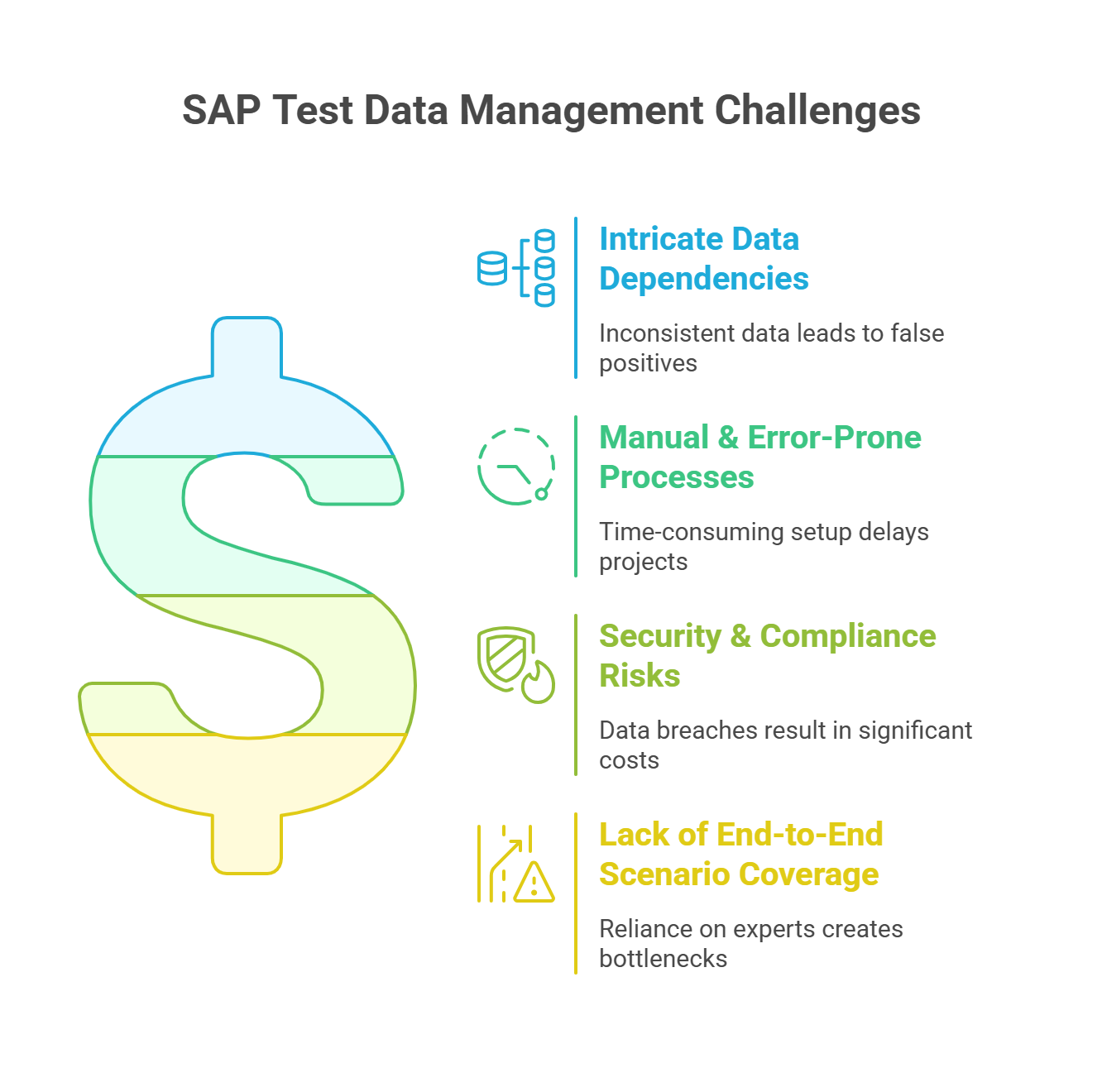
It’s a frustratingly common story in the world of software development. Your highly skilled, expensive QA team is ready to get to work, but instead of testing, they’re spending a staggering 30-50% of their time just setting up test environments. This isn’t just a minor delay; it’s a critical bottleneck that results in approximately 74% of projects getting delayed. For organizations whose operations live and breathe on SAP, this problem is magnified tenfold.
The core challenge lies in effective SAP data testing as part of the overall SAP testing. SAP landscapes are intricate webs of interconnected modules and vast data volumes, making the task of creating realistic, compliant test data a monumental effort. The failure to manage this process effectively has predictable and painful consequences: project delays spiral into budget overruns, software quality suffers, and significant security vulnerabilities are left wide open.
This isn’t just an operational headache anymore. It has become a strategic imperative.
This post explores how a modern, automated approach to Test Data Management (TDM) can transform this critical challenge into your competitive advantage. We will unpack the real costs of outdated methods and introduce a new way forward with advanced SAP test data management tools like Qyrus DataChain, designed to cut through the complexity and deliver real results.
The Root of the Challenge: Why SAP Test Data Management is Uniquely Complex
To understand why so many resources are spent on SAP data testing, we first need to appreciate the platform’s unique nature. The problem isn’t just about handling large amounts of data; it’s about managing data that is vast, intricate, and deeply interconnected. This inherent complexity is the primary reason that manual approaches are no longer viable.
At their core, SAP systems manage enormous quantities of information, characterized by complex inter-relationships and dependencies between different modules and data objects. Generating representative test datasets that accurately reflect these complexities—without introducing redundant data—is a significant hurdle.
The most critical challenge is maintaining Data Consistency and Referential Integrity. Multiple SAP modules, such as finance, sales, and HR, are tightly linked. For a test process to be valid, the data must respect these connections. For example, a test of an “order-to-cash” cycle must preserve the referential links between customer records, sales orders, and financial documents to behave realistically. If the test data for a sales scenario lacks consistent master data in the finance module, tests are likely to fail for reasons unrelated to the function being tested, leading to “false positives” and wasted time.
This difficulty is compounded by the need for multiple testing environments. A typical SAP project requires several non-production systems for development, QA, UAT, and performance testing. Ensuring that test data is consistent and relevant across these diverse environments is vital for reliable outcomes. Manually refreshing these landscapes to keep the data realistic is a labor-intensive and disruptive process that often gets neglected, causing test environments to grow stale and unreliable.
These fundamental challenges—data volume, referential integrity, and environment synchronization—are why a strategic approach to sap test data management is no longer a luxury, but a necessity.
The Hidden Toll: Unpacking the Real Costs of Poor SAP Data Testing
An inadequate strategy for SAP data testing isn’t just an inconvenience that slows things down; it’s a constant drain on resources that silently chips away at your bottom line and exposes your organization to significant risk. The true cost manifests in tangible financial burdens, operational drag, and a growing list of compliance dangers.
The Financial Burden
When test data is a bottleneck, the financial repercussions are swift and severe. It is a primary contributor to the widely observed phenomenon where SAP implementation projects frequently exceed their initial budgets, with overruns of 40% to 60% being common. This is often compounded by the outdated practice of creating full copies of production systems for testing. This not only leads to bloated storage but also incurs ongoing maintenance costs that can be up to seven times higher than the initial cost of the storage capacity.
Beyond the direct costs, poor data management grinds productivity to a halt. Teams waste countless hours investigating “false positives”, bugs that aren’t real software defects but are simply the result of inconsistent or corrupt test data.
This problem is rooted in what can only be described as a referential integrity nightmare. A single, seemingly simple business process, like an “Order to Cash” scenario, triggers a cascade of corresponding data across completely different modules. A sales transaction in the Sales and Distribution (SD) module can create financial postings in Financial Accounting (FI) and inventory movements in Materials Management (MM). If the test data for this scenario lacks the corresponding data in FI or MM, the test will fail for reasons completely unrelated to the function being tested. Manually tracking and synchronizing this complex chain of data is an almost impossible, error-prone task.
The Compliance and Security Risk
In today’s regulatory landscape, the stakes for data privacy have never been higher. Protecting Personally Identifiable Information (PII) to comply with stringent regulations like GDPR and HIPAA is non-negotiable. Yet, a staggering survey found that only about 7% of companies were fully compliant with data privacy laws within their test environments.
This creates a breeding ground for “shadow data”—untracked or unmanaged sensitive data that proliferates across test systems. Breaches involving this specific type of data are even more costly, averaging an alarming USD 5.27 million. The message is clear: using the right SAP test data management tools is no longer optional for organizations that take security and compliance seriously.
The Path Forward: A Modern Approach to SAP Test Data Management
The solution to this complex data maze isn’t to work harder or hire more people to manage spreadsheets. The solution is to fundamentally change the approach. A modern strategy for SAP data testing hinges on automation—streamlining the entire process to eliminate manual effort, ensure data integrity, and provide data on demand. The goal is to empower testing teams, not to bury them in data preparation.
This is precisely why we are excited to introduce Qyrus DataChain.
Qyrus DataChain is a powerful solution designed specifically to streamline the entire process of test data creation for both SAP master data and business transaction processes. It was built from the ground up to directly address the core challenges of complexity, manual error, and the dependency on specialized system knowledge that plague traditional testing cycles. It represents a strategic shift, turning test data management from a bottleneck into an accelerator.
How Qyrus DataChain Works: From a Single Input to Test-Ready Data
Qyrus DataChain was designed for simplicity and power, replacing hours of painstaking manual work with a streamlined, automated workflow. It moves your team beyond error-prone spreadsheets by treating complex, related data as a single, manageable unit. Here’s how it transforms the process.
Step 1: Seamless Data Extraction
Everything starts with a single piece of information. The user simply provides one document or transaction number—like a sales order number, for instance—as the starting point. There is no need to manually hunt down every related document; this one input is all the tool needs to begin.
Step 2: Automated Transaction Mapping
This is where magic happens. Once the initial transaction number is provided, Qyrus DataChain automatically scans your SAP system to identify and map every single linked transaction. It intelligently follows the entire document trail, finding the associated quotation, the follow-on delivery, the final billing document, and the corresponding accounting entries. This automated mapping finally solves the “referential integrity nightmare,” ensuring that the entire end-to-end process data is captured accurately and completely.
Step 3: Comprehensive Data Generation
With all the linked transactions identified, the tool automatically extracts the relevant data from each step. This information is then instantly compiled into a single, structured file that is synchronized, traceable, and ready to be used for testing. This eliminates the need for manual data collection and spreadsheet maintenance, which is not only time-consuming but a primary source of errors and inconsistencies.
Step 4: Extensive Coverage
This powerful capability isn’t limited to just one business scenario. As one of the most versatile SAP test data management tools available, DataChain works across all common SAP transactions. This includes Inquiry, Quotation, Purchase Requisition, Quality Notifications, Accounting, and Material Movement, ensuring broad applicability for your most critical testing needs.
The Measurable Impact: The ROI of Automated SAP Data Testing
Adopting a modern approach with advanced SAP test data management tools isn’t a leap of faith; it’s a strategic investment that delivers substantial and quantifiable returns across cost, speed, and quality. The statistics from industry reports paint a compelling picture of the transformation.
Dramatically Reduce Time and Costs
By automating the most labor-intensive parts of the testing process, organizations see an immediate and significant reduction in wasted time and expense.
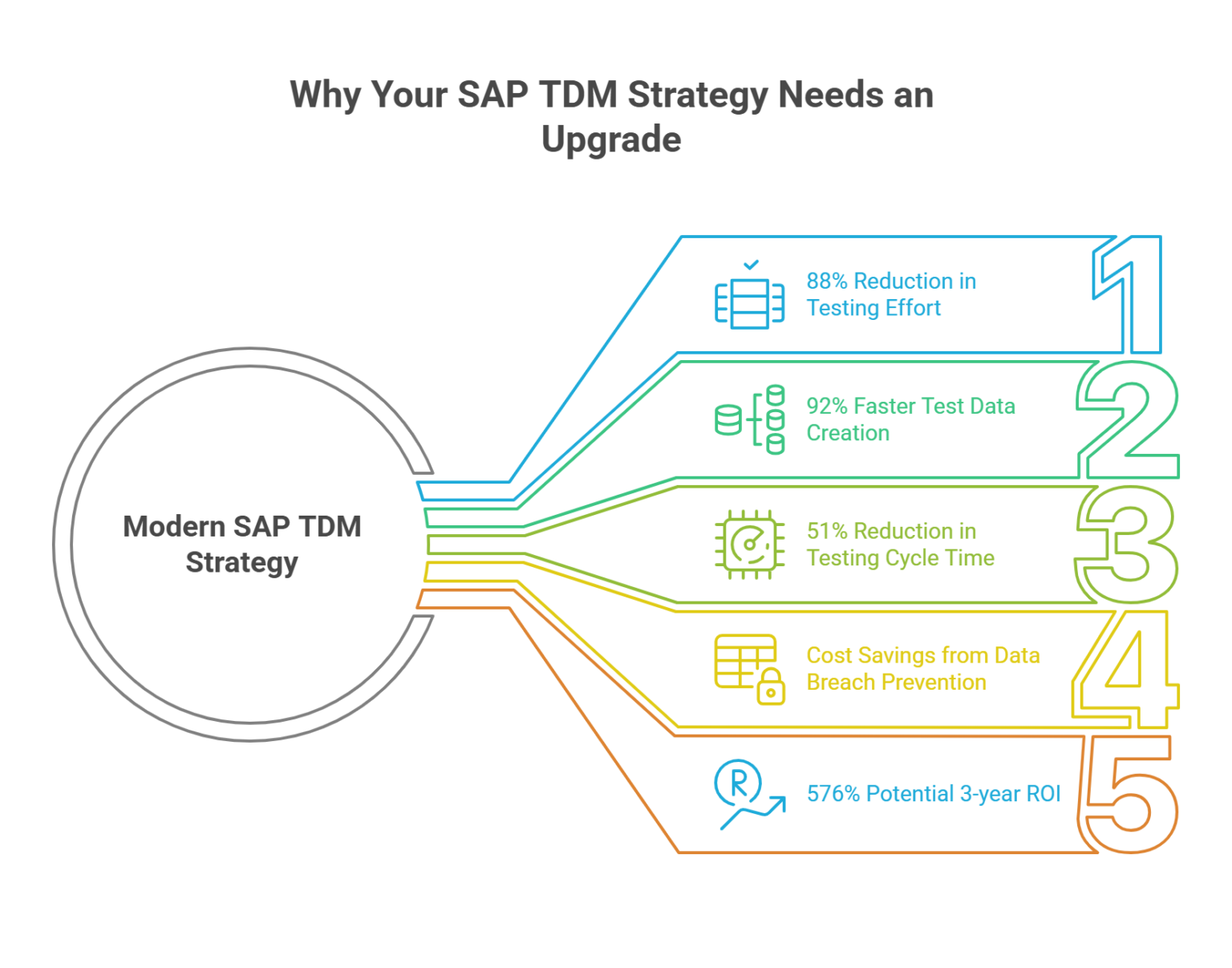
Faster Data Creation & Refreshes: Some organizations have achieved up to 92% faster test data creation and have accelerated their data refresh processes by as much as 90%.
Accelerated Testing Cycles: On average, the time required to complete testing cycles can be reduced by 51%.
Infrastructure & Hardware Savings: By creating lean, relevant data subsets instead of full copies, companies have reported reducing SAP HANA infrastructure costs by up to 70% and cutting S/4HANA hardware costs by up to 80%.
Ensure Complete Coverage and Enhance Quality
Automating data extraction and generation eliminates the primary source of testing issues: human error. This leads to higher quality data, which in turn leads to higher quality software.
Minimize Manual Errors: By removing error-prone spreadsheet maintenance and manual data collection, the risk of data inconsistencies is virtually eliminated, leading to more reliable testing.
Improve Defect Detection: Better data leads to better testing. One case study demonstrated a 70% improvement in test data coverage, which allowed the team to find more defects earlier.
Reduce Defect Leakage: Finding defects before they reach production is crucial. A notable case study at Yorkshire Water showed that implementing a modern TDM strategy resulted in the average defect leakage per release decreasing dramatically from 2.19 to just 0.67.
Accelerate Overall Project Delivery
The cumulative effect of these efficiencies is a significant acceleration in the entire software development lifecycle.
Impressive ROI: The financial returns on a mature SAP data testing strategy can be extraordinary. Organizations using Tricentis SAP testing solutions, which rely on effective TDM, have reported an average three-year ROI of 576%, demonstrating that this is an investment that pays for itself many times over.
Real-World Results with Qyrus: A Case Study
These industry statistics are powerfully demonstrated in a real-world scenario. A global automobile manufacturer was struggling with slow, resource-intensive manual testing for its critical SAP S/4HANA business processes. By implementing the Qyrus platform for SAP testing, which combines codeless automation with powerful test data management, the company achieved transformative results:
Overall testing effort was slashed by 88%.
Regression testing time was reduced by a staggering 92%.
Test execution time for critical Order-to-Cash and Procure-to-Pay cycles plummeted from 40 hours to just 5 hours.
100% test automation coverage was achieved for the processes in scope.
This case study showcases how leveraging a holistic platform that excels at SAP data testing can turn impressive industry statistics into a reality for your organization.
From Bottleneck to Business Accelerator: Redefine Your TDM Strategy
In today’s fast-paced digital enterprise, inefficient and manual processes are a significant liability. As we’ve seen, clinging to outdated methods for SAP data testing is not just slowing you down—it’s actively costing you money, exposing you to risk, and preventing your teams from delivering their best work. The data is clear: the hidden costs of poor test data management are too high to ignore.
By embracing a modern, automated approach with powerful sap test data management tools like Qyrus DataChain, you can fundamentally change this dynamic. You can transform Test Data Management from a painful bottleneck into a powerful catalyst for innovation and operational excellence. It’s time to move beyond the limitations of spreadsheets and empower your teams with the accurate, complete, and instantly available data they need to build better software, faster.
Take the Next Step
Ready to see how Qyrus DataChain can make a substantial difference in your SAP testing processes? We would love to schedule a brief demo to show you how our SAP Testing solution can directly benefit your team.
Schedule Your Qyrus DataChain Demo Today
The dust has just settled from Apple’s Worldwide Developers Conference (WWDC), and the entire tech world is buzzing about one thing: iOS 26. This isn’t just another annual update. Apple has officially unveiled what many are calling the most significant redesign of the iPhone operating system since iOS 7, marking a revolutionary new chapter for the user experience. From a groundbreaking visual overhaul to a massive leap in AI capabilities, iOS 26 is set to redefine how we interact with our most personal devices.
The developer beta is officially out, and the race is on for development teams to prepare their applications for a public release expected this September. In this crucial early phase, having access to a reliable testing environment is paramount. That’s why we are incredibly excited to make a major announcement of our own.
Qyrus is proud to be the first test automation solution to provide full support for the new iOS 26 beta.
We believe in empowering developers to stay ahead of the curve. This blog post will explore the most exciting iOS 26 features and demonstrate how you can start testing them today with Qyrus, ensuring your app is not just compatible, but truly shines on this next-generation OS.
A Glimpse into the Future: Exploring the Key iOS 26 Features
Before we discuss testing, it’s essential to understand the magnitude of change in the iOS 26 beta. This update is packed with foundational shifts and exciting new functionalities.
First, you might be wondering why Apple skipped from iOS 18 to iOS 26. In a major strategy shift, Apple has changed its naming convention to align all its operating systems under a unified numbering scheme reflecting the year of use. This brings us iOS 26, iPadOS 26, and macOS 26, all designed for the 2026 software cycle.
Now, let’s look at the groundbreaking iOS 26 features that developers need to prepare for:
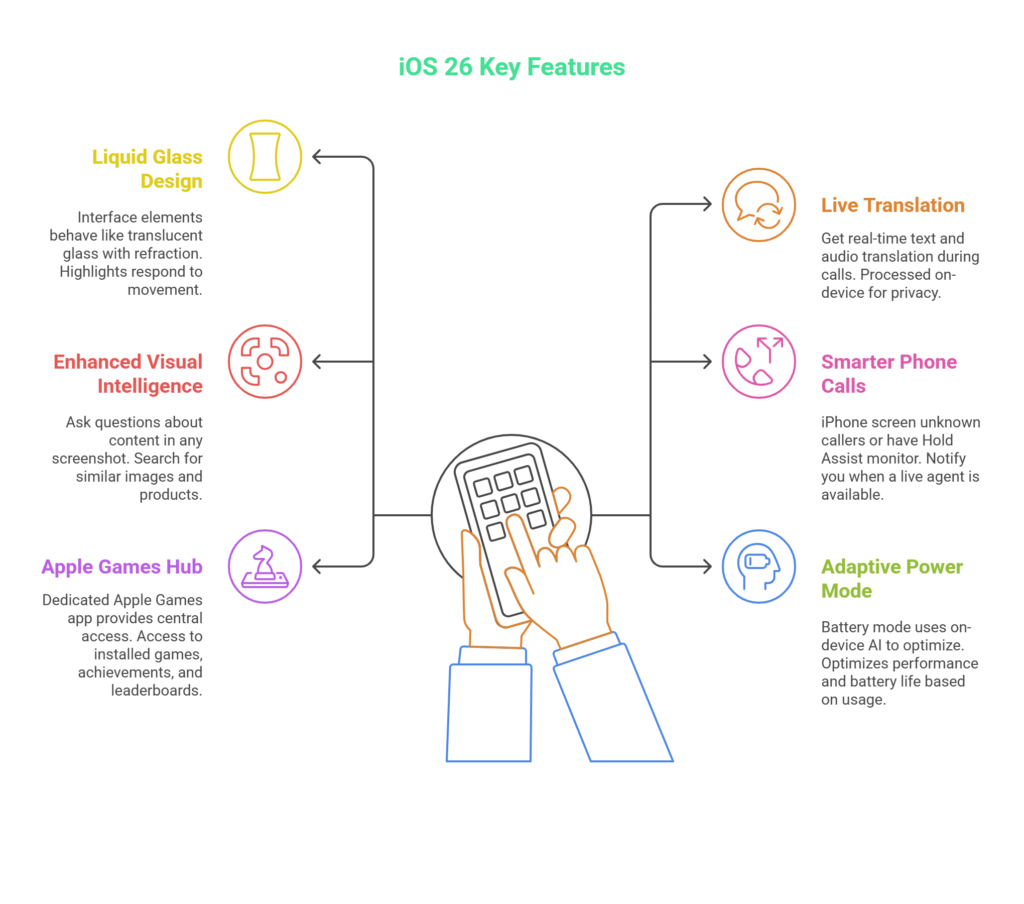
The “Liquid Glass” Design Language: This is the centerpiece of iOS 26, representing the first major visual redesign since iOS 7. Interface elements now behave like translucent glass, with properties like refraction and specular highlights that respond dynamically to device movement. This new design creates an enhanced sense of depth and motion and extends across the entire system, from a more transparent Control Center to an edge-to-edge Browse experience in Safari.
A Leap in Apple Intelligence: iOS 26 significantly expands Apple’s AI capabilities.
Live Translation provides real-time translation of text and audio conversations directly in Messages, FaceTime, and Phone calls, all processed privately on-device.
Enhanced Visual Intelligence now works on screenshots, allowing you to ask ChatGPT questions about screen content or search for similar images and products on supported apps like Google or Etsy.
Revolutionized Phone and Messages Features: Daily communication gets a massive upgrade.
Call Screening lets your iPhone automatically answer calls from unknown numbers to ask for the caller’s name and purpose before you decide to answer.
Hold Assist monitors calls for you when you’re on hold and notifies you the moment a live agent becomes available, saving you from waiting endlessly by the phone.
The Apple Games App: iOS 26 introduces a new, dedicated Apple Games hub. This app serves as a central destination for all gaming activities, unifying access to installed games, Apple Arcade, multiplayer sections, leaderboards, and Game Center achievements.
These are just a few of the many foundational changes in iOS 26. The sheer scope of this update, from its visual core to its AI-powered features, underscores the critical need for early and thorough testing.
Don’t Wait for September: Why Testing on the iOS 26 Beta is Business-Critical
With a public release expected in mid-September 2025, it might seem like there’s plenty of time. However, the sheer magnitude of the changes in the iOS 26 beta makes early, rigorous testing a non-negotiable for any serious development team. Waiting could mean scrambling to fix major issues just before launch.
Here’s why you must start testing your applications on the iOS 26 beta immediately:
Adapt to the “Liquid Glass” Revolution: This isn’t just a new coat of paint; it’s a fundamental shift in UI philosophy. The new translucent and refractive materials of the “Liquid Glass” design can directly impact the readability and visual integrity of your app’s interface. Early testing is the only way to catch visual bugs, ensure your custom UI elements don’t clash with the new aesthetic, and guarantee a seamless visual experience for your users.
Validate New API and Framework Integrations: iOS 26 introduces powerful new frameworks for developers, like the Foundation Models Framework that allows apps to integrate Apple Intelligence features with just a few lines of code. To leverage these new capabilities, you need to test the integrations now, ensuring they perform correctly and add real value to your application.
Mitigate Core Functionality Risks: An update of this scale, described as Apple’s most ambitious software redesign in over a decade, inevitably introduces the risk of breaking existing features. Running your full regression test suites now on the iOS 26 beta is crucial to identify and fix any critical bugs that could disrupt your app’s core functionality.
Secure a Competitive Advantage: The public release in September is a hard deadline. Teams that start testing now will be prepared to launch fully compatible, optimized, and potentially feature-rich updates the day iOS 26 becomes available. This readiness is a powerful differentiator in a competitive market.
In short, proactive testing on the iOS 26 beta allows you to move from a reactive, last-minute rush to a strategic, confident launch plan.
Leading the Market, Not Following It
In a moment of significant technological change, speed and reliability are what matter most. Responding to the critical need for early testing, we are immensely proud to announce a major milestone: Qyrus is the first test automation platform to offer full support for the new iOS 26 beta.
This isn’t by accident. It’s a direct result of our commitment to providing development teams with the tools they need to innovate without boundaries. This immediate support is powered by the Qyrus Device Farm, our robust infrastructure designed for streamlined, secure, and comprehensive testing. We provide on-demand access to real mobile devices, ensuring your testing reflects real-world usage. Our entire test cloud is ISO 27001/SOC 2 compliant, giving you class-leading security, and we stand by our 99.9% real device availability promise.
To facilitate deep and thorough testing of the iOS 26 beta, we offer extensive capabilities, including being the only company to provide dedicated devices for your specific testing needs. This allows you to conduct focused, uninterrupted validation. You can further tweak your test scripts with advanced features like network throttling, biometrics (beta), and seamless CI integration to simulate a wide range of conditions your users might face.
Our device farm is already being equipped with the specific hardware required to run iOS 26. Apple has confirmed that the iOS 26 beta supports iPhone 11 and newer models, officially ending support for the iPhone XR, iPhone XS, and iPhone XS Max. The full list of compatible devices you can expect to find on our platform includes:
iPhone 16, 15, 14, 13, 12, and 11 series (all models)
iPhone SE (2nd and 3rd generation)
It is important to acknowledge the nature of this software. The iOS 26 beta is a pre-release version, and the OS itself is subject to change and potential instability. That is precisely why early access to a secure, stable, and highly available testing environment like Qyrus is so valuable. We provide the reliable infrastructure to navigate the beta phase, identify issues, and validate your app’s performance with confidence.
Testing the New iOS 26 Features: Practical Use Cases with Qyrus
Understanding the new iOS 26 features is the first step; validating your app against them is the next. As the first automation platform to support the iOS 26 beta, Qyrus provides the tools you need to tackle these unique testing challenges head-on. Here are some practical use cases for how you can use Qyrus today:
Validating the “Liquid Glass” UI: The new “Liquid Glass” design is a complete visual overhaul with translucent materials that create unprecedented depth and motion. This is where visual testing becomes essential.
Qyrus in Action: Use Qyrus’s visual regression testing to capture baseline screenshots of your app on a current OS and compare them against its appearance on the iOS 26 beta. This will instantly highlight any unintended layout shifts, broken elements, or readability issues caused by the new refractive and transparent interface components. Automate user journeys to ensure your custom UI remains crisp and functional against the new dynamic backgrounds.
Testing Apple Intelligence Integrations: iOS 26 introduces powerful on-device AI, including Live Translation in calls and messages and Enhanced Visual Intelligence that can analyze screen content.
Qyrus in Action: Automate UI tests to verify that these new AI-driven features integrate cleanly with your app. For example, you can create a test that takes a screenshot within your app and validates that the new Visual Intelligence contextual menu appears and functions as expected without disrupting your app’s interface.
Ensuring Compatibility with New Communication Features: Game-changing features like AI-powered Call Screening and Hold Assist will alter how the OS manages phone calls. While testing the core OS feature is Apple’s job, you need to ensure your app doesn’t break when they are active.
Qyrus in Action: Design tests that check your app’s stability and UI integrity while a call is in one of these new states. For example, does your app’s UI remain stable and responsive in the background while Hold Assist is active? Does your app correctly handle contacts that are now filtered by the new Unknown Sender Screening in Messages?
Verifying Integration with the Apple Games App: The new, dedicated Apple Games app acts as a central hub for all gaming activities.
Qyrus in Action: Automate test workflows that launch your game from the new Apple Games app. You can then run scripts that verify achievements, scores, and leaderboards are correctly reported back and displayed within the hub’s interface, ensuring a seamless experience for gamers.
Executing Full Regression on the iOS 26 Beta: Above all, a major OS update of this scale—the most ambitious in over a decade —requires comprehensive regression testing.
Qyrus in Action: Run your entire existing test suite on real iPhones running the iOS 26 beta in the Qyrus Device Farm. This is the most effective way to catch critical bugs in your app’s core functionalities before the public release in September.
By leveraging these use cases, you can move beyond basic compatibility checks and ensure your app is truly optimized for the revolutionary experience iOS 26 promises to deliver.
Get Ahead of the Curve: Start Your iOS 26 Beta Testing Today
With a developer beta currently available and a public release slated for mid-September 2025, the time to act is now. Being the first automation platform to support the iOS 26 beta, Qyrus makes it simple to begin your essential mobile app testing and validation cycles.
Here’s how you can get started on the Qyrus platform:
Access Our Real Device Farm:Log in to the Qyrus platform and navigate to our extensive mobile device farm. As the only company providing dedicated devices for testing, you can ensure a focused and stable environment.
Select Your iOS 26 Beta Device: Browse the available iPhones that are compatible with iOS 26, such as the iPhone 11 series or newer. Select a device running the new iOS 26 beta to begin your session.
Upload and Test: Upload your application’s build file (.ipa) and start executing your test cases. You can run your existing regression suites to check for compatibility or build new tests to validate the exciting new iOS 26 features.
Don’t let the public release date sneak up on you. Being prepared means starting today.
Take the next step to future-proof your application. Contact our team to schedule a personalized demo or start a trial to see how Qyrus can accelerate your iOS 26 beta testing and ensure you’re ready for launch day.
Be First, Be Ready
The launch of the iOS 26 beta marks a pivotal moment for the mobile landscape. This is not a simple incremental update; it is a revolutionary leap forward, representing Apple’s most ambitious software redesign in over a decade. From the foundational shift of the “Liquid Glass” design to the deep integration of Apple Intelligence, iOS 26 will fundamentally change user expectations.
In this new environment, waiting is not an option. Proactive, early, and thorough testing is the only way to ensure your application is ready to thrive.
As the first automation platform to provide support for the iOS 26 beta, Qyrus offers you a critical head start. We remove the environmental barriers, giving you immediate access to a secure, real-device testing platform so you can focus on what truly matters: ensuring your app delivers a flawless and innovative experience from day one. Embrace the future of iOS with confidence and a trusted partner by your side.
To know more about our mobile testing capabilities and get a personalized demo, please contact us.
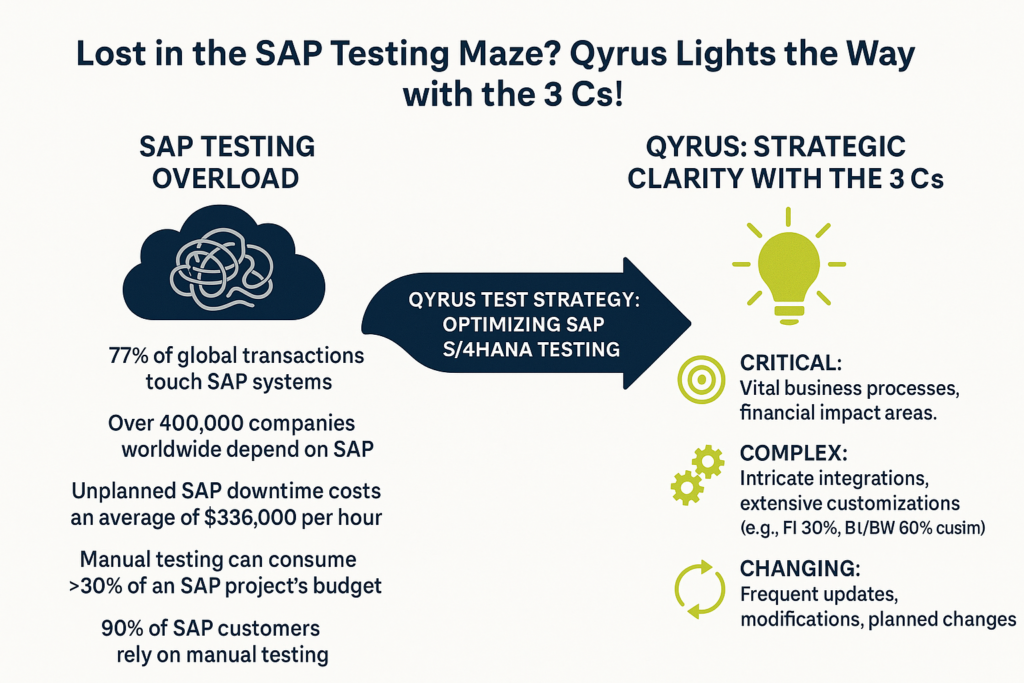
SAP. The very name evokes images of comprehensive business solutions, a digital backbone powering the world’s largest enterprises. It’s a sprawling empire, underpinning critical business processes from finance and supply chain to sales and human resources for countless organizations. In fact, an astounding 77% of global transactions touch an SAP system, and over 400,000 companies worldwide rely on these solutions for their core operations. Think about that for a moment. The vast majority of the world’s commerce, the distribution of 78% of the world’s food and 82% of its medical devices, all flows through SAP systems. This incredible reach, while a testament to SAP’s power, also presents a monumental challenge for quality assurance teams. How do you even begin to test something so vast, so interconnected? The sheer scale can easily make testing feel like an insurmountable task, leaving teams feeling overwhelmed before they even start.
For those on the front lines of SAP quality assurance, the daily reality is often a complex matrix of difficult decisions. The primary struggle? Pinpointing what absolutely, critically needs to be tested amidst millions of potential scenarios. Then comes the automation question: which areas are genuinely ripe for automation to yield the best return, and which will just lead to maintenance nightmares? And perhaps one of the most persistent headaches is accurately analyzing the true impact of frequent releases, updates, and customizations. Even a seemingly minor change in one module can send ripples across the entire integrated landscape, from sales and distribution to materials management and finance. Many organizations find themselves wrestling with these challenges, leading to inefficiencies and, more critically, potential risks.
The traditional, often manual, approach of trying to test “everything” is not just inefficient; but in the complex world of SAP, it’s practically impossible and economically unviable. Manual testing alone can devour 30% or more of an SAP project’s budget. Clearly, a shift is needed. It’s time to move beyond brute-force tactics and chart a course for a more intelligent, strategic, and ultimately more effective SAP S/4HANA testing approach. The goal isn’t just to test more, but to test smarter, focusing efforts where they deliver the most value and mitigate the highest risks. This is where a well-defined strategy becomes not just helpful, but absolutely essential for success.
Introducing the “3 Cs”: A Framework for Focused SAP Testing
To truly start optimizing SAP S/4HANA testing, we need a guiding philosophy, a framework that cuts through the noise and directs our attention to what genuinely matters. Enter the “3 Cs”—a powerful lens through which to view your SAP landscape and prioritize your testing efforts with intelligence and precision.
The Three Pillars of Smart SAP Testing: Critical, Complex, and Changing
The “3 Cs” provide a simple yet profound way to categorize and understand different aspects of your SAP environment:
Critical: This pillar focuses on identifying those business processes and transactions that are absolutely vital to your organization’s survival and success. Think about your core financial operations where errors could lead to significant financial misstatements or compliance breaches. Consider customer-facing processes where a glitch could directly impact revenue and reputation, or supply chain activities where downtime can cause huge disruptions. SAP systems often underpin these very core functions, and the financial stakes of failure are enormous, with unplanned SAP downtime potentially costing organizations hundreds of thousands, or even millions, per hour. Identifying these critical pathways is the first step in a resilient SAP S/4HANA testing approach.
Complex: SAP landscapes are inherently intricate, often featuring multiple interconnected modules like FICO, SD, and MM, along with extensive customizations. Each organization’s SAP setup is frequently tailored to its unique needs, with customization levels varying significantly across modules—FI (Financial Accounting) might see 30% customization, while BI/BW (Business Intelligence/Business Warehouse) could reach 60%. This pillar helps you understand transactions and processes characterized by high intricacy. This could involve numerous steps, multi-system integrations (including bespoke code and third-party add-ons), or complex custom development that standard scripts simply can’t cover. These complex areas are often where hidden defects lie.
Changing: The digital world is in constant motion, and SAP systems are no exception. This pillar directs your focus to areas of your SAP environment that are dynamic and volatile. This includes functionalities undergoing recent modifications, planned updates, or frequent patches, such as those common with SAP S/4HANA cloud editions that may release quarterly updates. Continuous testing becomes necessary to ensure that these regular updates do not disrupt existing SAP functionalities. Keeping a close eye on these changing elements is crucial for effective regression testing and ensuring stability.
From Volume to Value: The Strategic Impact of the “3 Cs”
Adopting the “3 Cs” framework fundamentally shifts your testing paradigm. Instead of attempting the impossible task of “testing everything,” you transition to a strategic, risk-based methodology. This is where the real value in optimizing SAP S/4HANA testing emerges.
This focused approach enables far more efficient resource allocation. By understanding what is critical to the business, complex in its structure, and frequently changing, you can direct your valuable testing resources—both human and technological—to the areas where they will have the most impact. This means prioritizing test cases that cover high-risk functionalities, ensuring that your most critical operations are robust, your most complex interactions are verified, and your most recent changes haven’t introduced instability. It’s about moving from a mindset of sheer volume to one of strategic value, ensuring your SAP S/4HANA testing approach is both efficient and highly effective in safeguarding your business operations.
Bringing the “3 Cs” to Life: The Qyrus Methodology
Understanding the “3 Cs” is the foundational step; operationalizing this framework is where the real transformation in your SAP S/4HANA testing approach begins. This is precisely where Qyrus steps in, offering a suite of intelligent modules designed to dissect your SAP landscape through the lens of Criticality, Complexity, and Change, thereby truly optimizing SAP S/4HANA testing efforts.
Spotlighting the Essentials: Qyrus Business Analysis for Criticality and Change
To zero in on what’s “Critical” and what’s “Changing” within your daily operations, Qyrus Business Analysis offers a powerful arsenal of analytical tools. It equips users with insightful charts and tables that illuminate T-code (transaction code) usage, data activity, user behavior, and frequently changed transactions. Imagine being able to clearly see which SAP modules are most frequently used, distinguishing between Master and Business data activity.
This module doesn’t just present data; it provides deep insights that allow you to pinpoint business-critical areas based on actual system usage and identify evolving functionalities by tracking frequently used and altered transactions. By understanding these dynamics, you can confidently identify which parts of your SAP system are absolutely critical to test and which are undergoing significant change, directly informing users of a smarter testing strategy.
Navigating Development Dynamics: Qyrus Workbench Insights for Complexity and Flux
The “Complex” and “Changing” aspects often stem from ongoing development activities within your SAP system. Qyrus Workbench Insights is tailored to shed light on these very elements. This module typically focuses on development changes, such as the creation of new programs, tables, or enhancements. These are often system-wide modifications that necessitate transport requests, clearly flagging them as areas of active change and potential complexity.
A key feature here is the ImpactAnalyzer, a tool designed to help identify and analyze the impact of such changes within the SAP system. By leveraging Workbench Insights, your team gains a clearer understanding of what new developments are occurring, how frequently objects are being changed by developers, and crucially, the potential ripple effects of these modifications, allowing you to proactively address areas of induced complexity and recent change.
Mastering Configuration Nuances: Qyrus Customization Insights for Evolving Complexity
Beyond code development, SAP systems are heavily shaped by “Changing” configurations and the “Complexity” these customizations introduce. Qyrus Customization Insights provides essential visibility into this domain. It focuses on configuration changes, such as setting up company codes or altering business process settings, which are typically managed through customizing requests. Qyrus allows you to track these modifications, offering clarity on what’s modifiable versus what has been released, and even presenting trends in system customizations over selected periods. Furthermore, by highlighting the top 5 business customizations and detailing user-wise customization activities, this module helps you understand not just what is changing, but also which specific business needs are driving these customizations and potentially adding layers of unique complexity to your SAP environment. This granular view is invaluable for a targeted SAP S/4HANA testing approach.
The Qyrus Transformation: From SAP Chaos to Testing Clarity and Confidence
Implementing the “3 Cs” framework through Qyrus isn’t just a theoretical exercise; it’s a practical pathway to transform your SAP testing from a source of stress into a pillar of strength and confidence. By leveraging the deep insights gleaned from its specialized modules, Qyrus empowers organizations to move beyond reactive problem-solving to proactive risk management, truly optimizing SAP S/4HANA testing outcomes.
Cutting Through the Clutter: Pinpoint Prioritization with Qyrus
One of the most immediate and significant benefits of adopting the Qyrus methodology is the newfound ability to prioritize testing efforts with surgical precision. Qyrus’s Test Strategy Module, inherently driven by the “3 Cs,” empowers your QA teams to make informed, data-backed decisions, ensuring that focus is squarely placed on high-risk and high-impact areas first. Imagine having a consolidated view where insights from Qyrus Business Analysis clearly flag “Critical” processes based on actual usage and highlight “Usage Changes”.
Simultaneously, Qyrus Workbench Insights brings “Development Changes” and associated “Complexity” to the forefront, while Qyrus Customization Insights reveals “Configuration Changes”. This integrated intelligence allows you to cut through the clutter of an expansive SAP landscape, ensuring that your most valuable testing resources are directed where they matter most, a cornerstone of an effective SAP S/4HANA testing approach.
Intelligent Automation, Real Results: Qyrus’s Blueprint for SAP Test Automation
While the benefits of SAP test automation are well-documented, with organizations reporting an 85% reduction in testing efforts, the challenge often lies in knowing what and how to automate effectively within complex SAP environments. Many organizations struggle with SAP automation, reports indicate that around 72% of companies still depend on manual testing to validate critical SAP processes, and only about 25% have largely automated their SAP testing. Qyrus fuels a smarter automation strategy by providing clear, actionable metrics on criticality, complexity, and change frequency derived directly from its Business Analysis, Workbench Insights, and Customization Insights sub-modules.
This data-driven approach helps identify the most suitable candidates for automation – those that are critical, frequently used, complex, or prone to change. Furthermore, Qyrus enhances this by offering capabilities to intelligently filter your existing test repositories, whether they are Automated Regression Suites (ARS), Core Qyrus tests, or Smoke tests, based on these dynamic insights. This ensures your automation efforts are not just expansive but also highly relevant and efficient.
De-risking Releases: Qyrus for Proactive SAP Impact Analysis
A major source of anxiety in SAP operations is the uncertainty surrounding new releases and updates. Qyrus helps transform this uncertainty into confidence through proactive impact analysis. Qyrus Workbench Insights, for example, features an Impact Analyzer that is instrumental in identifying and analyzing the potential ripple effects of development changes before they are deployed. Imagine being able to see how a specific transport request might affect various objects and programs.
Insights into frequently changed objects, the top 5 workbench customizations (like PROG, SUSH, TABL), and even user-specific workbench activities allow your teams to anticipate potential issues and mitigate risks proactively. Coupled with visibility into customization trends from Qyrus Customization Insights, you gain a much clearer picture of what’s changing and what the potential consequences are, a vital component for optimizing SAP S/4HANA testing and ensuring smoother, de-risked releases.
The Qyrus Advantage
Ultimately, the Qyrus transformation culminates in a significant competitive edge: The Qyrus Advantage. By harnessing the integrated intelligence of its platform and the precision of the “3 Cs” framework, organizations achieve a marked reduction in wasted effort, moving away from costly manual processes that can consume over 30% of project budgets. This strategic focus inherently improves test coverage on what truly matters, ensuring critical business functions are robustly validated.
The result is demonstrably faster release cycles through such optimized approaches. Most importantly, this leads to minimized business risk, evidenced by significant reductions in production errors and a more resilient SAPS/4HANA testing approach that safeguards your core operations, all facilitated by the comprehensive, data-driven Qyrus platform.
Fine-Tuning Your SAP Test Strategy with Qyrus’s Intelligent UI
Having a robust framework like the “3 Cs” is crucial, but the ability to dynamically apply and refine it is what truly elevates your SAP S/4HANA testing approach. Qyrus bridges this gap with an intelligent and interactive user interface, specifically designed to put you in control and enable a highly tailored strategy for optimizing SAP S/4HANA testing.
The Command Center: Qyrus’s UI for Strategic SAP Test Design
Think of Qyrus’s Test Strategy Customization Screen as your central command center. This powerful, yet remarkably user-friendly interface is where the “3 Cs” framework comes alive, allowing you to move from theoretical understanding to practical application. It’s designed to empower users to fine-tune numerous parameters, effectively translating your strategic priorities into actionable criteria that guide the entire test selection process. This screen provides a transparent and interactive way to define exactly what criticality, complexity, and change mean for your specific SAP landscape and testing goals.
Dialing in Precision: Granular Controls in the Qyrus Test Strategy UI
Qyrus offers an impressive level of granular control, allowing you to meticulously define your testing priorities:
3C’s Parameter Controls: You have direct influence over how each ‘C’ is weighted.
For Criticality, adjust sliders for minimum score thresholds (typically on a 1-10 scale) and select specific aspects such as “Financial Impact,” “Customer Facing,” or “Compliance Related” to ensure these areas are prioritized.
For Complexity, similar slides for minimum scores can be set, along with options to specifically include elements like “Multi-System Integration” or “Custom Development” which inherently add layers of intricacy.
For Change, again, sliders can define minimum change scores, and you can flag “Recent Modifications” or “Planned Changes” to ensure these volatile areas receive due attention.
Impact Analysis Parameters: Beyond the “3 Cs,” Qyrus allows you to factor in the broader impact of potential issues.
An “Impact Score Threshold” slide (e.g., 1-100) helps filter based on the severity of potential impact.
“Dependency Depth” controls allow you to define how far upstream or downstream the analysis should consider related processes, ensuring a comprehensive view of potential knock-on effects.
These detailed controls ensure that the subsequent test selection aligns perfectly with your nuanced understanding of risk and business priorities.
Intelligent Execution: AI-Driven Test Selection with Qyrus
The true power of these granular settings is unleashed when Qyrus’s AI engine gets to work. The parameters you define directly fuel an intelligent, AI-powered test selection process from your existing test repositories.
Filtered Test Selection: You can specify which types of tests the AI should consider, with checkboxes for your Automated Regression Suite (ARS), Core Qyrus testing (covering Web, API, Mobile, Desktop, Data), and dedicated Smoke Tests.
Real-Time Visibility: As you apply these filters, the Qyrus interface provides instant feedback.
A “Selected Transaction Codes & Business Processes” table dynamically updates, showing precisely which codes and processes match your criteria, along with their “3C’s” tags (often color-coded for easy identification) and an overall impact score.
The “AI-Selected Tests Section” then populates with the specific test cases chosen by the AI. This includes key performance metrics like the total number of tests selected, estimated test coverage percentage, and projected runtime. You’ll see a table detailing each selected test case (ID, description, test type with visual indicators, and the related transaction/process).
Smart Logic at Work: The AI prioritizes transaction codes with higher criticality, complexity, or change scores. It intelligently matches tests to business processes and transaction codes, optimizing comprehensive coverage while minimizing redundancy. The estimated runtime also gives you a practical understanding of the testing effort required.
This seamless integration of user-defined strategy with AI-driven execution, visualized clearly on a single screen, offers a sophisticated yet simple way to ensure your testing is both targeted and efficient, truly optimizing your SAP S/4HANA testing efforts.
Conclusion: Conquer SAP Testing Complexity with Qyrus
The journey through the SAP testing labyrinth, with its sheer scale—where 77% of global transactions flow through SAP systems and downtime can cost an average of $336,000 per hour —can indeed feel overwhelming. Traditional testing methods often buckle under this pressure, proving inefficient and economically draining. However, as we’ve explored, a path to clarity and control exists. The strategic “3 Cs” framework—focusing on what’s Critical, Complex, and Changing—provides the guiding principles needed to navigate this intricate environment, and Qyrus expertly brings this framework to life.
Qyrus’ comprehensive Test Strategy Module stands as the definitive solution for truly optimizing SAP S/4HANA testing. By seamlessly integrating the deep analytical power of its Business Analysis, Workbench Insights, and Customization Insights sub-modules, Qyrus provides unparalleled visibility into your SAP landscape. This is further amplified by its intelligent Test Strategy Customization UI, which empowers you to meticulously fine-tune your SAP S/4HANA testing approach based on these “3 Cs” and precise impact parameters, driving AI-powered test selection.
If the challenges of SAP testing complexity, inefficient resource allocation, and release uncertainty resonate with your experience, it’s time to explore a smarter path. Don’t let your SAP testing efforts remain a source of apprehension. We urge you to learn more about how Qyrus can revolutionize your approach. Take the next step towards clarity, confidence, and control.
Request a personalized demo of the Qyrus SAP Testing solution today and witness firsthand how the power of the “3 Cs,” combined with our intelligent platform, can transform your SAP testing from a monumental hurdle into a strategic advantage.
The landscape of enterprise mobility is booming, fundamentally changing how we work and interact with technology. Globally, over half the world’s population now owns a smartphone, a trend that underscores the increasing importance of mobile devices in our daily lives. In the U.S. alone, smartphone penetration is remarkably high, with approximately 91% of adults owning one in 2024. This widespread adoption fuels a massive investment in mobile applications; the global enterprise application market, encompassing mobile, reached approximately US$238 billion in 2020, and is expected to reach at about US$527.40 billion by 2030.
Within this dynamic web and mobile environment, businesses face a critical decision: whether to develop native applications or web apps. This choice carries significant implications for performance, user engagement, and overall success. While web apps offer certain advantages, this blog post will demonstrate why native apps, with their inherent strengths, remain crucial for delivering optimal mobile experiences. We’ll explore the key dimensions that set native applications apart, backing up our analysis with relevant statistics and industry insights.
Native vs. Web: Defining the Mobile Application Landscape
Before we delve deeper into the advantages of native applications, it’s crucial to establish a clear understanding of what differentiates them from their web-based counterparts.
Native Apps:
At their core, native applications are software programs meticulously crafted to operate on a specific mobile operating system. This means a native app built for iOS, Apple’s operating system, won’t run on Android devices, and vice-versa. Developers use the platform’s native programming languages and tools; for instance, Swift or Objective-C for iOS, and Kotlin or Java for Android.
The result is an application tightly integrated with the device’s hardware and software, delivering optimal performance and a truly native user experience. Native apps are distributed through and installed directly from app stores like Apple’s App Store or the Google Play Store.
Web Apps:
In contrast, web apps are not tied to a specific operating system. They are accessed through the mobile device’s web browser, much like any other website. These applications are built using standard web technologies such as HTML, CSS, and JavaScript. Responsive web design techniques enable web apps to adapt their layout and appearance to various screen sizes, ensuring a degree of usability across different devices. While web apps offer cross-platform accessibility, it’s important to recognize that they operate within the browser environment, which can introduce limitations and compromise the end user experience.
It’s also worth mentioning Progressive Web Apps (PWAs). PWAs represent a more advanced evolution of web apps, incorporating features that blur the lines with native app functionality. PWAs can offer offline access and push notifications, providing an enhanced user experience. However, even PWAs fundamentally run within a browser “wrapper” and may not achieve the same level of performance and device integration as a true native application.
The Need for Speed: Native Apps and the Performance Edge
When it comes to mobile applications, performance is a critical battleground. Users demand instantaneous responses, smooth transitions, and overall efficiency. In this arena, native applications consistently demonstrate a compelling advantage.
Native apps are purpose-built and compiled to execute directly on the device’s operating system, whether it’s iOS or Android. This close-to-the-metal approach allows them to harness the full power of the device’s CPU and GPU, resulting in optimized performance. Factors like faster load times (expected within 2 seconds), fluid animations, and highly responsive interactions are hallmarks of well-crafted native applications. For resource-intensive tasks such as complex calculations, 3D rendering, or real-time data processing, the performance edge of native applications becomes even more pronounced.
Web apps, in contrast, operate within the mobile browser environment. They rely on web technologies like HTML, CSS, and JavaScript, which must be interpreted and rendered by the browser. This introduces an extra layer of processing, often leading to slower performance and a less responsive user experience, especially under fluctuating or poor network conditions. This performance disparity can have tangible consequences; slow apps can frustrate users and decrease productivity. In fact, studies indicate that users expect apps to load within mere seconds, and failing to meet this expectation can lead to abandonment. Native applications, optimized for speed and efficiency, are better positioned to satisfy these demanding user expectations. Furthermore, research indicates that native apps generally consume less energy and utilize device resources more effectively than web apps, contributing to improved battery life and smoother overall device operation.
Engagement Elevated: The UX Power of Native Apps
Performance is only one piece of the puzzle; user experience (UX) and user interface (UI) are paramount in the competitive mobile landscape; they can significantly influence user engagement and satisfaction. In this critical area, native applications provide distinct advantages.
Because native applications are specifically designed and developed for a particular mobile operating system, they adhere to that platform’s established design guidelines and UI conventions. This platform-specific design creates a sense of familiarity and consistency, making the application feel intuitive, natural, and easy to navigate for the user. Users are accustomed to the look and feel of their operating system, and native apps seamlessly integrate with these expectations. Consider the smooth animations, fluid transitions, and highly responsive interactions that characterize well-designed native apps; these elements contribute substantially to a polished and engaging user experience.
Moreover, native apps possess a greater capacity to leverage device-specific features and hardware. Whether it’s accessing the device’s camera, utilizing GPS for location-based services, integrating with biometric authentication, or employing push notifications for timely updates, native applications can tap into the full potential of the mobile device. This deep integration enables richer, more interactive, and more context-aware experiences than are typically achievable with web apps.
The impact of this superior UX and feature integration is clearly reflected in user behavior and engagement metrics. Statistics consistently demonstrate that a high percentage of mobile internet usage occurs within native applications, with some studies indicating nearly 90% of mobile internet time is spent in apps. Mobile apps also exhibit substantially higher conversion rates compared to web apps, with reports showing rates as much as 157% higher, underscoring their effectiveness in driving desired user actions and achieving business objectives. Furthermore, users spend significantly more time engaged with native mobile apps compared to web applications, highlighting the superior engagement they offer. In the competitive web and mobile landscape, this enhanced engagement and user preference represent a crucial differentiator.
Unlocking Device Potential: Native Apps and Feature Access
A fundamental advantage of native applications lies in their ability to fully harness the power of a mobile device’s hardware and software capabilities. This deep integration is a cornerstone of their value in the web and mobile ecosystem.
Native applications are not constrained by the limitations of a browser; they have direct access to a rich array of device features. Consider the possibilities: native apps can seamlessly integrate with the device’s camera to capture photos and videos, utilize GPS for precise location tracking and navigation, employ the accelerometer and gyroscope for motion-sensing and immersive experiences, and leverage biometric authentication for enhanced security. Furthermore, they can access core functionalities such as the contacts list, calendar, and push notification services, creating a cohesive and intuitive user experience.
This level of access empowers developers to create sophisticated and engaging applications that push the boundaries of what’s possible on mobile devices. For example, augmented reality (AR) applications, which overlay digital information onto the real world, heavily rely on native access to the camera, sensors, and processing power. Similarly, high-performance gaming, which demands optimized use of the device’s graphics capabilities and real-time responsiveness, typically thrives in the native application environment.
In essence, native applications provide the tools and capabilities to craft truly immersive, feature-rich, and deeply integrated mobile experiences. This capability remains a critical factor in their continued importance, even amidst the ongoing evolution of web and mobile technologies.
Always Available: The Power of Offline Functionality in Native Apps
While we live in an increasingly connected world, reliable internet access isn’t always guaranteed. This is particularly true in various enterprise scenarios and mobile-centric workflows. Native applications offer a significant advantage by providing robust offline functionality.
Native mobile apps possess the capability to store data locally on the device, enabling continued operation even without an active internet connection. This is a crucial feature for numerous use cases. Imagine field technicians conducting inspections in remote areas with limited connectivity, warehouse staff managing inventory in facilities with spotty Wi-Fi, or healthcare providers accessing patient records in locations with unreliable networks. Native apps allow these users to perform their tasks, access critical information, and collect data seamlessly, with synchronization occurring automatically once a connection is restored.
In contrast, web apps generally require an active internet connection to load pages and fetch data. Although modern web technologies like service workers and Progressive Web Apps (PWAs) can provide some degree of offline functionality through caching, the implementation is often more complex and the reliability can be less consistent compared to native solutions. In many cases, web apps offer limited functionality or become entirely unusable when offline.
For enterprises with a mobile-enabled workforce, especially those operating in the field or in areas with inconsistent connectivity, the offline capabilities of native applications can be a game-changer. It ensures business continuity, maximizes productivity, and enhances data accuracy, regardless of network availability.
The Native Edge: Choosing Quality in a Mobile-First World
In the ever-evolving landscape of web and mobile technology, the discussion about native applications versus web apps remains relevant. Both approaches have their strengths and weaknesses, and the “best” choice often depends on the specific requirements and objectives of a given project. However, when the goal is to deliver peak performance, create highly engaging user experiences, and fully leverage the capabilities of mobile devices, native applications continue to hold a decisive edge.
While web apps and hybrid app development can offer advantages in terms of cost-effectiveness and cross-platform reach, they frequently involve compromises in crucial areas. Native applications, by their very nature, are optimized for the mobile environment, providing a level of speed, responsiveness, and seamless integration that is often difficult to replicate with other approaches. In today’s mobile-first world, where users expect and demand high-quality, intuitive, and seamless mobile experiences, native applications become a crucial tool for businesses seeking to differentiate themselves and achieve success. User behavior and engagement statistics underscore this point: users spend a significant majority of their mobile time within native applications, and these apps consistently demonstrate higher conversion rates, indicating their effectiveness in driving desired user actions.
For businesses committed to delivering exceptional mobile experiences and recognizing the importance of high-performing native applications, Qyrus offers a suite of cutting-edge mobile testing solutions. As discussed, although web apps are not ideal for mobile devices, Qyrus also offers the ability to execute web tests on mobile devices. Qyrus empowers development teams to ensure their native applications perform flawlessly across a wide range of mobile devices and operating system versions. Don’t leave the success of your native or web applications to chance; invest in quality and reliability with Qyrus.
Jerin Mathew M M is a seasoned professional currently serving as a Content Manager at Qyrus. He possesses over 10 years of experience in content writing and editing, primarily within the international business and technology sectors. Prior to his current role, he worked as a Content Manager at Tookitaki Technologies, leading corporate and marketing communications. His background includes significant tenures as a Senior Copy Editor at The Economic Times and a Correspondent for the International Business Times UK. Jerin is skilled in digital marketing trends, SEO management, and crafting analytical, research-backed content.