COBOL Modernization: Approaches, Tools and How to Prove the Result
 Jerin Mathew
COBOL modernization updates applications with modern interfaces, platforms and delivery practices while keeping business operations running. Options include exposing programs through APIs, moving them to a new runtime, translating them to Java or rewriting them. Most application estates need a blend of all four.
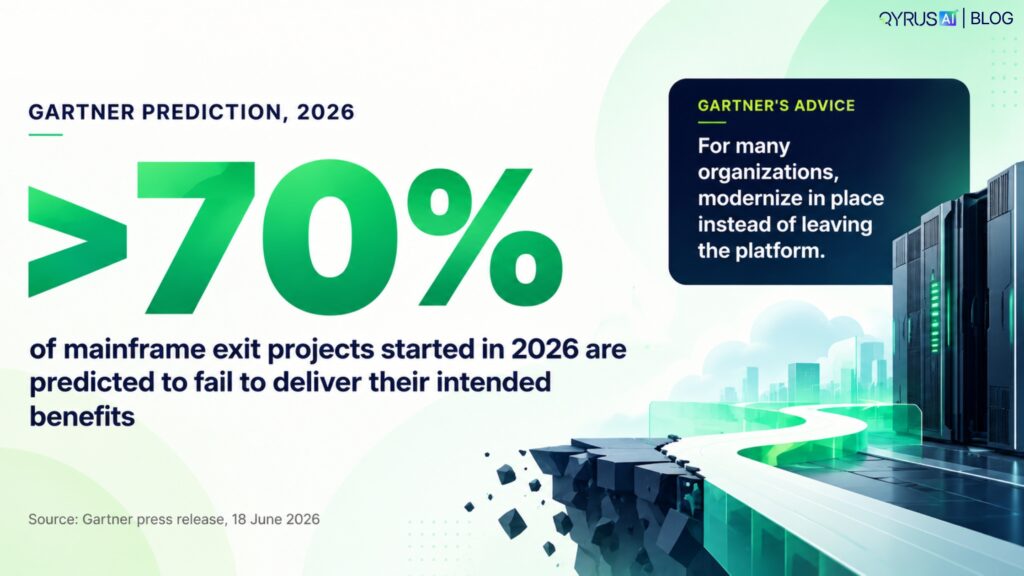
The main challenge is not selecting a tool but proving that the modernized application behaves like the original COBOL system. Gartner predicts that more than 70% of mainframe exit projects started in 2026 will fail to deliver their intended benefits, primarily because teams overestimate generative AI’s capabilities. AI can aid code interpretation, but it cannot establish that translated code preserves the original behavior. This guide covers modernization options, tools and a testing approach to move critical workloads and manage risks.
What is COBOL modernization?
COBOL modernization is the process of updating or transforming COBOL applications, which are usually legacy systems that remain vital to enterprise operations. IBM describes it as adopting current development practices, refactoring COBOL code to modern programming languages, or migrating to newer platforms.
It is system-level work, not a language swap. A COBOL application includes data structures in copybooks, batch jobs in JCL, transactions in CICS or IMS, and databases such as Db2 and VSAM. IBM says the work also covers data architecture, runtime replacement, transaction integrity and security. Translating the source alone leaves most of it undone.
Why modernize COBOL applications?
Teams modernize COBOL applications to connect them to modern systems, cut maintenance risk and release changes faster. The business logic is usually sound. The cost sits in everything around it. IBM lists four drivers:
- Connecting COBOL applications to modern infrastructure is complicated without APIs or middleware.
- Verbose code, outdated documentation and tight coupling make debugging and adding features slow.
- Security and compliance. Older code may lack current data privacy controls and the latest security patches.
- Delivery speed. Adding CI/CD pipelines and automated testing shortens release cycles.
None of these requires leaving the mainframe. Gartner recommends modernizing workloads in place for many organizations and keeping full exits for rare cases.
What are the main COBOL modernization approaches?What are the main COBOL modernization approaches?
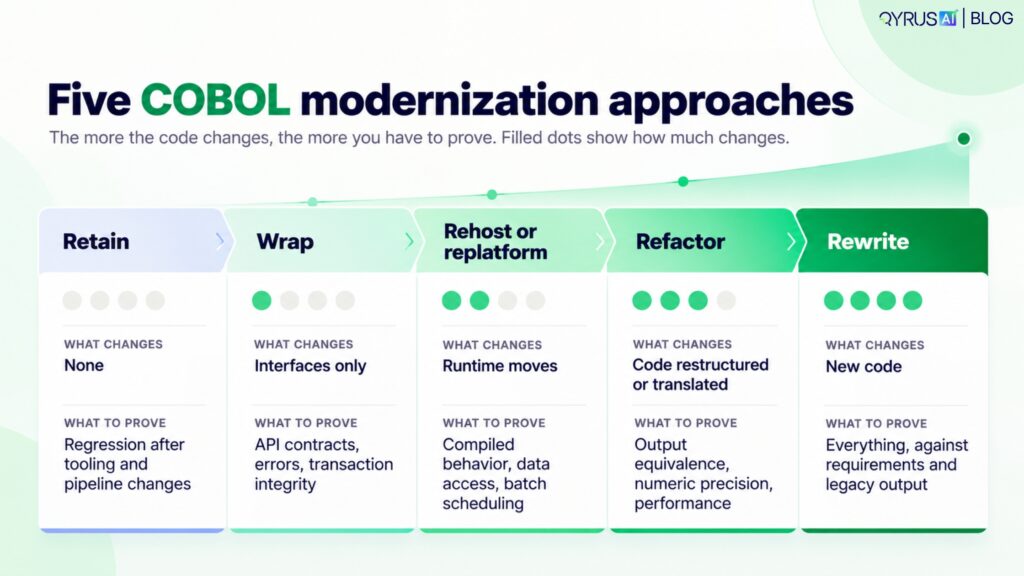
There are five approaches: retain, wrap, rehost or replatform, refactor, and rewrite. They differ in how much code changes and how much proof you need afterward. Most estates use several, applied workload by workload.
| Approach | What changes | Best for | What you must test |
| Retain | Nothing in the code. Tune, document and add DevOps practices | Stable, well-understood workloads with sound economics | Regression after tooling and pipeline changes |
| Wrap | COBOL stays. Business functions are exposed as APIs or microservices | Sound core logic that needs new channels or integrations | API contracts, error handling, transaction integrity |
| Rehost or replatform | Runtime or infrastructure moves. Source stays COBOL, often recompiled | Logic is stable but platform cost or skills are the problem | Compiled behavior, data access, batch scheduling |
| Refactor | Code is restructured, or translated automatically to Java or C# | High coupling or slow change blocks delivery | Output equivalence, numeric precision, performance |
| Rewrite | New code built from validated requirements | Unmaintainable code with business rules that are well understood | Everything, against requirements and against legacy output |
The rule for “rewrite or modernize” is simple. Rewrite only when you can state the business rules with confidence and the code is blocking change. If the rules are undocumented, the running COBOL program is your specification, and a rewrite will lose behavior nobody wrote down. Keep the code, wrap it or move it, and recover the rules first. Mapping dependencies first tells you which workloads sit in which row of this table.
AWS offers two of these patterns as managed options. Automated refactoring converts the application stack and data layer to Java while preserving functional equivalence, and replatforming keeps the COBOL on a Rocket Software runtime.
Should you use automated refactoring or a manual rewrite?
Use both, in different places. Automated refactoring is faster for bulk translation of stable code. A manual rewrite fits logic you are deliberately redesigning. Neither removes the need for equivalence testing.
| Factor | Automated refactoring | Manual rewrite |
| Speed on large codebases | Fast for bulk translation | Slow, scales with team size |
| Handling of undocumented rules | Translates them as written, errors included | Needs rules recovered first, which costs time |
| Numeric and data fidelity | Depends on the tool’s handling of packed decimals, rounding and encoding | Under your control, if the team knows the pitfalls |
| Resulting code | Can look like COBOL written in Java | Idiomatic and designed for the target |
| Skills needed | Reviewers who read both COBOL and the target | COBOL expertise plus target-language design |
| Audit trail | Tool-generated, needs review | Manual, depends on discipline |
The practical pattern is a hybrid. Let automation translate the stable bulk, give engineers the workloads with complex rules, and run both through the same equivalence tests. IBM says AI output must be verified and tested. Futurum adds that passing tests does not prove correctness when decades of undocumented edge cases encode business and regulatory rules.
How do you modernize COBOL in waves without disrupting operations?
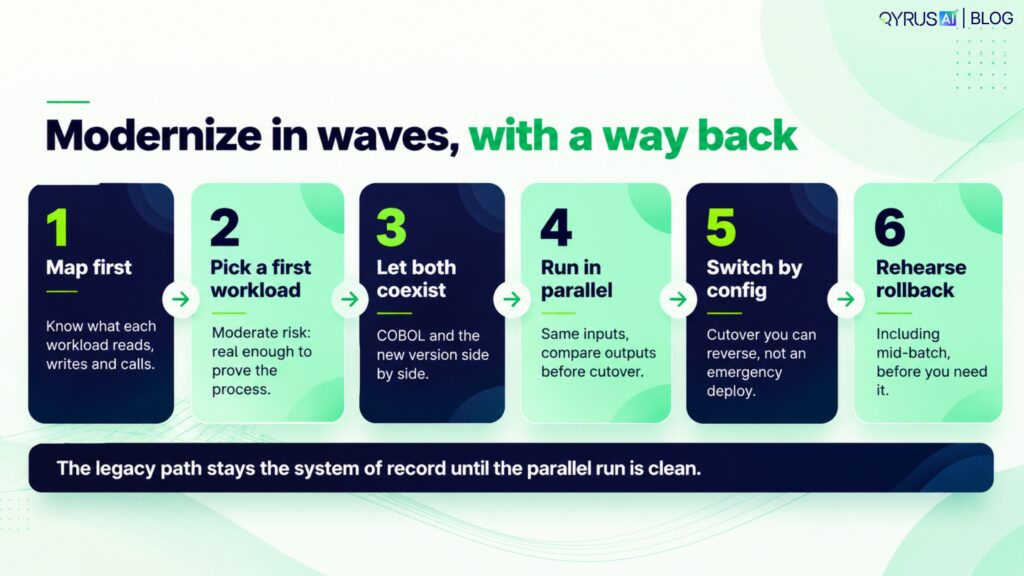
You cannot promise zero disruption, but you can limit it. Move one workload at a time, keep the legacy path running as the system of record, compare outputs, and make cutover a switch you can reverse. IBM’s advice is to start small, then scale gradually to critical modules using lessons from earlier phases.
A wave-based plan has six steps:
- Map first. Identify what each workload reads, writes and calls, so you know which workloads must move together. Workloads that write the same tables belong in the same wave.
- Pick a moderate-risk first workload. It should be real enough to prove the process and small enough to survive a mistake.
- Let both versions coexist. One documented COBOL-to-Java case ran the COBOL and Java versions of each billing algorithm side by side, converting and cutting over one function at a time rather than all at once.
- Run in parallel. Feed the same production-like inputs to both paths and compare outputs before any cutover.
- Make cutover a configuration change. Switching back to COBOL should be a controlled step, not an emergency deployment.
- Rehearse rollback. Reverting in the middle of a batch run can double-post transactions already processed by the new path, so test it before you need it.
This approach has overhead. Teams run two toolchains for a while, and a small system with modest volume and no regulatory exposure may be better served by a conventional rewrite.
What are the biggest COBOL modernization challenges?
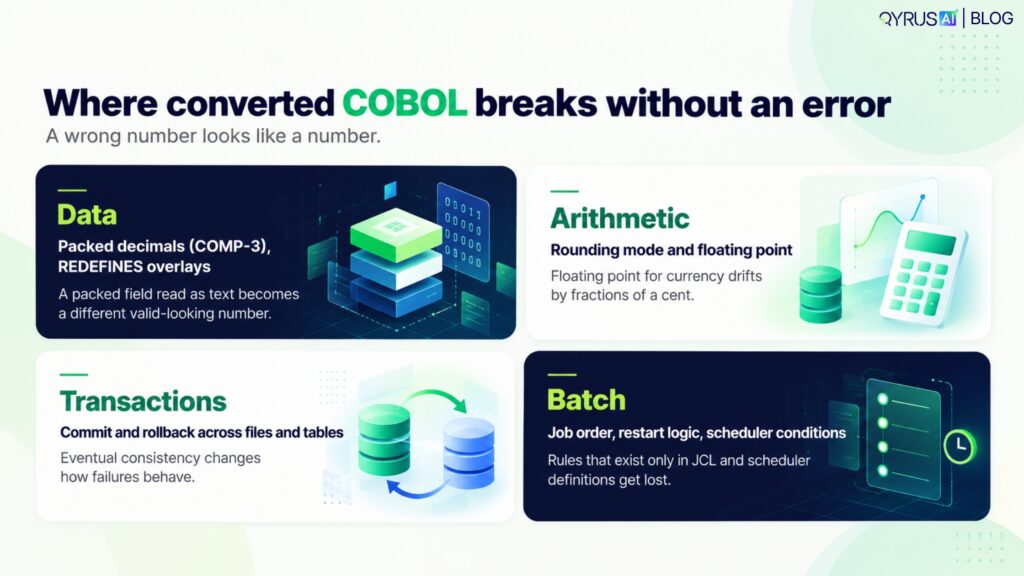
The biggest challenges are undocumented business rules, hidden dependencies, data and arithmetic differences between COBOL and the target, and scarce skills. The dangerous ones raise no error, because a wrong number looks like a number. Watch for these:
- Packed decimals. Amounts are often stored as packed decimal (COMP-3). Using floating-point types in the target introduces rounding errors. The HackerNoon case notes that using double is wrong for currency, and careless BigDecimal rounding causes fractional-cent discrepancies that compound across large customer bases.
- Character encoding. Mainframes use EBCDIC. Translation has to be decided field by field, because binary and packed fields must not be translated as text.
- The same storage can be read under several layouts. Modern languages have no direct equivalent, so each layout needs explicit handling and test coverage.
- CICS applications commit or roll back updates across VSAM and Db2 as one unit. Distributed targets often replace that with eventual consistency, which changes failure behavior.
- Batch logic. Job ordering, restart rules and scheduler conditions often exist only in JCL and scheduler definitions.
- Data access that was implicit in COBOL can become a database call on every invocation in Java.
Skills sit underneath all of these. Few people know both the legacy code and the target stack, so keep the people who know the legacy behavior involved until cutover.
How do you test modernized COBOL applications?
Test for equivalence, not only regression. Regression asks whether the new system passes tests written for it. Equivalence asks whether the modernized path produces what the legacy path produced from the same inputs, except where a difference was deliberately chosen and approved.
The method has three parts.
Compare at field level, not just totals. The HackerNoon case warns that comparing only final bill totals can miss two offsetting errors that cancel out. Diff every output field, including intermediate values.
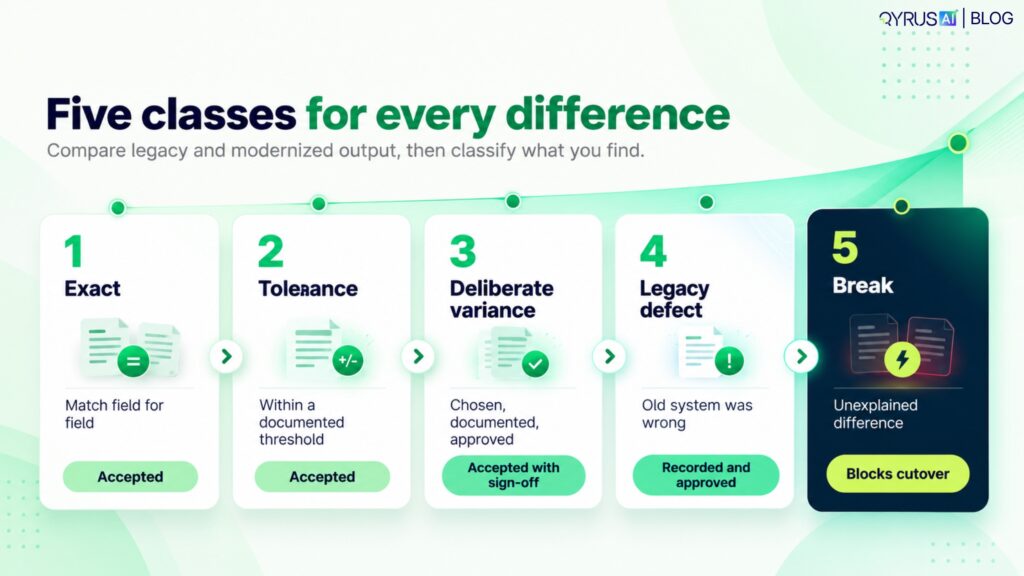
Classify every difference. A raw diff of millions of records is noise. Sorting differences into five classes turns it into evidence a lead, a risk officer and an auditor can all read:
| Class | Meaning | Effect on cutover |
| Exact | Legacy and modernized outputs match field for field | None |
| Tolerance | Difference within a documented threshold, such as a rounding convention | Accepted when documented |
| Deliberate variance | A difference that was chosen, documented and approved | Accepted with sign-off on record |
| Legacy defect | The old system was wrong and the new one is right | Recorded and approved so it is not mistaken for a regression |
| Break | An unexplained difference | Blocks cutover until resolved |
Run in parallel until the reconciliation report shows no unexplained differences. Keep the legacy path as the system of record, reconcile every cycle, and set the cutover criterion as an agreed number of consecutive clean cycles. Public examples show the idea but also its limits. A Mphasis engineer’s parallel-run proof of concept compared six positions in a single run, which is a demonstration of the method rather than evidence of production readiness.
Two more points. Test mainframe applications through APIs where you can, because screen-based scripts break when layouts change and reach only the data on screen. And include performance in the gate, since a correct but slower batch job can miss its window. Automated regression testing and end-to-end testing across layers cover the web and API layers around the mainframe core.
How do you reduce COBOL modernization risk?
Reduce risk by deciding with evidence, moving in small steps and treating proof as a gate. Use this checklist before each wave:- Dependencies are mapped, and workloads that share writes are in the same wave.
- Business rules are recovered and validated by someone who knows the domain, not inferred once and trusted.
- Each workload has a chosen approach, with retain and wrap treated as real options.
- Numeric rules are explicit: precision, rounding mode and encoding per field.
- Equivalence tests exist before any code moves, and the legacy path stays live until they pass.
- Rollback has been rehearsed, including mid-batch.
- Audit evidence is kept: who approved each variance and each cutover.
What are the best COBOL modernization tools and vendors in 2026?
The best tool depends on the job: understanding the estate, transforming code, running the new platform, or proving equivalence. Few products cover all four, so shortlist by category. QyrusAI is our product; the other entries come from vendor and analyst documentation, so confirm current details with each vendor before you commit.| Category | Tool | What it does |
| Comprehension and proof | QyrusAI | Maps programs, jobs, files and tables, recovers business rules for human validation, generates tests from them and reconciles legacy against modernized output. Works alongside transformation tools |
| Transformation | IBM watsonx Code Assistant for Z | Announced in 2023 to translate COBOL to Java on IBM Z, with automated testing and a semantic-equivalence check. Some functions depend on IBM’s Application Discovery and Delivery Intelligence |
| Transformation and managed runtime | AWS Mainframe Modernization with AWS Transform | Automated refactoring to Java that preserves functional equivalence, plus managed replatforming |
| Replatforming | Rocket Software (Enterprise suite, Visual COBOL) | Keeps COBOL source and moves the runtime to a managed or cloud platform |
| AI coding agents | Claude Code, Devin | Read and analyze COBOL codebases and can generate equivalent implementations. Anthropic positioned Claude Code on discovery, analysis and documentation in February 2026, and Devin’s documentation describes migration to Java, Python or C# |
How QyrusAI helps you modernize COBOL and prove the result
QyrusAI is an enterprise AI platform that helps organizations Modernize, Assure and Operate their critical systems. In a COBOL program, it works on both sides of the transformation step: before the code moves and after. In Modernize, QyrusAI reads source libraries, copybooks, JCL and database definitions through read-only paths and builds an Enterprise Knowledge Graph of programs, jobs, files, tables, transactions and dependencies. It resolves copybook and procedure expansion, DD-to-dataset mapping and dynamic calls before it proposes business rules, and a person validates each rule. The outputs are a business-readable design document, a dependency graph, and a business rules catalog. This is the evidence behind the approach decisions in the table above, described in more detail in our discovery-first approach to legacy modernization. In Assure, tests are generated from the validated rules, so verification starts from the same record that shaped the plan. QyrusAI compares legacy and modernized outputs with the five-class reconciliation described above, and tests mainframe applications through APIs rather than screens. Database checks use read-only credentials, so QyrusAI can query and validate without changing data. QyrusAI does not replace your transformation tool. It works alongside the engine or partner you choose and supplies the context before the move and the proof after it. It works today on z/OS and IBM i estates, and other platforms are scoped per engagement.Prove it before you cut over
COBOL modernization succeeds when each workload gets the approach that fits it and each move is proved against the legacy path. Map first, choose per workload, move in waves, and treat unexplained differences as blockers. QyrusAI supplies the comprehension before the move and the equivalence evidence after it. Request a demo to see how QyrusAI documents your COBOL estate and generates tests from the rules it recovers.Frequently asked questions
Should we rewrite or modernize our COBOL applications?
Can we modernize COBOL without downtime?
How long does COBOL modernization take?
Can AI convert COBOL to Java reliably?
How do you test COBOL-to-Java output?
What should we modernize first?
Do we have to leave the mainframe to modernize COBOL?
Stay Ahead, Stay in the Loop with QyrusAI!
One Platform for Modernization, Quality Assurance and Intelligent IT Operations.
 November 3, 2026
 13 min