Why Regulated SAP Environments Need Test Orchestration, Not Just Test Automation
 Varun RS
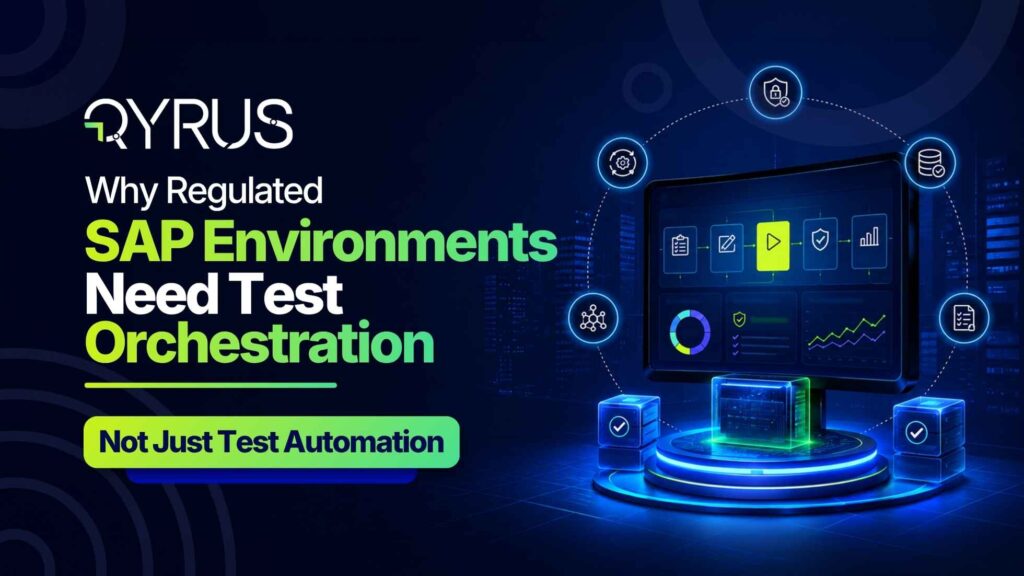
In heavily regulated sectors, telling a compliance officer that a test passed is essentially meaningless. The mandate isn’t about simple binary outcomes. It is about proving to an internal audit committee or a federal regulator that the exact right tests ran in the correct sequence before any code modification touched the production environment.
This is fundamentally an evidence and sequencing problem. Basic automation answers a very narrow question. It tells you if a button works. It does not verify the holistic integrity of an entire SAP release.
For banks, insurers, and manufacturing firms bound by stringent controls, the gap between simple test execution and complete release orchestration is where massive compliance risks hide. A modern enterprise resource planning environment connects countless third-party applications, external data lakes, and legacy mainframes.
The capacity to bridge technological eras from traditional mainframes to contemporary NoSQL settings is the hallmark of a robust quality assurance approach. Through the use of agentic orchestration methods, organizations create a flexible structure that addresses present operational needs and future technology incorporation.
Automation vs. Orchestration: The Distinction That Matters in SAP
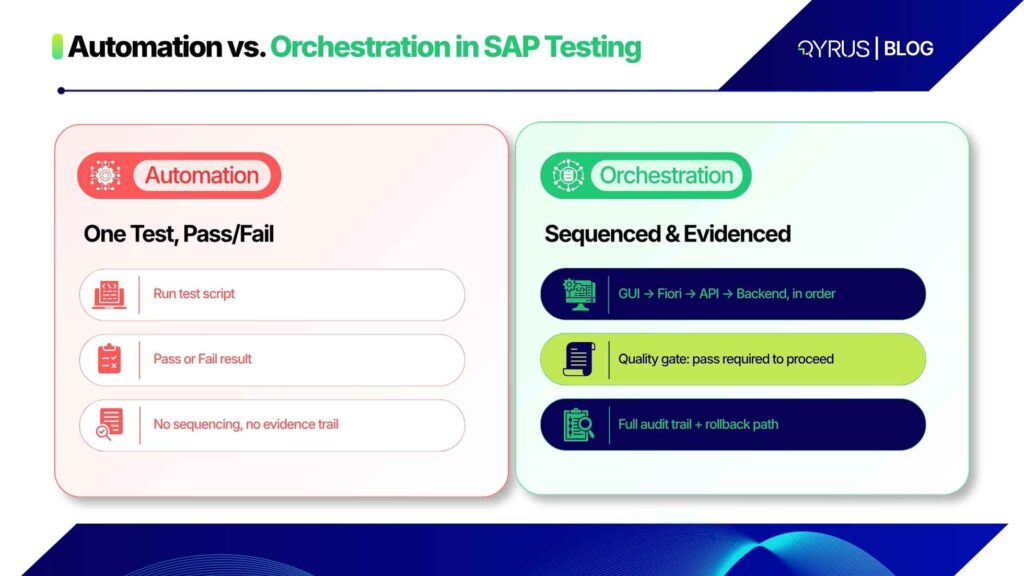
In complex enterprise architectures, grasping the technical difference between automating a script and orchestrating a release cycle is essential for maintaining operational stability. Automation focuses strictly on executing isolated test cases.
An engineer writes a script to interact with a specific user interface, fill out a standardized form, or ping an application programming interface endpoint. The testing tool then reports a simple pass or fail status. While this approach is useful for localized component checks, this isolated methodology falls apart completely when confronted with cross-functional business processes.
Consider a standard Order-to-Cash workflow within a large organization. This process rarely lives inside a single application boundary. It typically spans the legacy SAP GUI for initial order entry, transitions to a modern Fiori web portal for managerial approvals, requires outbound API calls to third-party logistics providers, and finally updates core backend financial databases. Automation simply tackles one of those localized steps independently.
Test orchestration manages the entire sequence from end to end. It ensures that step two only triggers if step one successfully writes the correct state to the underlying database. Orchestration coordinates intelligent quality gates, applies necessary compensation steps if a connected system is temporarily unavailable, and captures immutable evidence at every single phase of the journey.
Instead of just asking if the code works, orchestration asks if the business process survives the code change. It actively manages the dependencies, the environment variables, and the asynchronous data handoffs that define modern enterprise software. This broader scope is what allows engineering teams to move beyond basic maintenance and start deploying highly complex integrations with absolute confidence.
What Regulated Industries Actually Need From SAP Testing
The financial services sector provides the starkest example of why basic pass and fail metrics are insufficient for modern software delivery. In this environment, software quality assurance is fundamentally a governance and risk management function. The financial stakes for any system failure are exceptionally severe.
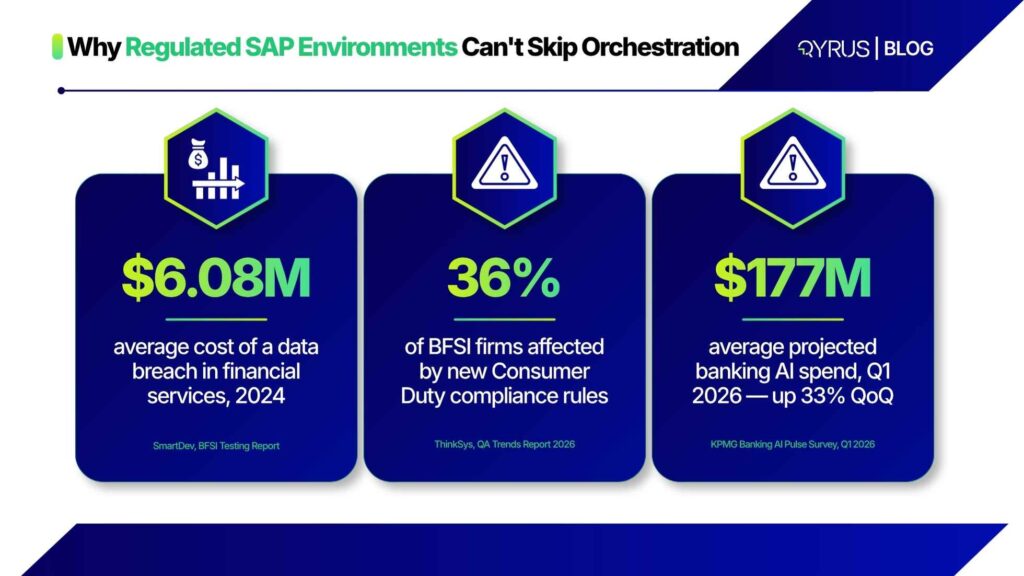
In 2024, the average cost of a data breach in the financial sector surpassed $6.08 million, according to data from IBM’s annual security analysis. This figure is significantly higher than non-financial industries because a single faulty integration update can disrupt vital loan approvals or corrupt cross-border transaction ledgers.
Changing legal frameworks are also forcing strict discipline onto technical teams. New compliance rules like the Consumer Duty regulations currently affect roughly 36% of BFSI firms. These mandates create a strict requirement for compliance-ready testing trails where every single code change is thoroughly documented and linked directly to a specific business requirement.
The pressure on quality engineering teams is accelerating rapidly as banks invest heavily in new predictive technologies. Average projected AI spend across banking organizations reached $177 million in the first quarter of 2026, as detailed in recent KPMG banking reports.
Implementing advanced intelligence securely at this magnitude necessitates what industry analysts refer to as governed intelligence. This idea encompasses the integration of automated testing within enterprise workflows, ensuring total observability and full traceability.
Regulators demand a continuous audit trail demonstrating that an SAP transport received thorough, sequential validation prior to implementation. They anticipate comprehensive records indicating precisely who authorized a release, what information was utilized for validation, and how the system performed under simulated stress. Orchestration provides the infrastructure to capture this vital governance data automatically.
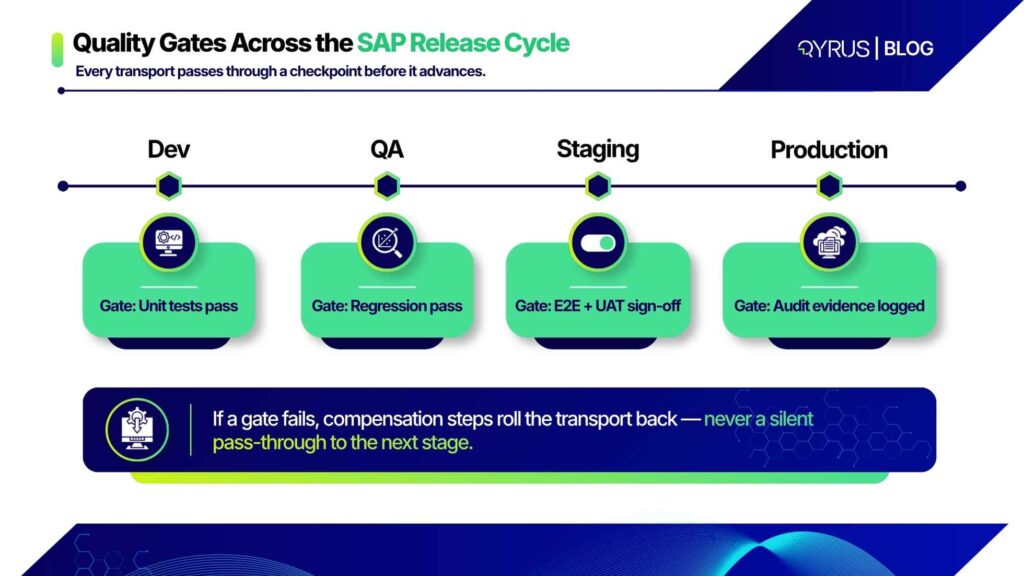
Quality Gates and Compensation Patterns for SAP Release Management
Dependable SAP release management is strongly dependent on programmatic quality checkpoints connected directly to the transport lifecycle. As a newly set up transport transitions from the Development stage to Quality Assurance, then to Staging, and finally to Production, it must undergo thorough orchestration evaluations.
If a transport does not pass a certain validation checkpoint, the orchestration system must automatically invoke a Saga pattern or a compensation transaction to stop incomplete data commits from damaging the testing environment.
For example, if an orchestrated test successfully creates a new vendor record in the SAP database but fails the subsequent validation check in a connected customer relationship management tool, a compensation pattern automatically rolls back that specific vendor creation.
This mechanism maintains strict state consistency across the entire integrated environment. It prevents bad data from silently polluting downstream systems. It is highly beneficial for teams exploring different test data management strategies to maintain clean testing pipelines.
Similarly, orchestration platforms utilize advanced circuit breakers during the environment promotion phase. If a downstream integration API is unresponsive during a staging test, the circuit breaker halts the transport promotion immediately.
This prevents the continuous integration pipeline from attempting repeated doomed executions or pushing flawed code forward into a production state. Such a detailed level of control is critical for any SAP S/4HANA migration performance testing initiative, where maintaining data integrity is the utmost priority. Applying these particular patterns converts a delicate testing pipeline into a robust release mechanism capable of managing the unpredictable characteristics of hybrid cloud environments.
How Qyrus Orchestrates SAP Testing End-to-End
To understand the true operational impact of this approach, we can examine the recent transformation of a major North American Coca-Cola Bottler. This enterprise required seamless validation across a highly complex logistics network utilizing legacy SAP GUI interfaces, modern web portals, and mobile delivery applications used by drivers in the field. They deployed the Qyrus platform to implement true end-to-end test orchestration across their entire technical footprint.
Utilizing a sophisticated desktop recorder designed specifically for SAP GUI environments, the engineering team mapped out their most complex supply chain workflows.
A critical component of their ultimate success was the direct integration of the Qyrus Data Hub, which provided dynamic data handling capabilities. Instead of relying on static spreadsheets that break easily, the orchestration engine captured unique shipment identifiers at runtime and passed them sequentially through the entire mobile delivery sequence.
Security and environment access were managed natively through the Qyrus Vault. This feature secured environment hierarchies and managed automated credential injection without ever exposing sensitive passwords or tokens in the testing logs. The platform also automatically generated complete PDF reporting for internal audits, capturing detailed screenshots and network payloads at every single step of the execution.
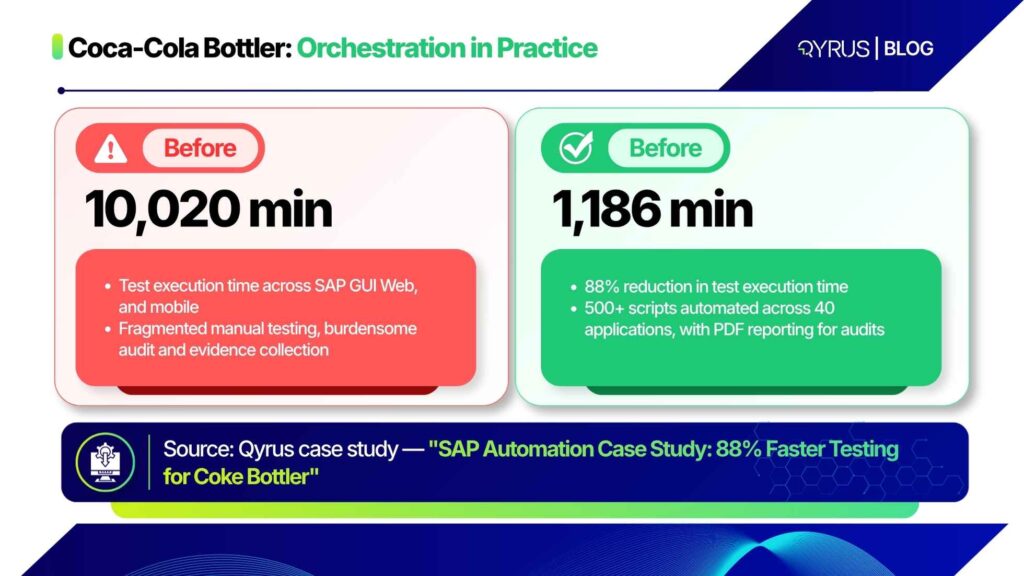
This shift to a modern AI test orchestration platform to modernize enterprise QA resulted in significant efficiency improvements. It decreased their total test execution duration by 88%, shortening a procedure that once required 10,020 minutes to merely 1,186 minutes. They effectively coordinated more than 500 scripts among 40 various integrated applications.
The Future of SAP Quality Governance
The conversation surrounding enterprise quality engineering is shifting rapidly. The most pressing question for technical leadership is no longer whether a specific automated script can execute successfully in a silo. The core requirement is proving, with an immutable audit trail, that the exact correct sequence of validations occurred before a release was authorized for production. This operational reality is especially true given the growing need for automated app testing for financial software where federal regulatory scrutiny is a constant factor in daily operations.
Integrating artificial intelligence and high-speed automation into your delivery pipelines requires the underlying discipline of orchestration to maintain safety and compliance. You cannot scale deployment velocity without scaling your governance mechanisms simultaneously, a core principle in understanding continuous testing in DevOps.
When your next SAP module update requires validation, you must ensure your platform can provide the exact evidence your governance officers demand. Building quality gates into your pipelines is the only reliable way to protect your production data from the risks of continuous delivery.
Talk to us about orchestrating SAP release evidence for your compliance team.
 September 16, 2026
  7 min
7 min