How QyrusAI Enables FinOps with Continuous Cost Visibility, Governance & Automation
 Vivek Tumulu
Creating a FinOps Strategy that supports your business agenda without breaching the limits is as hard as it sounds. We have helped our clients and worked on our internal infrastructure and let me tell you it is a headache, but we saw that problem and built our solution around it, so next time it’s easier.
To give you the most effective advice, think of a cost alert as a relay race. Finance sees the number go up and picks up the baton. Engineering owns the workload, so the baton must reach them. The product knows whether the cost is worth it. Operations know what is risky to touch. Every handoff is a chance to drop it, and the baton rarely carries much: usually a number and a date.
This QyrusAI guide covers the specifics of the handoffs. If you want to understand the basics of allocation, budgeting, tagging and optimization work, our complete FinOps guide covers them. FinOps works best for the company when cost awareness becomes part of everyday engineering, product, and financial decisions.
The real FinOps problem is insight without action
FinOps is designed to answer one question well: what did we spend?
But the four questions that matter? Those live in different departments, with different tools, different data models, and different priorities.
Question | Owner | Their Data | Time to Answer | Typical Result |
Why did spend change? | Finance (billing) + Engineering (workloads) | Cost aggregations + infrastructure metrics | 3-5 days | Spreadsheet analysis post-month-close |
Who owns it? | Infrastructure team + tagging governance | Tag labels + manual records | 1-2 weeks | 35-60% of spend remains “unattributed” |
Which business service does it affect? | Product + Application Architecture | Service catalog + deployment records | 1-3 weeks | Vague: “something related to payments” |
What can we change safely? | Operations + SRE + Engineering | Dependency graphs + runbooks | 2-4 weeks | “Let’s test this on dev first” (costs remain unoptimized) |
This path is getting longer. In the FinOps Foundation’s 2026 survey, 98% of practitioners said they manage AI spend, 90% manage SaaS, 64% manage licensing and 48% manage data centers. The Foundation now describes its mission as maximizing the business value of technology, not only cloud. More kinds of spend mean more runners and more batons.
Each cost type has different owners, different tools, different rhythms. A single cost event now involves:
- Cloud provider APIs (for billing)
- Kubernetes monitoring (for container costs)
- AI provider consoles (for token usage)
- SaaS vendor dashboards (for seat counts)
- On-premises asset tracking (for CapEx depreciation)
- Multiple business unit forecasts (for demand planning)
Nobody sees the whole picture. And nobody owns connecting the dots.
The QyrusAI: The problem isn’t data scarcity It’s data fragmentation. Your company usually has all the information needed to make smart cost decisions. It’s just distributed across 8-12 different systems, owned by different teams, updated at different frequencies, in different formats.
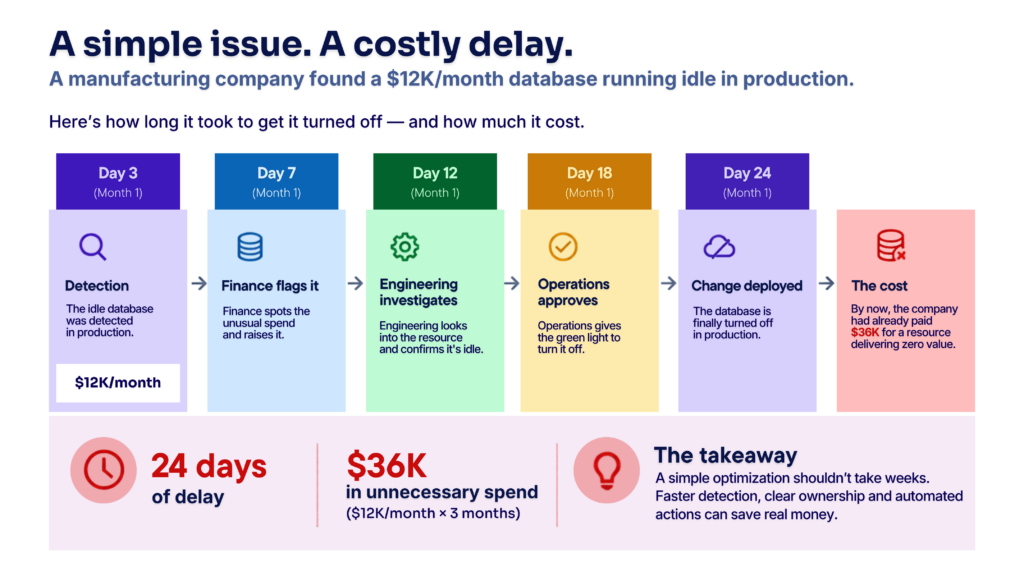
Let’s look at this closely on why cost handoffs fail
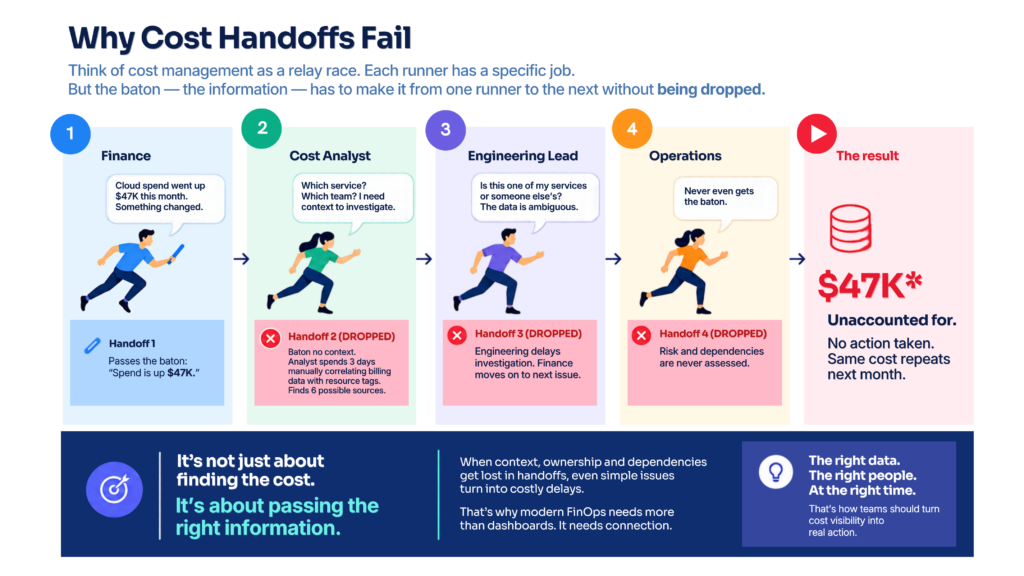
The Problem with Current FinOps Approach
- Billing dashboard shows what was spent
- Tags determine ownership (if they exist)
- Recommendations are lists, not ranked by impact/effort/risk
- Approval workflows are generic, not context-aware
- Automation is all-or-nothing (automate everything or nothing)
- Success measured by tools used, not by outcomes achieved
QyrusAI Operating Approach
- Live discovery shows what is running and what changed
- Dependencies + telemetry infer ownership (tags are validation, not primary)
- Recommendations ranked by savings, effort, risk, and business alignment
- Workflows route to right approver based on change type, risk, environment
- Automation respects guardrails; easy-to-undo actions are auto-approved
- Success measured by realized savings and time-to-resolution
QyrusAI is built to be the connective layer. It links cost data, technical context, ownership and action, so the baton arrives with everything the next runner needs.
The QyrusAI operating loop
The current FinOps models describe phases a team moves through over months. But with QyrusAI It’s different. It is a loop that runs all the time, one cost signal at a time.
Stage | What QyrusAI Does | Data Source | Output |
1. OBSERVE | We continuously scan cloud, SaaS, on-premises, AI providers for new resources, usage changes, cost spikes. To help build live map of your infrastructure. | Cloud APIs, SaaS dashboards, licensing databases, AI provider logs, infrastructure monitoring | Cost anomalies, new resources, idle resources, usage trends |
2. EXPLAIN | For each cost signal, trace root cause we can differentiate which service? which feature? which business unit? Using dependencies, tags etc. | Dependency graph, tag mappings, application metadata, resource utilization metrics | “Database X increased 40% because feature Y had 5x more user traffic” |
3. ASSIGN | Identify accountable owner and route alert with full context. Multiple routing rules (team owner, cost center, business unit, on-call engineer). | Ownership mappings, service catalog, org chart integrations | Alert to Engineering Lead + Finance Partner with details attached |
4. DECIDE | For identified waste or inefficiency, the QyrusAI generates ranked actions. In order of savings amount, effort level, risk score, prerequisites, dependencies. | Historical optimization data, current system state, business rules | Option to Right-size database (save $8K/month, low risk, 2-hour work) |
5. ACT | Execute approved actions through workflows. Low-risk actions can be auto-approved. Medium-risk need owner sign-off. High-risk need multiple approvals along with a rollback plan. | Approval workflows, policy rules, risk scoring | Database is resized; and idle resource is stopped. |
6. VERIFY | Check that action had intended effect. Did cost go down? Did performance stay stable? Is savings holding one week later? One month later? | Post-action metrics, cost tracking, alerting, performance monitoring | “Savings verified: -$7,800/mo; latency stayed at baseline” |
The last step matters most and gets skipped most. A saving that isn’t checked later is only a guess.
Get Complete visibility
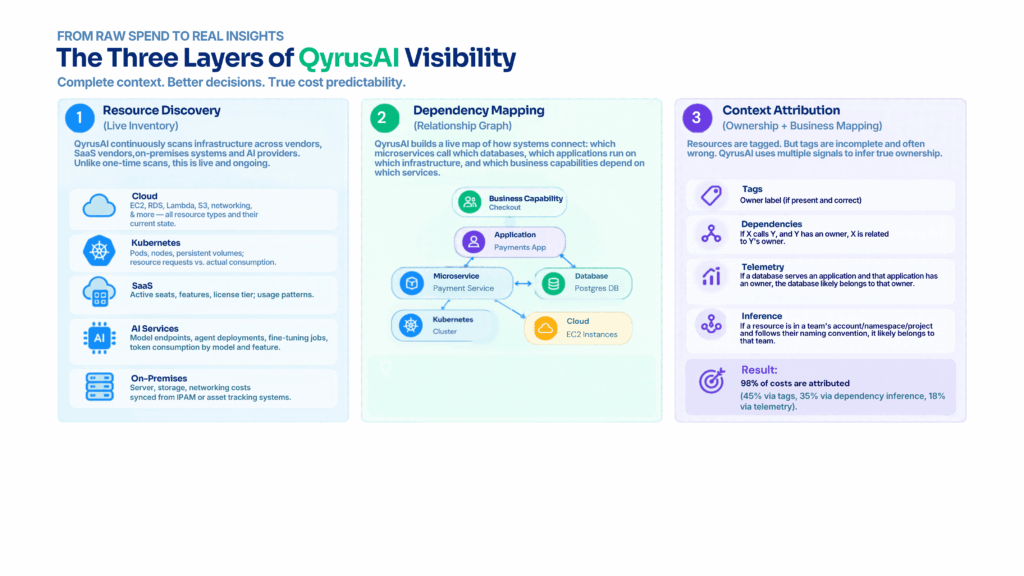
Visibility should just be limited to a screen full of numbers. Useful visibility should tell you what a cost belongs to and what depends on it.
Here is what QyrusAI builds by taking a step beyond:
- Continuous discovery of cloud, hybrid, SaaS, licensing and AI-provider spend, so the picture is not a monthly snapshot.
- A dependency map that shows which applications, services and infrastructure rely on each other, and which business service sits on top.
- Contextual attribution for resources with missing or wrong tags. It uses ownership information, telemetry and dependency links to work out who the cost belongs to.
- Cost flows across shared platforms, so a shared cluster or service doesn’t become one big bill with no owner.
- A common cost format. Data is organized using FOCUS, the open cost and usage specification, which makes spending from different providers comparable.
The key difference is that this visibility is backed by dependencies, not only by tags. Tags are labels people add by hand, and people forget. Dependencies show how systems behave.
Let’s say spend rises in a Kubernetes environment that fifteen teams share. On a normal dashboard, you see one larger number for the cluster.
With dependency-backed visibility, the path looks different:
- QyrusAI sees the rise and checks which workloads change.
- It traces the increase to one service and recent deployment.
- It finds that the service supports an AI summarization feature used by the claims team.
- It names the owning team and the business capability affected.
The baton now carries a service, a cause, an owner and a business reason. The next runner can move.
Governance at the point of decision
Most governance happens in meetings, after the money is spent. The better place for it is the moment someone is about to decide.
QyrusAI puts checks at four moments:
- Before deployment: Policy checks and guardrails catch choices that break cost rules, like a resource that exceeds a team’s limit.
- While running flags cost spikes and automatically alert the responsible team.
- Before optimization each action gets a risk, check and is routed to the right approver.
- After the action confirms expected savings the result and keeps logs for every action for compliance.
Not every action deserves the same care. A simple way to think about it:
Type of decision | Example | How it is governed |
Low risk, easy to undo | Stop an idle development environment | Automated by policy |
Medium risk | Right-size non-critical service | Recommendation, then owner approval |
High risk | Change production database capacity | Impact simulation, approval and a rollback plan |
Affects the business | Change an AI model tier or retire a feature | Requires joint approval across Product, Finance, and Engineering. |
The same action can sit in different rows depending on where it happens. Stopping a server may be automatic in development and need approval in production. QyrusAI uses this context, including environment, owner and dependencies, to choose the path. It is also why Guardrails and Approvals work as parts of one system and not as separate tools.
Automation with judgment
Automation has a bad reputation in cost work and we can completely agree on that. Bad scripts often trigger outages that cost far more than the savings they generate. QyrusAI accelerates decision-making rather than bypassing human review entirely.
If a production AI agent starts failing on one step and retrying it. Each retry uses more tokens. Your monthly bill will show a massive charge without explaining why. Here is how our workflow catches it early:
- Observe. AI Workloads shows token use climbing for one agent workflow.
- Explain. QyrusAI identifies the agent, the model, the workflow and the feature involved, and shows that retries, not new users, caused the rise.
- Assign. The alert goes to the team that handles the agent, with the details attached.
- Decide. QyrusAI suggests options: fix the retry logic, route simple requests to a lower-cost model, or apply a usage restriction.
- Act. The owner picks an option and approves it through a new workflow.
- Verify. The platform checks that cost per completed outcome fell, and the feature still works.
This matches what industry groups recommend for AI spend. The FinOps Foundation’s guidance suggests tracking cost per unit of work, costs per GPU hour and cost per token because AI costs shift with fast-changing engineering and pricing choices. Cloud providers are moving the same way: Google Cloud has added spend caps and AI cost visibility for the same reason.
Four use cases
Shared platform cost ownership
The problem: Many teams use one Kubernetes, data or integration platform, and cost shows up only at the platform level.
How QyrusAI helps.
- Maps workloads to teams and business services.
- Allocates shared cost using usage, dependency and ownership signals.
- Shows idle capacity and requests that are larger than needed.
- Sends optimization actions to the people who own the workloads.
The result. Shared infrastructure stops acting like a pool of cost nobody owns.
AI feature cost control
The problem. The AI invoice goes up, and nobody can say whether the cause is a new feature, expensive model calls, retries or one customer workflow.
How QyrusAI helps.
- Our model AI spends down by model, agent, feature, team and use case.
- Tracks token use, retries and cost per completed outcome.
- Flags workflow with many retries or little value.
- Suggests model routing, prompt changes, caching or usage of guardrails.
The result. AI becomes a product cost you can measure, not a single unexplained line.
Migration and modernization cost control
The problem. Workloads that move to a new platform are often oversized or inefficient after cutover, and the early savings drift away.
How QyrusAI helps.
- Uses dependency information to plan migration waves in a safe order.
- Watches newly migrated resources from day one.
- Applies ML-based capacity forecasting and Auto-Optimize as the environment settles.
- Catches cost drift before it becomes the new normal.
The result. Migration savings don’t quietly disappear after go-live.
Forecasting planned change, not only past spend
The problem. A forecast built from last quarter can’t see next quarter’s migration, launch or AI rollout. The FinOps Foundation’s forecasting guidance recommends combining historical cost and usage with planned infrastructure, application and demand changes.
How QyrusAI helps.
- Combines past spend with live usage, dependency changes and planned technical work.
- Models the cost impact of migrations, launches, environment changes and AI feature rollouts.
- Gives Finance a forward view that reflects what engineering is actually planning.
The result. Forecasts become inputs to planning, not a report on what already happened.
What makes QyrusAI different
Area | Typical FinOps tooling | QyrusAI approach |
Visibility | Account, service and tag views | Dependency-aware views across cloud, SaaS, licenses and AI |
Attribution | Tag-based or manual allocation | Context-based, using ownership, telemetry and dependencies |
Recommendations | Long lists of ideas | Ranked actions based on savings, effort and risk |
Governance | Budget alerts and policies | Context-aware guardrails and approval workflows |
Automation | Scripts or manual engineering work | Governed workflows with people in the loop |
AI cost | Provider invoice totals | Model, agent, feature, token, retry and outcome views |
Change impact | Analysis after the change | Simulation before the change reaches the bill |
How to put this into practice
You don’t need to switch everything on at once. A sensible order looks like this:
- Connect your sources. Cloud providers, SaaS, licensing, on-premises infrastructure and AI providers.
- Build the live picture. Discover resources and map applications, dependencies, teams and business services.
- Set ownership rules. Name a primary and a backup owner for each area and decide how shared costs get split. Start with showback and move to chargeback only when teams trust the numbers.
- Turn on detection and ranking. Enable anomaly detection, recommendations and risk scoring.
- Set up governance workflows. Define policies, thresholds, approvers, exceptions and audit needs.
- Begin with safe automation. Start with actions that are easy to undo. Expand to production only after your guardrails and rollback steps have proven themselves.
- Measure what actually happened. Track results, not activity.
What success looks like
Outcome | What it means in practice |
Faster resolution | Alerts arrive with a likely cause and an owner |
More confidence in allocation | Less spend is left unowned or untagged |
More recommendations acted on | A short, ranked list replaces a backlog nobody opens |
Safer optimization | Simulation and approvals protect reliability |
Savings that last | Results are checked after the action |
Better AI economics | Teams can see cost by feature, agent, model and retry |
What to expect, and what to check
We would want you to hear this from us than find it out later.
- Results depend on your data. Your output depends entirely on data quality. Plan to spend the first few weeks plugging gaps in your connected sources.
- People still make the decisions. QyrusAI recommends and helps with routing them. Your owners approve the actions that carry risk.
- Start small in production. Begin with reversible actions and widen the scope as trust grows.
- We don’t promise a savings number. We won’t promise arbitrary savings numbers upfront. Baseline your current spending first so you have a realistic benchmark.
- Culture still matters. A tool can’t make teams care about cost. It can make caring easier by putting the right information in front of the right person.
The takeaway
Spotting a cost problem is the easy half. The hard half is getting it to the right person, with the right context, and fixing it safely without slowing anyone down.
That is the job of the operating loop: observe, explain, assign, decide, act, verify. Each stage carries the baton a little further, and the last one makes sure it didn’t get dropped after the finish line.
See how QyrusAI turns cost visibility into governed action. Book a FinOps readiness review to find out where spend has no owner, which dependencies drive your costs, and which optimizations are safe to automate.
Frequently Asked Questions
How does QyrusAI handle untagged or shared resources?
Can QyrusAI automate optimization in production?
How does QyrusAI connect cost to business value?
What makes AI cost management actionable in QyrusAI?
How does QyrusAI stop savings from disappearing?
Stay Ahead, Stay in the Loop with QyrusAI!
One Platform for Modernization, Quality Assurance and Intelligent IT Operations.
 November 3, 2026
 13 min