
Why SAP Testing Breaks at Scale: The Hidden Cost of Brittle Automation
 Varun RS

Introduction: SAP Automation Works Until the Environment Starts Changing
An SAP team successfully automates a set of critical business processes. Initial results are highly positive: regression cycles become faster, manual effort decreases, and the suite appears to deliver exactly what was expected.
Then, the environment changes.
An SAP Fiori application is updated, altering its document object model. A mandatory release shift modifies transaction flows. A dynamically generated field alters its internal identifier. A third-party integrated app changes its API, or a business process is modified to meet new compliance rules. Suddenly, previously working tests begin failing. The end-user could likely execute the transaction without issue, but the automation itself can no longer recognize or interact with the application reliably.
SAP test automation rarely fails because automation is an ineffective concept. It fails due to the automation method frequently relying too much on components, scripts, and assumptions that ultimately shift as the SAP landscape advances. Test scripts grow fragile when they rely too much on static UI components, predefined locators, and particular application frameworks.
The main argument outlining modern enterprise quality assurance is evident: as the SAP landscape expands and becomes increasingly dynamic, maintaining fragile automation becomes more costly. What starts as a controllable regression suite can swiftly transform into a significant maintenance challenge amidst dynamic Fiori applications, S/4HANA release timelines, and complex system integrations.
What Makes SAP Testing Different?
Enterprise leaders often underestimate the complexity of SAP testing, assuming it is standard browser testing applied to a larger application. However, modern SAP environments are highly complex ecosystems. They simultaneously encompass SAP S/4HANA, SAP Fiori, SAP SuccessFactors, SAP Ariba, custom ABAP applications, and third-party enterprise platforms like Salesforce.
More importantly, individual SAP transactions frequently participate in larger business processes:
- Order-to-Cash: Salesforce → SAP S/4HANA → SAP Inventory → SAP Billing → Payment
- Procure-to-Pay: SAP Ariba → SAP S/4HANA → Purchasing → Supplier Finance
- Hire-to-Retire: SAP SuccessFactors → SAP S/4HANA → Payroll → Employee Lifecycle
A test may pass at the individual application level while the overall business process still fails. For example, an automated script might successfully input data into a Fiori purchase order screen, but if the downstream financial ledger isn’t updated, the process is broken. Scalable SAP testing must understand applications, objects, integrations, and overarching business processes together.
Why Traditional Locators Struggle with SAP Fiori
The shift to SAP Fiori brought a new level of complexity to automation. Fiori’s contemporary, web-oriented framework depends extensively on dynamic, metadata-based rendering, which consistently weakens conventional test automation tools.
The locator problem
Conventional UI automation often relies on fixed identifiers such as XPath expressions, CSS selectors, and HTML IDs. These deterministic approaches work effectively when application structures remain strictly stable. However, SAP Fiori applications involve dynamically generated elements and metadata-driven interfaces that render differently based on context. Addressing these SAP Fiori test automation issues are essential since a test script may rely on a particular identifier today, but that identifier could completely change following a small application update. The button remains, the business process is the same, yet the automation does not succeed.
Why dynamic IDs create maintenance overhead
The use of dynamic UI5 frameworks means that elements receive generated IDs that change unpredictably. A control ID that renders as __xmlview1 during one session might render as __xmlview0 during the next. This dynamic generation immediately breaks any locator tied to the original string. This leads to a devastating maintenance chain: application change → locator changes → test failure → investigation → manual script update → retest → regression execution.
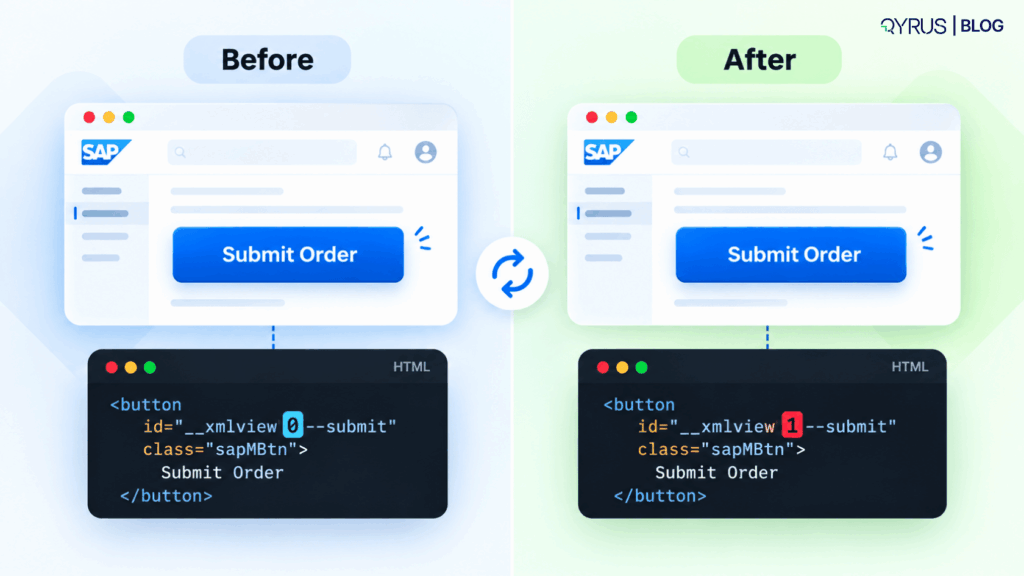
The Hidden Cost of Brittle SAP Automation
When an enterprise relies on fragile test scripts, the financial and operational tolls compound, directly contributing to the high failure rate of ERP implementations across the industry.

Test script maintenance
When scripts fail, highly skilled QA engineers are forced to spend substantial time identifying failed tests, manually determining whether the failures represent real product defects or automation decay, updating locators, revalidating scripts, and maintaining test data.
Regression cycle delays
When an automation suite requires significant manual maintenance before every major release, it loses its primary benefit: speed. Instead of seamlessly moving from build to execution to analysis, teams must halt CI/CD pipelines to repair and validate automation scripts, delaying release cycles.
False failures
Brittle automation routinely creates failures unrelated to actual application defects. This leads to noisy test results, increased investigation time, and drastically reduced confidence in the automation. Genuine, critical business defects can easily get buried in the noise and leak into production.
Opportunity cost
The biggest hidden cost is what teams cannot accomplish because their capacity is entirely consumed by script maintenance. Instead of improving risk-based testing, validating new business processes, or refining release quality, engineers spend their time keeping legacy scripts barely functional.
Regression Testing: Where the Problem Multiplies
The maintenance burden of brittle automation scales exponentially in enterprise regression suites. A minor UI change does not necessarily mean only one test case needs updating. In interconnected SAP environments, the same application component is frequently utilized by multiple business processes, different test environments, and various user roles.
One SAP change → Multiple affected objects → Multiple test cases → Regression failures → Manual investigation → Automation maintenance → Delayed release.
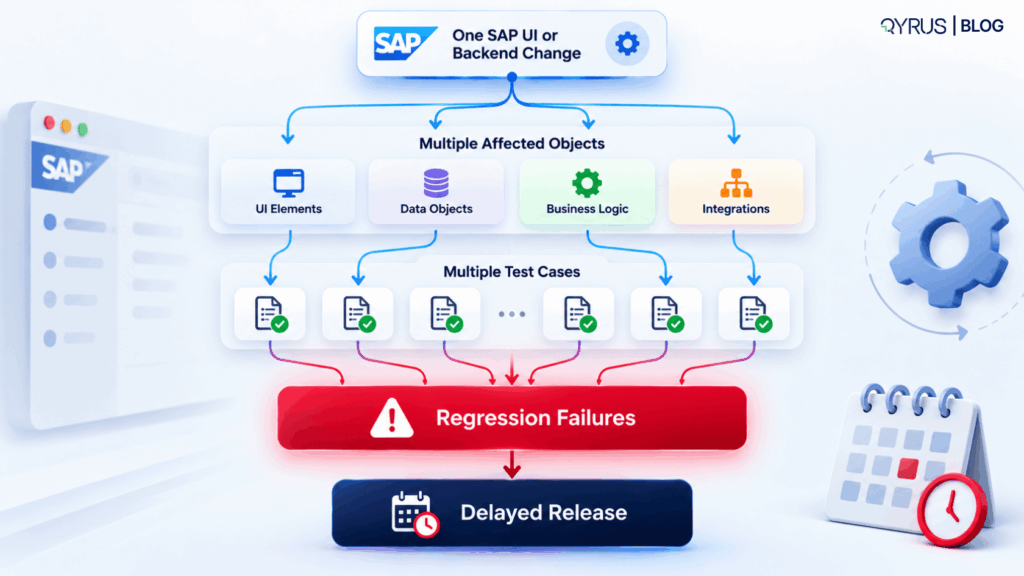
This cascading failure mechanism makes the phrase “breaks at scale” a tangible, daily reality for large organizations.
The S/4HANA Upgrade Challenge
The fragility of traditional automation is acutely problematic during an SAP S/4HANA transformation. S/4HANA upgrades are not just “migration validation.” They fundamentally alter various layers: Fiori applications substitute outdated UIs, SAP HANA brings in new data formats, and essential business processes are redesigned.
This transformation creates a vastly larger testing surface. Furthermore, adhering to the SAP S/4HANA Cloud release schedule involves managing bi-annual major upgrades alongside bi-weekly hotfixes. Brittle automation becomes incredibly expensive because it must survive an environment undergoing continuous transformation. Teams must implement resilient SAP S/4HANA cloud testing strategies to keep pace with these frequent release cycles.
SAP Testing Doesn’t Stop at SAP
Modern business processes rarely live entirely inside SAP. A typical procurement process may start in SAP Ariba, transition to SAP S/4HANA for handling, engage with a specific supplier portal, and finish in an external financial application. Testing only SAP screens does not validate the entire business process.
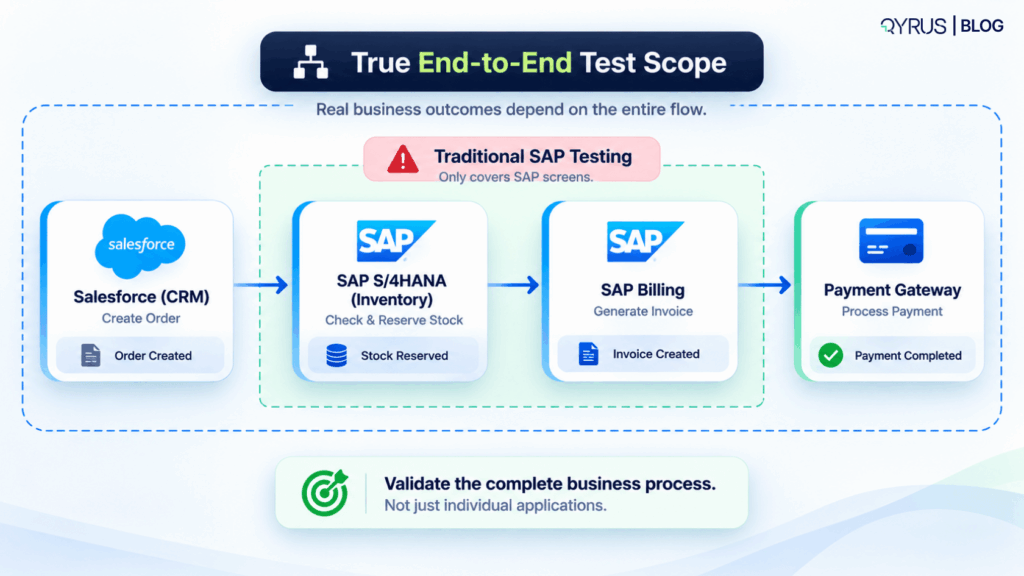
The primary unit of testing should increasingly be the comprehensive business process, creating a natural and necessary bridge toward true end-to-end enterprise testing.
Why Cross-System Dependencies Make Automation More Fragile
Expanding the testing scope introduces cross-system dependencies. In a multi-system workflow, an automated test may fail because a Fiori UI dynamically changed, a Salesforce DOM was updated, an API contract was quietly altered, or test data became desynchronized.
This interconnected fragility creates a severe diagnostic problem: When an end-to-end test fails, where did the failure originate? A scalable SAP testing strategy requires deep visibility across the entire workflow. Implementing robust end-to-end SAP business process validation demands capabilities beyond simple browser record-and-playback tools, including cross-application orchestration and deep dependency awareness.
The Shift from Script-Centric Automation to Resilient Automation
To break free from the overwhelming upkeep liabilities of fragile scripts, organizations need to implement a crucial paradigm shift. Rather than inquiring about how to keep all these scripts, organizations should ask: “How can automation adjust when the application evolves?”
The Traditional Script-Centric Model: Application → Locator → Script → Execution. If the locator changes, the script breaks. The Resilient Automation Model: Application → Object Recognition → Business Intent → Adaptive Execution. The automation framework understands what it needs to interact with based on intent, rather than relying solely on a static identifier.
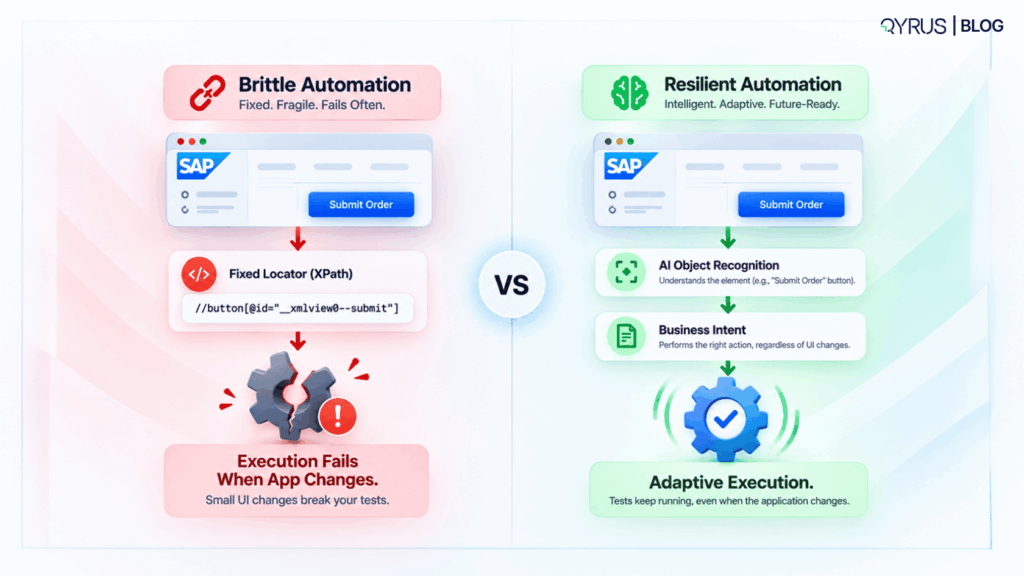
How AI-Based Object Recognition Changes SAP Automation
Artificial intelligence is fundamentally changing how testing systems interact with complex interfaces, moving beyond rigid code dependencies.
From fixed locators to intelligent recognition
AI-powered object recognition helps automation identify elements based on deep contextual information rather than static locators. By utilizing computer vision and structural analysis, intelligent systems build multi-attribute fingerprints for every UI element. If a primary ID changes, the system evaluates secondary attributes to locate the intended control, providing greater resilience to UI updates.
Self-healing automation
The evolution of self-healing test automation allows automation to detect when expected interactions fail, analyze the interface for the most probable alternative, and complete the intended action. Crucially, self-healing must strictly preserve the intended test action without introducing semantic drift (making a failed test pass when a real defect exists).
What Resilient SAP Automation Should Look Like
A scalable SAP testing strategy should ideally provide a comprehensive framework built on adaptability:
- Application Awareness: Natively understand SAP structures, Fiori design paradigms, and backend architecture.
- Dynamic Object Recognition: Reduce dependency on fragile identifiers using multi-attribute contextual matching.
- Self-Healing: Autonomously adapt when elements move or change IDs while preserving business intent.
- Business-Process Awareness: Validate data-driven workflows spanning multiple transactions.
- Cross-Application Testing: Support validating SAP alongside Salesforce, Ariba, APIs, and downstream systems.
- Regression Intelligence: Prioritize testing based on actual application code changes to minimize redundant execution.
- Maintainability: Implement unified data strategies, such as managing SAP test data efficiently, to reduce the manual engineering effort required to keep operations running.
From Automation Coverage to Automation Resilience
Most organizations measure automation using volume-based vanity metrics like test case counts and pass/fail rates. However, high coverage with brittle scripts simply equates to massive technical debt.
To evaluate true operational readiness, organizations must introduce resilience-focused metrics: How often do tests require manual maintenance? How quickly can the suite recover after a cloud update? How much effort is spent purely repairing tests? The value of SAP automation isn’t determined only by how much you automate; it is determined by how well that automation survives change.
Building a More Sustainable SAP Testing Strategy
Transitioning to a resilient quality engineering engine requires a structured approach:
- Step 1: Identify business-critical processes. Prioritize workflows like Order-to-Cash and Procure-to-Pay.
- Step 2: Map dependencies. Identify all SAP and non-SAP applications involved in the full data journey.
- Step 3: Identify automation fragility. Audit test assets for hard-coded locators and duplicate manual efforts.
- Step 4: Introduce adaptive automation. Migrate away from legacy tools and implement agentic regression for SAP testing powered by AI and self-healing.
- Step 5: Measure resilience. Track maintenance effort, automation failure rates, and regression cycle times.
QyrusAI: Making SAP Test Automation More Resilient
QyrusAI is a comprehensive platform built to help enterprises seamlessly modernize, assure, and operate their most critical software ecosystems. For organizations struggling with the weight of maintaining brittle scripts, QyrusAI exemplifies the shift toward resilient, cross-platform automation. QyrusAI SAP Scribe uses ERP-aware AI models explicitly tailored to the customer’s landscape, moving decidedly beyond brittle XPath-based execution. Specifically for dynamic user interfaces, the QyrusAI Fiori Test Specialist can autonomously generate end-to-end executable test scripts using SAP application source code and specifications. Because processes rarely exist in isolation, deploying modern AI-powered SAP testing tools like QyrusAI enables validation across complete multi-system business processes. In the end, its self-repairing features significantly lessen the manual upkeep demands tied to constant application modifications.
For organizations aiming to lessen the maintenance load of SAP automation while boosting assurance in essential business operations, AI-driven testing provides a more robust solution ahead. QyrusAI combines SAP-aware automation, smart object detection, self-healing capabilities, and cross-application testing to assist teams in creating and sustaining dependable end-to-end SAP testing at scale.
Explore AI-powered SAP testing with QyrusAI.
FAQs
1: Why does SAP test automation become difficult to maintain?
Traditional testing scripts rely heavily on static locators. As SAP environments continuously evolve—driven by dynamic UI element generation, changing backend configurations, frequent S/4HANA releases, and shifting integrations—these static scripts break, creating massive maintenance debt.
2: Why do XPath-based automation scripts break in SAP Fiori?
XPath-based scripts frequently fail because Fiori utilizes metadata-driven interfaces and dynamic DOM structures. As seen when understanding dynamic IDs in SAP UI5, control identifiers are often generated dynamically at runtime (e.g., __xmlview1 changes to __xmlview0 upon a page reload), breaking rigidly coded scripts.
3: How does SAP S/4HANA impact testing and test automation?
In the field of testing and test automation SAP S/4HANA holds a significant importance, by substantially broadening the testing domain by incorporating new data frameworks, Fiori interfaces, and API adjustments. With SAP S/4HANA Cloud follows a rapid release timeline featuring semi-annual upgrades and bi-weekly hotfixes, manual testing instantly falls behind and loses its significance.
4: What is self-healing test automation?
Self-healing test automation uses AI enabled features to adjust to changes in web sites or Apps UI. In a scenario where an expected locator fails, the programming interface using computer vision and structural similarity to identify alternative interaction methods, ensuring the test runs smoothly without any hurdles while providing the expected results.
5: Can SAP testing tools test processes across non-SAP applications?
Yes, but that will be only true if the company invests in an all-in-one testing platform. Today’s business workflows bounce all over the place from SAP S/4HANA and Salesforce to Ariba and external APIs so you need a tool that can effortlessly glue all those moving parts together in a single test.
6: How can AI reduce SAP test automation maintenance?
AI drastically reduces maintenance by moving automation away from rigid script dependencies. By utilizing AI-based object recognition, tools locate elements contextually rather than relying on brittle CSS or XPath selectors. AI also powers self-healing, automatically adapting execution during runtime to bypass UI changes without manual intervention.
SAP Automation Must Be Built to Survive Change
SAP automation doesn’t become difficult because enterprises automate too much; it becomes difficult when automation is built around assumptions that cannot keep up with a constantly evolving environment. SAP Fiori interfaces are highly dynamic, S/4HANA transformations expand testing surfaces, and enterprise processes span complex webs of third-party systems. As regression suites grow, script maintenance can consume the very value automation was supposed to create.
For SAP testing to scale effectively without crushing quality engineering teams, automation needs to become as adaptable as the applications it tests. By shifting away from script-centric rigidity and embracing intelligent object recognition and self-healing frameworks, organizations can build sustainable testing engines capable of supporting continuous enterprise transformation.
Ready to transform your SAP testing strategy? Contact us today to eliminate maintenance debt and build a resilient, AI-powered automation framework with QyrusAI.

 September 9, 2026
  12 min