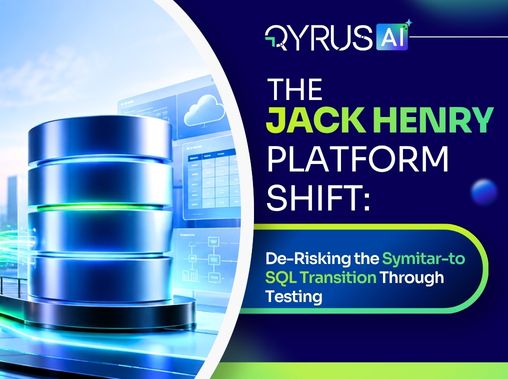

Application Discovery | Dependency Mapping | Legacy Modernization
Modernizing on Jack Henry?
Testing Has to Move With You.
Meet QyrusAI at Jack Henry Connect 2026
- October 19–21, 2026
- Kansas City, Missouri
- QyrusAI Booth #1604
Talk to us on your next modernization drive
The Jack Henry ecosystem is evolving, and for institutions running Symitar, modernization is no longer a future consideration.
As core architecture changes, integrations expand, and digital experiences continue to evolve, financial institutions need a way to understand what can safely change, validate every layer of the transaction journey, and reduce risk throughout the transition.
At Jack Henry Connect 2026, QyrusAI will be sharing how financial institutions can bring modernization and testing together instead of treating them as separate initiatives.
Modernization and Testing
Two Sides of the Same Risk-Reduction Strategy
Modernization efforts rarely fail because of the migration alone. They fail when dependencies, workflows, integrations, and downstream impacts are not fully understood or validated along the way.
For institutions operating within the Jack Henry ecosystem, that challenge spans everything from digital banking and APIs to Episys, Quest, PowerOn, data, batch operations, and the integrations connecting them.
Our latest whitepaper explores how financial institutions can bring discovery, modernization, and continuous testing together to create a safer path forward.
In the whitepaper, you’ll learn:
- Why the changing Jack Henry and Symitar ecosystem creates new testing and maintenance challenges
- How to discover dependencies and rationalize applications before migration begins
- Why modernization and testing should move together rather than sequentially
- How to validate transactions across web, mobile, APIs, Quest, Episys, and data
- How change-based regression can improve confidence during active modernization
- How operational visibility can extend quality beyond deployment
Understand the Environment Before You Change It
QyrusAI helps financial institutions identify applications, dependencies, integrations, and technical risk before migration begins.
Through application discovery, dependency mapping, rationalization, and Digital Twin-based impact analysis, teams can better understand what is truly load-bearing, what can be retired, and where a proposed change may create downstream impact.
That foundation makes it possible to modernize with greater clarity instead of relying on disconnected documentation or institutional knowledge.
Test the Transaction, Not Just the Channel
A banking transaction does not stop at the digital interface.
It can move through digital banking, integration services, core processing, operational workflows, batch processes, and data before the final outcome is complete.
QyrusAI helps validate those layers as one connected journey, bringing together web, mobile, API, desktop, core, and data testing so that a passing channel test does not hide a downstream failure.
Meet QyrusAI at Booth #1604
At Jack Henry Connect, talk with the QyrusAI team about how your institution can:
- Modernize with greater visibility into dependencies and technical risk
- Build testing into modernization from the beginning
- Automate regression across critical banking workflows
- Validate changes across multiple systems and channels Improve confidence throughout migration and ongoing releases
ANALYSTS’ REPORTS
Analysts Endorse QYRUSAI
Explore the independent reports and endorsements that affirm QyrusAI’s position as the transformative, all-in-one platform for modern IT estate management.
Integration
Works With Your Existing Enterprise Stack.
QyrusAI Modernize connects to your existing tools — CMDBs, ITSM platforms, cloud providers, and enterprise architecture repositories — so discovery enriches the tools you already use rather than replacing them.
CUSTOMER TESTIMONIALS
Enterprises running the loop
in their own words.
Real Teams. Real Outcomes. Real Confidence in what ships next.
Qyrus not only supports the testing of our Web, Mobile, and API components as part of our CI/CD processes, but also in ongoing regression-testing across our partner ecosystem. The real power of Qyrus is that we have this extremely broad testing capability in one tool, run in the cloud, and reusable across all our development teams.

The transition to Qyrus has marked a significant turning point for us. By embracing automation, we not only streamlined our SAP test automation process but also achieved a remarkable reduction in overall project testing time by 40%.
... the Qyrus platform have been a great addition to Monument's product delivery capabilities. Within a few months, we have been able to create a comprehensive test suite of complex end-to-end test scenarios spanning multiple platforms and channels. The Quinnox team has helped us embed the Qyrus solution, and the supporting processes around it, into our agile delivery methodology.
Resources
Go Deeper on QyrusAI for Legacy Modernization
November 13, 2026 |
13 min
Enterprise Knowledge Graph: What It Is and How to Build One for Your IT Estate
Read More
November 11, 2026 |
12 min
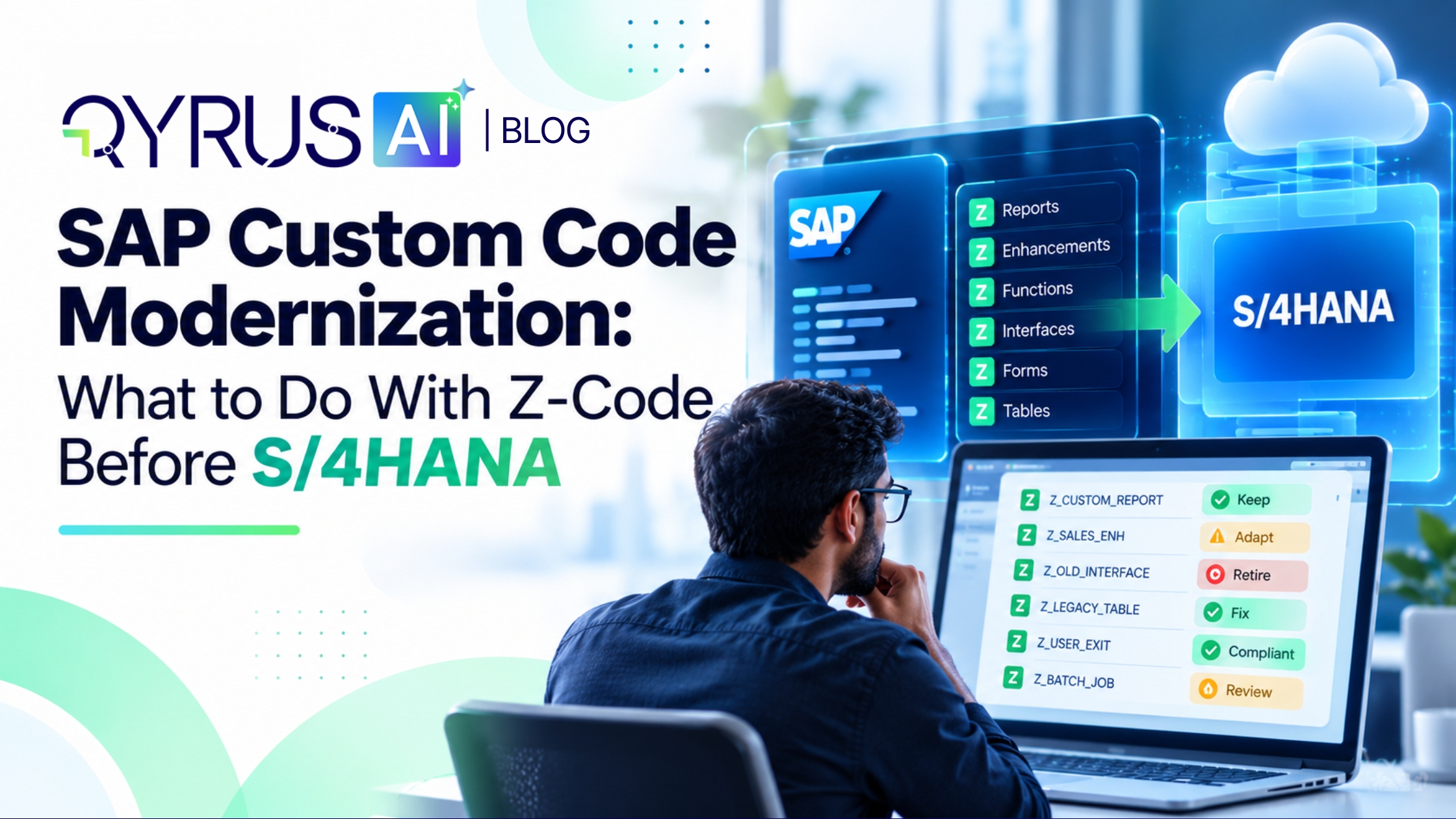
SAP Custom Code Modernization: What to Do With Z-Code Before S/4HANA
Read More
November 3, 2026 |
13 min
How QyrusAI Enables FinOps with Continuous Cost Visibility, Governance & Automation
Read More
November 6, 2026 |
2 min
Transforming IT Service Desk Operations with QyrusAI for a Leading UK Bank
Read More
October 19, 2026 |
3 min
Accelerating Network Modernization Through Intelligent IT Discovery With QyrusAI
Read More
September 24, 2026 |
6 min
How a Global Data & Analytics Leader Scaled SAP GUI and Fiori Test Automation for Complex BRIM Workflows
Read More
October 23, 2026 |
2 min
Prove It Before You Replace It: Evidence-First Mainframe Modernization for BFSI
Read More
October 23, 2026 |
2 min
Prove It Before You Replace It: Evidence-First Mainframe Modernization for BFSI
Read More
Blog
November 13, 2026 |
13 min
Enterprise Knowledge Graph: What It Is and How to Build One for Your IT Estate
Read More
November 11, 2026 |
12 min
SAP Custom Code Modernization: What to Do With Z-Code Before S/4HANA
Read More
November 3, 2026 |
13 min
How QyrusAI Enables FinOps with Continuous Cost Visibility, Governance & Automation
Read MoreCase Study
November 6, 2026 |
2 min
Transforming IT Service Desk Operations with QyrusAI for a Leading UK Bank
Read More
October 19, 2026 |
3 min
Accelerating Network Modernization Through Intelligent IT Discovery With QyrusAI
Read More
September 24, 2026 |
6 min
How a Global Data & Analytics Leader Scaled SAP GUI and Fiori Test Automation for Complex BRIM Workflows
Read MoreEvents
Reports
October 23, 2026 |
2 min
Prove It Before You Replace It: Evidence-First Mainframe Modernization for BFSI
Read More
Whitepaper
October 23, 2026 |
2 min
Prove It Before You Replace It: Evidence-First Mainframe Modernization for BFSI
Read More
FREQUENTLY ASKED QUESTIONS
Common Questions About QyrusAI Modernization
Lorem ipsum dolor sit amet, consectetur adipiscing elit, sed do eiusmod tempor
incididunt ut labore et dolore magna aliqua. Ut enim ad minim veniam, quis nostrud.
How is this different from a CMDB or an EA repository like LeanIX?
Does Qyrus Modernize work with SAP S/4HANA migrations?
Yes — and SAP migrations are one of the highest-urgency use cases. QyrusAI reads your SAP environment in read-only mode, inventories all RFCs, IDocs, OData services, SOAP connections, CPI integrations, background jobs, and Z-objects, and produces a blast-radius score for every proposed S/4HANA change. The Estate X-Ray and Phase Zero governance workflow are specifically designed for ECC-to-S/4HANA programmes with fixed cutover dates.
How long does the initial discovery scan take?
The first scan of a mid-market estate (200–400 applications) typically produces an initial topology map within 48–72 hours. The map enriches continuously from that point — adding confidence detail, business-service attribution, and dependency validation as more signals are observed. A Phase Zero engagement (discovery, dependency mapping, and modernization prioritization) is typically scoped at 4–6 weeks.
Does it require agent installation on every system?
No. QyrusAI reads from APIs, connectors, log streams, and cloud provider metadata — it does not require an agent on every application or server. For some legacy on-premise environments a lightweight collector may be deployed, but this is scoped per engagement and never required across the full estate before value is delivered.
What happens to the modernization plan if the estate changes while the programme is running?
The Knowledge Graph is continuously updated. If a new application is deployed, a dependency changes, or a system is decommissioned mid-programme, the change is reflected in the graph and the modernization wave plan is re-scored automatically. Your transformation plan is always based on the current estate, not the estate as it was when the programme started.
Does Qyrus Modernize integrate with Assure for testing?
Yes — this is the core joint value of the two pillars. Every modernization slice Modernize produces is automatically handed to Assure for equivalence testing. Assure generates test cases from the code analysis output, runs them against the modernized slice, and produces an evidence record before any release decision is made. The conversion is never marked complete until Assure has proved it works.
• STAY AHEAD, STAY IN THE LOOP.
Ready to See What You've Been Missing?
Explore how enterprises are moving beyond reactive modernization to intelligent, data-driven transformation strategies.