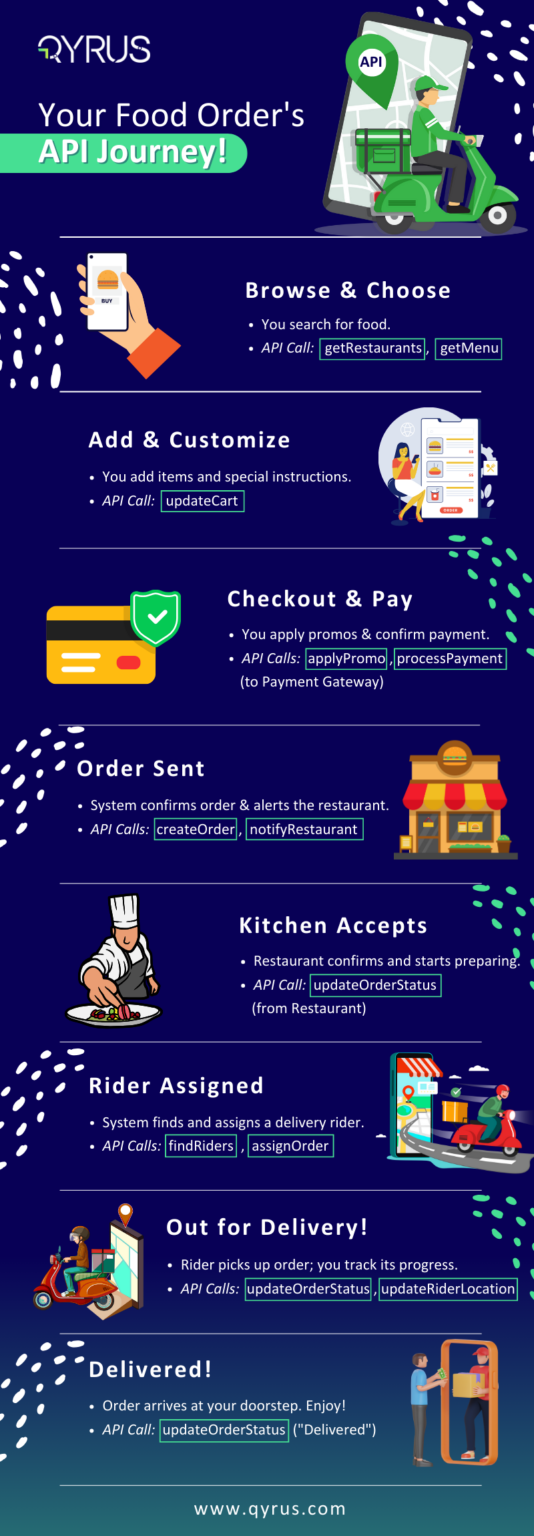
Click. Order. Delivered. Today, getting your favorite meal delivered is often just a few taps away, thanks to the booming FoodTech industry. But behind that simple user experience lies a complex web of interconnected systems. Think about it: your food delivery app needs to talk seamlessly to restaurant ordering systems, health data providers, payment gateways, and delivery logistics platforms.
What makes this intricate dance possible? APIs – Application Programming Interfaces. They are the invisible messengers ensuring your order details reach the kitchen correctly, your payment goes through securely, and you can track your delivery in real-time.
However, when these messengers falter, the consequences can be significant. Minor glitches can cascade into major service disruptions, leading to incorrect orders, payment failures, and frustrated customers whose trust is easily broken. The financial impact is startling; according to one industry survey, 66% of companies report losing up to $500,000 per year due to poor integration, including API failures, with 10% losing more than $1 million annually. These aren’t just abstract numbers; they represent real losses stemming from disruptions in critical operations that underpin the entire FoodTech business model.
This is where robust API testing becomes absolutely critical. It’s the process of rigorously checking these API connections to ensure they function reliably, perform under pressure, and remain secure. Effective API testing strategies enable platforms to handle massive traffic surges during peak hours, process orders with near-perfect accuracy, and manage high volumes (~100 orders per minute) without breaking a sweat.
In this post, we’ll dive into the world of FoodTech to explore critical API testing examples. We’ll look at common challenges faced by developers and testers in this dynamic sector and discuss best practices. Furthermore, we’ll touch upon how comprehensive testing platforms like Qyrus can help ensure your FoodTech APIs deliver a five-star experience, every time.
Taste the Dish, Test the APIs: Why Both are Vital in FoodTech
Think of your favorite food delivery app. It’s not a single, monolithic system. Instead, it’s an ecosystem built on communication, with APIs acting as the vital communication lines. The app on your phone (User App) needs to talk to the restaurant’s order management system. That system, in turn, might need to communicate with inventory APIs. Then there’s the delivery logistics platform coordinating drivers, which constantly updates your app via APIs. And, of course, payment gateways process your transaction through secure API calls. It’s a constant, high-speed conversation happening behind the scenes: User Apps <-> Restaurant Systems <-> Delivery Logistics <-> Payment Gateways.
Now, imagine if those communication lines get crossed or drop out. The business impact isn’t just a minor inconvenience; it can be catastrophic. An API failure could mean orders getting lost or duplicated, restaurants receiving incorrect customization details (hello, unwanted pineapple on pizza!), payment processing errors leading to double charges or failed transactions or tracking information simply vanishing. Service outages kill the user experience, incorrect orders damage trust, payment issues cause financial headaches, and ultimately, the platform’s reputation suffers. In the competitive FoodTech landscape, users won’t hesitate to switch apps after a bad experience.
This is why rigorous API testing isn’t just a ‘nice-to-have’; it’s driven by core business needs specific to FoodTech:
Functional Reliability is Non-Negotiable: At its heart, a food app must reliably execute core tasks. Can users search for restaurants and see accurate menus? Does the ordering API capture items, quantities, and those crucial special instructions correctly? Do payment APIs handle various methods smoothly? Can users track their order from kitchen to doorstep accurately? API testing ensures these fundamental workflows function flawlessly, preventing operational chaos and ensuring customer expectations are met.
Peak Performance Under Pressure: FoodTech platforms face predictable, yet massive, surges in demand. Think lunch rushes, dinner peaks, weekend specials, or major sporting events. APIs must handle this immense, often sudden, increase in traffic – thousands of concurrent users placing orders, querying menus, and tracking deliveries – without buckling. Performance testing simulates these high-stress conditions to guarantee the APIs remain responsive and the platform stable, avoiding frustrating slowdowns or crashes precisely when demand is highest.
Bulletproof Data Security: Given that these apps handle sensitive personal information (names, addresses, phone numbers) and critical payment details (credit card numbers, bank info), security is paramount. APIs are potential gateways for attackers if not properly secured. Rigorous security testing of APIs is essential to verify authentication, authorization, and data encryption, protecting against data breaches, unauthorized access, and financial fraud, thereby maintaining user trust and regulatory compliance.
Essentially, meticulous API testing ensures the intricate network of services powering a FoodTech app works together reliably, scales effectively, and operates securely. It’s the secret sauce that enables a smooth, trustworthy experience from the moment a user opens the app to the final delivery confirmation. We’ll explore more specific API testing examples next.
Real-World Examples: API Testing in Action
To understand where the rubber meets the road in FoodTech API testing, let’s look beyond generic concepts and examine specific, critical testing areas with practical examples. These scenarios highlight the diverse functionalities that rely heavily on robust APIs:
Complex Data Integration & Processing APIs:
Why it’s critical: Modern FoodTech features, especially those related to health and personalization, often pull data from a wide array of sources – think user wearables, public health databases (like USDA), commercial nutrition APIs (like FatSecret), and direct user input via the app. Testing is absolutely crucial to ensure these data ingestion APIs, any backend ETL (Extract, Transform, Load) processing APIs, and the interactions with data storage function reliably and accurately. Garbage data in means garbage insights out.
Example: Consider testing the intricate API pipeline designed for health insights. This involves validating APIs that pull nutrition data from USDA and FatSecret, combining it correctly with meals logged by the user via the app’s API. Further testing ensures the processing step, perhaps triggered via an AWS Glue job API, runs correctly, and that the final, processed data is accurately stored, maybe in Amazon S3, ready for insight generation.
AI & Analytics API Testing:
Why it’s critical: Features are increasingly powered by AI and Machine Learning models, often exposed via APIs – think personalized recommendation engines predicting what you might like or analytics forecasting dietary outcomes. Testing must validate the inputs these APIs expect, the outputs they generate (are they relevant? accurate?), and their performance under load.
Example: Imagine testing the API endpoint responsible for personalized healthy meal suggestions. This API might take a user’s recent order history and profile data as input, pass it to an Amazon SageMaker ML model in the backend, and return tailored recommendations. Tests need to verify that the API handles various input formats correctly, that the suggestions returned are logical and relevant to the user’s profile, and that these recommendations are generated promptly without excessive delay.
Why it’s critical: It’s essential to validate that the entire interconnected system – encompassing data pipelines, AI models, user-facing APIs, and third-party integrations – can handle the strain of expected user loads and high data volumes without performance degradation. This ensures the app remains responsive even during peak usage.
Example: Let’s simulate a high-traffic event, like 5,000 users simultaneously tapping into their “Health Insights” tab right after completing their orders post-lunch rush. Load testing here verifies that the various APIs involved – fetching insights, calculating metrics, possibly calling underlying AI/data APIs – all respond within acceptable time limits, preventing slowdowns or timeouts for the users.
Multi-Interface & Cross-Platform Testing:
Why it’s critical: Consistency is key. Users expect features and data to look and behave the same whether they access the service via an iOS app, an Android app, or a web portal. Testing ensures the underlying APIs deliver consistent data and functionality across all these platforms and potentially other interfaces (like admin or support dashboards).
Example: Take the “Health Insights” feature again. Testing must confirm that the personalized insights, nutritional breakdowns, and recommendations generated by the backend APIs are displayed accurately and consistently, regardless of whether the user views them on their iPhone app, their Android tablet, or by logging into their account on the website.
Chatbot / Conversational AI Testing:
Why it’s critical: FoodTech apps increasingly deploy chatbots for tasks like placing orders or answering support queries. These AI-driven conversations require a different testing approach because natural language is inherently variable. Traditional testing tools, which often rely on exact text matching, can easily fail when a chatbot provides a perfectly valid response using slightly different phrasing.
Example: Consider testing a health-focused chatbot designed to provide calorie information. If the test script expects the exact response, “Your total calorie intake today is 1,500 calories,” it might incorrectly mark the test as failed if the chatbot responds, “You’ve consumed 1,500 calories so far today.” Both responses are correct, but the phrasing differs. This necessitates specialized testing tools (like Qyrus’s LLM Evaluator) capable of understanding the meaning (semantics) of the response, not just the literal string of text.
Payment Integration Testing:
Why it’s critical: Handling payments requires absolute precision and security. Testing must rigorously verify interactions with various payment gateways, ensuring reliability across different payment methods (credit cards, digital wallets, etc.) and secure handling of sensitive financial data.
Example: Suppose a food delivery app decides to integrate a popular new digital wallet payment option. Thorough payment integration testing becomes crucial. It needs to verify that the /initiatePayment API correctly redirects the user to the wallet provider for authorization. Equally important is testing the callback API that securely confirms payment success or failure from the provider. Testing must also cover edge cases like insufficient funds (ensuring the API handles the error gracefully and provides clear user feedback) and confirm that the internal recordTransaction API logs the final payment status accurately for backend reconciliation.
Testing across these diverse and complex areas is fundamental to delivering a reliable, performant, and trustworthy FoodTech application.
Best Practices for Robust FoodTech API Testing
Achieving reliable, scalable, and secure FoodTech applications requires adopting solid API testing best practices. Modern testing platforms like Qyrus not only support these practices but actively enhance them through intelligent automation and specialized features. Here’s how:
Embrace Comprehensive Automation
In the fast-paced FoodTech world, manually testing every API change across Web, Mobile, and backend layers is unsustainable. Automating API tests, along with relevant Web and Mobile UI checks, is crucial for rapid feedback during development and reliable regression checking before releases.
Qyrus’s unified platform is designed explicitly for testing across Web, Mobile, and API layers. The platform helps accelerate your automation efforts by leveraging its AI capabilities; features like TestPilot can generate functional test scripts quickly just from a URL or application interaction, while TestGenerator can automatically create test scenarios directly from requirements documented in JIRA tickets, significantly speeding up initial test creation.
Adopt Data-Driven & AI-Informed Testing
FoodTech apps deal with vast amounts of data variation – different user profiles, dietary preferences, order histories, locations, promotions, etc. Testing must cover diverse and realistic data sets. Furthermore, as apps incorporate AI, testing needs to validate these intelligent components effectively.
Organizations can implement robust data-driven testing by using tools like Qyrus Echo to generate synthetic, yet realistic, data tailored specifically to FoodTech scenarios (e.g., creating thousands of varied user profiles or complex order histories). For validating AI-driven features, employ specialized tools like Qyrus Eval, which is designed to intelligently assess AI model outputs, essential for ensuring the reliability of personalization engines or chatbots.
Prioritize Performance Under Realistic Load
Don’t wait for users to discover performance issues during peak hours. Conduct thorough performance and load testing that simulates real-world user behavior, expected peak traffic volumes, and the complex data interactions typical in FoodTech systems.
Qyrus’s integrated Performance Testing capabilities are designed to stress-test your applications. Gain crucial visibility into how your APIs and systems behave under pressure by utilizing tools like Insights & AnalytiQ, which provides deep performance analytics to help you identify and resolve bottlenecks early in the development cycle.
Ensure Seamless End-to-End Workflow Validation
Users experience workflows, not individual APIs. Test complete user journeys (like order placement and tracking) that span multiple internal APIs, third-party services (like payment gateways), and potentially different user interfaces (Web/Mobile). Where necessary, use service virtualization to isolate dependencies.
Use Qyrus’s core platform can easily orchestrate complex test scenarios that flow across different application layers (API, Web, Mobile). Simplify testing dependencies by employing API Builder to instantly virtualize backend APIs. This allows teams to conduct isolated testing of workflows or front-end components even when dependent backend services are unavailable or still under development, enabling parallel work streams.
Integrate Continuous Monitoring & Maintenance
Testing doesn’t stop at deployment. Monitor API health and performance in production. Crucially, have efficient processes for maintaining your automated test suites as the application evolves, preventing tests from becoming outdated and flaky.
Reduce the significant effort often associated with test maintenance by using Qyrus’s Healer feature. This AI-powered capability can automatically detect and suggest fixes for tests broken by minor UI or API changes. For specialized components like chatbots, leverage monitoring tools like BotMetrics to track their performance and behavior.
Build on a Secure & Compliant Foundation
Security is non-negotiable when handling sensitive user and payment data. Ensure your testing practices include security checks (like validating authentication and authorization) and that your testing infrastructure itself adheres to high security standards.
Conduct your testing activities with confidence by relying on Qyrus’s secure testing infrastructure. The platform is noted as being ISO 27001 & SOC2 compliant, ensuring that the environment where you run tests and manage test data meets stringent industry security and compliance standards.
By integrating these best practices, supported by the capabilities of an intelligent platform like Qyrus, FoodTech companies can significantly enhance the quality, reliability, and security of their critical API infrastructure.
Conclusion: Delivering Success in FoodTech with Superior API Testing
APIs are the backbone of the entire operation. From the moment a user searches for a restaurant to the final delivery notification, countless API calls work in concert to create that seamless experience we’ve all come to expect. Consequently, the success of any FoodTech platform hinges significantly on the quality and reliability of these APIs, making rigorous testing not just a technical task, but a fundamental business necessity.
Ignoring API testing is simply not an option in this competitive landscape. Navigating the unique challenges of FoodTech API testing – complex workflows, multi-interface synchronization, realistic performance simulation, and stringent security requirements – requires the right approach and the right tools. This is where a comprehensive testing platform like Qyrus becomes invaluable.
By simplifying test creation for intricate API chains, facilitating data-driven testing, offering sophisticated load and performance simulation, and incorporating security checks, Qyrus empowers FoodTech companies to implement best practices efficiently, overcome testing hurdles, and ensure their APIs consistently deliver exceptional, reliable experiences.
Investing in superior API testing is investing in the success and growth of your FoodTech venture.
Ready to ensure your APIs are delivering a five-star experience?
Discover how Qyrus can streamline your testing efforts: Request a Demo
Don’t let API failures compromise your service. Embrace comprehensive testing and deliver the seamless FoodTech experience your customers deserve.
Introduction: The Time Crunch in Software Development
For many years, traditional testing methodologies have served as the standard approach within the software development process. However, these conventional methods often struggle to provide the speed and efficiency required in today’s fast-paced digital landscape. As Enkonix notes, software time-to-market can range from six months to as long as five years, largely dependent on the product’s complexity.
In fact, lengthy test cycles frequently act as a significant bottleneck, impeding an organization’s agility and slowing down its ability to compete. Ranorex points out that quality assurance (QA) for a software application can take anywhere from 6 to 10 weeks, influenced by the intricacies of both the testing plan and the application itself.
Unfortunately, these extended testing phases can hinder a company’s capacity to deliver new features and products to market promptly. To fully understand this issue, it’s essential to analyze software testing life cycle and how it relates to the broader context of the software development life cycle.
But what if testing could be transformed from a roadblock into a catalyst for speed? Imagine a scenario where testing is a streamlined process that accelerates, rather than delays, your time to market. Or imagine a world where you can discover bugs before UI testing, allowing fixes to be completed along with UI development.
Fortunately, modern approaches are emerging that offer the promise of dramatically reducing testing time and enabling significantly faster software releases, allowing organizations to deliver value to their customers more quickly and efficiently. In this blog post, we will explore strategies to optimize the software testing life cycle and achieve this acceleration.
The Quicksand of Lengthy Test Cycles: Understanding the Pain
Prolonged test cycles present a significant obstacle for software development organizations, hindering their ability to deliver software releases in a timely and efficient manner. Let’s explore the core problems arising from these extended timelines:
The Grip of Increased Time-to-Market: Lengthy test cycles directly translate to delayed software releases, increasing the time it takes for new features and products to reach customers.
The Erosion of Competitiveness: Delays in software releases can severely compromise an organization’s competitiveness. In today’s dynamic markets, competitors who can deliver updates and innovations more rapidly gain a distinct advantage, potentially capturing market share.
The Strain on Resources and the Surge in Costs: Extended test cycles demand more resources, leading to increased costs. These resources include increased personnel hours from testing and development teams, as well as the need for expanded testing infrastructure to accommodate diverse operating systems and devices.
The Toll on Morale: Frustration and Burnout: The constant pressure of prolonged timelines, combined with the often-repetitive nature of lengthy testing processes, can lead to frustration and burnout among testing and development teams.
The Specter of Missed Market Opportunities: Delays in software releases can result in missed market opportunities. In rapidly evolving industries, even short delays can mean missing crucial market windows.
Unraveling the Reasons Behind the Delays: Why Test Cycles Drag On
To effectively address the problem of lengthy test cycles, it’s crucial to understand the underlying factors that contribute to these delays. Let’s examine the common reasons why test cycles often drag on:
The Weight of Reliance on Manual Testing: One significant contributor to prolonged test cycles is the heavy reliance on manual testing processes. These methods are inherently time-consuming, as each test case requires execution by a human tester. Manual testing is also susceptible to human error and can become increasingly difficult to scale as software complexity grows.
The Burden of Complex Test Frameworks: Organizations that depend heavily on code-based testing often develop or utilize complex test automation frameworks. Maintaining and scaling these frameworks can introduce substantial overhead and add significant time to the testing process.
The Pitfall of Inadequate Test Coverage: To expedite releases, teams may inadvertently compromise on testing thoroughness, resulting in inadequate test coverage. While this might seem to accelerate the initial testing phase, it often leads to a higher risk of defects slipping into production, which then necessitates costly and time-consuming rework.
The Challenge of Regression Testing: Each new software release or update necessitates regression testing to ensure that existing functionality remains unaffected. This requirement can significantly extend testing time, particularly in rapidly evolving software with frequent updates.
The Impediment of Siloed Teams and Poor Collaboration: When development and testing teams operate in silos, characterized by a lack of effective communication and collaboration, it can lead to significant delays and inefficiencies in the testing process. Issues may be discovered late in the cycle, requiring developers to revisit code, and poor communication can result in misunderstandings and duplicated efforts.
The Obstacle of Learning Curves for Testing Tools: Implementing new testing tools can initially slow down the testing process if these tools have steep learning curves. Testers may require considerable time and effort to become proficient, delaying test creation and execution.
The Difficulty of Integration with Existing Systems: Testing tools that lack seamless integration with other critical systems, such as Continuous Integration/Continuous Delivery (CI/CD) pipelines and defect management tools, can create bottlenecks in the software development lifecycle.
Lengthy test cycles trigger a chain reaction of negative consequences, starting with delayed software releases that reduce revenue and increase operational costs. This then leads to damaged brand reputation and lowered employee morale and finally hinders innovation as resources are consumed by simply trying to release on time. To avoid these repercussions, prioritizing efficient testing is essential.
A New Era of Testing: Modern Solutions for Speed
To overcome the delays and negative impacts of long test cycles, a new wave of modern software testing solutions is emerging, prioritizing speed, efficiency, and accuracy throughout the SDLC. A key innovation is codeless automation, which simplifies test creation by removing the need for extensive coding and enabling users to build tests through intuitive interfaces with action types. This democratization of test automation makes it accessible to more team members and significantly reduces the time to build and maintain test scripts.
Furthermore, AI is revolutionizing software testing by enhancing efficiency, accuracy, and coverage. AI-infused testing can automate test script maintenance, analyze test data, and even generate test cases autonomously, minimizing manual effort and improving test reliability. Modern solutions also emphasize continuous testing with seamless integration into CI/CD pipelines, and offer comprehensive testing across web, mobile, and APIs within a unified platform.
Qyrus: An AI-Driven, Outside-In Approach to SDLC Acceleration
Qyrus redefines efficiency not just in testing, but across the entire Software Development Life Cycle (SDLC). Engineered for speed and effectiveness, Qyrus employs a unique Outside-In approach, moving beyond traditional testing silos to provide a holistic, end-to-end perspective on software quality and delivery.
At the heart of this approach are Qyrus’s cutting-edge AI capabilities, including Generative AI and Reusable Agentic Workflows. These intelligent systems are designed to be inherently aware of your underlying systems and processes across web, mobile, and API platforms. This awareness allows Qyrus to:
Proactively Identify Issues: Instead of reacting to bugs found late in the cycle, Qyrus’s AI anticipates and flags potential problems throughout the SDLC.
Ensure System Consistency and Reliability: By understanding the interconnectedness of components, Qyrus helps maintain stability and coherence from development through deployment.
Enable Early Defect Detection: The Outside-In perspective, powered by AI, shifts defect discovery significantly earlier in the lifecycle, drastically reducing remediation costs and effort.
This intelligent, holistic strategy directly addresses the core challenge of lengthy development and testing cycles. By leveraging AI that understands the bigger picture and intervenes proactively, Qyrus streamlines workflows, enhances collaboration, and significantly accelerates your speed to market, ensuring robust, high-quality software delivery with unprecedented efficiency.
Quantifying the Gains: Real-World Time Savings with Qyrus
The Forrester Total Economic Impact (TEI) study on Qyrus offers compelling evidence of the tangible time savings achieved by organizations that implement Qyrus. A key finding of the study is that Qyrus enables the regression automation of around 90% of manual test cases.
This high level of automation translates directly into substantial time savings. Beyond regression testing, Qyrus also delivers considerable time efficiencies in other critical testing phases.
The study found that Qyrus reduced User Acceptance Testing (UAT) time by 20%, leading to notable productivity gains for various stakeholders. Furthermore, Qyrus’s automated reporting capabilities significantly streamline the reporting process, saving teams nearly two days’ worth of effort in generating regular reports for QA or UAT stages.
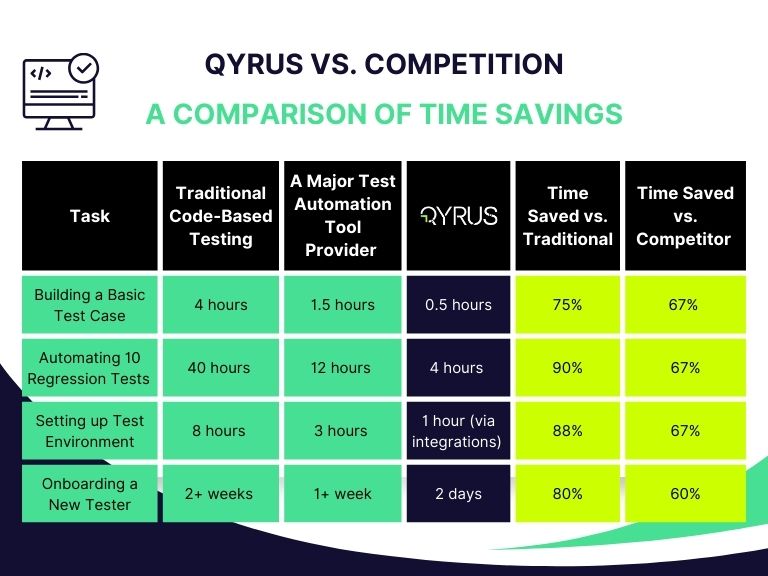
Qyrus vs. Competition: A Comparison of Time Savings
The table below provides data to illustrate these comparative time savings:
Qyrus’s design philosophy sets it apart from competitors who often focus on technical users with complex interfaces. Instead, Qyrus is built for all users, empowering manual and novice testers to quickly automate across many different domains while also providing the highly skilled technical tester with all the bells and whistles to test even faster. This emphasis on simplicity translates to significant time savings across various testing activities.
Qyrus’s intuitive design enables faster test creation, more efficient regression automation, and quicker test environment setup and team onboarding. By simplifying the testing process, Qyrus allows teams to spend less time on test management and more time on developing high-quality software.
Conclusion: Reclaim Time and Accelerate Success
Lengthy test cycles inflict significant pain points on businesses, resulting in delayed product releases, increased costs, and a sluggish response to market demands. These extended timelines can hinder innovation, negatively impact customer satisfaction, and ultimately affect profitability.
Qyrus offers a robust solution to these challenges through its codeless automation and AI-powered testing capabilities. Organizations have experienced significant automation of manual regression test cases, leading to considerable time savings. Furthermore, Qyrus has demonstrated its ability to reduce UAT testing time and streamline reporting processes.
Qyrus’s focus on simplicity and user-friendliness provides a key advantage over competitors. Its intuitive interface empowers all users to build tests more efficiently.
Don’t let long test cycles hold you back. Reclaim your time and accelerate your success with Qyrus!
Explore Qyrus’s comprehensive features and discover how it can transform your software testing process. Start your free trial today or request a demo to experience the benefits of faster time to market and higher quality software.
In today’s digital age, users expect software applications to work seamlessly across a multitude of devices and platforms. This expectation creates a significant challenge for software development teams: the increasing software testing costs and complexity of software testing infrastructure.
Historically, companies have tackled this by acquiring and maintaining a wide array of physical devices, virtual machines, and software licenses to mimic real-world user environments. Think of the stacks of devices, the rows of servers, and the sheer number of tools needed – it’s a lot! This traditional approach leads to a substantial financial burden and support from cross-functional teams to support. It includes the initial investment in hardware and software and the ongoing operational expenses like power, cooling, maintenance, and IT support.
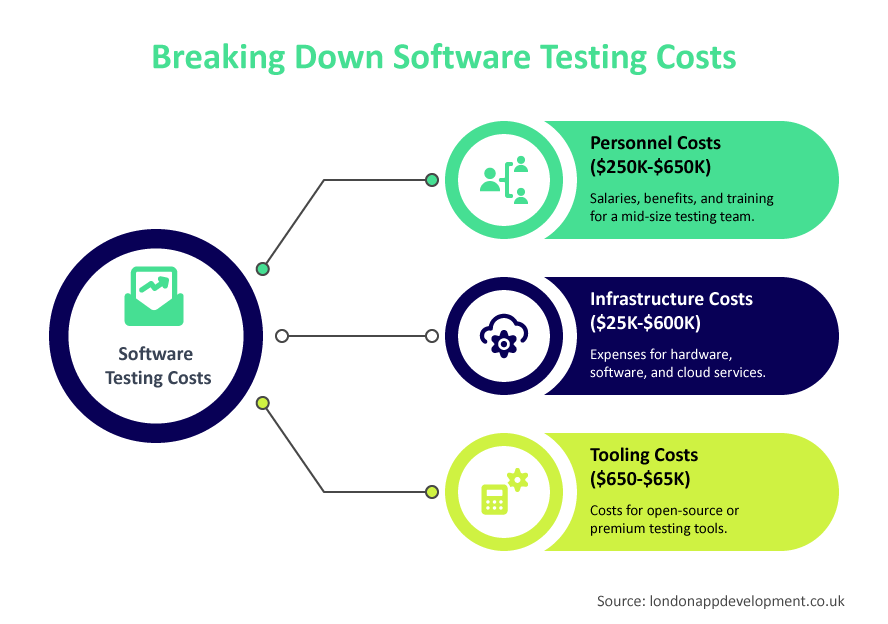
To put this into perspective, ITConvergence reports that organizations typically spend between $10,000 and $50,000 on the initial setup of their testing infrastructure. But that’s just the beginning. According to London App Development, 25-35% of the total software development budget is spent on testing.
As technology advances and these costs continue to climb, businesses face a critical question: Are there smarter, more cost-effective ways to manage our software testing? Can strategies like infrastructure consolidation and the use of Artificial Intelligence provide a more viable and economical path to ensuring software quality and simultaneously reducing software testing costs?
Unveiling the Hidden Costs: The Pitfalls of Fragmented Test Infrastructure
Maintaining a fragmented test infrastructure can feel like navigating a minefield for software development organizations. It’s not just about the obvious expenses; it’s the hidden costs and inefficiencies that truly eat away at your resources. Let’s break down these pain points:
The High Price of Entry: Setting up a fragmented test infrastructure demands significant upfront investment. You’re looking at acquiring a diverse range of testing environments – physical devices, virtual machines, various operating systems – the costs quickly add up. This initial outlay can strain budgets, especially for startups and smaller businesses. Cost estimation in software testing becomes crucial here, and a fragmented approach makes accurate estimation incredibly difficult.
Operational Costs That Keep on Climbing: The spending doesn’t stop after the initial setup. Maintaining a fragmented infrastructure involves continuous expenses that can feel like a relentless drain. Think about hardware maintenance and upgrades, software licenses for a multitude of testing tools, the ever-increasing power consumption to run it all, and the large teams needed to manage and support this complex system.
Complexity Overload: Trying to configure, maintain, and ensure consistency across numerous, separate testing environments is a huge challenge. Differences in setup, versions, and configurations can easily lead to errors and unreliable test results. Imagine the frustration of chasing bugs only to realize they were caused by an environmental inconsistency! This complexity makes reliable cost estimation in software testing a nightmare, as unexpected issues constantly arise.
Scalability Challenges: Need to scale your testing efforts up or down? With a fragmented infrastructure, it’s a slow and painful process. Acquiring new hardware, provisioning environments, and getting them to play nicely with your existing systems takes time and effort, potentially delaying critical releases. This lack of agility directly impacts time to market and increases overall software testing costs.
Integration Headaches: Fragmented infrastructures often involve a mix of testing tools and environments that simply don’t work well together. This leads to data silos, wasted effort, and a struggle to achieve a smooth, efficient testing workflow. End-to-end testing becomes particularly difficult, as different parts of the application struggle to communicate.
Time-to-Market Erosion: All the challenges mentioned above – managing disparate environments, troubleshooting inconsistencies, and dealing with integration issues – contribute to a slower testing process. This ultimately delays software releases, preventing organizations from delivering new features and updates to customers quickly. In a fast-paced market, this delay translates directly into lost revenue and increased software testing costs.
The Consolidation Cure: Streamlining Your Testing Ecosystem for Cost Savings
Test infrastructure consolidation offers a powerful solution to the challenges we’ve discussed. It’s about moving towards a unified approach to software testing, leaving behind the fragmented chaos. The core idea is to reduce the number of separate tools and test environments, creating a streamlined and integrated ecosystem. This shift can unlock significant benefits and directly address the question of how to reduce the cost of software testing.
Slash Licensing Costs: One of the most immediate and noticeable advantages of consolidation is the potential for significant reductions in software licensing expenses. By moving away from a multitude of individual tools, you can decrease the number of software licenses needed, leading to substantial savings on procurement and ongoing subscription fees. Platforms that offer a comprehensive suite of testing capabilities within a single environment are key to achieving these savings.
Simplify Management and Maintenance: A consolidated testing ecosystem inherently simplifies management. Instead of grappling with a variety of tools, each with its own interface, update schedule, and compatibility requirements, your IT teams can focus on a single, unified platform like Qyrus. This streamlined approach reduces the administrative overhead associated with managing a diverse toolset, freeing up valuable IT resources and decreasing the workload on the teams responsible for maintaining the testing infrastructure. This directly translates to reduced operational costs.
Enhance Integration and Efficiency: Consolidated platforms are designed with better integration in mind. When your testing tools exist within a unified ecosystem, they are more likely to offer seamless interoperability, resulting in more efficient workflows. This level of integration streamlines the testing process, enabling a better flow of information between different stages of the software development lifecycle and directly contributes to how to reduce the cost of software testing.
Accelerated Time to Market: By addressing the challenges of fragmented infrastructure, consolidation contributes to a faster time to market. Streamlined workflows, reduced errors, and improved collaboration enable quicker testing cycles, allowing organizations to deliver new features and updates to customers more rapidly.
By embracing test infrastructure consolidation, organizations can move towards a more efficient, cost-effective, and manageable approach to software testing, ultimately leading to higher quality software and faster release cycles.
The AI Revolution: Intelligent Efficiency in Software Testing
Beyond consolidating your testing tools, Artificial Intelligence (AI) is a game-changer when it comes to reducing software testing costs. AI’s ability to analyze large datasets, identify patterns, and make smart decisions can be applied throughout the testing lifecycle, boosting efficiency and lowering operational costs. It’s about making testing smarter, not just faster.
AI is transforming tasks that traditionally demand significant manual effort:
Intelligent Test Generation: AI algorithms can analyze software requirements, user stories, and existing systems to automatically generate test cases. This significantly reduces the time and resources testing teams spend on manual test design and creation, leading to faster test coverage and lower labor costs.
Automated Test Maintenance: Software applications are constantly changing, which means test scripts need frequent, time-consuming manual updates. AI-powered tools can detect changes in the application (like modifications to the user interface or code) and automatically update the relevant test scripts. This greatly reduces the burden of manual test maintenance, ensuring tests remain effective and up to date.
Smart Defect Analysis: When tests fail, it takes testers a long time to analyze the results, find the root cause of defects, and prioritize them for development teams. AI can help by identifying patterns in test failures, correlating issues, and prioritizing defects based on their severity and impact. This allows teams to focus their efforts and resources on the most critical issues, leading to faster resolution times and reduced costs associated with debugging.
Predictive Analytics: By analyzing historical test data, such as past failure rates, defect trends, and code changes, AI can predict potential risk areas within the application. This enables testing teams to proactively focus their efforts on these high-risk areas, optimizing test coverage and potentially preventing costly defects from ever reaching production. According to London App Development, using predictive analytics in testing can reduce the time spent on defect fixing by up to 30%.
In essence, integrating AI into software testing empowers organizations to achieve greater efficiency, reduce manual effort, and ultimately lower the overall costs of ensuring software quality.
Qyrus: The Power of Consolidation for Cost-Effective Testing
Qyrus embodies the principles of test infrastructure consolidation by providing a comprehensive, codeless, and intelligent test automation platform designed for Web, Mobile, and API testing. This unified platform eliminates the need for multiple, specialized testing tools. By consolidating your testing activities within Qyrus, your organization can significantly reduce licensing costs and simplify the overall testing ecosystem.
Qyrus operates using an on-demand SaaS model with integrated browser and device farms. This is a crucial aspect of consolidation, as it removes the need for organizations to invest in and maintain their own extensive physical or virtual test infrastructure. This eliminates the overhead associated with hardware procurement, maintenance, and ongoing operational costs. Qyrus provides the necessary infrastructure on demand, enabling you to scale your testing efforts without the traditional burdens of infrastructure management.
As the Forrester Total Economic Impact study highlights, Qyrus’s strength lies in its ability to “build a scenario and string add-in components of all three [mobile, web, and API] to create an end-to-end scenario.” This further emphasizes Qyrus’s capability to unify different aspects of testing within a single platform.
Qyrus: AI-Driven Cost Reduction in Action
Qyrus harnesses the power of Artificial Intelligence (AI) to drive down the costs associated with software testing significantly. As an AI-infused platform, Qyrus incorporates intelligent capabilities across various aspects of the testing process, leading to increased efficiency and substantial cost savings.
One key area where Qyrus leverages AI is in test script maintenance.
Qyrus features Healer, an advanced AI-based tool that helps prevent test flakiness and brittleness. By recreating the base functionality of a script if it fails, Healer reduces the time spent investigating and fixing unreliable tests, ensuring that testing efforts are focused on genuine defects rather than test instability. Furthermore, Qyrus’s AI/ML-driven features assist in autocorrecting, self-navigating, and generating tests. By automating these traditionally manual tasks, Qyrus enables faster test creation and execution, saving valuable time and resources for testing teams.
The Forrester Total Economic Impact (TEI) study reveals several key benefits that directly translate to significant cost reductions:
Significant cost avoidance from reduced downtime: This is partly due to Qyrus’s proactive AI detection, which reduces 50% of incidents that enter production.
Time savings with regression testing automation: Qyrus enables the regression automation of around 90% of manual test cases, significantly reducing the need for manual regression testing.
Productivity gains during UAT and reporting: Qyrus’s enhanced automation and user-friendly features reduce time spent on UAT testing by 20%, and its automated reporting capabilities save nearly two days of effort in generating regular reports.
Time savings in resolving issues due to reduced production errors: Qyrus enables more automated and proactive identification of production errors, saving QA testers and developers time in managing fixes, and reduces incidents by about half.
By integrating AI throughout its platform, Qyrus empowers organizations to achieve substantial cost savings through reduced manual effort, improved test stability, and a decrease in production defects and downtime.
The Future of Testing: A Strategic Path to Cost Efficiency
The persistent challenge of high costs linked to traditional test infrastructure and manual processes continues to burden software development organizations. However, the rise of test infrastructure consolidation and the integration of Artificial Intelligence offer compelling ways to achieve substantial cost reduction.
Qyrus emerges as a powerful platform that effectively combines these two crucial approaches. As the demands on software testing continue to increase in complexity and the pressure to deliver high-quality software at speed intensifies, adopting a platform like Qyrus presents a compelling advantage. By embracing a unified, AI-driven approach, organizations can achieve more efficient, scalable, and significantly more cost-effective software testing practices, positioning themselves for success in the future of technology.
Want to reduce testing costs and improve quality? Try Qyrus now and experience the difference.
Qyrus, a leading AI-powered test automation platform has been featured in Gartner’s latest report on the impact of Generative AI (GenAI) on the Software Delivery Life Cycle (SDLC).
GenAI is rapidly changing how software is built, tested, and delivered. The new-gen technology offers significant quality-of-life improvements for developers, with Gartner clients reporting productivity gains of around 10-15%. The real value lies in enhancing the developer experience and tackling specific SDLC bottlenecks.
This Gartner report, “How Generative AI Impacts the Software Delivery Life Cycle” (April 4, 2025), provides crucial insights into leveraging GenAI effectively while navigating its challenges.
At Qyrus, we proactively embrace critical industry trends like GenAI to best serve our customers. Our inclusion as an example vendor in Gartner’s research on AI-augmented testing reflects our commitment to leveraging cutting-edge technology for customer success and satisfaction.
Explore this research to:
Understand Gartner’s perspective on GenAI’s role in areas like code generation, debugging, application modernization, and AI-augmented testing.
Discover why Qyrus is recognized in the AI-augmented testing landscape.
Learn about the key benefits and risks software engineering teams should consider when adopting GenAI tools.
Gain insights into effectively integrating GenAI into your software development and testing workflows.
Gartner, How Generative AI Impacts the Software Delivery Life Cycle, Matt Brasier, 4 April 2025.
In today’s fast-paced software development landscape, speed is paramount. The ability to rapidly release high-quality software can be the difference between market leadership and falling behind. Traditional software testing methods often act as a test execution bottleneck, hindering release cycles and straining resources.
Qyrus offers a solution: a comprehensive, AI-powered testing platform designed to accelerate test execution and drastically improve software quality. By harnessing the power of codeless automation, AI, and machine learning, Qyrus empowers teams to achieve faster release cycles without compromising on quality. Qyrus improves web application quality and accessibility, while also shortening the time to market.
The Need for Speed: Overcoming Testing Bottlenecks
Software testing, while crucial, often presents significant hurdles. Time constraints, limited resources, and the relentless pressure to accelerate release cycles can lead to compromises in test coverage, ultimately impacting software quality. This translates to a dismal “inquiry to close won” conversion rate of less than 1% for a lead-centric process. Flipping that around, our cross-functional business processes fail more than 99% of the time. This is tragic, expensive, and needs to change.
Many organizations find themselves trapped in a testing bottleneck due to:
Application Development Fragmentation: A staggering number of applications, often resulting from acquisitions, leads to fragmented Agile development and testing. This makes the testing process time-consuming and resource intensive. Think of it like trying to assemble a puzzle where the pieces constantly change shape.
Siloed Teams: Different teams working in isolation make it difficult to test end-to-end user journeys. This causes communication breakdown, duplication of efforts, and inconsistency in testing. It’s like having different departments in a company speaking different languages.
But what if you could overcome these challenges and achieve faster test execution without sacrificing quality? What if you could assemble that puzzle with ease, and have all your departments speak the same language?
Qyrus: The Brains Behind the Speed
Qyrus isn’t just about automation; it’s about intelligent automation. It leverages cutting-edge technologies and a comprehensive feature set to drastically accelerate your software testing process.
Here’s how Qyrus helps you escape the testing bottleneck:
AI-Infused Testing: Qyrus utilizes AI and ML tools to automatically identify and fix test scripts, reducing maintenance overhead and ensuring tests remain reliable. This includes features like:
Healer: An advanced AI tool that prevents test flakiness and brittleness by recreating the base functionality of a script if it fails.
Rover: An autonomous exploratory testing solution using machine learning that is capable of generating tests without any human interaction. Rover can generate test steps, check for crashes, and even ensure the reliability of apps.
Codeless Automation: Qyrus’s intuitive low-code/no-code approach empowers both technical and non-technical users to create and execute tests, eliminating the need for complex coding and reducing the learning curve.
Web and Mobile Recorders: Streamline test building and create comprehensive, automated mobile test scripts with a low-code, no-code environment, capable of handling AI-driven mobile applications.
Parallel Testing: Qyrus enables parallel test execution, allowing you to run multiple tests simultaneously and significantly reduce overall testing time.
CI/CD Integration: Seamlessly integrate Qyrus with your existing continuous integration/continuous delivery (CI/CD) pipeline to automate workflows and ensure continuous testing throughout the development lifecycle.
Proof in the Pudding: Qyrus Delivers
Qyrus delivers quantifiable results, including:
Reduce test execution time by at least 50%.
Reduce test building time by at least 70%.
By combining these powerful features with an intelligent, AI-driven approach, Qyrus empowers organizations to achieve unprecedented speed and efficiency in their software testing efforts.
The study, based on interviews with representatives from an organization using Qyrus, projected a three-year financial analysis and found significant economic benefits:
Return on Investment (ROI): 213%
Net Present Value (NPV): $1 Million
The quantified benefits for the composite organization over three years include:
Time savings with regression testing automation: Qyrus enables the regression automation of around 90% of manual test cases, leading to a time saving worth $228,000.
Productivity gains during user acceptance testing (UAT) and reporting: Enhanced automation and user-friendly features reduce time spent on UAT testing by 20%, with automated reporting capabilities saving nearly two days of effort in generating regular reports, worth $212,000.
Time savings in remediating issues due to reduced production errors: Qyrus enables more automated and proactive identification of production errors, reducing incidents by about half, resulting in a benefit of $482,000.
Business growth due to accelerated feature release and market response: Automation and efficiency in the testing lifecycle enable faster release of new features, resulting in a cumulative increase in operating profits worth $29,000.
Cost avoidance from reduced downtime: Proactive AI detection reduces 50% of incidents that enter production, achieving significant cost savings worth $557,000 by preventing defects from moving to production.
The study demonstrates that Qyrus is not just a technological advantage, but a sound economic investment, delivering substantial returns and cost savings for organizations.
Qyrus: Your Testing Future, Today
In today’s fast-paced digital landscape, businesses need a software testing solution that can keep up with the demands of modern application development. Qyrus offers a comprehensive, AI-driven platform that simplifies and accelerates the testing process, helping organizations to deliver high-quality software faster and more efficiently.
From its codeless automation and AI-infused testing capabilities to its seamless integration with existing development ecosystems, Qyrus empowers teams to achieve unprecedented levels of test coverage, reduce defects, and improve overall software quality. The Forrester TEI study demonstrates the significant economic benefits that Qyrus can deliver, including a 213% ROI and a net present value of $1 million.
Whether you’re in banking, retail, logistics, manufacturing, or any other industry, Qyrus provides a versatile and scalable solution to meet your unique testing needs. By choosing Qyrus, you’re not just investing in a software testing platform; you’re investing in the future of your business.
Welcome to the second post in our series on Agentic Orchestration. In our introduction, we explained why the future of QA requires a shift from simple automation to an intelligent, agent-driven framework. Now, we’ll dive into the first step of that process: the ‘Eyes and Ears’ of the operation, the SEER Sense stage. If you missed our first post, we suggest starting there to get the full context.
How Qyrus Senses Change and Kickstarts Autonomous Testing
In the ever-evolving world of software development, change is the only constant. New features are added, bugs are fixed, and designs are tweaked, all at a breakneck pace. Traditional testing methods often struggle to keep up with this constant flux, leading to missed bugs, delayed releases, and frustrated developers. But what if your testing process could automatically adapt to change, like a chameleon blending seamlessly into its environment? This is the power of agentic orchestration, and at the heart of this revolution lies the “Sense” stage of the SEER framework (Sense, Evaluate, Execute, Report).
In this second installment of our series, we’ll explore how Qyrus Agentic acts as the eyes and ears of your development process, constantly monitoring for changes and triggering the appropriate testing actions. It’s like having a vigilant guardian constantly watching over your software, ensuring that no update goes unnoticed.
The ‘Sense’ Stage Explained
The ‘Sense’ stage is the foundation of Qyrus’ Agentic AI capabilities, designed to transition software testing from a reactive approach to a proactive one. It ensures high-quality software with minimal effort by detecting changes across various platforms and tools.
Change is in the Air: Detecting the When and Where
The primary objective of the ‘Sense’ stage is to identify precisely when and where a change occurs within the software development lifecycle. This involves continuously monitoring various sources for updates that could potentially impact the software’s quality, acting as the eyes and ears of your development process.
Imagine a radar system constantly scanning the horizon for potential threats. The ‘Sense’ stage acts in a similar fashion, vigilantly monitoring code repositories, project management tools, design platforms, and even user journey maps for any modifications. This proactive approach ensures that no change goes unnoticed, no matter how small or seemingly insignificant. By detecting changes early on, Qyrus SEER enables a shift from reactive to proactive testing, allowing teams to address potential issues before they escalate into major problems.
Watch Towers: The Guardians of Change
Watch Towers are the sentinels of the ‘Sense’ stage, constantly monitoring various sources for any changes that could impact the software’s quality. They act as the eyes and ears of Qyrus SEER, ensuring that no update goes unnoticed.
These Watch Towers are strategically positioned across the development landscape, keeping a close watch on platforms like:
GitHub (UI & API): Watch Towers receive push events and pull request merges. This allows Qyrus SEER to detect changes in the codebase, enabling immediate testing of new code commits.
Jira/ServiceNow/Azure DevOps: The system listens for changes to stories, tasks, or backlog items. This ensures that any modifications to project requirements are immediately identified and incorporated into the testing process.
Figma: Watch Towers detect design updates relevant to front-end/UX components. This allows Qyrus Agentic to adapt to changes in the user interface and user experience, ensuring visual accessibility across updates.
Qyrus Journeys: The system identifies changes in user journey definitions or test flows. By monitoring how users interact with the application, Qyrus Agentic can ensure that testing aligns with real-world usage patterns.
These components enable Qyrus Agentic to maintain a comprehensive overview of the software development lifecycle, ensuring that all relevant changes are captured and addressed.
The ‘Sense’ Stage Under the Hood: Technical Mechanisms for Change Detection
To effectively capture changes across diverse platforms, the ‘Sense’ stage employs several technical mechanisms. These mechanisms ensure that Qyrus Agentic is promptly notified of any updates that may impact software quality:
Webhooks: These provide real-time notifications from platforms like GitHub and Jira, alerting Qyrus to new commits, pull requests, or story updates.
API Polling: For systems that do not support webhooks, Qyrus Agentic uses API polling to periodically check for updates.
Event-Driven Pipelines: These pipelines facilitate the collection of triggers, indicating new or modified items, ensuring a streamlined and responsive change detection process.
By combining these technical mechanisms, Qyrus SEER achieves unparalleled continuous testing capabilities. It’s like having a network of sensors constantly monitoring your development environment, instantly detecting any changes and triggering the appropriate testing actions. This proactive approach ensures that no bug goes unnoticed, no matter how small or subtle.
The ‘Sense’ Stage: Eyes and Ears
How Qyrus uses ‘Watch Towers’ to monitor the entire development ecosystem for changes.
Code Repos
Git, SVN
Design Tools
Figma, Sketch
Requirement Docs
Jira, Confluence
API Specs
Swagger, Postman
The ‘Sense’ Stage
Aggregates all change data into a single trigger.
OUTPUT: Change Data Trigger → Sent to ‘Evaluate’ Stage
Benefits of the ‘Sense’ Stage: Proactive, Real-Time, and Comprehensive
The ‘Sense’ stage offers several key benefits that enhance the efficiency and effectiveness of software testing:
Proactive Testing: By initiating testing as soon as changes are detected, the ‘Sense’ stage enables a shift from reactive to proactive testing. This approach allows for the early identification and resolution of defects, reducing the risk of costly rework later in the development cycle.
Real-Time Adaptation: The ‘Sense’ stage ensures that Qyrus can respond to code updates, story modifications, and design changes in real-time. This adaptability is crucial for maintaining test coverage and relevance in dynamic development environments.
Comprehensive Monitoring: By tracking changes across various platforms and tools, the ‘Sense’ stage provides a comprehensive overview of the software development lifecycle. This holistic monitoring ensures that no critical update is overlooked, contributing to more robust and reliable software.
With its proactive, real-time, and comprehensive monitoring capabilities, the ‘Sense’ stage lays the foundation for a truly autonomous and efficient testing process. It’s like having a vigilant watchdog constantly guarding your software, ensuring that no change goes unnoticed, and no bug slips through the cracks.
Conclusion: Sense the Change, Embrace the Future
The ‘Sense’ stage is a critical component of Qyrus SEER, enabling proactive, real-time, and comprehensive monitoring of changes across the software development lifecycle. By identifying when and where changes occur, Qyrus ensures that testing efforts are always aligned with the latest code, requirements, and designs, resulting in more robust and reliable software.
But the journey doesn’t end here. Once changes are sensed, they need to be evaluated for their impact on the software. In the next part of this series, we’ll dive deep into the ‘Evaluate’ stage, exploring how Qyrus SEER uses Single Use Agents (SUAs) to assess the impact of these changes, generate or adapt test cases, and optimize testing strategies. Stay tuned to discover how Qyrus transforms detected changes into actionable insights, ensuring comprehensive test coverage and efficient resource allocation.
For years, software development teams have relied on a mix of manual and automated testing methods, hoping to catch those pesky bugs before they wreak havoc on users. But let’s face it, this approach is like trying to navigate a busy city with a tattered map and a broken compass. You might get to your destination eventually, but it’s going to be a bumpy ride. Traditional testing methods often lead to inconsistent coverage, inefficient release timelines, and sky-high maintenance costs.
Manual testing requires a small army of testers, while conventional automation tools lack the intelligence to manage comprehensive end-to-end testing across various types and stages. It’s like trying to assemble a complex puzzle with only half the pieces – frustrating and ultimately unproductive. This outdated approach is screaming for a change, begging for a solution that can navigate the complexities of modern software development with intelligence and precision.
Agentic Orchestration: The Self-Driving Revolution of Software Testing
Imagine a world where software tests itself, where intelligent agents tirelessly work behind the scenes to ensure quality at every stage of development. This is the promise of agentic orchestration, an AI-driven, fully autonomous system that manages test case creation, execution, and reporting. It’s like having a self-driving car for your software testing process – you set the destination, and the system takes care of the rest.
Agentic orchestration empowers development and testing teams to achieve exceptional results without the traditional overhead. It’s a paradigm shift from reactive to proactive testing, ensuring high-quality software with minimal effort. No more sleepless nights worrying about missed bugs or delayed releases. With agentic orchestration, you can finally shift gears and focus on what matters most – building amazing software that delights your users.
The Evolution of Testing
From rigid, linear pipelines to a dynamic, intelligent, and cyclical orchestration framework.
Traditional Automation
P
C
B
T
D
Linear, rigid, and breaks easily.
Agentic Orchestration
SEERFramework
Code
APIs
UX/UI
Docs
Dynamic, cyclical, and intelligent.
Qyrus SEER: Your Co-Pilot for Autonomous Testing
Qyrus SEER (Sense, Evaluate, Execute and Report) is a framework for AI-powered agent orchestration. It features AIVerse, a comprehensive suite of Single Use Agents (SUAs) – specialized GenAI-driven models designed to address specific problems or scenarios within the quality assurance process. These agents act like a team of expert testers, each with their own unique skills and knowledge, collaborating to ensure your software is rock solid.
SUAs can collaborate or operate independently, enhancing test automation with an extraordinary level of intelligence and speed. They can generate test cases, discover APIs, create realistic test data, and even self-heal when things go wrong. It’s like having a team of tireless testers working around the clock, catching bugs before they even have a chance to rear their ugly heads.
With Qyrus SEER, you can finally say goodbye to the headaches of traditional testing and embrace a new era of self-driving quality. It’s time to shift gears, accelerate your release cycles, and steer your software development towards a brighter future.
What is Agent Orchestration?
Agent orchestration represents a paradigm shift in software testing, using AI-driven agents to automate and optimize the entire testing process. Unlike traditional methods that often require extensive manual intervention or fall short in end-to-end coverage, AI agent orchestration leverages intelligent automation to create a dynamic, self-improving testing ecosystem. It enables a move from reactive to proactive testing, ensuring superior software quality with less effort.
Think of it as an orchestra, where each musician plays a specific instrument to create a harmonious symphony. In agentic orchestration, each AI agent is a specialized musician, playing its part to ensure a flawless performance. The agent orchestration framework acts as the conductor, coordinating the agents to work together seamlessly.
Qyrus Agentic, a leading AI agent orchestration platform, takes this concept to the next level with its unique approach.
Our Features
AI-Powered Agents: At the heart of agentic ai orchestration are SUAs. These autonomous entities are designed to perform specific tasks within the testing lifecycle, such as generating test cases, discovering APIs, or creating realistic test data. Each SUA is a specialist in its domain, contributing to the overall intelligence and efficiency of the system.
Orchestration Layer: The orchestration layer acts as the central nervous system, coordinating SUAs to work together seamlessly. It ensures that the right agent is deployed at the right time, in the right sequence, to achieve testing objectives. This layer may also apply business rules or enterprise testing policies.
Feedback Loops: Agentic orchestration includes continuous feedback loops that allow the system to learn and adapt from past tests. By analyzing historical test results, defect trends, and risk profiles, the system can refine test cases, optimize test execution, and enhance overall test coverage. This continuous learning ensures that the testing process becomes more effective over time.
With its AI-powered agents, intelligent orchestration, and continuous feedback loops, Qyrus Agentic offers a comprehensive solution for multi-agent orchestration in software testing. It’s like having a self-learning orchestra, constantly improving its performance to deliver a flawless symphony of software quality.
The Benefits of Agentic Orchestration: Unleashing a Tidal Wave of Efficiency and Quality
Qyrus Agentic offers a multitude of benefits that address the key challenges of traditional software testing, resulting in a more efficient, reliable, and cost-effective approach to quality assurance. By automating and optimizing the testing process, agentic orchestration enables organizations to achieve faster releases, improved test coverage, and significant cost savings.
Advantages of adopting Qyrus SEER
Increased Efficiency: Agentic orchestration accelerates test cycles and significantly reduces manual effort. AI-powered agents automate test case creation, execution, and reporting, freeing up testers to focus on more strategic activities. This leads to faster feedback loops and quicker identification of defects.
Improved Coverage: Agentic orchestration facilitates comprehensive testing across UI, API, and data layers. By leveraging SUAs for different testing tasks, the system ensures that all aspects of the application are thoroughly tested. This results in more robust and reliable software.
Reduced Costs: By automating key testing processes, Qyrus SEER lowers operational and hiring costs. The platform eliminates the need for multiple tools, reduces the reliance on large testing teams, and streamlines the overall testing workflow. This enables organizations to achieve significant cost savings while improving the quality of their software.
Faster Releases: Agentic orchestration accelerates time to market by enabling faster test cycles and continuous feedback. The AI-driven system adapts to code and UI changes in real-time, ensuring that tests are always up to date. This allows development teams to release new features and updates with minimal risk.
Self-Healing: Qyrus SEER incorporates self-healing capabilities that allow the automation to adapt to changes in the application. This reduces the need for constant test script updates and ensures that tests remain effective over time. The result is a more stable and maintainable testing environment.
In essence, agentic orchestration empowers software development teams to break free from the shackles of outdated testing methods and embrace a new era of efficiency, quality, and speed. It’s like having a team of expert testers working tirelessly behind the scenes, ensuring your software is always at its best. With Qyrus Agentic, you can finally say goodbye to the headaches of manual testing and embrace a future where quality is not just a goal, but a guarantee.
SEER: The Brain Behind the Machine
Qyrus SEER is an agentic AI orchestration framework to automate and orchestrate testing activities. SEER is designed to automate and orchestrate testing activities based on incoming triggers, such as new code commits, updates to user stories, or design changes.
The agent orchestration framework uses SUAs across structured Reasoning and Orchestration layers, each focusing on a distinct set of responsibilities. The main goal is to continuously track changes, analyze their impact, generate or adapt test cases, execute these tests, and report findings.
AlVerse: The Powerhouse of Specialized Agents
Qyrus AlVerse is a key component of Qyrus SEER, comprising a suite of SUAs designed to address specific testing challenges. These specialized GenAl-driven models can work together or independently to elevate test automation with intelligence and speed.
The AlVerse, combined with SUAs, advances software test automation towards objective-based testing, providing an automated testing continuum. Each SUA serves a distinct purpose:
Generating tests/scenarios
Providing advanced insights and reporting
Data amplification
API discovery
Self-healing
Qyrus AlVerse has SUAs deployed at every phase of the SDLC, designed to ‘Shift Left’, find defects early, reduce costs and improve overall quality.
Every agent has tools, such as functions to parse JSON, build tests, or something else.
Qyrus SEER: A Symphony of Benefits for Every Role
Qyrus SEER is designed to provide value to everyone involved in the software development lifecycle, from testers and developers to executives. By addressing the unique challenges and priorities of each role, Qyrus SEER ensures that the entire organization benefits from a more efficient, reliable, and cost-effective approach to software testing.
Testers: Qyrus Agentic offers a paradigm shift for testers, enabling “testing without testing”. This means that testers can focus on more strategic activities, such as exploratory testing and test planning, while the AI-powered system handles the repetitive tasks of test case creation, execution, and maintenance.
Developers: For developers, Qyrus SEER provides the confidence to code with confidence, knowing that their changes are thoroughly tested in real-time. The platform’s self-adapting capabilities ensure that tests are always up to date, providing developers with instant, stable feedback. By automating key testing processes, Qyrus SEER reduces dependency on testing teams, allowing developers to iterate more quickly and release new features with minimal risk. The platform’s self-healing automation eliminates flaky scripts, allowing developers to focus on coding rather than fixing broken tests.
Top Leaders: Qyrus SEER enables executives to accelerate releases with near-zero risk. The AI-powered system ensures consistent quality across the entire application, from front-end to back-end, leading to a more efficient development cycle and a strategic competitive advantage. By automating key testing processes and reducing the reliance on large testing teams, Qyrus SEER enables organizations to achieve significant cost savings. The platform’s AI-driven capabilities streamline the overall testing workflow, resulting in faster time to market and improved business outcomes.
Conclusion: The Dawn of Autonomous Testing
Agentic orchestration signals a transformative shift in software testing, moving away from traditional, often inefficient methods, towards an AI-driven, fully autonomous system. Qyrus SEER, powered by the Qyrus AIVerse, orchestrates SUAs to achieve unparalleled results in test automation. This innovative approach promises faster releases, improved test coverage, and significant cost savings, ensuring high-quality software with minimal effort.
This series will delve into how SEER enhances each stage of the testing process.
But how does it all begin? The answer lies in the first critical step: Sense.
In the next part, we’ll explore how SEER’s “Watch Towers” act as vigilant sentinels, identifying when and where changes occur across your development landscape, from GitHub and Jira to Figma and Qyrus Journeys. Discover how Qyrus SEER knows exactly when to spring into action, ensuring that no code commit, user story update, or design tweak goes unnoticed.
In the realm of software testing, time is a critical factor. The faster we can test, the quicker we can deliver quality software. Parallel testing is a strategy that allows multiple tests to run simultaneously, significantly reducing test times.
It’s a game-changer, especially when dealing with complex software testing scenarios like SAP, Web, Mobile, Data, and API testing.
But parallel testing isn’t without its challenges.
Resource management, test data synchronization, and maintaining consistency across testing environments can be daunting. However, with the right strategies and tools, these hurdles can be overcome.
One such tool is artificial intelligence.
AI-based testing platforms such as Qyrus can optimize test execution, balance test loads, and even predict flaky tests.
Qyrus offers a transformative approach to software testing through an agentic orchestration platform. This AI-driven system manages test case creation, execution, and reporting, enabling development and testing teams to achieve exceptional results without traditional overhead.
What is Parallel Testing?
Parallel testing involves executing multiple tests simultaneously. This method aims to reduce the total duration needed for test execution dramatically. It uses distributed systems or cloud services to facilitate tests running in parallel, ensuring efficient use of resources.
This approach is distinct due to its ability to handle numerous test cases at once. It makes full use of available infrastructure, reducing the bottleneck that comes with sequential testing. The result is a more agile and responsive testing process, crucial for software teams aiming to optimize their delivery timelines without sacrificing quality.
The Importance of Parallel Testing
The foremost advantage of parallel testing is the significant reduction in overall test times. By running tests concurrently, software teams can achieve quicker validations and delivery. This reduces the wait time for testing results and speeds up the development process.
Furthermore, parallel testing enhances software quality and reliability. It does so by improving test coverage without extending time frames, thereby catching more defects early in the cycle. This practice not only streamlines the testing workflow but also supports continuous integration and deployment initiatives, vital for maintaining competitive, high-quality software products.
How Qyrus Enables Parallel Testing
Qyrus leverages Single Use Agents (SUAs) to automate test case creation, execution, and adaptation. These specialised Gen AI-driven models can collaborate or operate independently, enhancing test automation with an extraordinary level of intelligence and speed.
Qyrus’s Agentic Orchestration platform, Qyrus Agentic, plays a crucial role in coordinating parallel test execution by seamlessly automating and managing the various stages of the testing process. Qyrus Agentic utilizes the SEER (Sense, Evaluate, Execute, Report) framework to facilitate this automation.
The AI-driven platform continuously monitors changes, evaluates their implications, generates or adapts relevant test cases, executes these tests concurrently, and reports the outcomes effectively.
Additionally, Qyrus enhances the efficiency of parallel test execution through its ability to dynamically allocate resources, allowing it to spin up ephemeral environments as needed. This dynamic resource management ensures optimal utilization of testing resources, significantly improving the speed and reliability of the testing process.
Key Features and Benefits of Qyrus Parallel Testing
Scalability: Enable scalable testing across diverse environments, adapting to growing project demands effortlessly.
Comprehensive Coverage: Qyrus Agentic provides unified test orchestration for UI, API, mobile, component, performance, security, and database testing, ensuring cross-platform and cross-device coverage.
AI-Driven Automation: Reduce your test creation efforts and maintenance with AI-driven automation. Qyrus adapts to code and UI changes, ensuring tests are always up to date.
Real-Time Feedback: Seamlessly integrate Qyrus Agentic into your CI/CD pipelines and experience seamless testing. The platform automatically senses changes in your code and generates tests giving you real-time feedback directly within your environment.
Reduced Costs: Reduce hiring and operational costs. Not only does it result in cost savings exceeding 30%, but it also significantly enhances outcomes by a factor of four.
Self-Healing: Self-healing automation eliminates the need for constant updates to test scripts, allowing you to focus on coding rather than fixing broken tests.
Conclusion: Embracing AI for Continuous Improvement
AI facilitates continuous improvement in testing strategies by learning from past data. It adapts strategies to better align with evolving software needs. This process of continuous learning and improvement is vital for maintaining an edge in the competitive software market.
Qyrus’s smart integration of AI in parallel testing is reshaping the software testing landscape. It brings enhanced efficiency and effectiveness by executing tests simultaneously.
Qyrus significantly reduces testing time, accelerates releases, and improves overall software quality.
Ready to accelerate your software releases and improve quality? Try Qyrus Agentic today and experience the power of AI-driven parallel testing! Start your free trial now.
Behavioral Health Team
Behavioral Health, a digital initiative by the insurance group, stands out as a vital player in supporting employee mental health. Its rich digital platform offers employers essential tools to aid employee well-being, such as personalized resources, clinical treatments, and tailored educational programs. In their mission to enhance employee engagement and destigmatize mental health issues, the Behavioral Health team adopted Qyrus as an automation tool for web and mobile application testing, facilitating a seamless transition from their previous systems.
About/Overview
The importance of the organization’s Behavioral Health cannot be overstated—it is central to nurturing employee welfare through its all-encompassing digital platform. As they embarked on re-platforming their systems to enhance user experience, they recognized the need for a reliable testing solution that guarantees the high quality of their web and mobile applications. By shifting from Selenium to Qyrus, they managed to simplify the complexities associated with script creation, thus enabling faster and more efficient testing.
Challenge
Before embracing Qyrus, the company faced several challenges in their testing processes:
Complexity with Selenium: Crafting and maintaining scripts using Selenium demanded substantial coding expertise, particularly in C#, making it a time-intensive endeavor.
Lack of Mobile Automation: The inability of Selenium to offer comprehensive mobile application testing contributed to significant test coverage gaps.
Efficiency Concerns: Conducting smoke tests was both time-consuming and resource-heavy, causing delays in upholding application quality.
Life with Qyrus
Features & Values
The adoption of Qyrus addressed these challenges, revolutionizing the organization’s approach to testing.
Key Features Utilized:
Ease of Use: As a Selenium alternative, Qyrus supplanted Selenium by offering a user-friendly interface with low-code testing features, which diminished reliance on extensive technical knowledge.
Web and Mobile Testing: Thanks to its comprehensive support for both platforms, Qyrus allowed the company to execute tests smoothly across various devices.
Manual Step Creation: The ability to manually craft and execute test scripts streamlined the process, rendering testing more accessible and efficient.
Support and Training: Qyrus’ dedicated support team enabled swift adoption and sustained success in testing processes.
Results
The organization experienced notable improvements after integrating Qyrus:
Time Savings: Rewriting smoke tests with Qyrus took merely 1.5 hours, a stark contrast to the entire week required with Selenium.
Ease of Adoption: As a Selenium alternative, the transition to Qyrus was smooth, alleviating stress and frustration while facilitating training for additional QA members.
Eliminated Selenium Overheads: By eliminating the dependency on Selenium QA automation engineers with the adoption of Qyrus as a Selenium alternative, the team cut costs associated with hiring specialized expertise.
Enhanced Collaboration: Demonstrating Qyrus to other QA teams at the company sparked widespread interest and engagement, democratizing testing processes across teams.
Future Dreams
Results + Outcome
The successful integration of Qyrus in Behavioral Health’s workflow has notably simplified their test automation of mobile apps and web applications. The platform’s low-code capabilities, coupled with its efficiency and ease of use, have positioned the organization’s Behavioral Health application to scale their testing operations, further supporting their digital transformation objectives.
Aspirations
Looking ahead, the business plans to broaden their use of Qyrus across a more extensive test suite, particularly as they continue to replatform their applications. By persistently exploring Qyrus’ features, the team aspires to further refine their testing processes, improve application quality, and sustain their leadership in mental health support.
By continually advancing their testing processes with Qyrus, the organization aims to uphold its dedication to mental health support and digital innovation.
Strategies to identify challenges in SAP Testing and solve them easily
Does testing SAP systems feel more like an intricate challenge than a standard process? Navigating the SAP testing landscape can feel like being lost in a dense jungle? We can understand that. The inherent complexity of SAP environments, which often involve extensive customization and deep integration with other applications, makes SAP Testing daunting.
The SAP Testing Jungle: Why Existing Methods Fall Short?
The diverse modules and customizations within SAP systems complicate test coverage, test scenario creation requiring a more nuanced approaches than standard testing protocols can provide. The challenges are numerous and can quickly overwhelm even the most seasoned teams:
1. Complexity by Customization
One of the primary challenges in SAP testing is the high level of customization in many SAP implementations. Each organization often tailors the system to its specific needs, leading to a unique setup that can complicate the testing process. Conventional test cases may not suffice to cover the vast array of custom functionalities, which requires QA teams to develop more specialized and extensive testing protocols
2. Interconnected Systems
SAP systems are frequently integrated with various external applications and technologies, making end-to-end testing crucial. Any changes made in one system can potentially impact others, disrupting key business processes. Therefore, it is essential to ensure that rigorous integration testing is performed to identify and resolve issues arising from these interactions. This interconnectedness creates additional testing burdens, as testers must consider the implications of modifications across the entire IT landscape.
3. Data Quality and Data Migration
Poor data quality and ineffective data migration can significantly impede the SAP testing process. Organizations must ensure that data is accurately transferred and meets the required quality standards to prevent operational disruptions. Data migration challenges often necessitate additional validation testing to confirm that the data within the SAP system is both accurate and complete
4. Security Concerns
The increasing number of cyber threats makes SAP systems security another challenge. SAP testers must conduct thorough assessments to identify potential vulnerabilities and ensure data protection. Confidentiality is paramount when handling sensitive business data, making security testing an indispensable part of the SAP testing process.
5. Inadequate Training and User Adoption
Another challenge often faced during SAP testing is the inadequate training of end-users. Insufficient training can lead to low user adoption rates, decreased productivity, and resistance to new systems and processes. Comprehensive, role-based training and ongoing support are crucial for user confidence. Ongoing support and resources post-implementation are also vital but costly for the organization.
6. Evolving Compliance Requirements
Many industries have strict regulatory requirements that SAP systems must adhere to. Testing processes must be designed to ensure compliance with these industry-specific regulations and standards. Failing to meet compliance can result in legal repercussions and financial penalties, making it imperative that testing strategies are aligned with regulatory demands
7. SAP Test Data Management
SAP Test Data Management (TDM) involves the strategies and tools utilized to manage test data effectively in SAP environments. Effective SAP TDM not only ensures that test environments are populated with accurate and relevant data. Given the complexity of SAP applications, which include multiple integrated modules and extensive business logic, lack of effective TDM plays a crucial role in ensuring success of SAP Testing.
Test Automation Mirage: Why Some Solutions Just Don’t Cut It
Many organizations turn to automation to solve these challenges, but not every SAP test automation tool is created equal. Generic sap testing tools for automation often struggle with the unique interfaces found in SAP systems, such as SAP GUI and SAP Fiori, making them inadequate for comprehensive testing.
Moreover, maintaining automated tests can become costly and complex, especially when new team members need to modify existing scripts or when there are frequent system updates. Consequently, the traditional SAP test automation tool and approach often fall short, leaving businesses vulnerable to errors, delays, and increased costs.
Is there a Solution? Qyrus Advantage
Qyrus offers a fresh approach to SAP testing, going beyond simple tools to provide a complete solution tailored to the unique challenges of SAP environments. Powered by AI, Qyrus automates your SAP testing, leading to faster test runs, highly accurate results, and significant cost savings. It also addresses all the limitations of current SAP Test automation tools in the market.
As an all-in-one, end-to-end platform, Qyrus simplifies even the most complex SAP landscapes, seamlessly integrating with your existing systems to provide continuous testing and quick feedback.
Whether you’re a small business or a large enterprise, Qyrus is designed to handle your needs, transforming how you approach SAP quality assurance. Instead of just checking for errors, Qyrus helps you build quality into your SAP systems from the start.
Why Choose Qyrus for SAP Testing?
A Holistic Approach
Qyrus isn’t just an SAP test automation tool; it’s a complete testing platform. It handles all your testing needs in one place, covering not only SAP environments but also web, mobile, and API testing. This unified approach ensures consistent testing and scales easily to fit your entire IT landscape.
Instead of using separate, disconnected tools, Qyrus provides a single, integrated solution. This means you’re not just testing individual parts of your system; you’re ensuring everything works together seamlessly within your SAP ecosystem. This comprehensive view minimizes the risk of missing critical issues and creates a more reliable foundation for your business.
Empowering Teams with Ease of Use
Qyrus’s no-code interface makes testing accessible to everyone, whether they’re technical experts or not. This empowers both technical and non-technical teams to actively participate in the testing process, reducing reliance on specialized resources and fostering greater collaboration and efficiency.
Qyrus’s intuitive design simplifies test setup and management, enabling broader participation in quality assurance across the organization. By making testing more accessible, Qyrus cultivates a company-wide commitment to quality.
AI-Augmented Insights for Better Decision-Making
Qyrus goes beyond basic testing with its Gen AI-powered SAP test automation tool. The tiny but powerful models provide actionable insights, improving both decision-making and testing accuracy. By analysing test data and offering valuable feedback, these AI-driven tools help you identify and fix problems more efficiently. Featuring Gen AI sap test script generation, the Qyrus SAP test automation tool transforms raw data into meaningful information, empowering you to make informed decisions that lead to better results and more reliable systems.
Core Features that Set Qyrus Apart
Qyrus’s innovative approach to SAP testing is built on key principles: a hybrid testing methodology, AI-powered test orchestration, and objective-based testing. Here are some of the key features that make Qyrus stand out:
AI-Powered Test Orchestration: Qyrus’s unique Single-Use Agents (SUAs) automate the entire test lifecycle, from generating test cases to orchestrating their execution, ensuring maximum coverage with minimal test time.
Qyrus SAP Test Strategy: figures out what to test, which to automate first, and what gets impacted due to changes – solving for maximum automation RoI
Qyrus DataChain: Generate realistic and compliant test data rapidly, removing the need for production data and ensuring full test coverage.
Qyrus Robotic Smoke Testing (RST): Automate routine smoke tests with an intelligent framework, which reduces manual effort and provides actionable insights.
Qyrus Document Exchange Testing (IDoc): Provides detailed discrepancy detection to ensure seamless data exchange within your SAP environment.
Qyrus Accelerated Regression Suite (ARS): Accelerate your SAP regression testing with a script-less framework designed to cover core business processes like Recruit to Retire, Lead to Cash, Source to Pay, and Plan to Fulfil.
Extensive Module Support: Qyrus covers diverse SAP environments, including both standard and custom solutions.
Unlocking Your SAP Potential: From Bottleneck to Breakthrough
With the growing adoption of Agile and DevOps, the need for intelligent, automated testing solutions is rapidly increasing. Verified Market Research projects the SAP testing market to reach $1.4 billion by 2031, underscoring this demand.
Qyrus isn’t just keeping up with the future of SAP testing—it’s actively shaping it. Because efficient SAP testing isn’t just a necessity, it’s a strategic advantage. Qyrus transforms testing from a bottleneck into a driver of innovation, enabling faster deployments, reduced costs, and higher quality SAP implementation.
Don’t let outdated testing methods hold you back – gain the competitive edge with the Qyrus SAP test automation tool.
Partner with Qyrus and unlock the full potential of your SAP investment. As you know, more than just a tool, Qyrus provides a comprehensive solution and a collaborative approach to help you achieve your business goals. From complex migrations to ongoing maintenance, we’re here to support your journey.
Start your free Qyrus trial of our SAP test automation tool and see how you can reduce your SAP testing costs by up to 50%.
Jerin Mathew
Manager
Jerin Mathew M M is a seasoned professional currently serving as a Content Manager at Qyrus. He possesses over 10 years of experience in content writing and editing, primarily within the international business and technology sectors. Prior to his current role, he worked as a Content Manager at Tookitaki Technologies, leading corporate and marketing communications. His background includes significant tenures as a Senior Copy Editor at The Economic Times and a Correspondent for the International Business Times UK. Jerin is skilled in digital marketing trends, SEO management, and crafting analytical, research-backed content.