With automation tools like Qyrus, users can test their applications much quicker. Organizations have significantly cut their test build and run times with Qyrus, and they do not need to code or create manual tests. Test users can now make scripts with a click of a mouse. However, when building large but similar test scripts, test building can feel tedious when users have to keep creating the same steps over and over again. With step functions, users can now step up their test-building capabilities. Parth and Steve will explain how step functions can bring value to testers and organizations.
Tell us more about step functions offered by Qyrus and its use cases. (From a high level, provide a summary of this feature)
Parth: So, a user can reuse existing steps from a previous test script in a new test script. They don’t need to recreate the same steps in their script and can directly use what they already created.
Steve: It allows users to maintain the test scripts easily. If a user makes an edit in one location, all locations using these steps will be updated. Especially for big test scripts, maintenance times can be exponentially reduced with this feature.
What are step functions’ overall impact on the testing process?
Parth: Users can create larger and more scalable scripts when building tests. Test building becomes easier for the user as it drastically decreases human error when recreating the same steps across different tests.
Steve: There is a clear reduction in effort and time spent by the user. Users gain more time to create better and more impactful test cases. Companies also see a cost-benefit tied to the effort reduction, with more opportunity for users to write efficient test scripts.
Parth: Reusable test steps also help during test execution and reporting. It is simpler for users to select which test steps and scripts to run if the user wants to only run specific test steps. It also makes viewing test reports easier.
How might step functions help testers and developers? What value can this feature bring?
Steve: Testers can reuse the steps they have from an existing script to build new ones. They are able to build new tests much faster. The edits made in one location will update to all other scripts. With this feature, long test scripts can now be completed in just a few clicks. Furthermore, users can easily track scripts implementing certain step functions, especially in a customizable way using Qyrus’ mind maps.
Parth: Developers can also run steps from a CI pipeline to test a specific area of their application. A step functions implementation is flexible and can be used across a variety of tools.
Does the same or similar functionality exist without Qyrus, and how do competitors address similar problems?
Parth: Other users may have to recreate steps or find a more roundabout way to implement steps from another script. Step functions give an easy and simple ability to incorporate existing steps within a new test script.
Steve: I agree with Parth. They may have to export the steps to another folder or library in order to use them elsewhere. Or find another way to import the test steps.
How do you see step functions impacting day-to-day operations across organizations?
Steve: This function has already impacted many day-to-day operations across multiple organizations by making scripts much easier to maintain. Step functions lower maintenance, allowing organizations to strengthen business operations and their provided services. Users can create new tests effortlessly, as already created steps can be implemented anywhere else.
Parth: All your scripts can now be easily maintained with step functions. If updates are required, users can make those changes, and the step functions that will update whatever scripts use them. Step functions are easy to integrate within pipelines, which could offer faster test building and testing capabilities. Their reusability also allows updates within one function to update across any test scripts using them, bringing high scalability across test suites and folders.
In the realm of software testing, Qyrus introduces a simple, yet game-changing feature with step functions, addressing a common challenge users face in test script creation. This innovation allows users to reuse existing steps from previous test scripts, streamlining the process, reducing repetition, and enhancing accuracy. This practical tool significantly improves test-building efficiency, making it easier to create larger and more scalable test scripts. By minimizing manual work and the potential for error, step functions empower testers and developers to focus on refining test cases and ensuring quality. This feature also simplifies test execution, reporting, and maintenance, providing a clear advantage over other methods. Qyrus’ step functions are yet another one of the platform’s innovations on reusability in test creation, adding to other prominent features such as its end-to-end, or Component Testing, and its ability to reuse functional API tests for performance API tests. Step functions emerge as a valuable addition, optimizing day-to-day operations and further solidifying its commitment to enhancing testing processes.
Step into a world of magical efficiency, where a mystical recorder unlocks the secrets of desktop application testing. Welcome to this week’s Feature Friday, where we unravel the enchanting capabilities of QloudBridge’s latest innovation – the QloudBridge Recorder. Like a master magician, Qyrus has conjured up this cutting-edge feature, setting new standards in the realm of desktop application testing. The QloudBridge Recorder is no ordinary wand; it has the power to record not just Windows applications, but also enterprise legacy applications like SAP. With its spellbinding abilities, users can effortlessly capture every interaction with these applications, weaving a seamless script that automates their testing process. Join us as Milton Par and Amairani Lopez guide us through the wondrous functionalities and versatile applications of the QloudBridge Recorder. Prepare to be mesmerized as we unveil the secrets behind its effortless script-building magic!
Tell us more about the QloudBridge recorder offered by Qyrus and its use cases.
Milton: The QloudBridge recorder is a game-changer in the world of testing. It allows users to effortlessly record and generate test scripts for desktop applications, eliminating the tedious manual script-building process. With just a few clicks, the QloudBridge recorder captures user actions, creating a script that’s readily available for execution.
Amy: Absolutely, Milton! The recorder simplifies the testing workflow, benefiting testers, developers, and business technologists alike. For testers, it saves valuable time and effort in creating scripts for desktop applications, enabling them to focus on analyzing test results and improving testing efficiency.
What is the recorder’s overall impact on the testing process?
Milton: The QloudBridge recorder significantly streamlines the test preparation phase, transforming complex desktop application testing into a seamless experience. By automatically generating scripts, it reduces the chances of human error and enhances the reliability of test automation.
Amy: Indeed, it’s a remarkable feature for developers, too. With precise element identification and script generation, they can debug and fine-tune scripts quickly during the development phase, accelerating the overall development process for testing applications.
What value can this feature bring while testing on desktop applications?
Milton: The recorder empowers testing teams to build accurate test cases with ease, irrespective of their coding background. For business technologists, this means that they can actively contribute to the testing process without the need for coding skills, promoting collaboration across teams. And beyond that, the simplified UI will make it easier for them to understand and grasp, as well.
Amy: Additionally, the QloudBridge Recorder boosts productivity by reducing the dependency on manual script creation. This enables testers and developers to focus more on test analysis and software improvements on desktop applications, ultimately delivering better-quality products to end-users.
Does the same or similar functionality exist without Qyrus, and how do competitors address similar problems?
Milton: While there are other recorders available on the market, the QloudBridge recorder stands out with its seamless integration into Qyrus’s comprehensive testing platform. This ensures a smooth end-to-end testing experience for desktop applications with easy access to other Qyrus features.
Amy: Moreover, the QloudBridge recorder’s ability to detect and support various actions, such as clicks, sets, window switching, and application launching, sets it apart from competitors. Its versatility enhances testing capabilities across a wide range of applications and scenarios.
How do you see QloudBridge recorder impacting day-to-day operations across organizations?
Milton: The QloudBridge recorder is a true time-saver. With simplified script generation, organizations can accelerate their testing cycles and achieve faster release cycles without compromising on the quality of their applications.
Amy: Agreed! It also fosters collaboration between testing, development, and business teams, breaking down the barriers to communication. The QloudBridge recorder empowers teams to collaborate more effectively and deliver products that meet user expectations.
The QloudBridge recorder redefines desktop application testing, making it more intuitive, efficient, and productive. By automating script creation and facilitating collaboration, this feature empowers testing teams to deliver high-quality software at an accelerated pace. Embrace the QloudBridge recorder and unlock a world of possibilities in desktop application testing with Qyrus. Thank you, Milton and Amy, for sharing your insights on this remarkable feature! Stay tuned for more exciting innovations in the world of software testing. Happy testing!
The rise in prominence of AI chatbots over traditional rule-based types is at an all-time high. For example, contact centers will save agent labor costs of $80 Billion using conversational AI by 2026. Similar usage trends are evident in other business verticals as well.
Conversational AI-based chatbots rely on machine learning and natural language processing to deliver optimal interactions. End-to-end technology enablement helps these bots overcome the flexibility limitations of other chatbot types.
Despite the all-pervasive power of AI, certain issues raise the need for checks and balances. For example, recently, generative AI has been mired in issues like accuracy, bias, and privacy concerns. And corporate AI chatbots can have no room for errors or ‘hallucination.’
Join us as we unravel different chatbot types, components, testing, and challenges. As part of this journey, you will understand the importance of terms like utterance, intent, and entity in AI chatbot technology. We have also thrown in use cases to demonstrate how you can test an AI chatbot’s intent and entity detection capability.
This eBook includes ways to leverage AI for testing with Qyrus’ Sage platform. Sage’s seamless integration with bot-building platforms simplifies chatbot testing and reduces turnaround times. Its intuitive interface, detailed insights, and loop closure mechanisms enable single-click AI model training options for developers.
Download this eBook to understand how you can:
Optimally test chatbots for implementation success
Extract intents and entities for ideal AI chatbot outcomes
Overcome challenges in intent and entity extraction.
Exploit the power of AIand automation for chatbot testing.
Simplify AI chatbot tests with the Sage testing platform.
Speed, efficiency, accuracy, maintenance, and costs. These are constant challenges during automated website tests.
Now factor in aspects like the need for comprehensive coverage, shorter release cycles, and faster go-to-market mandates. The situation can get quite complicated for QA professionals. This is where recent automated website testing developments attempt to overcome existing limitations.
Join us as we survey these trends to see how these transform website testing processes.
Trend #1
AI is here to stay QA professionals are no strangers to AI due to its widespread use for testing websites. This has been the case even in the ‘pre-ChatGPT’ days. On this front, the deeper integration of AI and Machine Learning (ML) promises to further transform automated software testing.
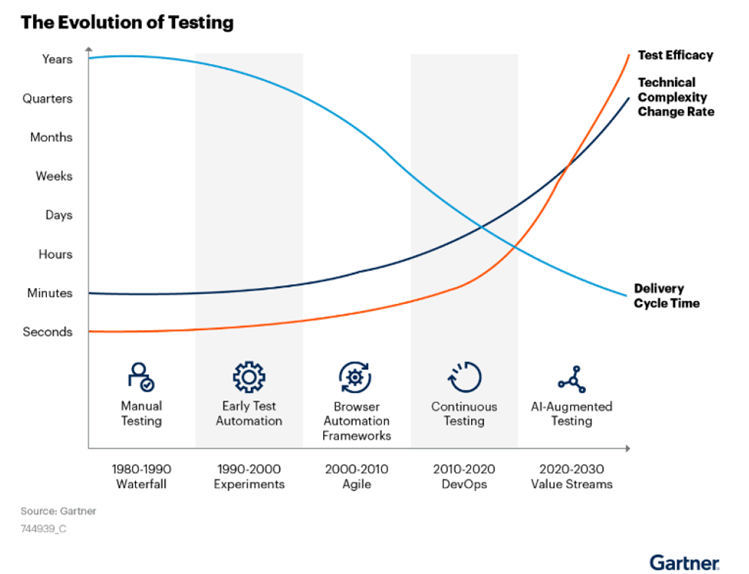
According to Gartner, AI-augmented testing delivers significant advantages like test efficacy, technical complexity, and delivery cycle times. AI’s utility to create comprehensive test cases and avoid duplication of efforts is one such use case.
Today, AI-enabled features are quite in vogue for use cases, right from automated website testing to visual tests. AI augmentation overcomes automated testing challenges like flakiness, brittleness, and fragmentation. This is of great assistance to ensure optimal tests and Website functionality across its development lifecycle.
A case in point is Qyrus Healer, which uses self-healing code to mitigate common automation issues like test failures. Healer relies on AI to reduce the effort spent on refactoring and script maintenance. As a result, tests can recover in microseconds with an accuracy of over 99.9%.
Generative AI has also made inroads into website automated testing. For example, Qyrus TestPilot is the world’s first ChatGPT plugin to automate Web app testing. This enables testers to generate tests using natural language queries. It can also identify Web app functionality based on just the domain URL.
QyrusTestPilot seamlessly creates and executes complex test scenarios without manual intervention. It leverages generative AI for the identification of complex bugs that might be missed by manual test-building methods.
Trend #2
Comprehensive testing takes center stage End-to-end Web, Mobile, and API testing capabilities are here to stay. Since comprehensive testing platforms span the entire software lifecycle, it eliminates the need for complex testing frameworks and cost-heavy infrastructure.
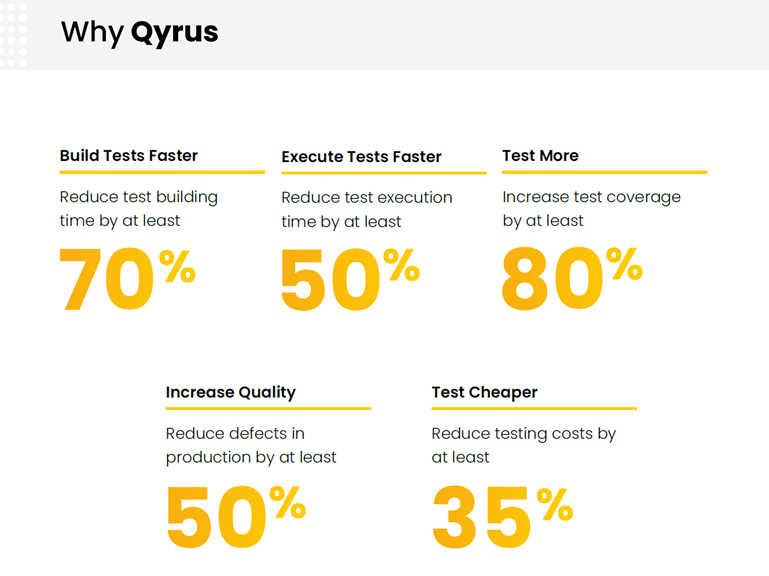
A comprehensive test platform replaces multiple-point solutions, delivering significant benefits in management, scalability, and test coverage. For instance, the latest automated website testing platforms like Qyrus can enhance test coverage by at least 80%. Multiple benefits accompany these, as illustrated in Figure: Why Qyrus.
Next-gen testing platforms include comprehensive Website automated testing and test data management tools. Real-time insights that include test reports, analytics, and dashboards ensure maximum efficiency.
Comprehensive Web application testing tools also include features like data parameterization and global variables. These capabilities ensure optimal test building and coverage.
Trend #3
Codeless approaches amp up test automation The low-code and no-code revolution has taken the developer community by storm over the last couple of years. Industry estimates indicate that this market will grow at a compounded annual rate of 28%, with a worth of $45.5 billion by 2027.
Software testing has also been a significant beneficiary of the low code, no code movement. Using low-code, no-code interfaces in Web application testing tools substantially reduce lead times and cost overheads associated with test automation.
For example, QA teams can quickly automate test cases using drag-and-drop interfaces or ready-made templates. These interventions mean that even less experienced users can rapidly scale test exercises.
Web application testing tools also leverage low-code, no-code capabilities for the automation of repetitive tasks like test case execution and data management. This frees up testers for higher-value assignments.
By nature of its definition, low-code or no-code software testing tools must offer easy-to-use yet customization-friendly UIs to be effective. Qyrus achieves this with a highly intuitive test-building approach.
With Qyrus, testers can leverage the platform’s predictive step-building approaches to build tests faster. The tester can just type a simple description of desired test step functionality and select from the presented Auto-suggest options. This is complemented by powerful Test Recorder features for easy creation and import of complex Web tests.
Trend #4
Smarter test data management possibilities Consolidating fragmented data sets like Excel sheets and databases is an eternal challenge in Web testing environments. The recent introduction of synthetic data further complicates test automation efforts.
Estimates indicate that synthetic generation will contribute 60% of the data required for AI and analytics project development by 2024. Reliance on multiple discrete data management tools impacts test speeds. The inclusion of intelligent test data management features in Web application testing tools addresses these issues.
Intelligent test data management mitigates challenges associated with distributed data siloes. Advanced website testing platforms enable testers to consolidate and manage test data from a single location. These solutions also include features to generate synthetic test data during runtime.
The Qyrus interface is a notable example of such intelligent test data management integration. With seamless data imports from databases or API calls, testers can ensure high test data speeds, Qyrus can also effortlessly generate synthetic data within the Test Data Management system at runtime. A suite of advanced test data management tools complements these capabilities.
Trend #5
Real-world Testing gets Device Farm to assist Gone are the days of self-owned test infrastructure like device farms. On this front, virtual devices also fail to fulfill the need for Website testing in real-world conditions.
The need to deliver outstanding user experiences calls for testing at scales that are not achievable in-house. This is where cloud-hosted device farm services like Qyrus Device Infrastructure ensure that testers get unfettered access to world-class testing infrastructure.
Device farm services enable automated or manual Website tests 24x7x365, irrespective of the tester’s location. Seamless provisioning features ensure instant availability to thousands of real devices, browsers, network types, and OS versions. Each device in Qyrus’ device farm includes granular configuration and provisioning options that ensure end-to-end test environment design.
Features like on-demand scalability and high availability levels are the best benefits of opting for cloud-based device farm services. Qyrus Device Infrastructure also leverages AI to deliver comprehensive testing capabilities and insights.
Class-leading security is another benefit of opting for hosted device farms. For instance, the ISO 27001 and SOC 2 compliant Qyrus test cloud assures absolute peace of mind for our customers.
Imagine embarking on a thrilling journey, armed with a mystical spyglass that grants you the ability to unravel the enigmatic workings of ancient relics. As you venture through the labyrinth of hidden treasures, the spyglass reveals secrets that once eluded your grasp. In the realm of software testing, a parallel unfolds with the advent of QSpy – a wondrous tool by Qyrus that unlocks the mysterious landscape of desktop applications. Much like an enchanted spyglass, QSpy empowers testing teams to uncover the hidden locators and coordinates, navigating through the complex Windows desktop applications and legacy applications like SAP. Step into the realm of QSpy, and witness the magic that revolutionizes the art of testing, effortlessly illuminating the path to seamless automation and enchanted quality assurance. Welcome to this week’s Feature Friday, where we will explore QSpy in Qyrus Desktop Testing. We have Milton Par and Amairani Lopez who will dive into the enhanced features and use cases of this valuable tool.
Tell us more about QSpy by Qyrus and its use cases.
Milton: QSpy is an innovative application by Qyrus that facilitates obtaining locator values and element coordinates from various desktop and legacy applications like SAP. It simplifies the script-building process by automatically adding these locator values and coordinates into your test scripts.
Amy: QSpy’s ability to detect locator values such as Name and ID with a Control Type, along with its highlight feature, makes it a powerful tool for precise element identification and smoother test automation.
What is QSpy’s overall impact on the testing process?
Milton: QSpy significantly streamlines the test preparation phase by eliminating the manual effort of locating elements in desktop apps. It reduces script creation time and enhances test script accuracy, ultimately leading to improved testing efficiency.
Amy: Absolutely! This feature empowers testers with an effortless way to extract locator values and coordinates, minimizing human error and increasing the reliability of test automation. Furthermore, the “Always on Top” functionality stands as a beacon of convenience, allowing testers to have QSpy seamlessly at their side throughout the testing journey. No more toggling between windows, no more interruptions – QSpy remains within reach, making the process of grabbing locator values and building scripts an uninterrupted and smooth endeavor. With this powerful combination of precise identification and uninterrupted accessibility, QSpy transforms the testing experience, unlocking unparalleled productivity and confidence for all users.
How might QSpy help testers, developers, and business technologists? What value can this feature bring?
Milton: For testers, QSpy saves valuable time and effort spent on locating elements in desktop applications, allowing them to focus on writing effective test scripts and analyzing results. The combination of QSpy and Qyrus’s low-code, no-code step builder empowers even non-technical business technologists to build scripts without any coding background, streamlining the entire testing process and fostering collaboration across teams.
Amy: Developers can benefit from the precise element identification, which ensures stable automation scripts and quicker debugging during the development phase. With QSpy seamlessly integrated into Qyrus, testers can easily run these tests on any registered Windows or Mac machine, facilitating smooth and efficient test execution across various environments. This comprehensive approach to desktop testing enhances the overall development lifecycle, promoting faster releases and ensuring exceptional software quality.
Does the same or similar functionality exist without Qyrus, and how do competitors address similar problems?
Milton: While other tools may offer basic locator detection, QSpy’s integrated highlight feature and the seamless integration within Qyrus’s low-code, no-code framework set it apart from competitors, providing users with a unique and efficient experience.
Amy: Qyrus’s QSpy addresses the challenges of element identification in desktop applications, making it a standout feature in the testing domain.
How do you see QSpy impacting day-to-day operations across organizations?
Milton: QSpy’s ease of use and powerful element detection capabilities will revolutionize the way testing teams handle desktop application testing. It will result in more accurate test automation, shorter testing cycles, and increased productivity.
Amy: Organizations can expect faster script building, reduced maintenance efforts, and a more robust testing process, ultimately contributing to better product quality and customer satisfaction.
QSpy in Qyrus Desktop Testing introduces a cutting-edge solution to streamline the process of obtaining locator values and element coordinates from desktop applications. Its impact on test automation efficiency, test script reliability, and overall testing productivity makes it an indispensable feature for all users. In the magical world of Qyrus desktop testing, QSpy shines as the guiding light, bridging the gap between testers, developers, and business technologists. As the quest for quality assurance continues, QSpy will remain an unwavering companion, illuminating the path to seamless automation and enchanting quality. Embrace the magic of QSpy, for it unlocks the secrets of desktop applications and leads us to a realm where testing transcends the ordinary, becoming a wondrous journey of discovery and excellence.
Fortify your Web Testing with Test Recorder, now available as a featured extension on the Chrome browser.
In today’s digital age, where websites and web applications reign supreme, the importance of efficient testing tools cannot be overstated. Just picture this – countless engineering teams toiling away, facing the daunting challenges posed by outdated and clunky tools. It’s no wonder they often struggle to meet deadlines and deliver top-notch results. But fear not!
Qyrus and its game-changing test screen recorder are here to save the day. We’re all about re-imagining web testing and empowering engineering teams to work smarter, not harder. So buckle up and join us as we uncover the benefits of using efficient tools for web testing, and how they can transform how you build and test your software.
Why Web Testing needs better tools
Compatibility Issues are Prominent With a multitude of browsers, operating systems, and devices ensuring that a website functions correctly across all platforms can be a significant challenge.
Dynamic Content requires in-depth Testing Websites with dynamic content that change based on user interactions or real-time changes can be difficult to test, given the analysis of dynamic updates, user flow verification, and non-intrusive observation capabilities required. Too few tools tackle all these challenges, and fewer still do so effectively.
Performance Issues cause Bottlenecks Load times, response times, and the ability to handle multiple users simultaneously are all crucial aspects of web testing. Identifying bottlenecks and performance issues can be complex and time-consuming. With the increasing prevalence of cyber threats, ensuring a website’s security is a major concern. Testing for vulnerabilities and potential exploits is a critical part of web testing, which can be time-consuming when done manually.
Enhancing User Experience is pivotal Ensuring a website is user-friendly and providing a positive user experience is challenging. This includes testing the navigation, layout, design elements, and more.
Automation doesn’t fix everything While automation can speed up the testing process, creating automated tests for complex web applications can be a challenge, owing to the complexity of web testing scenarios, resource constraints, and limited interoperability and compatibility, among other things. There is a need for tools that can bridge this gap while reducing the overall testing complexity.
Continuous Updates require Continuous Testing Websites are continuously updated with content, functionality, and design changes. This means, to maintain a secure and seamless user experience, there needs to be continuous testing on all updates.
In today’s digital world, engineering teams can’t afford to overlook the importance of using top-notch web testing tools. Manual testing alone just doesn’t cut it anymore, especially with the ever-increasing complexity of web applications. We’re talking about automation and robust tools here! And let’s not forget the cost of poor testing tools on a business – we’re talking about lost revenue, unhappy customers, and a tarnished reputation. Investing in better web testing tools is the key to optimizing performance, boosting security, and ensuring the success of your business.
Introducing: Qyrus’ Test Recorder
Qyrus’ Web Test Recorder is the newest feature addition to our Web Testing Solutions. A notch above our previous web test recorder, this is an AI-powered, Cloud-native solution to codeless web testing, swiftly eliminating all web testing woes faced by an engineering team. Everything about this feature is built to fortify web testing processes, to meet high standards of code standardization and code security.
Similar to other web recorders, our free web recorder captures all your actions based on your clicks. This helps teams build tests as not only does it help preserve data from different testing scripts and environments, but it also allows you to execute tests faster across different browsers and devices. Our previous website recorder allowed you with dynamic data handling, and building tests on localhost apps. Our new and improved web recorder goes a step further allowing you to also put a particular test on pause, and resume working on it after some time if needed!
But that’s not all! Our free web recorder was used by teams as a web screen recorder through our screen recorder Chrome Extension. Recently, we were awarded the honor of the Encapsulatebadge by the Chrome Web Store. The Test Recorder is now a Google Chrome store-featured staple!
“It’s a proud moment for the Qyrus team as our Web recorder – Encapsulate now carries a “Featured” badge on the Chrome web store. A featured badge is only given to extensions which provide great user experience, and follow Google recommended technical best practices.” – Ravi Sundaram, President, Qyrus
Automated & Refined Web Testing Practices Our Test Recorder takes web testing with Qyrus to the next level with its AI-powered automation. By capturing actions based on clicks, it eliminates manual effort and streamlines testing processes. This capability ensures consistent and precise testing, saving time and effort for engineering teams while maintaining high standards of accuracy.
Consolidated Test Scripts for Reuse With Qyrus’ Test Recorder, test scripts are easily preserved and can be reused across different testing scenarios and environments. This feature enhances efficiency by reducing the effort it takes to maintain scripts.
Predictive Bug Diagnosis & Mitigation This tool goes beyond just recording your actions; it utilizes AI capabilities to diagnose potential bugs and suggest mitigation strategies. By analyzing test data and patterns, it helps engineering teams proactively identify and address issues, minimizing the impact of bugs on the overall web application’s performance and security.
Real-time Reporting & Visual Test Results Access real-time metrics and visual test results that empower teams with valuable insights into test execution. With visual representations of test results, engineering teams can quickly identify areas of concern and make informed decisions. This capability enhances visibility and facilitates effective collaboration among team members.
Enhanced UI Testing Flexibility It allows teams to pause a particular test and resume working on it later, accommodating interruptions or the need to shift focus. Test Recorder also allows you to effortlessly record website interactions This flexibility enables teams to adapt to changing priorities while maintaining productivity and ensuring thorough testing of the web application’s user interface.
Cross-browser compatibility The tool can record and replay sessions across different browsers, ensuring comprehensive compatibility testing. It’s quite helpful in how quickly it helps users import and execute tests out on the Qyrus platform using the screen recorder on Chrome and other browsers.
Handling Dynamic Content The Test Recorder facilitates dynamic data handling, helping testers catch bugs earlier in the testing cycle. Furthermore, the local browser execution allows you to execute these tests you’ve built locally, especially on the interactions existing in dynamic elements of the website.
Fast-track Web Testing & Development with Qyrus’ Web Screen Recorder Chrome Extension
Making the switch to efficient web testing tools is of utmost importance in fortifying the security and success of your web tools. Moreover, with the continuous evolution of web technologies and the increasing complexity of web applications, the need for such advanced testing tools will only grow. The ability to quickly adapt to new technologies and testing scenarios will be crucial, and that’s exactly where tools like Qyrus’ Test Recorder – a free web recorder come into play.
Qyrus’ Test Recorder has proven to be a great asset for web testing with its web screen recorder by providing automation, consolidated test scripts, bug prediction, real-time metrics, and enhanced UI testing flexibility. Whether it’s e-commerce websites, cross-browser testing, form validation, or load testing, Qyrus’ Test Recorder caters to a wide range of real-life use cases and is slated to transform the way organizations use web testing processes today.
Experience the power of seamless and secure web testing firsthand – take the leap and give our web screen recorder Chrome extension a try today!
Can you tell us how Qyrus tests GraphQL and SOAP APIs on Qyrus API testing?
In the ever-evolving landscape of software testing, Qyrus continues to push the boundaries of innovation, consistently enriching its platform with new features to elevate the testing experience. These integrations empower testers with an expanded array of customization and usage options, revolutionizing the way they build test cases. One capability we’d like to shine a light on is the different types of APIs we can test on the platform. We’ve talked about API testing in the past, but today we’d like to expand more on how Qyrus can test GraphQL and SOAP APIs and how Qyrus can empower users to perform faster, simpler, and better API testing.
Joyal: Qyrus’ API testing allows you to test both functionality and behavior for both SOAP and GraphQL APIs. You can also test the client-side performance of these APIs and chain them together in our API Process testing section to test full business processes.
Brett: Many organizations out there use REST APIs in their business processes, but still, there are also organizations that utilize SOAP and GraphQL APIs in their applications. That being said, it’s important to be able to test those types of APIs. Qyrus is expanding its capabilities to include even more types in the future.
How does testing this feature impact the testing process overall?
Brett: Users can be more all-encompassing when it comes to what they’re able to test on the platform. As we mentioned, REST APIs are widely used but providing the user with the ability to test SOAP and GraphQL as well means that test coverage can be expanded and more of the testing across the application can be automated.
Joyal: I agree with Brett. These capabilities make testing more efficient, using fewer resources and improving overall application performance.
How might this feature help testers, developers, and business technologists? What value can this feature bring?
Joyal: For testers, they can build functional tests to test the behavior of their APIs. They can, again, test the client-side performance of those APIs and test them in an end-to-end business process.
Brett: Developers can import their APIs to Qyrus and quickly add assertions to them to validate that the APIs are working as expected. And they can test them across different environments like staging, dev, or production.
Joyal: Since Qyrus has simplified the testing process, business technologists can quickly and seamlessly create API tests using the same import feature Brett mentioned. Assertions can be easily added and in a codeless manner, again simplifying the process for less technical users.
Does the same or similar functionality exist without Qyrus, and how do competitors address similar problems?
Brett: With Qyrus, you truly don’t need to code at all to create test scripts. Codeless testing can improve product quality, increase development efficiency, and expand test coverage. With the amount of reusability that Qyrus offers, users will find the entire process to be much quicker compared to using other similar API testing tools. Another advantage with Qyrus is that everything is on the cloud, including the test reports, which provide a great amount of detail and troubleshooting capabilities.
How do you see the implementation of testing GraphQL and SOAP APIs on Qyrus impacting day-to-day operations across organizations?
Joyal: As we mentioned multiple times earlier, users can import APIs to create test scripts, and everything is codeless, day-to-day operations will greatly speed up, and the amount of effort it takes to perform the same amount of testing will be greatly reduced.
As we conclude our exploration of Qyrus API testing, with a special focus on the testing of GraphQL and SOAP APIs, it becomes evident that the platform continues to take leaps in empowering users. The expanded range of customization options and the flexibility to utilize various API calls reflect Qyrus’ commitment to providing testers with a wide range of capabilities to choose from. Qyrus remains steadfast in its mission to provide users with a plethora of features. Embrace the power of Qyrus API testing and unlock a world of possibilities to elevate your testing endeavors to new heights.
The exponential use of AI in mobile testing is driven by the need to meet the demand for faster release cycles of increasingly complex mobile applications. AI has also become a key facilitator of automated mobile testing trends, making testing faster and more efficient and ensuring different stakeholders can now contribute meaningfully to testing and help build a successful mobile app.
Rise of AI in Mobile Testing According to Global Market Insights, the automated mobile testing market earned US$6 billion in revenue in 2022. The findings of Future Market Insights say that the AI-enabled testing tools market will be valued at US$426.1 million in 2023. By 2033, this figure will touch US$ 2030.75 million. These figures indicate that organizations across the globe see value in leveraging artificial intelligence in software testing or mobile testing to deliver high-quality native mobile experiences, irrespective of the use case.
The raison d’être for the accelerated adoption of AI-backed mobile automation testing tools is the complexity of mobile testing. Mobile testers must test for mobile devices with various features, functionalities, processors, power consumption needs, etc. Such device segmentation creates testing challenges as testers must build test scripts based on numerous user behavior patterns, real-world usage scenarios, application behavior, app usage, historical bug reports, etc.
AI helps automate this long, drawn-out process replete with challenges, by creating relevant, effective, and intelligent test scenarios; by analyzing vast amounts of structured and unstructured data, AI development software can build test scripts for every scenario, thus simplifying the life of the testing team.
The rapid adoption of AI in testing is also an outcome of a growing problem in the tech world, the skills gap; the industry has also been a long sufferer of a panic of resignations. Together this has resulted in a situation wherein skilled experts across functions, including testing, are in short supply, resulting in understaffing of this department and/or organizations compromising with the testing process.
But there is a silver lining in the dark cloud.
The emergence of automated mobile testing and AI has ensured that critical testing actions can be automated. Leveraging AI in testing frees up testers’ time, enhances productivity with a leaner team, and improves the efficiency and accuracy of the overall mobile testing process. There is also a rapid evolution in the AI space, further driving efficiencies. While still in its nascent stages, companies have begun experimenting with generative AI in testing.
Generative AI can help create data and test cases on the fly by leveraging its data synthesizing and text production capabilities. AI can ensure anyone can execute these tests, irrespective of their testing knowledge or skill sets, and benefit from granular test reports. The testing tool integrated with generative AI can also help zero in on the defects and deliver actionable insights on debugging problematic code or take action on the tester’s behalf.
Features that Help Mobile Testing Organizations can leverage an AI-empowered testing platform that delivers a range of features. Some of these AI-enabled features include:
Self-Healing: The premise behind self-healing tests is that the components of any app are dynamic and can change if the app is updated or modified in any way. In such cases, the test script that worked earlier can fail, which calls for the test to be rebuilt and executed again. AI development software can automatically identify test errors due to dynamic properties, suggest remedial measures, or even update the test script, thus preventing test flakiness and brittleness.
Imagine a scenario wherein a test fails for a specific functionality, and upon problem identification, you find that developers changed the ID value of an element e.g., the login button. Without AI, you will need to go through your scripts, update the locator values of that button, or ask the development team to revert to the old ID. With the right AI tool, you can save time and maintenance costs as the tool monitors and makes changes to scripts when needed.
Qyrus’ Healer, an AI Tool, makes testing faster, smarter, and much easier by mitigating the need to modify and maintain test scripts. AI-driven test script correction means errors are rectified automatically, saving effort and valuable resources.
Improved Test Coverage: Testers need to analyze and build scripts for a significant number of user journeys for mobile apps. With AI-enabled testing, users can improve test coverage by visually analyzing the mobile application’s user journey and automatically building a test script based on the activity map. AI testing ensures they do not miss a critical case during the test build process.
As a tester and developer, you must be able to get granular visibility into the numerous and diverse user journeys that can take place on the app. More importantly, there might be navigation flows that you might have yet to think about. This helps build test cases and scenarios that might have been overlooked in initial test planning, thus making the mobile testing process more comprehensive.
Rover is Qyrus’ AI-enabled reinforcement learning bot that makes its way through a mobile app and records its journey. But it does not stop there. While traversing the app, it can build and export test scripts on the Qyrus platform, thus making it a comprehensive mobile testing tool. While Rover helps testers build test cases for many user journeys, developers can delve deeper into performance data to identify areas of improvement. Overall, it facilitates the building of a more robust app, that works optimally for all kinds of user journeys.
Test Intelligence: One of the key benefits of AI is that it can analyze the data produced by mobile app testing services quickly and comprehensively. It can detect and categorize errors, and even identify false negatives and true positives across numerous test cases. As can be imagined, this goes a long way in improving the productivity of testers and QAs and accelerates release cycles.
Move to AI-Powered Mobile Testing Approach Qyrus is a codeless, automated, AI and ML-driven mobile testing solution that is purpose-built to improve mobile application quality and, simultaneously, improve testing efficiency and speed up time to market. Users can automatically identify and fix test scripts, test mobile applications comprehensively, and get meaningful performance insights for test data. This results in better-quality apps.
AI application in mobile testing is the way forward, and it is imperative to adopt AI in mobile testing to make it more competitive and attuned to the demands of a modern mobile application and its development lifecycle.
Discover how powerful AI tools and test-driven Machine learning can accelerate and improve test coverage and reduce costs.
Introduction In the ever-evolving world of software development, testing takes center stage to ensure flawless user experiences. But let’s face it: traditional testing methods can be a real pain. They eat up time, drain resources, and leave room for pesky human errors. As risks and security breaches run rampant in today’s digital landscape, organizations face mounting pressure to level up their testing game.
But fear not! This case study explores the exciting world of AI and test-driven machine learning, showing how these advanced technologies can overcome testing difficulties, reduce expenses, and greatly improve the efficiency of your testing procedures. Get ready to unleash the power of quality like never before!
The High Costs of Risks and Security Breaches In an increasingly interconnected world, software failures and security breaches come with substantial financial and reputational costs. Industry statistics reveal that software bugs and vulnerabilities cost the U.S. economy an estimated $59.5 billion annually. Furthermore, the average cost of a data breach in 2021 was a staggering $4.24 million (source: Ponemon Institute). These figures underscore the urgent need for robust and efficient software testing to mitigate risks and potential financial losses.
Challenges with Current Testing Methods That Increase Costs
Manual Effort and Resource Allocation Current testing methods face challenges due to manual efforts and resource allocation. Labor-intensive processes demand dedicated personnel to carry out repetitive tasks, leading to increased costs. Skilled testers are often necessary, resulting in higher salary expenses. Moreover, as software complexity grows, the need for manual effort escalates, adding extra testing costs. These factors highlight the limitations of current methods and the need for more efficient and cost-effective testing solutions like testing in ML. With machine learning algorithms used, testing in ML can analyze historical test data to identify areas of higher defect probability, enabling proactive testing measures and optimizing resource allocation.
Test Environment Setup and Maintenance Traditional approaches often require significant time and resources. This includes acquiring hardware, obtaining software licenses, and maintaining infrastructure, all of which contribute to the overall costs. Additionally, ensuring compatibility across various operating systems, browsers, and devices further adds to the expenses. AI and ML testing tools automate repetitive tasks, reduce manual effort, and optimize resource allocation. They generate test scenarios and prioritize cases, enhancing efficiency in testing ML models. These factors highlight the complexities and financial burdens associated with test setup and maintenance in current testing methods, that can be combated with testing with machine learning models.
Test Execution and Time Constraints Manual execution of test cases is time-consuming, particularly for large-scale projects. Longer test execution cycles result in delays in software delivery, leading to potential revenue loss. To meet project deadlines, overtime payments or additional hiring may be necessary, resulting in additional expenses.
Regression Testing and Maintenance Regression testing is essential to ensure that changes or updates in the software do not introduce new defects. With traditional methods, regression testing is often performed manually, resulting in increased effort and costs. Additionally, there is a huge overload in maintaining test scripts and updating them for every software.
PS: AI-enabled features can help you add visual aid to your regression testing. There’s a fun read about it, here.
Defect Resolution and Post-Release Support Traditional testing methods may fail to identify all defects, leading to post-release issues and customer support costs. Delayed defect detection and resolution can result in higher expenses related to bug fixing, customer complaints, and reputational damage. Additionally, providing ongoing support and maintenance after the software release further increases costs for organizations.
Conquering Testing Costs with AI and ML Wizardry
Automated Testing and Resource Optimization AI and machine learning in testing automation tools can significantly reduce manual effort and costs by automating repetitive testing tasks. Their intelligent test case generation algorithms can create test scenarios, minimizing the need for human intervention. Machine learning algorithms can analyze historical data to optimize resource allocation and prioritize test cases based on their potential impact.
Cloud-Based Testing Environments st-driven AI tools and Machine learning models can facilitate the creation of scalable and on-demand test environments in the cloud, eliminating the need for costly infrastructure setup, maintenance, and associated costs. Virtualization and containerization technologies driven by AI can provide flexible and cost-effective test environments, reducing hardware and licensing expenses. These ML models help monitor software in the production environment, alert teams to problems, and resolve them quickly, reducing costs from defects after release.
Intelligent Test Execution and Acceleration AI algorithms can analyze test execution patterns and optimize test suites to reduce redundancy. This eliminates unnecessary test cases and accelerates the overall testing process, as machine learning models can learn from past test runs, also eliminating the initial challenges of machine learning models. It predicts the most critical areas of the software to focus its testing efforts, optimizes resource utilization, and minimizes test execution time, which goes a long way in saving costs.
Smart Regression Testing and Maintenance AI-powered test automation frameworks capture software changes and update test scripts automatically, reducing manual effort in regression testing. Testing in ML analyzes code changes and automatically generates relevant test cases for impacted areas, ensuring efficient regression testing and reducing maintenance overhead.
Early Defect Detection and Predictive Analytics AI and testing machine learning models can analyze large volumes of test data, log files, and customer feedback to detect patterns and anomalies that indicate potential defects or quality issues without extra costs. Predictive analytics models can identify areas of higher defect probability, enabling proactive measures and reducing post-release support costs. Moreover, AI-driven monitoring and error-tracking systems can continuously monitor software performance in production, alerting teams to potential issues and facilitating timely resolution.
Conclusion Software testing in today’s dynamic environment needs smarter tools in order to increase the level of automation they provide and enable DevOps teams to deliver high-quality applications. These tools need to go beyond being just a framework for test creation and execution and need to deliver the high level of adaptiveness and accuracy our testing processes require.
Machine learning models used for test optimization and predictive analytics can significantly boost the ROI of testing efforts by focusing resources on critical areas. Adopting smart AI tools and test-driven machine learning is at the forefront of recognizing this requirement and adds to the much-needed acceleration and automation global engineering teams need to deliver good software. By harnessing the power of these technologies, organizations can significantly reduce costs, enhance the accuracy and efficiency of testing processes, and mitigate the risks associated with software failures and security breaches, as we witness the evolution of software testing frameworks.
If you’d like to get started on leveraging AI and test-driven Machine Learning to streamline your testing processes, improve software development outcomes, and produce high-quality code – try Qyrus and see the difference it can make for your engineering team!
Get ready for an intriguing Feature Friday, as we unveil Qyrus’ recent addition to the Mobility testing service – the powerful push file action type. Empowering testers and developers alike, this feature enables seamless file uploading to mobile devices, streamlining the testing process and enhancing efficiency. Join us as we explore the versatility and value of this capability, catering to a myriad of use cases and revolutionizing day-to-day operations for organizations working with mobile applications.
Tell us more about the ability to push files on the Mobility testing service. What use cases might it serve?
Steve: Push file is a new action type that has recently been added to the Qyrus Mobility testing service. Push file enables users to upload certain file types to the mobile device during the testing process. Users can upload things such as PDFs, PNGs, or JPEGs to a mobile device’s local storage.
Parth: If a user’s application requires uploading any specific file for testing purposes, this action type would suit their needs. For example, if an app needs to scan a QR code, the user can upload an image of that QR code to the device. This is just one sample use case of how this new action type can help with different types of testing.
What is this feature’s overall impact on the testing process?
Steve: In general, we see this feature providing benefits during the test-building process. It can help users create more simplified tests in a codeless fashion. Previously, users would have to go through a roundabout way in order to test certain use cases, thus cutting down on the number of test steps needed and ultimately also aiding with the amount of time it takes the test script to execute.
Parth: I agree with what Steve said, it really helps with effort reduction when it comes to both building and executing test scripts. Furthermore, one could extrapolate that this would also lead to further cost benefits.
How might the push file action type help testers, developers, and business technologists? What value can this feature bring?
Parth: Testers can utilize this new feature to increase and widen their test coverage as well as, just mentioned before, test more efficiently and faster. Developers might find this feature useful when they want to test the base functionality of the app themselves. They can go ahead and perform these tests quickly on Qyrus because of the ease of use that comes with the platform.
Steve: As for business technologists, this action type in and of itself would make it easier for them to go and possibly build tests on their own, too. Otherwise, it can help simplify the test scripts that they may be analyzing or looking at for their own purposes.
Does the same or similar functionality exist without Qyrus, and how do competitors address similar problems?
Steve: With Qyrus, the ability to perform this type of action is much easier. That is, pushing or uploading a file to a mobile device for testing. Instead of having to go through roundabout and convoluted ways to achieve this ability, Qyrus does it all in one step.
Parth: There is an extra effort from the tester’s side when it comes to doing something like this outside of Qyrus. A tester would have to download a file from a hosted link, for example.
How do you see this feature impacting day-to-day operations across organizations?
Parth: This new feature enables users to easily run tests that require uploading files for testing purposes. Furthermore, other methods of uploading or pushing files to mobile devices require multiple steps that can sometimes be very confusing to the user.
Steve: The user can reuse the same uploaded file on the mobile device after it has already been uploaded once. So once the device has that file, unless it is removed or wiped from the device, the file shall remain.
In wrapping up this Feature Friday, we’ve explored the impact of Qyrus’ push file action type on mobile application testing. With its user-friendly approach and versatile use cases, this feature transforms the way testers and developers interact with their mobile applications. As a result, organizations can achieve higher efficiency, and reduced effort, and ultimately deliver top-notch mobile experiences to their end-users. Qyrus continues to innovate and revolutionize the testing landscape, making it the ultimate choice for comprehensive and seamless testing solutions.
Kumar Vivek
Development
Duis aute irure dolor in reprehenderit in voluptate velit esse cillum dolore eu fugiat nulla pariatur. Excepteur sint occaecat cupidatat non proident, sunt in culpa qui officia deserunt mollit anim.