Why 60% of SAP S/4HANA Migrations Miss Their Deadline – And It’s Not the Technology
 Varun RS
Fifty-five percent of SAP customers have now deployed S/4HANA in some form. Only thirty-four percent have actually finished the transition. That gap between “live” and “done” is not a rounding error — it’s the story of most SAP migrations running right now, and it explains why so many of them slip past their own deadlines even when the underlying technology works exactly as designed.
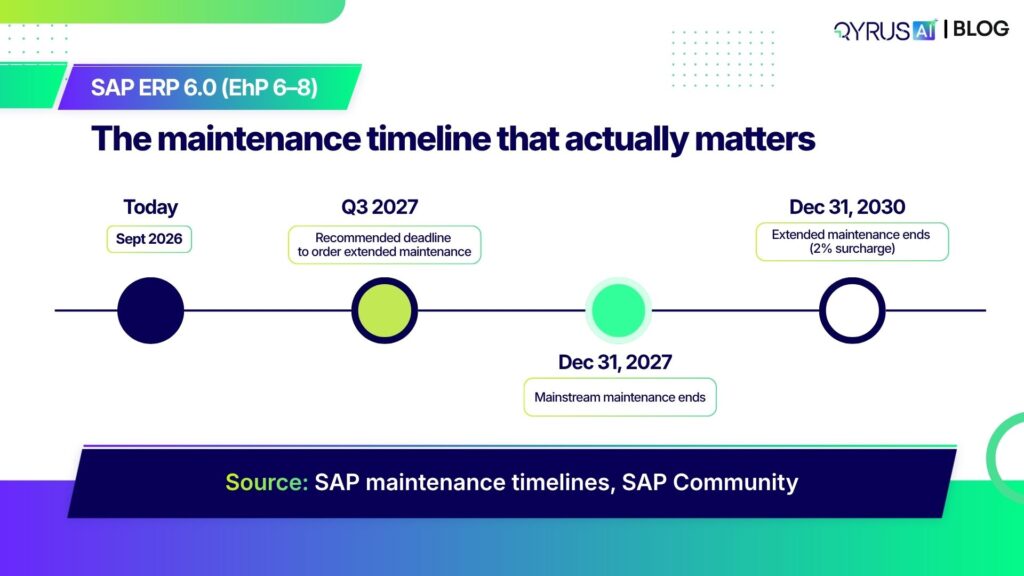
With SAP ERP 6.0’s mainstream maintenance ending December 31, 2027, for organizations on Enhancement Packages 6 through 8, the window to migrate without a rushed, high-risk scramble is closing. But new research from 2026 makes one thing clear: the organizations that miss this deadline mostly don’t miss it because of SAP. They miss it because of how the migration itself is run.
The Deadline Everyone’s Watching, and the Number Nobody Talks About
The mechanics of the deadline are simple enough. SAP ERP 6.0 on Enhancement Packages 6 through 8 loses mainstream maintenance on December 31, 2027. Extended maintenance is available as a bridge through December 31, 2030, at a 2 percentage-point surcharge on the maintenance base — after which only customer-specific maintenance remains, with no new fixes, no legal updates, and steadily increasing risk.
What’s less discussed is where the industry actually stands against that date. SAPinsider’s 2026 ERP Migration and Transformation Benchmark puts current deployment at 55%, but only 34% of organizations have fully completed their transition. Of the rest, 41% plan to finish before the 2027 cutoff, 18% concede they won’t make it in time, and 7% have no migration plan at all.
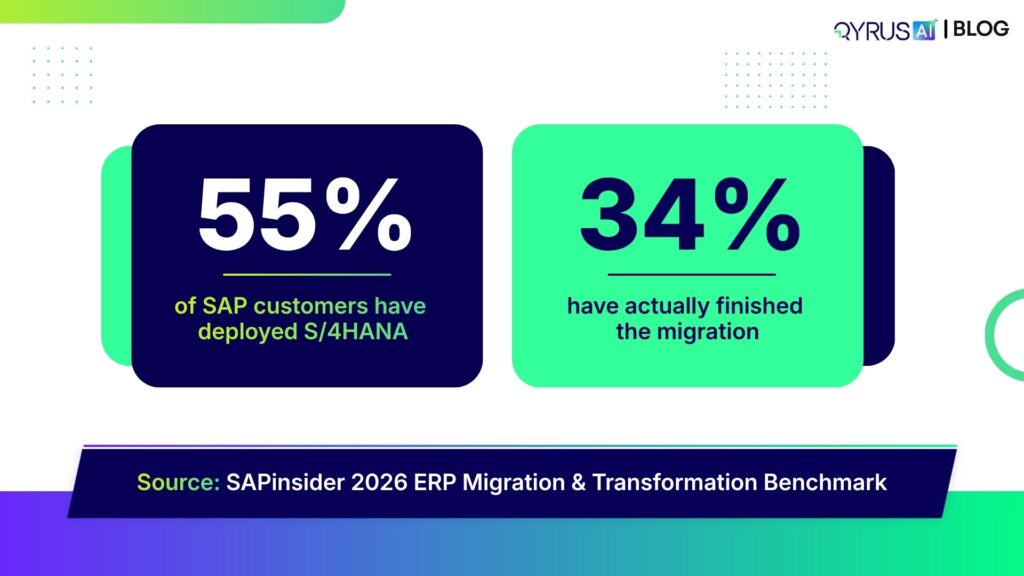
That 55%-to-34% gap is the number worth sitting with. An initial go-live is not a completed migration. Plenty of organizations are technically “live” on S/4HANA while running parallel systems, incomplete data models, and unresolved integration debt underneath — the exact conditions that turn a deadline-driven project into a multi-year scramble. If you’re mid-transition, our complete guide to SAP S/4HANA migration performance testing covers what a stable go-live actually requires.
What Actually Derails SAP S/4HANA Migrations
The ISG Data
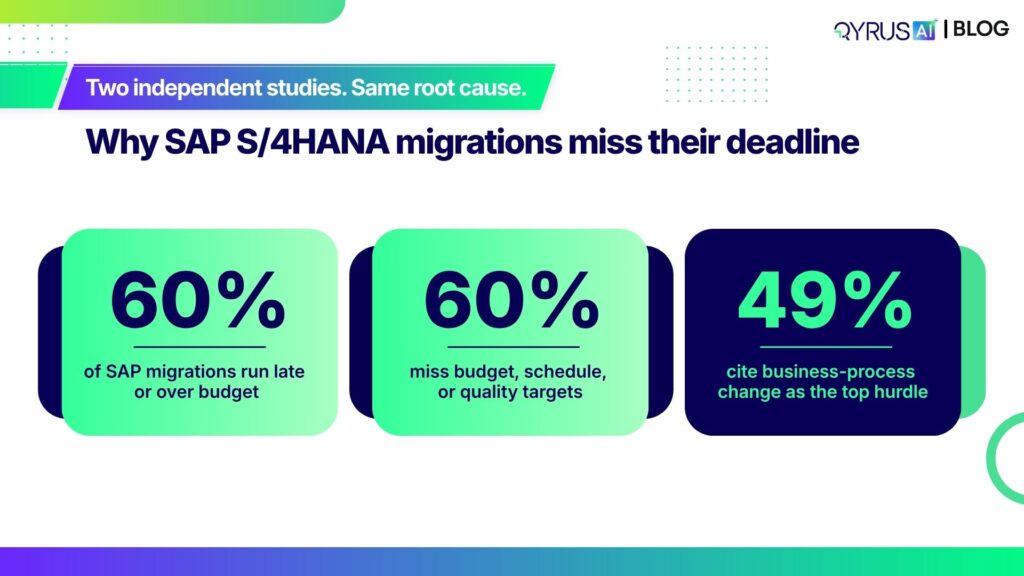
ISG’s State of SAP Migrations report, published in February 2026 and based on a survey of more than 200 senior decision-makers at large global companies, found that nearly 60% of SAP migration projects run late or over budget. The report’s authors point to underestimated complexity, scope that expands mid-project, and internal constraints nobody accounted for going in.
The mechanism behind that number is organizational, not technical. Most migration programs run through multiple system integrators, SAP service providers, and niche specialists at once — and ISG’s research points to a lack of clear decision-making rights and acceptance criteria between them as a primary driver of the delays. Nobody owns the call, so the call doesn’t get made until it’s already a problem.
A Second Study Says the Same Thing
That pattern isn’t unique to one study. A 2025 Horváth survey of 200 SAP customer companies in the DACH region found the same 60% figure for projects missing budget, schedule, or quality targets — and identified business-process change as the single biggest hurdle, cited by 49% of respondents. It also surfaced a leadership gap: at smaller firms, the CEO personally leads the S/4HANA program in just 14% of cases.
Two independent studies, on different populations, converging on the same root cause: this keeps getting run like an IT upgrade when it’s actually an enterprise transformation program. Our piece on navigating the SAP testing strategic approach to optimizing S/4HANA goes deeper on what that distinction means for test strategy specifically.
The Quiet Trade-Off: Stability Now, Transformation Deferred
Here’s what that pressure actually produces in practice. ISG’s research found that fewer than one in five organizations (18%) reimplement their processes and technology during the move to S/4HANA. Nearly half (49%) carry out little to no re-engineering at all, choosing instead to preserve legacy processes and data structures largely as they are.
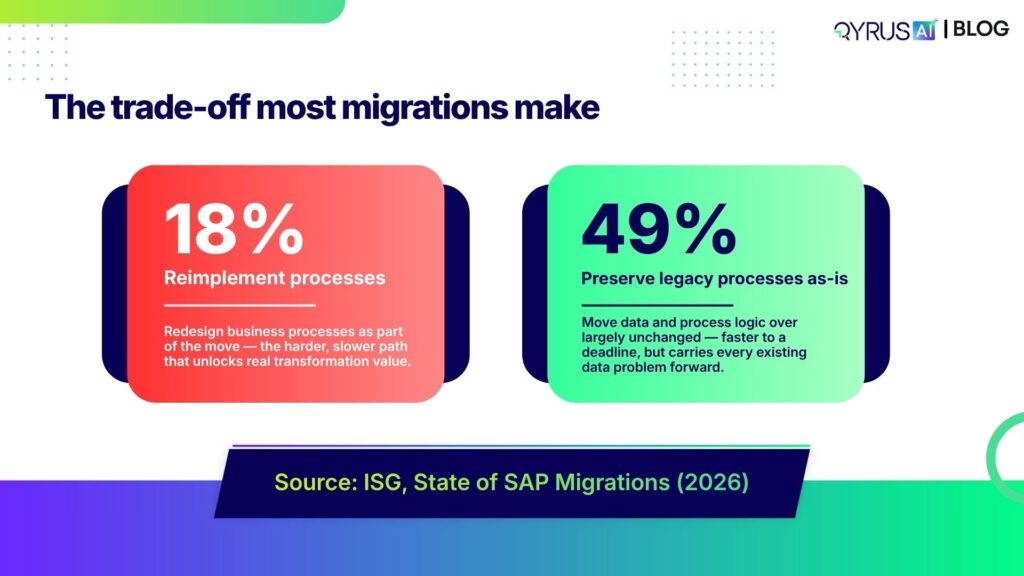
That’s a rational response to deadline pressure — moving data and process logic over unchanged is faster than redesigning it. But it doesn’t make the underlying problem disappear. It just moves it. Master data that’s fragmented or stale in ECC doesn’t become clean by virtue of running on HANA; it just runs faster. Every report, every forecast, and eventually every AI agent built on top of that data inherits whatever was already broken underneath it.
Why This Matters More Now Than It Did Two Years Ago
The stakes attached to that trade-off have shifted. SAPinsider’s 2026 Benchmark found that 43% of respondents now cite SAP’s AI roadmap — the Business AI Platform and Autonomous Suite announced at Sapphire 2026, including more than 200 specialized AI agents and 50 Joule Assistants — as the primary external factor shaping their ERP strategy. That’s ahead of the 2027 maintenance deadline itself, now cited by 39%.
This isn’t a laggard problem, either. Even large, well-resourced programs are still mid-transition under this same pressure: Airbus’s digital leadership has publicly acknowledged that most of the company’s SAP migration work remains ahead of it, despite the 2027 timeline bearing down on a sprawling estate that still includes legacy SAP R/3 and ECC 6.0 systems.
What changed is the cost of getting the data wrong. A fragmented Business Partner record used to mean finance and procurement disagreed on a report. Now it means every autonomous agent and AI forecast built on top of S/4HANA inherits that same fragmentation — and a technically successful interface exchange can still mask incorrect data underneath. Our post on true data integrity in SAP EDI processes walks through exactly how that plays out at the IDoc level.
Discover, Govern, Validate, Operate: How QyrusAI Closes the Gap
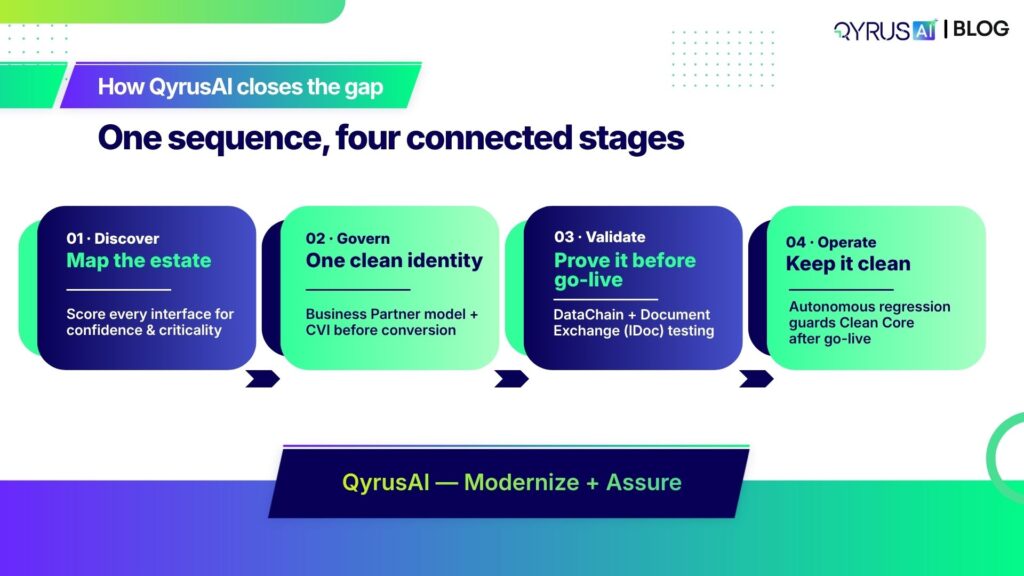
The pattern in both studies points to the same fix: treat the migration as a sequence of decisions to get right in order, not a single technical event. QyrusAI’s Modernize and Assure workspaces are built around exactly that sequence.
Discover. Before you fix a single master record or commit to a migration path, you need an honest, evidence-based map of the SAP estate — not tribal knowledge or a stale architecture diagram. QyrusAI’s discovery capability inventories every integration (RFC, IDoc, REST/OData, SOAP, CPI iFlows) and scores each one for confidence and criticality, so scope gets locked before the project starts, not renegotiated mid-flight.
Govern. The Business Partner model consolidates fragmented customer, vendor, and employee records into one master object per legal entity. Customer-Vendor Integration (CVI) is the bridge that keeps legacy and Business Partner records synchronized — and it needs to go in before conversion, not during it, with continuous deduplication and enrichment keeping records from fragmenting again after go-live.
Validate. This is where QyrusAI’s Assure workspace does the heavy lifting. Qyrus Assure DataChain takes a single document or transaction number and maps every linked transaction across the flow — quotation, delivery, billing — cutting test data creation time by up to 92% and closing the “referential integrity nightmare” that makes manual test data setup for SAP such a bottleneck. Document Exchange (IDoc/EDI) Testing solves the specific problem covered above: it links every incoming IDoc to the business transaction it actually posted, catching the silent mapping flaws a “successful” technical status alone won’t reveal. This is the same approach that helped a $30B+ US automaker cut testing effort by 88% on its own complex SAP S/4HANA workflows. For more on closing the test data gap specifically, see the hidden tax on SAP projects and how DataChain eliminates it.
Operate. Clean Core isn’t a milestone you hit once — it’s a discipline that erodes one “quick” core modification at a time. QyrusAI’s Autonomous Regression Suite keeps testing running after go-live, connecting to SAP’s standard APIs with no scripting required, so drift back into the core gets caught by a scheduled test run instead of discovered in production months later.
Where to Start Your SAP S/4HANA Migration Governance
The runway is shorter than the calendar suggests. For organizations planning to use extended maintenance as a bridge, SAP’s own guidance recommends completing that ordering process by Q3 2027 — which pulls the real decision point well ahead of the headline deadline.
A few places to start regardless of where your program stands today:
- Map the estate first. Score every interface for confidence and criticality before you commit to a scope or a migration path.
- Stand up CVI early. Build the Business Partner bridge before conversion begins, not as a mid-project fire drill.
- Separate the obligatory cleanup from the discretionary work — and fund both. The fixes required for technical success (missing fields, postal formats) always get done because the system won’t go live without them. The fixes that create business value (deduplication, enrichment) are the first thing cut when the timeline tightens, and that’s exactly what erodes user trust in the new system on day one.
- Test the identity model, not just the interfaces. A clean Business Partner record only matters if it flows correctly through Lead-to-Cash and Source-to-Pay — prove that before go-live, not after.
None of this changes the deadline. But it’s the difference between a migration your organization controls and one that controls you.
Frequently Asked Questions
What is the SAP S/4HANA 2027 deadline?
December 31, 2027, is when SAP ends mainstream maintenance for SAP ERP 6.0 on Enhancement Packages 6 through 8. After that date, SAP no longer provides standard support, security patches, or legal updates for those releases unless an organization has purchased extended maintenance.
What happens after SAP ECC mainstream maintenance ends?
Organizations on Enhancement Packages 6–8 can purchase extended maintenance through December 31, 2030, at a 2 percentage-point surcharge on their maintenance base. After 2030, only reduced customer-specific maintenance is available, with no new fixes or legal updates.
Why do most SAP S/4HANA migrations run over budget or behind schedule?
Research from ISG and Horváth both point to governance failures rather than technology gaps: underestimated complexity, expanding scope, unclear decision rights across multiple vendors, and business-process change that gets underestimated going in.
What is Customer-Vendor Integration (CVI) and why does it matter?
CVI is the bridge that synchronizes legacy customer and vendor records into SAP’s unified Business Partner structure. It needs to be implemented before system conversion — not during or after — and it runs continuously to keep records in sync rather than functioning as a one-time migration step.
What is SAP Clean Core?
Clean Core is the practice of keeping custom logic out of the SAP core system and building it instead as side-by-side extensions on SAP Business Technology Platform (BTP). It has to be actively maintained after go-live, since even small core modifications accumulate and eventually degrade AI and automation capabilities built on top of the system.
How long does an SAP S/4HANA migration typically take?
Timelines vary by path: a brownfield conversion (keeping the existing system in place) typically runs 6 to 10 months, while a greenfield rebuild can take 12 to 36 months depending on customization volume and transformation ambition.
How can QyrusAI help reduce SAP S/4HANA migration risk?
QyrusAI combines estate discovery, Business Partner and CVI governance, AI-driven SAP test automation, and continuous post-go-live regression testing in one workspace — covering the full sequence from mapping the estate to keeping it clean after go-live.
The Bottom Line
The 2027 deadline is real, but it isn’t the thing most migrations actually fail against. The data is consistent across every study cited here: programs miss their targets because of how they’re governed, not because the underlying platform can’t get there. Mapping the estate honestly, governing to one clean identity, and testing before you trust the result is the sequence that keeps a deadline-driven program from becoming a multi-year rescue effort.
Ready to see where your own SAP S/4HANA migration stands against this pattern? Request a QyrusAI demo to walk through your estate, your data governance gaps, and your testing coverage with the team.
 September 23, 2026
  10 min