This case study explores how a leading global beverage business, one of the largest players in the consumer-packaged goods (CPG) industry, revolutionized its testing processes by transitioning from entirely manual methods to an advanced, AI-powered automated testing approach with Qyrus.
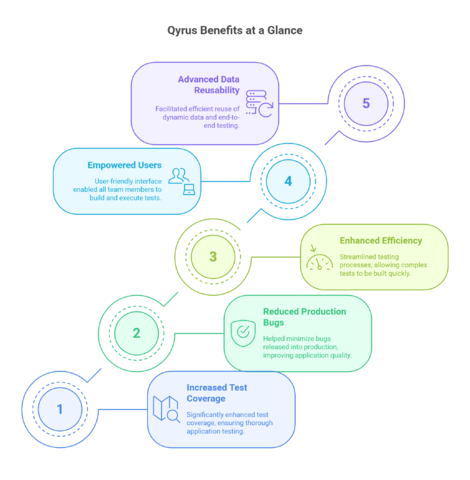
Facing persistent challenges such as lengthy testing cycles, inconsistent quality, declining test coverage, and difficulties in reusing dynamic data, the company sought an innovative solution. This article will detail how the implementation of Qyrus led to a significant increase in test coverage, a substantial reduction in production bugs, and a remarkable enhancement in overall testing efficiency and quality within their operations.
About the Client
This consumer-packaged goods company is a leading global beverage business, formed through the merger of several bottling companies and distribution companies. It operates in multiple markets across the globe. The company is known for marketing, producing, and distributing a wide range of beverages, including energy drinks, still and sparkling waters, juices, sports drinks, and ready-to-drink teas. It is recognized as the world’s largest independent bottler for a major beverage brand, boasting significant annual revenues and a large consumer base. The company focuses on sustainable growth, innovation, and meeting the specific needs of local markets while leveraging its scale and capabilities to drive growth.
The Challenge
When starting with Qyrus, the client was only performing manual testing. This was an issue since it was taking a large amount of time to complete the testing process and as a result quality was suffering overall. Taking too much time manually testing various processes and features on their app had caused test coverage to slip, as well, introducing virtual cracks to the foundation of their software.
The client had difficulty with automating their testing using traditional or conventional automation methods. Some of the testers were more experienced than others, and this was causing a gap in the quality of the manual tests being done. They also wanted to make sure that they were making use of reusing dynamic data throughout the test scripts.
Life with Qyrus
The client working in consumer-packaged goods is making use of multiple services on the Qyrus platform. Currently, Web Testing and Mobile Testing services are being used to build out web and mobile test scripts. Then, the client is able to perform end-to-end business process testing, chaining the web and mobile test scripts together and enabling test data to be transferred downstream between the individual web and mobile components.
Overall, the client feels that Qyrus is pretty easy to use and grasp. Implementing Qyrus’ testing strategy is not difficult at all and getting set up is as easy as recording your test or asking our AI to help you with test generation. A mixture of both technical and non-technical end users for the client are building and executing test scripts on Qyrus.
Key Features Used
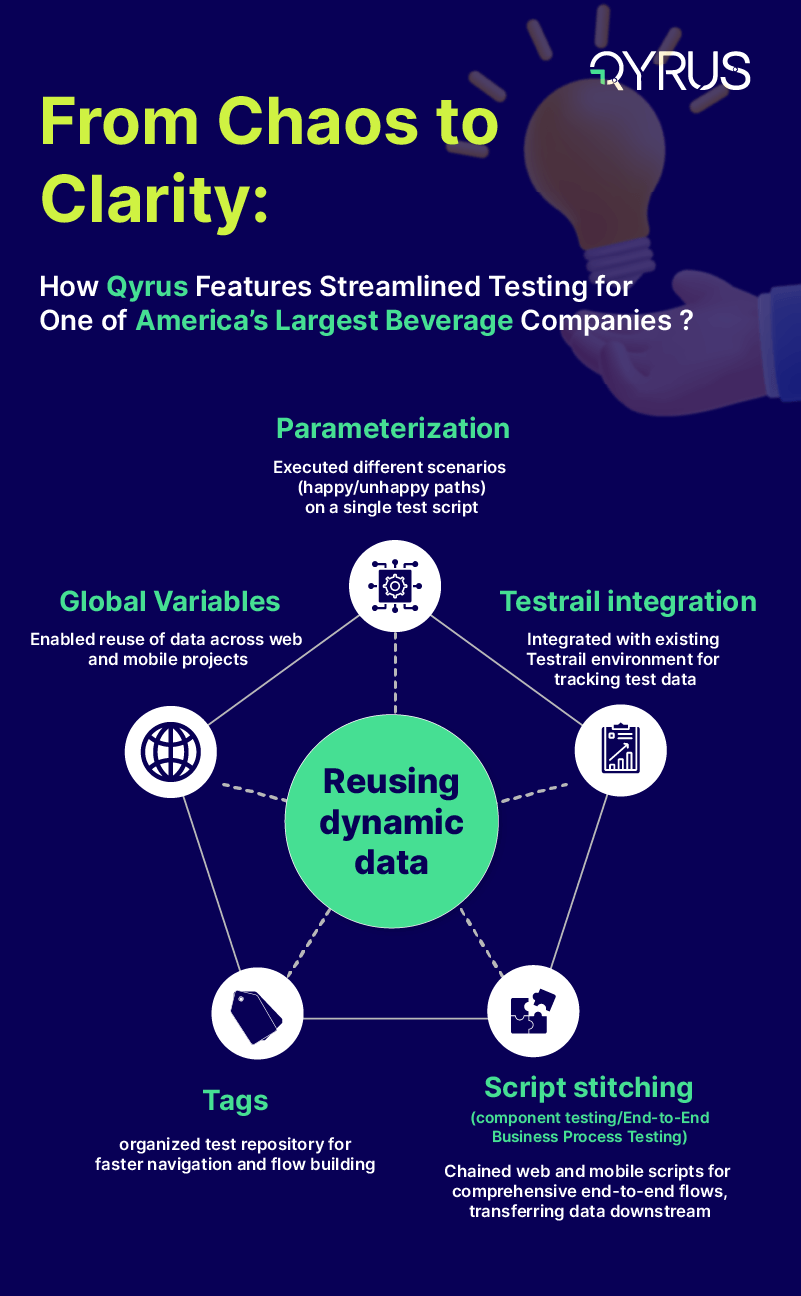
Global Variables: The client was able to make use of global variables to help with reusing data across their various web and mobile projects. This aided in their quest to reuse dynamic data across their scripts.
End-to-End Business Process Testing: The client stitched together the web and mobile scripts into comprehensive business process tests that executed end-to-end flows for a complete picture into the behavior and performance of your various processes across your applications.
Parameterization: The client was able to parameterize specific test steps in their scripts to aid with reusing data and executing different scenarios on a single test script. They were able to execute both happy and unhappy path test scenarios using this method.
Script Tagging: By tagging their scripts, the client was able to better organize their test repository and scripts. This allowed for faster navigation around the app and quicker building of end-to-end flows.
TestRail Integration: The client integrated Qyrus with their TestRail environment for the tracking of various test data and information.
Future Dreams
The client envisions a future where their automated testing processes continue to evolve and improve. They plan to explore advanced AI-driven testing techniques to further enhance the accuracy and efficiency of their test scripts. By integrating machine learning algorithms, they aim to predict potential issues before they arise, thus ensuring even higher quality and reliability in their applications.
In addition, the client is committed to expanding their use of Qyrus across all their global operations. They intend to leverage the platform’s capabilities to support continuous integration and continuous delivery (CI/CD) pipelines, enabling faster and more frequent releases of new features and updates. This will not only reduce time-to-market but also ensure that their products consistently meet the highest standards of quality.
Results & Outcomes
A PoC was originally done in August of 2024 where the client took Qyrus on a test drive for 6 weeks total. In the end, the client was able to achieve a significant increase in test coverage when implementing Qyrus’ automated test scripts when compared to their manual testing being performed. Data around how long it took team members to perform manual tests varies due to a differing level of knowledge and expertise on their team. And for the same reason the comfort level on Qyrus differed.
However, after a little more than 1 month, users reported being very comfortable with the platform. In total, it took the team 45 minutes to build a complex test of over 40+ steps.
The client had acquired 4 web licenses and 5 mobile licenses to spread across their team. As a result of using Qyrus, there has been a noticeable reduction in bugs spread into production by the client team.
Conclusion
Through the adoption of automated testing with Qyrus, the client working in consumer-packaged goods was able to significantly enhance their testing efficiency and quality. The ease of use and the comprehensive features of the Qyrus platform enabled both technical and non-technical team members to build and execute complex test scripts effectively. As a result, the client saw a marked increase in test coverage and a substantial reduction in production bugs. The successful implementation of Qyrus not only streamlined their testing processes but also allowed them to focus on delivering high-quality products to their consumers in the consumer-packaged goods industry. This transformation underscores the importance of embracing innovative solutions to overcome traditional testing challenges and drive sustainable growth.
If you’re in the Food and Beverage industry, you know firsthand how rapidly technology is reshaping everything. From streamlined online ordering and delivery apps to sophisticated supply chain management and engaging customer loyalty platforms, digital tools are no longer just a side dish—they’re a core ingredient for success. This digital wave brings incredible opportunities, but it also places a huge emphasis on ensuring every piece of software, whether it’s customer-facing or powering your backend operations, works flawlessly.
In today’s fast-moving F&B landscape, a glitchy mobile app, an unresponsive web portal, or an API hiccup can directly impact your customer satisfaction, operational efficiency, and ultimately, your brand’s reputation. The demand for seamless, intuitive, and reliable digital experiences is higher than ever. Ensuring quality across your mobile, web, and API applications isn’t just an IT task; it’s a critical business imperative that can set you apart from the competition.
Dive into our presentation to explore the unique software testing challenges the Food and Beverage sector faces today. We’ll walk you through essential best practices for quality assurance and show you exactly how Qyrus, with our intelligent testing platform and innovative AlVerse, provides tailored solutions to help your F&B business master these challenges. Discover how you can ensure quality and innovate with confidence in this exciting digital era.
We invite you to contact us today for a discussion. Let us show you how Test Orchestration can elevate your testing strategy and help you build better software, faster.
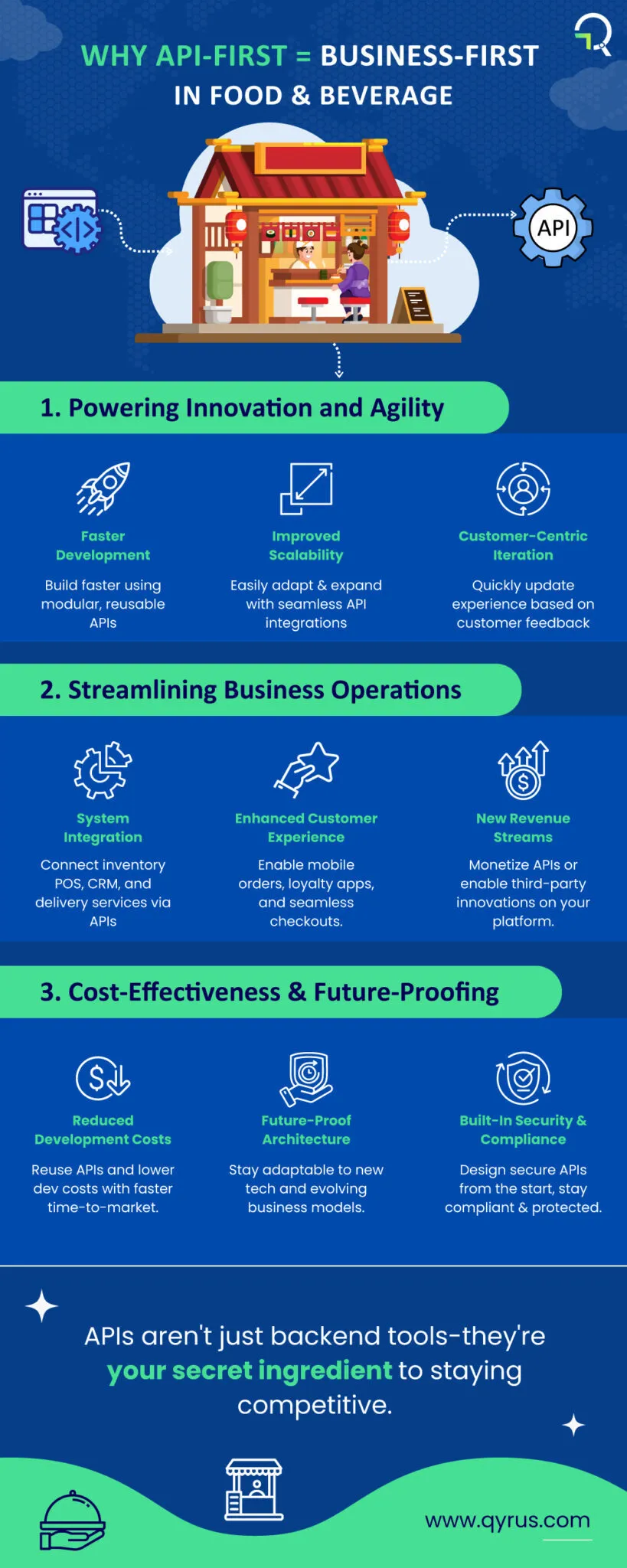
F&B leaders, time to stop thinking APIs are just “IT stuff.” They’re your 𝘴𝘦𝘤𝘳𝘦𝘵 𝘴𝘢𝘶𝘤𝘦 for driving operational efficiency and customer loyalty.
From 𝐟𝐫𝐚𝐧𝐜𝐡𝐢𝐬𝐞 𝐬𝐜𝐚𝐥𝐚𝐛𝐢𝐥𝐢𝐭𝐲 to 𝐦𝐨𝐛𝐢𝐥𝐞 𝐨𝐫𝐝𝐞𝐫-𝐚𝐡𝐞𝐚𝐝 to 𝐫𝐞𝐚𝐥-𝐭𝐢𝐦𝐞 𝐢𝐧𝐯𝐞𝐧𝐭𝐨𝐫𝐲 𝐬𝐲𝐧𝐜, an 𝐀𝐏𝐈-𝐟𝐢𝐫𝐬𝐭 𝐬𝐭𝐫𝐚𝐭𝐞𝐠𝐲 powers it all.
Let’s break it down 👇
✓ 𝐋𝐚𝐮𝐧𝐜𝐡 𝐧𝐞𝐰 𝐨𝐫𝐝𝐞𝐫𝐢𝐧𝐠 𝐞𝐱𝐩𝐞𝐫𝐢𝐞𝐧𝐜𝐞𝐬 without ripping out legacy POS ✓ 𝐈𝐧𝐭𝐞𝐠𝐫𝐚𝐭𝐞 𝐂𝐑𝐌, 𝐥𝐨𝐲𝐚𝐥𝐭𝐲, 𝐚𝐧𝐝 𝐝𝐞𝐥𝐢𝐯𝐞𝐫𝐲 𝐩𝐚𝐫𝐭𝐧𝐞𝐫𝐬 seamlessly (think DoorDash, and Uber Eats) ✓ 𝐀𝐝𝐚𝐩𝐭 𝐦𝐞𝐧𝐮𝐬, 𝐩𝐫𝐢𝐜𝐢𝐧𝐠, 𝐚𝐧𝐝 𝐩𝐫𝐨𝐦𝐨𝐬 across all platforms in real time ✓ 𝐅𝐮𝐭𝐮𝐫𝐞-𝐩𝐫𝐨𝐨𝐟 𝐲𝐨𝐮𝐫 𝐬𝐭𝐚𝐜𝐤 as you grow from 10 locations to 10,000
Just ask 𝐒𝐭𝐚𝐫𝐛𝐮𝐜𝐤𝐬, their mobile app experience is built entirely on an API-driven architecture.
Or look at 𝐒𝐰𝐞𝐞𝐭𝐠𝐫𝐞𝐞𝐧 , real-time personalization and omnichannel ordering? All thanks to a composable, API-first approach.
𝐓𝐡𝐢𝐬 𝐢𝐬 𝐡𝐨𝐰 𝐦𝐨𝐝𝐞𝐫𝐧 𝐅&𝐁 𝐬𝐜𝐚𝐥𝐞𝐬.
👇 Dive into the infographic to see how APIs go from backend tools to front-of-house power plays.
API-First = Business-First in F&B. Period.
Embedded this Infographic.

<a href="https://www.qyrus.com/post/why-api-first-equals-to-business-first-in-food-beverage/"><img style="width:100%;" src="/wp-content/uploads/2025/05/Why-API-First-Business-First-in-Food-Beverage-new.jpg"></a><br>Why API First Equals to Business First in Food Beverage<a href="https://www.qyrus.com/post/why-api-first-equals-to-business-first-in-food-beverage/">Why API First Equals to Business First in Food Beverage</a>
A Digital Banquet: Why Mobile is the Main Course in Today’s F&B World
The Food and Beverages (F&B) sector is undergoing a seismic shift, a digital transformation of epic proportions. Gone are the days when a physical presence was enough; today, the battle for customer loyalty and market share is increasingly fought on the small screen. Consumers crave convenience, transparency, and immediate gratification, and mobile apps have become the primary channel to satisfy these demands. This isn’t just a trend; it’s the new reality.
Consider the staggering numbers. The global F&B market is enormous, projected to surge from USD 7.4 trillion in 2025 to an incredible USD 9.4 trillion by 2029, growing at a steady 6.2% CAGR (Food Industry Market Report). Within this vast market, technology is rapidly carving out its space. The dedicated food tech market, valued at nearly USD 294 billion in 2024, is set to approach $468 billion USD by 2033 (Foodtech Market Report).
Where does this growth converge? On mobile. People simply spend more time engaging with apps than websites – a staggering 86% increase, in fact. From ordering dinner via a delivery app to checking loyalty points at a favorite cafe or even scanning a QR code for a menu, mobile is central to the modern F&B experience.
This intense reliance on mobile applications brings a critical business function into the spotlight: mobile application testing. Ensuring these digital touchpoints are flawless isn’t just good practice; it’s essential for survival and growth. As customer expectations rise and the digital landscape becomes more complex, the need for robust testing strategies and effective mobile testing tools becomes paramount. The market reflects this urgency; the global mobile application testing solution market stood at $6.77 billion USD in 2024 and is forecast to skyrocket to nearly $32 billion USD by 2034, driven by the relentless demand for seamless mobile experiences (Mobile Application Testing Solution Market Growth).
For CEOs in the F&B sector, understanding and prioritizing mobile application testing is no longer optional. It’s a strategic imperative crucial for protecting revenue, delighting customers, ensuring operational efficiency, and ultimately, leading the digital charge in this dynamic industry.
Serving Up Success: Why Flawless Mobile Application Testing is a CEO’s Mandate
In the fast-paced F&B industry, your mobile app isn’t just another marketing channel; it’s often the primary storefront, the main ordering platform, and a key driver of customer loyalty. Getting the mobile experience right isn’t just desirable, it’s fundamental to business success. But why exactly is flawless mobile application testing non-negotiable for CEOs?
Meeting Sky-High Customer Expectations
Today’s consumers live on their smartphones. They expect instant access, intuitive navigation, seamless ordering, secure payments, and real-time updates. A clunky interface, a slow loading menu, a payment error, or inaccurate delivery tracking isn’t just an inconvenience; it’s a reason to switch to a competitor. First impressions are brutal in the digital world. Consider this sobering statistic: a staggering 94% of users uninstall mobile apps within the first 30 days of installation. This highlights the critical need for robust quality and exceptional user experience right from the start. Fail here, and you lose customers before you even have a chance to build a relationship.
The High Stakes of Mobile Performance
For CEOs, the strategic value of rigorous mobile application testing translates directly to the bottom line and operational stability:
Protecting Revenue & Preventing Loss: Bugs, crashes, and performance lags aren’t just frustrating; they directly impact sales. How much? Research by Kobiton reveals that for many companies, mobile apps account for a quarter of their total revenue. Furthermore, 75% of companies report that slow app releases, often hampered by inadequate testing, cost them over $100,000 per year. An untested or poorly tested application is a direct threat to your revenue streams. Effective testing, using the right mobile app testing tools, safeguards this vital income.
Ensuring Customer Satisfaction & Loyalty: In the hyper-competitive F&B space, a smooth, reliable, and delightful digital experience builds trust and encourages repeat business. Think seamless ordering, easy customization, reliable delivery tracking, and integrated loyalty rewards. Flawless execution keeps customers happy and coming back for more.
Achieving Operational Excellence: Your mobile app often needs to seamlessly integrate with backend systems – Point of Sale (POS), kitchen display systems, inventory management, and delivery partner platforms. Thorough mobile testing hacks ensure these intricate connections work flawlessly, preventing order errors, communication breakdowns, and operational chaos.
Managing Costs Effectively: It’s a well-established fact in software development: finding and fixing bugs early is significantly cheaper than addressing them after launch. Investing in comprehensive testing upfront prevents costly emergency fixes, reputational damage, and lost revenue down the line.
In essence, neglecting mobile app quality is akin to leaving money on the table while simultaneously frustrating your customers and stressing your operations. For F&B leaders steering their companies through the digital age, prioritizing mobile excellence through rigorous testing isn’t just important – it’s imperative.
The Recipe for Complexity: Tackling Unique F&B Mobile Application Testing Hurdles
While the goal is a seamless user experience, the journey to achieving it in the F&B mobile app world is fraught with unique challenges. Testing these applications isn’t just about finding bugs; it’s about navigating a complex ecosystem where digital interactions meet real-world logistics, timing is critical, and user expectations are incredibly high. CEOs need to appreciate these complexities to understand the true value of investing in robust mobile application testing and sophisticated mobile testing tools.
What Makes F&B App Testing Different?
Food and beverage apps operate at the intersection of multiple systems and user types, demanding specific testing focus areas:
Intricate Cross-Device Flows: An order often involves multiple applications – the customer’s app, the restaurant’s POS or tablet, and the delivery partner’s app. Ensuring data flows seamlessly and accurately between these different platforms and devices is a significant testing challenge.
Critical Real-Time Functionality: Features like live order tracking and instant payment processing are not just nice-to-haves; they’re core expectations. Testing must validate these real-time updates under various scenarios to ensure accuracy and reliability. Any lag or error severely impacts user trust.
Demanding Performance Under Pressure: F&B apps experience sharp peaks in demand (lunch/dinner rushes, promotions, weekends). Performance testing is crucial to ensure the app remains responsive, stable, and can handle high user loads and transaction volumes without crashing or slowing down, especially under varying network conditions.
Crucial UI/UX Optimization: From browsing menus visually to customizing complex orders and navigating checkout, the user interface must be intuitive and efficient. Testing needs to cover diverse user journeys across different screen sizes and operating systems.
Common Hurdles Amplified in F&B
Beyond these specific demands, F&B apps face amplified versions of common mobile testing challenges:
Platform Fragmentation: Ensuring a consistent, high-quality experience across countless Android and iOS devices, versions, and screen sizes is a constant battle.
Localization Nuances: Handling different languages, currencies, regional regulations, measurement units (e.g., metric vs. imperial for nutrition info), and local menu availability requires meticulous testing.
Third-Party Integration Risks: F&B apps heavily rely on external services – payment gateways, mapping APIs, POS systems, loyalty platforms. Ensuring these integrations are stable and handling errors gracefully is vital.
Security & Data Privacy: Handling sensitive customer data (addresses, payment details, order history) makes F&B apps prime targets. Rigorous security testing is essential to prevent breaches and comply with regulations like GDPR and CCPA.
The Physical-Digital Link: Unlike purely digital apps, F&B app success depends on real-world logistics. Testing needs to account for variations in delivery times, order accuracy (matching the digital order to the physical product), and communication between digital systems and physical operations.
Furthermore, the rapid proliferation of IoT devices in kitchens and supply chains, coupled with the rollout of 5G networks, adds layers of complexity. This demands more advanced mobile application testing methodologies to ensure seamless connectivity, performance, and compatibility across an increasingly interconnected ecosystem. Simply put, the F&B digital landscape requires a sophisticated approach to quality assurance.
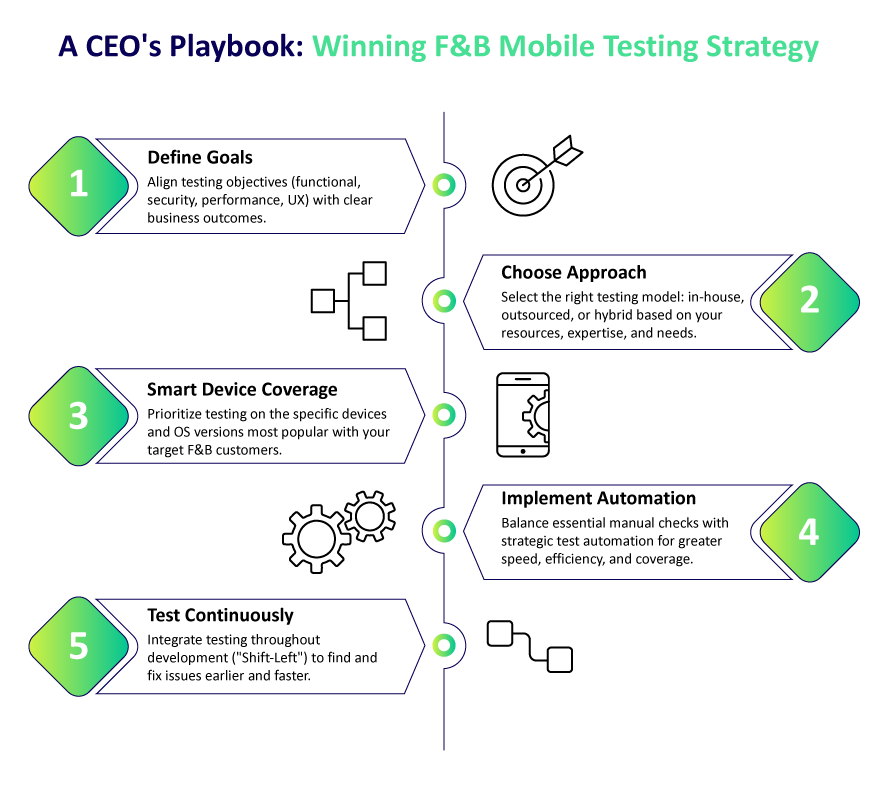
The CEO’s Playbook: Crafting a Winning Strategy with Mobile App Testing Tools
Understanding the challenges is crucial but turning that understanding into action requires a clear strategy. For CEOs aiming to deliver exceptional mobile experiences in the F&B sector, implementing a robust mobile application testing strategy isn’t just an operational task; it’s a leadership decision.
Here’s a playbook outlining the key pillars for success:
Define Clear Testing Goals: What does success look like for your mobile app? Before diving into testing, establish clear, measurable objectives. This involves defining the scope across various testing types: functional testing (Does it work as expected?), security testing (Is customer data safe?), performance testing (Can it handle peak loads?), usability testing (Is it easy and intuitive to use?), and UI/UX testing (Does it look and feel right?). Aligning these goals with business objectives is key.
Select the Right Testing Approach: How will you execute your testing? Decide on the optimal model for your organization – building an in-house testing team, outsourcing to specialized QA partners, or adopting a hybrid approach that combines both. Your choice will depend on factors like internal expertise, budget, speed-to-market requirements, and the complexity of your application.
Determine Smart Device Coverage: You can’t test on every device, so prioritize wisely. Identify the most popular devices, operating systems, and screen sizes used by your target audience in your key markets. Leverage market data and analytics to create a device matrix that provides maximum relevant coverage without unnecessary overhead. Using appropriate mobile app testing tools that offer access to a wide range of real devices is crucial here.
Implement Effective Automation: While manual testing is essential for exploratory and usability checks, automation is vital for efficiency, speed, and coverage, especially for repetitive regression tests. Strive for a balanced approach, automating where it provides the most value – freeing up human testers for more complex and nuanced validation. Modern mobile testing tools often incorporate AI to make test creation and maintenance more efficient.
Establish Continuous Testing: Don’t treat testing as a final gate before release. Integrate mobile application testing throughout the entire development lifecycle (often called “Shift-Left”). This means testing early and often, ideally integrating automated tests into your CI/CD (Continuous Integration/Continuous Deployment) pipeline. This approach catches issues sooner when they are cheaper and easier to fix, accelerating release cycles. Furthermore, embracing modern practices like cloud-based and remote testing is now standard, allowing teams to efficiently test across numerous real devices and network conditions in a scalable manner.
By focusing on these strategic pillars, F&B CEOs can build a foundation for mobile quality that supports business goals, enhances customer satisfaction, and ensures their digital offerings are ready to compete.
Meet Qyrus: The Right Ingredients for Superior F&B Mobile Application Testing
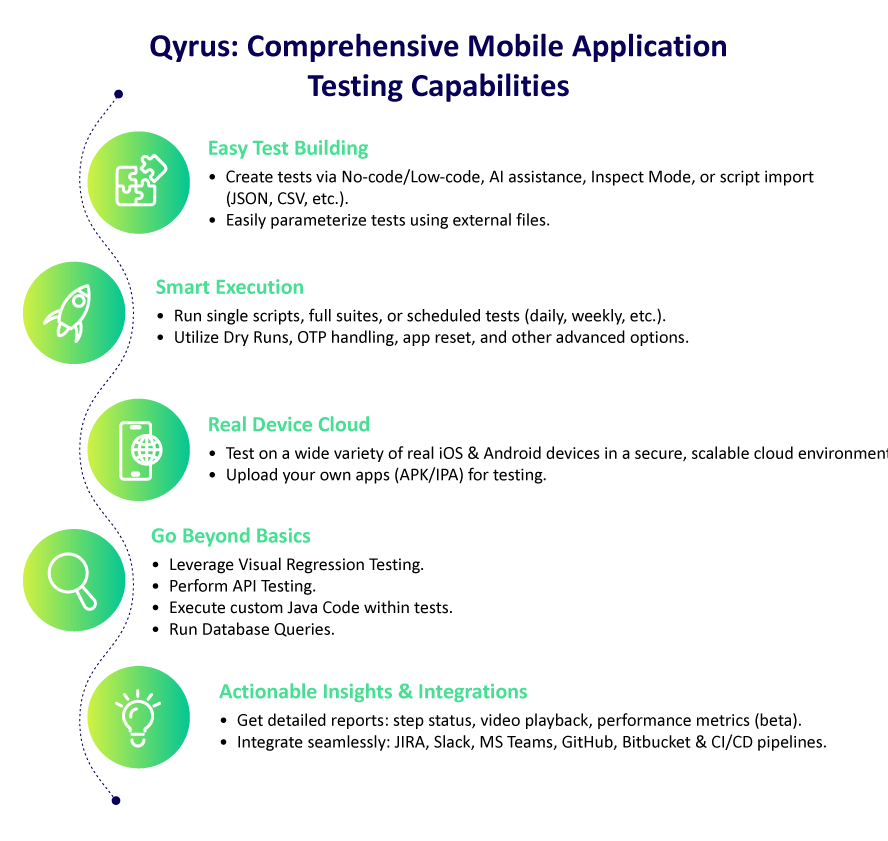
Navigating the complex landscape of F&B mobile app testing requires more than just a strategy; it demands powerful, flexible, and efficient mobile testing tools. You need a partner that understands the intricacies of ensuring quality across diverse platforms, integrations, and user scenarios. Enter Qyrus – a comprehensive platform built to streamline and elevate your mobile application testing efforts.
Qyrus isn’t just another tool; it’s designed as an all-in-one solution specifically addressing the pain points faced by development and QA teams, particularly relevant for the demanding F&B sector. Here’s how Qyrus provides the advantage F&B leaders need:
Comprehensive Coverage, Simplified: Qyrus offers a unified platform tackling various testing needs – functional, visual, performance, and even API testing. Instead of juggling multiple tools, you get a single, integrated environment to manage your entire testing lifecycle.
Accelerated Testing with Ease of Use: Time-to-market is critical. Qyrus empowers teams with user-friendly features like no-code/low-code test creation and AI-assisted scripting, allowing both technical and less-technical users to build and execute tests quickly and efficiently.
Real-World Accuracy on Real Devices: Emulators and simulators can only go so far. Qyrus provides access to a scalable and secure real device farm, enabling you to test your F&B app on the actual iOS and Android devices your customers are using, ensuring compatibility and a true representation of the user experience.
Tackling F&B Complexity: Qyrus offers advanced capabilities crucial for F&B scenarios. Validate layouts precisely across devices with visual regression testing. Assess app responsiveness under load and gather performance metrics like CPU and memory usage. Test intricate backend interactions via API testing. You can even execute custom Java code for complex validations.
Scalability & Flexibility: As your business grows, your testing needs evolve. Qyrus supports this with features like data parameterization using external files and environment profiles, allowing you to easily run the same tests across different data sets and testing environments (e.g., staging vs. production).
Seamless Workflow Integration: Qyrus understands that testing doesn’t happen in a vacuum. The platform integrates smoothly with essential tools your teams already use, including JIRA for defect tracking, version control systems like GitHub and Bitbucket, and CI/CD pipelines, ensuring testing is embedded within your development workflow.
By leveraging Qyrus as your central mobile app testing tool, F&B organizations can move beyond simply finding bugs to proactively ensuring quality, accelerating releases, and delivering the exceptional mobile experiences that drive customer loyalty and business growth.
Future-Proofing Your Menu: Staying Ahead with Advanced Mobile Application Testing
The digital transformation in the Food and Beverages sector isn’t slowing down. As technology continues to evolve, so will customer expectations and the complexity of the mobile applications designed to meet them. For forward-thinking CEOs, anticipating these changes and adapting their mobile application testing strategies accordingly is crucial for sustained success. Staying ahead requires not just keeping pace but actively preparing for what’s next on the menu.
What mobile testing trends are shaping the future of F&B mobile apps and their testing needs?
AI-Driven Personalization: Apps are becoming smarter, leveraging Artificial Intelligence (AI) to offer personalized recommendations, predict ordering habits, and tailor promotions. Testing these sophisticated AI algorithms for accuracy, bias, and effectiveness will become increasingly critical. Teams will need mobile testing tools capable of validating complex, data-driven user experiences.
Rise of Contactless Experiences: Driven partly by recent global events but also by sheer convenience, contactless ordering, payment, and even pickup/delivery options are becoming standard. Testing these flows requires ensuring seamless integration with various payment systems, NFC technology, QR code scanners, and location services, all while maintaining robust security.
Deeper Cross-Platform Integration: The lines between web, mobile, and in-store digital touchpoints (like kiosks) will continue to blur. Customers will expect a consistent and connected experience regardless of how they interact with your brand. This necessitates comprehensive end-to-end testing across all platforms, ensuring data synchronicity and a unified brand experience.
Adapting to these trends requires a commitment to continuous improvement in your testing practices. It means embracing automation, potentially leveraging AI within your testing processes, and utilizing advanced mobile app testing tools like Qyrus that offer capabilities such as visual testing, performance monitoring, and robust API validation.
Futureproofing isn’t just about adopting new technologies; it’s about ensuring your quality assurance processes evolve alongside them, guaranteeing your digital offerings remain relevant, reliable, and ready for whatever comes next.
Conclusion: Leading the Digital Charge in F&B
For CEOs navigating the dynamic Food and Beverages landscape, the message is clear: mobile is no longer just a channel; it’s central to your business strategy. The pursuit of digital excellence, driven by robust mobile application testing, is fundamental to success. It’s about much more than just catching bugs; it’s about building consumer trust, reducing operational risks, ensuring seamless customer experiences, and ultimately, creating sustainable competitive advantages in a crowded marketplace.
Investing in a comprehensive testing strategy, supported by powerful and efficient mobile testing tools like Qyrus, allows F&B leaders to move from reactive problem-solving to proactive quality management. It enables you to confidently embrace innovation, meet evolving consumer expectations head-on, navigate complex integrations, and ensure your digital storefront delivers on its promise every single time.
As technology continues its relentless march, the F&B leaders who prioritize and invest in sophisticated mobile application testing will be best positioned to capture market share, enhance brand reputation, and drive profitable growth.
Don’t let inadequate testing leave a bad taste in your customers’ mouths. Evaluate your current approach, embrace the tools and strategies needed for excellence, and lead the digital charge in your sector.
Ready to elevate your F&B mobile testing? Explore Qyrus with a free trial or contact us today for a personalized demo.
We’ve all been there. It’s late in the sprint, UI testing is in full swing, and suddenly… a critical bug surfaces. After digging in, it turns out the root cause isn’t in the user interface at all, but deep within an underlying API. Finding these issues so late throws schedules into chaos, puts immense pressure on the QA team, and leads to frustrating delays. It’s a common pain point, especially when you consider that over 90% of executives now view APIs as mission-critical and 77% of businesses have adopted microservices, creating complex dependencies beneath the surface.
For QA Managers, this situation is particularly challenging. You might have a fantastic team skilled in navigating user interfaces and ensuring a great user experience, but they might lack the coding background or specific tooling knowledge typically associated with API testing. Asking developers for specifications or Postman collections can introduce delays or dependencies. The result? API testing often gets pushed later, or coverage remains lighter than ideal, despite 74% of developers now following an API-first approach. With 66% of organizations managing over 100 APIs, manually keeping track or relying solely on UI testing becomes unsustainable.
But what if your team’s existing UI expertise could be the key to unlocking earlier API insights? What if they could perform effective API discovery and create baseline API tests while doing the UI testing they already know? This blog will guide you, the QA Manager, through a practical, UI-driven API discovery workflow. We’ll explore how you can empower your current team using accessible API discovery tools, enabling them to contribute significantly to API quality and provide feedback much earlier in the process – without requiring them to become expert coders overnight.
The Strategic Edge: Why Earlier API Feedback is Golden for QA
So, the UI team finds API bugs late in the game. It’s frustrating, but it’s just part of the process, right? Not necessarily. Shifting API feedback earlier, even if it means using insights gleaned from testing a stable UI build, provides significant strategic advantages that directly address the chaos of late-cycle surprises. Investing time in a structured API discovery process, even one initiated through UI interaction, pays dividends.
Here’s why striving for earlier API validation is worth the effort:
Sidestep Late-Cycle Fire Drills: This is the big one. When you establish a baseline of API tests (discovered via UI interactions on Release N) and run them against Release N+1 early in its cycle, you catch API regressions or breaking changes before they derail extensive UI testing. Finding and fixing API issues earlier is significantly less disruptive and costly than dealing with them after they’ve impacted multiple UI components or user flows. Think fewer emergency meetings and more predictable releases.
Slash Debugging Time: Ever spent hours trying to figure out why a UI element is misbehaving, only to find the culprit was a faulty API response? When you run API tests derived from your API discovery efforts alongside your UI tests, you gain crucial diagnostic power. If a UI test fails, and a corresponding API test also fails, you can point development teams to the likely source much faster, dramatically speeding up root cause analysis.
Broaden Test Coverage Intelligently: Empowering your UI testers to perform basic API validation adds a vital layer to your test coverage. It leverages their deep functional knowledge of how the application should work and applies it to the underlying API interactions. This expands your safety net without the immediate need for dedicated API specialists or complex coding efforts, making better use of your existing team’s capabilities. Considering that 67% of organizations handle over 10 million API requests per month, ensuring these crucial interactions are covered is vital.
Boost Team Skills and Ownership: Introducing UI testers to API concepts via accessible API discovery tools is a fantastic way to upskill your team. It builds their confidence, broadens their technical understanding, and fosters a greater sense of ownership over application quality, end-to-end.
Enhance API Visibility & Security: While UI-driven discovery focuses on known flows, the process inherently increases visibility into the APIs being used. Simply knowing which APIs are active, even from UI interactions, is a step up from having no inventory, especially when only 58% of organizations have an established API discovery process. This increased awareness is a foundational step towards better API security posture, helping mitigate the risks highlighted by the fact that 37% of organizations suffered an API security incident last year.
Investing in earlier API feedback, facilitated by practical API discovery tools, isn’t just about finding bugs sooner; it’s about creating a more efficient, resilient, and capable QA process.
The QA Manager as Enabler: Equipping Your Team for API Discovery Success
As a QA Manager, seeing API-related bugs slip through until the late stages of UI testing is a major red flag. It signals a gap in test coverage and often leads to those stressful, down-to-the-wire fixes. While the immediate reaction might be frustration, the strategic response is enablement. Your role evolves beyond simply managing test execution; it becomes about empowering your team with the right processes and API discovery tools to catch these issues sooner.
Instead of viewing your UI-focused team as lacking API skills, recognize their deep functional knowledge of the application as a powerful asset. They know how the application should behave, which is the perfect starting point for validating the APIs that drive that behavior. Your role is to bridge the gap:
Identify the Need & Opportunity: Acknowledge the pattern – are API bugs consistently found late? Is your team hesitant about traditional API testing? This is your cue to explore alternative approaches, like UI-driven API discovery, that leverage your team’s existing strengths.
Champion the Right Tools: Your team doesn’t need to become hardcore developers overnight. Your role involves researching and introducing accessible API discovery tools, specifically those like browser extensions that integrate with familiar UI testing workflows. Providing a tool that simplifies capturing and understanding API calls is key to lowering the barrier to entry.
Facilitate the Workflow: Introduce the concept of UI-driven API discovery. Guide your team on how to use the chosen tool during their regular testing (e.g., on a stable staging environment) to capture a baseline of API interactions for key user journeys. Help them understand the value of this baseline for future regression testing.
Integrate Strategically: Plan how the outputs of this API discovery process – the captured API calls and basic tests – will be integrated into your team’s broader testing strategy. This might involve adding API regression checks to your test cycles for upcoming releases, using the findings to inform exploratory testing, or aiding developers in root cause analysis.
By shifting from solely managing bug reports to actively enabling your team with accessible methods and tools for API discovery, you transform your QA function. You build new capabilities within your existing team, foster greater ownership, and ultimately create a more robust and efficient quality assurance process.
How It Works: Your UI Testing Powers Your API Discovery
So, how does this UI-driven API discovery actually work in practice? It’s simpler than you might think, especially when using intuitive API discovery tools designed for this exact purpose. Let’s walk through the typical workflow using the Qyrus API Discovery Extension as our example.
The core idea is to leverage the UI interactions your team already performs. The Qyrus extension acts like a smart recorder running in the background of the browser (specifically Chrome, for the extension).
Here’s the step-by-step process:
Run Your UI Tests: Have your QA team perform their regular manual or automated UI tests on a stable version of your application (web or mobile accessed via browser). This could be on a staging environment, a dedicated QA build, or even key flows on the current production release to establish a baseline. The key is interacting with the application just like a user would.
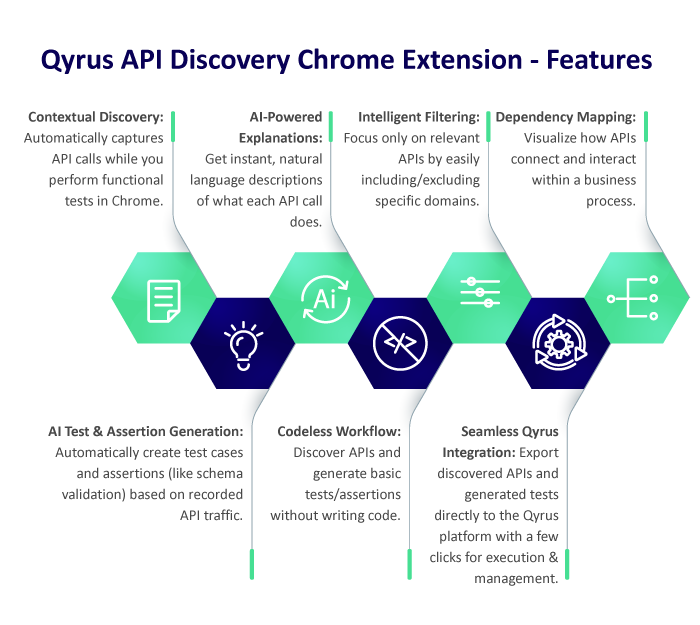
Capture APIs Automatically: While the UI tests are running, ensure the Qyrus API Discovery Extension is active. It seamlessly monitors network traffic originating from the application and automatically records the underlying API calls associated with the actions being performed (like button clicks, form submissions, data loading, etc.).
Understand with AI & Filter Noise: Once the test flow is complete, the extension presents the captured API calls. This is where the intelligence comes in:
AI Explanations: Instead of raw data, the tool provides natural language explanations for what each API call likely does, making it instantly more understandable for testers less familiar with API jargon.
Intelligent Filtering: You can easily configure the extension to ignore calls to irrelevant domains (like analytics platforms or third-party widgets), focusing the API discovery only on your application’s core APIs.
(Optional) Visualize the Flow: For complex user journeys involving multiple API calls, the extension can often map the dependencies between them, showing how data might flow from one API call to the next (e.g., using an authentication token from login in subsequent requests).
Export Your Baseline API Tests: With the relevant APIs captured and understood, the final step is incredibly straightforward. With just a few clicks, export the captured API calls, their details, and even AI-generated assertions directly into the Qyrus platform (like qAPI). This instantly creates a baseline suite of API tests reflecting the user flows you just tested.
This workflow transforms standard UI testing into a powerful API discovery exercise. It leverages the team’s existing skills and activities, uses smart API discovery tools to automate the difficult parts (capture, explanation, assertion generation), and results in a tangible set of API tests ready to be used for future regression analysis.
Best Practices: Making UI-Driven API Discovery Work For You
Implementing a new approach, even one leveraging existing workflows, requires some strategy. To get the most out of UI-driven API discovery using API discovery tools like the Qyrus extension, QA Managers should focus on these key practices:
Start with a Solid Baseline: Garbage in, garbage out applies here too. Run your initial API discovery sessions (using the UI testing workflow) on a stable, known version of your application. This could be the current production release or a well-tested staging build. Capturing APIs against key, representative user flows on a reliable version ensures your baseline API test suite is accurate and trustworthy.
Shift API Regression Left: This is where the UI-driven approach delivers powerful early insights. Take the baseline API test suite captured from Release N and execute it against Release N+1 as soon as the APIs are deployed to a test environment. This often happens before the N+1 UI is fully stable or ready for extensive testing. Running these API tests early allows you to catch critical API regressions or breaking changes much sooner in the N+1 development cycle, preventing them from impacting later UI testing efforts.
Complement, Don’t Just Replace UI Tests: View the API tests generated through this API discovery method as a valuable addition to your testing arsenal, not necessarily a complete replacement for UI tests. Use them in conjunction. When a UI test fails, running the corresponding API tests can quickly help determine if the issue lies in the front-end logic or the back-end API response, significantly aiding root cause analysis.
Iterate and Update Your Baseline: Applications evolve. As new features are added or major workflows change, your initial API baseline might become outdated. Make it a practice to periodically re-run the API discovery process on significant new releases or feature updates. This keeps your API regression suite relevant and ensures you capture newly introduced APIs.
Empower Through Training: While using API discovery tools like the Qyrus extension is designed to be intuitive, provide your UI team with brief training. Ensure they understand how to activate the tool during their testing, how to filter noise effectively, how to export the results, and the basic purpose of using the generated API tests for regression. This builds confidence and ensures consistent usage.
By following these practices, QA Managers can effectively integrate UI-driven API discovery into their Agile process, transforming it into a sustainable strategy for improving quality and efficiency.
Addressing Your Questions: API Discovery via the UI Workflow
Adopting a new approach naturally brings questions. Let’s address some common queries QA Managers might have about using UI interactions and related API discovery tools to build API test suites:
Q1: If the UI already exists to run tests on, isn’t it too late for ‘discovery’? What’s the ‘shift left’ benefit?
A: That’s a great point! While this method requires an existing UI (from Release N) for the initial discovery, the “shift left” benefit applies to future releases. The API test baseline you create from Release N allows you to test the APIs for Release N+1 much earlier in its cycle – as soon as they’re available in a QA environment, often before the N+1 UI is fully baked. This accelerates feedback on API regressions for the next release. Plus, the enhanced API discovery provides immediate value by improving root cause analysis for the current release (Release N).
Q2: My UI testers are great, but they don’t know APIs or how to code tests. Can they really handle this?
A: Absolutely – that’s precisely who this approach empowers! API discovery tools like the Qyrus extension are designed to be codeless. The process leverages the UI interactions your team already performs. The tool handles the complex parts: capturing calls, providing AI-driven explanations in plain language, and even generating baseline assertions automatically. Your team’s functional knowledge is the key ingredient; the tool provides the accessible mechanism for them to contribute to API testing.
Q3: Why use this instead of just asking developers for their Postman collections?
A: Getting collections from developers is a valid approach, but this UI-driven method offers distinct advantages, especially if:
Developer collections aren’t readily available, consistently updated, or easy for your QA team to understand/use.
Most developers have very basic test cases that are based on expected usage and generally just check for a 200 status code.
Rarely will these collections have sufficient coverage over edge cases that QA is required to test against – waiting until the UI is ready to find these issues can be costly.
You want QA to have more ownership and control over creating API tests based directly on user workflows they understand.
You want to capture the actual APIs being called by the UI during specific interactions, which might sometimes differ slightly from theoretical specs.
This method complements other approaches and provides a practical option driven directly by QA’s functional testing activities.
Q4: How reliable are the AI-generated assertions? Do we just trust them blindly?
A: Think of the AI-generated assertions as a significant head start, not necessarily the finished product. Based on the observed API responses during the API discovery phase, the AI suggests relevant checks (like schema validation, checking specific JSON paths, etc.). This saves enormous time compared to writing them manually from scratch. Your team can then easily review, refine, and add more specific business logic assertions as needed within the Qyrus platform, ensuring the tests are both comprehensive and accurate.
By understanding how this specific UI-driven API discovery workflow functions, QA Managers can confidently address these common concerns and highlight its practical benefits for their teams.
Empower Your Team, Elevate Your API Testing with Smarter Discovery
The challenge is clear: finding critical API bugs during late-stage UI testing puts quality at risk and drains valuable sprint time. But the solution might already be within your team. For QA Managers, the opportunity lies in empowering your skilled UI testers – those who know your application’s functionality inside and out – to become active participants in API quality assurance. You don’t need to wait for specialized hires or complex tooling rollouts; you can leverage their existing expertise today.
Adopting a UI-driven API discovery workflow, facilitated by accessible API discovery tools like the Qyrus API Discovery Chrome Extension, provides a practical and powerful path forward. It allows your team to capture real-world API interactions during their normal testing routines, understand them with AI assistance, and generate baseline API tests without writing code. This baseline becomes invaluable for shifting API regression testing left in subsequent release cycles, providing earlier feedback and enabling faster root cause analysis when issues do arise.
Stop letting API issues hide until the last minute. As a QA Manager, you can champion this pragmatic approach to API discovery. Equip your UI team, integrate the workflow, and start building a more robust, efficient, and collaborative testing strategy. Elevate your team’s capabilities and catch critical issues sooner.
Ready to empower your UI team and get started with UI-driven API discovery?
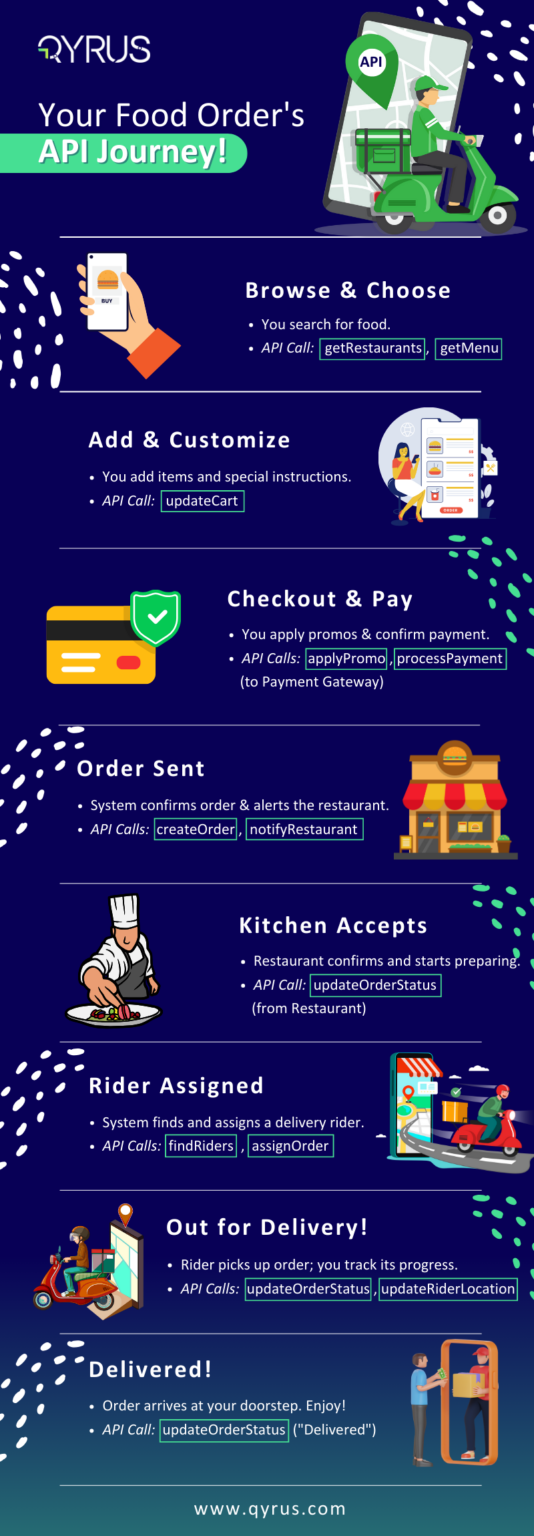
Click. Order. Delivered. Today, getting your favorite meal delivered is often just a few taps away, thanks to the booming FoodTech industry. But behind that simple user experience lies a complex web of interconnected systems. Think about it: your food delivery app needs to talk seamlessly to restaurant ordering systems, health data providers, payment gateways, and delivery logistics platforms.
What makes this intricate dance possible? APIs – Application Programming Interfaces. They are the invisible messengers ensuring your order details reach the kitchen correctly, your payment goes through securely, and you can track your delivery in real-time.
However, when these messengers falter, the consequences can be significant. Minor glitches can cascade into major service disruptions, leading to incorrect orders, payment failures, and frustrated customers whose trust is easily broken. The financial impact is startling; according to one industry survey, 66% of companies report losing up to $500,000 per year due to poor integration, including API failures, with 10% losing more than $1 million annually. These aren’t just abstract numbers; they represent real losses stemming from disruptions in critical operations that underpin the entire FoodTech business model.
This is where robust API testing becomes absolutely critical. It’s the process of rigorously checking these API connections to ensure they function reliably, perform under pressure, and remain secure. Effective API testing strategies enable platforms to handle massive traffic surges during peak hours, process orders with near-perfect accuracy, and manage high volumes (~100 orders per minute) without breaking a sweat.
In this post, we’ll dive into the world of FoodTech to explore critical API testing examples. We’ll look at common challenges faced by developers and testers in this dynamic sector and discuss best practices. Furthermore, we’ll touch upon how comprehensive testing platforms like Qyrus can help ensure your FoodTech APIs deliver a five-star experience, every time.
Taste the Dish, Test the APIs: Why Both are Vital in FoodTech
Think of your favorite food delivery app. It’s not a single, monolithic system. Instead, it’s an ecosystem built on communication, with APIs acting as the vital communication lines. The app on your phone (User App) needs to talk to the restaurant’s order management system. That system, in turn, might need to communicate with inventory APIs. Then there’s the delivery logistics platform coordinating drivers, which constantly updates your app via APIs. And, of course, payment gateways process your transaction through secure API calls. It’s a constant, high-speed conversation happening behind the scenes: User Apps <-> Restaurant Systems <-> Delivery Logistics <-> Payment Gateways.
Now, imagine if those communication lines get crossed or drop out. The business impact isn’t just a minor inconvenience; it can be catastrophic. An API failure could mean orders getting lost or duplicated, restaurants receiving incorrect customization details (hello, unwanted pineapple on pizza!), payment processing errors leading to double charges or failed transactions or tracking information simply vanishing. Service outages kill the user experience, incorrect orders damage trust, payment issues cause financial headaches, and ultimately, the platform’s reputation suffers. In the competitive FoodTech landscape, users won’t hesitate to switch apps after a bad experience.
This is why rigorous API testing isn’t just a ‘nice-to-have’; it’s driven by core business needs specific to FoodTech:
Functional Reliability is Non-Negotiable: At its heart, a food app must reliably execute core tasks. Can users search for restaurants and see accurate menus? Does the ordering API capture items, quantities, and those crucial special instructions correctly? Do payment APIs handle various methods smoothly? Can users track their order from kitchen to doorstep accurately? API testing ensures these fundamental workflows function flawlessly, preventing operational chaos and ensuring customer expectations are met.
Peak Performance Under Pressure: FoodTech platforms face predictable, yet massive, surges in demand. Think lunch rushes, dinner peaks, weekend specials, or major sporting events. APIs must handle this immense, often sudden, increase in traffic – thousands of concurrent users placing orders, querying menus, and tracking deliveries – without buckling. Performance testing simulates these high-stress conditions to guarantee the APIs remain responsive and the platform stable, avoiding frustrating slowdowns or crashes precisely when demand is highest.
Bulletproof Data Security: Given that these apps handle sensitive personal information (names, addresses, phone numbers) and critical payment details (credit card numbers, bank info), security is paramount. APIs are potential gateways for attackers if not properly secured. Rigorous security testing of APIs is essential to verify authentication, authorization, and data encryption, protecting against data breaches, unauthorized access, and financial fraud, thereby maintaining user trust and regulatory compliance.
Essentially, meticulous API testing ensures the intricate network of services powering a FoodTech app works together reliably, scales effectively, and operates securely. It’s the secret sauce that enables a smooth, trustworthy experience from the moment a user opens the app to the final delivery confirmation. We’ll explore more specific API testing examples next.
Real-World Examples: API Testing in Action
To understand where the rubber meets the road in FoodTech API testing, let’s look beyond generic concepts and examine specific, critical testing areas with practical examples. These scenarios highlight the diverse functionalities that rely heavily on robust APIs:
Complex Data Integration & Processing APIs:
Why it’s critical: Modern FoodTech features, especially those related to health and personalization, often pull data from a wide array of sources – think user wearables, public health databases (like USDA), commercial nutrition APIs (like FatSecret), and direct user input via the app. Testing is absolutely crucial to ensure these data ingestion APIs, any backend ETL (Extract, Transform, Load) processing APIs, and the interactions with data storage function reliably and accurately. Garbage data in means garbage insights out.
Example: Consider testing the intricate API pipeline designed for health insights. This involves validating APIs that pull nutrition data from USDA and FatSecret, combining it correctly with meals logged by the user via the app’s API. Further testing ensures the processing step, perhaps triggered via an AWS Glue job API, runs correctly, and that the final, processed data is accurately stored, maybe in Amazon S3, ready for insight generation.
AI & Analytics API Testing:
Why it’s critical: Features are increasingly powered by AI and Machine Learning models, often exposed via APIs – think personalized recommendation engines predicting what you might like or analytics forecasting dietary outcomes. Testing must validate the inputs these APIs expect, the outputs they generate (are they relevant? accurate?), and their performance under load.
Example: Imagine testing the API endpoint responsible for personalized healthy meal suggestions. This API might take a user’s recent order history and profile data as input, pass it to an Amazon SageMaker ML model in the backend, and return tailored recommendations. Tests need to verify that the API handles various input formats correctly, that the suggestions returned are logical and relevant to the user’s profile, and that these recommendations are generated promptly without excessive delay.
Why it’s critical: It’s essential to validate that the entire interconnected system – encompassing data pipelines, AI models, user-facing APIs, and third-party integrations – can handle the strain of expected user loads and high data volumes without performance degradation. This ensures the app remains responsive even during peak usage.
Example: Let’s simulate a high-traffic event, like 5,000 users simultaneously tapping into their “Health Insights” tab right after completing their orders post-lunch rush. Load testing here verifies that the various APIs involved – fetching insights, calculating metrics, possibly calling underlying AI/data APIs – all respond within acceptable time limits, preventing slowdowns or timeouts for the users.
Multi-Interface & Cross-Platform Testing:
Why it’s critical: Consistency is key. Users expect features and data to look and behave the same whether they access the service via an iOS app, an Android app, or a web portal. Testing ensures the underlying APIs deliver consistent data and functionality across all these platforms and potentially other interfaces (like admin or support dashboards).
Example: Take the “Health Insights” feature again. Testing must confirm that the personalized insights, nutritional breakdowns, and recommendations generated by the backend APIs are displayed accurately and consistently, regardless of whether the user views them on their iPhone app, their Android tablet, or by logging into their account on the website.
Chatbot / Conversational AI Testing:
Why it’s critical: FoodTech apps increasingly deploy chatbots for tasks like placing orders or answering support queries. These AI-driven conversations require a different testing approach because natural language is inherently variable. Traditional testing tools, which often rely on exact text matching, can easily fail when a chatbot provides a perfectly valid response using slightly different phrasing.
Example: Consider testing a health-focused chatbot designed to provide calorie information. If the test script expects the exact response, “Your total calorie intake today is 1,500 calories,” it might incorrectly mark the test as failed if the chatbot responds, “You’ve consumed 1,500 calories so far today.” Both responses are correct, but the phrasing differs. This necessitates specialized testing tools (like Qyrus’s LLM Evaluator) capable of understanding the meaning (semantics) of the response, not just the literal string of text.
Payment Integration Testing:
Why it’s critical: Handling payments requires absolute precision and security. Testing must rigorously verify interactions with various payment gateways, ensuring reliability across different payment methods (credit cards, digital wallets, etc.) and secure handling of sensitive financial data.
Example: Suppose a food delivery app decides to integrate a popular new digital wallet payment option. Thorough payment integration testing becomes crucial. It needs to verify that the /initiatePayment API correctly redirects the user to the wallet provider for authorization. Equally important is testing the callback API that securely confirms payment success or failure from the provider. Testing must also cover edge cases like insufficient funds (ensuring the API handles the error gracefully and provides clear user feedback) and confirm that the internal recordTransaction API logs the final payment status accurately for backend reconciliation.
Testing across these diverse and complex areas is fundamental to delivering a reliable, performant, and trustworthy FoodTech application.
Best Practices for Robust FoodTech API Testing
Achieving reliable, scalable, and secure FoodTech applications requires adopting solid API testing best practices. Modern testing platforms like Qyrus not only support these practices but actively enhance them through intelligent automation and specialized features. Here’s how:
Embrace Comprehensive Automation
In the fast-paced FoodTech world, manually testing every API change across Web, Mobile, and backend layers is unsustainable. Automating API tests, along with relevant Web and Mobile UI checks, is crucial for rapid feedback during development and reliable regression checking before releases.
Qyrus’s unified platform is designed explicitly for testing across Web, Mobile, and API layers. The platform helps accelerate your automation efforts by leveraging its AI capabilities; features like TestPilot can generate functional test scripts quickly just from a URL or application interaction, while TestGenerator can automatically create test scenarios directly from requirements documented in JIRA tickets, significantly speeding up initial test creation.
Adopt Data-Driven & AI-Informed Testing
FoodTech apps deal with vast amounts of data variation – different user profiles, dietary preferences, order histories, locations, promotions, etc. Testing must cover diverse and realistic data sets. Furthermore, as apps incorporate AI, testing needs to validate these intelligent components effectively.
Organizations can implement robust data-driven testing by using tools like Qyrus Echo to generate synthetic, yet realistic, data tailored specifically to FoodTech scenarios (e.g., creating thousands of varied user profiles or complex order histories). For validating AI-driven features, employ specialized tools like Qyrus Eval, which is designed to intelligently assess AI model outputs, essential for ensuring the reliability of personalization engines or chatbots.
Prioritize Performance Under Realistic Load
Don’t wait for users to discover performance issues during peak hours. Conduct thorough performance and load testing that simulates real-world user behavior, expected peak traffic volumes, and the complex data interactions typical in FoodTech systems.
Qyrus’s integrated Performance Testing capabilities are designed to stress-test your applications. Gain crucial visibility into how your APIs and systems behave under pressure by utilizing tools like Insights & AnalytiQ, which provides deep performance analytics to help you identify and resolve bottlenecks early in the development cycle.
Ensure Seamless End-to-End Workflow Validation
Users experience workflows, not individual APIs. Test complete user journeys (like order placement and tracking) that span multiple internal APIs, third-party services (like payment gateways), and potentially different user interfaces (Web/Mobile). Where necessary, use service virtualization to isolate dependencies.
Use Qyrus’s core platform can easily orchestrate complex test scenarios that flow across different application layers (API, Web, Mobile). Simplify testing dependencies by employing API Builder to instantly virtualize backend APIs. This allows teams to conduct isolated testing of workflows or front-end components even when dependent backend services are unavailable or still under development, enabling parallel work streams.
Integrate Continuous Monitoring & Maintenance
Testing doesn’t stop at deployment. Monitor API health and performance in production. Crucially, have efficient processes for maintaining your automated test suites as the application evolves, preventing tests from becoming outdated and flaky.
Reduce the significant effort often associated with test maintenance by using Qyrus’s Healer feature. This AI-powered capability can automatically detect and suggest fixes for tests broken by minor UI or API changes. For specialized components like chatbots, leverage monitoring tools like BotMetrics to track their performance and behavior.
Build on a Secure & Compliant Foundation
Security is non-negotiable when handling sensitive user and payment data. Ensure your testing practices include security checks (like validating authentication and authorization) and that your testing infrastructure itself adheres to high security standards.
Conduct your testing activities with confidence by relying on Qyrus’s secure testing infrastructure. The platform is noted as being ISO 27001 & SOC2 compliant, ensuring that the environment where you run tests and manage test data meets stringent industry security and compliance standards.
By integrating these best practices, supported by the capabilities of an intelligent platform like Qyrus, FoodTech companies can significantly enhance the quality, reliability, and security of their critical API infrastructure.
Conclusion: Delivering Success in FoodTech with Superior API Testing
APIs are the backbone of the entire operation. From the moment a user searches for a restaurant to the final delivery notification, countless API calls work in concert to create that seamless experience we’ve all come to expect. Consequently, the success of any FoodTech platform hinges significantly on the quality and reliability of these APIs, making rigorous testing not just a technical task, but a fundamental business necessity.
Ignoring API testing is simply not an option in this competitive landscape. Navigating the unique challenges of FoodTech API testing – complex workflows, multi-interface synchronization, realistic performance simulation, and stringent security requirements – requires the right approach and the right tools. This is where a comprehensive testing platform like Qyrus becomes invaluable.
By simplifying test creation for intricate API chains, facilitating data-driven testing, offering sophisticated load and performance simulation, and incorporating security checks, Qyrus empowers FoodTech companies to implement best practices efficiently, overcome testing hurdles, and ensure their APIs consistently deliver exceptional, reliable experiences.
Investing in superior API testing is investing in the success and growth of your FoodTech venture.
Ready to ensure your APIs are delivering a five-star experience?
Discover how Qyrus can streamline your testing efforts: Request a Demo
Don’t let API failures compromise your service. Embrace comprehensive testing and deliver the seamless FoodTech experience your customers deserve.
Jerin Mathew
Manager
Jerin Mathew M M is a seasoned professional currently serving as a Content Manager at Qyrus. He possesses over 10 years of experience in content writing and editing, primarily within the international business and technology sectors. Prior to his current role, he worked as a Content Manager at Tookitaki Technologies, leading corporate and marketing communications. His background includes significant tenures as a Senior Copy Editor at The Economic Times and a Correspondent for the International Business Times UK. Jerin is skilled in digital marketing trends, SEO management, and crafting analytical, research-backed content.